

C4 carbon fixation

Encyclopedia
C4 carbon fixation is one of three biochemical mechanisms, along with
and CAM photosynthesis
, used in carbon fixation
. It is named for the 4-carbon molecule present in the first product of carbon fixation in these plants, in contrast to the 3-carbon molecule products in plants.
fixation is an elaboration of the more common carbon fixation and is believed to have evolved more recently. and CAM overcome the tendency of the enzyme RuBisCO
to wastefully fix oxygen rather than carbon dioxide in what is called photorespiration
. This is achieved by using a more efficient enzyme to fix in mesophyll cells and shuttling this fixed carbon via malate
or asparate to bundle-sheath cells. In these bundle-sheath cells, RuBisCO is isolated from atmospheric oxygen and saturated with the released by decarboxylation
of the malate or oxaloacetate. These additional steps, however, require more energy in the form of ATP
. Because of this extra energy requirement, plants are able to more efficiently fix carbon in only certain conditions, with the more common pathway being more efficient in other conditions.
and C. R. Slack, in Australia, in 1966, so it is sometimes called the Hatch-Slack pathway.
In plants, the first step in the light-independent reaction
s of photosynthesis involves the fixation of by the enzyme RuBisCO
into 3-phosphoglycerate. However, due to the dual carboxylase / oxygenase
activity of RuBisCo
, an amount of the substrate is oxidized
rather than carboxylated
, resulting in loss of substrate and consumption of energy, in what is known as photorespiration
.
In order to bypass the photorespiration
pathway, plants have developed a mechanism to efficiently deliver to the RuBisCO
enzyme. They utilize their specific leaf anatomy where chloroplasts exist not only in the mesophyll
cells in the outer part of their leaves but in the bundle sheath cells as well. Instead of direct fixation to RuBisCO in the Calvin cycle
, is incorporated into a 4-carbon organic acid
, which has the ability to regenerate in the chloroplasts of the bundle sheath cells. Bundle sheath cells can then utilize this to generate carbohydrates by the conventional pathway.
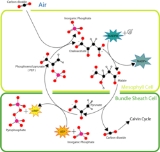
The first step in the pathway is the conversion of pyruvate to phosphoenolpyruvate (PEP), by the enzyme pyruvate orthophosphate dikinase. This reaction requires inorganic phosphate and ATP
plus pyruvate, producing phosphoenolpyruvate
, AMP
, and inorganic pyrophosphate
(PPi). The next step is the fixation of into PEP by the enzyme PEP carboxylase
. Both of these steps occur in the mesophyll cells:
PEP carboxylase has a lower Km
for — and, hence, higher affinity — than RuBisCO. Furthermore, O2 is a very poor substrate for this enzyme. Thus, at relatively low concentrations of , most will be fixed by this pathway.
The product is usually converted to malate
, a simple organic compound
, which is transported to the bundle-sheath cells surrounding a nearby vein
. Here, it is decarboxylated to produce and pyruvate. The now enters the Calvin cycle
and the pyruvate is transported back to the mesophyll
cell.
Since every molecule has to be fixed twice, first by 4-carbon organic acid and second by RuBisCO, the pathway uses more energy than the pathway. The pathway requires 18 molecules of ATP for the synthesis of one molecule of glucose, whereas the pathway requires 30 molecules of ATP. This energy debt is more than paid for by avoiding losing more than half of photosynthetic carbon in photorespiration
as occurs in some tropical plants, making it an adaptive mechanism for minimizing the loss.
There are several variants of this pathway:
anatomy. Their vascular bundles are surrounded by two rings of cells, the inner ring, called bundle sheath cells, contain starch
-rich chloroplast
s lacking grana, which differ from those in mesophyll
cells present as the outer ring. Hence, the chloroplasts are called dimorphic. This peculiar anatomy is called kranz anatomy, from the German word for wreath
. The primary function of kranz anatomy is to provide a site in which can be concentrated around RuBisCO, thereby avoiding photorespiration
. In order to maintain a significantly higher concentration in the bundle sheath compared to the mesophyll, the boundary layer of the kranz has a low conductance to , a property that may be enhanced by the presence of suberin
.
Although most plants exhibit kranz anatomy, there are many species that operate a limited cycle without any distinct bundle sheath tissue. Suaeda aralocaspica
, Bienertia cycloptera and Bienertia sinuspersici (all chenopods
) are terrestrial plants that inhabit dry, salty depressions in the deserts of south-east Asia. These plants have been shown to operate single-cell -concentrating mechanisms, which are unique among the known mechanisms. Although the cytology of both species differs slightly, the basic principle is that fluid-filled vacuoles are employed to divide the cell into two separate areas. Carboxylation enzymes in the cytosol can, therefore, be kept separate from decarboxylase enzymes and RuBisCO in the chloroplasts, and a diffusive barrier can be established between the chloroplasts (which contain RuBisCO) and the cytosol. This enables a bundle-sheath-type area and a mesophyll-type area to be established within a single cell. Although this does allow a limited cycle to operate, it is relatively inefficient, with the occurrence of much leakage of from around RuBisCO. There is also evidence for the exhibiting of inducible photosynthesis by non-kranz aquatic macrophyte Hydrilla verticillata under warm conditions, although the mechanism by which leakage from around RuBisCO is minimised is currently uncertain.
pathway under conditions of drought
, high temperature
s, and nitrogen
or limitation. When grown in the same environment, at 30°C, grasses lose approximately 833 molecules of water per molecule that is fixed, whereas grasses lose only 277 water molecules per molecule fixed. This increased water use efficiency of grasses means that soil moisture is conserved, allowing them to grow for longer in arid environments.
carbon fixation has evolved
on up to 40 independent occasions in different families of plants, making it a prime example of convergent evolution
. plants arose around during the Oligocene
(precisely when is difficult to determine) and did not become ecologically significant until around , in the Miocene Period
. metabolism originated when grasses migrated from the shady forest undercanopy to more open environments, where the high sunlight gave it an advantage over the pathway. Drought was not necessary for its innovation; rather, the increased resistance to water stress was a by-product of the pathway and allowed plants to more readily colonise arid environments.
Today, plants represent about 5% of Earth's plant biomass and 1% of its known plant species. Despite this scarcity, they account for about 30% of terrestrial carbon fixation. Increasing the proportion of C4 plants on earth could assist biosequestration
of and represent an important climate change
avoidance strategy. Present-day plants are concentrated in the tropics (below latitudes of 45°) where the high air temperature contributes to higher possible levels of oxygenase activity by RuBisCO
, which increases rates of photorespiration in plants.
of monocots utilise carbon fixation compared to 15 dicot families. Of the monocot clades containing plants, the grass (Poaceae
) species use the photosynthetic pathway most. Forty-six percent of grasses are and together account for 61% of species. These include the food crops maize, sugar cane, millet
, and sorghum
. Of the dicot clades containing species, the order
, Caryophyllales
contains the most species. Of the families in the Caryophyllales, the Chenopodiaceae
use carbon fixation the most, with 550 out of 1400 species using it. About 250 of the 1000 species of the related Amaranthaceae
also use .
Members of the sedge family Cyperaceae
, and numerous families of Eudicots, including the daisies Asteraceae
, cabbages Brassicaceae
, and spurges Euphorbiaceae
also use .
C3 carbon fixation
carbon fixation is a metabolic pathway for carbon fixation in photosynthesis. This process converts carbon dioxide and ribulose bisphosphate into 3-phosphoglycerate through the following reaction:...
and CAM photosynthesis
Crassulacean acid metabolism
Crassulacean acid metabolism, also known as CAM photosynthesis, is a carbon fixation pathway that evolved in some plants as an adaptation to arid conditions. The stomata in the leaves remain shut during the day to reduce evapotranspiration, but open at night to collect carbon dioxide...
, used in carbon fixation
Carbon fixation
In biology, carbon fixation is the reduction of carbon dioxide to organic compounds by living organisms. The obvious example is photosynthesis. Carbon fixation requires both a source of energy such as sunlight, and an electron donor such as water. All life depends on fixed carbon. Organisms that...
. It is named for the 4-carbon molecule present in the first product of carbon fixation in these plants, in contrast to the 3-carbon molecule products in plants.
fixation is an elaboration of the more common carbon fixation and is believed to have evolved more recently. and CAM overcome the tendency of the enzyme RuBisCO
RuBisCO
Ribulose-1,5-bisphosphate carboxylase oxygenase, commonly known by the shorter name RuBisCO, is an enzyme involved in the first major step of carbon fixation, a process by which atmospheric carbon dioxide is converted by plants to energy-rich molecules such as glucose. RuBisCo is an abbreviation...
to wastefully fix oxygen rather than carbon dioxide in what is called photorespiration
Photorespiration
Photorespiration, or "'photo-respiration'", is a process in plant metabolism by which RuBP has oxygen added to it by the enzyme , instead of carbon dioxide during normal photosynthesis. This is the beginning step of the Calvin-Benson cycle...
. This is achieved by using a more efficient enzyme to fix in mesophyll cells and shuttling this fixed carbon via malate
Malate
Malate is the ionized form of malic acid. It is an important chemical compound in biochemistry. In the C4 carbon fixation process, malate is a source of CO2 in the Calvin cycle....
or asparate to bundle-sheath cells. In these bundle-sheath cells, RuBisCO is isolated from atmospheric oxygen and saturated with the released by decarboxylation
Decarboxylation
Decarboxylation is a chemical reaction that releases carbon dioxide . Usually, decarboxylation refers to a reaction of carboxylic acids, removing a carbon atom from a carbon chain. The reverse process, which is the first chemical step in photosynthesis, is called carbonation, the addition of CO2 to...
of the malate or oxaloacetate. These additional steps, however, require more energy in the form of ATP
Adenosine triphosphate
Adenosine-5'-triphosphate is a multifunctional nucleoside triphosphate used in cells as a coenzyme. It is often called the "molecular unit of currency" of intracellular energy transfer. ATP transports chemical energy within cells for metabolism...
. Because of this extra energy requirement, plants are able to more efficiently fix carbon in only certain conditions, with the more common pathway being more efficient in other conditions.
pathway
The pathway was discovered by Dr. Marshall Davidson HatchMarshall Hatch
Dr Marshall Davidson Hatch AM is an Australian biochemist and plant physiologist and Chief Research Scientist at the CSIRO Division of Plant Industry in Canberra...
and C. R. Slack, in Australia, in 1966, so it is sometimes called the Hatch-Slack pathway.
In plants, the first step in the light-independent reaction
Light-independent reaction
The light-independent reactions of photosynthesis are chemical reactions that convert carbon dioxide and other compounds into glucose. These reactions occur in the stroma, the fluid-filled area of a chloroplast outside of the thylakoid membranes. These reactions take the light-dependent reactions...
s of photosynthesis involves the fixation of by the enzyme RuBisCO
RuBisCO
Ribulose-1,5-bisphosphate carboxylase oxygenase, commonly known by the shorter name RuBisCO, is an enzyme involved in the first major step of carbon fixation, a process by which atmospheric carbon dioxide is converted by plants to energy-rich molecules such as glucose. RuBisCo is an abbreviation...
into 3-phosphoglycerate. However, due to the dual carboxylase / oxygenase
Oxygenase
An oxygenase is any enzyme that oxidizes a substrate by transferring the oxygen from molecular oxygen O2 to it. The oxygenases form a class of oxidoreductases; their EC number is EC 1.13 or EC 1.14....
activity of RuBisCo
RuBisCO
Ribulose-1,5-bisphosphate carboxylase oxygenase, commonly known by the shorter name RuBisCO, is an enzyme involved in the first major step of carbon fixation, a process by which atmospheric carbon dioxide is converted by plants to energy-rich molecules such as glucose. RuBisCo is an abbreviation...
, an amount of the substrate is oxidized
Redox
Redox reactions describe all chemical reactions in which atoms have their oxidation state changed....
rather than carboxylated
Carboxylation
Carboxylation in chemistry is a chemical reaction in which a carboxylic acid group is introduced in a substrate. The opposite reaction is decarboxylation.-Carboxylation in organic chemistry:In organic chemistry many different protocols exist for carboxylation...
, resulting in loss of substrate and consumption of energy, in what is known as photorespiration
Photorespiration
Photorespiration, or "'photo-respiration'", is a process in plant metabolism by which RuBP has oxygen added to it by the enzyme , instead of carbon dioxide during normal photosynthesis. This is the beginning step of the Calvin-Benson cycle...
.
In order to bypass the photorespiration
Photorespiration
Photorespiration, or "'photo-respiration'", is a process in plant metabolism by which RuBP has oxygen added to it by the enzyme , instead of carbon dioxide during normal photosynthesis. This is the beginning step of the Calvin-Benson cycle...
pathway, plants have developed a mechanism to efficiently deliver to the RuBisCO
RuBisCO
Ribulose-1,5-bisphosphate carboxylase oxygenase, commonly known by the shorter name RuBisCO, is an enzyme involved in the first major step of carbon fixation, a process by which atmospheric carbon dioxide is converted by plants to energy-rich molecules such as glucose. RuBisCo is an abbreviation...
enzyme. They utilize their specific leaf anatomy where chloroplasts exist not only in the mesophyll
Mesophyll
Mesophyll can refer to:* Mesophyll tissue, in plant anatomy, photosynthetic parenchyma cells that lie between the upper and lower epidermis layers of a leaf...
cells in the outer part of their leaves but in the bundle sheath cells as well. Instead of direct fixation to RuBisCO in the Calvin cycle
Calvin cycle
The Calvin cycle or Calvin–Benson-Bassham cycle or reductive pentose phosphate cycle or C3 cycle or CBB cycle is a series of biochemical redox reactions that take place in the stroma of chloroplasts in photosynthetic organisms...
, is incorporated into a 4-carbon organic acid
Organic acid
An organic acid is an organic compound with acidic properties. The most common organic acids are the carboxylic acids, whose acidity is associated with their carboxyl group –COOH. Sulfonic acids, containing the group –SO2OH, are relatively stronger acids. The relative stability of the conjugate...
, which has the ability to regenerate in the chloroplasts of the bundle sheath cells. Bundle sheath cells can then utilize this to generate carbohydrates by the conventional pathway.
The first step in the pathway is the conversion of pyruvate to phosphoenolpyruvate (PEP), by the enzyme pyruvate orthophosphate dikinase. This reaction requires inorganic phosphate and ATP
Adenosine triphosphate
Adenosine-5'-triphosphate is a multifunctional nucleoside triphosphate used in cells as a coenzyme. It is often called the "molecular unit of currency" of intracellular energy transfer. ATP transports chemical energy within cells for metabolism...
plus pyruvate, producing phosphoenolpyruvate
Phosphoenolpyruvate
Phosphoenolpyruvic acid , or phosphoenolpyruvate as the anion, is an important chemical compound in biochemistry. It has the high-energy phosphate bond found in living organisms, and is involved in glycolysis and gluconeogenesis...
, AMP
Adenosine monophosphate
Adenosine monophosphate , also known as 5'-adenylic acid, is a nucleotide that is used as a monomer in RNA. It is an ester of phosphoric acid and the nucleoside adenosine. AMP consists of a phosphate group, the sugar ribose, and the nucleobase adenine...
, and inorganic pyrophosphate
Pyrophosphate
In chemistry, the anion, the salts, and the esters of pyrophosphoric acid are called pyrophosphates. Any salt or ester containing two phosphate groups is called a diphosphate. As a food additive, diphosphates are known as E450.- Chemistry :...
(PPi). The next step is the fixation of into PEP by the enzyme PEP carboxylase
Phosphoenolpyruvate carboxylase
Phosphoenolpyruvate carboxylase is an enzyme in the family of carboxy-lyases that catalyzes the addition of bicarbonate to phosphoenolpyruvate to form the four-carbon compound oxaloacetate:This reaction is used for carbon fixation in so-called "CAM" and "C4" plants where it plays a key role in...
. Both of these steps occur in the mesophyll cells:
- pyruvate + Pi + ATP → PEP + AMP + PPi
- PEP + CO2 → oxaloacetate
PEP carboxylase has a lower Km
Michaelis-Menten kinetics
In biochemistry, Michaelis–Menten kinetics is one of the simplest and best-known models of enzyme kinetics. It is named after German biochemist Leonor Michaelis and Canadian physician Maud Menten. The model takes the form of an equation describing the rate of enzymatic reactions, by relating...
for — and, hence, higher affinity — than RuBisCO. Furthermore, O2 is a very poor substrate for this enzyme. Thus, at relatively low concentrations of , most will be fixed by this pathway.
The product is usually converted to malate
Malate
Malate is the ionized form of malic acid. It is an important chemical compound in biochemistry. In the C4 carbon fixation process, malate is a source of CO2 in the Calvin cycle....
, a simple organic compound
Organic compound
An organic compound is any member of a large class of gaseous, liquid, or solid chemical compounds whose molecules contain carbon. For historical reasons discussed below, a few types of carbon-containing compounds such as carbides, carbonates, simple oxides of carbon, and cyanides, as well as the...
, which is transported to the bundle-sheath cells surrounding a nearby vein
Vein
In the circulatory system, veins are blood vessels that carry blood towards the heart. Most veins carry deoxygenated blood from the tissues back to the heart; exceptions are the pulmonary and umbilical veins, both of which carry oxygenated blood to the heart...
. Here, it is decarboxylated to produce and pyruvate. The now enters the Calvin cycle
Calvin cycle
The Calvin cycle or Calvin–Benson-Bassham cycle or reductive pentose phosphate cycle or C3 cycle or CBB cycle is a series of biochemical redox reactions that take place in the stroma of chloroplasts in photosynthetic organisms...
and the pyruvate is transported back to the mesophyll
Mesophyll
Mesophyll can refer to:* Mesophyll tissue, in plant anatomy, photosynthetic parenchyma cells that lie between the upper and lower epidermis layers of a leaf...
cell.
Since every molecule has to be fixed twice, first by 4-carbon organic acid and second by RuBisCO, the pathway uses more energy than the pathway. The pathway requires 18 molecules of ATP for the synthesis of one molecule of glucose, whereas the pathway requires 30 molecules of ATP. This energy debt is more than paid for by avoiding losing more than half of photosynthetic carbon in photorespiration
Photorespiration
Photorespiration, or "'photo-respiration'", is a process in plant metabolism by which RuBP has oxygen added to it by the enzyme , instead of carbon dioxide during normal photosynthesis. This is the beginning step of the Calvin-Benson cycle...
as occurs in some tropical plants, making it an adaptive mechanism for minimizing the loss.
There are several variants of this pathway:
- The 4-carbon acid transported from mesophyll cells may be malate, as above, or aspartate
- The 3-carbon acid transported back from bundle-sheath cells may be pyruvate, as above, or alanineAlanineAlanine is an α-amino acid with the chemical formula CH3CHCOOH. The L-isomer is one of the 20 amino acids encoded by the genetic code. Its codons are GCU, GCC, GCA, and GCG. It is classified as a nonpolar amino acid...
- The enzyme that catalyses decarboxylation in bundle-sheath cells differs. In maize and sugarcane, the enzyme is NADP-malic enzyme; in millet, it is NAD-malic enzyme; and, in Panicum maximum, it is PEP carboxykinase.
leaf anatomy
The plants often possess a characteristic leafLeaf
A leaf is an organ of a vascular plant, as defined in botanical terms, and in particular in plant morphology. Foliage is a mass noun that refers to leaves as a feature of plants....
anatomy. Their vascular bundles are surrounded by two rings of cells, the inner ring, called bundle sheath cells, contain starch
Starch
Starch or amylum is a carbohydrate consisting of a large number of glucose units joined together by glycosidic bonds. This polysaccharide is produced by all green plants as an energy store...
-rich chloroplast
Chloroplast
Chloroplasts are organelles found in plant cells and other eukaryotic organisms that conduct photosynthesis. Chloroplasts capture light energy to conserve free energy in the form of ATP and reduce NADP to NADPH through a complex set of processes called photosynthesis.Chloroplasts are green...
s lacking grana, which differ from those in mesophyll
Mesophyll
Mesophyll can refer to:* Mesophyll tissue, in plant anatomy, photosynthetic parenchyma cells that lie between the upper and lower epidermis layers of a leaf...
cells present as the outer ring. Hence, the chloroplasts are called dimorphic. This peculiar anatomy is called kranz anatomy, from the German word for wreath
Wreath
A wreath is an assortment of flowers, leaves, fruits, twigs and/or various materials that is constructed to resemble a ring. They are used typically as Christmas decorations to symbolize the coming of Christ, also known as the Advent season in Christianity. They are also used as festive headdresses...
. The primary function of kranz anatomy is to provide a site in which can be concentrated around RuBisCO, thereby avoiding photorespiration
Photorespiration
Photorespiration, or "'photo-respiration'", is a process in plant metabolism by which RuBP has oxygen added to it by the enzyme , instead of carbon dioxide during normal photosynthesis. This is the beginning step of the Calvin-Benson cycle...
. In order to maintain a significantly higher concentration in the bundle sheath compared to the mesophyll, the boundary layer of the kranz has a low conductance to , a property that may be enhanced by the presence of suberin
Suberin
Suberin is a waxy substance found in higher plants. Suberin is a main constituent of cork, and is named after the Cork Oak, Quercus suber.-Anatomy and physiology:...
.
Although most plants exhibit kranz anatomy, there are many species that operate a limited cycle without any distinct bundle sheath tissue. Suaeda aralocaspica
Suaeda aralocaspica
Suaeda aralocaspica is a species of plant in the family Amaranthaceae, that is restricted to the deserts of central Asia. It is a halophyte, that uses carbon fixation, but lacks the characteristic leaf anatomy of other plants. It is a monoecious, annual, that grows to a height of between...
, Bienertia cycloptera and Bienertia sinuspersici (all chenopods
Chenopodioideae
The Chenopodioideae is a subfamily of the flowering plant family Amaranthaceae, formerly classified in family Chenopodiaceae.Food species include several Chenopodium species , Orache , and Spinach .-Genera:The subfamily includes about 25 genera.* Tribus Atripliceae C. A...
) are terrestrial plants that inhabit dry, salty depressions in the deserts of south-east Asia. These plants have been shown to operate single-cell -concentrating mechanisms, which are unique among the known mechanisms. Although the cytology of both species differs slightly, the basic principle is that fluid-filled vacuoles are employed to divide the cell into two separate areas. Carboxylation enzymes in the cytosol can, therefore, be kept separate from decarboxylase enzymes and RuBisCO in the chloroplasts, and a diffusive barrier can be established between the chloroplasts (which contain RuBisCO) and the cytosol. This enables a bundle-sheath-type area and a mesophyll-type area to be established within a single cell. Although this does allow a limited cycle to operate, it is relatively inefficient, with the occurrence of much leakage of from around RuBisCO. There is also evidence for the exhibiting of inducible photosynthesis by non-kranz aquatic macrophyte Hydrilla verticillata under warm conditions, although the mechanism by which leakage from around RuBisCO is minimised is currently uncertain.
The evolution and advantages of the C4 pathway
plants have a competitive advantage over plants possessing the more common C3 carbon fixationC3 carbon fixation
carbon fixation is a metabolic pathway for carbon fixation in photosynthesis. This process converts carbon dioxide and ribulose bisphosphate into 3-phosphoglycerate through the following reaction:...
pathway under conditions of drought
Drought
A drought is an extended period of months or years when a region notes a deficiency in its water supply. Generally, this occurs when a region receives consistently below average precipitation. It can have a substantial impact on the ecosystem and agriculture of the affected region...
, high temperature
Temperature
Temperature is a physical property of matter that quantitatively expresses the common notions of hot and cold. Objects of low temperature are cold, while various degrees of higher temperatures are referred to as warm or hot...
s, and nitrogen
Nitrogen
Nitrogen is a chemical element that has the symbol N, atomic number of 7 and atomic mass 14.00674 u. Elemental nitrogen is a colorless, odorless, tasteless, and mostly inert diatomic gas at standard conditions, constituting 78.08% by volume of Earth's atmosphere...
or limitation. When grown in the same environment, at 30°C, grasses lose approximately 833 molecules of water per molecule that is fixed, whereas grasses lose only 277 water molecules per molecule fixed. This increased water use efficiency of grasses means that soil moisture is conserved, allowing them to grow for longer in arid environments.
carbon fixation has evolved
Evolution
Evolution is any change across successive generations in the heritable characteristics of biological populations. Evolutionary processes give rise to diversity at every level of biological organisation, including species, individual organisms and molecules such as DNA and proteins.Life on Earth...
on up to 40 independent occasions in different families of plants, making it a prime example of convergent evolution
Convergent evolution
Convergent evolution describes the acquisition of the same biological trait in unrelated lineages.The wing is a classic example of convergent evolution in action. Although their last common ancestor did not have wings, both birds and bats do, and are capable of powered flight. The wings are...
. plants arose around during the Oligocene
Oligocene
The Oligocene is a geologic epoch of the Paleogene Period and extends from about 34 million to 23 million years before the present . As with other older geologic periods, the rock beds that define the period are well identified but the exact dates of the start and end of the period are slightly...
(precisely when is difficult to determine) and did not become ecologically significant until around , in the Miocene Period
Miocene
The Miocene is a geological epoch of the Neogene Period and extends from about . The Miocene was named by Sir Charles Lyell. Its name comes from the Greek words and and means "less recent" because it has 18% fewer modern sea invertebrates than the Pliocene. The Miocene follows the Oligocene...
. metabolism originated when grasses migrated from the shady forest undercanopy to more open environments, where the high sunlight gave it an advantage over the pathway. Drought was not necessary for its innovation; rather, the increased resistance to water stress was a by-product of the pathway and allowed plants to more readily colonise arid environments.
Today, plants represent about 5% of Earth's plant biomass and 1% of its known plant species. Despite this scarcity, they account for about 30% of terrestrial carbon fixation. Increasing the proportion of C4 plants on earth could assist biosequestration
Biosequestration
Biosequestration is the capture and storage of the atmospheric greenhouse gas carbon dioxide by biological processes.This may be by increased photosynthesis ; by enhanced soil carbon trapping in agriculture; or by the use of algal bio sequestration to absorb the carbon...
of and represent an important climate change
Climate change
Climate change is a significant and lasting change in the statistical distribution of weather patterns over periods ranging from decades to millions of years. It may be a change in average weather conditions or the distribution of events around that average...
avoidance strategy. Present-day plants are concentrated in the tropics (below latitudes of 45°) where the high air temperature contributes to higher possible levels of oxygenase activity by RuBisCO
RuBisCO
Ribulose-1,5-bisphosphate carboxylase oxygenase, commonly known by the shorter name RuBisCO, is an enzyme involved in the first major step of carbon fixation, a process by which atmospheric carbon dioxide is converted by plants to energy-rich molecules such as glucose. RuBisCo is an abbreviation...
, which increases rates of photorespiration in plants.
Plants that use carbon fixation
About 7600 species of plants use carbon fixation, which represents about 3% of all terrestrial species of plants. All these 7600 species are angiosperms. carbon fixation is less common in dicots than in monocots, with only 4.5% of dicots using the pathway, compared to 40% of monocots. Despite this, only three familiesFamily (biology)
In biological classification, family is* a taxonomic rank. Other well-known ranks are life, domain, kingdom, phylum, class, order, genus, and species, with family fitting between order and genus. As for the other well-known ranks, there is the option of an immediately lower rank, indicated by the...
of monocots utilise carbon fixation compared to 15 dicot families. Of the monocot clades containing plants, the grass (Poaceae
Poaceae
The Poaceae is a large and nearly ubiquitous family of flowering plants. Members of this family are commonly called grasses, although the term "grass" is also applied to plants that are not in the Poaceae lineage, including the rushes and sedges...
) species use the photosynthetic pathway most. Forty-six percent of grasses are and together account for 61% of species. These include the food crops maize, sugar cane, millet
Millet
The millets are a group of small-seeded species of cereal crops or grains, widely grown around the world for food and fodder. They do not form a taxonomic group, but rather a functional or agronomic one. Their essential similarities are that they are small-seeded grasses grown in difficult...
, and sorghum
Sorghum
Sorghum is a genus of numerous species of grasses, one of which is raised for grain and many of which are used as fodder plants either cultivated or as part of pasture. The plants are cultivated in warmer climates worldwide. Species are native to tropical and subtropical regions of all continents...
. Of the dicot clades containing species, the order
Order (biology)
In scientific classification used in biology, the order is# a taxonomic rank used in the classification of organisms. Other well-known ranks are life, domain, kingdom, phylum, class, family, genus, and species, with order fitting in between class and family...
, Caryophyllales
Caryophyllales
Caryophyllales is an order of flowering plants that includes the cacti, carnations, amaranths, ice plants, and many carnivorous plants. Many members are succulent, having fleshy stems or leaves.-Description:...
contains the most species. Of the families in the Caryophyllales, the Chenopodiaceae
Chenopodiaceae
Chenopodiaceae were a family of flowering plants, also called the Goosefoot Family. They are now included within family Amaranthaceae. The vast majority of Chenopods are weeds, and many are salt and drought tolerant. A few food crops also belong to the family: spinach, beets, chard, quinoa, and...
use carbon fixation the most, with 550 out of 1400 species using it. About 250 of the 1000 species of the related Amaranthaceae
Amaranthaceae
The flowering plant family Amaranthaceae, the Amaranth family, contains about 176 genera and 2,400 species.- Description :Most of these species are herbs or subshrubs; very few are trees or climbers. Some species are succulent....
also use .
Members of the sedge family Cyperaceae
Cyperaceae
Cyperaceae are a family of monocotyledonous graminoid flowering plants known as sedges, which superficially resemble grasses or rushes. The family is large, with some 5,500 species described in about 109 genera. These species are widely distributed, with the centers of diversity for the group...
, and numerous families of Eudicots, including the daisies Asteraceae
Asteraceae
The Asteraceae or Compositae , is an exceedingly large and widespread family of vascular plants. The group has more than 22,750 currently accepted species, spread across 1620 genera and 12 subfamilies...
, cabbages Brassicaceae
Brassicaceae
Brassicaceae, a medium sized and economically important family of flowering plants , are informally known as the mustards, mustard flowers, the crucifers or the cabbage family....
, and spurges Euphorbiaceae
Euphorbiaceae
Euphorbiaceae, the Spurge family are a large family of flowering plants with 300 genera and around 7,500 species. Most are herbs, but some, especially in the tropics, are also shrubs or trees. Some are succulent and resemble cacti....
also use .
See also
- C3 carbon fixationC3 carbon fixationcarbon fixation is a metabolic pathway for carbon fixation in photosynthesis. This process converts carbon dioxide and ribulose bisphosphate into 3-phosphoglycerate through the following reaction:...
- CAM PhotosynthesisCrassulacean acid metabolismCrassulacean acid metabolism, also known as CAM photosynthesis, is a carbon fixation pathway that evolved in some plants as an adaptation to arid conditions. The stomata in the leaves remain shut during the day to reduce evapotranspiration, but open at night to collect carbon dioxide...