

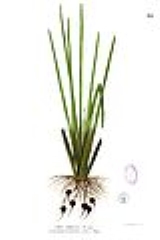
Eleocharis

Encyclopedia
Eleocharis is a genus of 250 or more species of flowering plant
s in the sedge family, Cyperaceae
. They are known commonly as spikerushes, although spikesedges is a more technically appropriate name and most scientists who study them in earnest refer to them as such. The genus has a geographically cosmopolitan distribution
, with centers of diversity in the Amazon Rainforest
and adjacent eastern slopes of the South America
n Andes
, northern Australia
, eastern North America
, California
, Southern Africa
, and subtropical Asia
. The vast majority of Eleocharis species grow in aquatic or mesic habitats from sea level to higher than 5,000 meters in elevation (in the tropical Andes).
The genus itself is relatively easy to recognize; all Eleocharis species have photosynthetic stems and lack leaves (the leaves have been reduced to sheaths surrounding the base of the stems). Many species are robust, rhizomatously-spreading plants of lowland tropical wetland
s, while many others are small caespitose annual or perennial herbs growing near streams, and still others are intermediate. There are also a number of species that are obligate aquatic
species, which usually have submerged, branching stems and often exhibit interesting photosynthetic adaptations, such as the ability to switch between C3 and C4 types of photosynthesis
in response to different environmental stimuli. In all Eleocharis species, the flowers are borne on unbranched terminal spikelets at the apices of stems.
In spite of the diversity of the genus itself, taxonomic characters useful for delimiting species within it are few, and many species are very difficult to tell apart. Many currently recognized species with very wide geographic ranges are highly polymorphic
. Some of these species probably contain multiple independently-evolving lineages. Because of their difficult nature, many botanists avoid collecting these plants and so many species are under-represented in the botanical record.
One of the best known species is the Chinese water chestnut, Eleocharis dulcis
. These plants bear tubers on their rhizomes which may be peeled and eaten raw or boiled. In Australia, magpie geese rely almost exclusively on these tubers for sustenance for a significant portion of the year.
Flowering plant
The flowering plants , also known as Angiospermae or Magnoliophyta, are the most diverse group of land plants. Angiosperms are seed-producing plants like the gymnosperms and can be distinguished from the gymnosperms by a series of synapomorphies...
s in the sedge family, Cyperaceae
Cyperaceae
Cyperaceae are a family of monocotyledonous graminoid flowering plants known as sedges, which superficially resemble grasses or rushes. The family is large, with some 5,500 species described in about 109 genera. These species are widely distributed, with the centers of diversity for the group...
. They are known commonly as spikerushes, although spikesedges is a more technically appropriate name and most scientists who study them in earnest refer to them as such. The genus has a geographically cosmopolitan distribution
Cosmopolitan distribution
In biogeography, a taxon is said to have a cosmopolitan distribution if its range extends across all or most of the world in appropriate habitats. For instance, the killer whale has a cosmopolitan distribution, extending over most of the world's oceans. Other examples include humans, the lichen...
, with centers of diversity in the Amazon Rainforest
Amazon Rainforest
The Amazon Rainforest , also known in English as Amazonia or the Amazon Jungle, is a moist broadleaf forest that covers most of the Amazon Basin of South America...
and adjacent eastern slopes of the South America
South America
South America is a continent situated in the Western Hemisphere, mostly in the Southern Hemisphere, with a relatively small portion in the Northern Hemisphere. The continent is also considered a subcontinent of the Americas. It is bordered on the west by the Pacific Ocean and on the north and east...
n Andes
Andes
The Andes is the world's longest continental mountain range. It is a continual range of highlands along the western coast of South America. This range is about long, about to wide , and of an average height of about .Along its length, the Andes is split into several ranges, which are separated...
, northern Australia
Australia
Australia , officially the Commonwealth of Australia, is a country in the Southern Hemisphere comprising the mainland of the Australian continent, the island of Tasmania, and numerous smaller islands in the Indian and Pacific Oceans. It is the world's sixth-largest country by total area...
, eastern North America
North America
North America is a continent wholly within the Northern Hemisphere and almost wholly within the Western Hemisphere. It is also considered a northern subcontinent of the Americas...
, California
California
California is a state located on the West Coast of the United States. It is by far the most populous U.S. state, and the third-largest by land area...
, Southern Africa
Southern Africa
Southern Africa is the southernmost region of the African continent, variably defined by geography or geopolitics. Within the region are numerous territories, including the Republic of South Africa ; nowadays, the simpler term South Africa is generally reserved for the country in English.-UN...
, and subtropical Asia
Asia
Asia is the world's largest and most populous continent, located primarily in the eastern and northern hemispheres. It covers 8.7% of the Earth's total surface area and with approximately 3.879 billion people, it hosts 60% of the world's current human population...
. The vast majority of Eleocharis species grow in aquatic or mesic habitats from sea level to higher than 5,000 meters in elevation (in the tropical Andes).
The genus itself is relatively easy to recognize; all Eleocharis species have photosynthetic stems and lack leaves (the leaves have been reduced to sheaths surrounding the base of the stems). Many species are robust, rhizomatously-spreading plants of lowland tropical wetland
Wetland
A wetland is an area of land whose soil is saturated with water either permanently or seasonally. Wetlands are categorised by their characteristic vegetation, which is adapted to these unique soil conditions....
s, while many others are small caespitose annual or perennial herbs growing near streams, and still others are intermediate. There are also a number of species that are obligate aquatic
Aquatic plant
Aquatic plants are plants that have adapted to living in aquatic environments. They are also referred to as hydrophytes or aquatic macrophytes. These plants require special adaptations for living submerged in water, or at the water's surface. Aquatic plants can only grow in water or in soil that is...
species, which usually have submerged, branching stems and often exhibit interesting photosynthetic adaptations, such as the ability to switch between C3 and C4 types of photosynthesis
Photosynthesis
Photosynthesis is a chemical process that converts carbon dioxide into organic compounds, especially sugars, using the energy from sunlight. Photosynthesis occurs in plants, algae, and many species of bacteria, but not in archaea. Photosynthetic organisms are called photoautotrophs, since they can...
in response to different environmental stimuli. In all Eleocharis species, the flowers are borne on unbranched terminal spikelets at the apices of stems.
In spite of the diversity of the genus itself, taxonomic characters useful for delimiting species within it are few, and many species are very difficult to tell apart. Many currently recognized species with very wide geographic ranges are highly polymorphic
Polymorphism (biology)
Polymorphism in biology occurs when two or more clearly different phenotypes exist in the same population of a species — in other words, the occurrence of more than one form or morph...
. Some of these species probably contain multiple independently-evolving lineages. Because of their difficult nature, many botanists avoid collecting these plants and so many species are under-represented in the botanical record.
One of the best known species is the Chinese water chestnut, Eleocharis dulcis
Eleocharis dulcis
The Chinese water chestnut , more often called simply the water chestnut, is a grass-like sedge grown for its edible corms. The water chestnut is actually not a nut at all, but an aquatic vegetable that grows in marshes, underwater in the mud...
. These plants bear tubers on their rhizomes which may be peeled and eaten raw or boiled. In Australia, magpie geese rely almost exclusively on these tubers for sustenance for a significant portion of the year.
Selected species
- Eleocharis acicularisEleocharis acicularisEleocharis acicularis is a species of spikesedge known by the common names needle spikerush and dwarf hairgrass. It has a circumboreal distribution and it can also be found throughout the rest of the Americas. It is also found in Australia, where it is probably an introduced species...
- needle spikerush; dwarf hairgrass - Eleocharis atropurpureaEleocharis atropurpureaEleocharis atropurpurea is a species of spikesedge known by the common name purple spikerush. This is an aquatic plant native to much of the tropical world. It also has a wide distribution in temperate regions of North and South America and Asia. It is present in Europe, where it may be an...
- purple spikerush - Eleocharis bella - beautiful spikerush
- Eleocharis bolanderiEleocharis bolanderiEleocharis bolanderi is a species of spikesedge known by the common name Bolander's spikerush. It is native to the western United States, where it grows in wet spots in several types of habitat, including mountain meadows and springs. It is a rhizomatous perennial herb producing erect, hairless...
- Bolander's spikerush - Eleocharis cellulosa - coastal spikerush, Gulf Coast spikerush
- Eleocharis compressa - flatstem spikerush
- Eleocharis geniculataEleocharis geniculataEleocharis geniculata is a species of spikesedge known by several common names, including bent spikerush and Canada spikesedge. This is a widespread plant of wet areas in the Americas, Asia, Africa, and some Pacific Islands. It is an annual spikesedge growing to a maximum height of about 40...
- Canada spikesedge - Eleocharis macrostachyaEleocharis macrostachyaEleocharis macrostachya is a species of spikesedge known by the common name pale spikerush. It is widely distributed in North America and occurs in parts of South America. It is a plant of varied moist habitats, including freshwater lakes and brackish marshes and ponds, ditches, vernal pools, and...
- pale spikerush - Eleocharis montevidensisEleocharis montevidensisEleocharis montevidensis is a species of spikesedge known by the common name sand spikerush. It is a widespread coastal plant native to the Americas, ranging from North Carolina south to Argentina, where it grows in moist, sandy spots in many habitat types, including lakes, riverbanks, wet...
- sand spikerush - Eleocharis mutata - scallion grass
- Eleocharis obtusaEleocharis obtusaEleocharis obtusa is a species of spikesedge known by the common name blunt spikerush. This plant is widely distributed across Canada and the United States, where it grows in wet areas such as riverbanks and moist forest floors. It is also a weed of rice paddies, especially when the rice plants are...
- blunt spikerush - Eleocharis pachycarpaEleocharis pachycarpaEleocharis pachycarpa is a species of spikesedge known by the common name black sand spikerush. This plant is native to Chile but it grows in other parts of the world as an introduced species, such as Australia and the US states of California and Nevada. It is a resident of moist areas, such as...
- black sand spikerush - Eleocharis pachystyla - false junco
- Eleocharis palustrisEleocharis palustrisEleocharis palustris Roem. & Schult. is a species of mat-forming perennial plants in the genus Eleocharis growing in wetlands throughout the Boreal Kingdom. E...
- common spikerush - Eleocharis parishiiEleocharis parishiiEleocharis parishii is a species of spikesedge known by the common name Parish's spikerush. It is native to the western United States and northern Mexico, where it grows in moist and sandy habitats with fresh to brackish water. It is a rhizomatous perennial herb forming mats of ridged stems up to...
- Parish's spikerush - Eleocharis parvulaEleocharis parvulaEleocharis parvula is a species of spikesedge known by the common names dwarf spikerush, small spikerush and hairgrass in aquaria. It has a circumboreal distribution, growing throughout Eurasia and North America, into Central America. It is a plant of brackish and saltwater habitat, such as marshes...
- dwarf spikerush - Eleocharis quadrangulataEleocharis quadrangulataEleocharis quadrangulata is a species of spikesedge known by the common names squarestem spikerush and four-angled spikerush. It is native to much of North America from eastern Canada to southern Mexico, where it grows in and around freshwater in lakes and other water bodies. It is a rhizomatous...
- squarestem spikerush - Eleocharis quinquefloraEleocharis quinquefloraEleocharis quinqueflora is a species of spikesedge known by the common name fewflower spikerush. This plant has a circumboreal distribution and is also found in the southern half of the United States, as well as Chile. It is a resident of wet meadows, bogs, hot springs, and other moist places. This...
- fewflower spikerush - Eleocharis radicansEleocharis radicansEleocharis radicans is a species of spikesedge known by the common name rooted spikerush. This aquatic or semi-aquatic plant is native to the Americas as far north as Virginia and northern California. It grows in wet places such as streams, lakes, bogs, and moist meadows, where it roots on soaked...
- rooted spikerush - Eleocharis rostellataEleocharis rostellataEleocharis rostellata is a species of spikesedge known by the common name beaked spikerush. It is native to the Americas, where it is widespread from Canada to the West Indies to Chile....
- beaked spikerush - Eleocharis tenuis - slender spikerush
- Eleocharis torticulmisEleocharis torticulmisEleocharis torticulmis is a rare species of flowering plant in the sedge family known by the common names twisted spikerush and twist-stem spikerush. It is endemic to Plumas County, California, where it is known from two locations within a kilometer of each other in the Butterfly Valley Botanical...
- twisted spikerush - Eleocharis viviparaEleocharis viviparaEleocharis vivipara is a species of flowering plant in the sedge family known by several common names, including umbrella hairgrass, sprouting spikerush, and viviparous spikerush. It is native to the southern United States. It takes the form of a clump of thin stems. A spike of flowers appears at...
- umbrella hairgrass
External links
- USDA Plants Profile: North American Species
- eFloras Profile
- Baksh & Richards (2006) An architectural model for Eleocharis: morphology and development of Eleocharis cellulosa (Cyperaceae). Am J Botany 93:707-15.
- Hairgrass
- Botany.com
- Rataj, Karel. 1977. Aquarium plants; hair grass. TFH 12/77.