

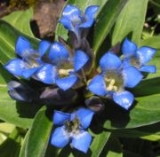
Gentianales

Encyclopedia
Gentianales are an order of flowering plant
s, included within the asterid group of dicotyledon
s.
The circumscription of Gentiales in the Cronquist system
included a broadly defined Loganiaceae
(since broken up into several families), Retziaceae, Gentianaceae
, Saccifoliaceae, Apocynaceae
, and Asclepiadaceae
. The circumscription recognized by the Angiosperm Phylogeny Group
(APG) includes Apocynaceae (including Asclepiadaceae), Gelsemiaceae
(segregated from Loganiaceae), Gentianaceae (including Saccifoliaceae), Loganiaceae, and Rubiaceae
.
Under the APG definition some well-known members of Gentianales are coffee
, gardenia
s, and frangipani.
APG includes Retziaceae in Stilbaceae
(order Lamiales
).
Flowering plant
The flowering plants , also known as Angiospermae or Magnoliophyta, are the most diverse group of land plants. Angiosperms are seed-producing plants like the gymnosperms and can be distinguished from the gymnosperms by a series of synapomorphies...
s, included within the asterid group of dicotyledon
Dicotyledon
The dicotyledons, also known as dicots, are a group of flowering plants whose seed typically has two embryonic leaves or cotyledons. There are around 199,350 species within this group...
s.
The circumscription of Gentiales in the Cronquist system
Cronquist system
The Cronquist system is a taxonomic classification system of flowering plants. It was developed by Arthur Cronquist in his texts An Integrated System of Classification of Flowering Plants and The Evolution and Classification of Flowering Plants .Cronquist's system places flowering plants into two...
included a broadly defined Loganiaceae
Loganiaceae
Loganiaceae are a family of flowering plants classified in order Gentianales. The family includes 13 genera, distributed around the world's tropics.Earlier treatments of the family have included up to 29 genera...
(since broken up into several families), Retziaceae, Gentianaceae
Gentianaceae
Gentianaceae are a family of flowering plants of 87 genera and over 1500 species. Flowers are actinomorphic and bisexual with fused sepals and petals. The stamens are attached to the inside of the petals and alternate with the corolla lobes. There is a glandular disk at the base of the gynoecium,...
, Saccifoliaceae, Apocynaceae
Apocynaceae
The Apocynaceae or dogbane family is a family of flowering plants that includes trees, shrubs, herbs, and lianas.Many species are tall trees found in tropical rainforests, and most are from the tropics and subtropics, but some grow in tropical dry, xeric environments. There are also perennial herbs...
, and Asclepiadaceae
Asclepiadaceae
According to APG II, the Asclepiadaceae is a former plant family now treated as a subfamily in the Apocynaceae...
. The circumscription recognized by the Angiosperm Phylogeny Group
Angiosperm Phylogeny Group
The Angiosperm Phylogeny Group, or APG, refers to an informal international group of systematic botanists who came together to try to establish a consensus on the taxonomy of flowering plants that would reflect new knowledge about plant relationships discovered through phylogenetic studies., three...
(APG) includes Apocynaceae (including Asclepiadaceae), Gelsemiaceae
Gelsemiaceae
Gelsemiaceae is a family of flowering plants, belonging to order Gentianales. The family contains only two genera: Gelsemium and Mostuea. Gelsemium has three species, one native to Southeast Asia and southern China and two native to Southeastern United States, Mexico and Central America...
(segregated from Loganiaceae), Gentianaceae (including Saccifoliaceae), Loganiaceae, and Rubiaceae
Rubiaceae
The Rubiaceae is a family of flowering plants, variously called the coffee family, madder family, or bedstraw family. The group contains many commonly known plants, including the economically important coffee , quinine , and gambier , and the horticulturally valuable madder , west indian jasmine ,...
.
Under the APG definition some well-known members of Gentianales are coffee
Coffea
Coffea is a genus of flowering plants in the Rubiaceae family. They are shrubs or small trees native to tropical and southern Africa and tropical Asia. Seeds of several species are the source of the popular beverage coffee. Coffee ranks as one of the world's most valuable and widely traded...
, gardenia
Gardenia
Gardenia is a genus of 142 species of flowering plants in the coffee family, Rubiaceae, native to the tropical and subtropical regions of Africa, southern Asia, Australasia and Oceania....
s, and frangipani.
APG includes Retziaceae in Stilbaceae
Stilbaceae
Stilbaceae is a family of flowering plants in the order Lamiales.Genera include:*Anastrabe E. Mey. ex Benth.*Bowkeria Harv.*Campylostachys Kunth*Charadrophila Marloth*Euthystachys A. DC.*Halleria L.*Ixianthes Benth....
(order Lamiales
Lamiales
Lamiales is an order in the asterid group of dicotyledonous flowering plants. It includes approximately 11,000 species divided into about 20 families...
).