

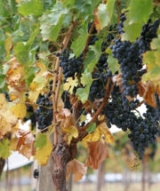
Vitaceae

Encyclopedia
Vitaceae are a family of dicotyledon
ous flowering plant
s including the grapevine
and Virginia creeper
. The family name is derived from the genus Vitis
. The name sometimes appears as Vitidaceae, but Vitaceae is a conserved name
and therefore has priority over both Vitidaceae and another name sometimes found in the older literature, Ampelidaceae.
The relationships of Vitaceae are unclear and the family does not appear to have any close relatives. In the Cronquist system
, the family was placed near the family Rhamnaceae
in order Rhamnales
. The family was placed in the Rosid clade, but not classified in an order, by the Angiosperm Phylogeny Group
(APG). APG III
(2009) places Vitaceae in its own order, Vitales. Phylogenetic analyses support Vitaceae as the sister-group to all other rosids (Jansen et al. 2006).
Most Vitis species have 38 chromosomes (n=19), but 40 (n=20) in subgenus Muscadinia, while Ampelocissus
, Parthenocissus
, and Ampelopsis
also have 40 chromosomes (n=20) and Cissus
has 24 chromosomes (n=12).
The family is economically important as grape
s (Vitis species) are an important fruit crop and, when fermented, produce wine
.
Species of the genus Tetrastigma
serve as hosts to parasitic plant
s in the family Rafflesiaceae
.
Leea
, sometimes classified in its own family, Leeaceae, is included in Vitaceae by the APG and the Angiosperm Phylogeny Web.
Dicotyledon
The dicotyledons, also known as dicots, are a group of flowering plants whose seed typically has two embryonic leaves or cotyledons. There are around 199,350 species within this group...
ous flowering plant
Flowering plant
The flowering plants , also known as Angiospermae or Magnoliophyta, are the most diverse group of land plants. Angiosperms are seed-producing plants like the gymnosperms and can be distinguished from the gymnosperms by a series of synapomorphies...
s including the grapevine
Grapevine
Grapevine is the common name for plants of the genus Vitis. Other meanings include:*Grapevine , a term often used to describe a form of communication by means of gossip or rumor, as in "heard it through the grapevine"...
and Virginia creeper
Parthenocissus quinquefolia
Virginia creeper, five-leaved ivy, or five-finger is a woody vine native to eastern and central North America, in southeastern Canada, the eastern and central United States, eastern Mexico, and Guatemala, west as far as Manitoba, South Dakota, Utah and Texas.-Growth:It is a prolific climber,...
. The family name is derived from the genus Vitis
Vitis
Vitis is a genus of about 60 species of vining plants in the flowering plant family Vitaceae. The genus is made up of species predominantly from the Northern hemisphere. It is economically important as the source of grapes, both for direct consumption of the fruit and for fermentation to produce...
. The name sometimes appears as Vitidaceae, but Vitaceae is a conserved name
Conserved name
A conserved name or nomen conservandum is a scientific name that has specific nomenclatural protection. Nomen conservandum is a Latin term, meaning a "name which should be conserved"...
and therefore has priority over both Vitidaceae and another name sometimes found in the older literature, Ampelidaceae.
The relationships of Vitaceae are unclear and the family does not appear to have any close relatives. In the Cronquist system
Cronquist system
The Cronquist system is a taxonomic classification system of flowering plants. It was developed by Arthur Cronquist in his texts An Integrated System of Classification of Flowering Plants and The Evolution and Classification of Flowering Plants .Cronquist's system places flowering plants into two...
, the family was placed near the family Rhamnaceae
Rhamnaceae
Rhamnaceae, the Buckthorn family, is a large family of flowering plants, mostly trees, shrubs and some vines.The family contains 50-60 genera and approximately 870-900 species. The Rhamnaceae have a worldwide distribution, but are more common in the subtropical and tropical regions...
in order Rhamnales
Rhamnales
The Rhamnales are an order of dicotyledon plants. In the Cronquist system, the following families were placed here:* Family Elaeagnaceae – * Family Leeaceae* Family Rhamnaceae * Family Vitaceae...
. The family was placed in the Rosid clade, but not classified in an order, by the Angiosperm Phylogeny Group
Angiosperm Phylogeny Group
The Angiosperm Phylogeny Group, or APG, refers to an informal international group of systematic botanists who came together to try to establish a consensus on the taxonomy of flowering plants that would reflect new knowledge about plant relationships discovered through phylogenetic studies., three...
(APG). APG III
APG III system
The APG III system of flowering plant classification is the third version of a modern, mostly molecular-based, system of plant taxonomy...
(2009) places Vitaceae in its own order, Vitales. Phylogenetic analyses support Vitaceae as the sister-group to all other rosids (Jansen et al. 2006).
Most Vitis species have 38 chromosomes (n=19), but 40 (n=20) in subgenus Muscadinia, while Ampelocissus
Ampelocissus
Ampelocissus is a genus of Vitaceae having 90 or more species found variously in tropical Africa, Asia, Central America, and Oceania. The type species, A...
, Parthenocissus
Parthenocissus
Parthenocissus , creepers, is a genus of climbing plants from the grape family, Vitaceae. It contains about 12 species, from Asia and North America. Several are grown for ornamental use....
, and Ampelopsis
Ampelopsis
Ampelopsis is a genus of climbing shrubs, in the grape family Vitaceae. The name is derived from the Greek word ampelos, which means "vine"...
also have 40 chromosomes (n=20) and Cissus
Cissus
Cissus is a genus of approximately 350 species of woody vines in the grape family . They have a cosmopolitan distribution, though the majority are to be found in the tropics. In Tamil they are known as pirandai .-Medicinal:...
has 24 chromosomes (n=12).
The family is economically important as grape
Grape
A grape is a non-climacteric fruit, specifically a berry, that grows on the perennial and deciduous woody vines of the genus Vitis. Grapes can be eaten raw or they can be used for making jam, juice, jelly, vinegar, wine, grape seed extracts, raisins, molasses and grape seed oil. Grapes are also...
s (Vitis species) are an important fruit crop and, when fermented, produce wine
Wine
Wine is an alcoholic beverage, made of fermented fruit juice, usually from grapes. The natural chemical balance of grapes lets them ferment without the addition of sugars, acids, enzymes, or other nutrients. Grape wine is produced by fermenting crushed grapes using various types of yeast. Yeast...
.
Species of the genus Tetrastigma
Tetrastigma
Tetrastigma is a genus of plants in the grape family, Vitaceae. The plants are vines that climb with tendrils and have palmately compound leaves. The species are found in subtropical and tropical regions of Asia, Malesia, and Australia, where they grow in primary rainforest, gallery forest and...
serve as hosts to parasitic plant
Parasitic plant
A parasitic plant is one that derives some or all of its sustenance from another plant. About 4,100 species in approximately 19 families of flowering plants are known. Parasitic plants have a modified root, the haustorium, that penetrates the host plant and connects to the xylem, phloem, or...
s in the family Rafflesiaceae
Rafflesiaceae
Rafflesiaceae is a family of parasitic plants found in east and southeast Asia, including Rafflesia arnoldii, the plant with the largest flower of all plants. The plants are endoparasites of vines in the genus Tetrastigma and lack stems, leaves, roots, and any photosynthetic tissue...
.
Leea
Leea
Leea is a genus of plants that are distributed throughout Northern and eastern Australia, New Guinea, South and Southeast Asia and parts of Africa. Leea contains approximately 70 species and is placed in the Vitaceae family. The APG II system places Leea in the subfamily Leeoideae...
, sometimes classified in its own family, Leeaceae, is included in Vitaceae by the APG and the Angiosperm Phylogeny Web.