


Ericales

Encyclopedia
The Ericales are a large and diverse order of dicotyledon
s, including for example tea, persimmon
, blueberry
, Brazil nut
, and azalea
. The order includes tree
s and bush
es, liana
s and herbaceous
plants. Together with ordinary autophytic
plants, the Ericales include chlorophyll
-deficient myco-heterotrophic plants (e. g. Sarcodes sanguinea) and carnivorous plant
s (e. g. genus Sarracenia
).
Many species have five petals, often grown together. Fusion of the petals is a trait that was traditionally used to place the order in the subclass Sympetalae
.
Mycorrhiza
is an interesting property, frequently associated with the Ericales. Indeed, the symbiosis with root fungi is quite common among the order representatives, and there are even three kinds of it which can be found exclusively among Ericales (namely, ericoid, arbutoid and monotropoid mycorrhiza). In addition, some families among the order are notable for their exceptional ability to accumulate aluminum (Jansen et al., 2004).
Ericales are a cosmopolitic order. Areas of distribution of families vary largely - while some are restricted to tropics, others exist mainly in Arctic or temperate regions. The entire order contains over 8000 species, of which the Ericaceae account for 2000-4000 species (by various estimates).
(Camellia sinensis) from the Theaceae
family. The order also includes some edible fruits, including kiwi fruit (Actinidia deliciosa), persimmon
(genus Diospyros), blueberry
, huckleberry
and cranberry
, Brazil nut
, and Mamey sapote
. The order also includes shea
(Vitellaria paradoxa), which is the major dietary lipid source for millions of sub-Saharan Africans. Many Ericales species are cultivated for their showy flowers: well-known examples are azalea
, rhododendron
, camellia
, polyanthus
, cyclamen
, phlox
, and busy Lizzie
.
.
These make up a basal group of asterids. Under the Cronquist system
, the Ericales included a smaller group of plants, which were placed among the Dilleniidae
:
Dicotyledon
The dicotyledons, also known as dicots, are a group of flowering plants whose seed typically has two embryonic leaves or cotyledons. There are around 199,350 species within this group...
s, including for example tea, persimmon
Persimmon
A persimmon is the edible fruit of a number of species of trees in the genus Diospyros in the ebony wood family . The word Diospyros means "the fire of Zeus" in ancient Greek. As a tree, it is a perennial plant...
, blueberry
Blueberry
Blueberries are flowering plants of the genus Vaccinium with dark-blue berries and are perennial...
, Brazil nut
Brazil Nut
The Brazil nut is a South American tree in the family Lecythidaceae, and also the name of the tree's commercially harvested edible seed.- Order :...
, and azalea
Azalea
Azaleas are flowering shrubs comprising two of the eight subgenera of the genus Rhododendron, Pentanthera and Tsutsuji . Azaleas bloom in spring, their flowers often lasting several weeks...
. The order includes tree
Tree
A tree is a perennial woody plant. It is most often defined as a woody plant that has many secondary branches supported clear of the ground on a single main stem or trunk with clear apical dominance. A minimum height specification at maturity is cited by some authors, varying from 3 m to...
s and bush
Shrub
A shrub or bush is distinguished from a tree by its multiple stems and shorter height, usually under 5–6 m tall. A large number of plants may become either shrubs or trees, depending on the growing conditions they experience...
es, liana
Liana
A liana is any of various long-stemmed, woody vines that are rooted in the soil at ground level and use trees, as well as other means of vertical support, to climb up to the canopy to get access to well-lit areas of the forest. Lianas are especially characteristic of tropical moist deciduous...
s and herbaceous
Herbaceous
A herbaceous plant is a plant that has leaves and stems that die down at the end of the growing season to the soil level. They have no persistent woody stem above ground...
plants. Together with ordinary autophytic
Photosynthesis
Photosynthesis is a chemical process that converts carbon dioxide into organic compounds, especially sugars, using the energy from sunlight. Photosynthesis occurs in plants, algae, and many species of bacteria, but not in archaea. Photosynthetic organisms are called photoautotrophs, since they can...
plants, the Ericales include chlorophyll
Chlorophyll
Chlorophyll is a green pigment found in almost all plants, algae, and cyanobacteria. Its name is derived from the Greek words χλωρος, chloros and φύλλον, phyllon . Chlorophyll is an extremely important biomolecule, critical in photosynthesis, which allows plants to obtain energy from light...
-deficient myco-heterotrophic plants (e. g. Sarcodes sanguinea) and carnivorous plant
Carnivorous plant
Carnivorous plants are plants that derive some or most of their nutrients from trapping and consuming animals or protozoans, typically insects and other arthropods. Carnivorous plants appear adapted to grow in places where the soil is thin or poor in nutrients, especially nitrogen, such as acidic...
s (e. g. genus Sarracenia
Sarracenia
Sarracenia is a genus comprising 8 to 11 species of North American pitcher plants. The genus belongs to the family Sarraceniaceae, which also contain the closely allied genera Darlingtonia and Heliamphora....
).
Many species have five petals, often grown together. Fusion of the petals is a trait that was traditionally used to place the order in the subclass Sympetalae
Sympetalae
Sympetalae, meaning “with fused petals”, is a descriptive botanical name used in the Eichler, Engler, and Wettstein systems for a group in the flowering plants...
.
Mycorrhiza
Mycorrhiza
A mycorrhiza is a symbiotic association between a fungus and the roots of a vascular plant....
is an interesting property, frequently associated with the Ericales. Indeed, the symbiosis with root fungi is quite common among the order representatives, and there are even three kinds of it which can be found exclusively among Ericales (namely, ericoid, arbutoid and monotropoid mycorrhiza). In addition, some families among the order are notable for their exceptional ability to accumulate aluminum (Jansen et al., 2004).
Ericales are a cosmopolitic order. Areas of distribution of families vary largely - while some are restricted to tropics, others exist mainly in Arctic or temperate regions. The entire order contains over 8000 species, of which the Ericaceae account for 2000-4000 species (by various estimates).
Economic importance
The most profitable plant in the order is teaTea
Tea is an aromatic beverage prepared by adding cured leaves of the Camellia sinensis plant to hot water. The term also refers to the plant itself. After water, tea is the most widely consumed beverage in the world...
(Camellia sinensis) from the Theaceae
Theaceae
The Theaceae is a family of flowering plants, composed of shrubs and trees. Some botanists include the family Ternstroemiaceae within the Theaceae while others do not...
family. The order also includes some edible fruits, including kiwi fruit (Actinidia deliciosa), persimmon
Persimmon
A persimmon is the edible fruit of a number of species of trees in the genus Diospyros in the ebony wood family . The word Diospyros means "the fire of Zeus" in ancient Greek. As a tree, it is a perennial plant...
(genus Diospyros), blueberry
Blueberry
Blueberries are flowering plants of the genus Vaccinium with dark-blue berries and are perennial...
, huckleberry
Huckleberry
Huckleberry is a common name used in North America for several species of plants in two closely related genera in the family Ericaceae:* Vaccinium* GaylussaciaHuckleberry may also refer to:-Plants:...
and cranberry
Cranberry
Cranberries are a group of evergreen dwarf shrubs or trailing vines in the subgenus Oxycoccus of the genus Vaccinium. In some methods of classification, Oxycoccus is regarded as a genus in its own right...
, Brazil nut
Brazil Nut
The Brazil nut is a South American tree in the family Lecythidaceae, and also the name of the tree's commercially harvested edible seed.- Order :...
, and Mamey sapote
Mamey sapote
The mamey sapote is a species of tree native to southern Mexico. Today, the tree is cultivated not only in Mexico, but also in Central America, the Caribbean, and South Florida for its fruit, which is commonly eaten in many Latin American countries...
. The order also includes shea
Shea
Vitellaria paradoxa, also classified as Butyrospermum parkii and B. paradoxa, commonly known as shea tree, shi tree, or , vitellaria or karité, is a tree of the Sapotaceae family indigenous to Africa, occurring in Mali, Cameroon, Congo, Côte d'Ivoire, Ghana, Guinea, Togo, Nigeria, Senegal, Sudan,...
(Vitellaria paradoxa), which is the major dietary lipid source for millions of sub-Saharan Africans. Many Ericales species are cultivated for their showy flowers: well-known examples are azalea
Azalea
Azaleas are flowering shrubs comprising two of the eight subgenera of the genus Rhododendron, Pentanthera and Tsutsuji . Azaleas bloom in spring, their flowers often lasting several weeks...
, rhododendron
Rhododendron
Rhododendron is a genus of over 1 000 species of woody plants in the heath family, most with showy flowers...
, camellia
Camellia
Camellia, the camellias, is a genus of flowering plants in the family Theaceae. They are found in eastern and southern Asia, from the Himalaya east to Korea and Indonesia. There are 100–250 described species, with some controversy over the exact number...
, polyanthus
Primula
Primula is a genus of 400–500 species of low-growing herbs in the family Primulaceae. They include primrose, auricula, cowslip and oxlip. Many species are grown for their ornamental flowers...
, cyclamen
Cyclamen
Cyclamen is a genus of 23 species of perennials growing from tubers, valued for their flowers with upswept petals and variably patterned leaves...
, phlox
Phlox
Phlox is a genus of 67 species of perennial and annual plants found mostly in North America in diverse habitats from alpine tundra to open woodland and prairie. Some flower in spring, others in summer and autumn....
, and busy Lizzie
Busy Lizzie
Impatiens walleriana Hook.f. also known as Busy Lizzy, Balsam or simply Impatiens, is native to eastern Africa from Kenya to Mozambique. It is a herbaceous perennial plant growing to 15-60 cm tall, with broad lanceolate leaves 3-12 cm long and 2-5 cm broad...
.
Classification
The following families are typical of newer classifications. Those marked with an asterisk are recognized in the APG III systemAPG III system
The APG III system of flowering plant classification is the third version of a modern, mostly molecular-based, system of plant taxonomy...
.
- Family ActinidiaceaeActinidiaceaeActinidiaceae, or the Chinese Gooseberry family, is a small family of plants. It includes three genera and about 360 species. It is a member of the order Ericales.-Distribution:...
* (kiwifruitKiwifruitThe kiwifruit, often shortened to kiwi in many parts of the world, is the edible berry of a cultivar group of the woody vine Actinidia deliciosa and hybrids between this and other species in the genus Actinidia....
family) - Family BalsaminaceaeBalsaminaceaeBalsaminaceae are a family of dicotyledonous plants, comprising two genera and 850+ species, all but one of which belong to the genus Impatiens...
* (balsamImpatiensImpatiens is a genus of about 850–1,000 species of flowering plants, widely distributed throughout the Northern Hemisphere and tropics. Together with the puzzling Hydrocera triflora, this genus makes up the family Balsaminaceae...
family)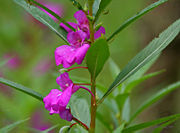
- Family ClethraceaeClethraceaeClethraceae is a small family of flowering plants in the order Ericales, native to warm temperate to tropical regions of Asia and the Americas, with one species also on Madeira...
* (clethraClethraClethra is a genus of between 30-70 species of flowering shrubs or small trees. It is one of two genera in the family Clethraceae...
family) - Family CyrillaceaeCyrillaceaeCyrillaceae is a small family of flowering plants in the order Ericales, native to warm temperate to tropical regions of the Americas. The family comprises two genera, each with a single species, Cyrilla racemiflora and Cliftonia monophylla....
* (cyrillaCyrillaCyrilla racemiflora, the sole species in the genus Cyrilla, is a flowering plant in the family Cyrillaceae, native to warm temperate to tropical regions of the Americas, from the southeastern United States , south through the Caribbean, Mexico and Central America to northern Brazil and...
family) - Family DiapensiaceaeDiapensiaceaeDiapensiaceae is a small family of flowering plants, comprising 12 species in five genera. Three of the genera, Berneuxia, Galax, and Pyxidanthera, contain only a single species. The Asian species of Shortia were formerly separated as the genus Schizocodon, and some authors still recognize S....
* - Family EbenaceaeEbenaceaeThe Ebenaceae are a family of flowering plants, which includes ebony and persimmon. The family has approximately 500 species of trees and shrubs in two genera, Diospyros and Euclea. The species are mostly evergreen and native to the tropics and subtropics, with a few deciduous species native to...
* (ebonyEbonyEbony is a dense black wood, most commonly yielded by several species in the genus Diospyros, but ebony may also refer to other heavy, black woods from unrelated species. Ebony is dense enough to sink in water. Its fine texture, and very smooth finish when polished, make it valuable as an...
and persimmonPersimmonA persimmon is the edible fruit of a number of species of trees in the genus Diospyros in the ebony wood family . The word Diospyros means "the fire of Zeus" in ancient Greek. As a tree, it is a perennial plant...
family) - Family EricaceaeEricaceaeThe Ericaceae, commonly known as the heath or heather family, is a group of mostly calcifuge flowering plants. The family is large, with roughly 4000 species spread across 126 genera, making it the 14th most speciose family of flowering plants...
* (heathEricaErica ,the heaths or heathers, is a genus of approximately 860 species of flowering plants in the family Ericaceae. The English common names "heath" and "heather" are shared by some closely related genera of similar appearance....
, rhododendronRhododendronRhododendron is a genus of over 1 000 species of woody plants in the heath family, most with showy flowers...
, and blueberryVacciniumVaccinium is a genus of shrubs or dwarf shrubs in the plant Family Ericaceae. The fruit of many species are eaten by humans and some are of commercial importance, including the cranberry, blueberry, bilberry or whortleberry, lingonberry or cowberry, and huckleberry...
family) - Family FouquieriaFouquieriaFouquieria is a genus of 11 species of desert plants, the sole genus in the family Fouquieriaceae. The genus includes the ocotillo and the boojum tree or cirio . They have semi-succulent stems with thinner spikes projecting from them, with leaves on the bases spikes...
ceae* (OcotilloOcotilloFouquieria splendens Engelm. is a desert plant of the southwestern United States and northern Mexico. Common names include ocotillo, desert coral, coachwhip, Jacob's staff, and vine cactus, although it is not a true cactus...
family) - Family LecythidaceaeLecythidaceaeThe Lecythidaceae comprise a family of about 20 genera and 250-300 species of woody plants native to tropical South America and Madagascar.According to the most recent molecular analysis of Lecythidaceae The Lecythidaceae comprise a family of about 20 genera and 250-300 species of woody plants...
* (Brazil nutBrazil NutThe Brazil nut is a South American tree in the family Lecythidaceae, and also the name of the tree's commercially harvested edible seed.- Order :...
family) - Family Maesaceae
- Family MarcgraviaceaeMarcgraviaceaeMarcgraviaceae is a neotropical angiosperm family in the order Ericales.The members of the family are shrubs, woody epiphytes and lianas with alternate, pinnately-nerved leaves. The flowers are arranged in racemes. The flowers are accompanied by modified, fleshy saccate bracts which produce nectar....
* - Family Mitrastemonaceae*
- Family MyrsinaceaeMyrsinaceaeMyrsinaceae, or the Myrsine family, is a rather large family from the order Ericales. It consists of 35 genera and about 1000 species....
(cyclamenCyclamenCyclamen is a genus of 23 species of perennials growing from tubers, valued for their flowers with upswept petals and variably patterned leaves...
and scarlet pimpernelScarlet pimpernelScarlet pimpernel is a low-growing annual plant found in Europe, Asia and North America...
family) - Family Pellicieraceae
- Family Pentaphyllacaceae*
- Family PolemoniaceaePolemoniaceaePolemoniaceae are a family of about 25 genera with 270-400 species of annual and perennial plants, native to the Northern Hemisphere and South America, with the center of diversity in western North America, especially in California.Only one genus is found in Europe, and two in Asia, where they...
* (phloxPhloxPhlox is a genus of 67 species of perennial and annual plants found mostly in North America in diverse habitats from alpine tundra to open woodland and prairie. Some flower in spring, others in summer and autumn....
family) - Family PrimulaceaePrimulaceaePrimulaceae is a family of flowering plants with about 24 genera, including some favorite garden plants and wildflowers. It is also known as the primrose family.- Genera :...
* (primrosePrimulaPrimula is a genus of 400–500 species of low-growing herbs in the family Primulaceae. They include primrose, auricula, cowslip and oxlip. Many species are grown for their ornamental flowers...
and snowbellSoldanellaThe genus Soldanella, commonly known in English as snowbell, includes about 15 species in the flowering plant family Primulaceae, native to European mountains, from the Pyrenees, the Apennines, the Alps, the Carpathians and the Balkans...
family) - Family RoridulaRoridulaRoridula is a South African genus of plants that, whilst having many of the adaptations of a carnivorous plant, such as the possession of insect-trapping sticky hairs, does not directly digest the animals it traps. Instead, it has a mutualistic relationship with Pameridea roridulae, a species of...
ceae* - Family SapotaceaeSapotaceaeSapotaceae is a family of flowering plants, belonging to order Ericales. The family includes approximately 800 species of evergreen trees and shrubs in approximately 65 genera . Distribution is pantropical....
* (sapodillaSapodillaManilkara zapota, commonly known as the sapodilla, is a long-lived, evergreen tree native to southern Mexico, Central America and the Caribbean. An example natural occurrence is in coastal Yucatan in the Petenes mangroves ecoregion, where it is a subdominant plant species...
family) - Family SarraceniaceaeSarraceniaceaeSarraceniaceae is a family of pitcher plants , belonging to order Ericales .The family comprises three extant genera: Sarracenia , Darlingtonia , and Heliamphora . The extinct Archaeamphora longicervia may also belong to this family...
* (American pitcher plantPitcher plantPitcher plants are carnivorous plants whose prey-trapping mechanism features a deep cavity filled with liquid known as a pitfall trap. It has been widely assumed that the various sorts of pitfall trap evolved from rolled leaves, with selection pressure favouring more deeply cupped leaves over...
family) - Family SladeniaceaeSladeniaceaeSladeniaceae Airy Shaw is a family of flowering plants containing tree species found in sub-tropical to tropical environments in East Africa , Burma, Yunnan and Thailand...
* - Family StyracaceaeStyracaceaeStyracaceae is a small family of flowering plants in the order Ericales, containing 11 genera and about 160 species of trees and shrubs. The family occurs in warm temperate and subtropical regions of the Northern Hemisphere....
* (silverbellHalesiaHalesia , also known as is a small genus of four or five species of deciduous large shrubs or small trees in the family Styracaceae, native to eastern Asia and eastern North America...
family) - Family Symplocaceae* (sapphireberry family)
- Family Ternstroemiaceae (see Pentaphyllacaceae)
- Family TetrameristaceaeTetrameristaceaeTetrameristaceae is the botanical name of a family of flowering plants. The family consists of four species, of trees or shrubs, in two genera:* Tetramerista in Southeast Asia* Pentamerista in the Guyanas....
* - Family TheaceaeTheaceaeThe Theaceae is a family of flowering plants, composed of shrubs and trees. Some botanists include the family Ternstroemiaceae within the Theaceae while others do not...
* (teaCamellia sinensisCamellia sinensis is the species of plant whose leaves and leaf buds are used to produce Chinese tea. It is of the genus Camellia , a genus of flowering plants in the family Theaceae. White tea, green tea, oolong, pu-erh tea and black tea are all harvested from this species, but are processed...
and camelliaCamelliaCamellia, the camellias, is a genus of flowering plants in the family Theaceae. They are found in eastern and southern Asia, from the Himalaya east to Korea and Indonesia. There are 100–250 described species, with some controversy over the exact number...
family) - Family TheophrastaceaeTheophrastaceaeTheophrastaceae is a small family of flowering plants. As currently circumscribed, the family consists of seven genera and 95 species of trees or shrubs, native to tropical regions of the Americas....
These make up a basal group of asterids. Under the Cronquist system
Cronquist system
The Cronquist system is a taxonomic classification system of flowering plants. It was developed by Arthur Cronquist in his texts An Integrated System of Classification of Flowering Plants and The Evolution and Classification of Flowering Plants .Cronquist's system places flowering plants into two...
, the Ericales included a smaller group of plants, which were placed among the Dilleniidae
Dilleniidae
Dillenidae is a botanical name at the rank of subclass....
:
- Family EricaceaeEricaceaeThe Ericaceae, commonly known as the heath or heather family, is a group of mostly calcifuge flowering plants. The family is large, with roughly 4000 species spread across 126 genera, making it the 14th most speciose family of flowering plants...
- Family CyrillaceaeCyrillaceaeCyrillaceae is a small family of flowering plants in the order Ericales, native to warm temperate to tropical regions of the Americas. The family comprises two genera, each with a single species, Cyrilla racemiflora and Cliftonia monophylla....
- Family ClethraceaeClethraceaeClethraceae is a small family of flowering plants in the order Ericales, native to warm temperate to tropical regions of Asia and the Americas, with one species also on Madeira...
- Family GrubbiaceaeGrubbiaceaeGrubbiaceae is a family of flowering plants endemic to the Cape floristic region of South Africa. The family includes five species of leathery-leaved shrubs in two genera, Grubbia and Strobilocarpus. They are commonly known as sillyberry....
- Family Empetraceae
- Family Epacridaceae
- Family PyrolaceaePyrolaceaePyrolaceae was a small family of flowering plants under the old Cronquist system of plant classification. It included the four genera Chimaphila, Moneses, Orthilia, and Pyrola, and sometimes also the eight genera formerly usually placed in the family Monotropaceae.Recent genetic research by the...
- Family MonotropaceaeMonotropaceaeMonotropaceae was a small family of flowering plants under the old Cronquist system of plant classification. It included 10 genera Allotropa, Cheilotheca, Hemitomes, Monotropa, Monotropastrum, Monotropsis, Pityopus, Pleuricospora, Pterospora, Sarcodes....