
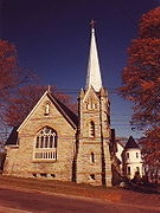
Windsor is a town located in Hants County, Mainland
Nova ScotiaNova Scotia is one of Canada's three Maritime provinces and is the most populous province in Atlantic Canada. The name of the province is Latin for "New Scotland," but "Nova Scotia" is the recognized, English-language name of the province. The provincial capital is Halifax. Nova Scotia is the...
at the junction of the Avon and
St. Croix RiverThe St. Croix River is a river in Nova Scotia entirely contained in Hants and Halifax Counties. Its headwaters are Panuke Lake. The river has been exploited for water power. There were water mills in the nineteenth century and in the 1930’s three hydroelectric dams were built; they still...
s. It is the largest community in western
Hants CountyHants County is a county in the Canadian province of Nova Scotia which was the home of Thomas Chandler Haliburton, Alden Nowlan and Noel Doiron. The county of Hants was created June 17, 1781, and consisted of the townships of Windsor, Falmouth and Newport...
with a 2001 population of 3,779 and was at one time the
shire townA county seat is an administrative center, or seat of government, for a county or civil parish. The term is primarily used in the United States....
of the county. The region encompassing present day Windsor was originally part of
PisiguitIn the Minas Basin of Acadia, which is now Nova Scotia, the settlement of Grand-Pré grew eastward towards the Pisiquid River. This settlement became known as Pisiguit or . Pisiguit came from the Mi'kmaq term Pesaquid, meaning "Junction of Waters". It became so large that it was viewed as...
, a Mi'kmaq term meaning "Junction of Waters". This name referred to the confluence of the Avon and St. Croix rivers, which flow into the
Minas BasinThe Minas Basin is an inlet of the Bay of Fundy and a sub-basin of the Fundy Basin located in Nova Scotia, Canada. It is known for its extremely high tides.- Geography :- Boundary :...
. When the Acadians lived in the area, the town was raided by the New Englanders 1704. The area was central to both
Father Le Loutre's WarFather Le Loutre’s War , also known as the Indian War, the Micmac War and the Anglo-Micmac War, took place between King George's War and the French and Indian War in Acadia and Nova Scotia. On one side of the conflict, the British and New England colonists were led by British Officer Charles...
and the Expulsion of the Acadians during the
Bay of Fundy Campaign (1755)The Bay of Fundy Campaign occurred during the French and Indian War when the British ordered the Expulsion of the Acadians from Acadia after the Battle of Beausejour . The Campaign started at Chignecto and then quickly moved to Grand Pré, Rivière-aux-Canards, Pisiguit, Cobequid, and finally Port...
. The town has a claim to being the birth place of hockey and also was the home of Canada's first internationally best-selling author
Thomas Chandler HaliburtonThomas Chandler Haliburton was the first international best-selling author from Canada. He was also significant in the history of Nova Scotia.-Life:...
.
History
Having migrated from
Port Royal, Nova ScotiaPort Royal was the capital of Acadia from 1605 to 1710 and is now a town called Annapolis Royal in the western part of the Canadian province of Nova Scotia. Initially Port Royal was located on the north shore of the Annapolis Basin, Nova Scotia, at the site of the present reconstruction of the...
, the Acadians were the first to settle in
PisiguitIn the Minas Basin of Acadia, which is now Nova Scotia, the settlement of Grand-Pré grew eastward towards the Pisiquid River. This settlement became known as Pisiguit or . Pisiguit came from the Mi'kmaq term Pesaquid, meaning "Junction of Waters". It became so large that it was viewed as...
around 1685.
Raid on Pisiquid (1704)
During
Queen Anne's WarQueen Anne's War , as the North American theater of the War of the Spanish Succession was known in the British colonies, was the second in a series of French and Indian Wars fought between France and England, later Great Britain, in North America for control of the continent. The War of the...
, in response to the Canadian and
NativeThe indigenous peoples of the Americas are the pre-Columbian inhabitants of North and South America, their descendants and other ethnic groups who are identified with those peoples. Indigenous peoples are known in Canada as Aboriginal peoples, and in the United States as Native Americans...
Raid on Deerfield, Massachusetts, Benjamin Church (military officer) led the Raid on Pisiguit (1704) and burned the village to the ground. In the Raid on Pisiquid, Church burned 40 houses along with out-buildings, crops and cattle. There was resistance and two Mi’kmaq were wounded.
Father Le Loutre's War
Despite the British
Conquest of AcadiaThe Siege of Port Royal , also known as the Conquest of Acadia, was conducted by British regular and provincial forces under the command of Francis Nicholson against a French Acadian garrison under the command of Daniel d'Auger de Subercase, at the Acadian capital, Port Royal...
in 1710, Nova Scotia remained primarily occupied by Catholic Acadians and Mi'kmaq.
Father Le Loutre's WarFather Le Loutre’s War , also known as the Indian War, the Micmac War and the Anglo-Micmac War, took place between King George's War and the French and Indian War in Acadia and Nova Scotia. On one side of the conflict, the British and New England colonists were led by British Officer Charles...
began when
Edward CornwallisLieutenant General Edward Cornwallis was a British military officer who founded Halifax, Nova Scotia with 2500 settlers and later served as the Governor of Gibraltar.-Early life:...
arrived to establish
HalifaxHalifax is a city in Canada, which was the capital of the province of Nova Scotia and shire town of Halifax County. It was the largest city in Atlantic Canada until it was amalgamated into Halifax Regional Municipality in 1996...
with 13 transports on June 21, 1749. By unilaterally establishing Halifax the British were violating earlier treaties with the Mi'kmaq (1726), which were signed after
Dummer's WarDummer's War , also known as Lovewell's War, Father Rale's War, Greylock's War, the Three Years War, the 4th Indian War or the Wabanaki-New England War of 1722–1725, was a series of battles between British settlers of the three northernmost British colonies of North America of the time and the...
. The British quickly began to build other settlements. To guard against Mi'kmaq, Acadian and French attacks on the new Protestant settlements, British fortifications were erected in Halifax (1749), Dartmouth (1750), Bedford (Fort Sackville) (1751),
LunenburgLunenburg , is a Canadian port town in Lunenburg County, Nova Scotia.Situated on the province's South Shore, Lunenburg is located on a peninsula at the western side of Mahone Bay. The town is approximately 90 kilometres southwest of the county boundary with the Halifax Regional Municipality.The...
(1753) and
LawrencetownLawrencetown is a Canadian rural community in Nova Scotia's Halifax Regional Municipality on Route 207. The settlement was established during Father Le Loutre's War.- History :...
(1754).
Within 18 months of establishing Halifax, the British also took firm control of peninsula Nova Scotia by building fortifications in all the major Acadian communities: present-day Windsor (Fort Edward); Grand Pre (
Fort Vieux LogisThe site of Fort Vieux Logis is in present-day Hortonville, Nova Scotia, Canada and was built during Father Le Loutre's War. The fort was created to help prevent the Acadian Exodus from the region. The site of the fort is on the field where the Acadian Cross and the New England Planters monument...
) and Chignecto (
Fort LawrenceFort Lawrence was a British fort built during Father Le Loutre's War and located on the Isthmus of Chignecto .-Father Le Loutre's War:...
). (A British fort already existed at the other major Acadian centre of
Annapolis Royal, Nova ScotiaAnnapolis Royal is a town located in the western part of Annapolis County, Nova Scotia. Known as Port Royal until the Conquest of Acadia in 1710 by Britain, the town is the oldest continuous European settlement in North America, north of St...
. Cobequid remained without a fort.) Many Acadians left this region in the
Acadian ExodusThe Acadian Exodus happened during Father Le Loutre’s War and involved almost half of the total Acadian population of Nova Scotia deciding to relocate to French controlled territories...
, which preceded the Expulsion of the Acadians.
French and Indian War
During the French and Indian War, Fort Edward and Windsor played a significant role in the deportation, particularly the
Bay of Fundy Campaign (1755)The Bay of Fundy Campaign occurred during the French and Indian War when the British ordered the Expulsion of the Acadians from Acadia after the Battle of Beausejour . The Campaign started at Chignecto and then quickly moved to Grand Pré, Rivière-aux-Canards, Pisiguit, Cobequid, and finally Port...
. Acadians were imprisoned in the fort as they were notified about the expulsion. Acadians numbering in the thousands were deported from mainland Nova Scotia. The deportees frequently were held onboard ships for several weeks before being moved to their destinations, thus exacerbating unhealthy conditions below decks and leading to the deaths of hundreds. Many hundreds more were lost through ship sinkings and disease onboard ships while enroute to ports in Britain's American colonies, Britain, and France. The British also broke apart families and sent them to different places. Their justification for this was to more efficiently put people on the boats. This resulted in more loss of life as families could not survive without essential members.
New England Planters
The Township of Windsor was founded in 1764 by
New England PlantersThe New England Planters were settlers from the New England colonies who responded to invitations by the lieutenant governor of Nova Scotia, Charles Lawrence, to settle lands left vacant by the Bay of Fundy Campaign of the Acadian Expulsion...
. The next year, its first Agricultural Fair was held. This fair is still continued today, and is the oldest and longest-running such fair in North America.
American Revolution
In the
American RevolutionThe American Revolution was the political upheaval during the last half of the 18th century in which thirteen colonies in North America joined together to break free from the British Empire, combining to become the United States of America...
, Windsor was an important British stronghold. Fort Edward was the headquarters in Atlantic Canada for
84th Regiment of Foot (Royal Highland Emigrants)The 84th Regiment of Foot was a British regiment in the American Revolutionary War that was raised to defend present day Ontario, Quebec and Atlantic Canada from the constant land and sea attacks by American Revolutionaries...
. A relief force was mustered at Windsor to crush the American-led siege at the
Battle of Fort CumberlandThe Battle of Fort Cumberland was an attempt by a small number of militia commanded by Jonathan Eddy to bring the American Revolutionary War to Nova Scotia in late 1776...
in 1776.
Loyalists
Following the American Revolution, Windsor was settled by
United Empire LoyalistsThe name United Empire Loyalists is an honorific given after the fact to those American Loyalists who resettled in British North America and other British Colonies as an act of fealty to King George III after the British defeat in the American Revolutionary War and prior to the Treaty of Paris...
.
Plaster War
Windsor developed its gypsum deposits, usually selling it to American markets at
Passamaquoddy BayPassamaquoddy Bay is an inlet of the Bay of Fundy, between the U.S. state of Maine and the Canadian province of New Brunswick, at the mouth of the St. Croix River. Most of the bay lies within Canada, with its western shore bounded by Washington County, Maine. The southernmost point is formed by...
. Often this trade was illegal; in 1820, an effort to stop this smuggling trade resulted in the "Plaster War," in which local smugglers resoundingly defeated the efforts of
New BrunswickNew Brunswick is one of Canada's three Maritime provinces and is the only province in the federation that is constitutionally bilingual . The provincial capital is Fredericton and Saint John is the most populous city. Greater Moncton is the largest Census Metropolitan Area...
officials to bring the trade under their control.
Kings
The
University of King's CollegeThe University of King's College is a post-secondary institution in Halifax, Nova Scotia, Canada. King's is a small liberal arts university offering mainly undergraduate programs....
and its secondary school, King's Collegiate School, were founded in 1788-1789 by
United Empire LoyalistsThe name United Empire Loyalists is an honorific given after the fact to those American Loyalists who resettled in British North America and other British Colonies as an act of fealty to King George III after the British defeat in the American Revolutionary War and prior to the Treaty of Paris...
as Anglican academic institutions. The college remained in the community until a disastrous fire on February 3, 1920. In 1922 it moved to Halifax, with the assistance of the
Carnegie FoundationCarnegie Corporation of New York, which was established by Andrew Carnegie in 1911 "to promote the advancement and diffusion of knowledge and understanding," is one of the oldest, largest and most influential of American foundations...
and continues to this day.
The King's Collegiate School continued operation on the campus and was joined by a sister girls school, 'Edgehill School', in 1890. In 1976 both institutions merged to form
King's-Edgehill SchoolKing's-Edgehill School is a Canadian independent University Preparatory boarding and day School located in the town of Windsor, Nova Scotia.-History:...
, and remains the oldest independent (i.e. private) school in the
CommonwealthThe Commonwealth of Nations, normally referred to as the Commonwealth and formerly known as the British Commonwealth, is an intergovernmental organisation of fifty-four independent member states...
outside of the
United KingdomThe United Kingdom of Great Britain and Northern IrelandIn the United Kingdom and Dependencies, other languages have been officially recognised as legitimate autochthonous languages under the European Charter for Regional or Minority Languages...
.
Haliburton
Thomas Chandler HaliburtonThomas Chandler Haliburton was the first international best-selling author from Canada. He was also significant in the history of Nova Scotia.-Life:...
brought fame to Windsor during the 19th century with his writings about a clockmaker named
Sam SlickSam Slick was a character created by Thomas Chandler Haliburton, a Canadian judge and author. With his wry wit and Yankee voice, Sam Slick of Slicksville put forward his views on "human nature" in a regular column in the Novascotian, beginning in 1835...
.
Ships, rail and roads
In 1878, Windsor was officially incorporated as a town. Its harbour made the town a centre for shipping and shipbuilding during the age of sail. As the port of registry for the massive wooden shipbuilding industry of the
Minas BasinThe Minas Basin is an inlet of the Bay of Fundy and a sub-basin of the Fundy Basin located in Nova Scotia, Canada. It is known for its extremely high tides.- Geography :- Boundary :...
, Windsor was the homeport of one of the largest fleet of sailing ships in Canada. Notable vessels registered at Windsor included
HamburgHamburg was a three masted barque built in 1886 at Hantsport, Nova Scotia. She was the largest three masted barque ever built in Canada . Hamburg was one of the last of over a hundred large sailing vessels built by the Churchill family of Hantsport, led by Ezra Churchill. Her name continued the...
, the largest three masted barque built in Canada and
Kings CountyKings County was a four masted barque built in 1890 at Kingsport, Nova Scotia on the Minas Basin. She was named to commemorate Kings County, Nova Scotia and represented the peak of the county's shipbuilding era...
, the largest four masted barque. Following the completion of the
Nova Scotia RailwayThe Nova Scotia Railway is a historic Canadian railway. It was composed of two lines, one connecting Richmond with Windsor, the other connecting Richmond with Pictou via Truro....
's line from Halifax in 1857, the town became an important steamship connection giving Halifax access to the
Bay of FundyThe Bay of Fundy is a bay on the Atlantic coast of North America, on the northeast end of the Gulf of Maine between the Canadian provinces of New Brunswick and Nova Scotia, with a small portion touching the U.S. state of Maine...
shipping routes. The railway continued westward as the
Windsor and Annapolis RailwayThe Windsor and Annapolis Railway was a historic Canadian railway that operated in Nova Scotia's Annapolis Valley.The railway ran from Windsor to Annapolis Royal and leased connections to Nova Scotia's capital of Halifax...
in 1870, eventually connecting to Yarmouth as the
Dominion Atlantic RailwayThe Dominion Atlantic Railway was a historic Canadian railway which operated in the western part of Nova Scotia, primarily through an agricultural district known as the Annapolis Valley....
in 1893. No longer the railhead, Windsor's steamship connection diminished but the central location of Windsor on the railway fostered the growth of numerous factories such as textile mills, fertilizer plants and furniture factories. The home of one of the industrialist families of this era, the Shands, is preserved today in Windsor as the
Shand House MuseumThe Shand House Museum is part of the Nova Scotia Museum. Located in Windsor, Nova Scotia, it was built in 1890-91 for Clifford and Henrie Shand. It is an late-Victorian Era home, and most of its elaborate machine-made trim features are still intact...
.
Over the course of its history, Windsor was victim to two disastrous fires, on October 17, 1897, and January 6, 1924, both of which destroyed part of the town.
In 1970, the construction of a flood-control causeway carrying
Highway 101Highway 101 is an east-west highway in Nova Scotia that runs from Bedford to Yarmouth.The highway follows a route along the southern coast of the Bay of Fundy through the Annapolis Valley. Between its western terminus at Yarmouth to Weymouth, the highway is 2-lane controlled access. Between...
and the
Dominion Atlantic RailwayThe Dominion Atlantic Railway was a historic Canadian railway which operated in the western part of Nova Scotia, primarily through an agricultural district known as the Annapolis Valley....
across the Avon River closed Windsor off from shipping and has affected navigation in the Avon River downstream from the causeway due to excessive siltation. Highway 101 is scheduled to be upgraded to a 4-lane
expresswayA limited-access road known by various terms worldwide, including limited-access highway, dual-carriageway and expressway, is a highway or arterial road for high-speed traffic which has many or most characteristics of a controlled-access highway , including limited or no access to adjacent...
in the future and there have been discussions about replacing the causeway with railroad and highway bridges to improve water flow. Today, the Avon River on the upstream side of the causeway which is obstructed from freely flowing into the Bay of Fundy is called 'Lake Pisiquid'.
Hockey
Windsor maintains a claim as the cradle of
ice hockeyIce hockey, often referred to as hockey, is a team sport played on ice, in which skaters use wooden or composite sticks to shoot a hard rubber puck into their opponent's net. The game is played between two teams of six players each. Five members of each team skate up and down the ice trying to take...
, based upon a reference (in a novel by Thomas Haliburton) of boys from King's Collegiate School playing "hurley", on the frozen waters of 'Long Pond' adjacent to the school's campus during the early 19th century. Students from King's-Edgehill School still play hockey on "Long Pond", a pond proclaimed by some as the "Cradle of Hockey", located at the farm of Howard Dill. Windsor also boasts the oldest hockey
arenaAn arena is an enclosed area, often circular or oval-shaped, designed to showcase theater, musical performances, or sporting events. It is composed of a large open space surrounded on most or all sides by tiered seating for spectators. The key feature of an arena is that the event space is the...
in Canada, the
Stannus Street RinkThe Stannus Street Rink, also known as the Windsor Rink, in Windsor, Nova Scotia is a former ice hockey arena. It is considered the oldest ice hockey arena in Canada, having been built in 1897.-History:...
, which no longer hosts hockey games. The town's current arena is
Hants Exhibition ArenaThe Hants Exhibition Arena is owned by the Windsor Agricultural Society and is located at 239 Wentworth Street in Windsor, Nova Scotia. The arena is home to the Hants County Exhibition , and the following hockey teams: Windsor Royals of the Nova Scotia Junior Hockey League, Avon View Avalanche,...
. The town was also recently involved in the shooting of a television series called
Road Hockey RumbleRoad Hockey Rumble is a half-hour reality series that was produced by Paperny Films and broadcast on OLN. It follows two all-Canadian hosts, Calum MacLeod and Mark McGuckin. It is in the documentary form but crosses over into the genres of sports, travel, and comedy with an attitude that defies...
. The town of Windsor is also home to the historic Windsor Royals Jr. B Hockey Club, as well as the Avon River Rats Jr. C Hockey Club.
Surrounding area
Windsor is 66 km northwest of Halifax, approximately 20 km from the eastern end of the
Annapolis ValleyThe Annapolis Valley is a valley and region in the Canadian province of Nova Scotia. It is located in the western part of the Nova Scotia peninsula, formed by a trough between two parallel mountain ranges along the shore of the Bay of Fundy.-Geography:...
. Windsor used to be a railway junction for the
Dominion Atlantic RailwayThe Dominion Atlantic Railway was a historic Canadian railway which operated in the western part of Nova Scotia, primarily through an agricultural district known as the Annapolis Valley....
where a route to
Truro-Education:Truro has one high school, Cobequid Educational Centre. Post-secondary options include a campus of the Nova Scotia Community College, as well as the Nova Scotia Agricultural College in the neighboring town of Bible Hill.- Sports :...
joined with the mainline between Halifax and
YarmouthYarmouth is a town and fishing port located on the Gulf of Maine in rural southwestern Nova Scotia, Canada. It is the shire town of Yarmouth County. The town is located in the heart of the world's largest lobster fishing grounds and has Canada's highest lobster catch.- History :The townsite may...
.
Today the community is a local service centre and nucleus of the
West Hants Municipal DistrictWest Hants is a municipal district in Hants County, Nova Scotia.It occupies the western half of Hants County, running from the Minas Basin to the boundary with Halifax County, sharing this boundary with the East Hants municipal district....
.
Fundy Gypsum, a mining company operating
gypsumGypsum is a very soft sulfate mineral composed of calcium sulfate dihydrate, with the chemical formula CaSO4·2H2O. It is found in alabaster, a decorative stone used in Ancient Egypt. It is the second softest mineral on the Mohs Hardness Scale...
mines just east of town, is a major employer in the region. Southwestern Nova Scotia's only
alpine skiAlpine Ski is an Alpine skiing arcade game, released by Taito in 1981.- Description :The player controls a skier, who can move left, right, or increase forward speed. The aim is to maneuver a skier through a downhill ski course, a slalom course, and a ski jumping competition in the shortest time...
hill is located 3 km up the Avon River valley from Windsor at
MartockMartock is a rural Canadian agricultural community located in the Avon River valley of western Hants County, Nova Scotia.The community was named after Martock House which was the original home in the area. The Georgian style mansion was built in 1790 and originally boasted more than of land. Col....
. It is home to the
Windsor Pumpkin RegattaThe Windsor Pumpkin Regatta is an annual water race held in October on Lake Pesaquid in Windsor, Nova Scotia. The course is a half mile from start to finish...
.
Windsor is also home to the
Mermaid Theatre of Nova ScotiaThe Mermaid Theatre of Nova Scotia was co-founded in 1972 in Wolfville, Nova Scotia, by the late Evelyn Garbary, Tom Miller, and Sara Lee Lewis who continues to serve as Managing Director. The Theatre moved to Windsor, Nova Scotia in 1987, purchasing a large commercial building in the town’s...
. The theatre supports a touring troupe, which performs locally and internationally, as well as many children's theatre programs.
Climate
Municipal government
The town operates under a Council/Manager system of local
governmentGovernment refers to the legislators, administrators, and arbitrators in the administrative bureaucracy who control a state at a given time, and to the system of government by which they are organized...
consisting of current elected Mayor Paul Beazley, current Deputy Mayor Laurie Murley, three elected Councillors, Dave Sealey, Liz Galbraith, and John Bergante and a Chief Administrative Officer, Louis Coutinho.
Further reading
- Joshua M. Smith, Borderland Smuggling: Patriots, Loyalists, and Illicit Trade in the Northeast, 1783-1820 (Gainesville: University Press of Florida, 2006).
- Garth Vaughan, The Puck stops Here: The origin of Canada's great game - Ice Hockey, (Goose Lane Editions, 1996)