


RMS Olympic

Encyclopedia
RMS
Olympic was the lead ship of the Olympic-class
ocean liner
s built for the White Star Line
, which also included Titanic and Britannic
. In April 1908, during finalising of the ambitious design,the Olympic Games had been held in London, England and this gave natural impetus to the choice of name for the new ship, conveniently following a long White Star Line tradition of choosing names with an 'ic' ending. Unlike her ill-fated younger sisters, Olympic served a long and illustrious career (1911 to 1935), including service as a troopship during World War I, earning the nickname "Old Reliable." For a short time she was the largest ocean liner in the world.
, the chairman of White Star Line
, and William Pirrie
, the chairman of Harland and Wolff
shipyard
, intended the Olympic-class ships to surpass rival Cunard's
largest ships, Lusitania
and Mauretania
, in size and luxury. Construction of the Olympic began three months before Titanic to ease pressures on the shipyard. Several years would pass before Gigantic (renamed Britannic after Titanic' s sinking) was constructed with post-Titanic modifications.
In order to accommodate the construction of the class, Harland and Wolff upgraded their facility in Belfast; the most dramatic change was the combining of three slipways into two larger ones. Olympic' s keel was laid in December 1908 and she was launched on 20 October 1910. For her launch, the hull was painted in a light grey colour for photographic purposes (a common practice of the day for the first ship in a new class, as it made the lines of the ship clearer in the black and white photographs). Her hull was repainted following the launch.
Her maiden voyage commenced on 14 June 1911. Designer Thomas Andrews
was present for the passage to New York and return, along with a number of engineers, as part of Harland and Wolff's "Guarantee Group" to spot areas for improvement. Olympic had a cleaner, sleeker look than other ships of the day: rather than fitting her with bulky exterior air vents, Harland and Wolff used smaller air vents with electric fans, with a "dummy" fourth funnel used for additional ventilation. For the powerplant Harland and Wolff employed a combination of reciprocating engines with a centre low-pressure turbine, as opposed to the steam turbines used on Cunard's Lusitania and Mauretania. White Star claimed the Olympic class's engine set-up to be more economical than expansion engines or turbines alone. Olympic consumed 650 tons of coal per twenty four hours with an average speed of 21.7 knots on her maiden voyage, compared to 1000 tons of coal per twenty four hours for both the Lusitania and Mauretania.
Hawke collision Olympic' s first major mishap occurred on 20 September 1911, when she collided with a British warship, HMS Hawke
off the Isle of Wight
. Although the incident resulted in the flooding of two of her compartments and a twisted propeller shaft, Olympic was able to return to Southampton
under her own power.
At the subsequent inquiry the Royal Navy
blamed Olympic for the incident, alleging that her large displacement generated a suction that pulled Hawke into her side. In command during this incident was Captain Edward Smith, who was lost at sea a year later onboard Titanic. One crew member, Violet Jessop
, survived not only the collision with the Hawke but also the later sinking of Titanic and the 1916 sinking of Britannic
, the third ship of the class.
 The Hawke incident was a financial disaster for Olympic
' s operator, and keeping her out of revenue service made matters worse. Olympic returned to Belfast, and to speed up her repair, Harland and Wolff was forced to delay Titanic' s completion in order to use her propeller shaft for Olympic. In February 1912, Olympic lost a propeller blade, and once again returned to her builder for repairs. To get her back to service as soon as possible, Harland & Wolff again had to pull resources from Titanic, delaying her maiden voyage from 20 March 1912 to 10 April 1912.
Titanic disaster On 14 April 1912, Olympic, now under the command of Herbert James Haddock, received the distress call from her sister Titanic, headed for rescue. But when about 100 miles away from Titanic's last known position, received a message from Cunard Liner RMS Carpathia
, the message reads:
inspector. The men were not satisfied and ceased work.
On 25 April a deputation of strikers witnessed a test of four of the collapsible boats. Only one was unseaworthy and they said that they were prepared to recommend the men return to work if it was replaced. These terms were accepted. However, the deputation said that they would not sail aboard the Olympic unless the strikebreakers were removed, a condition which the company refused to accept, saying that they would rather abandon the sailing than dismiss loyal men.
All 54 strikers were arrested on a charge of mutiny when they went ashore. On 4 May 1912 Portsmouth magistrates found the charges against the mutineers were proven, but discharged them without imprisonment or fine due to the circumstances of the case. Most of the strikers returned to work and the Olympic sailed on 15 May.
' s.
In 1913, Olympic returned to service and briefly regained the title of largest ocean liner in the world, until SS Imperator
entered passenger service in June 1913.
, Olympic initially remained in commercial service under Captain Herbert James Haddock. She sailed from New York on 20 October 1914 for Britain, though carrying very few passengers, as Germany had announced that her U-boats would sink the Olympic on sight and most of the passengers had cancelled.
, she received distress signals from the battleship HMS Audacious
, which had struck a mine
off Tory Island
and was taking on water.
The Olympic took off 250 of the Audacious' crew, then the destroyer HMS Fury managed to attach a tow cable between Audacious and Olympic and they headed west for Lough Swilly. However, the cable parted after the Audacious' steering gear failed. A second attempt was made to tow the warship, but the cable became tangled in HMS Liverpool
' s propellers and was severed, and a third attempt also failed when the cable gave way. By 17:00 the Audacious' quarterdeck was awash and it was decided to evacuate the remaining crew members to Olympic and Liverpool, and at 20:55 there was an explosion aboard the Audacious and she sank.
Admiral Sir John Jellicoe
, Commander of the Home Fleet, was anxious to suppress the news of the sinking of Audacious, for fear of the demoralizing effect it could have on the British public, so ordered Olympic to be held in custody at Lough Swilly. No communications were permitted and passengers were not allowed to leave the ship. The only people departing her were the crew of the Audacious and Chief Surgeon John Beaumont, who was transferring to RMS Celtic
. Steel tycoon Charles M. Schwab
, who was travelling aboard the liner, sent word to Jellicoe that he had urgent business in London with the Admiralty, and Jellicoe agreed to release Schwab if he remained silent about the fate of Audacious. Finally, on 2 November, Olympic was allowed to go to Belfast where the passengers disembarked.
' s return to Britain, the White Star Line intended to lay her up in Belfast until the war was over, but in September 1915 she was requisitioned by the Admiralty
to be used as a fast troop transport. Stripped of her peacetime fittings, and armed with 12-pounders and 4.7-inch guns, the newly-designated HMT (His Majesty's Transport) 2810 left Liverpool on 24 September 1915, carrying soldiers to Mudros, Greece for the Gallipoli
campaign. On 1 October she sighted lifeboats from the French ship Provincia which had been sunk by a U-boat that morning off Cape Matapan
and picked up 34 survivors.
From 1916 to 1917, Olympic was chartered by the Canadian Government to transport troops from Halifax, Nova Scotia
to Britain. In 1917 she gained 6-inch guns and was painted with a "dazzle"
camouflage scheme to make it more difficult for observers to estimate her speed and heading. Her many visits to Halifax Harbour
carrying Canadian troops safely overseas, and back home after the war, made her a favourite symbol in the City of Halifax
. Noted Group of Seven
artist Arthur Lismer
made several paintings of her in Halifax. A large dance hall, "Olympic Gardens" was also named in her honour. After the United States declared war on Germany in 1917, Olympic also transported thousands of U.S. troops to Britain.
's pressure hull. The crew of U-103 blew her ballast tanks, scuttled and abandoned the submarine. This is the only known incident in World War I in which a merchant vessel sank an enemy warship. Olympic returned to Southampton with at least two hull plates dented and her prow twisted to one side, but not breached.
Olympic did not stop to pick up survivors, but continued on to Cherbourg. The USS Davis
sighted a distress flare and picked up 31 survivors from U-103. It was discovered that U-103 had been preparing to torpedo the Olympic when she was sighted, but the crew could not flood the two stern torpedo tubes.
During the war, Olympic is reported to have carried up to 201,000 troops and other personnel, burning 347,000 tons of coal and travelling about 184,000 miles. Her impressive World War I service earned her the nickname Old Reliable.
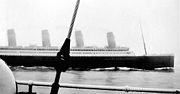 In August 1919 Olympic returned to Belfast for restoration to civilian service. Her interior was modernized and her boilers were converted to burn oil rather than coal. Oil was more expensive than coal, but it reduced the refuelling time from days to hours, and allowed the engine room personnel to be reduced from 350 to 60 people. During the conversion work and drydocking, a dent with a crack at the centre was discovered below her waterline which was later concluded to have been caused by a torpedo that had failed to detonate.
Olympic emerged from her refit with an increased tonnage of 46,439, allowing her to retain her claim to the title of largest British built liner afloat, although the Cunard Line's Aquitania
was slightly longer. In 1920 she returned to passenger service, on one voyage that year carrying 2,403 passengers. She was joined by two former German liners, Majestic
and Homeric, for an express service from 1922, operating successfully until the Great Depression
reduced demand after 1930.
At the turn of 1927-28, Olympic was converted to carry tourist third cabin passengers as well as first, second and third class. Tourist third cabin was an attempt to attract travellers who desired comfort without the accompanying high ticket price. New public rooms were constructed for this class, although tourist third cabin and second class would merge to become 'tourist' by late 1931.
One year later, Olympic's first class cabins were again improved by adding more bathrooms, a dance floor was fitted in the enlarged first class dining saloon, and a number of new suites with private facilities were installed forward on B-deck. More improvements would follow in a later refit, but 1929 saw Olympic' s best average passenger lists since 1925.
One of the attractions of the Olympic was the fact that it was nearly identical to the Titanic, and many passengers sailed on the Olympic as a way of vicariously experiencing the voyage of the Olympic' s ill-fated sister ship.
At the end of 1932, with passenger traffic in decline, Olympic went for an overhaul and refit that took four months. She returned to service in March 1933 described by her owners as "looking like new." Her engines were performing at their best and she repeatedly recorded speeds in excess of 23 knots, despite averaging less than that in regular transatlantic service. Passenger capacities were given as 618 first class, 447 tourist class and only 382 third class after the decline of the immigrant trade. 1933 was Olympic' s worst year of business - carrying under 10,000 passengers in total.
In 1934, Olympic again struck a ship. The approaches to New York were marked by lightships and Olympic, like other liners, had been known to pass close by these vessels. On 15 May 1934, Olympic, inbound in heavy fog, was homing in on the radio beacon of Nantucket Lightship LV-117
. Now under the command of Captain John Binks the ship failed to turn in time and sliced through the smaller vessel, which broke apart and sank. Four of the lightship's crew went down with the vessel and seven were rescued, of whom three died of their injuries - thus there were seven fatalities out of a crew of eleven. Three of the lightship's surviving crewmen were interviewed by the newsreels immediately after the accident.
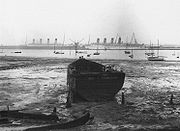 In 1934, the White Star Line
merged with the Cunard Line
at the instigation of the British government. This merger allowed funds to be granted for the completion of the future RMS Queen Mary
. Cunard White Star then started retiring its surplus tonnage, which included the majority of the old White Star liners. Olympic was withdrawn from service in 1935 and sold to Sir John Jarvis
for £100,000 to be partially demolished at Jarrow
, providing work for the region. In 1937, Olympic was towed to Inverkeithing
to T.W. Ward's yard for final demolition.
.
Olympic had the UK Official Number 131345 and used the Code Letters
HSRP.
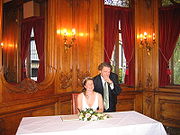 Olympic's fittings were auctioned off immediately before she was scrapped; some of her fittings, namely those of the First Class Lounge and part of the Aft Grand Staircase, can be found in the White Swan Hotel, in Alnwick
, Northumberland
, England. Some fittings and panelling also ended up at a Haltwhistle
paint factory. The rest of her fittings found homes in scattered places throughout Great Britain.
In 2000, Celebrity Cruises
purchased some of Olympic's original wooden panels and created the RMS Olympic Restaurant on board their newest cruise ship, Millennium
. According to Celebrity Cruise Line, this wood panelling once lined Olympic's à la carte restaurant.
In 2004, in the Titanic Museum
in Branson, Missouri
, USA, a first class cabin from the Olympic served as an example of the class's interior quarters.
The clock depicting 'Honour and Glory Crowning Time' from Olympic's grand staircase is on display at the Southampton
Maritime Museum
.
There is also a private home in the town of Southport
, UK, that is fitted with the interiors from the Olympic.
Royal Mail Ship
Royal Mail Ship , usually seen in its abbreviated form RMS, a designation which dates back to 1840, is the ship prefix used for seagoing vessels that carry mail under contract by Royal Mail...
Olympic was the lead ship of the Olympic-class
Olympic class ocean liner
The Olympic-class ocean liners were a trio of ocean liners built by the Harland & Wolff shipyard for the White Star Line in the early 20th century...
ocean liner
Ocean liner
An ocean liner is a ship designed to transport people from one seaport to another along regular long-distance maritime routes according to a schedule. Liners may also carry cargo or mail, and may sometimes be used for other purposes .Cargo vessels running to a schedule are sometimes referred to as...
s built for the White Star Line
White Star Line
The Oceanic Steam Navigation Company or White Star Line of Boston Packets, more commonly known as the White Star Line, was a prominent British shipping company, today most famous for its ill-fated vessel, the RMS Titanic, and the World War I loss of Titanics sister ship Britannic...
, which also included Titanic and Britannic
HMHS Britannic
HMHS Britannic was the third and largest of the White Star Line. She was the sister ship of and , and was intended to enter service as a transatlantic passenger liner. She was launched just before the start of the First World War and was laid up at her builders in Belfast for many months before...
. In April 1908, during finalising of the ambitious design,the Olympic Games had been held in London, England and this gave natural impetus to the choice of name for the new ship, conveniently following a long White Star Line tradition of choosing names with an 'ic' ending. Unlike her ill-fated younger sisters, Olympic served a long and illustrious career (1911 to 1935), including service as a troopship during World War I, earning the nickname "Old Reliable." For a short time she was the largest ocean liner in the world.
History
J. Bruce IsmayJ. Bruce Ismay
Joseph Bruce Ismay was an English businessman who served as chairman and managing director of the White Star Line of steamships. He came to international attention as the highest-ranking White Star official among the 706 survivors Joseph Bruce Ismay (12 December 1862 – 17 October 1937) was...
, the chairman of White Star Line
White Star Line
The Oceanic Steam Navigation Company or White Star Line of Boston Packets, more commonly known as the White Star Line, was a prominent British shipping company, today most famous for its ill-fated vessel, the RMS Titanic, and the World War I loss of Titanics sister ship Britannic...
, and William Pirrie
William Pirrie, 1st Viscount Pirrie
William James Pirrie, 1st Viscount Pirrie, KP, PC was a leading Irish shipbuilder and businessman. He was chairman of Harland and Wolff, shipbuilders, between 1895 and 1924, and also served as Lord Mayor of Belfast between 1896 and 1898...
, the chairman of Harland and Wolff
Harland and Wolff
Harland and Wolff Heavy Industries is a Northern Irish heavy industrial company, specialising in shipbuilding and offshore construction, located in Belfast, Northern Ireland....
shipyard
Shipyard
Shipyards and dockyards are places which repair and build ships. These can be yachts, military vessels, cruise liners or other cargo or passenger ships. Dockyards are sometimes more associated with maintenance and basing activities than shipyards, which are sometimes associated more with initial...
, intended the Olympic-class ships to surpass rival Cunard's
Cunard Line
Cunard Line is a British-American owned shipping company based at Carnival House in Southampton, England and operated by Carnival UK. It has been a leading operator of passenger ships on the North Atlantic for over a century...
largest ships, Lusitania
RMS Lusitania
RMS Lusitania was a British ocean liner designed by Leonard Peskett and built by John Brown and Company of Clydebank, Scotland. The ship entered passenger service with the Cunard Line on 26 August 1907 and continued on the line's heavily-traveled passenger service between Liverpool, England and New...
and Mauretania
RMS Mauretania (1906)
RMS Mauretania was an ocean liner designed by Leonard Peskett and built by Swan, Hunter & Wigham Richardson at Wallsend, Tyne and Wear for the British Cunard Line, and launched on 20 September 1906. At the time, she was the largest and fastest ship in the world. Mauretania became a favourite among...
, in size and luxury. Construction of the Olympic began three months before Titanic to ease pressures on the shipyard. Several years would pass before Gigantic (renamed Britannic after Titanic
In order to accommodate the construction of the class, Harland and Wolff upgraded their facility in Belfast; the most dramatic change was the combining of three slipways into two larger ones. Olympic
Her maiden voyage commenced on 14 June 1911. Designer Thomas Andrews
Thomas Andrews (shipbuilder)
Thomas Andrews, Jr. was an Irish businessman and shipbuilder; managing director and head of the draughting department for the shipbuilding company Harland and Wolff in Belfast, Ireland. Andrews was the shipbuilder in charge of the plans for the ocean liner...
was present for the passage to New York and return, along with a number of engineers, as part of Harland and Wolff's "Guarantee Group" to spot areas for improvement. Olympic had a cleaner, sleeker look than other ships of the day: rather than fitting her with bulky exterior air vents, Harland and Wolff used smaller air vents with electric fans, with a "dummy" fourth funnel used for additional ventilation. For the powerplant Harland and Wolff employed a combination of reciprocating engines with a centre low-pressure turbine, as opposed to the steam turbines used on Cunard's Lusitania and Mauretania. White Star claimed the Olympic class's engine set-up to be more economical than expansion engines or turbines alone. Olympic consumed 650 tons of coal per twenty four hours with an average speed of 21.7 knots on her maiden voyage, compared to 1000 tons of coal per twenty four hours for both the Lusitania and Mauretania.
Hawke collision Olympic
HMS Hawke (1891)
HMS Hawke, launched in 1891, was the sixth British warship to be named Hawke. She was an Edgar-class protected cruiser.-Service:...
off the Isle of Wight
Isle of Wight
The Isle of Wight is a county and the largest island of England, located in the English Channel, on average about 2–4 miles off the south coast of the county of Hampshire, separated from the mainland by a strait called the Solent...
. Although the incident resulted in the flooding of two of her compartments and a twisted propeller shaft, Olympic was able to return to Southampton
Southampton
Southampton is the largest city in the county of Hampshire on the south coast of England, and is situated south-west of London and north-west of Portsmouth. Southampton is a major port and the closest city to the New Forest...
under her own power.
At the subsequent inquiry the Royal Navy
Royal Navy
The Royal Navy is the naval warfare service branch of the British Armed Forces. Founded in the 16th century, it is the oldest service branch and is known as the Senior Service...
blamed Olympic for the incident, alleging that her large displacement generated a suction that pulled Hawke into her side. In command during this incident was Captain Edward Smith, who was lost at sea a year later onboard Titanic. One crew member, Violet Jessop
Violet Jessop
Violet Constance Jessop was an ocean liner stewardess and nurse who achieved fame by surviving the disastrous sinkings of sister ships RMS Titanic and HMHS Britannic in 1912 and 1916 respectively...
, survived not only the collision with the Hawke but also the later sinking of Titanic and the 1916 sinking of Britannic
HMHS Britannic
HMHS Britannic was the third and largest of the White Star Line. She was the sister ship of and , and was intended to enter service as a transatlantic passenger liner. She was launched just before the start of the First World War and was laid up at her builders in Belfast for many months before...
, the third ship of the class.
Titanic disaster On 14 April 1912, Olympic, now under the command of Herbert James Haddock, received the distress call from her sister Titanic, headed for rescue. But when about 100 miles away from Titanic's last known position, received a message from Cunard Liner RMS Carpathia
RMS Carpathia
RMS Carpathia was a Cunard Line transatlantic passenger steamship built by Swan Hunter & Wigham Richardson. Carpathia made her maiden voyage in 1903 and became famous for rescuing the survivors of after the latter ship hit an iceberg and sank on 15 April 1912...
, the message reads:
1912 "mutiny"
Olympic, like Titanic, did not carry enough lifeboats for everyone on board, and was hurriedly equipped with additional, second-hand collapsible lifeboats following her return to England. Towards the end of April 1912, as she was about to sail from Southampton to New York, the ship's firemen went on strike because of fears that the ship's new collapsible lifeboats were not seaworthy. The 40 collapsible lifeboats were secondhand, having been transferred from troopships, and many were rotten and could not open. The men instead sent a request to the Southampton manager of the White Star Line that the collapsible boats be replaced by wooden lifeboats; the manager replied that this was impossible and that the collapsible boats had been passed as seaworthy by a Board of TradeBoard of Trade
The Board of Trade is a committee of the Privy Council of the United Kingdom, originating as a committee of inquiry in the 17th century and evolving gradually into a government department with a diverse range of functions...
inspector. The men were not satisfied and ceased work.
On 25 April a deputation of strikers witnessed a test of four of the collapsible boats. Only one was unseaworthy and they said that they were prepared to recommend the men return to work if it was replaced. These terms were accepted. However, the deputation said that they would not sail aboard the Olympic unless the strikebreakers were removed, a condition which the company refused to accept, saying that they would rather abandon the sailing than dismiss loyal men.
All 54 strikers were arrested on a charge of mutiny when they went ashore. On 4 May 1912 Portsmouth magistrates found the charges against the mutineers were proven, but discharged them without imprisonment or fine due to the circumstances of the case. Most of the strikers returned to work and the Olympic sailed on 15 May.
Refit
On 9 October 1912 White Star withdrew Olympic from service and returned her to her builders at Belfast to be refitted to incorporate lessons learned from the Titanic disaster. A complement of 64 wooden lifeboats were installed along the boat deck, stacked two high. In addition, an inner watertight skin was constructed in the boiler and engine rooms and some of the watertight bulkheads were extended up to B-deck. At the same time, alterations and additions to her passenger cabins were carried out on B Deck which necessitated deleting her B Deck promenades - one of the few features that separated her from her sister ship. With these changes, Olympics gross tonnage rose to 46,359 tons, 31 tons larger than TitanicIn 1913, Olympic returned to service and briefly regained the title of largest ocean liner in the world, until SS Imperator
SS Imperator
SS Imperator was an ocean liner built for the Hamburg Amerikanische Packetfahrt Actien Gesellschaft launched in 1912. She was the first of a trio of successively larger Hamburg America ships that included and built by the line for transatlantic passenger service...
entered passenger service in June 1913.
World War I
In World War IWorld War I
World War I , which was predominantly called the World War or the Great War from its occurrence until 1939, and the First World War or World War I thereafter, was a major war centred in Europe that began on 28 July 1914 and lasted until 11 November 1918...
, Olympic initially remained in commercial service under Captain Herbert James Haddock. She sailed from New York on 20 October 1914 for Britain, though carrying very few passengers, as Germany had announced that her U-boats would sink the Olympic on sight and most of the passengers had cancelled.
Audacious incident
On the sixth day of her voyage, the Royal Navy alerted Haddock that four U-boats were pursuing his ship and ordered him to head north for Glasgow instead of continuing into the English Channel. On 27 October, as the Olympic passed near Lough SwillyLough Swilly
Lough Swilly in Ireland is a glacial fjord or sea inlet lying between the western side of the Inishowen Peninsula and the Fanad Peninsula, in County Donegal. Along with Carlingford Lough and Killary Harbour it is one of three known glacial fjords in Ireland....
, she received distress signals from the battleship HMS Audacious
HMS Audacious (1912)
HMS Audacious was a King George V-class battleship of the Royal Navy. The vessel did not see any combat in the First World War, being sunk by a German naval mine off the northern coast of Donegal, Ireland in 1914.- Design :...
, which had struck a mine
Naval mine
A naval mine is a self-contained explosive device placed in water to destroy surface ships or submarines. Unlike depth charges, mines are deposited and left to wait until they are triggered by the approach of, or contact with, an enemy vessel...
off Tory Island
Tory Island
Toraigh is an inhabited island 14.5 km off the northwest coast of County Donegal, Ireland. It is also known in Irish as Oileán Thoraigh, Oileán Thoraí or Oileán Thúr Rí.-Language:The main spoken language on the island is Irish, but English is also understood...
and was taking on water.
The Olympic took off 250 of the Audacious
HMS Liverpool (1909)
HMS Liverpool was a 4,800 ton Town-class light cruiser of the British Royal Navy commissioned in 1909. Named for the port city of Liverpool, the cruiser served continuously in home waters subordinated to the Home Fleet from 1909 through the initial stages of the First World War.During the war,...
Admiral Sir John Jellicoe
John Jellicoe, 1st Earl Jellicoe
Admiral of the Fleet John Rushworth Jellicoe, 1st Earl Jellicoe, GCB, OM, GCVO was a British Royal Navy admiral who commanded the Grand Fleet at the Battle of Jutland in World War I...
, Commander of the Home Fleet, was anxious to suppress the news of the sinking of Audacious, for fear of the demoralizing effect it could have on the British public, so ordered Olympic to be held in custody at Lough Swilly. No communications were permitted and passengers were not allowed to leave the ship. The only people departing her were the crew of the Audacious and Chief Surgeon John Beaumont, who was transferring to RMS Celtic
RMS Celtic (1901)
RMS Celtic was an ocean liner owned by the White Star Line. The first ship larger than the in gross tonnage, Celtic was the first of a quartet of ships over 20,000 tons, dubbed The Big Four....
. Steel tycoon Charles M. Schwab
Charles M. Schwab
Charles Michael Schwab was an American steel magnate. Under his leadership, Bethlehem Steel became the second largest steel maker in the United States, and one of the most important heavy manufacturers in the world....
, who was travelling aboard the liner, sent word to Jellicoe that he had urgent business in London with the Admiralty, and Jellicoe agreed to release Schwab if he remained silent about the fate of Audacious. Finally, on 2 November, Olympic was allowed to go to Belfast where the passengers disembarked.
Naval service
Following OlympicAdmiralty
The Admiralty was formerly the authority in the Kingdom of England, and later in the United Kingdom, responsible for the command of the Royal Navy...
to be used as a fast troop transport. Stripped of her peacetime fittings, and armed with 12-pounders and 4.7-inch guns, the newly-designated HMT (His Majesty's Transport) 2810 left Liverpool on 24 September 1915, carrying soldiers to Mudros, Greece for the Gallipoli
Gallipoli
The Gallipoli peninsula is located in Turkish Thrace , the European part of Turkey, with the Aegean Sea to the west and the Dardanelles straits to the east. Gallipoli derives its name from the Greek "Καλλίπολις" , meaning "Beautiful City"...
campaign. On 1 October she sighted lifeboats from the French ship Provincia which had been sunk by a U-boat that morning off Cape Matapan
Cape Matapan
Cape Tainaron , also known as Cape Matapan , is situated at the end of the Mani, Laconia, Greece. Cape Matapan is the southernmost point of mainland Greece. It separates the Messenian Gulf in the west from the Laconian Gulf in the east.-History:...
and picked up 34 survivors.
From 1916 to 1917, Olympic was chartered by the Canadian Government to transport troops from Halifax, Nova Scotia
Nova Scotia
Nova Scotia is one of Canada's three Maritime provinces and is the most populous province in Atlantic Canada. The name of the province is Latin for "New Scotland," but "Nova Scotia" is the recognized, English-language name of the province. The provincial capital is Halifax. Nova Scotia is the...
to Britain. In 1917 she gained 6-inch guns and was painted with a "dazzle"
Dazzle camouflage
Dazzle camouflage, also known as Razzle Dazzle or Dazzle painting, was a camouflage paint scheme used on ships, extensively during World War I and to a lesser extent in World War II...
camouflage scheme to make it more difficult for observers to estimate her speed and heading. Her many visits to Halifax Harbour
Halifax Harbour
Halifax Harbour is a large natural harbour on the Atlantic coast of Nova Scotia, Canada, located in the Halifax Regional Municipality.-Harbour description:The harbour is called Jipugtug by the Mi'kmaq first nation, anglisized as Chebucto...
carrying Canadian troops safely overseas, and back home after the war, made her a favourite symbol in the City of Halifax
City of Halifax
Halifax is a city in Canada, which was the capital of the province of Nova Scotia and shire town of Halifax County. It was the largest city in Atlantic Canada until it was amalgamated into Halifax Regional Municipality in 1996...
. Noted Group of Seven
Group of Seven
Group of Seven can refer to:*G7 - the "Group of seven" industrially advanced nations .*Group of Seven - a group of Canadian landscape artists....
artist Arthur Lismer
Arthur Lismer
Arthur Lismer, CC was an English-born Canadian painter and member of the Group of Seven.-Early life:At age 13 he apprenticed at a photo-engraving company. He was awarded a scholarship, and used this time to take evening classes at the Sheffield School of Arts from 1898 until 1905...
made several paintings of her in Halifax. A large dance hall, "Olympic Gardens" was also named in her honour. After the United States declared war on Germany in 1917, Olympic also transported thousands of U.S. troops to Britain.
Sinking of U-103
In the early hours of 12 May 1918, while en route for France with US troops under the command of Captain Bertram Fox Hayes, Olympic sighted a surfaced U-boat 500 m (1,640.4 ft) ahead. Her gunners opened fire at once, and she turned to ram the submarine, which immediately crash dived to 30 m (98.4 ft) and turned to a parallel course. Almost immediately afterwards Olympic struck the submarine just aft of her conning tower and her port propeller sliced through U-103Unterseeboot 103 (1917)
SM U-103 was an Imperial Germany Navy Type Mittel U U-boat during the First World War. U-103 was built on AG Weser in Bremen, launched on 9 June 1917 and commissioned 15 July 1917...
's pressure hull. The crew of U-103 blew her ballast tanks, scuttled and abandoned the submarine. This is the only known incident in World War I in which a merchant vessel sank an enemy warship. Olympic returned to Southampton with at least two hull plates dented and her prow twisted to one side, but not breached.
Olympic did not stop to pick up survivors, but continued on to Cherbourg. The USS Davis
USS Davis (DD-65)
USS Davis was a Sampson-class destroyer in the United States Navy during World War I. She was the second Navy ship named for Rear Admiral Charles Henry Davis . She served with the United States Coast Guard as '....
sighted a distress flare and picked up 31 survivors from U-103. It was discovered that U-103 had been preparing to torpedo the Olympic when she was sighted, but the crew could not flood the two stern torpedo tubes.
During the war, Olympic is reported to have carried up to 201,000 troops and other personnel, burning 347,000 tons of coal and travelling about 184,000 miles. Her impressive World War I service earned her the nickname Old Reliable.
Post-war
Olympic emerged from her refit with an increased tonnage of 46,439, allowing her to retain her claim to the title of largest British built liner afloat, although the Cunard Line's Aquitania
RMS Aquitania
RMS Aquitania was a Cunard Line ocean liner designed by Leonard Peskett and built by John Brown & Company in Clydebank, Scotland. She was launched on 21 April 1913 and sailed on her maiden voyage to New York on 30 May 1914...
was slightly longer. In 1920 she returned to passenger service, on one voyage that year carrying 2,403 passengers. She was joined by two former German liners, Majestic
RMS Majestic (1914)
RMS Majestic, launched in 1914 as SS Bismarck, was, at 56,551 gross tonnage, the largest ship in the world until the completion of the in 1935. Originally slated to be the third and largest member of German HAPAG Line's trio of transatlantic liners, her completion was delayed by World War I...
and Homeric, for an express service from 1922, operating successfully until the Great Depression
Great Depression
The Great Depression was a severe worldwide economic depression in the decade preceding World War II. The timing of the Great Depression varied across nations, but in most countries it started in about 1929 and lasted until the late 1930s or early 1940s...
reduced demand after 1930.
At the turn of 1927-28, Olympic was converted to carry tourist third cabin passengers as well as first, second and third class. Tourist third cabin was an attempt to attract travellers who desired comfort without the accompanying high ticket price. New public rooms were constructed for this class, although tourist third cabin and second class would merge to become 'tourist' by late 1931.
One year later, Olympic's first class cabins were again improved by adding more bathrooms, a dance floor was fitted in the enlarged first class dining saloon, and a number of new suites with private facilities were installed forward on B-deck. More improvements would follow in a later refit, but 1929 saw Olympic
One of the attractions of the Olympic was the fact that it was nearly identical to the Titanic, and many passengers sailed on the Olympic as a way of vicariously experiencing the voyage of the Olympic
At the end of 1932, with passenger traffic in decline, Olympic went for an overhaul and refit that took four months. She returned to service in March 1933 described by her owners as "looking like new." Her engines were performing at their best and she repeatedly recorded speeds in excess of 23 knots, despite averaging less than that in regular transatlantic service. Passenger capacities were given as 618 first class, 447 tourist class and only 382 third class after the decline of the immigrant trade. 1933 was Olympic
In 1934, Olympic again struck a ship. The approaches to New York were marked by lightships and Olympic, like other liners, had been known to pass close by these vessels. On 15 May 1934, Olympic, inbound in heavy fog, was homing in on the radio beacon of Nantucket Lightship LV-117
United States lightship LV-117
The Nantucket Lightship LV-117 was a lightvessel of the United States Lighthouse Service, operating off of Nantucket Shoals. She was operated for only three years, from 1931 to 1934, before she was sunk in a collision with the RMS Olympic, the sister-ship of the RMS Titanic. Seven of the eleven...
. Now under the command of Captain John Binks the ship failed to turn in time and sliced through the smaller vessel, which broke apart and sank. Four of the lightship's crew went down with the vessel and seven were rescued, of whom three died of their injuries - thus there were seven fatalities out of a crew of eleven. Three of the lightship's surviving crewmen were interviewed by the newsreels immediately after the accident.
Retirement
White Star Line
The Oceanic Steam Navigation Company or White Star Line of Boston Packets, more commonly known as the White Star Line, was a prominent British shipping company, today most famous for its ill-fated vessel, the RMS Titanic, and the World War I loss of Titanics sister ship Britannic...
merged with the Cunard Line
Cunard Line
Cunard Line is a British-American owned shipping company based at Carnival House in Southampton, England and operated by Carnival UK. It has been a leading operator of passenger ships on the North Atlantic for over a century...
at the instigation of the British government. This merger allowed funds to be granted for the completion of the future RMS Queen Mary
RMS Queen Mary
RMS Queen Mary is a retired ocean liner that sailed primarily in the North Atlantic Ocean from 1936 to 1967 for the Cunard Line...
. Cunard White Star then started retiring its surplus tonnage, which included the majority of the old White Star liners. Olympic was withdrawn from service in 1935 and sold to Sir John Jarvis
Sir John Jarvis, 1st Baronet
Sir John Jarvis, 1st Baronet was a British industrialist and philanthropist who became a Conservative Party politician...
for £100,000 to be partially demolished at Jarrow
Jarrow
Jarrow is a town in Tyne and Wear, England, located on the River Tyne, with a population of 27,526. From the middle of the 19th century until 1935, Jarrow was a centre for shipbuilding, and was the starting point of the Jarrow March against unemployment in 1936.-Foundation:The Angles re-occupied...
, providing work for the region. In 1937, Olympic was towed to Inverkeithing
Inverkeithing
Inverkeithing is a town and a royal burgh in Fife, Scotland, located on the Firth of Forth. According to population estimates , the town has a population of 5,265. The port town was given burgh status by King David I of Scotland in the 12th century and is situated about 9 miles north from...
to T.W. Ward's yard for final demolition.
Official number and code letters
Official Numbers were a forerunner to IMO NumbersIMO ship identification number
The IMO ship identification number is made of the three letters "IMO" followed by the seven-digit number assigned to all ships by IHS Fairplay when constructed. This is a unique seven digit number that is assigned to propelled, sea-going merchant ships of 100 GT and above...
.
Olympic had the UK Official Number 131345 and used the Code Letters
Code letters
Code letters were a method of identifying ships before the introduction of modern navigation aids. Later, with the introduction of radio, code letters were also used as radio callsigns.-History:...
HSRP.
Olympic today
Alnwick
Alnwick is a small market town in north Northumberland, England. The town's population was just over 8000 at the time of the 2001 census and Alnwick's district population was 31,029....
, Northumberland
Northumberland
Northumberland is the northernmost ceremonial county and a unitary district in North East England. For Eurostat purposes Northumberland is a NUTS 3 region and is one of three boroughs or unitary districts that comprise the "Northumberland and Tyne and Wear" NUTS 2 region...
, England. Some fittings and panelling also ended up at a Haltwhistle
Haltwhistle
Haltwhistle is a small town and civil parish in Northumberland, England, situated east of Brampton, near Hadrian's Wall, and the villages of Plenmeller, Rowfoot and Melkridge...
paint factory. The rest of her fittings found homes in scattered places throughout Great Britain.
In 2000, Celebrity Cruises
Celebrity Cruises
Celebrity Cruises is a cruise line founded in 1988 by the Greek Chandris Group. In 1997, Celebrity Cruises Ltd. merged with Royal Caribbean International to become Royal Caribbean Cruises Ltd., which operates Celebrity, Royal Caribbean International, Azamara Club Cruises, Pullmantur Cruises and CDF...
purchased some of Olympic's original wooden panels and created the RMS Olympic Restaurant on board their newest cruise ship, Millennium
Millennium (ship)
GTS Millennium is the flagship of the Millennium Class of cruise ships, operated by the Celebrity Cruises line. Her sister ships are Constellation, Infinity, and Summit.She was built at Chantiers de l'Atlantique in St. Nazaire, France...
. According to Celebrity Cruise Line, this wood panelling once lined Olympic's à la carte restaurant.
In 2004, in the Titanic Museum
Titanic Museum (Branson, Missouri)
The Titanic Museum Attraction is a permanent two-story museum shaped like the RMS Titanic itself. It is located on Country Highway 76, Branson, Missouri and built half-scale to the original...
in Branson, Missouri
Branson, Missouri
Branson is a city in Taney County in the U.S. state of Missouri. It was named after Reuben Branson, postmaster and operator of a general store in the area in the 1880s....
, USA, a first class cabin from the Olympic served as an example of the class's interior quarters.
The clock depicting 'Honour and Glory Crowning Time' from Olympic's grand staircase is on display at the Southampton
Southampton
Southampton is the largest city in the county of Hampshire on the south coast of England, and is situated south-west of London and north-west of Portsmouth. Southampton is a major port and the closest city to the New Forest...
Maritime Museum
Maritime museum
A maritime museum is a museum specializing in the display of objects relating to ships and travel on large bodies of water...
.
There is also a private home in the town of Southport
Southport
Southport is a seaside town in the Metropolitan Borough of Sefton in Merseyside, England. During the 2001 census Southport was recorded as having a population of 90,336, making it the eleventh most populous settlement in North West England...
, UK, that is fitted with the interiors from the Olympic.
Further reading
- Chirnside, Mark, RMS Olympic: Titanic's Sister.
- Chirnside, Mark, The Olympic-Class Ships.
- Layton, J. Kent, Atlantic Liners: A Trio of Trios
External links
- Titanic Research & Modelling Association, for Olympic-Class Research
- Olympic Home at Atlantic Liners
- RMS Olympic; Old Reliable
- Encyclopedia Titanica: RMS Olympic
- Olympic on Titanic-Titanic.com
- The RMS Olympic Restaurant on the Celebrity Millennium (Virtual Tour of ship's Plaza Deck shows panoramic view).
- Olympic's Fittings at White Swan Hotel, Alnwick, England
- Maritimequest RMS Olympic Photo Gallery
- Lostliners: RMS Olympic
- White Star Line RMS Olympic the Ship Magnificent
- Lego RMS Olympic
- White Star Line History Website, Olympics owners.