
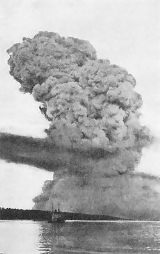
The
Halifax Explosion occurred on Thursday, December 6, 1917, when the city of
HalifaxThe City of Halifax was the capital of the province of Nova Scotia and shire town of Halifax County, and was the largest city in Atlantic Canada until it was amalgamated into Halifax Regional Municipality in 1996...
,
Nova ScotiaNova Scotia is a Canadian province located on Canada's southeastern coast. It is the most populous province in Atlantic Canada. Its capital, Halifax, is a major economic centre of the region. Nova Scotia is the second-smallest province in Canada with an area of...
,
CanadaCanada is a country occupying most of northern North America, extending from the Atlantic Ocean in the east to the Pacific Ocean in the west and northward into the Arctic Ocean...
, was devastated by the huge detonation of the
SS Mont-BlancThe SS Mont-Blanc was a French freighter which exploded while carrying ammunition in Halifax Harbour on December 6, 1917 causing the Halifax Explosion which killed 2000 people. The explosion was caused by a collision with the Norwegian ship SS Imo. Mont-Blanc was built in Middlesbrough, England in...
, a
FrenchFrance , officially the French Republic , is a country located in Western Europe, with several overseas islands and territories located on other continents. Metropolitan France extends from the Mediterranean Sea to the English Channel and the North Sea, and from the Rhine to the Atlantic Ocean...
cargo shipA cargo ship or freighter is any sort of ship or vessel that carries cargo, goods, and materials from one port to another. Thousands of cargo carriers ply the world's seas and oceans each year; they handle the bulk of international trade...
, fully loaded with wartime explosives, which accidentally collided with the Norwegian SS
Imo in "The Narrows" section of the
Halifax HarbourHalifax Harbour is a large natural harbour on the Atlantic coast of Nova Scotia, Canada, located in the Halifax Regional Municipality.-Harbour description:The harbour is called Jipugtug by the Mi'kmaq first nation, anglisized as Chebucto...
. About 2,000 people were killed by debris, fires, or collapsed buildings and it is estimated that over 9,000 people were injured. This is still the
world's largest man-made accidental explosion.
At 8:40 in the morning, the SS
Mont-Blanc, chartered by the French government to carry munitions to Europe, collided with the unloaded Norwegian ship
Imo, chartered by the Commission for Relief in Belgium to carry relief supplies.
Mont-Blanc caught fire ten minutes after the collision and exploded about twenty-five minutes later (at 9:04:35 AM). All buildings and structures covering nearly along the adjacent shore were obliterated, including those in the neighbouring communities of
RichmondRichmond is a Canadian urban neighbourhood comprising part of the North End of the Halifax Peninsula in Nova Scotia's Halifax Regional Municipality....
and
DartmouthDartmouth , founded in 1750, is a community and planning area of the Halifax Regional Municipality, a provincially designated Metropolitan Area, and a former city in the Canadian province of Nova Scotia...
. The explosion caused a
tsunamiA is a series of water waves that is caused by the displacement of a large volume of a body of water, such as an ocean. The original Japanese term literally translates as "harbor wave." Tsunamis are a frequent occurrence in Japan; approximately 195 events have been recorded...
in the harbour and a pressure wave of air that snapped
treeA tree is a perennial woody plant. It is most often defined as a woody plant that has many secondary branches supported clear of the ground on a single main stem or trunk with clear apical dominance. A minimum height specification at maturity is cited by some authors, varying from 3 m to...
s, bent iron rails, demolished buildings, grounded vessels, and carried fragments of the
Mont-Blanc for kilometres.
Halifax in wartime
During
World War IWorld War I , also known as the First World War, the Great War, and the War to End All Wars, was a global military conflict which involved most of the world's great powers, assembled in two opposing alliances: the Triple Entente and the Triple Alliance...
, Halifax became a major international
port||-||-||-||-||-||-||-||-|}A port is a facility for receiving ships and/or transferring cargo. It is usually found at the edge of an ocean, sea, river, or lake. The best ports have deep water in channels or berths, and protection from the wind and waves...
and
navalA navy is the branch of a nation's armed forces principally designated for naval warfare and amphibious warfare; namely, lake- or ocean-borne combat operations and related functions...
facility. Halifax has one of the world's largest natural harbours that is ice free and was well connected through direct railway connections to other Canadian and North American cities. The harbour became a major shipment point for war supplies, troop ships to
EuropeEurope is, by convention, one of the world's seven continents. Comprising the westernmost peninsula of Eurasia, Europe is generally divided from Asia to its east by the water divide of the Ural Mountains, the Ural River, the Caspian Sea, the Caucasus Mountains , and the Black Sea to the southeast...
from
CanadaCanada is a country occupying most of northern North America, extending from the Atlantic Ocean in the east to the Pacific Ocean in the west and northward into the Arctic Ocean...
and the
United StatesThe United States of America is a federal constitutional republic comprising fifty states and a federal district...
and
hospital shipA hospital ship is a ship designated for primary function as a medical treatment facility or hospital; most are operated by the military forces or navies of various countries around the world, as they are intended to be used in or near war zones...
s returning the wounded. All neutral ships bound for North America had to report to Halifax for inspection. After German
submarineA submarine is a watercraft capable of independent operation below the surface of the water. It differs from a submersible, which has only limited underwater capability...
attacks began in 1916, Halifax's harbour assumed an even larger role as an assembly point for merchant ships awaiting naval escort in
convoyA convoy is a group of vehicles traveling together for mutual support and protection. Often, a convoy is organized with armed defensive support, though it may also be used in a non-military sense, for example when driving through remote areas.-Age of Sail:Naval convoys have been used for hundreds...
s. A large army garrison protected the city with forts, gun batteries, and
anti-submarine netAn anti-submarine net is a type of anti-submarine weapon. It is a strong metal-mesh net put underwater to try to keep enemy submarines and torpedoes and frogmen out of defended naval areas. They have often played major roles in naval actions....
s. These factors drove a major
militaryA military is an organization authorized by its nation to use force, usually including use of weapons, in defending its country by combating actual or perceived threats. As an adjective the term "military" is also used to refer to any property or aspect of a military...
, industrial and residential expansion of the city.
Collision and fire
Two-way passage by vessels through the narrow, curved harbour passage (called "The Narrows" - connecting the Atlantic Ocean and outer harbour with the
Bedford BasinBedford Basin is a large enclosed bay, forming the northwestern end of Halifax Harbour on Canada's Atlantic coast.-Geography:Geographically, the basin is situated entirely within the Halifax Regional Municipality and is oriented northwest-southeast, measuring approximately 8 kilometres long and 5...
) was not restricted as to direction of travel, provided that vessels followed established collision avoidance regulations. Shortly after the nets were opened around 7:30 AM on December 6,
Imo attempted to depart through the
starboardStarboard is the nautical term that refers to the right side of a vessel as perceived by a person on board a vessel and facing the bow . The equivalent for the left-hand side is port. The starboard side of a vessel is indicated with a
green navigation light at...
channel. It met an oncoming ship, an American
tramp steamerA ship engaged in the tramp trade is one which does not have a fixed schedule or published ports of call. As opposed to freight liners, tramp ships trade on the spot market with no fixed schedule or itinerary/ports-of-call...
. According to nautical regulations, vessels pass on their port sides with both ships steering to starboard. The two vessels agreed to pass on their 'incorrect' (starboard) sides, with
Imo steering to
portPort is the nautical term that refers to the left side of a ship, as perceived by a person on board the ship and facing towards the bow . The port side of a vessel is indicated with a red navigation light at night.The term is also used on aircraft, spacecraft, and analogous...
(left). This was a convenience for the incoming ship, which was docking on the Halifax side of the harbour.
The two steamers passed harmlessly. By roughly 8:15 AM,
Imo was in the port channel as
Stella Maris, a tugboat towing two barges, evaded
Imo by remaining on the Halifax side of the harbour, passing the
Imo on her starboard side and keeping her in the port channel.
But as
Imo departed through the port channel, a second incoming vessel, the French steamer
Mont-Blanc was entering via the starboard channel. A series of whistle blows communicated from both vessels indicated their intent to remain on course—a collision course. Captain Le Medec eventually ordered
Mont-Blanc hard to port, sending the ship into the center channel. At the same time,
Imo reversed its engines to stop, but the
backward action of the propellersPropeller walk is the term for a propeller's tendency to rotate a boat as well as accelerating it forwards or backwards.A right-handed propeller will tend to push the stern of the boat to starboard.When in reverse gear, the effect will be much greater and opposite...
altered her course, bringing her to the center channel as well. The last minute evasive maneuvers by both vessels had sent them back onto a collision course.
At roughly 8:45 AM,
Imo's
prowthumb|right|295pxThe prow is the forward most part of a ship's bow that cuts through the water. It is often depicted in movies with a carved figurehead in the form of a mermaid, a woman in 19th-century dress or other similar figure. The prow is the part of the bow above the waterline...
struck
Mont-Blanc and became lodged in its starboard bow, sparking the
benzolBenzol may refer to:* Benzole* Benzene* British Benzol, which was one of the largest independent oil distributors in the UK. It went into administration on 16 August 2005...
and
picric acidPicric acid is the chemical compound formally called 2,4,6-trinitrophenol . This, a yellow crystalline solid, is one of the most acidic phenols. Like other highly nitrated compounds such as TNT, picric acid is an explosive...
.
Imo attempted to pull back and dislodge, which likely generated further sparks. By now the barrels of benzol stored on the
Mont-Blanc's deck were aflame.
As the
fireFire is the rapid oxidation of a combustible material releasing heat, light, and various reaction products such as carbon dioxide and water. If hot enough, the gases may become ionized to produce plasma. Depending on the substances alight, and any impurities outside, the color of the flame and the...
spread out of control,
Mont-Blanc's crew were unable to reach fire-fighting equipment and, aware of their volatile cargo, they quickly abandoned ship upon the captain's orders. Within 10 minutes, their two rowboats containing the 40-man crew reached safety on the Dartmouth side of the harbour as the burning ship continued to drift towards the Halifax shore. Any warnings shouted by the
French speakingFrench is a Romance language globally spoken by about 65 million people as a first language , by 50 million as a second language, and by about another 200 million people as an acquired foreign language, with significant speakers in 57 countries. Most native speakers of the language live in France,...
crew were not understood as they fled further inland away from the burning ship, as Halifax is located in a primarily
EnglishEnglish is a West Germanic language that developed in England during the Anglo-Saxon era. As a result of the military, economic, scientific, political, and cultural influence of the British Empire during the 18th, 19th, and early 20th centuries, and of the United States since the mid 20th century,...
speaking part of Canada.
Other ships came to aid the burning
Mont-Blanc. Efforts to
scuttleScuttle may refer to:*Scuttling, deliberately sinking a ship by allowing water in*Coal scuttle, a bucket-like container for coal*Shaving scuttle, a teapot-like container for hot water*Scuttle, a fictional character in Disney's The Little Mermaid...
the ship also failed as the
seacockA seacock is a valve on the hull of a boat that can be opened or closed. A seacock may either permit water to flow in to the boat, such as for cooling an engine or for a salt water faucet; or out of the boat, such as for a sink drain or a toilet....
s were seized shut. HMCS
Niobe and
HMS HighflyerHMS Highflyer was the lead ship of the Highflyer class cruiser which served with the Royal Navy. She was built at the yards of Fairfield Shipbuilding and Engineering Company, Govan, being laid down in June 1897, launched on 4 June 1898 and commissioned on 7 December 1899.-Pre-1914:Like her sisters...
sent crews, in steam launches, to assist.
Hundreds of onlookers gathered on the shores of the harbour, watching as the flaming
Mont-Blanc eventually drifted along Pier 6 on the
RichmondRichmond is a Canadian urban neighbourhood comprising part of the North End of the Halifax Peninsula in Nova Scotia's Halifax Regional Municipality....
side of the waterfront, spreading the fire onto land by igniting some munitions cargo stored on the pier. Fire Box 83 was quickly pulled and local shop owner Constant Upham began calling several other fire houses directly, while watching the scene from his store window. West Street (Station 2) housed the first motorized fire engine in Canada, a 1913
American LaFranceAmerican LaFrance is an emergency and vocational vehicle manufacturer, currently based in Summerville, South Carolina. Focusing primarily on emergency apparatus fire engines and fire aerial including ambulance and rescue vehicles.-History:...
combination pumping engine. Members of the
Halifax Fire DepartmentHalifax Regional Fire and Emergency is the fire and rescue service of the Halifax Regional Municipality in Nova Scotia Canada.Although established in 1996 when municipal amalgamation took place, the service traces its history to 1754 when the oldest fire department in Canada was established at...
aboard the
Patricia, and horse-drawn apparatus from Brunswick, Gottingen, and Quinpool Road stations rushed to the pier.
Explosion and aftermath
At 9:04:35 AM, the cargo of
Mont-Blanc exploded with more force than any man-made explosion before it, equivalent to roughly 3 kilotons of TNT. (Compare to atomic bomb
Little BoyLittle Boy was the codename of the atomic bomb dropped on Hiroshima on August 6, 1945 by the B-29 Superfortress Enola Gay, piloted by Colonel Paul Tibbets of the 393d Bombardment Squadron, Heavy, of the United States Army Air Forces. It was the first atomic bomb to be used as a weapon...
dropped on
HiroshimaThe atomic bombings of Hiroshima and Nagasaki were nuclear attacks near the end of World War II against the Empire of Japan by the United States at the executive order of U.S. President Harry S. Truman on August 6 and August 9, 1945, respectively...
, which had an estimated power of 15 kilotons
TNT equivalentTNT equivalent is a method of quantifying the energy released in explosions. The ton of TNT is used as a unit of energy, approximately equivalent to the energy released in the detonation of this amount of TNT....
.). The ship was instantly destroyed in the giant fireball that rose over into the air, forming a large
mushroom cloudA mushroom cloud is a distinctive pyrocumulus mushroom-shaped cloud of condensed water vapor or debris resulting from a very large explosion. They are most commonly associated with nuclear explosions, but any sufficiently large blast will produce the same sort of effect. They can be caused by...
. Shards of hot metal rained down across Halifax and Dartmouth. The force of the blast triggered a tsunami, which rose up as high as above the harbour's high-water mark on the Halifax side. It was caused by the rapid displacement of harbour water near the blast, followed by water rushing back in towards the shore. The effects were likely compounded by the narrow cross-section of the harbour. There was little information documented on this event as witnesses were generally stunned and injured as the wave washed ashore, though the wave contributed to the death toll, dragging many victims on the harbour front into the waters.
Imo was lifted up onto the Dartmouth shore by the tsunami. Captain Haakon From and most of the crew that were on the bridge of the
Imo and on its decks were killed by the tsunami. A black rain of unconsumed carbon from the
Mont-Blanc fell over the city for about 10 minutes after the blast, coating survivors and structural debris with soot.
Since the explosion occurred in the winter, the blast caused stoves, lamps and furnaces to tip or spill, spreading fires throughout the devastation, particularly in
Halifax's North EndThe North End of Halifax is a neighbourhood located in the urban core of Nova Scotia's Halifax Regional Municipality, occupying the northern part of the Halifax Peninsula.-Geography:...
, leaving entire streets on fire. Fuel reserves were high in preparation for the winter. Many people who had survived the blast were trapped in these fires. Problems were compounded as firemen from surrounding communities arrived and were unable to use their equipment, as hoses and hydrants were not standardized across communities or regions. However, the winds cooperated, and firemen, soldiers and other volunteers had most of the fires contained by evening.
Some of Halifax was destroyed, essentially leaving a radius around the blast site uninhabitable. Many people who had gathered around the ship either to help or watch were killed in the blast or were hit by the resulting tsunami. Others who had been watching from the windows of their homes and businesses were killed instantly or severely injured by flying glass as their windows shattered inwards.
Professor Howard Bronson of
Dalhousie UniversityDalhousie University is a university located in Halifax, Nova Scotia, Canada. As the largest post-secondary educational institution in the Maritime Provinces it offers a wide array of programs, including a medical program and the Dalhousie Law School. The chancellor is Mr. Fred Fountain; Dr...
later wrote that the disaster had damaged buildings and shattered windows as far away as
SackvilleLower Sackville is located in the Halifax Regional Municipality, Nova Scotia, Canada. It is part of the urban area of Halifax .First settled in August of 1749 by Captain John Gorham, acting on orders from Governor Edward Cornwallis to establish a military fort named Fort Sackville, Lower Sackville...
and
Windsor JunctionWindsor Junction is a Canadian suburban community in Nova Scotia's Halifax Regional Municipality. It is located 15.6 km north west of the HRM urban core, 3 km north of the Bedford Basin near the communities of Waverley, Fall River and Lower Sackville.-Railway History:The name of the...
, about away. Buildings shook and items fell from shelves as far away as
TruroTruro is a town in central Nova Scotia, Canada...
and
New GlasgowNew Glasgow is the largest town in Pictou County, Nova Scotia, Canada. It is situated on the banks of the East River, which flows into Pictou Harbour and the Northumberland Strait, and which was once a commercial trade route....
. The explosion was felt and heard in Charlottetown, Prince Edward Island, roughly north, and as far away as North
Cape BretonCape Breton Island is an island on the Atlantic coast of North America. It likely corresponds to the French word "Breton", referring to Brittany.Cape Breton Island is part of the province of Nova Scotia, Canada...
, east.
Fragments of
Mont-Blanc rained down all over the city. A portion of
Mont-Blanc's anchor shaft, weighing was thrown west of the blast on the far side of the
Northwest ArmThe Northwest Arm, originally named Sandwich River, is an inlet in eastern Canada off the Atlantic Ocean in Nova Scotia's Halifax Regional Municipality.-Geography:...
; It is now part of a monument at the corner of Spinnaker Dr. and Anchor Dr. A gun barrel landed in Dartmouth, over east, near
Albro LakeAlbro Lake is a neighbourhood in the north end of the community of Dartmouth in Nova Scotia's Halifax Regional Municipality.Albro Lake takes its name from the shallow freshwater lake of the same name. The lake was named after Samuel Albro , who first settled in the area in the 1740s with a group...
. Another piece of wreckage was driven into the wall of
St. Paul's ChurchSt. Paul's Church is an evangelical Anglican church in downtown Halifax Nova Scotia within the Diocese of Nova Scotia and Prince Edward Island of the Anglican Church of Canada...
, where it remains today.
The Royal Naval College of Canada building was destroyed, and several cadets and instructors maimed.
Comparative power of explosion
The Halifax Explosion was one of a series of massive ammunition explosions which followed the large-scale manufacture, transport and use of high explosives in the 20th century and resulting in a grim
list of large, artificial, non-nuclear explosions. An extensive comparison of 130 major explosions by a team of scientists and historians in 1994 concluded that, "Halifax Harbour remains unchallenged in overall magnitude as long as five criteria are considered together: number of casualties, force of blast, radius of devastation, quantity of explosive material, and total value of property destroyed."
The
RAF Fauld ExplosionThe RAF Fauld explosion was a military accident which occurred at 11:11am on Monday, 27 November 1944 at the RAF Fauld underground munitions storage depot...
in 1944 exceeded Halifax in sheer force, but was contained underground, limiting its destructive effects.
The
HeligolandHeligoland is a small German archipelago in the North Sea.Formerly Danish and British possessions, the islands are located in the Heligoland Bight in the southeastern corner of the North Sea...
demolition in 1947 produced more force but was a deliberate series of explosions on uninhabited islands, limiting range and human loss. Likewise, the military tests
Misty PictureMisty Picture was a test conducted on May 14, 1987 by the United States Defense Nuclear Agency involving the detonation of several thousand tons of conventional explosives to simulate the explosion of a small nuclear bomb.From the test report:MISTY PICTUREwas the fourth test in the MISTY CASTLE...
and
Minor ScaleA minor scale in music theory is a diatonic scale with a third scale degree at an interval of a minor third above the tonic. While this definition encompasses modes with the minor third, such as Dorian mode, the term may more usually refer only to the natural minor, harmonic minor, and melodic...
were larger explosions than Halifax, but as deliberate tests resulted in no loss of life or (unintended) damage.
However, both studies concluded that such large-scale explosions are difficult to measure and compare and even the largest non-nuclear explosions are less than one-quarter the power of the
atomic bombings of Hiroshima and NagasakiThe atomic bombings of Hiroshima and Nagasaki were nuclear attacks near the end of World War II against the Empire of Japan by the United States at the executive order of U.S. President Harry S. Truman on August 6 and August 9, 1945, respectively...
.
Rumoured second explosion
A rumour of a second explosion had started roughly an hour after the first. Despite the high number of disciplined rescue workers, many of whom were military personnel, and although there are no records of an order to evacuate, soldiers reportedly had begun to clear the area with fear that smoke rising from the naval
munitions magazineMagazine is the name for an item or place within which ammunition is stored. It is taken from the Arabic word "makahazin" meaning "warehouse"....
at Wellington Barracks was an impending second explosion. This site did store a large amount of explosive material and munitions, but the smoke/steam was a result of scattered coals being extinguished by personnel on site. Many rescue efforts were halted as masses of people fled to the high ground and open areas of
Citadel HillCitadel Hill is a glacial drumlin located on the Halifax Peninsula. It measures approximately 80 metres above sea level and affords a commanding view of the entrance to Halifax Harbour, as well as nearby George's Island and McNabs Island....
,
Point Pleasant ParkPoint Pleasant Park is a large, partially forested municipal park at the southern tip of Halifax peninsula. It once hosted several artillery batteries, and a well-preserved eighteenth century Martello tower can be found there...
and the Halifax Commons, under the order of uniformed men. Rescuers and victims alike were delayed until almost noon when the situation was cleared, although some rescue parties ignored the evacuation and kept working. In the chaos and confusion, fear of German attacks had become rampant, leaving many to believe that the initial blast had been deliberate, further fueling the fear of a second explosion.
Blizzard
The next day brought a blizzard that dropped of snow on the community. Those who remained trapped in rubble, the injured, or those who had not been found or tended to, were often left in the bitter cold, adding to the loss of life. Rescuers were forced to work through the storm, and many people who were left homeless found shelter wherever they could. Houses left standing did not have windows after the blast, leaving survivors to use tar paper, carpets and other available materials to seal their homes from the elements. The snow, however, did aid firemen in ensuring any remaining fires were extinguished. This was apparently the largest blizzard in that decade.
Human loss and destruction
While it is unknown exactly how many deaths resulted from the disaster, a common estimate is 2,000, with an official database totaling 1,950 names made available through Nova Scotia Archives and Records Management in the Book of Remembrance. As many as 1,600 died immediately in the blast, the tsunami, and collapse of buildings, with an additional 9,000 injured, 6,000 of them seriously. 1,630 homes were completely destroyed in the explosion and fires, with 12,000 more houses damaged. This disaster left roughly 6,000 people homeless and without shelter and 25,000 without adequate housing. The city's industrial sector was in large part gone, with many workers among the casualties and the dockyard was heavily damaged.
The explosion killed more Nova Scotian residents than
World War IWorld War I , also known as the First World War, the Great War, and the War to End All Wars, was a global military conflict which involved most of the world's great powers, assembled in two opposing alliances: the Triple Entente and the Triple Alliance...
itself. Detailed estimates showed that among those killed, 600 were under the age of 15, 166 were labourers, 134 were soldiers and sailors, 125 were craftsmen, and 39 were workers for the railway.
Many of the wounds inflicted by the blast were permanently debilitating, with many people partially blinded by flying glass. Thousands of people had stopped to watch the ship burning in the harbour, with many people watching from inside buildings, leaving them directly in the path of flying glass from shattered windows. Roughly 600 people suffered eye injuries, and 38 of those lost their sight permanently. The large number of eye injuries led to better understanding on the part of physicians, and with the recently formed
Canadian National Institute for the BlindCNIB is a volunteer agency and charitable organization dedicated to assisting Canadians who are blind or living with vision loss, and to provide information about vision health for all Canadians...
, they managed to greatly improve the treatment of damaged eyes. The significant advances in eye care as a result of this disaster are often compared to the huge increase in burn care knowledge after the
Cocoanut Grove nightclub fireThe Cocoanut Grove was a nightclub in Boston, Massachusetts, United States. On November 28, 1942, the fashionable nightclub burned in what remains the deadliest nightclub fire in United States history, killing 492 people and injuring hundreds more. It is also the second-worst single-building fire...
in Boston. Halifax became internationally known as a center for care for the blind, accounting for a large proportion of patients.
According to estimates, roughly $35 million Canadian dollars in damages resulted (in 1917 dollars; adjusted for inflation, this is about CAD$500 million in 2007 dollars).
Communities affected
While the city of Halifax its North End neighborhood of Richmond suffered the most damage from the explosion, several neighbouring communities and settlements were also affected by the blast.
Dartmouth
The
DartmouthDartmouth , founded in 1750, is a community and planning area of the Halifax Regional Municipality, a provincially designated Metropolitan Area, and a former city in the Canadian province of Nova Scotia...
side of the harbour was not as densely populated as Halifax and was separated from the blast by the width of the harbour, but still suffered heavy damage. Estimates are that almost 100 people died on the Dartmouth side. Windows were shattered and many buildings were damaged or destroyed, including the
Oland BreweryOland Brewery is a brewing company in Halifax, Nova Scotia, Canada, and a unit of Labatt Brewing Company, itself a unit of InBev.The Oland family, which formerly owned Oland Brewery, has been active in public life in Nova Scotia. Victor de Bedia Oland was lieutenant-governor of Nova Scotia from...
and parts of the Starr Manufacturing Company.
Nova Scotia HospitalThe Nova Scotia Hospital is a psychiatric hospital in Dartmouth, Nova Scotia. It is the province's largest mental health facility.Founded by the Hon...
was the only hospital on the Dartmouth side of the harbour and many of the victims were treated there.
Mi'kmaq settlement
The small
Mi'kmaqThe Míkmaq are a First Nations people, indigenous to northeastern New England, Canada's Atlantic Provinces, and the Gaspé Peninsula of Quebec. The nation has a population of about 40,000 of whom nearly 11,000 speak the Algonquian language Lnuísimk, more commonly known as "Micmac"...
settlement directly opposite Halifax, in
Tuft's CoveTufts Cove is a Canadian urban neighbourhood in the Dartmouth area of Nova Scotia's Halifax Regional Municipality. It is situated on the eastern shore of Halifax Harbour in the North End of Dartmouth....
(also known as Turtle Grove), was completely obliterated. Unfortunately, little information was recorded on the effects of the disaster on the
First NationsFirst Nations is a term of ethnicity that refers to the Aboriginal peoples in Canada, who are neither Inuit nor Métis. There are currently over 600 recognised First Nations governments or bands spread all across Canada, roughly half of which are in the provinces of Ontario and British Columbia...
community. The settlement is known to have dated back to the 1700s, and on November 6 was slated to be relocated as
reservationsIn Canada, an Indian reserve is specified by the Indian Act as a "tract of land, the legal title to which is vested in Her Majesty, that has been set apart by Her Majesty for the use and benefit of a band." The Act also specifies that land reserved for the use and benefit of a band which is not...
were established through
IndianFirst Nations is a term of ethnicity that refers to the Aboriginal peoples in Canada, who are neither Inuit nor Métis. There are currently over 600 recognised First Nations governments or bands spread all across Canada, roughly half of which are in the provinces of Ontario and British Columbia...
reserve status lobbying. Fewer than 20 families resided in this community, and had not begun their move before the collision and fire drew the attention of onlookers around the harbour. Records show that 9 bodies were recovered, and the settlement was abandoned in the wake of the disaster.
Africville
The
blackThe term black people usually refers to a racial group of humans with skin colors that range from light brown to nearly black. It also has been used to categorize a number of diverse populations into a common group. Some definitions of the term include only people of relatively recent Sub Saharan...
community of
AfricvilleAfricville was a small unincorporated community located on the southern shore of Bedford Basin, in the city of Halifax, Nova Scotia, Canada. During the 20th century, the City of Halifax began to encroach on the southern shores of Bedford Basin, and the community was eventually included as part of...
, on the southern shores of the
Bedford BasinBedford Basin is a large enclosed bay, forming the northwestern end of Halifax Harbour on Canada's Atlantic coast.-Geography:Geographically, the basin is situated entirely within the Halifax Regional Municipality and is oriented northwest-southeast, measuring approximately 8 kilometres long and 5...
, adjacent to the
Halifax PeninsulaThe Halifax Peninsula is a community and planning area located in the urban core of Halifax Regional Municipality in the province of Nova Scotia. Halifax Peninsula is home to Downtown Halifax, the financial and economic heart of the region, which was also the site of the original settlement and...
, was spared the direct force of the blast by the shadow effect of the raised ground to the south. However Africville's small and frail homes were heavily damaged by the explosion and families recorded the deaths of five residents. Africville received little of the relief funds and none of the progressive reconstruction invested into other parts of the city after the explosion.
Heroism and rescue efforts
Many individuals, groups and organizations contributed to the rescue and relief in the days, months, and years following the disaster. Specific acts of heroism and bravery by individuals are detailed below.
Vince Coleman
The death toll could have been worse if not for the self-sacrifice of an
Intercolonial RailwayThe Intercolonial Railway of Canada , also referred to as the Intercolonial Railway , was a historic Canadian railway that operated from 1872 to 1918, when it became part of Canadian National Railways...
dispatcher,
P. Vincent (Vince) ColemanP. Vincent Coleman was a train dispatcher for the Canadian Government Railways who was killed in the Halifax Explosion...
, operating at the Richmond Railway Yards. He and his co-worker learned of the danger from the burning
Mont-Blanc from a sailor and began to flee. Coleman remembered, however, that an incoming passenger train from
Saint John, New BrunswickSaint John is the largest city in the province of New Brunswick, and the oldest incorporated city in Canada. The city is situated along the north shore of the Bay of Fundy at the mouth of the Saint John River. In 2006 the city proper had a population of 68,043...
was due to arrive at the rail yard within minutes, and he returned to his post to send out urgent telegraph messages to stop the train.
Coleman's message brought all incoming trains to a halt and was heard by other stations all along the Intercolonial Railway helping railway officials to respond immediately. The Saint John train is believed to have heeded the warning and stopped a safe distance from the blast at
RockinghamRockingham is a community located in Nova Scotia's Halifax Regional Municipality. It is part of a large suburban area along the western shore of Bedford Basin, north of Clayton Park and south of Bedford.-Geography:...
, saving the lives of about 300 railway passengers. The rescued train was later used to carry injured and homeless survivors to
Truro, Nova ScotiaTruro is a town in central Nova Scotia, Canada...
. Coleman was killed at his post as the explosion ripped through the city. He is honoured as a hero and fixture in
Canadian historyThe history of Canada begins with the arrival of human beings thousands of years ago. Inhabited for millennia by aboriginal peoples, Canada has evolved from a group of French and British colonies into a bilingual, multicultural federation. France sent the first large group of settlers in the 17th...
, notably being featured in a "
Heritage MinuteHeritage Minutes, also known officially as Historica Minutes: History by the Minute, are sixty-second short films each illustrating an important moment in Canadian history. They appear frequently on Canadian television and in cinemas before movies. The minutes were first introduced on March 31,...
" one-minute movie and a display at the
Maritime Museum of the AtlanticThe Maritime Museum of the Atlantic is a Canadian maritime museum located in downtown Halifax, Nova Scotia.The Maritime Museum of the Atlantic is a member institution of the Nova Scotia Museum and is the oldest and largest maritime museum in Canada with a collection of over 30,000 artifacts...
.
Tug Stella Maris
Towing a string of barges at the time of the collision, the
tugTuğ is a village in the Khojavend Rayon of Azerbaijan....
Stella Maris responded immediately to the fire, anchoring its barges and steaming beside the flaming
Mont Blanc. The tug's crew began spraying
Mont Blanc with their fire hose and were preparing to tow the burning ship away from the city when
Mont Blanc exploded. The blast killed 19 of the crew aboard
Stella Maris although five miraculously survived when the smashed tug was washed up on the Richmond shore.
Firemen
Firemen were among the first to respond to the disaster, rushing to
Mont-Blanc to attempt to extinguish the blaze before the explosion even occurred. They also played an instrumental role in regaining control of the devastated city after the blast, with members arriving to assist from across Halifax, and by the end of the day from as far away as
SpringhillSpringhill is a Canadian town in central Cumberland County, Nova Scotia.In early records, the town was called "Springhill Mines." Coal mining lead to the establishment and growth of the town, and until the 1960s, it was the town's only significant economic activity. Springhill was incorporated...
and
Amherst, Nova ScotiaAmherst is a Canadian town in northwestern Cumberland County, Nova Scotia.Located at the northeast end of the Cumberland Basin, an arm of the Bay of Fundy, Amherst is strategically situated on the eastern boundary of the Tantramar Marshes 3 kilometres east of the interprovincial border with New...
, and Moncton,
New BrunswickNew Brunswick is one of Canada's three Maritime provinces and is the only constitutionally bilingual province in the confederation. The provincial capital is Fredericton...
, via relief trains.
Halifax's Fire DepartmentHalifax Regional Fire and Emergency is the fire and rescue service of the Halifax Regional Municipality in Nova Scotia Canada.Although established in 1996 when municipal amalgamation took place, the service traces its history to 1754 when the oldest fire department in Canada was established at...
at the time comprised 8
fire stationA fire station is a structure or other area set aside for storage of firefighting apparatus , personal protective equipment, fire hose, fire extinguishers, and other fire extinguishing equipment...
s, 122 members (36 of whom were
fully employedA permanent full-time job has benefits , while temporary full-time jobs usually do not have benefits. Full-time jobs are often considered careers. They usually pay more than part-time jobs, and always carry more hours per week. The most common full-time workweek in the U.S. is between 32-40...
), 13 apparatus (1 of which was motorized), and roughly 30 horses. West Street's Station 2 was the first to arrive at pier 6 with the crew of the
American LaFranceAmerican LaFrance is an emergency and vocational vehicle manufacturer, currently based in Summerville, South Carolina. Focusing primarily on emergency apparatus fire engines and fire aerial including ambulance and rescue vehicles.-History:...
-built
Patricia, the first motorized fire engine in Canada.
They were responding to Box 83, the dockyard alarm at the corner of Roome Street and Campbell Road (now Barrington Street), as
Mont-Blanc drifted toward its resting place at Pier 6. Although the dockyard alarms were routine for the department, today was different, as
North EndThe North End of Halifax is a neighbourhood located in the urban core of Nova Scotia's Halifax Regional Municipality, occupying the northern part of the Halifax Peninsula.-Geography:...
general storeThe general store or general merchandise store is a store that carries a general line of merchandise.In Australia, Canada and the United States, a store named or subtitled "general store" is traditionally a retailer located in a small town or in a rural area...
keeper Constant Upham could see the serious nature of the fire from his home and called surrounding fire stations to advise them. Upham's store was on Campbell Road, directly in view of the burning ship, and as one of the few buildings at the time with a telephone, he placed his call sometime after 8:45 that morning. Despite this warning, none of the firemen knew that the ship carried munitions. It was believed however, that the vessel's crew was still onboard, as West Street's Station 2, Brunswick Street's Station 1, Gottingen Street, and Quinpool Road's Station 5 responded to Upham's call.
Fire Chief Edward P. Condon and Deputy Chief William P. Brunt, were next on the scene, arriving from Brunswick Street in the department's 1911
McLaughlinMcLaughlin or MacLaughlin is a surname of Irish and Scottish origin. The name is an Anglicisation of the Gaelic Mac Lochlainn...
Roadster. The heat was so overwhelming, no one could look at the inferno. Chief Condon pulled the Box 83 alarm again. In the final moments before the explosion, hoses were being unrolled as the fire spread to the docks. Retired
HosemanFirefighters, or firemen, are rescuers extensively trained primarily to put out hazardous fires that threaten civilian populations and property, to rescue people from car accidents, collapsed and burning buildings and other such situations...
John Spruin Sr. was on his way from Brunswick Street in a horse-drawn pumper, and Hoseman John H. E. Duggan was traveling from Isleville Street's Station 7 with another horse-drawn firefighting wagon.
None of the firemen knew the danger that they faced as 9:04 arrived, bringing about the explosion that obliterated the dockyard fire site. Fire Chief Edward Condon and Deputy Chief William Brunt were killed immediately along with the
Patricias crew members: Captain William T. Broderick, Captain G. Michael Maltus, Hoseman Walter Hennessey, and Hoseman Frank Killeen. Teamsters John Spruin and John Duggan were both struck and killed by shrapnel en route to the fire. Their horses were also killed instantly in the blast. Patricia
hoseman Frank D. Leahy died on December 31, 1917 from his injuries. Nine members of the Halifax Fire Department lost their lives performing their duty that day.
The only surviving member at the scene was Patricia
driver Billy (William) Wells, who was opening a hydrant at the time of the blast. He recounts the event for the Mail StarThe Chronicle Herald is a broadsheet published in Halifax, Nova Scotia. The largest newspaper company in Nova Scotia, The Chronicle Herald is also the highest circulation newspaper in the Atlantic provinces and is currently the largest independently owned newspaper company in Canada...
, October 6, 1967,
- It is explained that Billy was standing again as the tsunami came over him. He managed to remain on land.
Notably, firefighter Albert Brunt also survived the blast, by chance, as he slipped while attempting to jump onto the Patricia
as it rounded a corner on its way to the docks.
A new pumper was purchased by the city and arrived just a few days after the explosion. The Patricia was later restored by the
American LaFranceAmerican LaFrance is an emergency and vocational vehicle manufacturer, currently based in Summerville, South Carolina. Focusing primarily on emergency apparatus fire engines and fire aerial including ambulance and rescue vehicles.-History:...
company for $6,000, who donated $1,500 to a fund for the families of the firemen. The families of firemen killed in the blast received $1,000 from the city (close to $15,000 in 2007 dollars), with the exception of one, who received $500.
On the 75th anniversary of the Halifax Explosion, December 6, 1992, the Halifax Fire Department erected a monument at the current Station 4, at the corner of Lady Hammond Road and Robie Street, in honour of the fallen members who died fighting the fire on Mont-Blanc.
Medical relief
Almost immediately following the blast, Halifax hospitals began to overflow with the dead and injured. Anybody with medical training and experience, both military and civilian, found themselves tasked with the treatment of thousands. Military medical staff, mainly from British naval vessels in the harbour provided some of the first response teams and set up an improvised hospital ship aboard the coastal passenger ship SS Old Colony , which was enroute from the U.S. to Britain for naval conversion, and which had been tied up in Halifax for repairs. In the afternoon the
USS von SteubenSS Kronprinz Wilhelm was a German passenger liner built for the Norddeutscher Lloyd, a former shipping company of the Hapag-Lloyd by the AG Vulcan shipyard in Stettin, in 1901...
, a seized German
linerAn ocean liner is a ship designed to transport people from one seaport to another along regular long-distance maritime routes according to a schedule. Liners may also carry cargo, mail, and may sometimes be used for other purposes .Cargo vessels running to a schedule are sometimes referred to as...
turned troop transport, and the
USS Tacoma (CL-20)USS Tacoma was a Denver-class protected cruiser in the United States Navy during World War I. She was the second Navy ship named for the city of Tacoma, Washington....
, a Protected Cruiser that was returning to the U.S. from Convoy Duty across the Atlantic arrived to assist. Relief trains with doctors, nurses and supplies first arrived from Nova Scotia and New Brunswick towns a day and a half ahead of American relief. The first outside relief train arrived via the Intercolonial Railway from
Truro, Nova ScotiaTruro is a town in central Nova Scotia, Canada...
, away, at about noon, followed by a
Dominion Atlantic RailwayThe Dominion Atlantic Railway was a historic Canadian railway which operated in the western part of Nova Scotia, primarily through an agricultural district known as the Annapolis Valley....
relief train from
KentvilleKentville is a town in Kings County, Nova Scotia. It is one of the main towns in the Annapolis Valley, and it is the county seat of Kings County. As of 2006, the town of Kentville had a population of 5816 people.-History:...
, away. By nightfall, about a dozen trains had brought help from across the Maritimes including trains from
AmherstAmherst is a Canadian town in northwestern Cumberland County, Nova Scotia.Located at the northeast end of the Cumberland Basin, an arm of the Bay of Fundy, Amherst is strategically situated on the eastern boundary of the Tantramar Marshes 3 kilometres east of the interprovincial border with New...
, Moncton, New Brunswick and
New Glasgow, Nova ScotiaNew Glasgow is the largest town in Pictou County, Nova Scotia, Canada. It is situated on the banks of the East River, which flows into Pictou Harbour and the Northumberland Strait, and which was once a commercial trade route....
.
Later, American support was strong, particularly from
MassachusettsThe Commonwealth of Massachusetts is a state in the New England region of the northeastern United States. It is bordered by Rhode Island and Connecticut to the south, New York to the west, and Vermont and New Hampshire to the north; at its east lies the Atlantic Ocean. Most of its population of...
, with support trains bringing doctors, nurses, orderlies and much needed supplies to the effort. A relief train left from
BostonBoston is the capital and largest city of the Commonwealth of Massachusetts, and is one of the oldest cities in the United States. The largest city in New England, Boston is considered the economic and cultural center of the region and is sometimes regarded as the unofficial "Capital of New England"...
, away, at 10:00 PM on the day of the explosion. Relentlessly chugging through wintry terrain, it was delayed by heavy snowfall but reached Halifax just over 30 hours later at 3:00 AM on December 8, unloading much needed food, water, medical supplies, and some aid workers to relieve the Nova Scotia medical staff, many of whom had worked without rest since the morning of the explosion.
Many of the emergency procedures involved eye injuries and removals, lacerations, or amputations, with operating rooms and medical wards working around the clock for several days. Medical students at
Dalhousie UniversityDalhousie University is a university located in Halifax, Nova Scotia, Canada. As the largest post-secondary educational institution in the Maritime Provinces it offers a wide array of programs, including a medical program and the Dalhousie Law School. The chancellor is Mr. Fred Fountain; Dr...
were enlisted to assist, even those who had just begun studying in September. The Red Cross,
Salvation ArmyThe Salvation Army, an international movement, describes itself as an armed evangelical movement part of the Christian Church. It has a quasi-military structure and was founded in 1865 in the United Kingdom as the East London Christian Liberation Mission by William and Catherine Booth. It is well...
and Saint John Ambulance all focused their resources to the disaster, and away from the war overseas.
The lack of coordinated pediatric care in such a disaster was noted by a surgeon from Boston named William Ladd who had arrived to help. His insights from the explosion are generally credited with inspiring him to pioneer the specialty of pediatric surgery in North America.
Facilities
Halifax at the time had four public hospitals, four military hospitals, and seven private hospitals. The most important were Victoria General Hospital and Camp Hill Hospital, taking many of the critically injured while redirecting minor injuries to other sites and temporary facilities.
Victoria General Hospital was the largest civilian hospital in Halifax at that period. Three operating rooms ran non-stop after the explosion, treating the critically injured. The original structure no longer exists, as the current Victoria Building replaced it in 1948. However, the institution still exists today as the VG site, part of the QEII Health Sciences Centre, a 10 building group of facilities formed in 1996.
Located behind Citadel Hill, Camp Hill Hospital was a military hospital completed earlier the same year. It was built quickly in order to treat the large number of wounded returning from the war in Europe. It was completed only a few months before the explosion, and treated 1,400 wounded in the first 24 hours after the blast.
Archibald MacMechanArchibald McKellar MacMechan FRSC was a Canadian academic at Dalhousie University and writer. His works deal mainly with Nova Scotia and its history. The Halifax Disaster was an official history of the Halifax Explosion.Born in Kitchener, Ontario, he is credited with reviving Hermann Melville's...
, who collected many accounts of the disaster, describes Camp Hill Hospital as,
Camp Hill Hospital was also administratively absorbed into the QEII Health Sciences Centre, and none of its original facilities exist today. Its grounds now comprise the Halifax Infirmary site of the QEII, including the Camp Hill Veterans' Memorial Building, the Abbie J. Lane Memorial Building, and the new Halifax Infirmary Building.
Also, the Hospital for the Insane, also known as Mount Hope helped handle the casualties on the Dartmouth side of the harbour. Having opened in 1859, Mount Hope was designed to support 250 patients when completed. It was renamed to the
Nova Scotia HospitalThe Nova Scotia Hospital is a psychiatric hospital in Dartmouth, Nova Scotia. It is the province's largest mental health facility.Founded by the Hon...
in the early 1900s. It accommodated 200 patients following the blast. The hospital still exists today as part of the Capital District Health Authority, and is a fully accredited teaching facility affiliated with
Dalhousie UniversityDalhousie University is a university located in Halifax, Nova Scotia, Canada. As the largest post-secondary educational institution in the Maritime Provinces it offers a wide array of programs, including a medical program and the Dalhousie Law School. The chancellor is Mr. Fred Fountain; Dr...
.
Reconstruction
The North End Halifax neighborhood of Richmond received the brunt of the explosion. In 1917, Richmond was considered a working class neighborhood and was excluded from basic city services such as weekly garbage pick-up or paved roads After the explosion, the Halifax Relief Commission approached the reconstruction of Richmond as an opportunity to improve and modernize the city’s North End. English town planner,
Thomas AdamsThomas Adams was a pioneer of urban planning. Born on a farm near Edinburgh and a farmer in his early years, Adams moved to London where he worked as a journalist...
, and Montreal architect, George Ross were recruited to design a new housing plan for Richmond. Adams, inspired by the Victorian
Garden City MovementThe Garden city movement is an approach to urban planning that was founded in 1898 by Sir Ebenezer Howard in the United Kingdom. Garden cities were intended to be planned, self-contained, communities surrounded by greenbelts, containing carefully balanced areas of residences, industry, and...
, aimed to provide public access to green spaces and to create a low rise, low density and multifunctional urban neighborhood. The planners designed 324 large homes that each faced a tree- lined, paved boulevard. Ross and Adams specified that the homes be built with a new and innovative fire- proof material, blocks of compressed cement called Hydro-stone. The two planners designed the construction of over 300 new homes using Hydro-stone for the hundreds of North End residents who had been rendered homeless after the explosion.
Once finished, the Hydrostone neighborhood consisted of homes, businesses and parks, which helped create a new sense of community in the North End of Halifax. Adams and Ross were revolutionary in their enlightened approach to the reconstruction of the working-class, poor neighborhood. The construction of this new and cutting edge urban neighborhood was criticized by many upper- class Haligonians who thought the Hydrostone was too extravagant for its working class residents. Nevertheless, the Hydrostone remains a unique neighborhood and continues to serve as a valuable example of a modern urban- planning concept.
Popular culture
The canonical novel
Barometer RisingBarometer Rising is a Canadian novel by Hugh MacLennan. The story takes place in Halifax, Nova Scotia, and focuses on the effects of the Halifax Explosion and a romance plot. It is often included in Canadian high school cirriculums....
(1941) by the Canadian writer Hugh MacLennanJohn Hugh MacLennan, CC, CQ was a Canadian author and professor of English at McGill University. He won five Governor General's Awards and a Royal Bank Award.-Family and childhood:...
is set in Halifax at the time of the explosion and includes a carefully researched description of its impact on the city. Following in MacLennan's footsteps, journalist Robert MacNeilRobert Breckenridge Ware MacNeil, OC, known sometimes as Robin MacNeil, is currently a novelist and formerly was a television news anchor and journalist who had paired with Jim Lehrer to create The MacNeil/Lehrer Report in 1975.-Early life:MacNeil was born in Montreal, the son of Margaret Virginia...
penned Burden of DesireBurden of Desire is a large mass-market book based on the Halifax Explosion of 1917 written by Canadian-born journalist Robert MacNeil...
(1992) and used the explosion as a metaphor for the societal and cultural changes of the day. MacLennan and MacNeil exploit the romance genre to fictionalize the explosion, similar to the first attempt by Lieutenant-Colonel Frank McKelvey Bell, a medical officer who penned a short novella on the Halifax explosion shortly after the catastrophic event. His romance was A Romance of the Halifax DisasterA Romance of the Halifax Disaster is today a relatively rare novella by Lieutenant-Colonel Frank McKelvey Bell based on the Halifax Explosion of 1917. After the explosion, Bell assisted in the medical rescue. His experience in hospital wards allowed him to write of the physical trauma suffered...
(1918), a melodramatic piece which follows the love affair of a young woman and an injured soldier. A young adult fiction in the Dear CanadaDear Canada is a series of historical novels for older children first published starting in 2001 to the present by Scholastic Canada Ltd. They are similar to the Dear America series, each book is written in the form of the diary of a fictional young woman living during an important event in...
series, named No Safe Harbour where the narrator tries to find the other members of her family after the blast.
More recently, the novel Black Snow
(2009) by Halifax journalist Jon Tattrie followed an explosion victim's search for his wife in the ruined city, and A Wedding in December
(2005) by Anita ShreveAnita Shreve is an award winning American writer. The daughter of an airline pilot and a homemaker, she graduated from Dedham High School, attended Tufts University and began writing while working as a high school teacher. One of her first published stories, Past the Island, Drifting, was awarded...
has a story-within-the-story set in Halifax at the time of the explosion. The explosion is also referred to in some detail in John IrvingJohn Winslow Irving is an American novelist and Academy Award-winning screenwriter.Irving achieved critical and popular acclaim after the international success of The World According to Garp in 1978...
's novel Until I Find YouUntil I Find You is a 2005 novel by John Irving.It uses many of the themes and plot devices that have already seen treatment in other works by the author...
(2005) as well as Ami McKay's bestselling The Birth House
(2006). Ami McKayAmi McKay is a canadian journalist and bestselling novelist.McKay was born in rural Indiana, but now lives with her husband and two sons on the Bay of Fundy. She began her writing career as a freelancer for CBC Radio. Her work has aired on Maritime Magazine, Outfront, This Morning and Sunday Edition...
includes a passage in which protagonist Dora Rare travels to Halifax to offer her midwifery skills to mothers who go into labour after the explosion.
Keith Ross Leckie scripted a mini-series entitled Shattered City: The Halifax ExplosionShattered City: The Halifax Explosion is a two-part miniseries produced in 2003 by CBC Television. It presents a fictionalized version of the Halifax Explosion, a 1917 catastrophe that destroyed much of the city of Halifax. It was directed by Bruce Pittman and written by Keith Ross Leckie...
(2003), which took the title but has no relationship to Janet Kitz's acclaimed non-fiction book Shattered City: The Halifax Explosion and the Road to RecoveryShattered City: The Halifax Explosion and the Road to Recovery is a 1989 Canadian non-fiction book by Janet Kitz describing the experience of the Halifax Explosion with an emphasis on the experience of ordinary people and families who became victims or survivors of the 1917 munitions explosion in...
(1989). The mini-series follows soldier Charlie Collins through a romantic affair and his recovery from post-traumatic stress disorder. The movie exploited computer technology in order to achieve impressive special effects on a budget. However the film was panned by critics and criticized by historians for distortions and inaccuracies. One aspect which was criticized was the representation of German spies in the city; Jim Lotz's The Sixth of December
(1981) also toys with the fictional idea Halifax was home to a network of enemy spies during the war.
- Joel Plaskett
Joel Plaskett is a Canadian rock musician originally from Lunenburg, Nova Scotia. He grew up in Halifax, Nova Scotia and now resides across the harbour in Dartmouth, Nova Scotia...
references the event in the song "Truth Be Told" on the album
La De DaLa De Da is the second solo album by Joel Plaskett, released in 2005, following two albums released under the band name Joel Plaskett Emergency...
(2005).
- The Canadian rapper Classified
Luke Boyd, known professionally as Classified, is a Canadian rapper and producer from Enfield, Nova Scotia.His 2005 album Boy-Cott-In the Industry reached #46 on SoundScan's Canadian R&B charts. His singles "The Maritimes", "5th Element", "No Mistakes", and "Find Out" were all Top 20 hits on...
references the Halifax Explosion in his song "The Maritimes" saying:
Christmas
In 1918, Halifax sent a Christmas tree to Boston, as a token of gratitude for the help rendered by Massachusetts residents. That gift was renewed in 1971 when
Nova ScotiaNova Scotia is a Canadian province located on Canada's southeastern coast. It is the most populous province in Atlantic Canada. Its capital, Halifax, is a major economic centre of the region. Nova Scotia is the second-smallest province in Canada with an area of...
undertook to annually donate a large
Christmas treeThe Christmas tree is a decorated artificial or living tree, a popular tradition associated with the celebration of Christmas. Normally an evergreen coniferous tree that is brought into a home or used in the open, a Christmas tree is decorated with Christmas lights and colourful ornaments during...
to the City of
BostonBoston is the capital and largest city of the Commonwealth of Massachusetts, and is one of the oldest cities in the United States. The largest city in New England, Boston is considered the economic and cultural center of the region and is sometimes regarded as the unofficial "Capital of New England"...
in thanks and remembrance for the help that the Boston Red Cross and the Massachusetts Public Safety Committee provided immediately after the disaster. The gift began with the Christmas tree growers' association and was later taken over by the Nova Scotia Government. The tree is Boston's official Christmas tree and is lit on
Boston CommonThe Boston Common is a central public park in Boston, Massachusetts. It is sometimes erroneously referred to as the "Boston Commons". Dating from 1634, it is one of the oldest city parks in the United States. The oldest park in the United States is the Plaza de la Constitucion, established by...
throughout the holiday season. Knowing its symbolic importance to both cities, the Nova Scotia Department of Natural Resources has specific guidelines for selecting the tree. It must be an attractive
balsam firThe balsam fir is a North American fir, native to most of eastern and central Canada and the northeastern United States .-Growth & Morphology:It is a small to medium-size evergreen tree typically tall, rarely to tall, with a narrow conic...
,
white sprucePicea glauca is a species of spruce native to the north of North America, from central Alaska east to Newfoundland, and south to northern Montana, Michigan, Maine and Wisconsin; there is also an isolated population in the Black Hills of South Dakota and Wyoming.It is a medium-sized evergreen tree...
or
red sprucePicea rubens is a species of spruce native to eastern North America. Specifically, its habitat ranges from eastern Quebec to Nova Scotia, and from New England south in the Adirondack Mountains and Appalachians to western North Carolina....
, tall, healthy with good colour, medium to heavy density, uniform and symmetrical and easy to access.
For the Christmas tree extension specialist the "tree can be elusive, the demands excessive, and the job requires remembering the locations of the best specimens in the province and persuading the people who own them to give them up for a pittance." Most donors are "honoured to give up their trees... [and] most will gladly watch their towering trees fall" since everyone knows the reason it is being sent to Boston. Nova Scotian "children study [the explosion] in school and they know Boston was one of the first responders, and really a lifesaver." The trees "don't often come from tree farms, but from open land where they can grow tall and full." It is so important to the people of Nova Scotia that "people have cried over it, argued about it, even penned song lyrics in its honor."
See also
- SS Mont-Blanc
The SS Mont-Blanc was a French freighter which exploded while carrying ammunition in Halifax Harbour on December 6, 1917 causing the Halifax Explosion which killed 2000 people. The explosion was caused by a collision with the Norwegian ship SS Imo. Mont-Blanc was built in Middlesbrough, England in...
- Eric Davidson
John “Eric” Davidson was a Canadian mechanic from Halifax, Nova Scotia. Davidson was just 2 and 1/2 years old when he was blinded by the Halifax Explosion on December 6, 1917...
- auto mechanic blinded in the Halifax Explosion as a child
- List of the largest artificial non-nuclear explosions
- 1887 Nanaimo mine explosion
The Nanaimo mine explosion on May 3, 1887, in Nanaimo, British Columbia killed 150 miners. Only seven miners survived and the mine burned for one full day....
- Black Tom Explosion
The Black Tom explosion of July 30, 1916 in Jersey City, New Jersey was an act of sabotage on American ammunition supplies by German agents to prevent the materials from being used by the Allies in World War I.- Black Tom Island prior to the blast :...
of 1916
- Oppau explosion
The Oppau explosion occurred on September 21 1921 when a tower silo storing 4,500 tonnes of a mixture of ammonium sulfate and ammonium nitrate fertilizer exploded at a BASF plant in Oppau, now part of Ludwigshafen, Germany, killing 500–600 people and injuring about 2,000 more.The plant began...
(1921), explosion of a plant producing fertilizer from World War I ammonium nitrate
- Port Chicago disaster
The Port Chicago disaster was a deadly explosion that took place on July 17, 1944, at the Port Chicago Naval Magazine in Port Chicago, California, in the United States. Munitions, which were being loaded aboard a cargo vessel bound for the Pacific Theater of Operations, detonated, killing 320...
in World War IIWorld War II, or the Second World War , was a global military conflict which involved a majority of the world's nations, including all great powers, organized into two opposing military alliances: the Allies and the Axis...
- Bombay Explosion (1944)
The Bombay Explosion occurred on 14 April 1944, in the Victoria Dock of Bombay when the SS Fort Stikine carrying a mixed cargo of cotton bales, gold, ammunition including around 1,400 tons of explosive caught fire and was destroyed in two giant blasts, scattering debris, sinking surrounding ships...
, explosion on a ship in Bombay Harbor.
- Texas City disaster
The Texas City Disaster of April 16, 1947, started with the mid-morning fire and detonation of approximately 2,300 tons of ammonium nitrate on board the French-registered vessel SS Grandcamp in the port at Texas City, Texas, killing at least 581 people...
, A TexasTexas is the second-largest U.S. state in both area and population, and the largest state in the contiguous United States.The name had wide usage among native Americans, meaning "friends" or "allies"...
incident also involving a French registered ship carrying explosive cargo
Further reading
- Curse of the Narrows: The Halifax Explosion 1917, Laura M. MacDonald, Harper Collins Ltd., 2005.
- Explosion in Halifax Harbour: The illustrated account of a disaster that shook the world, David B. Flemming, Formac Publishing, 2004.
- The Halifax Explosion: Surviving the Blast that Shook a Nation, Joyce Glasner, Altitude PRess, 2003.
- The Halifax Explosion and the Royal Canadian Navy: Inquiry and Intrigue, John Griffith Armstrong, UBC Press, 2002.
- Ground Zero: A Reassessment of the 1917 Explosion in Halifax Harbour, Alan Ruffman and Colin D. Howell, eds., Nimbus Publishing
Nimbus Publishing is a Canadian publishing company, founded in 1978, based in Halifax. The company specializes in subjects relevant to the Atlantic Provinces.Nimbus Publishing is the largest Canadian English-language publisher east of Toronto....
, 1994.
- The Halifax Explosion: Realities and Myths, Alan Ruffman, 1992.
- The Survivors: The Children of the Halifax Explosion, Janet Kitz, Nimbus Publishing
Nimbus Publishing is a Canadian publishing company, founded in 1978, based in Halifax. The company specializes in subjects relevant to the Atlantic Provinces.Nimbus Publishing is the largest Canadian English-language publisher east of Toronto....
, 1992.
- Shattered City: The Halifax Explosion and the Road to Recovery
Shattered City: The Halifax Explosion and the Road to Recovery is a 1989 Canadian non-fiction book by Janet Kitz describing the experience of the Halifax Explosion with an emphasis on the experience of ordinary people and families who became victims or survivors of the 1917 munitions explosion in...
, Janet Kitz, Nimbus PublishingNimbus Publishing is a Canadian publishing company, founded in 1978, based in Halifax. The company specializes in subjects relevant to the Atlantic Provinces.Nimbus Publishing is the largest Canadian English-language publisher east of Toronto....
, 1989.
- The Halifax Explosion December 6, 1917, Graham Metson, McGraw-Hill Ryerson Limited, 1978.
- Miracles and Mysteries: The Halifax Explosion, December, 1917, Mary Ann Monnon, Lancelot Press, 1977.
- The Great Halifax Explosion, Dec. 6, 1917, Joan Horwood, Avalon Publications, 1976.
- Catastrophe and Social Change: Based upon a sociological study of the Halifax Disaster, Samuel Henry Prince, AMS Press, 1968.
- The Town That Died: The True Story of the Greatest Man-Made Explosion Before Hiroshima, Michael J. Bird, 1962.
- Barometer Rising
Barometer Rising is a Canadian novel by Hugh MacLennan. The story takes place in Halifax, Nova Scotia, and focuses on the effects of the Halifax Explosion and a romance plot. It is often included in Canadian high school cirriculums....
, Hugh MacLennanJohn Hugh MacLennan, CC, CQ was a Canadian author and professor of English at McGill University. He won five Governor General's Awards and a Royal Bank Award.-Family and childhood:...
, Collins Publishing, 1941.
- A Bolt of Blue, Joseph Sheldon, Cox Brothers Halifax, 1918.
- Heart Throbs of the Halifax Horror, Archibald MacMechan and Stanley K. Smith, G.E. Weir Halifax, 1918.
- Too Many To Mourn - One Family's Tragedy in the Halifax Explosion, James Mahar and Rowena Mahar, Nimbus Publishing, 1998.
External links