
All Topics  
Trilobite

 
Trilobite

   Email Print
   Bookmark   Link


Trilobite


Trilobites ("three-lobes") are extinct
Extinction

In biology and ecology, extinction is the death of every member of a species or group of taxon. The moment of extinction is generally considered to be the death of the last individual of that species ....
 marine arthropod
Arthropod

Arthropods are animals belonging to the Scientific classification Arthropoda , and include the insects, arachnids, crustaceans, and others....
s that form the class
Class (biology)

A class is the taxonomic rank in the biological classification of organisms in biology below phylum and above Order .The orders of taxonomy are life, Domain , kingdom , phylum, class , order , family , genus, and species....
 Trilobita. They appeared in the Early Cambrian period and flourished throughout the lower Paleozoic
Paleozoic

The Paleozoic or Palaeozoic Era is the earliest of three geology Era of the Phanerozoic Eon . The Paleozoic spanned from roughly , and is subdivided into six period ; from oldest to youngest they are: the Cambrian, Ordovician, Silurian, Devonian period, Carboniferous, and Permian...
 era before beginning a drawn-out decline to extinction when, during the Late Devonian extinction
Late Devonian extinction

The Late Devonian extinction was one of five major extinction events in the history of the Earth's biota. A major extinction occurred at the boundary that marks the beginning of the last phase of the Devonian period, the Famennian faunal stage, , about 364 million years ago, when nearly all of the fossil agnathan fishes suddenly disappeared....
, all trilobite orders, with the sole exception of Proetida
Proetida

Proetida is an order of trilobite that lived from the Ordovician to the Permian. It was the last order of trilobite to go extinct, finally dying out in the Permian extinction....
, died out. The last of the trilobites disappeared in the mass extinction
Permian-Triassic extinction event

The Permian?Triassic extinction event, informally known as the Great Dying, was an extinction event that occurred , forming the boundary between the Permian and Triassic geologic periods....
 at the end of the Permian
Permian

The PermianThe term "Permian" was introduced into geology in 1841 by Sir Roderick Murchison, president of the Geological Society of London, who identified typical strata in extensive Russian explorations undertaken with Edouard de Verneuil; Murchison asserted in 1841 that he named his "Permian system" after the ancient kingdom...
 about 250 million years ago (m.y.a.
Mya (unit)

In astronomy, geology, and paleontology, mya or "m.y.a." is an abbreviation for "million years ago". Like the related unit bya, mya is traditionally written in lower case....
).

Trilobites are a well-known fossil group, arguably next most famous after the dinosaur
Dinosaur

Dinosaurs were the dominant vertebrate animals of Landform ecosystems for over 160 million years, from the late Triassic Period until the end of the Cretaceous Period , when most of them became extinct in the Cretaceous?Tertiary extinction event....
s.


Discussion
Ask a question about 'Trilobite'
Start a new discussion about 'Trilobite'
Answer questions from other users
Full Discussion Forum


Recent Posts


Encyclopedia


Trilobites ("three-lobes") are extinct
Extinction

In biology and ecology, extinction is the death of every member of a species or group of taxon. The moment of extinction is generally considered to be the death of the last individual of that species ....
 marine arthropod
Arthropod

Arthropods are animals belonging to the Scientific classification Arthropoda , and include the insects, arachnids, crustaceans, and others....
s that form the class
Class (biology)

A class is the taxonomic rank in the biological classification of organisms in biology below phylum and above Order .The orders of taxonomy are life, Domain , kingdom , phylum, class , order , family , genus, and species....
 Trilobita. They appeared in the Early Cambrian period and flourished throughout the lower Paleozoic
Paleozoic

The Paleozoic or Palaeozoic Era is the earliest of three geology Era of the Phanerozoic Eon . The Paleozoic spanned from roughly , and is subdivided into six period ; from oldest to youngest they are: the Cambrian, Ordovician, Silurian, Devonian period, Carboniferous, and Permian...
 era before beginning a drawn-out decline to extinction when, during the Late Devonian extinction
Late Devonian extinction

The Late Devonian extinction was one of five major extinction events in the history of the Earth's biota. A major extinction occurred at the boundary that marks the beginning of the last phase of the Devonian period, the Famennian faunal stage, , about 364 million years ago, when nearly all of the fossil agnathan fishes suddenly disappeared....
, all trilobite orders, with the sole exception of Proetida
Proetida

Proetida is an order of trilobite that lived from the Ordovician to the Permian. It was the last order of trilobite to go extinct, finally dying out in the Permian extinction....
, died out. The last of the trilobites disappeared in the mass extinction
Permian-Triassic extinction event

The Permian?Triassic extinction event, informally known as the Great Dying, was an extinction event that occurred , forming the boundary between the Permian and Triassic geologic periods....
 at the end of the Permian
Permian

The PermianThe term "Permian" was introduced into geology in 1841 by Sir Roderick Murchison, president of the Geological Society of London, who identified typical strata in extensive Russian explorations undertaken with Edouard de Verneuil; Murchison asserted in 1841 that he named his "Permian system" after the ancient kingdom...
 about 250 million years ago (m.y.a.
Mya (unit)

In astronomy, geology, and paleontology, mya or "m.y.a." is an abbreviation for "million years ago". Like the related unit bya, mya is traditionally written in lower case....
).

Trilobites are a well-known fossil group, arguably next most famous after the dinosaur
Dinosaur

Dinosaurs were the dominant vertebrate animals of Landform ecosystems for over 160 million years, from the late Triassic Period until the end of the Cretaceous Period , when most of them became extinct in the Cretaceous?Tertiary extinction event....
s. When trilobites first appear in the fossil record of the Lower Cambrian
Cambrian

The Cambrian is a geologic period that began about Mya at the end of the Proterozoic eon and ended about Ma with the beginning of the Ordovician period ....
 they were already highly diverse and geographically dispersed. Because trilobites had wide diversity and an easily fossilized exoskeleton an extensive fossil record was left, with some 17,000 known species spanning Paleozoic
Paleozoic

The Paleozoic or Palaeozoic Era is the earliest of three geology Era of the Phanerozoic Eon . The Paleozoic spanned from roughly , and is subdivided into six period ; from oldest to youngest they are: the Cambrian, Ordovician, Silurian, Devonian period, Carboniferous, and Permian...
 time. Trilobites have provided important contributions to biostratigraphy
Biostratigraphy

Biostratigraphy is the branch of stratigraphy which focuses on correlating and assigning relative ages of rock Stratum by using the fossil assemblages contained within them....
, paleontology
Paleontology

File:Geological time spiral - sharper.pngPaleontology from Greek: pa?a??? "old, ancient", ??, ??t- "being, creature", and ????? "speech, thought" is the study of prehistory life, including organisms' evolution and interactions with each other and their environments ....
, evolutionary biology
Evolution

In biology, evolution is change in the heritability trait of a population of organisms from one generation to the next. These changes are caused by a combination of three main processes: variation, reproduction, and selection....
 and plate tectonics
Plate tectonics

Plate tectonics describes the large scale motions of Earth's lithosphere. The theory encompasses the older concepts of continental drift, developed during the first decades of the 20th century by Alfred Wegener, and seafloor spreading, understood during the 1960s....
. Trilobites are often placed within the arthropod
Arthropod

Arthropods are animals belonging to the Scientific classification Arthropoda , and include the insects, arachnids, crustaceans, and others....
 subphylum Schizoramia within the superclass Arachnomorpha (equivalent to the Arachnata), although several alternative taxonomies are found in the literature.

Trilobites had many life styles/strategies; some led a benthic life as predators, scavengers or filter feeders and some swam (a pelagic
Pelagic zone

Any water in the sea that is not close to the bottom is in the pelagic zone. The word pelagic comes from the Greek language p??a??? or p?lagos, which means open sea....
 lifestyle) and fed on plankton
Plankton

Plankton consist of any drifting organisms that inhabit the pelagic zone of oceans, seas, or bodies of fresh water. Plankton are defined by their ecological niche rather than their Phylogenetics or taxonomy classification....
. Most life styles expected of modern marine arthropods are seen in trilobites, except for parasitism. Some trilobites (particularly the family Olenida) are even thought to have evolved a symbiotic relationship with sulfur-eating bacteria from which they derived food.

Phylogeny

Despite their rich fossil record with thousands of genera found throughout the world, the taxonomy
Taxonomy

Taxonomy is the practice and science of classification. The word comes from the Greek language ', taxis and ', nomos .Taxonomies, or taxonomic schemes, are composed of taxonomic units known as taxa , or kinds of things that are arranged frequently in a hierarchical structure....
 and phylogeny of trilobites have many uncertainties. The systematic division of trilobites into nine distinct orders is represented by a widely held view that will inevitably change as new data emerge. Except possibly for the members of order Phacopida
Phacopida

Phacopida is an Order of trilobite that lived from the Ordovician to the Devonian. It is made up of a morphologically diverse group of related suborders....
, all trilobite orders appeared prior to the end of the Cambrian. Most scientists believe that order Redlichiida
Redlichiida

Redlichiida is an Order within the major extinct arthropod class Trilobita. The Redlichids are one of the four older classes of trilobites that originated in the Lower Cambrian....
, and more specifically its suborder Redlichiina
Redlichiina

Redlichiina is a suborder of the order Redlichiida of Trilobites. The suborder contains three superfamilies: Emuelloidea, Redlichioidea and Paradoxidoidea....
, contains a common ancestor of all other orders, with the possible exception of the Agnostina. While many potential phylogenies are found in the literature, most have suborder Redlichiina giving rise to orders Corynexochida
Corynexochida

Corynexochida is an order of trilobite that lived from the Lower Cambrian to the Middle Devonian. Like many of the other trilobite orders, Corynexochida contains many species with widespread characteristics....
 and Ptychopariida
Ptychopariida

Ptychopariida is a large, heterogeneous order of trilobite containing some of the most primitive species known. Many date to the Early Cambrian Period, but the order was extant through the Late Ordovician....
 during the Lower Cambrian, and the Lichida
Lichida

Lichida is an order of typically spiny trilobite that lived from the Ordovician to the Devonian period.These trilobites usually have 8-13 thorax segments....
 descending from either the Redlichiida or Corynexochida in the Middle Cambrian. Order Ptychopariida
Ptychopariida

Ptychopariida is a large, heterogeneous order of trilobite containing some of the most primitive species known. Many date to the Early Cambrian Period, but the order was extant through the Late Ordovician....
 is the most problematic order for trilobite classification. In the 1959 Treatise on Invertebrate Paleontology, what are now members of orders Ptychopariida, Asaphida
Asaphida

Asaphida is a large, morphologically diverse order of trilobite found in Stratum dated from the Middle Cambrian to the Silurian. The order contains six superfamilies, but no suborders....
, Proetida
Proetida

Proetida is an order of trilobite that lived from the Ordovician to the Permian. It was the last order of trilobite to go extinct, finally dying out in the Permian extinction....
, and Harpetida
Harpetida

Harpetida is one of the nine order s of the Extinction arthropod class Trilobite. They lived from the Upper Cambrian to the Late Devonian period....
 were grouped together as order Ptychopariida; subclass Librostoma was erected in 1990 to encompass all of these orders, based on their shared ancestral character of a natant (unattached) hypostome
Hypostome

A hypostome , is a Osseous_tissue harpoon-like structure near the mouth area of certain Parasitism arthropods including ticks and mites , that allows them to anchor themselves firmly in place on a host mammal while sucking blood....
. The most recently recognized of the nine trilobite orders, Harpetida, was erected in 2002. The progenitor of order Phacopida is unclear.

Terminology

Samgoniii 3lobes
Samgoniii Cepthopyg
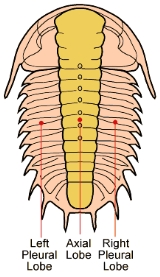
As might be expected for a group of animals comprising 1,500+ genera and 17,000+ species the morphology and description of trilobites can be complex. "Trilobite" (meaning "three-lobed") is named for the three longitudinal lobes: a central axial lobe, and two symmetrical pleural lobes that flank the axis (Fig 1). The trilobite body is divided into three major sections, a cephalon (head) with eyes, mouth parts and antennae, a thorax of multiple similar segments (that in some species allowed enrollment), and a pygidium (tail), see Fig 2. When describing differences between different taxa of trilobites, the presence, size, and shape of the cephalic features are often mentioned and shown in Figs 3 & 4.

Physical description

When trilobites are found, only the exoskeleton is preserved (often in an incomplete state) in all but a handful of locations. A few locations (Lagerstätten) preserve identifiable soft body parts (legs, gills, musculature & digestive tract) and enigmatic traces of other structures (e.g. fine details of eye structure) as well as the exoskeleton.

Trilobites range in length from 1 mm to 72 cm (1/25 inch to 28 inches), with a typical size range of 3 to 10 cm (1 to 4 inches). The world's largest trilobite, Isotelus rex
Isotelus

Isotelus is a genus of Asaphida trilobite from the middle and upper Ordovician period, fairly common in the Northeastern United States, northwest Manitoba, southwestern Quebec and southeastern Ontario....
, was found in 1998 by Canadian scientists in Ordovician rocks on the shores of Hudson Bay
Hudson Bay

Hudson Bay is a large , relatively shallow body of water in northeastern Canada. It is approximately 850 miles long and 650 miles wide. It drains a very large area that includes parts of Ontario, Quebec, Saskatchewan, Alberta, most of Manitoba, parts of North Dakota, South Dakota, Minnesota, and Montana, and the southeastern area of Nunavut...
.

Exoskeleton


The exoskeleton
Exoskeleton

An exoskeleton is an external skeleton that supports and protects an animal's body, in contrast to the internal endoskeleton of, for example, a human skeleton....
 is composed of calcite
Calcite

Calcite is a Carbonate minerals and the most stable Polymorphism of calcium carbonate . The other polymorphs are the minerals aragonite and vaterite....
 and calcium phosphate minerals in a protein lattice of chitin
Chitin

Chitin n is a long-chain polymer of a N-acetylglucosamine, a derivative of glucose, and is found in many places throughout the natural world....
 that covers the upper surface (dorsal) of the trilobite and curled round to produce a small fringe beneath called the doublure. The exoskeleton of trilobites are divided into three parts (tagmata
Tagma (biology)

In invertebrate biology, a tagma is a specialized grouping of arthropodan segmentation s, such as the head, the thorax, and the abdomen with a common function....
): a cephalon, composed of the two preoral and first four postoral segments completely fused together; a thorax
Thorax

The thorax is a division of an animal's body that lies between the head and the abdomen.In mammals, the thorax is the region of the body formed by the sternum, the thoracic vertebrae and the ribs....
 composed of freely articulating segments; and a pygidium
Pygidium

The pygidium is the posterior body part or shield of crustaceans and some arthropods, such as insects and the extinct trilobites. It contains the anus and, in females, the ovipositor....
 composed of the last segments fused together with the telson
Telson

The telson is the last division of the body of a crustacean. It is not considered a true segment because it does not arise in the embryo from teloblast areas as do real segments....
.

During molting
Ecdysis

Ecdysis is the molting of the cuticula in arthropods and related groups . Since the cuticula of these animals is also the skeletal support of the body and is inelastic, it is shed during growth and a new, larger covering is formed....
, the exoskeleton generally split between the head and thorax, which is why so many trilobite fossils are missing one or the other. In most groups there were facial sutures on the cephalon to facilitate molting.

Samgoniii Cranidium
Samgoniii Cephareas
Cephalon
The cephalon of trilobites is highly variable with a lot of morphological complexity. The glabella forms a dome underneath which sat the "crop" or "stomach". The ventral surface of the cephalon often preserves muscle attachment scars and the presence of the hypostome, a small rigid plate upon which sat the mouth and stomach. The hypostome is highly variable, sometimes supported by a membrane (natant), sometimes fused onto the doublure with an outline very similar to the glabella above (conterminant) or fused to the doublure with an outline significantly different from the glabella (impendent). Many variations in shape and placement of the hyperstome have been described. Size of the glabella, lateral fringe and hypostome variation have all been linked to different lifestyles, diets and ecological niches. The fringe of the cephalon is greatly exaggerated in the Harpetida
Harpetida

Harpetida is one of the nine order s of the Extinction arthropod class Trilobite. They lived from the Upper Cambrian to the Late Devonian period....
, in other species a bulge in the pre-glabellar area is preserved that suggests a brood pouch. Highly complex compound eyes are another obvious feature of the cephalon (see below). Figure 3 shows gross morphology of the cephalon. The cheeks (genae) are the pleural lobes on each side of the axial feature, the glabella. When trilobites molted or died, the librigenae (the so-called "free cheeks") often separated, leaving the cranidium (glabella + fixigenae) exposed. Figure 4 shows a more detailed view of the cephalon.

Thorax
The thorax is a series of articulated segments that lie between the cephalon and pygidium. Number of segments varies between 2 and 61 with most species in the 2 to 16 range. Each segment consists of the central axial ring and the outer plurae which protected the limbs and gills. The plurae are sometimes abbreviated to save weight or extended to form long spines. Apodemes are bulbous projections on the underside to which most leg muscles attached, although some leg muscles attached directly to the exoskeleton. Distinguishing where the thorax ends and the pygidium begins can be problematic and many segment counts suffer from this problem. Fossilised trilobites are often found enrolled (curled up) like modern woodlice for protection, evidence suggests enrollment helped protect against exploitation of arthropod cuticle weakness by Anomalacarid predator attacks. Some trilobites achieved a fully closed capsule (e.g. Phacops
Phacops

Phacops is a genus of trilobite in the order Phacopida, suborder Phacopina, superfamily Phacopoidea. They have a very widespread distribution, being found in Morocco, Europe, Australia and North America....
) while others with long pleural spines (e.g. Selenopeltis
Selenopeltis

Selenopeltis is an extinct genus of trilobite from the Ordovician of Africa....
) or a small pygidium (e.g. Paradoxides
Paradoxides

Paradoxides was a genus of relatively large trilobites found throughout the world during the Mid Cambrian period .It was a moderately large trilobite with a semicircular head, free cheeks each ending with a long, narrow, recurved spine, and relatively large eyes....
) left a gap at the sides or between the cephalon and pygidium . Even in an Agnostid, with only 2 articulating thoracic segments, the process of enrollment required a complex musculature to contract the exoskeleton and return to the flat condition. In Phacops
Phacops

Phacops is a genus of trilobite in the order Phacopida, suborder Phacopina, superfamily Phacopoidea. They have a very widespread distribution, being found in Morocco, Europe, Australia and North America....
 the pleurae overlap a smooth bevel (facet) allowing a close seal with the doublure. The doublure carries a panderian notch or protuberance on each segment to prevent over rotation of each segment. Long lateral muscles extended from the cephalon to mid way down the pygidium, attaching to the axial rings allowing enrollment while separate muscles on the legs tucked them out of the way.

Pygidium
Is a number of segments and the telson fused together to form the tail. The pygidium segments are similar to the thoracic segments bearing legs and gills but, are not articulated. Trilobites can be described based on the pydigium being micropygous (pydigium smaller than cephalon), isopygous (pydigium equal in size to cephalon), or macropygous (pydigium larger than cephalon).

Prosopon (surface sculpture)
Trilobite exoskeletons show a variety of small-scale structures collectively called prosopon. Prosopon does not include large scale extensions of the cuticle (e.g. hollow pleural spines) but to finer scale features, such as ribbing, domes, pustules, pitting, ridging and perforations. The exact purpose of the prosopon is not resolved but suggestions include structural strengthening, sensory pits or hairs, preventing predator attacks and maintaining aeration while enrolled. In one example, alimentary ridge networks (easily visible in Cambrian trilobites) might have been either digestive or respiratory tubes in the cephalon and other regions. Later, more advanced trilobites developed thicker cuticles (making alimentary prosopon harder to see) against predation by cephalopods.

Spines
Some trilobites such as those of the order Lichida
Lichida

Lichida is an order of typically spiny trilobite that lived from the Ordovician to the Devonian period.These trilobites usually have 8-13 thorax segments....
 evolved elaborate spiny forms, from the Ordovician
Ordovician

The Ordovician is a geologic period, the second of six of the Paleozoic era , and covers the time between 488.3?1.7 to 443.7?1.5 million years ago ....
 until the end of the Devonian
Devonian

The Devonian is a geologic period of the Paleozoic era spanning from . It is named after Devon, England, where rocks from this period were first studied....
 period. Examples of these specimens have been found in the Hamar Laghdad Formation of Alnif in Morocco
Morocco

Morocco , officially the Kingdom of Morocco , is a country located in North Africa with a population of nearly 34 million and an area just under 447,000 km2....
. Collectors of this material should be aware of a serious counterfeiting and fakery problem with much of the Moroccan material that is offered commercially. Spectacular spined trilobites have also been found in western Russia; Oklahoma, USA; and Ontario, Canada. These spiny forms could possibly have been a defensive response to the evolutionary appearance of fish
Fish

A fish is any marine biology vertebrate animal that is typically ectothermic , covered with scale , and equipped with two sets of paired fins and several unpaired fins....
.

Some trilobites had horns on their heads similar to those of modern beetles. Based on the size, location, and shape of the horns the most likely use of the horns was combat for mates, making the Asaphida
Asaphida

Asaphida is a large, morphologically diverse order of trilobite found in Stratum dated from the Middle Cambrian to the Silurian. The order contains six superfamilies, but no suborders....
 family
Family

Family denotes a group of people affiliated by a common ancestry, affinity or co-residence. Although the concept of consanguinity originally referred to relations by "blood," some cultural anthropology have argued that one must understand the idea of "blood" metaphorically, and that many societies understand 'family' through other concepts r...
 Raphiophoridae the earliest exemplars of this behavior. A conclusion likely to be applicable to other trilobites as well, such as in the Phacopid trilobite genus Walliserops
Walliserops

Walliserops is a genus of spinose phacopid trilobites found in Lower to Middle Devonian age rocks from Morocco. All species of Walliserops share, and are famous for, the spectacular three-pronged "trident" that rises from the glabella....
 that developed spectacular tridents.

Soft body parts


Legs and gills
Trilobites had a single pair of preoral antenna
Antenna (biology)

Antennae are paired appendages connected to the front-most morphogenesis of arthropods. In crustaceans, they are biramous and present on the first two segments of the head, with the smaller pair known as antennules....
e and otherwise undifferentiated biramous limbs. Each exopodite (walking leg) had six segments, homologous to other early arthropods. The first segment also bore a feather-like epipodite, or gill
Gill

A gill is an anatomical structure found in many aquatic ecosystem organisms. It is a respiration organ whose function is the extraction of oxygen from water and the excretion of carbon dioxide....
 branch, which was used for respiration and, in some species, swimming. The last expodite segment had a claw and 2 articulated flanking hooks. Many examples of hairs on the legs suggest adaptations for feeding or sensory organs to help with walking.

Digestive tract
The mouth of trilobites was situated on the rear edge of the hypostome, in front of the 2 pairs of legs attached to the cephalon. The mouth is linked by a small oesophagus to the stomach that lay forward of the mouth, below the glabella. The "intestine" led backwards from there to the pygidium.

Sensory organs

Many trilobites had eyes; they also had antenna
Antenna (biology)

Antennae are paired appendages connected to the front-most morphogenesis of arthropods. In crustaceans, they are biramous and present on the first two segments of the head, with the smaller pair known as antennules....
e that perhaps were used for taste and smell. Some trilobites were blind, probably living too deep in the sea for light to reach them. As such, they became secondarily blind in this branch of trilobite evolution. Others, such as Phacops rana
Phacops rana

Phacops rana is a species of trilobite from the middle Devonian period. Their fossils are found chiefly in the northeastern United States, southwestern Ontario, Canada, and in Morocco, Africa....
, had eyes that were quite large for use in more well lit, predator-filled waters.

Antennae

The pair of antennae suspected in most trilobites (but preserved only in a few) were highly flexible to allow them to be retracted when the trilobite was enrolled. The antennae are probably similar to those in extant arthropods and as such could sense touch, water motion, heat, vibration (sound), and especially olfaction (smell) or gustation (taste).

Eyes

Even the earliest trilobites had complex, compound eyes with lenses made of calcite, a unique characteristic of all trilobite eyes. This confirms that eyes of arthropods and probably other animals were already quite developed at the beginning of the Cambrian. Improving eyesight of both predator and prey in marine environments probably provided one of the evolutionary pressure
Evolutionary pressure

Any cause that reduces reproductive success in a proportion of a population potentially exerts evolutionary pressure or selection pressure....
s furthering an apparent rapid development of new life forms during what is known as the Cambrian Explosion
Cambrian explosion

The Cambrian explosion or Cambrian radiation was the seemingly rapid appearance of most major groups of complex animals around , as evidenced by the fossil record....
.

The trilobite eyes were typically compound, with each lens being an elongated prism. The number of lenses in such an eye varied: some trilobites had only one, while some had thousands of lenses in a single eye. In these compound eyes, the lenses were typically arranged hexagonally. The fossil record of trilobite eyes is complete enough that their evolution can be studied through time, which compensates to some extent the lack of preservation of soft internal parts.

The lens
Lens

Lens can refer to:...
es of trilobites eye
Eye

Eyes are Organ that detect light, and send signals along the optic nerve to the visual system and other areas of the brain. Complex optical systems with resolving power have come in ten fundamentally different forms, and 96% of animal species possess a complex optical system....
s were made of calcite
Calcite

Calcite is a Carbonate minerals and the most stable Polymorphism of calcium carbonate . The other polymorphs are the minerals aragonite and vaterite....
 (calcium carbonate
Calcium carbonate

Calcium carbonate is a chemical compound with the chemical formula CalciumCarbonOxygen3. It is a common substance found as Rock in all parts of the world, and is the main component of seashells, snails, and eggshells....
, CaCO3). Pure forms of calcite are transparent, and some trilobites used crystallographically oriented, clear calcite crystals to form each lens of each of their eyes. In this, they differ from most other arthropods, which have soft or chitin-supported eyes.

The rigid calcite lenses of a trilobite eye would have been unable to accommodate
Accommodation (eye)

Accommodation is the process by which the :eye increases optical power to maintain a clear image on an object as it draws near the eye. The young human eye can change focus from distance to 7 cm from the eye in 350 milliseconds....
 to a change of focus like the soft lens in a human eye would; however, in some trilobites the calcite formed an internal doublet
Doublet (lens)

In optics, a doublet is a type of lens made up of two simple lenses attached together. The lenses are made from glasses with different refractive index and different amounts of Dispersion ....
 structure, giving superb depth of field
Depth of field

In optics, particularly as it relates to film and photography, the depth of field is the portion of a scene that appears sharp in the image. Although a lens can precisely focus at only one distance, the decrease in sharpness is gradual on either side of the focused distance, so that within the DOF, the unsharpness is imperceptible under nor...
 and minimal spherical aberration
Spherical aberration

Spherical aberration is an optical effect observed in an optical device that occurs due to the increased refraction of light rays when they strike a lens or a reflection of light rays when they strike a mirror near its edge, in comparison with those that strike nearer the center....
, as rediscovered by French scientist René Descartes
René Descartes

Ren? Descartes , , also known as Renatus Cartesius , was a French philosophy, mathematician, scientist, and writer who spent most of his adult life in the Dutch Republic....
 and Dutch physicist Christiaan Huygens
Christiaan Huygens

Christiaan Huygens was a prominent Netherlands mathematics, astronomer, physics, and horology. His work included early telescopic studies, investigations and inventions related to time keeping, and studies of both optics and centrifugal force....
 many millions of years later. A living species with similar lenses is the brittle star
Brittle star

Brittle stars, or Ophiuroidea, are echinoderms, closely related to sea stars. They crawl across the seafloor using their flexible arms for locomotion....
 Ophiocoma wendtii
Ophiocoma wendtii

The brittle star Ophiocoma wendtii inhabits coral reefs from Bermuda to Brazil. It is known for its advanced compound eyes.Brittle stars have long, thin arms emanating from a small, disk-shaped body and are about the size of an outstretched human hand....
. In other trilobites, with a Huygens interface apparently missing, a gradient index lens is invoked with the refractive index
Refractive index

The refractive index of a medium is a measure for how much the speed of light is reduced inside the medium. For example, typical soda-lime glass has a refractive index of 1.5, which means that in glass, light travels at times the speed of light in a vacuum....
 of the lens changing towards the center.

Holochroal eye
Holochroal eye

Holochroal eyes are compound eyes with a many tiny lenses . They are the oldest and most widespread type of trilobite eye, and found in all orders of trilobite from the Cambrian to the Permian periods....
s had a great number (sometimes over 15,000) of small (30-100µm, rarely larger) lenses. Lenses were hexagonally close packed, touching each other, with a single corneal membrane
Cornea

The cornea is the transparency front part of the eye that covers the Iris , pupil, and anterior chamber. Together with the cilliary muscles, the cornea reflects light, and as a result helps the eye to dilate, accounting for approximately two-thirds of the eye's total optical power....
 covering all lenses. Holochroal eyes had no sclera, the white layer covering the eyes of most modern arthropods. Holochroal eyes are the ancestral eye of trilobites, and are by far the most common, found in all orders and through the entirety of the Trilobites' existence. Little is known of the early history of holochroal eyes; Lower and Middle Cambrian trilobites rarely preserve the visual surface.

Schizochroal eyes typically had fewer (to around 700), larger lenses than holochroal eyes and are found only in Phacopida
Phacopida

Phacopida is an Order of trilobite that lived from the Ordovician to the Devonian. It is made up of a morphologically diverse group of related suborders....
. Lenses were separate, with each lens having an individual cornea which extended into a rather large sclera. Schizochroal eyes appear quite suddenly in the early Ordovician, and were presumably derived from a holochroal ancestor. Field of view (all around vision), eye placement and coincidental development of more efficient enrollment mechanisms point to the eye as a more defensive "early warning" system than directly aiding in the hunt for food. Eyes which are functionally equivalent to the schizochroal eye are found in the modern insect species Xenos peckii.

Abathochroal eyes had around 70 small lenses, and are found only in Cambrian Eodiscina
Agnostida

Agnostida is an order of trilobite. These small trilobites first appeared toward the end of the Early Cambrian and thrived in the Middle Cambrian....
. Each lens was separate and had an individual cornea. The sclera was separate from the cornea, and did not run as deep as the sclera in schizochroal eyes.

Secondary blindness is not uncommon, particularly in long lived groups such as the Agnostida and Trinucleioidea. In Proetida, Phacopina and Tropidocoryphinae there are well studied trends showing progressive eye reduction between closely related species that eventually leads to blindness.

Several other structures on trilobites have been explained as photo-receptors. Of particular interest are the small areas of thinned cuticle on the underside of the hypostome (macula) which, in some trilobites, are suggested to be simple ventral eyes that could have detected night and day or allowed a trilobite to navigate while swimming (or turned) upside down.

Sensory pits

There are several types of prosopon that have been suggested as sensory apparatus collecting chemical or vibrational signals. The connection between large pitted fringes on the cephalon of Harpetida
Harpetida

Harpetida is one of the nine order s of the Extinction arthropod class Trilobite. They lived from the Upper Cambrian to the Late Devonian period....
 and Trinucleoidea with corresponding small or absent eyes makes for an interesting possibility of the fringe as a "compound ear".

Development

Trilobites grew through successive molt stages called instar
Instar

An instar is a developmental stage of arthropods, such as insects, between each ecdysis , until sexual maturity is reached. Arthropods must shed the exoskeleton in order to grow or assume a new form....
s
, in which existing segments increased in size and new trunk segments appeared at a sub-terminal generative zone during the "anamorphic" phase of development. The molt itself, is called ecdysis. This was followed by the "epimorphic" developmental phase, in which the animal continued to grow and molt, but no new trunk segments were expressed in the exoskeleton. The combination of anamorphic and epimorphic growth consistutes the "hemianamorphic" developmental mode that is common among many living arthropods.

Trilobite development was unusual in the way in which articulations developed between segments, and changes in the development of articulation gave rise to the conventionally recognized developmental phases of the trilobite life cycle (divided into 3 stages), which are not readily compared with those of other arthropods. Actual growth and change in external form of the trilobite would have occurred when the trilobite was soft shelled, following molting and before the next hard exoskeleton.

Trilobite larvae are known from the Cambrian to the Carboniferous and from all sub-orders. As instars from closely related taxa are more similar than instars from distantly related taxa, trilobite larvae provide morphological information important in evaluating high-level phylogenetic relationships among trilobites.

Trilobites are thought to have reproduced sexually, producing eggs, albeit without undoubted examples in the fossil record. Some species may have kept eggs or larvae in a brood pouch forward of the glabella, particularly when the ecological niche
Ecological niche

In ecology, a niche is a term describing the relational position of a species or population in its ecosystem to each other; e.g. a dolphin will be in another ecological niche to one that travels in a different school.....
 was particularly challenging to larvae. Size and morphology of the first calcified stage are highly variable between (but not within) trilobite taxa, suggesting some trilobites passed through more growth within the egg than others. Early developmental stages prior to calcification of the exoskeleton are a possibility, but so is calcification and hatching coinciding.

The earliest post-embryonic trilobite growth stage known with certainty are the protaspid stages. Starting with an indistinguishable proto-cephalon and proto-pygidium (anaprotaspid) a number of changes occur ending with a transverse furrow separating the proto-cephalon and proto-pygidium (metaprotaspid) that can continue to add segments. Segments are added at the posterior part of the pygidium but, all segments remain fused together.

The meraspid phase of development is marked by the appearance of an articulation between the head and the fused trunk. At the onset of the meraspid phase the animal had a two-part structure - the head and the plate of fused trunk segments, the pygidium. During the meraspid phase, new segments appeared near the rear of the pygidium as additional articulations developed at the anterior of the pygidium, releasing freely articulating thoracic segments. Segments are generally added one per molt (although two per molt and one every alternate molt are also recorded), with number of stages equal to the number of thoracic segments. A substantial amount of growth, from less than 25% up to 30-40%, probably took place in the meraspid stages.

The holaspid phase of growth commenced when a stable, mature number of segments had been released into the thorax. Molting continued during the holaspid stage, with no changes in thoracic segment number. Onset of the holaspid phase and the epimorphic phase was coincident in some, but not all, trilobites.

Some trilobites showed a marked transition in morphology at one particular instar, which has been called trilobite metamorphosis. Radical change in morphology is linked to the loss or gain of distinctive features that mark a change in mode of life. A change in lifestyle during development has significance in terms of evolutionary pressure
Evolutionary pressure

Any cause that reduces reproductive success in a proportion of a population potentially exerts evolutionary pressure or selection pressure....
, as the trilobite could pass through several ecological niches on the way to adult development and changes would strongly affect survivor-ship and dispersal of trilobite taxa. It is worth noting that trilobites with all protaspid stages planktonic and meraspid stages benthic (e.g. Asaphids) failed to last through the Ordovician extinctions, while trilobites that were planktonic for only the first protaspid stage before metamorphosing into benthic forms survived (e.g. Lichids, Phacopids). Pelagic larval life-style proved ill-adapted to the rapid onset of global climatic cooling and loss of tropical shelf habitats during the Ordovician.

Fossil record

The earliest trilobite known from the fossil record is the genus
Genus

A genus is a low-level taxonomic rank used in the classification of living and fossil organisms. The taxonomic ranks are domain , kingdom , phylum, class , order , family , genus, and species....
 Fallotaspis within Order
Order (biology)

In Biological classification used in biology, the order is a taxonomic rank between class and family . The superorder is a rank between class and order....
 Redlichiida
Redlichiida

Redlichiida is an Order within the major extinct arthropod class Trilobita. The Redlichids are one of the four older classes of trilobites that originated in the Lower Cambrian....
, dated to some . Other early genera include Profalloptaspis and Eofallotaspis, all appearing about the same time.

Origins

Based on morphological similarities, it is possible that the trilobites have their ancestors in arthropod-like creatures such as Spriggina
Spriggina

Fossils of Spriggina are known from the Ediacaran period, around . The segmented organism reached about 3 cm in length and may have been predatory....
, Parvancorina
Parvancorina

Parvancorina is a genus of shield-shaped Ediacaran Ediacaran biotas. It has a raised ridge down the central axis of symmetry. This ridge can be high in unflattened fossils....
, and other trilobitomorphs of the Ediacaran
Ediacaran

The Ediacaran Period is the last geological period of the Neoproterozoic Era and of the Proterozoic Eon, immediately preceding the Cambrian Period, the first period of the Paleozoic Era and of the Phanerozoic Eon....
 period of the Precambrian
Precambrian

The Precambrian is an informal name for the supereon comprising the eon of the geologic timescale that came before the current Phanerozoic eon....
. There are many morphological similarities between early trilobites and other Cambrian
Cambrian

The Cambrian is a geologic period that began about Mya at the end of the Proterozoic eon and ended about Ma with the beginning of the Ordovician period ....
 arthropods known from the Burgess Shale
Burgess Shale

The Burgess Shale Formation is one of the world's most celebrated fossil localities, and is famous for the exceptional preservation of the fossils found within it, in which the soft parts are preserved....
, the Maotianshan shales
Maotianshan shales

The Maotianshan Shales area a series of lower Cambrian deposits, famous for their Lagerst?tten. They take their name from Maotianshan Hill in Chengjiang County, Yunnan Province, China....
 at Chengjiang and other fossil
Fossil

Fossils are the preserved remains or trace fossil of animals, plants, and other organisms from the remote past. The totality of fossils, both discovered and undiscovered, and their placement in fossiliferous Rock formations and sedimentary rock layers is known as the fossil record....
iferous locations. These are investigated further here: It is reasonable to assume that the trilobites share a common ancestor with these other arthropods prior to the Ediacaran-Cambrian boundary. Ancestral trilobites may have been somewhat soft bodied and developed their thick carapaces through Cuticularisation. As with other forms of trilobite body evolution, this was a defensive measure.

Extinction

The reason for the extinction of the trilobites is not clear, although it may be no coincidence that their numbers began to decrease with the appearance of the first shark
Shark

Sharks are a type of fish with a full Cartilage skeleton and a highly Streamlines, streaklines and pathlinesd body. They respire with the use of five to seven gill slits....
s and other early gnathostomes in the Silurian
Silurian

The Silurian is a geologic period that extends from the end of the Ordovician period, about 443.7 ? 1.5 annum , to the beginning of the Devonian period, about 416.0 ? 2.8 Mya ....
 and their subsequent rise in diversity during the Devonian
Devonian

The Devonian is a geologic period of the Paleozoic era spanning from . It is named after Devon, England, where rocks from this period were first studied....
 period. Trilobites may have provided a rich source of food for these new animals. A smaller extinction event in the Middle Cambrian of trilobite orders possessing alimentary prosopon and a micropygidium may have been linked to the rise of cephalopods. Trilobites were under great selective pressure to develop defensive bodies quickly. The most radical change in body form occurred in the Middle Cambrian. As a means of defense, surviving orders developed isopygidius or macropygius bodies. This enabled trilobites to curl their bodies into a ball as a means of defense. A micropygidius trilobite cannot completely protect itself in a curled position with a pygidium smaller than the cephalon. It is analogous to pleurodirian (side-necked) turtles of the present day (Holocene). A terrestrial side neck could never evolve because the exposed neck in a side withdraw state would be vulnerable to a predator. Surviving trilobites developed thicker cuticles (as mentioned earlier) and as such, the alimentary prosopon are no longer visible due to the thickness.

After the mid-Cambrian extinction event, the next great extinction event occurred at the Frasnian - Famennian boundary at the end of the Devonian period. All orders (except one) of trilobites became extinct. Trilobites were bottlenecked into one single order, the Proetida. This single order survived for millions of years, continued through the Carboniferous period and lasted to the great extinction event at the end of the Permian (where the vast majority of species on Earth were wiped out). It is unknown why order Proedita alone, survived. It may have been a deeper water order that was able to avoid rapid changes that would affect species along the continental shelves. For many millions of years, the Proetida found a perfect niche. An analogy would be today's crinoid
Crinoid

Crinoids, also known as sea lilies or feather-stars, are marine animals that make up the class Crinoidea of the echinoderms . They live both in shallow water and in depths as great as 6,000 meters....
s which exist as deep water species only. In the Paleozoic era, vast 'forests' of crinoids lived in shallow near-shore environments.

Additionally, their relatively low numbers and diversity at the end of the Permian no doubt contributed to their extinction during that great mass extinction event. Foreshadowing this, the Ordovician mass extinction
Ordovician-Silurian extinction events

The Ordovician?Silurian extinction event or quite commonly the Ordovician extinction, was the third-largest of the five major extinction events in Earth's history in terms of percentage of Genus that went extinct and second largest overall in the overall loss of life....
, though somewhat less substantial than the Permian one, also seems to have significantly narrowed trilobite diversity.

The closest extant relatives of trilobites may be the horseshoe crab
Horseshoe crab

The horseshoe crab or Atlantic horseshoe crab is a marine chelicerate arthropod. Despite its name, it is more closely related to spiders, ticks, and scorpions than to crabs....
s, or the cephalocarids
Cephalocarida

Cephalocarida is a class inside the subphylum Crustacean that comprises only about nine shrimp-like benthic species. They were discovered in 1955, and are commonly referred to as horseshoe shrimps....
.

Fossil distribution

Cruziana2
Trilobites appear to have been exclusively marine organisms, since the fossilized remains of trilobites are always found in rocks containing fossils of other salt-water animals such as brachiopods, crinoids, and corals. Within the marine paleoenvironment, trilobites were found in a broad range from extremely shallow water to very deep water. Trilobites, like brachiopods, crinoids, and corals, are found on all modern continents, and occupied every ancient ocean from which Paleozoic fossils have been collected. The remnants of trilobites can range from the preserved body to pieces of the exoskeleton, which it sheds in the process known as ecdysis. In addition, the tracks left behind by trilobites living on the sea floor are often preserved as trace fossils.

There are three main forms of trace fossils associated with trilobites: Rusophycus; Cruziana & Diplichnites. These trace fossils represent the preserved life activity of trilobites active upon the sea floor. Rusophycus
Rusophycus

Rusophycus is a trace fossil allied to Cruziana. Rusophycus is the resting trace, recording the outline of the tracemaker; Cruziana is made when the organism moved....
, the resting trace, are trilobite excavations which involve little or no forward movement and ethological interpretations suggest resting, protection and hunting. Cruziana
Cruziana

Cruziana is a trace fossil consisting of elongate, bilobed, approximately bilaterally symmetrical burrows, usually preserved along bedding planes, with a sculpture of repeated striations that are mostly oblique to the long dimension....
, the feeding trace, are furrows through the sediment, which are believed to represent the movement of trilobites while deposit feeding. Many of the Diplichnites
Diplichnites

Diplichnites is an ichnogenus thought to be made by members of the Arthropoda family. It is a fossil trackway, showing two parallel lines of feet impressions....
 fossils are believed to be traces made by trilobites walking on the sediment surface. Similar trace fossils are also occasionally found in freshwater environments, but these occurrences are generally believed to be of non-trilobite arthropod origin.

Trilobite fossils are found worldwide, with many thousands of known species. Because they appeared quickly in geological time, and moulted like other arthropods, trilobites serve as excellent index fossil
Index fossil

Index fossils are fossils used to define and identify geologic columns . They work on the premise that, although different sediments may look different depending on the conditions under which they were laid down, they may include the remains of the same species of fossil....
s, enabling geologists to date the age of the rocks in which they are found. They were among the first fossils to attract widespread attention, and new species are being discovered every year. Some Native Americans
Indigenous peoples of the Americas

The indigenous peoples of the Americas are the pre-Columbian inhabitants of the Americas, their descendants, and many ethnic groups who identify with those peoples....
, recognizing that trilobites were water creatures, had a name for them which means "little water bug in the rocks".

A famous location for trilobite fossils in the United Kingdom
United Kingdom

The United Kingdom of Great Britain and Northern Ireland, commonly known as the United Kingdom , the UK or Britain,is a sovereign state located off the northwestern coast of continental Europe....
 is Wren's Nest
Wren's Nest

Wren's Nest is an area of Dudley, West Midlands , England. Located to the north west of Dudley town centre, it comprises the Wren's Nest NNR and the Wren's Nest housing estate....
, Dudley
Dudley

Dudley is a large town in the West Midlands , England, with a population of List of English cities by population. Since 1974 it has been the administrative centre of the wider Metropolitan Borough of Dudley; the original County Borough had undergone a lesser expansion in 1966....
 in the West Midlands
West Midlands (county)

The West Midlands is a metropolitan county in West Midlands England with a population of 2,591,300. It came into existence as a metropolitan county in 1974 after the passage of the Local Government Act 1972....
, where Calymene blumenbachi is found in the Silurian
Silurian

The Silurian is a geologic period that extends from the end of the Ordovician period, about 443.7 ? 1.5 annum , to the beginning of the Devonian period, about 416.0 ? 2.8 Mya ....
 Wenlock Group
Wenlock Group

Wenlock Group , in geology, is the middle series of stratum in the Silurian of Great Britain. This group in the typical area in the Wales border counties contains the following formations: Much Wenlock Limestone Formation, 90-300 ft.; Wenlock shale, up to 1900 ft.; Woolhope or Barr limestone and shale, 150 ft....
. This trilobite is featured on the town's coat of arms
Coat of arms

A coat of arms, more properly called an armorial achievement, armorial bearings or often just arms for short, in European tradition, is a design belonging to a particular person and used by them in a wide variety of ways....
 and was named the Dudley Bug or Dudley Locust by quarrymen who once worked the now abandoned limestone
Limestone

File:Limestone Formation In Waitomo.jpgLimestone is a sedimentary rock composed largely of the mineral calcite . The deposition of limestone strata is often a by-product and indicator of biological activity in the geology record....
 quarries. Other trilobites found there include Dalmanites, Trimerus, Bumastus and Balizoma. Llandrindod Wells
Llandrindod Wells

Llandrindod Wells , known locally as "Llandod", is a town in Powys, Wales. It was developed as a spa town in the 19th century, with a boom in the late 20th century as a centre of local government....
, Powys
Powys

Powys is a local-government Principal areas of Wales and preserved counties of Wales in Wales....
, Wales
Wales

native_name = Cymru|conventional_long_name = Wales|common_name = Wales|image_flag = Flag of Wales 2.svg|national_motto = ...
, is another famous trilobite location. The well known Elrathia kingi trilobite is found in abundance in the Wheeler Shale
Wheeler Shale

The Wheeler Shale is a Cambrian fossil locality world famousfor prolific agnostid and Elrathia kingii trilobite remains and represents a Lagerst?tte....
 of Cambrian
Cambrian

The Cambrian is a geologic period that began about Mya at the end of the Proterozoic eon and ended about Ma with the beginning of the Ordovician period ....
 age Utah
Utah

The State of Utah is a western United States U.S. state of the United States. It was the List of U.S. states by date of statehood admitted to the United States on January 4, 1896....
.

Spectacularly preserved trilobite fossils, often showing soft body parts (legs, gills, antennae, etc.) have been found in British Columbia
British Columbia

British Columbia is the westernmost of Canada's Provinces and territories of Canada and is famed for its natural beauty, as reflected in its Latin motto, Splendor sine occasu ....
, Canada (the Cambrian Burgess Shale
Burgess Shale

The Burgess Shale Formation is one of the world's most celebrated fossil localities, and is famous for the exceptional preservation of the fossils found within it, in which the soft parts are preserved....
 and similar localities); New York State, U.S.A. (Ordovician Walcott
Charles Doolittle Walcott

Charles Doolittle Walcott was an United States invertebrate paleontologist. He became known for his discovery in 1909 of well-preserved fossils in the Burgess shale formation of British Columbia, Canada....
-Rust Quarry, near Utica
Utica, New York

Utica is a city in the American state of New York, and the county seat of Oneida County, New York.The City of Utica is situated within the region referred to as the Mohawk Valley and the U.S....
, and Beecher's Trilobite Beds
Beecher's Trilobite Beds

Beecher's Trilobite Beds is a Lagerstatten of Late Ordovician age located within the Frankfort Shale in Cleveland's Glen, Rome, Oneida Co., New York, USA....
, near Rome
Rome

Rome is the capital city of Italy and Lazio, and is Italy's largest and most populous city, with 2,724,347 residents in an urban area of some ....
); China (Lower Cambrian Maotianshan Shales
Maotianshan shales

The Maotianshan Shales area a series of lower Cambrian deposits, famous for their Lagerst?tten. They take their name from Maotianshan Hill in Chengjiang County, Yunnan Province, China....
 near Chengjiang); Germany
Germany

Germany , officially the Federal Republic of Germany , is a country in Central Europe. It is bordered to the north by the North Sea, Denmark, and the Baltic Sea; to the east by Poland and the Czech Republic; to the south by Austria and Switzerland; and to the west by France, Luxembourg, Belgium, and the Netherlands....
 (the Devonian Hunsrück Slates
Hunsrück Slates

The Hunsr?ck Slate is a Devonian Lagerst?tte famous for exceptional preservation of a highly diverse fossil fauna assemblage. The various fossil localities are quarries located mostly south of the River Mosel and west of the Rhine in western Germany....
 near Bundenbach
Bundenbach

Bundenbach is a municipality in the Birkenfeld , in Rhineland-Palatinate, Germany....
) and, much more rarely, in trilobite-bearing strata in Utah (Wheeler Shale
Wheeler Shale

The Wheeler Shale is a Cambrian fossil locality world famousfor prolific agnostid and Elrathia kingii trilobite remains and represents a Lagerst?tte....
 and other formations) and Ontario
Ontario

Ontario is a Provinces and territories of Canada located in the Central Canada part of Canada, the largest by population and second largest, after Quebec, in total area....
.

Trilobites are collected commercially in Russia (especially in the St. Petersburg area), Germany, Morocco's Atlas Mountains
Atlas Mountains

The Atlas Mountains are a mountain range across a northern stretch of Africa extending about 2,400 km through Morocco, Algeria, and Tunisia. The highest peak is Jbel Toubkal, with an elevation of in southwestern Morocco....
, (where a burgeoning trade in faked trilobites is also under way), Utah, Ohio, British Columbia, and in other parts of Canada.


Importance


The study of Paleozoic trilobites in the Welsh-English borders by Niles Eldredge
Niles Eldredge

Niles Eldredge is an United States paleontology, who, along with Stephen Jay Gould, proposed the theory of punctuated equilibrium in 1972....
 was fundamental in formulating and testing Punctuated Equilibrium
Punctuated equilibrium

Punctuated equilibrium is a theory in Evolution which states that most Sexual reproduction species experience little change for most of their geological history, and that when phenotypic evolution does occur, it is localized in rare, rapid events of branching speciation ....
 as a mechanism of evolution.

Identification of the 'Atlantic' and 'Pacific' trilobite faunas either side of the Iapetus suture
Iapetus Ocean

The Iapetus Ocean was an ocean that existed in the Neoproterozoic and Paleozoic eras of the geologic timescale . The Iapetus Ocean was situated in the southern hemisphere, between the paleocontinents of Laurentia, Baltica and Avalonia....
 implied the closure of the Iapetus Ocean
Iapetus Ocean

The Iapetus Ocean was an ocean that existed in the Neoproterozoic and Paleozoic eras of the geologic timescale . The Iapetus Ocean was situated in the southern hemisphere, between the paleocontinents of Laurentia, Baltica and Avalonia....
, thus providing important supporting evidence for Continental Drift
Continental drift

Continental drift is the movement of the Earth's continents relative to each other. The hypothesis that continents 'drift' was first put forward by Abraham Ortelius in 1596 and was fully developed by Alfred Wegener in 1912....
 and Plate tectonics
Plate tectonics

Plate tectonics describes the large scale motions of Earth's lithosphere. The theory encompasses the older concepts of continental drift, developed during the first decades of the 20th century by Alfred Wegener, and seafloor spreading, understood during the 1960s....
.

Trilobites have been important in estimating the rate of speciation
Speciation

Speciation is the evolutionary process by which new biological species arise. The biologist Orator F. Cook seems to have been the first to coin the term 'speciation' for the splitting of lineages or 'cladogenesis,' as opposed to 'anagenesis' or 'phyletic evolution' occurring within lineages....
 during the period known as the Cambrian Explosion
Cambrian explosion

The Cambrian explosion or Cambrian radiation was the seemingly rapid appearance of most major groups of complex animals around , as evidenced by the fossil record....
 because they are the most diverse group of metazoans known from the fossil record of the early Cambrian.

Trilobites are excellent stratigraphic markers of the Cambrian period: researchers who find trilobites with alimentary prosopon, and a micropygium, have found Early Cambrian strata. Most of the Cambrian stratigraphy
Stratigraphy

Stratigraphy, a branch of geology, studies rock layers and layering . It is primarily used in the study of sedimentary rock and layered volcanic rocks....
 is based on the use of trilobite marker fossils.

Trilobites are the state fossils of Ohio
Ohio

Ohio is a Midwestern United States U.S. state of the United States. As part of the Great Lakes region , Ohio has long been a cultural and geographical crossroads in North America....
 (Isotelus
Isotelus

Isotelus is a genus of Asaphida trilobite from the middle and upper Ordovician period, fairly common in the Northeastern United States, northwest Manitoba, southwestern Quebec and southeastern Ontario....
), Wisconsin
Wisconsin

Wisconsin is one of the fifty U.S. state in the United States of America, located in the north central part of the United States. It borders two of the five Great Lakes and four U.S....
 (Calymene
Calymene

Calymene is a genus of trilobites in the order Phacopida, suborder Calymenina, that were found throughout North America and in Europe in Silurian outcrops....
 celebra
) and Pennsylvania
Pennsylvania

The Commonwealth of Pennsylvania , often colloquially referred to as PA by natives and Northeasterners, is a U.S. state located in the Northeastern United States and Mid-Atlantic States regions of the United States....
 (Phacops rana
Phacops rana

Phacops rana is a species of trilobite from the middle Devonian period. Their fossils are found chiefly in the northeastern United States, southwestern Ontario, Canada, and in Morocco, Africa....
).

Gallery


See also

  • Prehistoric life
  • List of trilobites
    List of trilobites

    This list of trilobites is a comprehensive listing of all Genus that have ever been included in the class trilobite, excluding purely vernacular terms....


Further reading

. .

External links

. (A site with information covering trilobites from all angles. Includes many line drawings and photographs.)
  • - Including extensive photographs organized by taxonomy and locality.