

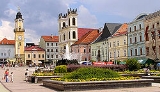
Banská Bystrica

Encyclopedia
Banská Bystrica is a key city in central Slovakia
located on the Hron
River in a long and wide valley encircled by the mountain chains of the Low Tatras, the Veľká Fatra
, and the Kremnica Mountains
. With 81,281 inhabitants, Banská Bystrica is the sixth most populous municipality in Slovakia. It started as a permanent settlement in the 9th century and obtained the municipal privileges of a Hungarian royal
town in 1255. The copper mining town acquired its present picturesque look in the Late Middle Ages
when the prosperous burghers built its central churches, mansions, and fortifications. It is the capital of the kraj
(Banská Bystrica Region
) and the okres
(Banská Bystrica District
). It is also the home of Matej Bel University
. As a historical city with an easy access to the surrounding mountains, Banská Bystrica is a popular winter and summer tourist destination
.
name (Banská Bystrica) includes two distinct roots: the adjective Banská (from Slovak
baňa – "mine") and the name of the local river Bystrica (from Slavic bystrica – "a swift stream"). Its name in is of the same etymological origin.
The river lent its name to the town as early as 1255 when the Latin
name Villa Nova Bystrice (meaning "New Town of Bystrica") was recorded. Several variations of Bystrica (Byztherze, Bystrice, Bystrzice etc.) were then regularly used without the adjective identifying it as a mining town until the late 16th century. Although the first written record of the Hungarian name Byzterchebana dates from 1263, it was rarely used afterwards.
The old German
name Neusohl ("New Zvolen") (first recorded in 1300) and later its Latin version (Neosolium) reflected the fact that some early settlers came from the nearby town of Zvolen
(at the time known in German as Altsohl, literally "Old Zvolen").
The two names have been used in parallel and even complementary (as in Novizolii Bistriciensis) throughout the history of the town. In the late 16th century the use of the mining adjective became more frequent (as in Bystrzicze na baniech or Bystricze Banska, both from 1530). This evolution resulted in the current form of the name, first recorded in 1773 as Banska Bistryca.
After 1867 the Hungarian name Besztercebánya became the official one, replacing both of the aforementioned names, having its origin probably in Byztherczebana from 1293. The parallel use of Slovak or German names in the written record did not, however, cease in this period.
Banská Bystrica became the official name of the city in 1920.
have been dated to 2000–1700 BCE. People of the Lusatian culture
built their settlements at Špania Dolina, Horné Pršany
, Malachov
, and Sásová
. Ancient hill fort
locations are still reflected in the local toponym
Hrádok, meaning "a small fort (later: castle)". The territory was inhabited by the Celtic tribe of the Cotini
(Púchov culture
) in the 3rd century BCE. The Germanic tribe
of the Quadi
took over the place during the Roman Era, leaving for instance a hoard
of silver artifacts in Netopierska jaskyňa (Bat Cave).
The present city was built upon a Slavic settlement, founded in the 9th century CE. It was later incorporated in Zólyom county in the Kingdom of Hungary
. The first known stone church was built by Saxon
immigrants in the then still independent settlement of Sásová
in the first half of the 13th century. In 1255, King Béla IV
granted Banská Bystrica extensive municipal privileges in order to attract more skilled settlers. Descendants of the German immigrants to this and other counties became later known as the Carpathian Germans
. The city flourished as a regional mining center. It built the Late Romanesque
Church of the Virgin Mary in the second half of the 13th century. During the same period, Banská Bystrica obtained its own coat of arms
inspired by the coat of arms of the ruling dynasty of the Árpáds
, also used as the historical flag of the Kingdom of Hungary. The local craftsmen were organized in fifty guild
s, with the butchers' guild being the oldest.
.jpg) The affluent Fugger
The affluent Fugger
and Thurzo
families founded the prosperous Ungarischer Handel company (German for "Hungarian Trade") in 1494. Depending mainly on the mines around Banská Bystrica, the company had become a leading world producer of copper by the 16th century. With the most sophisticated mining technologies in Europe, an advanced accounting system, and benefits including medical care
for its 1,000 employees, Ungarischer Handel was one of the largest and most modern early-capitalist firms. An early record of the miners' industrial action is from 1526 when the City Council needed to take refuge within the confines of City Castle. The Ottoman Empire
's thrust northwards
led the magistrate
to improve the city's fortifications with modern stone walls in 1589, but the Turks never occupied the region. Banská Bystrica became one of the foremost centers of the Protestant Reformation
in the Kingdom of Hungary
in the 16th century. Later on, the city had to fight for its religious freedom
guaranteed by the Royal Charter
against the ruling dynasty of the Austria
n Roman Catholic Habsburgs, for its physical independence against the Ottoman Turks
and for its self-governance against the Kingdom of Hungary's powerful magnate
s. In 1620 Prince Gabriel Bethlen
of Transylvania
, a Protestant, was elected King
of Hungary by the Diet
meeting at Banská Bystrica.
The village of Radvaň
, now a borough of Banská Bystrica, was granted the economically important right to hold annual fairs (Radvanský jarmok) in 1655. The fair was transferred to Banská Bystrica's main square in the 20th century. The copper deposits had been all but depleted by the 18th century, but new industries, such as timber
, paper, and textiles, developed. In 1766 the city became the capital of Zvolen County when Banská Bystrica also became the seat of a Roman Catholic bishopric
(1776) and of several institutions of higher education. Public services
expanded in the 19th century with the foundation of a permanent municipal hospital (1820), a municipal theater (1841), and a municipal museum (1889). The railway reached the town from Zvolen in 1873.
During World War II, Banská Bystrica became the center of anti-Nazi
opposition in Slovakia when the Slovak National Uprising
, one of the largest anti-Nazi resistance events in Europe, was launched from the city on 29 August 1944. The insurgents were defeated on 27 October, however, and Banská Bystrica was briefly occupied by the German forces before it was liberated by Soviet and Romanian troops on 26 March 1945. After the war, Banská Bystrica became the administrative, economic, and cultural hub of central Slovakia. It has been a university town
since the 1950s. Its largest Matej Bel University
was founded in 1992.
and covers an area of 103.37 square kilometres (39.9 sq mi). It is about half way between Slovakia's two largest cities, 208 kilometres (129 mi) north-east from Slovakia's capital Bratislava
and 217 kilometres (135 mi) west of Košice
. A chain of discrete suburbs and villages connects it with Zvolen, another major town 20 kilometres (12 mi) to the south.
Banská Bystrica is situated in the Hron River valley . The Hron River curves through the city from the east to the south. The city nests among three mountain chains: the Low Tatras to the north-east, the Veľká Fatra
to the north-west, and the Kremnica Mountains
to the west. All three are protected area
s because of their environmental value. Banská Bystrica hosts the headquarters of the Low Tatra National Park
. Despite the proximity of these mountain range
s, the local landscape is dominated by the much lower Urpín
Mountain, 510 metres (1,673 ft), which is a popular place of recreation.
with four distinct seasons. It is characterized by a significant variation between hot summers and cold, snowy winters.
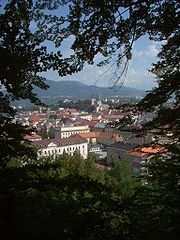 In 2005, the city had a total population of 81,704, making it the 6th largest municipality in Slovakia. The population density was 790 per square kilometer.
 The population was spread out with 13.2% under the age of 15, 68.2% in the so-called productive age (15–54 years for women and 15–59 years for men), and 18.6% in the so-called post-productive age (over 54 years for women and over 59 years for men). For every 100 women there were 89.5 men. The population was slightly decreasing (by 423) in 2005, with the number of deaths (727) higher than the number of live births (673) and a negative migration rate. The life expectancy
at birth was 75.1 years (as of 2001), which is a figure close to the median
life expectancy in the European Union
.
According to the 2001 census, the religious composition was 46.6% Roman Catholics, 30.2% people with no religious affiliation, and 13.9% Lutherans
. People's ethnic self-identification was 94.7% Slovak
and 1.4% Czech. Before World War II, the population of the city also included significant German
, Hungarian, and Jewish minorities and many people were trilingual, mastering Slovak, German, and Hungarian languages. The Jews resided for a long time in Radvaň because they used to be prohibited from entering the city. The synagogue in Banská Bystrica was built in 1867 and demolished in 1983.
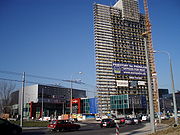 While Banská Bystrica's prosperity used to be derived from copper mining in the distant past, the most important sectors of the local economy are now tourism, timber, and mechanical industry. Two of the largest employers in Slovakia, Slovenská pošta
(the public postal service, ranked as the 3rd largest employer) and Lesy SR (the national forest service, ranked as 13th). have their headquarters in Banská Bystrica. In the period 2007–2013, the city intends to work with Zvolen
and other municipalities in the vicinity in order to jointly develop one of Slovakia's major metropolitan area
s. The municipal strategy of economic development
envisages Banská Bystrica as a regional center of tourism, services, administration, and entrepreneurship. The proclaimed three pillars of the future development are the natural and cultural heritage
, information technologies
, and infrastructure.
GDP per capita
in 2001 was €3,643, which was below Slovakia's average (€4,400). GDP per capita for the Banská Bystrica Region
(Banskobystrický kraj) in 2004 was PPS
€10,148.70 (current euros), which was below Slovakia's average of PPS €12,196.20. More recent data disaggregated to the level of districts or municipalities are not available, but all of Slovakia's regional seats have per-capita GDPs above their region averages.
The unemployment rate
in Banská Bystrica was 6.2% in December 2006, below the country's average of 9.4% at that time. The unemployment rate in the whole country has been decreasing since then, reaching 7.8% in November 2007.
The city has a balanced budget of more than one billion Slovak koruna
s (almost €33 million, as of 2007), with a small deficit of 37 million korunas. More than one fifth of the budget was used for investment. The highest revenue comes from the income tax
of persons (437 million korunas in 2006).
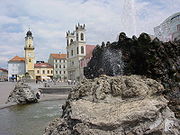 Most of the historical monuments are concentrated near its central, picturesque SNP Square
, which teems with flowers and street cafes in the summer. The square is named after the Slovak National Uprising
. It is dominated by a clock tower
built in 1552. Although less known than its famous counterpart in Pisa
, it is a leaning tower
with the top 40 centimeters (16 in.) off the perpendicular. A plague column
(Slovak: Morový stĺp) was erected in the square in the 18th century in gratitude to the Virgin Mary
for ending a deadly plague
. The column was temporarily removed before a visit of the Soviet
leader Nikita Khrushchev
in 1964 because a religious symbol was considered too embarrassing a background for the Communist leader's speech. The St. Francis Xavier Cathedral (Slovak: Kapitulský kostol, "Chapter Church") is a copy of the Jesuit
Church of the Gesu
in Rome and is since 1776 the seat of the Roman Catholic Diocese of Banská Bystrica
. Other major monuments on the square include an Art Nouveau
fountain from the beginning of the 20th century and a black obelisk
raised to the honor of the Soviet soldiers killed during the liberation of the city in 1945.
Most buildings enclosing the square and in the nearby streets are well-preserved Gothic
, Renaissance
, and Baroque
noblemen's
mansions and wealthy burghers
' residences. The most interesting among them are the Benicky House and the Thurzo House, the latter hosting a museum with a regional archaeological collection and remarkable Gothic fresco
s. Most of the buildings in the center have been transformed into luxury stores, restaurants, and cafes. SNP Square itself was completely reconstructed in 1994.
The museum located at the Memorial of the Slovak National Uprising
contains a large military collection, including an open-air exhibition
of World War II tanks, artillery, aircraft, and armored trains
.
Banská Bystrica has also a large network of marked hiking trails all around the city. In wintertime, it attracts fans of cross-country skiing
and downhill skiing
, as there are a number of ski resorts close to the city, including the Donovaly
resort famous for dogsled racing
.
at the edge of SNP Square. It is enclosed within what has remained of its original fortifications − a barbican
protecting the main gate, three bastion
s, and part of the walls. City Castle served as the city's administrative center and it also protected the king's treasury. The Parish Church
(Slovak: Farský kostol) of the Assumption of the Virgin Mary
built in the Romanesque
and Gothic styles contains precious Gothic altars and sculptures. One of the altars was carved by the famous Master Paul of Levoča
. The church was built in the 13th century. It is still surrounded by remnants of its ancient cemetery. The neighboring Church of the Holy Cross
was built in 1452 by the Slovak burghers as a counterpart to the Church of the Virgin Mary that then acquired the attribute German. The Matthias House (Slovak: Matejov dom) was built in 1479 as a five-story late-Gothic structure with a Gothic portal and stone console balcony. It served as a temporary residence of King Matthias Corvinus
and his Queen Consort
Beatrix. The Renaissance Old Town Hall, dated from 1500, has been transformed into an art museum.
was founded in 1959. It has given the opera world several diva
s, Edita Gruberová
being the most famous one. Every summer, the State Opera organizes a popular open-air festival at Zvolen Castle
. Štúdio tanca is a professional contemporary dance
theater established in 1998. A professional marionette
theater, Bábkové divadlo na Rázcestí (Puppet Theater at the Fork in the Road) founded in 1960, organizes the only marionette festival in Slovakia. Theatre from the Passage (Slovak: Divadlo z Pasáže) is Slovakia's only theater with a mentally disabled
cast whose mission is to help integrate mentally disabled people in society.
. The Old Town Hall building at City Castle hosts the State Gallery (Slovak: Štátna Galéria) specialized in contemporary
Slovak art. The Museum of the Slovak National Uprising (Slovak: Múzeum Slovenského národného povstania) features a collection of 203,000 militaria
, including an open-air exhibition of World War II heavy weapons. Other noteworthy museums are the regional Literature and Music Museum (Slovak: Literárne a hudobné múzeum) and Slovakia's only Postal Museum (Slovak: Poštové múzeum Slovenskej pošty).
ensembles for adults and three for children. Their aim is to preserve and present Slovak folklore traditions, especially the traditional music
. The oldest one is the award-winning Urpín Folklore Ensemble, founded in 1957. Mladosť Folklore Ensemble is affiliated with University of Matej Bel.
is the local football club, playing in the top Slovak football league, the Corgoň Liga. They have their home ground at SNP Stadium, with a capacity of 10,000. Other clubs based in the city include the Extraliga
ice hockey
club HC 05 Banská Bystrica
and the basketball club BKP Banská Bystrica.
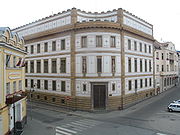 The city is governed by a mayor and a city council
(Slovak: mestské zastupiteľstvo). The mayor is the head of the city and its chief executive. The term of office is for four years. Since the 2010 municipal elections, Peter Gogola, an indepenedent, is Banská Bystrica's mayor. Banská Bystrica is divided into four electoral districts, consisting of the following neighborhoods:
Banská Bystrica is the capital of one of eight considerably autonomous Regions of Slovakia
. It used to be the capital of an even larger region, encompassing whole central Slovakia since 1960 until 1990, but this territory was divided in 1996 into the Banská Bystrica
, Žilina
and partly Trenčín
regions. Banská Bystrica is also the capital of a smaller district
. The Banská Bystrica District
(Slovak: okres Banská Bystrica) is nested within the Banská Bystrica Region (Slovak: Banskobystrický kraj).
In addition, several national public institutions have their headquarters in the city. The most prominent ones are the Tax Directorate of the Slovak Republic and the public postal service (Slovenská pošta
). The city also hosts a regional branch of National Bank of Slovakia
.
with 16,460 students, including 416 doctoral
students. Academy of Arts (Slovak: Akadémia umení) with 490 students is specialized in performing and fine art
s. A satellite campus
of the Slovak Medical University
is also located in the city.
There are 15 public primary schools, two private primary schools, and two religious primary schools. Overall, they enroll 7,029 pupils. The city's system of secondary education (some middle school
s and all high schools) consists of five gymnasia
with 3,280 students, seven specialized high schools with 2,873 students, and six vocational school
s with 1,884 students.
The largest library is the State Scientific Library with 2 million volumes. The geological institute of the Slovak Academy of Sciences
has a branch in Banská Bystrica and the small Banská Bystrica Regional Astronomical Observatory
is located on Urpín Mountain.
 Banská Bystrica has bus and train connections to the rest of the country, as well as to many other European cities.
The R1 expressway connects the city to Zvolen and to Slovakia's capital Bratislava. Some parts of this fast expressway are still under construction and the remaining work is planned to be completed by 2010. Other roads of state importance connect the city to Brezno (No. 66), to Ružomberok
(No. 59) and to Turčianske Teplice
(No. 14).
Banská Bystrica railway station
is a junction
between the Vrútky–Zvolen railway, which forms part of one of the rail links between Žilina
and Bratislava, and the Banská Bystrica–Červená Skala railway, which heads east towards Košice
.
The international Sliač Airport
offers scheduled flights to Prague
and charter flights to other destinations.
Public transport in the city is managed by two different companies. Dopravný podnik mesta Banská Bystrica is a public service run by the municipality. It operates trolleybus
es and minibus
es. The private company
SAD Zvolen has a fleet of bus
es. In addition to regular lines, it also offers express and night lines. 30% of people use their private cars for journeys to work and the average commute time is 35 minutes.
Slovakia
The Slovak Republic is a landlocked state in Central Europe. It has a population of over five million and an area of about . Slovakia is bordered by the Czech Republic and Austria to the west, Poland to the north, Ukraine to the east and Hungary to the south...
located on the Hron
Hron
Hron is a 298 km long left tributary of the Danube and the second longest river in Slovakia. It flows from its source located in the Low Tatra mountains through central and southern Slovakia, pouring into the Danube near Štúrovo and Esztergom...
River in a long and wide valley encircled by the mountain chains of the Low Tatras, the Veľká Fatra
Greater Fatra
Greater Fatra or Veľká Fatra is a mountain range in the Western Carpathians in Slovakia. In the geomorphological system, it is a part of the Fatra-Tatra Area. It is situated approximately among the towns of Ružomberok, Harmanec, Turčianske Teplice and Martin...
, and the Kremnica Mountains
Kremnica Mountains
The Kremnica Mountains are a volcanic mountain range in central Slovakia. They are part of the Western Carpathians and the Slovenské stredohorie Mts.The mountain range is situated east of the town of Kremnica, which gave it its name...
. With 81,281 inhabitants, Banská Bystrica is the sixth most populous municipality in Slovakia. It started as a permanent settlement in the 9th century and obtained the municipal privileges of a Hungarian royal
Kingdom of Hungary
The Kingdom of Hungary comprised present-day Hungary, Slovakia and Croatia , Transylvania , Carpatho Ruthenia , Vojvodina , Burgenland , and other smaller territories surrounding present-day Hungary's borders...
town in 1255. The copper mining town acquired its present picturesque look in the Late Middle Ages
Late Middle Ages
The Late Middle Ages was the period of European history generally comprising the 14th to the 16th century . The Late Middle Ages followed the High Middle Ages and preceded the onset of the early modern era ....
when the prosperous burghers built its central churches, mansions, and fortifications. It is the capital of the kraj
Regions of Slovakia
Since 1949 , Slovakia has been divided into a number of kraje . Their number, borders and functions have been changed several times. There are currently eight regions of Slovakia and they correspond to the EU's NUTS 3 level of local administrative units. Each kraj consists of okresy...
(Banská Bystrica Region
Banská Bystrica Region
The Banská Bystrica Region is one of the Slovak regions in the country of Slovakia in Europe.-Geography:It is located in the central part of Slovakia and has an area of 9,455 km². The region is prevailingly mountains, with several ranges within the area. The highest of them are the Low Tatras...
) and the okres
Districts of Slovakia
An okres is an administrative unit in Slovakia. It is inferior to a Region and superior to a municipality.-Characteristics:Several districts form a "Region"...
(Banská Bystrica District
Banská Bystrica District
Banská Bystrica District is a district in the Banská Bystrica Region of central Slovakia. Until 1918, the area belonged to the county of Zvolen within the Kingdom of Hungary.-Municipalities:*Badín*Baláže*Banská Bystrica*Brusno*Čerín...
). It is also the home of Matej Bel University
Matej Bel University
Matej Bel University is a university in the central Slovak town Banská Bystrica. It was established on 1 July 1992 and inaugurated on 23 October 1992...
. As a historical city with an easy access to the surrounding mountains, Banská Bystrica is a popular winter and summer tourist destination
Tourist destination
A tourist destination is a city, town, or other area that is dependent to a significant extent on the revenues accruing from tourism. It may contain one or more tourist attractions and possibly some "tourist traps."...
.
Etymology
The SlovakSlovak language
Slovak , is an Indo-European language that belongs to the West Slavic languages .Slovak is the official language of Slovakia, where it is spoken by 5 million people...
name (Banská Bystrica) includes two distinct roots: the adjective Banská (from Slovak
Slovak language
Slovak , is an Indo-European language that belongs to the West Slavic languages .Slovak is the official language of Slovakia, where it is spoken by 5 million people...
baňa – "mine") and the name of the local river Bystrica (from Slavic bystrica – "a swift stream"). Its name in is of the same etymological origin.
The river lent its name to the town as early as 1255 when the Latin
Latin
Latin is an Italic language originally spoken in Latium and Ancient Rome. It, along with most European languages, is a descendant of the ancient Proto-Indo-European language. Although it is considered a dead language, a number of scholars and members of the Christian clergy speak it fluently, and...
name Villa Nova Bystrice (meaning "New Town of Bystrica") was recorded. Several variations of Bystrica (Byztherze, Bystrice, Bystrzice etc.) were then regularly used without the adjective identifying it as a mining town until the late 16th century. Although the first written record of the Hungarian name Byzterchebana dates from 1263, it was rarely used afterwards.
The old German
Old German
Old German usually refers to Old High German, but it could also refer to:*Old Low German *Altdeutsche Tracht , a dress style popular among early 19th century German radicals...
name Neusohl ("New Zvolen") (first recorded in 1300) and later its Latin version (Neosolium) reflected the fact that some early settlers came from the nearby town of Zvolen
Zvolen
Zvolen |Slatina]] rivers, close to Banská Bystrica. With its ancient castle, the town has a historical center, which represents the seat of an okres .-History:...
(at the time known in German as Altsohl, literally "Old Zvolen").
The two names have been used in parallel and even complementary (as in Novizolii Bistriciensis) throughout the history of the town. In the late 16th century the use of the mining adjective became more frequent (as in Bystrzicze na baniech or Bystricze Banska, both from 1530). This evolution resulted in the current form of the name, first recorded in 1773 as Banska Bistryca.
After 1867 the Hungarian name Besztercebánya became the official one, replacing both of the aforementioned names, having its origin probably in Byztherczebana from 1293. The parallel use of Slovak or German names in the written record did not, however, cease in this period.
Banská Bystrica became the official name of the city in 1920.
| Previous names | |
| Name | Recorded in |
|---|---|
| Noua villa Bystrice prope Lypcham | 1255 |
| Byzterchebana | 1263 |
| Bystricia | 1287 |
| Neusohl | 1300 |
| Nouisolium | 1303 |
| Byztricia | 1340 |
| Bystrichia | 1400 |
| Bistriciensis civitas alias Novizolium |
1424 |
| Nouozolium | 1446 |
| Beszterczebánya | 1753 |
| Banska Bistryca | 1773 |
| Besztercebánya | 1898 |
| Baňská Bystrica | 1920 |
| Banská Bystrica | 1927 |
History
The earliest history of Banská Bystrica was connected with the exploitation of its abundant deposits of copper (and to a lesser extent of silver, gold, and iron). The tools used by prehistoric miners at the locality called Špania DolinaŠpania Dolina
Špania Dolina is a village and municipality in central Slovakia, near the city of Banská Bystrica. Although its permanent population does not exceed 200 people, it is a picturesque historic village situated 728 m above sea level and is surrounded by the Staré Hory and Veľká Fatra mountains...
have been dated to 2000–1700 BCE. People of the Lusatian culture
Lusatian culture
The Lusatian culture existed in the later Bronze Age and early Iron Age in most of today's Poland, parts of Czech Republic and Slovakia, parts of eastern Germany and parts of Ukraine...
built their settlements at Špania Dolina, Horné Pršany
Horné Pršany
Horné Pršany is a village and municipality of the Banská Bystrica District in the Banská Bystrica Region of Slovakia-History:In historical records, the village was first mentioned in 1407 .-External links:*http://www.horneprsany.sk...
, Malachov
Malachov
Malachov is a village and municipality in Banská Bystrica District in the Banská Bystrica Region of central Slovakia.-Geography:The municipality lies at an altitude of 505 metres and covers an area of 6.266km². It has a population of about 918 people....
, and Sásová
Šašová
Šašová is a village and municipality in Bardejov District in the Prešov Region of north-east Slovakia.-Geography:The municipality lies at an altitude of 255 metres and covers an area of 5.279 km².It has a population of about 158 people.-External links:...
. Ancient hill fort
Hill fort
A hill fort is a type of earthworks used as a fortified refuge or defended settlement, located to exploit a rise in elevation for defensive advantage. They are typically European and of the Bronze and Iron Ages. Some were used in the post-Roman period...
locations are still reflected in the local toponym
Toponymy
Toponymy is the scientific study of place names , their origins, meanings, use and typology. The word "toponymy" is derived from the Greek words tópos and ónoma . Toponymy is itself a branch of onomastics, the study of names of all kinds...
Hrádok, meaning "a small fort (later: castle)". The territory was inhabited by the Celtic tribe of the Cotini
Cotini
Cotini was a Celtic tribe most probably living in today's Slovakia, and in Moravia and southern Poland. They were probably identical or constituted a significant part of the archaeological Púchov culture, with the center in Havránok.The tribe was first time mentioned in 10 BC in the Elogium of...
(Púchov culture
Púchov culture
The Púchov culture was an archaeological culture named after site of Púchov-Skalka in Slovakia. Its probable bearer was the Celt Cotini tribe. It existed in northern and central Slovakia between the 2nd century BCE and the 1st century CE...
) in the 3rd century BCE. The Germanic tribe
Germanic peoples
The Germanic peoples are an Indo-European ethno-linguistic group of Northern European origin, identified by their use of the Indo-European Germanic languages which diversified out of Proto-Germanic during the Pre-Roman Iron Age.Originating about 1800 BCE from the Corded Ware Culture on the North...
of the Quadi
Quadi
The Quadi were a smaller Germanic tribe, about which little is definitively known. We only know the Germanic tribe the Romans called the 'Quadi' through reports of the Romans themselves...
took over the place during the Roman Era, leaving for instance a hoard
Hoard
In archaeology, a hoard is a collection of valuable objects or artifacts, sometimes purposely buried in the ground. This would usually be with the intention of later recovery by the hoarder; hoarders sometimes died before retrieving the hoard, and these surviving hoards may be uncovered by...
of silver artifacts in Netopierska jaskyňa (Bat Cave).
The present city was built upon a Slavic settlement, founded in the 9th century CE. It was later incorporated in Zólyom county in the Kingdom of Hungary
Kingdom of Hungary
The Kingdom of Hungary comprised present-day Hungary, Slovakia and Croatia , Transylvania , Carpatho Ruthenia , Vojvodina , Burgenland , and other smaller territories surrounding present-day Hungary's borders...
. The first known stone church was built by Saxon
Saxons
The Saxons were a confederation of Germanic tribes originating on the North German plain. The Saxons earliest known area of settlement is Northern Albingia, an area approximately that of modern Holstein...
immigrants in the then still independent settlement of Sásová
Šašová
Šašová is a village and municipality in Bardejov District in the Prešov Region of north-east Slovakia.-Geography:The municipality lies at an altitude of 255 metres and covers an area of 5.279 km².It has a population of about 158 people.-External links:...
in the first half of the 13th century. In 1255, King Béla IV
Béla IV of Hungary
Béla IV , King of Hungary and of Croatia , duke of Styria 1254–58. One of the most famous kings of Hungary, he distinguished himself through his policy of strengthening of the royal power following the example of his grandfather Bela III, and by the rebuilding Hungary after the catastrophe of the...
granted Banská Bystrica extensive municipal privileges in order to attract more skilled settlers. Descendants of the German immigrants to this and other counties became later known as the Carpathian Germans
Carpathian Germans
Carpathian Germans , sometimes simply called Slovak Germans , are a group of German language speakers on the territory of present-day Slovakia...
. The city flourished as a regional mining center. It built the Late Romanesque
Romanesque architecture
Romanesque architecture is an architectural style of Medieval Europe characterised by semi-circular arches. There is no consensus for the beginning date of the Romanesque architecture, with proposals ranging from the 6th to the 10th century. It developed in the 12th century into the Gothic style,...
Church of the Virgin Mary in the second half of the 13th century. During the same period, Banská Bystrica obtained its own coat of arms
Coat of arms
A coat of arms is a unique heraldic design on a shield or escutcheon or on a surcoat or tabard used to cover and protect armour and to identify the wearer. Thus the term is often stated as "coat-armour", because it was anciently displayed on the front of a coat of cloth...
inspired by the coat of arms of the ruling dynasty of the Árpáds
Árpád dynasty
The Árpáds or Arpads was the ruling dynasty of the federation of the Hungarian tribes and of the Kingdom of Hungary . The dynasty was named after Grand Prince Árpád who was the head of the tribal federation when the Magyars occupied the Carpathian Basin, circa 895...
, also used as the historical flag of the Kingdom of Hungary. The local craftsmen were organized in fifty guild
Guild
A guild is an association of craftsmen in a particular trade. The earliest types of guild were formed as confraternities of workers. They were organized in a manner something between a trade union, a cartel, and a secret society...
s, with the butchers' guild being the oldest.
Fugger
The Fugger family was a historically prominent group of European bankers, members of the fifteenth and sixteenth-century mercantile patriciate of Augsburg, international mercantile bankers, and venture capitalists like the Welser and the Höchstetter families. This banking family replaced the de'...
and Thurzo
Thurzo
Thurzo or Turzo was a Hungarian noble family from the 15th century to the first half of the 17th century.The ancestors of the Thurzo family came to the Kingdom of Hungary from Lower Austria....
families founded the prosperous Ungarischer Handel company (German for "Hungarian Trade") in 1494. Depending mainly on the mines around Banská Bystrica, the company had become a leading world producer of copper by the 16th century. With the most sophisticated mining technologies in Europe, an advanced accounting system, and benefits including medical care
Health care
Health care is the diagnosis, treatment, and prevention of disease, illness, injury, and other physical and mental impairments in humans. Health care is delivered by practitioners in medicine, chiropractic, dentistry, nursing, pharmacy, allied health, and other care providers...
for its 1,000 employees, Ungarischer Handel was one of the largest and most modern early-capitalist firms. An early record of the miners' industrial action is from 1526 when the City Council needed to take refuge within the confines of City Castle. The Ottoman Empire
Ottoman Empire
The Ottoman EmpireIt was usually referred to as the "Ottoman Empire", the "Turkish Empire", the "Ottoman Caliphate" or more commonly "Turkey" by its contemporaries...
's thrust northwards
Ottoman wars in Europe
The wars of the Ottoman Empire in Europe are also sometimes referred to as the Ottoman Wars or as Turkish Wars, particularly in older, European texts.- Rise :...
led the magistrate
Magistrate
A magistrate is an officer of the state; in modern usage the term usually refers to a judge or prosecutor. This was not always the case; in ancient Rome, a magistratus was one of the highest government officers and possessed both judicial and executive powers. Today, in common law systems, a...
to improve the city's fortifications with modern stone walls in 1589, but the Turks never occupied the region. Banská Bystrica became one of the foremost centers of the Protestant Reformation
Protestant Reformation
The Protestant Reformation was a 16th-century split within Western Christianity initiated by Martin Luther, John Calvin and other early Protestants. The efforts of the self-described "reformers", who objected to the doctrines, rituals and ecclesiastical structure of the Roman Catholic Church, led...
in the Kingdom of Hungary
Kingdom of Hungary
The Kingdom of Hungary comprised present-day Hungary, Slovakia and Croatia , Transylvania , Carpatho Ruthenia , Vojvodina , Burgenland , and other smaller territories surrounding present-day Hungary's borders...
in the 16th century. Later on, the city had to fight for its religious freedom
Freedom of religion
Freedom of religion is a principle that supports the freedom of an individual or community, in public or private, to manifest religion or belief in teaching, practice, worship, and observance; the concept is generally recognized also to include the freedom to change religion or not to follow any...
guaranteed by the Royal Charter
Royal Charter
A royal charter is a formal document issued by a monarch as letters patent, granting a right or power to an individual or a body corporate. They were, and are still, used to establish significant organizations such as cities or universities. Charters should be distinguished from warrants and...
against the ruling dynasty of the Austria
Austria
Austria , officially the Republic of Austria , is a landlocked country of roughly 8.4 million people in Central Europe. It is bordered by the Czech Republic and Germany to the north, Slovakia and Hungary to the east, Slovenia and Italy to the south, and Switzerland and Liechtenstein to the...
n Roman Catholic Habsburgs, for its physical independence against the Ottoman Turks
Ottoman Turks
The Ottoman Turks were the Turkish-speaking population of the Ottoman Empire who formed the base of the state's military and ruling classes. Reliable information about the early history of Ottoman Turks is scarce, but they take their Turkish name, Osmanlı , from the house of Osman I The Ottoman...
and for its self-governance against the Kingdom of Hungary's powerful magnate
Magnate
Magnate, from the Late Latin magnas, a great man, itself from Latin magnus 'great', designates a noble or other man in a high social position, by birth, wealth or other qualities...
s. In 1620 Prince Gabriel Bethlen
Gabriel Bethlen
Gabriel Bethlen was a prince of Transylvania , duke of Opole and leader of an anti-Habsburg insurrection in the Habsburg Royal Hungary. His last armed intervention in 1626 was part of the Thirty Years' War...
of Transylvania
Transylvania
Transylvania is a historical region in the central part of Romania. Bounded on the east and south by the Carpathian mountain range, historical Transylvania extended in the west to the Apuseni Mountains; however, the term sometimes encompasses not only Transylvania proper, but also the historical...
, a Protestant, was elected King
Elective monarchy
An elective monarchy is a monarchy ruled by an elected rather than hereditary monarch. The manner of election, the nature of the candidacy and the electors vary from case to case...
of Hungary by the Diet
Diet (assembly)
In politics, a diet is a formal deliberative assembly. The term is mainly used historically for the Imperial Diet, the general assembly of the Imperial Estates of the Holy Roman Empire, and for the legislative bodies of certain countries.-Etymology:...
meeting at Banská Bystrica.
The village of Radvaň
Radvan, Banská Bystrica
Radvaň is a borough of Banská Bystrica, located south-west of the city centre. Until 1964 it was a separate village, when it was merged into village Radvaň-Kráľová, which in turn was made a part of Banská Bystrica in 1966....
, now a borough of Banská Bystrica, was granted the economically important right to hold annual fairs (Radvanský jarmok) in 1655. The fair was transferred to Banská Bystrica's main square in the 20th century. The copper deposits had been all but depleted by the 18th century, but new industries, such as timber
Lumber
Lumber or timber is wood in any of its stages from felling through readiness for use as structural material for construction, or wood pulp for paper production....
, paper, and textiles, developed. In 1766 the city became the capital of Zvolen County when Banská Bystrica also became the seat of a Roman Catholic bishopric
Roman Catholic Diocese of Banská Bystrica
The Diocese of Banská Bystrica is a Roman Catholic diocese in central Slovakia. Its seat is in Banská Bystrica. The bishop seat is vacant.-History:The diocese was established on 13 March 1776 as a suffragan of the Archdiocese of Esztergom...
(1776) and of several institutions of higher education. Public services
Public services
Public services is a term usually used to mean services provided by government to its citizens, either directly or by financing private provision of services. The term is associated with a social consensus that certain services should be available to all, regardless of income...
expanded in the 19th century with the foundation of a permanent municipal hospital (1820), a municipal theater (1841), and a municipal museum (1889). The railway reached the town from Zvolen in 1873.
During World War II, Banská Bystrica became the center of anti-Nazi
Nazism
Nazism, the common short form name of National Socialism was the ideology and practice of the Nazi Party and of Nazi Germany...
opposition in Slovakia when the Slovak National Uprising
Slovak National Uprising
The Slovak National Uprising or 1944 Uprising was an armed insurrection organized by the Slovak resistance movement during World War II. It was launched on August 29 1944 from Banská Bystrica in an attempt to overthrow the collaborationist Slovak State of Jozef Tiso...
, one of the largest anti-Nazi resistance events in Europe, was launched from the city on 29 August 1944. The insurgents were defeated on 27 October, however, and Banská Bystrica was briefly occupied by the German forces before it was liberated by Soviet and Romanian troops on 26 March 1945. After the war, Banská Bystrica became the administrative, economic, and cultural hub of central Slovakia. It has been a university town
College town
A college town or university town is a community which is dominated by its university population...
since the 1950s. Its largest Matej Bel University
Matej Bel University
Matej Bel University is a university in the central Slovak town Banská Bystrica. It was established on 1 July 1992 and inaugurated on 23 October 1992...
was founded in 1992.
Geography
Banská Bystrica lies at an altitude of 362 metres (1,188 ft) above sea levelAbove mean sea level
The term above mean sea level refers to the elevation or altitude of any object, relative to the average sea level datum. AMSL is used extensively in radio by engineers to determine the coverage area a station will be able to reach...
and covers an area of 103.37 square kilometres (39.9 sq mi). It is about half way between Slovakia's two largest cities, 208 kilometres (129 mi) north-east from Slovakia's capital Bratislava
Bratislava
Bratislava is the capital of Slovakia and, with a population of about 431,000, also the country's largest city. Bratislava is in southwestern Slovakia on both banks of the Danube River. Bordering Austria and Hungary, it is the only national capital that borders two independent countries.Bratislava...
and 217 kilometres (135 mi) west of Košice
Košice
Košice is a city in eastern Slovakia. It is situated on the river Hornád at the eastern reaches of the Slovak Ore Mountains, near the border with Hungary...
. A chain of discrete suburbs and villages connects it with Zvolen, another major town 20 kilometres (12 mi) to the south.
Banská Bystrica is situated in the Hron River valley . The Hron River curves through the city from the east to the south. The city nests among three mountain chains: the Low Tatras to the north-east, the Veľká Fatra
Greater Fatra
Greater Fatra or Veľká Fatra is a mountain range in the Western Carpathians in Slovakia. In the geomorphological system, it is a part of the Fatra-Tatra Area. It is situated approximately among the towns of Ružomberok, Harmanec, Turčianske Teplice and Martin...
to the north-west, and the Kremnica Mountains
Kremnica Mountains
The Kremnica Mountains are a volcanic mountain range in central Slovakia. They are part of the Western Carpathians and the Slovenské stredohorie Mts.The mountain range is situated east of the town of Kremnica, which gave it its name...
to the west. All three are protected area
Protected area
Protected areas are locations which receive protection because of their recognised natural, ecological and/or cultural values. There are several kinds of protected areas, which vary by level of protection depending on the enabling laws of each country or the regulations of the international...
s because of their environmental value. Banská Bystrica hosts the headquarters of the Low Tatra National Park
Low Tatras National Park
Low Tatras National Park is a national park in Central Slovakia, between the Váh River and the Hron River valleys. The park and its buffer zone cover the whole Low Tatras mountain range...
. Despite the proximity of these mountain range
Mountain range
A mountain range is a single, large mass consisting of a succession of mountains or narrowly spaced mountain ridges, with or without peaks, closely related in position, direction, formation, and age; a component part of a mountain system or of a mountain chain...
s, the local landscape is dominated by the much lower Urpín
Urpín
Urpín is a mountain in the city of Banská Bystrica, Slovakia. It is situated on the left bank of the Hron river, above the old town. Despite its low elevation of 510 m AMSL , Urpín dominates the cityscape due to its proximity to the city center...
Mountain, 510 metres (1,673 ft), which is a popular place of recreation.
Climate
Banská Bystrica lies in the north temperate zone and has a continental climateContinental climate
Continental climate is a climate characterized by important annual variation in temperature due to the lack of significant bodies of water nearby...
with four distinct seasons. It is characterized by a significant variation between hot summers and cold, snowy winters.
Demographics
| Historical population of Banská Bystrica | |||||||
| Year | 1720 | 1869 | 1918 | 1950 | 1980 | 1991 | 2001 |
| Pop. | 2,646 | 5,950 | 10,776 | 22,651 | 62,923 | 83,698 | 83,056 |
Life expectancy
Life expectancy is the expected number of years of life remaining at a given age. It is denoted by ex, which means the average number of subsequent years of life for someone now aged x, according to a particular mortality experience...
at birth was 75.1 years (as of 2001), which is a figure close to the median
Median
In probability theory and statistics, a median is described as the numerical value separating the higher half of a sample, a population, or a probability distribution, from the lower half. The median of a finite list of numbers can be found by arranging all the observations from lowest value to...
life expectancy in the European Union
European Union
The European Union is an economic and political union of 27 independent member states which are located primarily in Europe. The EU traces its origins from the European Coal and Steel Community and the European Economic Community , formed by six countries in 1958...
.
According to the 2001 census, the religious composition was 46.6% Roman Catholics, 30.2% people with no religious affiliation, and 13.9% Lutherans
Lutheranism
Lutheranism is a major branch of Western Christianity that identifies with the theology of Martin Luther, a German reformer. Luther's efforts to reform the theology and practice of the church launched the Protestant Reformation...
. People's ethnic self-identification was 94.7% Slovak
Slovaks
The Slovaks, Slovak people, or Slovakians are a West Slavic people that primarily inhabit Slovakia and speak the Slovak language, which is closely related to the Czech language.Most Slovaks today live within the borders of the independent Slovakia...
and 1.4% Czech. Before World War II, the population of the city also included significant German
Carpathian Germans
Carpathian Germans , sometimes simply called Slovak Germans , are a group of German language speakers on the territory of present-day Slovakia...
, Hungarian, and Jewish minorities and many people were trilingual, mastering Slovak, German, and Hungarian languages. The Jews resided for a long time in Radvaň because they used to be prohibited from entering the city. The synagogue in Banská Bystrica was built in 1867 and demolished in 1983.
| Historical populations by ethnicity | |||
| Year | Slovaks | Germans | Hungarians |
| 1715 | 1,899 | 873 | 279 |
| 1850 | 4,221 | 978 | 44 |
| 1910 | 4,388 | ? | 5,261 |
| 1919 | 8,265 | 406 | 1,565 |
| 2001 | 78,700 | 53 | 446 |
Economy
Slovenská pošta
Slovenská pošta, a. s. is a state-owned company responsible for providing postal service in Slovakia established on January 1, 1993. It operates 1,566 post offices throughout the country. It is also the third largest employer in Slovakia. Since 1996, the headquarters are located in Banská Bystrica....
(the public postal service, ranked as the 3rd largest employer) and Lesy SR (the national forest service, ranked as 13th). have their headquarters in Banská Bystrica. In the period 2007–2013, the city intends to work with Zvolen
Zvolen
Zvolen |Slatina]] rivers, close to Banská Bystrica. With its ancient castle, the town has a historical center, which represents the seat of an okres .-History:...
and other municipalities in the vicinity in order to jointly develop one of Slovakia's major metropolitan area
Metropolitan area
The term metropolitan area refers to a region consisting of a densely populated urban core and its less-populated surrounding territories, sharing industry, infrastructure, and housing. A metropolitan area usually encompasses multiple jurisdictions and municipalities: neighborhoods, townships,...
s. The municipal strategy of economic development
Economic development
Economic development generally refers to the sustained, concerted actions of policymakers and communities that promote the standard of living and economic health of a specific area...
envisages Banská Bystrica as a regional center of tourism, services, administration, and entrepreneurship. The proclaimed three pillars of the future development are the natural and cultural heritage
Cultural heritage
Cultural heritage is the legacy of physical artifacts and intangible attributes of a group or society that are inherited from past generations, maintained in the present and bestowed for the benefit of future generations...
, information technologies
Information technology
Information technology is the acquisition, processing, storage and dissemination of vocal, pictorial, textual and numerical information by a microelectronics-based combination of computing and telecommunications...
, and infrastructure.
GDP per capita
Gross domestic product
Gross domestic product refers to the market value of all final goods and services produced within a country in a given period. GDP per capita is often considered an indicator of a country's standard of living....
in 2001 was €3,643, which was below Slovakia's average (€4,400). GDP per capita for the Banská Bystrica Region
Banská Bystrica Region
The Banská Bystrica Region is one of the Slovak regions in the country of Slovakia in Europe.-Geography:It is located in the central part of Slovakia and has an area of 9,455 km². The region is prevailingly mountains, with several ranges within the area. The highest of them are the Low Tatras...
(Banskobystrický kraj) in 2004 was PPS
Purchasing power parity
In economics, purchasing power parity is a condition between countries where an amount of money has the same purchasing power in different countries. The prices of the goods between the countries would only reflect the exchange rates...
€10,148.70 (current euros), which was below Slovakia's average of PPS €12,196.20. More recent data disaggregated to the level of districts or municipalities are not available, but all of Slovakia's regional seats have per-capita GDPs above their region averages.
The unemployment rate
Unemployment
Unemployment , as defined by the International Labour Organization, occurs when people are without jobs and they have actively sought work within the past four weeks...
in Banská Bystrica was 6.2% in December 2006, below the country's average of 9.4% at that time. The unemployment rate in the whole country has been decreasing since then, reaching 7.8% in November 2007.
The city has a balanced budget of more than one billion Slovak koruna
Slovak koruna
In 1993, coins were introduced in denominations of 10, 20 and 50 haliers, 1, 2, 5 and 10 korunas. The 10 and 20 halier coins were taken out of circulation on 31 December 2003....
s (almost €33 million, as of 2007), with a small deficit of 37 million korunas. More than one fifth of the budget was used for investment. The highest revenue comes from the income tax
Income tax
An income tax is a tax levied on the income of individuals or businesses . Various income tax systems exist, with varying degrees of tax incidence. Income taxation can be progressive, proportional, or regressive. When the tax is levied on the income of companies, it is often called a corporate...
of persons (437 million korunas in 2006).
Places of interest
Slovak National Uprising Square, Banská Bystrica
Slovak National Uprising Square , or SNP Square is an area in central Banská Bystrica, Slovakia, named after the insurgency of 1944. It has been the hub of the city's life and a prestigious address for more than 600 years...
, which teems with flowers and street cafes in the summer. The square is named after the Slovak National Uprising
Slovak National Uprising
The Slovak National Uprising or 1944 Uprising was an armed insurrection organized by the Slovak resistance movement during World War II. It was launched on August 29 1944 from Banská Bystrica in an attempt to overthrow the collaborationist Slovak State of Jozef Tiso...
. It is dominated by a clock tower
Clock tower
A clock tower is a tower specifically built with one or more clock faces. Clock towers can be either freestanding or part of a church or municipal building such as a town hall. Some clock towers are not true clock towers having had their clock faces added to an already existing building...
built in 1552. Although less known than its famous counterpart in Pisa
Leaning Tower of Pisa
The Leaning Tower of Pisa or simply the Tower of Pisa is the campanile, or freestanding bell tower, of the cathedral of the Italian city of Pisa...
, it is a leaning tower
Leaning tower
This is a list of leaning towers. A leaning tower is a tower which, either intentionally, due to errors in design, construction or to subsequent external influence, does not stand perpendicular to the ground...
with the top 40 centimeters (16 in.) off the perpendicular. A plague column
Marian and Holy Trinity columns
Marian columns are religious monuments built in honour of the Virgin Mary, often in thanksgiving for the ending of a plague or for some other help. The purpose of the Holy Trinity columns was usually simply to celebrate the church and the faith. However, the plague motif could sometimes play its...
(Slovak: Morový stĺp) was erected in the square in the 18th century in gratitude to the Virgin Mary
Mary (mother of Jesus)
Mary , commonly referred to as "Saint Mary", "Mother Mary", the "Virgin Mary", the "Blessed Virgin Mary", or "Mary, Mother of God", was a Jewish woman of Nazareth in Galilee...
for ending a deadly plague
Bubonic plague
Plague is a deadly infectious disease that is caused by the enterobacteria Yersinia pestis, named after the French-Swiss bacteriologist Alexandre Yersin. Primarily carried by rodents and spread to humans via fleas, the disease is notorious throughout history, due to the unrivaled scale of death...
. The column was temporarily removed before a visit of the Soviet
Soviet Union
The Soviet Union , officially the Union of Soviet Socialist Republics , was a constitutionally socialist state that existed in Eurasia between 1922 and 1991....
leader Nikita Khrushchev
Nikita Khrushchev
Nikita Sergeyevich Khrushchev led the Soviet Union during part of the Cold War. He served as First Secretary of the Communist Party of the Soviet Union from 1953 to 1964, and as Chairman of the Council of Ministers, or Premier, from 1958 to 1964...
in 1964 because a religious symbol was considered too embarrassing a background for the Communist leader's speech. The St. Francis Xavier Cathedral (Slovak: Kapitulský kostol, "Chapter Church") is a copy of the Jesuit
Society of Jesus
The Society of Jesus is a Catholic male religious order that follows the teachings of the Catholic Church. The members are called Jesuits, and are also known colloquially as "God's Army" and as "The Company," these being references to founder Ignatius of Loyola's military background and a...
Church of the Gesu
Church of the Gesu
The Church of the Gesù is the mother church of the Society of Jesus, a Roman Catholic religious order also known as the Jesuits. Officially named , its facade is "the first truly baroque façade", introducing the baroque style into architecture ,. The church served as model for innumerable Jesuit...
in Rome and is since 1776 the seat of the Roman Catholic Diocese of Banská Bystrica
Roman Catholic Diocese of Banská Bystrica
The Diocese of Banská Bystrica is a Roman Catholic diocese in central Slovakia. Its seat is in Banská Bystrica. The bishop seat is vacant.-History:The diocese was established on 13 March 1776 as a suffragan of the Archdiocese of Esztergom...
. Other major monuments on the square include an Art Nouveau
Art Nouveau
Art Nouveau is an international philosophy and style of art, architecture and applied art—especially the decorative arts—that were most popular during 1890–1910. The name "Art Nouveau" is French for "new art"...
fountain from the beginning of the 20th century and a black obelisk
Obelisk
An obelisk is a tall, four-sided, narrow tapering monument which ends in a pyramid-like shape at the top, and is said to resemble a petrified ray of the sun-disk. A pair of obelisks usually stood in front of a pylon...
raised to the honor of the Soviet soldiers killed during the liberation of the city in 1945.
Most buildings enclosing the square and in the nearby streets are well-preserved Gothic
Gothic architecture
Gothic architecture is a style of architecture that flourished during the high and late medieval period. It evolved from Romanesque architecture and was succeeded by Renaissance architecture....
, Renaissance
Renaissance architecture
Renaissance architecture is the architecture of the period between the early 15th and early 17th centuries in different regions of Europe, demonstrating a conscious revival and development of certain elements of ancient Greek and Roman thought and material culture. Stylistically, Renaissance...
, and Baroque
Baroque architecture
Baroque architecture is a term used to describe the building style of the Baroque era, begun in late sixteenth century Italy, that took the Roman vocabulary of Renaissance architecture and used it in a new rhetorical and theatrical fashion, often to express the triumph of the Catholic Church and...
noblemen's
Nobility
Nobility is a social class which possesses more acknowledged privileges or eminence than members of most other classes in a society, membership therein typically being hereditary. The privileges associated with nobility may constitute substantial advantages over or relative to non-nobles, or may be...
mansions and wealthy burghers
Bourgeoisie
In sociology and political science, bourgeoisie describes a range of groups across history. In the Western world, between the late 18th century and the present day, the bourgeoisie is a social class "characterized by their ownership of capital and their related culture." A member of the...
' residences. The most interesting among them are the Benicky House and the Thurzo House, the latter hosting a museum with a regional archaeological collection and remarkable Gothic fresco
Fresco
Fresco is any of several related mural painting types, executed on plaster on walls or ceilings. The word fresco comes from the Greek word affresca which derives from the Latin word for "fresh". Frescoes first developed in the ancient world and continued to be popular through the Renaissance...
s. Most of the buildings in the center have been transformed into luxury stores, restaurants, and cafes. SNP Square itself was completely reconstructed in 1994.
The museum located at the Memorial of the Slovak National Uprising
Slovak National Uprising
The Slovak National Uprising or 1944 Uprising was an armed insurrection organized by the Slovak resistance movement during World War II. It was launched on August 29 1944 from Banská Bystrica in an attempt to overthrow the collaborationist Slovak State of Jozef Tiso...
contains a large military collection, including an open-air exhibition
Open air museum
An open-air museum is a distinct type of museum exhibiting its collections out-of-doors. The first open-air museums were established in Scandinavia towards the end of the nineteenth century, and the concept soon spread throughout Europe and North America. Open-air museums are variously known as...
of World War II tanks, artillery, aircraft, and armored trains
Armoured train
An armoured train is a train protected with armour. They are usually equipped with railroad cars armed with artillery and machine guns. They were mostly used during the late 19th and early 20th century, when they offered an innovative way to quickly move large amounts of firepower...
.
Banská Bystrica has also a large network of marked hiking trails all around the city. In wintertime, it attracts fans of cross-country skiing
Cross-country skiing
Cross-country skiing is a winter sport in which participants propel themselves across snow-covered terrain using skis and poles...
and downhill skiing
Downhill
Downhill is an alpine skiing discipline. The rules for the Downhill were originally developed by Sir Arnold Lunn for the 1921 British National Ski Championships....
, as there are a number of ski resorts close to the city, including the Donovaly
Donovaly
Donovaly is a village in the Banská Bystrica Region of central Slovakia. Being situated in an important pass between the mountains of Veľká Fatra and Starohorské vrchy, on the route connecting Banská Bystrica with Ružomberok, it became a prominent centre of winter and summer...
resort famous for dogsled racing
Dogsled racing
Sled dog racing is a winter dog sport most popular in the Arctic regions of the United States, Canada, Russia, and some European countries. It involves the timed competition of teams of sleddogs that pull a sled with the dog driver or musher standing on the runners...
.
City Castle
The oldest part of Banská Bystrica is City CastleCastle
A castle is a type of fortified structure built in Europe and the Middle East during the Middle Ages by European nobility. Scholars debate the scope of the word castle, but usually consider it to be the private fortified residence of a lord or noble...
at the edge of SNP Square. It is enclosed within what has remained of its original fortifications − a barbican
Barbican
A barbican, from medieval Latin barbecana, signifying the "outer fortification of a city or castle," with cognates in the Romance languages A barbican, from medieval Latin barbecana, signifying the "outer fortification of a city or castle," with cognates in the Romance languages A barbican, from...
protecting the main gate, three bastion
Bastion
A bastion, or a bulwark, is a structure projecting outward from the main enclosure of a fortification, situated in both corners of a straight wall , facilitating active defence against assaulting troops...
s, and part of the walls. City Castle served as the city's administrative center and it also protected the king's treasury. The Parish Church
Parish church
A parish church , in Christianity, is the church which acts as the religious centre of a parish, the basic administrative unit of episcopal churches....
(Slovak: Farský kostol) of the Assumption of the Virgin Mary
Mary (mother of Jesus)
Mary , commonly referred to as "Saint Mary", "Mother Mary", the "Virgin Mary", the "Blessed Virgin Mary", or "Mary, Mother of God", was a Jewish woman of Nazareth in Galilee...
built in the Romanesque
Romanesque architecture
Romanesque architecture is an architectural style of Medieval Europe characterised by semi-circular arches. There is no consensus for the beginning date of the Romanesque architecture, with proposals ranging from the 6th to the 10th century. It developed in the 12th century into the Gothic style,...
and Gothic styles contains precious Gothic altars and sculptures. One of the altars was carved by the famous Master Paul of Levoča
Master Paul of Levoca
Master Paul of Levoča was a medieval carver and sculptor of the15th and 16th century, active mostly in the town of Levoča , in the Kingdom of Hungary, in what is today eastern Slovakia....
. The church was built in the 13th century. It is still surrounded by remnants of its ancient cemetery. The neighboring Church of the Holy Cross
Holy Cross Church
-Australia:*Holy Cross Catholic Parish, Redcliffe City, Queensland*Holy Cross Catholic Parish, Adelaide, South Australia-Canada:*Church of the Holy Cross, Skatin First Nation, British Columbia*Holy Cross Catholic Parish -England:...
was built in 1452 by the Slovak burghers as a counterpart to the Church of the Virgin Mary that then acquired the attribute German. The Matthias House (Slovak: Matejov dom) was built in 1479 as a five-story late-Gothic structure with a Gothic portal and stone console balcony. It served as a temporary residence of King Matthias Corvinus
Matthias Corvinus of Hungary
Matthias Corvinus , also called the Just in folk tales, was King of Hungary and Croatia from 1458, at the age of 14 until his death...
and his Queen Consort
Queen consort
A queen consort is the wife of a reigning king. A queen consort usually shares her husband's rank and holds the feminine equivalent of the king's monarchical titles. Historically, queens consort do not share the king regnant's political and military powers. Most queens in history were queens consort...
Beatrix. The Renaissance Old Town Hall, dated from 1500, has been transformed into an art museum.
Theaters
There are four theaters in Banská Bystrica. The State OperaOpera house
An opera house is a theatre building used for opera performances that consists of a stage, an orchestra pit, audience seating, and backstage facilities for costumes and set building...
was founded in 1959. It has given the opera world several diva
Diva
A diva is a celebrated female singer. The term is used to describe a woman of outstanding talent in the world of opera, and, by extension, in theatre, cinema and popular music. The meaning of diva is closely related to that of "prima donna"....
s, Edita Gruberová
Edita Gruberová
Edita Gruberová , is a Slovak soprano who is one of the most acclaimed coloraturas of recent decades. She is noted for her great tonal clarity, agility, dramatic interpretation, and ability to sing high notes with great power, which made her an ideal Queen of the Night in her early years...
being the most famous one. Every summer, the State Opera organizes a popular open-air festival at Zvolen Castle
Zvolen Castle
Zvolen Castle is a medieval castle located on a hill near the center of Zvolen, in central Slovakia.The original seat of the region was above the confluence of Slatina and Hron rivers on a steep cliff in a castle from the 12th century, known today as Pustý hrad...
. Štúdio tanca is a professional contemporary dance
Contemporary dance
Contemporary dance is a genre of concert dance that employs compositional philosophy, rather than choreography, to guide unchoreographed movement...
theater established in 1998. A professional marionette
Marionette
A marionette is a puppet controlled from above using wires or strings depending on regional variations. A marionette's puppeteer is called a manipulator. Marionettes are operated with the puppeteer hidden or revealed to an audience by using a vertical or horizontal control bar in different forms...
theater, Bábkové divadlo na Rázcestí (Puppet Theater at the Fork in the Road) founded in 1960, organizes the only marionette festival in Slovakia. Theatre from the Passage (Slovak: Divadlo z Pasáže) is Slovakia's only theater with a mentally disabled
Developmental disability
Developmental disability is a term used in the United States and Canada to describe lifelong disabilities attributable to mental or physical impairments, manifested prior to age 18. It is not synonymous with "developmental delay" which is often a consequence of a temporary illness or trauma during...
cast whose mission is to help integrate mentally disabled people in society.
Museums
The oldest museum in the city is the Museum of Central Slovakia (Slovak: Stredoslovenské múzeum), founded in 1889. Its historical exposition is located in the Thurzo House on SNP Square, while the natural history exposition is in the Tihányi Mansion in RadvaňRadvan, Banská Bystrica
Radvaň is a borough of Banská Bystrica, located south-west of the city centre. Until 1964 it was a separate village, when it was merged into village Radvaň-Kráľová, which in turn was made a part of Banská Bystrica in 1966....
. The Old Town Hall building at City Castle hosts the State Gallery (Slovak: Štátna Galéria) specialized in contemporary
Contemporary art
Contemporary art can be defined variously as art produced at this present point in time or art produced since World War II. The definition of the word contemporary would support the first view, but museums of contemporary art commonly define their collections as consisting of art produced...
Slovak art. The Museum of the Slovak National Uprising (Slovak: Múzeum Slovenského národného povstania) features a collection of 203,000 militaria
Militaria
Militaria are artifacts or replicas of military, police, etc., collected for their historical significance. Such antiques include firearms, swords, knives, and other weapons such as; uniforms, helmets, other military headgear, and armour; military orders and decorations; challenge coins and...
, including an open-air exhibition of World War II heavy weapons. Other noteworthy museums are the regional Literature and Music Museum (Slovak: Literárne a hudobné múzeum) and Slovakia's only Postal Museum (Slovak: Poštové múzeum Slovenskej pošty).
Folklore
There are four folkloreFolklore
Folklore consists of legends, music, oral history, proverbs, jokes, popular beliefs, fairy tales and customs that are the traditions of a culture, subculture, or group. It is also the set of practices through which those expressive genres are shared. The study of folklore is sometimes called...
ensembles for adults and three for children. Their aim is to preserve and present Slovak folklore traditions, especially the traditional music
Folk music
Folk music is an English term encompassing both traditional folk music and contemporary folk music. The term originated in the 19th century. Traditional folk music has been defined in several ways: as music transmitted by mouth, as music of the lower classes, and as music with unknown composers....
. The oldest one is the award-winning Urpín Folklore Ensemble, founded in 1957. Mladosť Folklore Ensemble is affiliated with University of Matej Bel.
Sport
FK Dukla Banská BystricaFK Dukla Banská Bystrica
FK Dukla Banská Bystrica is a Slovak football club from the town of Banská Bystrica. The club plays at the SNP Stadium .- History :* 1965 – Founded as VTJ Dukla Banská Bystrica* 1967 – Renamed AS Dukla Banská Bystrica...
is the local football club, playing in the top Slovak football league, the Corgoň Liga. They have their home ground at SNP Stadium, with a capacity of 10,000. Other clubs based in the city include the Extraliga
Slovak Extraliga
Slovak Extraliga is the name of the highest-level ice hockey league in Slovakia. As of 2009, it is ranked by the IIHF as the fifth strongest league in Europe. The name of the league is leased to sponsor and changes frequently. From 1993/94 to 1997/98 season it was called Extraliga, then the name...
ice hockey
Ice hockey
Ice hockey, often referred to as hockey, is a team sport played on ice, in which skaters use wooden or composite sticks to shoot a hard rubber puck into their opponent's net. The game is played between two teams of six players each. Five members of each team skate up and down the ice trying to take...
club HC 05 Banská Bystrica
HC 05 Banská Bystrica
HC 05 Banská Bystrica is a professional Slovak ice hockey team, currently playing in the Slovak Extraliga. They play their games at Zimný Banska Bystrica in the Slovak town Banská Bystrica...
and the basketball club BKP Banská Bystrica.
Government
City council
A city council or town council is the legislative body that governs a city, town, municipality or local government area.-Australia & NZ:Because of the differences in legislation between the States, the exact definition of a City Council varies...
(Slovak: mestské zastupiteľstvo). The mayor is the head of the city and its chief executive. The term of office is for four years. Since the 2010 municipal elections, Peter Gogola, an indepenedent, is Banská Bystrica's mayor. Banská Bystrica is divided into four electoral districts, consisting of the following neighborhoods:
- Staré mesto, Uhlisko, Prednádražie, Šalková, Senica, Majer (7 councilors)
- Kráľová, Iliaš, Kremnička, Rakytovce (4 councilors)
- Radvaň, Fončorda, Podlavice, Skubín (11 councilors)
- Sásová, Rudlová, Uľanka, Jakub, Kostiviarska (10 councilors)
Banská Bystrica is the capital of one of eight considerably autonomous Regions of Slovakia
Regions of Slovakia
Since 1949 , Slovakia has been divided into a number of kraje . Their number, borders and functions have been changed several times. There are currently eight regions of Slovakia and they correspond to the EU's NUTS 3 level of local administrative units. Each kraj consists of okresy...
. It used to be the capital of an even larger region, encompassing whole central Slovakia since 1960 until 1990, but this territory was divided in 1996 into the Banská Bystrica
Banská Bystrica Region
The Banská Bystrica Region is one of the Slovak regions in the country of Slovakia in Europe.-Geography:It is located in the central part of Slovakia and has an area of 9,455 km². The region is prevailingly mountains, with several ranges within the area. The highest of them are the Low Tatras...
, Žilina
Žilina Region
The Žilina Region is one of the eight Slovak administrative regions and consists of 11 districts .-Geography:It is located in northern Slovakia and has an area of 6,804 km² and a population of 694,763 . The whole area is mountainous, belonging to the Western Carpathians...
and partly Trenčín
Trencín Region
The Trenčín Region is one of the eight Slovak administrative regions. It consists of 9 districts .-Geography:It is located in the north-western Slovakia, has an area of 4,502 km² and a population of 600,386 . The Danubian Lowland reaches the region to Nové Mesto nad Váhom and Partizánske areas...
regions. Banská Bystrica is also the capital of a smaller district
Districts of Slovakia
An okres is an administrative unit in Slovakia. It is inferior to a Region and superior to a municipality.-Characteristics:Several districts form a "Region"...
. The Banská Bystrica District
Banská Bystrica District
Banská Bystrica District is a district in the Banská Bystrica Region of central Slovakia. Until 1918, the area belonged to the county of Zvolen within the Kingdom of Hungary.-Municipalities:*Badín*Baláže*Banská Bystrica*Brusno*Čerín...
(Slovak: okres Banská Bystrica) is nested within the Banská Bystrica Region (Slovak: Banskobystrický kraj).
In addition, several national public institutions have their headquarters in the city. The most prominent ones are the Tax Directorate of the Slovak Republic and the public postal service (Slovenská pošta
Slovenská pošta
Slovenská pošta, a. s. is a state-owned company responsible for providing postal service in Slovakia established on January 1, 1993. It operates 1,566 post offices throughout the country. It is also the third largest employer in Slovakia. Since 1996, the headquarters are located in Banská Bystrica....
). The city also hosts a regional branch of National Bank of Slovakia
National Bank of Slovakia
National Bank of Slovakia , is the central bank of Slovakia, which is a member of the European Union and the European System of Central Banks. Since 1 January 2009, it has also been a member of Eurosystem.-History:...
.
Education
Banská Bystrica is the home of Matej Bel UniversityMatej Bel University
Matej Bel University is a university in the central Slovak town Banská Bystrica. It was established on 1 July 1992 and inaugurated on 23 October 1992...
with 16,460 students, including 416 doctoral
Doctorate
A doctorate is an academic degree or professional degree that in most countries refers to a class of degrees which qualify the holder to teach in a specific field, A doctorate is an academic degree or professional degree that in most countries refers to a class of degrees which qualify the holder...
students. Academy of Arts (Slovak: Akadémia umení) with 490 students is specialized in performing and fine art
Fine art
Fine art or the fine arts encompass art forms developed primarily for aesthetics and/or concept rather than practical application. Art is often a synonym for fine art, as employed in the term "art gallery"....
s. A satellite campus
Satellite campus
A satellite campus or branch campus is a campus of a college or university that is physically detached from the main university or college area, and is often smaller than the main campus of an institution....
of the Slovak Medical University
Slovak Medical University
The Slovak Medical University in Bratislava is a state "college of university type" seated in Bratislava, Slovakia. It was created by law from 25 June 2002 with effect from 1 September 2002 and replaced the Slovak Postgraduate Academy of Medicine .The Slovak Medical University in Bratislava is an...
is also located in the city.
There are 15 public primary schools, two private primary schools, and two religious primary schools. Overall, they enroll 7,029 pupils. The city's system of secondary education (some middle school
Middle school
Middle School and Junior High School are levels of schooling between elementary and high schools. Most school systems use one term or the other, not both. The terms are not interchangeable...
s and all high schools) consists of five gymnasia
Gymnasium (school)
A gymnasium is a type of school providing secondary education in some parts of Europe, comparable to English grammar schools or sixth form colleges and U.S. college preparatory high schools. The word γυμνάσιον was used in Ancient Greece, meaning a locality for both physical and intellectual...
with 3,280 students, seven specialized high schools with 2,873 students, and six vocational school
Vocational school
A vocational school , providing vocational education, is a school in which students are taught the skills needed to perform a particular job...
s with 1,884 students.
The largest library is the State Scientific Library with 2 million volumes. The geological institute of the Slovak Academy of Sciences
Slovak Academy of Sciences
The Slovak Academy of Sciences SAV is the main scientific and research institution in Slovakia fostering basic and strategic basic research...
has a branch in Banská Bystrica and the small Banská Bystrica Regional Astronomical Observatory
Observatory
An observatory is a location used for observing terrestrial or celestial events. Astronomy, climatology/meteorology, geology, oceanography and volcanology are examples of disciplines for which observatories have been constructed...
is located on Urpín Mountain.
Transportation
The R1 expressway connects the city to Zvolen and to Slovakia's capital Bratislava. Some parts of this fast expressway are still under construction and the remaining work is planned to be completed by 2010. Other roads of state importance connect the city to Brezno (No. 66), to Ružomberok
Ružomberok
Ružomberok is a town in northern Slovakia, in the historical Liptov region. It has a population of around 30,000-Geography:...
(No. 59) and to Turčianske Teplice
Turcianske Teplice
Turčianske Teplice is a town in central Slovakia in the Žilina Region. It is about halfway between Martin and Kremnica. As of 2005 the town's population was 6,941...
(No. 14).
Banská Bystrica railway station
Banská Bystrica railway station
Banská Bystrica railway station serves the city and municipality of Banská Bystrica, seat of the Banská Bystrica Region, central Slovakia.Opened in 1873, the station is a junction between the Vrútky–Zvolen railway and the Banská Bystrica–Červená Skala railway.The station is currently owned by...
is a junction
Junction (rail)
A junction, in the context of rail transport, is a place at which two or more rail routes converge or diverge.This implies a physical connection between the tracks of the two routes , 'points' and signalling.one or two tracks each meet at a junction, a fairly simple layout of tracks suffices to...
between the Vrútky–Zvolen railway, which forms part of one of the rail links between Žilina
Žilina
Žilina is a city in north-western Slovakia, around from the capital Bratislava, close to both the Czech and Polish borders. It is the fourth largest city of Slovakia with a population of approximately 85,000, an important industrial center, the largest city on the Váh river, and the seat of a...
and Bratislava, and the Banská Bystrica–Červená Skala railway, which heads east towards Košice
Košice
Košice is a city in eastern Slovakia. It is situated on the river Hornád at the eastern reaches of the Slovak Ore Mountains, near the border with Hungary...
.
The international Sliač Airport
Sliac Airport
Sliač Airport , historically Letisko Tri Duby - is an international airport in central Slovakia, between Zvolen and Banská Bystrica, near the spa town of Sliač. The airport has one runway, which is 2,340 m long...
offers scheduled flights to Prague
Prague
Prague is the capital and largest city of the Czech Republic. Situated in the north-west of the country on the Vltava river, the city is home to about 1.3 million people, while its metropolitan area is estimated to have a population of over 2.3 million...
and charter flights to other destinations.
Public transport in the city is managed by two different companies. Dopravný podnik mesta Banská Bystrica is a public service run by the municipality. It operates trolleybus
Trolleybus
A trolleybus is an electric bus that draws its electricity from overhead wires using spring-loaded trolley poles. Two wires and poles are required to complete the electrical circuit...
es and minibus
Minibus
A minibus or minicoach is a passenger carrying motor vehicle that is designed to carry more people than a multi-purpose vehicle or minivan, but fewer people than a full-size bus. In the United Kingdom, the word "minibus" is used to describe any full-sized passenger carrying van. Minibuses have a...
es. The private company
Privately held company
A privately held company or close corporation is a business company owned either by non-governmental organizations or by a relatively small number of shareholders or company members which does not offer or trade its company stock to the general public on the stock market exchanges, but rather the...
SAD Zvolen has a fleet of bus
Bus
A bus is a road vehicle designed to carry passengers. Buses can have a capacity as high as 300 passengers. The most common type of bus is the single-decker bus, with larger loads carried by double-decker buses and articulated buses, and smaller loads carried by midibuses and minibuses; coaches are...
es. In addition to regular lines, it also offers express and night lines. 30% of people use their private cars for journeys to work and the average commute time is 35 minutes.
Twin towns – Sister cities
Banská Bystrica has several sister cities and partner towns around the world:| – Alba Alba, Italy Alba is a town and comune of Piedmont, Italy, in the province of Cuneo. It is considered the capital of the hilly area of Langhe, and is famous for its white truffle, peach and wine production... in Italy (since 1967) – Durham Durham Durham is a city in north east England. It is within the County Durham local government district, and is the county town of the larger ceremonial county... in United Kingdom (since 1967) – Hradec Králové Hradec Králové Hradec Králové is a city of the Czech Republic, in the Hradec Králové Region of Bohemia. The city's economy is based on food-processing technology, photochemical, and electronics manufacture. Traditional industries include musical instrument manufacturing – the best known being PETROF pianos... in Czech Republic (since 1967) – Salgótarján Salgótarján Salgótarján is a city with county rights in Nógrád county, north-eastern Hungary.-Location:At the foot of Karancs mountain, in the Cserhát hills, 250 meters above sea level, north-east from Budapest, west from Miskolc... in Hungary (since 1967) – Tula Tula, Russia Tula is an industrial city and the administrative center of Tula Oblast, Russia. It is located south of Moscow, on the Upa River. Population: -History:... in Russia (since 1967) – Herzliya Herzliya Herzliya is a city in the central coast of Israel, at the western part of the Tel Aviv District. It has a population of 87,000 residents. Named after Theodor Herzl, the founder of modern Zionism, Herzliya covers an area of 26 km²... in Israel (since 1995) – Larissa Larissa Larissa is the capital and biggest city of the Thessaly region of Greece and capital of the Larissa regional unit. It is a principal agricultural centre and a national transportation hub, linked by road and rail with the port of Volos, the city of Thessaloniki and Athens... in Greece (since 1995) – Montana Montana, Bulgaria - Elite High Scools :*Foreign Language HS "Petar Bogdan". Emphasis on English and German language proficiency. Recognized and praised for its scholars' academic accomplishments worldwide. http://gpchemont.com/sitegpche/... in Bulgaria (since 1995) – Tarnobrzeg Tarnobrzeg Tarnobrzeg is a city in south-eastern Poland, on the east bank of the river Vistula, with 49,419 inhabitants, as of December 31, 2009. Situated in the Subcarpathian Voivodeship since 1999, it had previously been the capital of Tarnobrzeg Voivodeship... in Poland (since 1995) |
– Zadar Zadar Zadar is a city in Croatia on the Adriatic Sea. It is the centre of Zadar county and the wider northern Dalmatian region. Population of the city is 75,082 citizens... in Croatia (since 1995) – Ascoli Piceno Ascoli Piceno Ascoli Piceno is a town and comune in the Marche region of Italy, capital of the province of the same name. Its population is c. 51,400.-Geography:... in Italy (since 1998) – Halberstadt Halberstadt Halberstadt is a town in the German state of Saxony-Anhalt and the capital of the district of Harz. It is located on the German Half-Timbered House Road and the Magdeburg–Thale railway.... in Germany (since 1998) – Dabas Dabas, Hungary Dabas is a town in Pest county, Hungary, and the center of a microregion. It has a population of 16,000.-History:The town consists of four different parts: Upper Dabas, Lower Dabas, Gyón and Sári. The village of Dabas was already a populous settlement in 1270, but in the Ottoman era the whole... in Hungary (since 2000) – Budva Budva Budva is a coastal town in Montenegro. It has around 15,000 inhabitants, and it is the centre of municipality... in Montenegro (since 2001) – Radom Radom Radom is a city in central Poland with 223,397 inhabitants . It is located on the Mleczna River in the Masovian Voivodeship , having previously been the capital of Radom Voivodeship ; 100 km south of Poland's capital, Warsaw.It is home to the biennial Radom Air Show, the largest and... in Poland (since 2001)' – Kovačica Kovacica Kovačica is a town and municipality located in the South Banat District of Vojvodina, Serbia. According to 2002 census, the town has a population of 6,764, while Kovačica municipality has 27,890 inhabitants... in Serbia (since 2002) – Vršac Vršac Vršac is a town and municipality located in Serbia. In 2002 the town's total population was 36,623, while Vršac municipality had 54,369 inhabitants. Vršac is located in the Banat region, in the Vojvodina province of Serbia. It is part of the South Banat District.-Name:The name Vršac is of Serbian... in Serbia (since 2004) – Saint Étienne Saint-Étienne Saint-Étienne is a city in eastern central France. It is located in the Massif Central, southwest of Lyon in the Rhône-Alpes region, along the trunk road that connects Toulouse with Lyon... in France (since 2006) – Charleston, West Virginia Charleston, West Virginia Charleston is the capital and largest city of the U.S. state of West Virginia. It is located at the confluence of the Elk and Kanawha Rivers in Kanawha County. As of the 2010 census, it has a population of 51,400, and its metropolitan area 304,214. It is the county seat of Kanawha County.Early... in United States (since 2009) |
Further reading
- Kto bol kto v histórii Banskej Bystrice, 1255–2000; zostavili Anna Klimová, Mária Némethová. [Banská Bystrica]: Štátna vedecká knižnica v Banskej Bystrici, 2002.