
All Topics  
Leaning Tower of Pisa

 
Leaning Tower of Pisa

   Email Print
   Bookmark   Link


Leaning Tower of Pisa


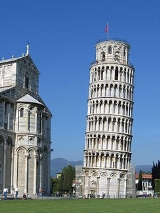
The Leaning Tower of Pisa or simply The Tower of Pisa is the campanile
Campanile

A campanile – pronounced – is, especially in Italy, a free-standing bell tower, often adjacent to a church or cathedral....
, or freestanding bell tower, of the cathedral
Cathedral

A cathedral is a Christian church that contains the seat of a bishop. It is a Religion building for worship, specifically of a denomination with an episcopal hierarchy, such as the Roman Catholic Church, Anglicanism, Orthodox Christian and some Lutheranism churches, which serves as a bishop's seat, and thus as the central church of a dioc...
 of the Italian city of Pisa
Pisa

Pisa is a city in Tuscany, central Italy, on the right bank of the mouth of the Arno River on the Ligurian Sea. It is the capital city of the Province of Pisa....
. It is situated behind the cathedral and is the third oldest structure in Pisa's Piazza del Duomo
Campo dei Miracoli

The Piazza del Duomo is a wide, walled area at the heart of the city of Pisa, Tuscany, Italy, recognized as one of the main centers for medieval art in the world....
 (Cathedral Square) after the cathedral and the baptistry.

Although intended to stand vertically, the tower began leaning to the southeast soon after the onset of construction in 1173 due to a poorly laid foundation and loose substrate
Stratum

In geology and related fields, a stratum is a layer of rock or soil with internally consistent characteristics that distinguishes it from contiguous layers....
 that has allowed the foundation to shift direction.


Discussion
Ask a question about 'Leaning Tower of Pisa'
Start a new discussion about 'Leaning Tower of Pisa'
Answer questions from other users
Full Discussion Forum


Recent Posts


Encyclopedia


The Leaning Tower of Pisa or simply The Tower of Pisa is the campanile
Campanile

A campanile – pronounced – is, especially in Italy, a free-standing bell tower, often adjacent to a church or cathedral....
, or freestanding bell tower, of the cathedral
Cathedral

A cathedral is a Christian church that contains the seat of a bishop. It is a Religion building for worship, specifically of a denomination with an episcopal hierarchy, such as the Roman Catholic Church, Anglicanism, Orthodox Christian and some Lutheranism churches, which serves as a bishop's seat, and thus as the central church of a dioc...
 of the Italian city of Pisa
Pisa

Pisa is a city in Tuscany, central Italy, on the right bank of the mouth of the Arno River on the Ligurian Sea. It is the capital city of the Province of Pisa....
. It is situated behind the cathedral and is the third oldest structure in Pisa's Piazza del Duomo
Campo dei Miracoli

The Piazza del Duomo is a wide, walled area at the heart of the city of Pisa, Tuscany, Italy, recognized as one of the main centers for medieval art in the world....
 (Cathedral Square) after the cathedral and the baptistry.

Although intended to stand vertically, the tower began leaning to the southeast soon after the onset of construction in 1173 due to a poorly laid foundation and loose substrate
Stratum

In geology and related fields, a stratum is a layer of rock or soil with internally consistent characteristics that distinguishes it from contiguous layers....
 that has allowed the foundation to shift direction. The tower presently leans to the southwest.

The height of the tower is 55.86 m (183.27 ft) from the ground on the lowest side and 56.70 m (186.02 ft) on the highest side. The width of the walls at the base is 4.09 m (13.42 ft) and at the top 2.48 m (8.14 ft). Its weight is estimated at . The tower has 296 or 294 steps; the seventh floor has two fewer steps on the north-facing staircase. The tower leans at an angle of 3.97 degrees. This means that the top of the tower is from where it would stand if the tower were perfectly vertical.

Construction

The Tower of Pisa was a work of art, performed in three stages over a period of about 177 years. Construction of the first floor of the white marble campanile began on August 9, 1173, a period of military success and prosperity. This first floor is surrounded by pillars with classical capitals, leaning against blind arches.

The tower began to sink after construction progressed to the third floor in 1178. This was due to a mere three-meter foundation, set in weak, unstable subsoil
Subsoil

Subsoil is the layer of soil under the topsoil on the surface of the ground. The subsoil may include substances such as clay and has only been partially broken down by air, sunlight, water etc., to produce true soil....
. This means the design was flawed from the beginning. Construction was subsequently halted for almost a century
Century

A century is one hundred consecutive years.Centuries are numbered names of numbers in English#Ordinal_numbers in English and many other languages ....
, because the Pisa
Pisa

Pisa is a city in Tuscany, central Italy, on the right bank of the mouth of the Arno River on the Ligurian Sea. It is the capital city of the Province of Pisa....
ns were almost continually engaged in battle
Battle

Generally, a battle is a conceptual component in the hierarchy of combat in warfare between two or more armed forces, wherein each group will seek to defeat the others within the scope of a military campaign, and are well defined in duration, area and force commitment....
s with Genoa
Genoa

Genoa is a city and an important seaport in northern Italy, the capital of the Province of Genoa and of the region of Liguria. The city has a population of about 610,000 and the urban area has a population of about 900,000....
, Lucca
Lucca

Lucca is a city in Tuscany, northern central Italy, situated on the river Serchio in a fertile plain near the Ligurian Sea. It is the capital city of the Province of Lucca....
 and Florence
Florence

Florence is the Capital city of the Italy Regions of Italy of Tuscany and of the provinces of Italy Province of Florence. It is the most populous city in Tuscany and has a population of 364,779 ....
. This allowed time for the underlying soil to settle. Otherwise, the tower would almost certainly have toppled. In 1198, clocks were temporarily installed on the third floor of the unfinished construction.

In 1272, construction resumed under Giovanni di Simone, architect of the Camposanto. In an effort to compensate for the tilt, the engineers built higher floors with one side taller than the other. This made the tower begin to lean in the other direction. Because of this, the tower is actually curved. Construction was halted again in 1284, when the Pisans were defeated by the Genoa
Genoa

Genoa is a city and an important seaport in northern Italy, the capital of the Province of Genoa and of the region of Liguria. The city has a population of about 610,000 and the urban area has a population of about 900,000....
ns in the Battle of Meloria
Battle of Meloria (1284)

The Battle of Meloria was fought on Sunday August 6 1284 near the Meloria islet, in the Tyrrhenian Sea. It was a typical medieval sea-fight, and accomplished the ruin of Pisa as a naval power....
.

The seventh floor was completed in 1319. The bell-chamber was not finally added until 1372. It was built by Tommaso di Andrea Pisano, who succeeded in harmonizing the Gothic
Gothic architecture

Gothic architecture is a style of architecture which flourished during the high and late Middle Ages. It evolved from Romanesque architecture and was succeeded by Renaissance architecture....
 elements of the bell-chamber with the Romanesque
Romanesque architecture

Romanesque architecture is the term that is used to describe the architecture of Middle Ages Europe which evolved into the Gothic architecture style beginning in the 12th century....
 style of the tower. There are seven bells, one for each note of the musical scale. The largest one was installed in 1655.

After a phase (1990-2001) of structural strengthening , the tower is currently undergoing gradual surface restoration, in order to repair visual damage, mostly corrosion and blackening. These are particularly strong due to the tower's age and to its particular conditions with respect to wind and rain.

Timeline

  • On January 5, 1172, Donna Berta di Bernardo, a widow and resident of the house of dell'Opera di Santa Maria, bequeathed sessanta soldi or "sixty coins" to the Opera Campanilis petrarum Sancte Marie. This money was to be used toward the purchase of a few stones which still form the base of the bell tower today.
  • On August 9, 1173, the foundations of the Tower were laid.
  • Nearly four centuries later Giorgio Vasari
    Giorgio Vasari

    Giorgio Vasari was an Italy Painting and architect, who is today famous for his biography of Italian artists, considered the ideological foundation of art history writing....
     wrote : "Guglielmo, according to what is being said, in [this] year 1174 with Bonanno as sculptor, laid the foundations of the belltower of the cathedral in Pisa."
  • Another possible builder is Gerardo di Gerardo. His name appears as a witness to the above legacy of Berta di Bernardo as "Master Gerardo", and as a worker whose name was Gerardo.
  • A more probable builder is Diotisalvi
    Diotisalvi

    Diotisalvi, Deotisalvi or Deustesalvet was an architect from Pisa, Italy, that worked in the second half of the 12th century in Pisa. Little is known of him....
    , because of the construction period and the structure's affinities with other buildings in Pisa. But he usually signed his works, and there is no signature by him in the belltower.
  • Giovanni di Simone was heavily involved in the work of completing the tower, under the direction of Giovanni Pisano
    Giovanni Pisano

    Giovanni Pisano was an Italy sculpture, painter and architect. Son of the famous sculptor Nicola Pisano, he received his training in the workshop of his father....
    , who at the time was master builder of the Opera di Santa Maria Maggiore. He could be the same Giovanni Pisano who completed the belfry tower.
  • Giorgio Vasari indicates that Tommaso di Andrea Pisano was the designer of the belfry between 1360 and 1370.
  • On December 27, 1233 the worker Benenato, son of Gerardo Bottici, oversaw the continuation of the construction of the belltower.
  • On February 23, 1260 Guido Speziale, son of Giovanni, a worker on the cathedral Santa Maria Maggiore, was elected to oversee the building of the Tower.
  • On April 12, 1264 the master builder Giovanni di Simone and 23 workers went to the mountains close to Pisa to cut marble. The cut stones were given to Rainaldo Speziale, worker of St. Francesco.


The architect

There has been controversy
Controversy

A controversy is a dispute, argument, discussion or debate featuring strong disagreements and opposing, contrary, or sharply contrasting opinions about an idea, subject, group or person....
 about the real identity of the architect
Architect

An architect is trained and licenced in planning and designing buildings, and participates in supervising the construction of a building. Etymologically, architect derives from the Latin architectus, itself derived from the Greek arkhitekton , i.e....
 of the Leaning Tower of Pisa. For many years, the design was attributed to Guglielmo and Bonanno Pisano
Bonanno Pisano

Bonanno Pisano , active in the 1170s and 1180s, was an Italian sculptor, mixing Byzantine art and Classical antiquity elements. Giorgio Vasari wrongly attributed the realisation of the Leaning Tower of Pisa to him in his Vite....
 , a well-known 12th-century resident artist
Artist

The definition of an artist is wide-ranging and covers a broad spectrum of activities to do with creating art, practicing the arts and/or demonstrating an art....
 of Pisa, famous for his bronze
Bronze

Bronze is a metal alloy consisting primarily of copper, usually with tin as the main additive, but sometimes with other chemical element such as phosphorus, manganese, aluminium, or silicon....
 casting, particularly in the Pisa Duomo
Campo dei Miracoli

The Piazza del Duomo is a wide, walled area at the heart of the city of Pisa, Tuscany, Italy, recognized as one of the main centers for medieval art in the world....
. Bonanno Pisano left Pisa in 1185 for Monreale
Monreale

Monreale is a town and comune in the province of Palermo, in Sicily, Italy, on the slope of Monte Caputo, overlooking the very fertile valley called "La Conca d'oro" , famed for its Orange , olive and almond trees, the produce of which is exported in large quantities....
, Sicily
Sicily

Sicily is an Autonomous regions with special statute of Italy. Of all the regions of Italy, Sicily covers the largest land area at 25,708 km? and currently has just over five million inhabitants....
, only to come back and die in his home town. His sarcophagus
Sarcophagus

A sarcophagus is a funeral receptacle for a corpse, most commonly carved or cut from stone. The word "sarcophagus" comes from the Greek language sa?? sarx meaning "flesh", and fa?e?? phagein meaning "to eat", hence sarkophagus means "flesh-eating"; from the phrase lithos sarkophagos the word came to refer to the limestone t...
 was discovered at the foot of the tower in 1820. However recent studies seem to indicate Diotisalvi
Diotisalvi

Diotisalvi, Deotisalvi or Deustesalvet was an architect from Pisa, Italy, that worked in the second half of the 12th century in Pisa. Little is known of him....
 as the original architect due to the time of construction and affinity with other Diotisalvi works, notably the bell tower of San Nicola (Pisa)
San Nicola (Pisa)

San Nicola is a church in Pisa, Tuscany, Italy....
 and the Baptistery
Baptistery

In Architecture the baptistery or baptistry is the separate centrally-planned structure surrounding the baptismal font. The baptistery may be incorporated within the body of a church or cathedral and be provided with an altar as a chapel....
 in Pisa. However, he usually signed his works and there is no signature by him in the bell tower which leads to further speculation.

History following construction

Galileo Galilei
Galileo Galilei

Galileo Galilei was a Grand Duchy of Tuscany physicist, mathematician, astronomer, and philosopher who played a major role in the Scientific Revolution....
 is said to have dropped two cannon balls
Cannon

A cannon is any tubular piece of artillery, that uses gunpowder or other usually explosive-based propellants to launch a projectile over a distance....
 of different masses from the tower to demonstrate that their speed
Speed

Speed is the rate of Motion , or equivalently the rate of change of distance.Speed is a Scalar quantity with dimensions length/time; the equivalent Vector quantity to speed is velocity....
 of descent was independent of their mass
Mass

In physical science, mass refers to the degree of acceleration a body acquires when subject to a force: bodies with greater mass are accelerated less by the same force....
. This is considered an apocryphal tale, and the only source for it comes from Galileo's secretary.

During World War II
World War II

World War II, or the Second World War , was a global military conflict which involved a Participants in World War II, including all of the great powers, organised into two opposing military alliances: the Allies of World War II and the Axis powers....
, the Allies
Allies

In general, allies are people, groups or nations that have joined together in an association for mutual benefit or to achieve some common purpose....
 discovered that the Nazis were using it as an observation post. A U.S. Army sergeant
Sergeant

Sergeant is a Military rank used in some form by most militaries, police forces, and other uniformed organizations around the world. Its origins are the Latin serviens, "one who serves", through the French term Sergent....
 was briefly entrusted with the fate of the tower and his decision not to call in an artillery
Artillery

Artillery is a military Combat Arms which employs any apparatus, machine, an assortment of tools or instruments, a system or systems used as weapons for the discharge of large projectiles in combat as a major contribution of fire power within the overall military capability of an armed force....
 strike saved the tower from destruction.

On February 27, 1964, the government of Italy requested aid in preventing the tower from toppling. It was, however, considered important to retain the current tilt, due to the vital role that this element played in promoting the tourism industry of Pisa.

A multinational task force
Task force

A task force is a temporary Military organization established to work on a single defined task or activity. Originally introduced by the United States Navy, the term has now caught on for general usage and is a standard part of NATO terminology....
 of engineers
Engineering

Engineering is the discipline and profession of applying Technology and science knowledge and utilizing natural laws and physical resources in order to design and implement materials, structures, machines, devices, systems, and process that safely realize a desired objective and meet specified criteria....
, mathematician
Mathematician

A mathematician is a person whose primary area of study and/or research is the field of mathematics....
s and historian
Historian

A historian is an individual who studies and writes about history, and is regarded as an authority on it. Historians are concerned with the continuous, systematic narrative and research of past events as relating to the human race; as well as the study of all events in time....
s was assigned and met on the Azores
Azores

The Azores is a Portugal archipelago in the Atlantic Ocean, about 1,500 km from Lisbon and about 3,900 km from the east coast of North America....
 islands to discuss stabilization methods. It was found that the tilt was increasing in combination with the softer foundations on the lower side. Many methods were proposed to stabilize the tower, including the addition of 800 metric tons of lead counterweights to the raised end of the base.

In 1987, the tower was declared as part of the Piazza dei Miracoli
Campo dei Miracoli

The Piazza del Duomo is a wide, walled area at the heart of the city of Pisa, Tuscany, Italy, recognized as one of the main centers for medieval art in the world....
 UNESCO World Heritage Site along with the neighbouring cathedral
Cathedral

A cathedral is a Christian church that contains the seat of a bishop. It is a Religion building for worship, specifically of a denomination with an episcopal hierarchy, such as the Roman Catholic Church, Anglicanism, Orthodox Christian and some Lutheranism churches, which serves as a bishop's seat, and thus as the central church of a dioc...
, baptistery
Baptistery

In Architecture the baptistery or baptistry is the separate centrally-planned structure surrounding the baptismal font. The baptistery may be incorporated within the body of a church or cathedral and be provided with an altar as a chapel....
 and cemetery.

On January 7, 1990, after over two decades of work on the subject, the tower was closed to the public. While the tower was closed, the bells were removed to relieve some weight, and cables were cinched around the third level and anchored several hundred meters away. Apartments and houses in the path of the tower were vacated for safety. The final solution to prevent the collapse of the tower was to slightly straighten the tower to a safer angle, by removing of soil from underneath the raised end. The tower was straightened by 18 inches (45 centimetres), returning to the exact position that it occupied in 1838. After a decade of corrective reconstruction and stabilization efforts, the tower was reopened to the public on December 15, 2001, and has been declared stable for at least another 300 years.

In May 2008, after the removal of another of earth, engineers announced that the Tower had been stabilized such that it had stopped moving for the first time in its history. They stated it would be stable for at least 200 years.

Technical information

Lightmatter Pisa
* Elevation of Piazza dei Miracoli: about 2 metres (6 feet, DMS)
  • Height: 55.863 metres (183 ft 3 in), 8 stories
  • Outer diameter of base:
  • Inner diameter of base:
  • Angle of slant: 3.97 degrees or from the vertical
  • Weight:
  • Thickness of walls at the base: 8 ft (2.4 m)
  • Total number of bells: 7, tuned to musical scale
    Musical scale

    In music, a scale is a group of musical note collected in ascending and descending order that provides material for or is used to conveniently represent part or all of a musical work including melody and/or harmony....
    , clockwise
    • 1st bell: L'assunta, cast in 1654 by Giovanni Pietro Orlandi, weight 3,620 kg (7,981 lb)
    • 2nd bell: Il Crocifisso, cast in 1572 by Vincenzo Possenti, weight 2,462 kg (5,428 lb)
    • 3rd bell: San Ranieri, cast in 1719-1721 by Giovanni Andrea Moreni, weight 1,448 kg (3,192 lb)
    • 4th bell: La Terza (1st small one), cast in 1473, weight 300 kg (661 lb)
    • 5th bell: La Pasquereccia or La Giustizia, cast in 1262 by Lotteringo, weight 1,014 kg (2,235 lb)
    • 6th bell: Il Vespruccio (2nd small one), cast in the 14th century
      1300s

      Events and trends* 1308 - Avignon Papacy established, which splits and weakens the Roman Catholic Church....
       and again in 1501 by Nicola di Jacopo, weight 1,000 kg (2,205 lb)
    • 7th bell: Dal Pozzo
      Carlo Antonio Dal Pozzo

      Carlo Antonio Dal Pozzo was an archbishop Metropolitan bishop of the Pisa Diocese.He came from the noble family of Dal Pozzo Della Cisterna of Biella....
      , cast in 1606 and again in 2004, weight 652 kg (1,437 lb)
  • Steps to bell tower: 296


A special note on the 5th bell: The name Pasquareccia comes from Easter, because it used to ring on Easter
Easter

Easter is the most important religious feast in the Christianity liturgical year.Christians believe that Jesus was Resurrection of Jesus from the dead three days after his Crucifixion of Jesus, and celebrate this resurrection on Easter Day or Easter Sunday , two days after Good Friday....
 day. However, this bell is older than the bell-chamber itself, and comes from the tower Vergata in Palazzo Pretorio in Pisa, where it was called La Giustizia (The Justice). The bell was tolled to announce capital executions of criminals and traitors, including Count Ugolino
Ugolino della Gherardesca

Ugolino della Gherardesca , count of Donoratico, was an Italy nobility, politician and naval commander. He was frequently accused of treason and features prominently in Dante's Divine Comedy....
 in 1289 A new bell was transferred on the belltower to replace the broken Pasquareccia bell at the end of the 18th century.

Gallery


See also

  • List of leaning towers
  • Round tower
    Round tower

    Round tower may refer to:Types of tower:* Irish round tower, a type of early mediaeval stone tower* Broch, a type of Iron Age drystone structure found in Scotland...
    , for other types of round towers.
  • Leaning Tower of Niles
    Leaning Tower of Niles

    The leaning tower of Niles, Illinois, Illinois was completed in 1934 by industrialist Robert Ilg as part of a recreation park for employees of the Ilg Hot Air Electric Ventilating Company of Chicago, IL....
    , a replica of the Tower of Pisa
  • Torre delle Milizie
    Torre delle Milizie

    The Torre delle Milizie is a tower in Rome, annexed to the Trajan's Market in the Imperial fora.One of the main mediaeval monuments of the city, the tower is on a square plan, its base sides measure 10.5 x 9.5 m, and it currently stands at almost 50 meters....
    , a tilting medieval tower in Rome
  • Machang
    Machang

    Machang is a territory of Kelantan, Malaysia. It is bordered by the districts of Kota Bharu to the north, Pasir Puteh to the east, Tanah Merah, Malaysia to the west and Kuala Krai to the south....
     - another leaning tower
  • The Greyfriars Tower
    Buildings in King's Lynn

    King's Lynn is an attractive English people market town in West Norfolk. This page details a selection of some of the more prominent buildings in King's Lynn with pictures where available....
     - the remains of a Franciscan monastery in King's Lynn
    King's Lynn

    King's Lynn is a town and port in Norfolk, England. Over the years, the town has been known variously as Bishop's Lynn and Lynn Regis, while it is frequently referred to by locals as simply Lynn, the Celtic languages word for lake....
    . It is also leaning and is consequently nicknamed 'The Leaning Tower of Lynn' in reference to the Leaning Tower of Pisa.


External links


  • Virtual reality movies
  • (creative commons
    Creative Commons

    Creative Commons is a non-profit organization devoted to expanding the range of creativity works available for others to build upon legally and to share....
    -licensed photos, laser scans, panoramas), data from a University of Ferrara
    University of Ferrara

    The University of Ferrara is the main university of the city of Ferrara in the Emilia-Romagna region of northern Italy. In the years prior to the World War I the University of Ferrara, with more than 500 students, was the best attended of the free universities in Italy....
    /CyArk
    CyArk

    CyArk is a nonprofit, noncommercial project of the Kacyra Family Foundation located in Orinda, California, United States. The company's website refers to it as a "High-Definition Heritage Network"....
     research partnership, includes 3D scan data from Leaning Tower.