


Slovak National Uprising

Encyclopedia
The Slovak National Uprising or 1944 Uprising was an armed insurrection organized by the Slovak resistance
movement during World War II
. It was launched on August 29 1944 from Banská Bystrica
in an attempt to overthrow the collaborationist Slovak State of Jozef Tiso
. Although the rebel forces were defeated by Nazi Germany
, guerrilla warfare
continued until the Soviet Army
occupied Slovakia
in 1945.
In the post-war period, many political entities attempted to "hijack" the uprising to their credit. The Stalinist regime in Czechoslovakia
presented the Uprising as an event initiated and governed by communist forces. Slovak ultranationalists, on the other hand, claim that the uprising was a plot against the Slovak nation, as one of its main objectives was to oust the regime of the puppet Slovak state and reestablish Czechoslovakia
, in which Slovaks were dominated by Czechs. In fact, many factions fought in the uprising, including large rebel units of the Slovak Army, nationalist and communist partisans
, and international forces. Given this factionalization, the Uprising did not have unambiguous popular support. Yet, the participants and supporters of the Uprising represented every religion, class, gender, age, and anti-Nazi political faction of the Slovak nation.
, leader of the Czechoslovak government in exile
in London, had initiated the preparations for a possible revolt in 1943, when he made first contacts with the dissident elements of the Slovak Army. In December 1943, various groups that would be involved with the uprising—the government in exile, Czechoslovak democrats
and communists and Slovak army—formed the underground Slovak National Council
, and signed the so-called Christmas Treaty, a joint declaration to recognize Beneš's authority and to recreate Czechoslovakia after the war. The council was responsible for creating the preparatory phase of the Uprising.
In March 1944, Slovak army Lieutenant Colonel
Ján Golian
took charge of the preparations. Conspirators stockpiled money, ammunition and other supplies in military bases in central and eastern Slovakia. The rebelling forces called themselves Czechoslovak Forces of the Interior and the First Czechoslovak Army. Approximately 3,200 Slovak soldiers deserted
and joined partisan groups or the Soviet Red Army. In April 1944 Slovak Jews
, Rudolf Vrba
and Alfred Wetzler
escaped from Auschwitz and eventually spoke about the horrors in German death camps.
In summer 1944 partisans intensified their war against German occupation forces, mainly in the mountains of north-central Slovakia. In July, Red Army troops in the Soviet Union and Poland
began to advance towards Slovakia. By August 1944 the Red Army was at Krosno
, Poland and within 40 kilometers of the North-Eastern Slovak border.
Two heavily armed divisions of the Slovak Army together with the entire eastern Slovak Air Force
were deliberately relocated to Prešov
in north-eastern Slovakia in summer 1944 to execute one of two planned options to begin the uprising. The two options were:
Colonel
Viliam Talský was Chief of Staff over the two divisions. He had agreed in advance with the insurrectional army leadership and the uprising planning committee of the Slovak National Council to execute either of these two plans, depending on the circumstances he faced. On August 27, 1944 in Martin
, a group of communist partisans under Soviet command in Kiev killed 30 members of a German military mission en route from Romania
, a country that had just changed sides to support the Allies. German troops began to occupy Slovakia the next day to put down the rebellion
. German arrangements for such occupation were done few weeks earlier.
At 19:00 hours on August 29, 1944 Slovak Defence Minister
General
Ferdinand Čatloš
announced on state radio that Germany had occupied Slovakia. Golian sent the coded message to all units at 20:00 to begin the Uprising. Instead of adhering to the agreed plan, Colonel Talský gathered the entire eastern Slovak Air Force on August 30 and abandoned the two divisions flying to a prearranged landing zone in Poland to join the Soviet Army. The two divisions, left in chaos and without leadership, were quickly disarmed on the afternoon of August 30 without a single shot. Consequently, the uprising commenced prematurely and lost a crucial component of their plan as well as their two most heavily armed divisions capable of resisting any German advance.
forces consisted of an estimated 18,000 soldiers. The total increased to 47,000 after mobilization
on September 9, 1944, and later to 60,000, plus 18,000 partisans from over 30 countries. The Slovak Insurgent Air Force
had a small number of mostly obsolete planes.
In addition to Slovak forces, the combatants included various other groups from escaped French POWs
to Soviet partisans and SOE
and OSS
operatives. The Slovak side had to use mostly biplane
s and improvised armored trains to fight against the better equipped German weapons. In addition to Soviet aid, United States B-17 Flying Fortress bombers landed at Tri Duby
airfield on October 7, 1944 and brought supplies and OSS agents. Before returning, they embarked 25 Allied pilots shot down over Slovakia in past few months and five French partisans.
in the morning of August 30 and made it their headquarters. German troops disarmed the Eastern Slovak Army on August 31. Many of the soldiers were sent to camps in Germany while others escaped and joined the Soviet-controlled partisans or returned home. On September 5 Ján Golian became the commander of all the rebel forces in Slovakia and was given the rank of General. Slovak forces in central Slovakia mobilized 47,000 men. His first analysis of the situation predicted that insurgents could resist German attacks for about two weeks.
By September 10 the rebels had gained control of large areas of central and eastern Slovakia, including two airfields, which were used by the Soviet Air Force to fly in equipment.
. Germany moved 40,000 SS
soldiers under Gottlob Berger
to suppress the uprising, which detained and disarmed two Slovak divisions and 20,000 soldiers that had been supposed to secure the mountain passes to help the Red Army. Beneš had met with Stalin and Molotov in Moscow in December 1943 to secure Soviet support for the uprising, but Stalin and STAVKA
failed to deliver the needed support on time to the insurgent army and even blocked Western offers of military aid, as they had done only a few weeks earlier during the Warsaw uprising
. Meanwhile, General Koniev and the Soviet partisan headquarters in Kiev, Ukraine, continued to undermine the Slovak insurgent army by ordering partisan groups operating in forward positions in Slovakia to conduct operations independently of the Slovak insurgent army and avoid coordination. The Soviet-led partisans even demanded and took desperately needed weapons and munitions that had been stored for the Slovak uprising. The vast majority of Soviet air drops of weapons over insurgent-held territory in Eastern and Northern Slovakia were quickly confiscated by Soviet partisans
and little ended up in the hands of the much stronger and better trained Slovak insurrectional army.
On September 8, the Red Army began an offensive on the Dukla Pass
on the Slovak-Polish
border and tried to fight through the Carpathian Mountains
to penetrate into Slovakia. This poorly-planned and late action resulted in tremendous casualties on both sides and became bogged down for nearly two months.
Beneš, the Soviet partisans, and various Slovak factions began to argue among themselves, each seeking operational control. Despite repeated efforts, General Golian could not persuade the different sides to coordinate their efforts. General Rudolf Viest
flew in and took command on October 7, with Golian becoming his second-in-command. Viest could not control the situation when political rivalries resurfaced in the face of military failure.
The uprising also coincided with the stalling of the Soviet summer offensive, the failure of the Warsaw Uprising, and other troubles on the side of the Western allies. The Red Army and its Czechoslovakian allies failed to quickly penetrate the Dukla Pass despite fierce fighting between September 8 and October 28; they suffered 85,000 casualties (21,000 dead). The Czechoslovak government in exile failed to convince Western allies to ignore Stalin's obstructionism and send more supplies to the area.
On September 17 two B-17 Flying Fortresss flew in the OSS mission of Lieutenant
James Holt-Green. The SOE team of Major John Sehmer followed the next day on its way to Hungary
. Their reports confirmed the suspicions of Western Allies that the situation of the uprising was worsening.
, who had been in charge of the troops fighting the Uprising, with General Höffle. By that time Germans had 48,000 soldiers; they consisted of eight German divisions, including four from the Waffen-SS
and one pro-Nazi Slovak formation.
On October 1 the rebel army was renamed the 1st Czechoslovak Army in Slovakia, in order to symbolize the beginning of the Czech-Slovak reunification that would be recognized by the Allied forces.
A major German counteroffensive began on October 17–18 when 35,000 German troops entered the country from Hungary, which had been under German military occupation since 19 March 1944. Stalin demanded that his advancing Second Ukrainian Front led by General Malinovsky be immediately diverted from Eastern Slovakia to Budapest. The western advance of Soviet forces came to a sudden halt in late October 1944, when Stalin's interests focused on Hungary, Austria and Poland rather than Slovakia or the Czech lands. By the end of October, Axis forces (six German divisions and one pro-Nazi Slovak unit) had taken back most of the territory from the insurgents and encircled the fighting groups. Battles cost at least 10,000 casualties on both sides.
Insurgents had to evacuate Banská Bystrica on October 27 just prior to the German takeover. SOE and OSS agents retreated to the mountains alongside the thousands of others fleeing the German advance. The rebels prepared to change their strategy to that of guerrilla warfare. On October 28, Viest sent London a message that said the organized resistance had ended. On October 30, General Höffle and President Tiso celebrated in Banská Bystrica and awarded medals to German soldiers for their part in the suppression of the uprising (claimed by some to have been done by Tiso as to save the lives of Slovak soldiers captured by German forces in the uprising, who were deported to concentration camps, and to save three Slovak cities from German bombardment).
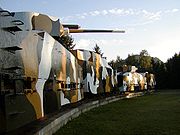 None the less, partisans and the remains of the regular forces continued their efforts in the mountains. In retaliation, Einsatzgruppen
executed many Slovaks suspected of aiding the rebels and Jews who had avoided deportation until then, and destroyed 93 villages on suspicion of collaboration
. A later estimate of the death toll was 5,304 and authorities discovered 211 mass grave
s that resulted from those atrocities. The largest executions occurred in Kremnička (747 killed, mostly Jews and Roma) and Nemecká
(900 killed).
On November 3 Germans captured Golian and Viest in Pohronský Bukovec
; they later interrogated and executed them.
SOE and OSS teams eventually united and sent a message in which they requested immediate assistance. Germans surrounded both groups on December 25 and captured them. Some of the men were summarily executed. Germans took the rest to Mauthausen
concentration camp where they were tortured and executed.
The German victory only postponed the eventual downfall of the pro-Nazi regime. Six months later, the Red Army had overrun Axis troops in Czechoslovakia. By December 1944 Romanian and Soviet troops had driven German troops out of southern Slovakia in the Battle of Budapest
. On January 19, 1945, the Red Army took Bardejov
, Svidník
, Prešov
and Košice
in Eastern Slovakia. On March 3–5 they had taken over northwest Slovakia. On March 25 they entered Banská Bystrica and on April 4 marched into Bratislava
.
The main military objectives were not achieved due to the bad timing of the uprising and lack of cooperation by Soviet partisans. This often undermined the plans of the insurrectional Slovak army. If the uprising had occurred later when preparations were complete, it is possible that the whole of the country would have reverted to the Allied side, allowing the Red Army to quickly pass through Slovakia (though it is questionable whether the Soviet leadership would have favoured this development because it would have greatly strengthened the democratic forces in Slovakia). The guerrilla struggle did tie up significant German forces that could otherwise have reinforced the Wehrmacht
on the eastern front against the advancing Ukrainian Front
s to the north and south of Slovakia. Nevertheless, much of Slovakia was left devastated by the Uprising and the German counter-offensive and occupation.
Resistance during World War II
Resistance movements during World War II occurred in every occupied country by a variety of means, ranging from non-cooperation, disinformation and propaganda to hiding crashed pilots and even to outright warfare and the recapturing of towns...
movement during World War II
World War II
World War II, or the Second World War , was a global conflict lasting from 1939 to 1945, involving most of the world's nations—including all of the great powers—eventually forming two opposing military alliances: the Allies and the Axis...
. It was launched on August 29 1944 from Banská Bystrica
Banská Bystrica
Banská Bystrica is a key city in central Slovakia located on the Hron River in a long and wide valley encircled by the mountain chains of the Low Tatras, the Veľká Fatra, and the Kremnica Mountains. With 81,281 inhabitants, Banská Bystrica is the sixth most populous municipality in Slovakia...
in an attempt to overthrow the collaborationist Slovak State of Jozef Tiso
Jozef Tiso
Jozef Tiso was a Slovak Roman Catholic priest, politician of the Slovak People's Party, and Nazi collaborator. Between 1939 and 1945, Tiso was the head of the Slovak State, a satellite state of Nazi Germany...
. Although the rebel forces were defeated by Nazi Germany
Nazi Germany
Nazi Germany , also known as the Third Reich , but officially called German Reich from 1933 to 1943 and Greater German Reich from 26 June 1943 onward, is the name commonly used to refer to the state of Germany from 1933 to 1945, when it was a totalitarian dictatorship ruled by...
, guerrilla warfare
Guerrilla warfare
Guerrilla warfare is a form of irregular warfare and refers to conflicts in which a small group of combatants including, but not limited to, armed civilians use military tactics, such as ambushes, sabotage, raids, the element of surprise, and extraordinary mobility to harass a larger and...
continued until the Soviet Army
Soviet Army
The Soviet Army is the name given to the main part of the Armed Forces of the Soviet Union between 1946 and 1992. Previously, it had been known as the Red Army. Informally, Армия referred to all the MOD armed forces, except, in some cases, the Soviet Navy.This article covers the Soviet Ground...
occupied Slovakia
Slovakia
The Slovak Republic is a landlocked state in Central Europe. It has a population of over five million and an area of about . Slovakia is bordered by the Czech Republic and Austria to the west, Poland to the north, Ukraine to the east and Hungary to the south...
in 1945.
In the post-war period, many political entities attempted to "hijack" the uprising to their credit. The Stalinist regime in Czechoslovakia
Czechoslovakia
Czechoslovakia or Czecho-Slovakia was a sovereign state in Central Europe which existed from October 1918, when it declared its independence from the Austro-Hungarian Empire, until 1992...
presented the Uprising as an event initiated and governed by communist forces. Slovak ultranationalists, on the other hand, claim that the uprising was a plot against the Slovak nation, as one of its main objectives was to oust the regime of the puppet Slovak state and reestablish Czechoslovakia
Czechoslovakia
Czechoslovakia or Czecho-Slovakia was a sovereign state in Central Europe which existed from October 1918, when it declared its independence from the Austro-Hungarian Empire, until 1992...
, in which Slovaks were dominated by Czechs. In fact, many factions fought in the uprising, including large rebel units of the Slovak Army, nationalist and communist partisans
Partisan (military)
A partisan is a member of an irregular military force formed to oppose control of an area by a foreign power or by an army of occupation by some kind of insurgent activity...
, and international forces. Given this factionalization, the Uprising did not have unambiguous popular support. Yet, the participants and supporters of the Uprising represented every religion, class, gender, age, and anti-Nazi political faction of the Slovak nation.
Preliminaries
Edvard BenešEdvard Beneš
Edvard Beneš was a leader of the Czechoslovak independence movement, Minister of Foreign Affairs and the second President of Czechoslovakia. He was known to be a skilled diplomat.- Youth :...
, leader of the Czechoslovak government in exile
Government in exile
A government in exile is a political group that claims to be a country's legitimate government, but for various reasons is unable to exercise its legal power, and instead resides in a foreign country. Governments in exile usually operate under the assumption that they will one day return to their...
in London, had initiated the preparations for a possible revolt in 1943, when he made first contacts with the dissident elements of the Slovak Army. In December 1943, various groups that would be involved with the uprising—the government in exile, Czechoslovak democrats
Democracy
Democracy is generally defined as a form of government in which all adult citizens have an equal say in the decisions that affect their lives. Ideally, this includes equal participation in the proposal, development and passage of legislation into law...
and communists and Slovak army—formed the underground Slovak National Council
Slovak National Council
The Slovak National Council is the name of different types of supreme bodies in the history of Slovakia. They existed within the Kingdom of Hungary, Czechoslovakia or the Slovak Republic or were bodies of Slovak exiles:...
, and signed the so-called Christmas Treaty, a joint declaration to recognize Beneš's authority and to recreate Czechoslovakia after the war. The council was responsible for creating the preparatory phase of the Uprising.
In March 1944, Slovak army Lieutenant Colonel
Lieutenant colonel
Lieutenant colonel is a rank of commissioned officer in the armies and most marine forces and some air forces of the world, typically ranking above a major and below a colonel. The rank of lieutenant colonel is often shortened to simply "colonel" in conversation and in unofficial correspondence...
Ján Golian
Ján Golian
Ján Golian was a Slovak Brigadier General who became famous as one of the main organizers and the commander of the insurrectionist 1st Czecho-Slovak Army in Slovakia during the Slovak National Uprising against the Nazis...
took charge of the preparations. Conspirators stockpiled money, ammunition and other supplies in military bases in central and eastern Slovakia. The rebelling forces called themselves Czechoslovak Forces of the Interior and the First Czechoslovak Army. Approximately 3,200 Slovak soldiers deserted
Desertion
In military terminology, desertion is the abandonment of a "duty" or post without permission and is done with the intention of not returning...
and joined partisan groups or the Soviet Red Army. In April 1944 Slovak Jews
History of the Jews in Slovakia
Before World War II, 135,000 Jews lived in Slovakia. Some emigrated before the war, but most were killed in deportation. After the Slovak Republic proclaimed its independence in March 1939 under the protection of Nazi Germany, Slovakia began a series of measures aimed against the Jews in the...
, Rudolf Vrba
Rudolf Vrba
Rudolf "Rudi" Vrba, born Walter Rosenberg was a Slovak-Canadian professor of pharmacology at the University of British Columbia, who came to public attention during the Second World War when, in April 1944, he escaped from the Auschwitz concentration camp in German-occupied Poland with the first...
and Alfred Wetzler
Alfréd Wetzler
Alfréd Israel Wetzler , who later wrote under the alias Jozef Lánik, was a Slovak Jew, and one of a very small number of Jews known to have escaped from the Auschwitz death camp during the Holocaust. Wetzler was born on 10 May 1918, in the Slovak town of Trnava where he was a worker in the period...
escaped from Auschwitz and eventually spoke about the horrors in German death camps.
In summer 1944 partisans intensified their war against German occupation forces, mainly in the mountains of north-central Slovakia. In July, Red Army troops in the Soviet Union and Poland
Poland
Poland , officially the Republic of Poland , is a country in Central Europe bordered by Germany to the west; the Czech Republic and Slovakia to the south; Ukraine, Belarus and Lithuania to the east; and the Baltic Sea and Kaliningrad Oblast, a Russian exclave, to the north...
began to advance towards Slovakia. By August 1944 the Red Army was at Krosno
Krosno
Krosno is a town and county in Subcarpathian Voivodeship, Poland with 47,455 inhabitants, as of 2 June 2009.Notably Krosno is the site of the first oil well in the world....
, Poland and within 40 kilometers of the North-Eastern Slovak border.
Two heavily armed divisions of the Slovak Army together with the entire eastern Slovak Air Force
Slovenské vzdušné zbrane
The Slovak Air Force , between 1939 and 1945, was the air force of the short-lived World War II Slovak Republic. Its mission was to provide air support at fronts, and to protect Bratislava and metropolitan areas against enemy air strikes...
were deliberately relocated to Prešov
Prešov
Prešov Historically, the city has been known in German as Eperies , Eperjes in Hungarian, Fragopolis in Latin, Preszów in Polish, Peryeshis in Romany, Пряшев in Russian and Пряшів in Rusyn and Ukrainian.-Characteristics:The city is a showcase of Baroque, Rococo and Gothic...
in north-eastern Slovakia in summer 1944 to execute one of two planned options to begin the uprising. The two options were:
- the two divisions would start the uprising by coordinating their capture of Dukla PassDukla PassThe Dukla Pass is a strategically significant mountain pass in the Laborec Highlands of the Outer Eastern Carpathians, on the border between Poland and Slovakia, and close to the western border of Ukraine....
(joining Poland and Slovakia through the Carpathian Mountains) with the arrival of the Soviet Army (1st Ukrainian Front1st Ukrainian FrontThe 1st Ukrainian Front was a front—a force the size of a Western Army group—of the Soviet Union's Red Army during the Second World War.-Wartime:...
under MarshallMarshal of the Soviet UnionMarshal of the Soviet Union was the de facto highest military rank of the Soviet Union. ....
Ivan KonevIvan KonevIvan Stepanovich Konev , was a Soviet military commander, who led Red Army forces on the Eastern Front during World War II, retook much of Eastern Europe from occupation by the Axis Powers, and helped in the capture of Germany's capital, Berlin....
), or - respond to insurrectional army leader Ján Golian's orders to start resistance by immediately confronting any invading German forces and hold the pass until the Soviet Army could arrive.
Colonel
Colonel
Colonel , abbreviated Col or COL, is a military rank of a senior commissioned officer. It or a corresponding rank exists in most armies and in many air forces; the naval equivalent rank is generally "Captain". It is also used in some police forces and other paramilitary rank structures...
Viliam Talský was Chief of Staff over the two divisions. He had agreed in advance with the insurrectional army leadership and the uprising planning committee of the Slovak National Council to execute either of these two plans, depending on the circumstances he faced. On August 27, 1944 in Martin
Martin, Slovakia
Martin is a city in northern Slovakia, situated on the Turiec river, between the Malá Fatra and Veľká Fatra mountains, near the city of Žilina. The population numbers approximately 58,000, which makes it the eighth largest city in Slovakia...
, a group of communist partisans under Soviet command in Kiev killed 30 members of a German military mission en route from Romania
Romania
Romania is a country located at the crossroads of Central and Southeastern Europe, on the Lower Danube, within and outside the Carpathian arch, bordering on the Black Sea...
, a country that had just changed sides to support the Allies. German troops began to occupy Slovakia the next day to put down the rebellion
Rebellion
Rebellion, uprising or insurrection, is a refusal of obedience or order. It may, therefore, be seen as encompassing a range of behaviors aimed at destroying or replacing an established authority such as a government or a head of state...
. German arrangements for such occupation were done few weeks earlier.
At 19:00 hours on August 29, 1944 Slovak Defence Minister
Defence minister
A defence minister is a person in a cabinet position in charge of a Ministry of Defence, which regulates the armed forces in some sovereign nations...
General
General
A general officer is an officer of high military rank, usually in the army, and in some nations, the air force. The term is widely used by many nations of the world, and when a country uses a different term, there is an equivalent title given....
Ferdinand Čatloš
Ferdinand Catloš
Ferdinand Čatloš was a Slovak military officer and politician. Throughout his short career in the administration of the Slovak Republic he held the post of Minister of Defence. He was also the commanding officer of the Field Army Bernolák during the Invasion of Poland...
announced on state radio that Germany had occupied Slovakia. Golian sent the coded message to all units at 20:00 to begin the Uprising. Instead of adhering to the agreed plan, Colonel Talský gathered the entire eastern Slovak Air Force on August 30 and abandoned the two divisions flying to a prearranged landing zone in Poland to join the Soviet Army. The two divisions, left in chaos and without leadership, were quickly disarmed on the afternoon of August 30 without a single shot. Consequently, the uprising commenced prematurely and lost a crucial component of their plan as well as their two most heavily armed divisions capable of resisting any German advance.
Forces
Accounts of the exact numbers of combatants vary. At first, the rebel Slovak partisanSlovak partisans
Slovak partisans were fighters in irregular military groups participating in the Slovak resistance movement, including against Nazi Germany and collaborationism during World War II.-Beginning:...
forces consisted of an estimated 18,000 soldiers. The total increased to 47,000 after mobilization
Mobilization
Mobilization is the act of assembling and making both troops and supplies ready for war. The word mobilization was first used, in a military context, in order to describe the preparation of the Prussian army during the 1850s and 1860s. Mobilization theories and techniques have continuously changed...
on September 9, 1944, and later to 60,000, plus 18,000 partisans from over 30 countries. The Slovak Insurgent Air Force
Slovak Insurgent Air Force
The Slovak Insurgent Air Force was a Pro-Allied air unit which fought against Axis forces in Slovakia and participated in Slovak National Uprising in autumn 1944.-History:...
had a small number of mostly obsolete planes.
In addition to Slovak forces, the combatants included various other groups from escaped French POWs
Prisoner of war
A prisoner of war or enemy prisoner of war is a person, whether civilian or combatant, who is held in custody by an enemy power during or immediately after an armed conflict...
to Soviet partisans and SOE
Special Operations Executive
The Special Operations Executive was a World War II organisation of the United Kingdom. It was officially formed by Prime Minister Winston Churchill and Minister of Economic Warfare Hugh Dalton on 22 July 1940, to conduct guerrilla warfare against the Axis powers and to instruct and aid local...
and OSS
Office of Strategic Services
The Office of Strategic Services was a United States intelligence agency formed during World War II. It was the wartime intelligence agency, and it was a predecessor of the Central Intelligence Agency...
operatives. The Slovak side had to use mostly biplane
Biplane
A biplane is a fixed-wing aircraft with two superimposed main wings. The Wright brothers' Wright Flyer used a biplane design, as did most aircraft in the early years of aviation. While a biplane wing structure has a structural advantage, it produces more drag than a similar monoplane wing...
s and improvised armored trains to fight against the better equipped German weapons. In addition to Soviet aid, United States B-17 Flying Fortress bombers landed at Tri Duby
Sliac
Sliač is a small spa town located in central Slovakia, on the Hron river, between Banská Bystrica and Zvolen. The town is known for its healing hot springs and for an airport which has been used for military as well as civil purposes...
airfield on October 7, 1944 and brought supplies and OSS agents. Before returning, they embarked 25 Allied pilots shot down over Slovakia in past few months and five French partisans.
Uprising begins
Rebels began the uprising on August 29 8:00 p.m. under the command of Ján Golian. They entered Banská BystricaBanská Bystrica
Banská Bystrica is a key city in central Slovakia located on the Hron River in a long and wide valley encircled by the mountain chains of the Low Tatras, the Veľká Fatra, and the Kremnica Mountains. With 81,281 inhabitants, Banská Bystrica is the sixth most populous municipality in Slovakia...
in the morning of August 30 and made it their headquarters. German troops disarmed the Eastern Slovak Army on August 31. Many of the soldiers were sent to camps in Germany while others escaped and joined the Soviet-controlled partisans or returned home. On September 5 Ján Golian became the commander of all the rebel forces in Slovakia and was given the rank of General. Slovak forces in central Slovakia mobilized 47,000 men. His first analysis of the situation predicted that insurgents could resist German attacks for about two weeks.
By September 10 the rebels had gained control of large areas of central and eastern Slovakia, including two airfields, which were used by the Soviet Air Force to fly in equipment.
Momentum lost
The pro-German government of Tiso remained in power in BratislavaBratislava
Bratislava is the capital of Slovakia and, with a population of about 431,000, also the country's largest city. Bratislava is in southwestern Slovakia on both banks of the Danube River. Bordering Austria and Hungary, it is the only national capital that borders two independent countries.Bratislava...
. Germany moved 40,000 SS
Schutzstaffel
The Schutzstaffel |Sig runes]]) was a major paramilitary organization under Adolf Hitler and the Nazi Party. Built upon the Nazi ideology, the SS under Heinrich Himmler's command was responsible for many of the crimes against humanity during World War II...
soldiers under Gottlob Berger
Gottlob Berger
Gottlob Berger was a German Nazi who held the rank of Obergruppenführer during World War II and was later convicted of war crimes.In 1939, he was Reichsführer-SS Heinrich Himmler's main recruiting officer...
to suppress the uprising, which detained and disarmed two Slovak divisions and 20,000 soldiers that had been supposed to secure the mountain passes to help the Red Army. Beneš had met with Stalin and Molotov in Moscow in December 1943 to secure Soviet support for the uprising, but Stalin and STAVKA
Stavka
Stavka was the term used to refer to a command element of the armed forces from the time of the Kievan Rus′, more formally during the history of Imperial Russia as administrative staff and General Headquarters during late 19th Century Imperial Russian armed forces and those of the Soviet Union...
failed to deliver the needed support on time to the insurgent army and even blocked Western offers of military aid, as they had done only a few weeks earlier during the Warsaw uprising
Warsaw Uprising
The Warsaw Uprising was a major World War II operation by the Polish resistance Home Army , to liberate Warsaw from Nazi Germany. The rebellion was timed to coincide with the Soviet Union's Red Army approaching the eastern suburbs of the city and the retreat of German forces...
. Meanwhile, General Koniev and the Soviet partisan headquarters in Kiev, Ukraine, continued to undermine the Slovak insurgent army by ordering partisan groups operating in forward positions in Slovakia to conduct operations independently of the Slovak insurgent army and avoid coordination. The Soviet-led partisans even demanded and took desperately needed weapons and munitions that had been stored for the Slovak uprising. The vast majority of Soviet air drops of weapons over insurgent-held territory in Eastern and Northern Slovakia were quickly confiscated by Soviet partisans
Soviet partisans
The Soviet partisans were members of a resistance movement which fought a guerrilla war against the Axis occupation of the Soviet Union during World War II....
and little ended up in the hands of the much stronger and better trained Slovak insurrectional army.
On September 8, the Red Army began an offensive on the Dukla Pass
Battle of the Dukla Pass
Battle of the Dukla Pass, also known as the Dukla / Carpatho-Dukla / Rzeszów-Dukla / Dukla-Prešov Offensive was the scene of bitterly contested battle for the Dukla Pass on the Eastern Front of World War II between Nazi Germany and the Soviet Union in September-October 1944. German resistance was...
on the Slovak-Polish
Poland
Poland , officially the Republic of Poland , is a country in Central Europe bordered by Germany to the west; the Czech Republic and Slovakia to the south; Ukraine, Belarus and Lithuania to the east; and the Baltic Sea and Kaliningrad Oblast, a Russian exclave, to the north...
border and tried to fight through the Carpathian Mountains
Carpathian Mountains
The Carpathian Mountains or Carpathians are a range of mountains forming an arc roughly long across Central and Eastern Europe, making them the second-longest mountain range in Europe...
to penetrate into Slovakia. This poorly-planned and late action resulted in tremendous casualties on both sides and became bogged down for nearly two months.
Beneš, the Soviet partisans, and various Slovak factions began to argue among themselves, each seeking operational control. Despite repeated efforts, General Golian could not persuade the different sides to coordinate their efforts. General Rudolf Viest
Rudolf Viest
Rudolf Viest , was Czechoslovakian division general of Slovakian ethnicity, commander of the partisan army during the Slovak National Uprising and the only Slovak general during the interwar period in the first Czechoslovak republic.In the years 1920-1939 he was...
flew in and took command on October 7, with Golian becoming his second-in-command. Viest could not control the situation when political rivalries resurfaced in the face of military failure.
The uprising also coincided with the stalling of the Soviet summer offensive, the failure of the Warsaw Uprising, and other troubles on the side of the Western allies. The Red Army and its Czechoslovakian allies failed to quickly penetrate the Dukla Pass despite fierce fighting between September 8 and October 28; they suffered 85,000 casualties (21,000 dead). The Czechoslovak government in exile failed to convince Western allies to ignore Stalin's obstructionism and send more supplies to the area.
On September 17 two B-17 Flying Fortresss flew in the OSS mission of Lieutenant
Lieutenant
A lieutenant is a junior commissioned officer in many nations' armed forces. Typically, the rank of lieutenant in naval usage, while still a junior officer rank, is senior to the army rank...
James Holt-Green. The SOE team of Major John Sehmer followed the next day on its way to Hungary
Hungary
Hungary , officially the Republic of Hungary , is a landlocked country in Central Europe. It is situated in the Carpathian Basin and is bordered by Slovakia to the north, Ukraine and Romania to the east, Serbia and Croatia to the south, Slovenia to the southwest and Austria to the west. The...
. Their reports confirmed the suspicions of Western Allies that the situation of the uprising was worsening.
Counteroffensive
On September 19 German command replaced SS-Obergruppenführer BergerGottlob Berger
Gottlob Berger was a German Nazi who held the rank of Obergruppenführer during World War II and was later convicted of war crimes.In 1939, he was Reichsführer-SS Heinrich Himmler's main recruiting officer...
, who had been in charge of the troops fighting the Uprising, with General Höffle. By that time Germans had 48,000 soldiers; they consisted of eight German divisions, including four from the Waffen-SS
Waffen-SS
The Waffen-SS was a multi-ethnic and multi-national military force of the Third Reich. It constituted the armed wing of the Schutzstaffel or SS, an organ of the Nazi Party. The Waffen-SS saw action throughout World War II and grew from three regiments to over 38 divisions, and served alongside...
and one pro-Nazi Slovak formation.
On October 1 the rebel army was renamed the 1st Czechoslovak Army in Slovakia, in order to symbolize the beginning of the Czech-Slovak reunification that would be recognized by the Allied forces.
A major German counteroffensive began on October 17–18 when 35,000 German troops entered the country from Hungary, which had been under German military occupation since 19 March 1944. Stalin demanded that his advancing Second Ukrainian Front led by General Malinovsky be immediately diverted from Eastern Slovakia to Budapest. The western advance of Soviet forces came to a sudden halt in late October 1944, when Stalin's interests focused on Hungary, Austria and Poland rather than Slovakia or the Czech lands. By the end of October, Axis forces (six German divisions and one pro-Nazi Slovak unit) had taken back most of the territory from the insurgents and encircled the fighting groups. Battles cost at least 10,000 casualties on both sides.
Insurgents had to evacuate Banská Bystrica on October 27 just prior to the German takeover. SOE and OSS agents retreated to the mountains alongside the thousands of others fleeing the German advance. The rebels prepared to change their strategy to that of guerrilla warfare. On October 28, Viest sent London a message that said the organized resistance had ended. On October 30, General Höffle and President Tiso celebrated in Banská Bystrica and awarded medals to German soldiers for their part in the suppression of the uprising (claimed by some to have been done by Tiso as to save the lives of Slovak soldiers captured by German forces in the uprising, who were deported to concentration camps, and to save three Slovak cities from German bombardment).
Aftermath
Einsatzgruppen
Einsatzgruppen were SS paramilitary death squads that were responsible for mass killings, typically by shooting, of Jews in particular, but also significant numbers of other population groups and political categories...
executed many Slovaks suspected of aiding the rebels and Jews who had avoided deportation until then, and destroyed 93 villages on suspicion of collaboration
Collaboration
Collaboration is working together to achieve a goal. It is a recursive process where two or more people or organizations work together to realize shared goals, — for example, an intriguing endeavor that is creative in nature—by sharing...
. A later estimate of the death toll was 5,304 and authorities discovered 211 mass grave
Mass grave
A mass grave is a grave containing multiple number of human corpses, which may or may not be identified prior to burial. There is no strict definition of the minimum number of bodies required to constitute a mass grave, although the United Nations defines a mass grave as a burial site which...
s that resulted from those atrocities. The largest executions occurred in Kremnička (747 killed, mostly Jews and Roma) and Nemecká
Nemecká
Nemecká is a village and municipality in Brezno District, in the Banská Bystrica Region of central Slovakia. The name suggests villagers, or part of them, being of German stock, possibly a result of Ostsiedlung....
(900 killed).
On November 3 Germans captured Golian and Viest in Pohronský Bukovec
Pohronský Bukovec
Pohronský Bukovec is a village and municipality in Banská Bystrica District in the Banská Bystrica Region of central Slovakia.-Geography:The municipality lies at an altitude of 530 metres and covers an area of 14.771km². It has a population of about 88 people.-External links:...
; they later interrogated and executed them.
SOE and OSS teams eventually united and sent a message in which they requested immediate assistance. Germans surrounded both groups on December 25 and captured them. Some of the men were summarily executed. Germans took the rest to Mauthausen
Mauthausen-Gusen concentration camp
Mauthausen Concentration Camp grew to become a large group of Nazi concentration camps that was built around the villages of Mauthausen and Gusen in Upper Austria, roughly east of the city of Linz.Initially a single camp at Mauthausen, it expanded over time and by the summer of 1940, the...
concentration camp where they were tortured and executed.
The German victory only postponed the eventual downfall of the pro-Nazi regime. Six months later, the Red Army had overrun Axis troops in Czechoslovakia. By December 1944 Romanian and Soviet troops had driven German troops out of southern Slovakia in the Battle of Budapest
Battle of Budapest
The Siege of Budapest centered on the Hungarian capital city of Budapest. It was fought towards the end of World War II in Europe, during the Soviet Budapest Offensive. The siege started when Budapest, defended by Hungarian and German troops, was first encircled on 29 December 1944 by the Red Army...
. On January 19, 1945, the Red Army took Bardejov
Bardejov
Bardejov is a town in North-Eastern Slovakia. It is situated in the Šariš region and has about 33,000 inhabitants. The spa town, mentioned for the first time in 1241, exhibits numerous cultural monuments in its completely intact medieval town center...
, Svidník
Svidník
Svidník is a town in eastern Slovakia, acting as the capital of Svidník District in Prešov Region. It has a population of 12,384 .-Geography:...
, Prešov
Prešov
Prešov Historically, the city has been known in German as Eperies , Eperjes in Hungarian, Fragopolis in Latin, Preszów in Polish, Peryeshis in Romany, Пряшев in Russian and Пряшів in Rusyn and Ukrainian.-Characteristics:The city is a showcase of Baroque, Rococo and Gothic...
and Košice
Košice
Košice is a city in eastern Slovakia. It is situated on the river Hornád at the eastern reaches of the Slovak Ore Mountains, near the border with Hungary...
in Eastern Slovakia. On March 3–5 they had taken over northwest Slovakia. On March 25 they entered Banská Bystrica and on April 4 marched into Bratislava
Bratislava
Bratislava is the capital of Slovakia and, with a population of about 431,000, also the country's largest city. Bratislava is in southwestern Slovakia on both banks of the Danube River. Bordering Austria and Hungary, it is the only national capital that borders two independent countries.Bratislava...
.
The main military objectives were not achieved due to the bad timing of the uprising and lack of cooperation by Soviet partisans. This often undermined the plans of the insurrectional Slovak army. If the uprising had occurred later when preparations were complete, it is possible that the whole of the country would have reverted to the Allied side, allowing the Red Army to quickly pass through Slovakia (though it is questionable whether the Soviet leadership would have favoured this development because it would have greatly strengthened the democratic forces in Slovakia). The guerrilla struggle did tie up significant German forces that could otherwise have reinforced the Wehrmacht
Wehrmacht
The Wehrmacht – from , to defend and , the might/power) were the unified armed forces of Nazi Germany from 1935 to 1945. It consisted of the Heer , the Kriegsmarine and the Luftwaffe .-Origin and use of the term:...
on the eastern front against the advancing Ukrainian Front
Ukrainian Front
Ukrainian Front may refer to several Soviet fronts of the Second World War:* Ukrainian Front formed during the Polish September Campaign*1st Ukrainian Front, renamed from Voronezh Front on October 20, 1943....
s to the north and south of Slovakia. Nevertheless, much of Slovakia was left devastated by the Uprising and the German counter-offensive and occupation.