
All Topics  
Strategic Arms Limitation Talks

 
Strategic Arms Limitation Talks

   Email Print
   Bookmark   Link


Strategic Arms Limitation Talks


The Strategic Arms Limitation Talks refers to two rounds of bilateral
Bilateralism

Bilateralism comprises the political and cultural relations between two state .Most international diplomacy is done bilaterally. Examples of this include treaties between two countries, exchanges of ambassadors, and state visits....
 talks and corresponding international treaties between the Soviet Union
Soviet Union

The Union of Soviet Socialist Republics was a Constitution of the Soviet Union socialist state that existed in Eurasia from 1922 to 1991.The name is a translation of the , romanization of Russian Soyuz Sovetskikh Sotsialisticheskikh Respublik, abbreviated ????, SSSR....
 and the United States
United States

The United States of America is a Federal government constitutional republic comprising U.S. state and a federal district. The country is situated mostly in central North America, where its Contiguous United States and Washington, D.C., the Capital districts and territories, lie between the Pacific Ocean and Atlantic Oceans, Borders of the U...
—the Cold War
Cold War

The Cold War was the continuing state of conflict, tension and competition that existed between a number of world powers, including the United States, the Soviet Union, People's Republic of China, France, United Kingdom and those countries' respective allies from the mid-1940s to the early 1990s....
 superpower
Superpower

A superpower is a state with a leading position in the international relations and the ability to influence events and its own interests and project Power in international relations to protect those interests; it is traditionally considered to be one step higher than a great power....
s—on the issue of armament control
Arms race

The term arms race, in its original usage, describes a competition between two or more parties for real or apparent military supremacy. Each party competes to produce larger numbers of weapons, greater armies, or superior military technology in a technological escalation....
. There were two rounds of talks and agreements: SALT I and SALT II. A subsequent treaty was START.

Negotiations started in Helsinki
Helsinki

Helsinki is the Capital and largest List of cities and towns in Finland of Finland. It is in the southern part of Finland, on the shore of the Gulf of Finland, by the Baltic Sea....
, Finland
Finland

Finland , officially the Republic of Finland , is a Nordic countries situated in the Fennoscandian region of northern Europe. It borders Sweden on the west, Russia on the east, and Norway on the north, while Estonia lies to its south across the Gulf of Finland....
, in 1969 and focused on limiting the two countries' stocks of nuclear weapons.


Discussion
Ask a question about 'Strategic Arms Limitation Talks'
Start a new discussion about 'Strategic Arms Limitation Talks'
Answer questions from other users
Full Discussion Forum


Recent Posts


Encyclopedia


The Strategic Arms Limitation Talks refers to two rounds of bilateral
Bilateralism

Bilateralism comprises the political and cultural relations between two state .Most international diplomacy is done bilaterally. Examples of this include treaties between two countries, exchanges of ambassadors, and state visits....
 talks and corresponding international treaties between the Soviet Union
Soviet Union

The Union of Soviet Socialist Republics was a Constitution of the Soviet Union socialist state that existed in Eurasia from 1922 to 1991.The name is a translation of the , romanization of Russian Soyuz Sovetskikh Sotsialisticheskikh Respublik, abbreviated ????, SSSR....
 and the United States
United States

The United States of America is a Federal government constitutional republic comprising U.S. state and a federal district. The country is situated mostly in central North America, where its Contiguous United States and Washington, D.C., the Capital districts and territories, lie between the Pacific Ocean and Atlantic Oceans, Borders of the U...
—the Cold War
Cold War

The Cold War was the continuing state of conflict, tension and competition that existed between a number of world powers, including the United States, the Soviet Union, People's Republic of China, France, United Kingdom and those countries' respective allies from the mid-1940s to the early 1990s....
 superpower
Superpower

A superpower is a state with a leading position in the international relations and the ability to influence events and its own interests and project Power in international relations to protect those interests; it is traditionally considered to be one step higher than a great power....
s—on the issue of armament control
Arms race

The term arms race, in its original usage, describes a competition between two or more parties for real or apparent military supremacy. Each party competes to produce larger numbers of weapons, greater armies, or superior military technology in a technological escalation....
. There were two rounds of talks and agreements: SALT I and SALT II. A subsequent treaty was START.

Negotiations started in Helsinki
Helsinki

Helsinki is the Capital and largest List of cities and towns in Finland of Finland. It is in the southern part of Finland, on the shore of the Gulf of Finland, by the Baltic Sea....
, Finland
Finland

Finland , officially the Republic of Finland , is a Nordic countries situated in the Fennoscandian region of northern Europe. It borders Sweden on the west, Russia on the east, and Norway on the north, while Estonia lies to its south across the Gulf of Finland....
, in 1969 and focused on limiting the two countries' stocks of nuclear weapons. These treaties have led to START (Strategic Arms Reduction Treaty). START I
START I

START is a treaty between the United States of America and the Soviet Union on the Reduction and Limitation of Strategic Offensive Arms. The treaty was signed by the United States and the USSR, that barred its signatories from deploying more than 6,000 nuclear warheads atop a total of 1,600 ICBMs, submarine-launched ballistic missiles, and...
 (a 1991 agreement between the United States and the Soviet Union) and START II
START II

START II, the Strategic Arms Reduction Treaty, which was signed by United States President of the United States George H....
 (a 1993 agreement between the United States and Russia) placed specific caps on each side's number of nuclear weapons.

SALT I

SALT I is the common name for the Strategic Arms Limitation Talks Agreement, also known as Strategic Arms Limitation Talks. SALT I froze the number of strategic ballistic missile launchers at existing levels, and provided for the addition of new submarine-launched ballistic missile
Submarine-launched ballistic missile

Submarine-launched ballistic missiles or SLBMs are ballistic missiles delivering nuclear weapons that are launched from submarines. Modern variants usually deliver multiple independently targetable reentry vehicles each of which carries a warhead and allows a single launched missile to strike several targets....
 (SLBM) launchers only after the same number of older intercontinental ballistic missile
Intercontinental ballistic missile

An intercontinental ballistic missile, or ICBM, is a long-range ballistic missile typically designed for nuclear weapons delivery, that is, delivering one or more nuclear weapon....
 (ICBM) and SLBM launchers had been dismantled.

The strategic nuclear forces niche of the Soviet Union and the United States were changing in character in 1968. The U.S.'s total number of missiles had been static since 1967 at 1,054 ICBMs and 656 SLBMs, but there was an increasing number of missiles with multiple independently targetable reentry vehicle
Multiple independently targetable reentry vehicle

A multiple independently targetable reentry vehicle is a collection of nuclear weapons carried on a single intercontinental ballistic missile or a submarine-launched ballistic missile ....
 (MIRV) warheads being deployed. MIRV's carried multiple nuclear warheads, often with dummies, to confuse ABM systems, making MIRV defence by ABM systems increasingly difficult and expensive. One clause of the treaty required both countries to limit the number of sites protected by an anti-ballistic missile
Anti-ballistic missile

An anti-ballistic missile is a missile designed to counter ballistic missiles . A ballistic missile is used to deliver nuclear weapon, Chemical warfare, Biological warfare or conventional warheads in a ballistics flight trajectory....
 (ABM) system to two each. The Soviet Union had deployed such a system around Moscow
Moscow

Moscow is the capital and the largest types of inhabited localities in Russia of the Russian Federation. It is also the largest European cities and metropolitan areas, with the Moscow metropolitan area ranking among the largest urban areas in the world....
 in 1966 and the United States announced an ABM program to protect twelve ICBM sites in 1967. A modified two-tier Moscow ABM system is still used, probably with missile interceptors equipped with conventional instead of nuclear warheads. The U.S. built only one ABM
Anti-ballistic missile

An anti-ballistic missile is a missile designed to counter ballistic missiles . A ballistic missile is used to deliver nuclear weapon, Chemical warfare, Biological warfare or conventional warheads in a ballistics flight trajectory....
 site to protect Minuteman base in North Dakota where the "Safeguard Program
Safeguard Program

The Safeguard Program was a United States United States Army anti-ballistic missile system developed in the late 1960s. Safeguard was designed to protect U.S....
" was deployed. Due to the system's expense and limited effectiveness, the Pentagon disbanded "Safeguard" in 1975.

Negotiations lasted from November 17, 1969 until May 1972 in a series of meetings beginning in Helsinki
Helsinki

Helsinki is the Capital and largest List of cities and towns in Finland of Finland. It is in the southern part of Finland, on the shore of the Gulf of Finland, by the Baltic Sea....
, with the U.S. delegation headed by Gerard C. Smith
Gerard C. Smith

Gerard Coad Smith was the chief U.S. delegate to the Strategic Arms Limitation Talks in 1969 and the first U.S. Chairman of the Trilateral Commission....
, director of the Arms Control and Disarmament Agency
Arms Control and Disarmament Agency

The U.S. Arms Control and Disarmament Agency was established as an independent agency of the United States government by the Arms Control and Disarmament Act , September 26, 1961, a bill drafted by presidential adviser John J....
. Subsequent sessions alternated between Vienna
Vienna

Vienna is the Capital of Republic of Austria and also one of the nine states of Austria. Vienna is Austria's primary city, with a population of about 1.7 million...
 and Helsinki. After a long deadlock, the first results of SALT I came in May 1971, when an agreement was reached over ABM systems. Further discussion brought the negotiations to an end on May 26, 1972 in Moscow
Moscow

Moscow is the capital and the largest types of inhabited localities in Russia of the Russian Federation. It is also the largest European cities and metropolitan areas, with the Moscow metropolitan area ranking among the largest urban areas in the world....
 when Richard Nixon
Richard Nixon

Richard Milhous Nixon was the List of Presidents of the United States President of the United States and the only president to resign the office....
 and Leonid Brezhnev
Leonid Brezhnev

Leonid Ilyich Brezhnev was General Secretary of the Communist Party of the Soviet Union from 1964 to 1982, serving in that position longer than anyone other than Joseph Stalin....
 signed the Anti-Ballistic Missile Treaty
Anti-Ballistic Missile Treaty

The Anti-Ballistic Missile Treaty was a treaty between the United States and the Soviet Union on the limitation of the anti-ballistic missile systems used in defending areas against missile-delivered nuclear weapons....
 and the Interim Agreement Between The United States of America and The Union of Soviet Socialist Republics on Certain Measures With Respect to the Limitation of Strategic Offensive Arms. A number of agreed statements were also made. This helped improve relations between the USA and the Soviet Union.

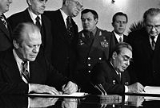
Carter Brezhnev Sign Salt Ii

SALT II

It was a contraversial experiment of negotiations between Richard Nixon and Leonid Brezhnev from 1972 to 1979 between the U.S. and the Soviet Union, which sought to curtail the manufacture of strategic nuclear weapon
Nuclear weapon

A nuclear weapon is an explosive device that derives its destructive force from nuclear reactions, either nuclear fission or a combination of fission and nuclear fusion....
s. It was a continuation of the progress made during the SALT I talks. SALT II was the first nuclear arms treaty which assumed real reductions in strategic forces to 2,250 of all categories of delivery vehicles on both sides. SALT II helped the U.S. to discourage the Soviets from arming their third generation ICBMs of SS-17, SS-19 and SS-18 types with many more MIRVs. In the late 1970s the USSR's missile design bureaus had developed experimental versions of these missiles equipped with anywhere from 10 to 38 thermonuclear warheads each. Additionally, the Soviets secretly agreed to reduce Tu-22M production to thirty aircraft per year and not to give them an intercontinental range. It was particularly important for the US to limit Soviet efforts in the Intermediate-Range Nuclear Forces
Intermediate-Range Nuclear Forces Treaty

The Intermediate-Range Nuclear Forces Treaty was a 1987 agreement between the United States and the Soviet Union. Signed in Washington, D.C. by President of the United States Ronald Reagan and General Secretary of the Communist Party of the Soviet Union Mikhail Gorbachev on December 8, 1987, it was ratified by the United States Senate on Ma...
 (INF) rearmament area. The SALT II Treaty banned new missile programs (a new missile defined as one with any key parameter 5% better than in currently deployed missiles), so both sides were forced to limit their new strategic missile types development although US preserved their most essential programs like Trident
Trident missile

The Trident missile is a multiple independently targetable reentry vehicle submarine-launched ballistic missile designed by Lockheed Martin Space Systems in the United States which is armed with nuclear weapons and is launched from Ballistic missile submarines, nuclear-powered ballistic missile submarines....
 and cruise missile
Cruise missile

A cruise missile is a guided missile missile that carries an explosive payload and uses a lifting wing and a propulsion system, usually a jet engine, to allow sustained flight; it is essentially a flying bomb....
s, which President Carter wished to use as his main defensive weapon as they were too slow to have first strike capability. In return, the USSR could exclusively retain 308 of its so-called "heavy ICBM
Heavy ICBM

Heavy ICBM is a term that was created in the 1970s to describe a class of Soviet ICBMs . They were characterized by a heavy throw-weight of 5 to 9 metric tons and a length of over 35 meters, and were thus capable of delivering a large number of warheads in a single MIRV missile....
" launchers of the SS-18 type.

An agreement to limit strategic launchers was reached in Vienna
Vienna

Vienna is the Capital of Republic of Austria and also one of the nine states of Austria. Vienna is Austria's primary city, with a population of about 1.7 million...
 on June 18, 1979, and was signed by Leonid Brezhnev
Leonid Brezhnev

Leonid Ilyich Brezhnev was General Secretary of the Communist Party of the Soviet Union from 1964 to 1982, serving in that position longer than anyone other than Joseph Stalin....
 and President of the United States
President of the United States

The President of the United States is the head of state and head of government of the United States and is the highest political official in the United States by influence and recognition....
 Jimmy Carter
Jimmy Carter

James Earl "Jimmy" Carter, Jr. served as the List of Presidents of the United States President of the United States from 1977 to 1981 and was the recipient of the 2002 Nobel Peace Prize....
. In response to the refusal of the U.S. Congress to ratify the treaty, a young member of the Senate Foreign Relations Committee, Senator Joseph Biden of Delaware
Delaware

Delaware is a U.S. state located on the East Coast of the United States in the Mid-Atlantic States region of the United States. The state takes its name from Thomas West, 3rd Baron De La Warr, a British nobleman and Virginia's first colonial governor, after whom Cape Henlopen was originally named....
, took the bold initiative to meet the Soviet Foreign Minister Andrey Gromyko, "" and secured several changes that neither the U.S. Secretary of State nor President Jimmy Carter could obtain.

Six months after the signing, the Soviet Union deployed troops to Afghanistan, and in September of the same year senators including Henry M. Jackson
Henry M. Jackson

Henry Martin "Scoop" Jackson was a United States United States House of Representatives and United States Senate for the state of Washington from 1941 until his death....
 and Frank Church
Frank Church

Frank Forrester Church III was a United States Senate from Idaho, serving four terms from 1957 to 1981. Church was a member of the Idaho Democratic Party....
 discovered the so-called "Soviet brigade" on Cuba. In light of these developments, the treaty was never formally ratified
Ratification

Ratification is the act of approving and paying for supplies or services provided to and accepted by the government as a result of an unauthorized commitment....
 by the United States Senate
United States Senate

The United States Senate is the upper house of the Bicameralism United States Congress, the lower house being the United States House of Representatives....
. Its terms were, nonetheless, honored by both sides until 1986 when the Reagan Administration withdrew from SALT II after accusing the Soviets of violating the pact.

Subsequent discussions took place under the Strategic Arms Reduction Treaty (START) and the Comprehensive Test Ban Treaty
Comprehensive Test Ban Treaty

The Comprehensive Nuclear-Test-Ban Treaty bans all nuclear weapon explosions in all environments, for military or civilian purposes....
.

USA/USSR arms limitation treaties

  • Partial or Limited Test Ban Treaty (PTBT/LTBT): 1963. Also put forth by Kennedy; banned nuclear tests in the atmosphere, underwater and in space. However, neither France nor China (both Nuclear Weapon States) signed.
  • Nuclear Non-Proliferation Treaty
    Nuclear Non-Proliferation Treaty

    The Treaty on the Non-Proliferation of Nuclear Weapons, also Nuclear Non-Proliferation Treaty is a treaty to limit the spread of nuclear weapons, opened for signature on July 1, 1968....
     (NPT): 1968. Established the U.S., USSR, UK, France
    France

    France , officially the French Republic , is a country whose Metropolitan France is located in Western Europe and that also comprises various Overseas departments and territories of France....
    , and China
    China

    China is a Culture of China, an ancient civilization, and, depending on perspective, a national or multinational entity extending over a large area in East Asia....
     as five "Nuclear-Weapon States". Non-Nuclear Weapon states were prohibited from (among other things) possessing, manufacturing, or acquiring nuclear weapons or other nuclear explosive devices. All 187 signatories were committed to the goal of (eventual) nuclear disarmament.
  • Anti-Ballistic Missile Treaty
    Anti-Ballistic Missile Treaty

    The Anti-Ballistic Missile Treaty was a treaty between the United States and the Soviet Union on the limitation of the anti-ballistic missile systems used in defending areas against missile-delivered nuclear weapons....
     (ABM): 1972. Entered into between the U.S. and USSR to limit the anti-ballistic missile (ABM) systems used in defending areas against missile-delivered nuclear weapons; ended by the US in 2002.
  • Strategic Arms Limitation Treaties
    Strategic Arms Limitation Talks

    The Strategic Arms Limitation Talks refers to two rounds of Bilateralism talks and corresponding international treaties between the Soviet Union and the United States?the Cold War superpowers?on the issue of arms race....
     I & II (SALT I & II): 1972 / 1979. Limited the growth of US and Soviet missile arsenals.
  • Prevention of Nuclear War Agreement
    Prevention of Nuclear War Agreement

    The Prevention of Nuclear War Agreement was created to reduce the danger of nuclear war between the United States and the Union of Soviet Socialist Republics....
    : 1973. Committed the U.S. and USSR to consult with one another during conditions of nuclear confrontation.
  • Intermediate-Range Nuclear Forces Treaty
    Intermediate-Range Nuclear Forces Treaty

    The Intermediate-Range Nuclear Forces Treaty was a 1987 agreement between the United States and the Soviet Union. Signed in Washington, D.C. by President of the United States Ronald Reagan and General Secretary of the Communist Party of the Soviet Union Mikhail Gorbachev on December 8, 1987, it was ratified by the United States Senate on Ma...
     (INF): 1987. Eliminated tactical ("battlefield") nuclear devices and GLCMs from Europe
    Europe

    Europe is, conventionally, one of the world's seven continents. Comprising the westernmost peninsula of Eurasia, Europe is generally divided from Asia to its east by the water divide of the Ural Mountains, the Ural , the Caspian Sea, and by the Caucasus Mountains to the southeast....
    .
  • Strategic Arms Reductions Treaty I (START I): 1991. This was signed by George H. W. Bush
    George H. W. Bush

    George Herbert Walker Bush served as the List of Presidents of the United States President of the United States from 1989 to 1993. Bush held a variety of political positions prior to his presidency, including Vice President of the United States in the administration of Ronald Reagan and Director of Central Intelligence under Gerald R....
     and Mikhail Gorbachev
    Mikhail Gorbachev

    Mikhail Sergeyevich Gorbachev is a Russian politician. He was the last General Secretary of the Communist Party of the Soviet Union, serving from 1985 until 1991, and also the last head of state of the USSR, serving from 1988 until its collapse in 1991....
    ; reduced the numbers of U.S. and Soviet long-range missiles and nuclear warheads from 10,000 per side to 6,000 per side.
  • Mutual Detargeting Treaty (MDT): 1994. U.S. and Russia
    Russia

    Russia , or the Russian Federation , is a list of countries spanning more than one continent country extending over much of northern Eurasia....
    n missiles no longer automatically target the other country; nuclear forces are no longer operated in a manner that presumes that the two nations are adversaries.
  • Comprehensive Test Ban Treaty
    Comprehensive Test Ban Treaty

    The Comprehensive Nuclear-Test-Ban Treaty bans all nuclear weapon explosions in all environments, for military or civilian purposes....
     (CTBT) 1996. Prohibits all nuclear test explosions in all environments; was signed by 71 States (US is not signatory).
  • Strategic Arms Reductions Treaty II (START II
    START II

    START II, the Strategic Arms Reduction Treaty, which was signed by United States President of the United States George H....
    ): 2000. Will reduce the numbers of U.S. and Russian long-range missiles and nuclear warheads from 6,000 per side to 3,500-3,000 per side. (START III
    START III

    The third Strategic Arms Reduction Treaty, or START III, was a treaty negotiated between the United States and Russia meant to drastically reduce the nuclear arsenals of those two countries....
     proposed for 2007).
  • Strategic Offensive Reductions Treaty (SORT/Moscow Treaty (2002)). Established bilateral strategic nuclear arms reductions and a new "strategic nuclear framework"; also invited all countries to adopt non-proliferation principles aimed at preventing terrorists, or those that harbored them, from acquiring or developing all types of WMD
    Weapons of mass destruction

    A weapon of mass destruction is a weapon that can kill large numbers of humans and/or cause great damage to man-made structures , natural structures , or the biosphere in general....
    's and related materials, equipment, and tech.


See also

  • START
    START I

    START is a treaty between the United States of America and the Soviet Union on the Reduction and Limitation of Strategic Offensive Arms. The treaty was signed by the United States and the USSR, that barred its signatories from deploying more than 6,000 nuclear warheads atop a total of 1,600 ICBMs, submarine-launched ballistic missiles, and...
  • Nuclear Non-Proliferation Treaty
    Nuclear Non-Proliferation Treaty

    The Treaty on the Non-Proliferation of Nuclear Weapons, also Nuclear Non-Proliferation Treaty is a treaty to limit the spread of nuclear weapons, opened for signature on July 1, 1968....
  • Comprehensive Test Ban Treaty
    Comprehensive Test Ban Treaty

    The Comprehensive Nuclear-Test-Ban Treaty bans all nuclear weapon explosions in all environments, for military or civilian purposes....
  • Threshold Test Ban Treaty
    Threshold Test Ban Treaty

    The Treaty on the Limitation of Underground Nuclear Weapon Tests, also known as the Threshold Test Ban Treaty , was signed in July 1974 by the USA and the USSR....
  • Intermediate-Range Nuclear Forces Treaty
    Intermediate-Range Nuclear Forces Treaty

    The Intermediate-Range Nuclear Forces Treaty was a 1987 agreement between the United States and the Soviet Union. Signed in Washington, D.C. by President of the United States Ronald Reagan and General Secretary of the Communist Party of the Soviet Union Mikhail Gorbachev on December 8, 1987, it was ratified by the United States Senate on Ma...


External links

  • Text of SALT II 1979
  • Arms Control Today: , June 2002.