

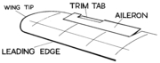
Aileron

Encyclopedia
.png)
Trailing edge
The trailing edge of an aerodynamic surface such as a wing is its rear edge, where the airflow separated by the leading edge rejoins. Essential control surfaces are attached here to redirect the air flow and exert a controlling force by changing its momentum...
of the wing
Wing
A wing is an appendage with a surface that produces lift for flight or propulsion through the atmosphere, or through another gaseous or liquid fluid...
of a fixed-wing aircraft
Fixed-wing aircraft
A fixed-wing aircraft is an aircraft capable of flight using wings that generate lift due to the vehicle's forward airspeed. Fixed-wing aircraft are distinct from rotary-wing aircraft in which wings rotate about a fixed mast and ornithopters in which lift is generated by flapping wings.A powered...
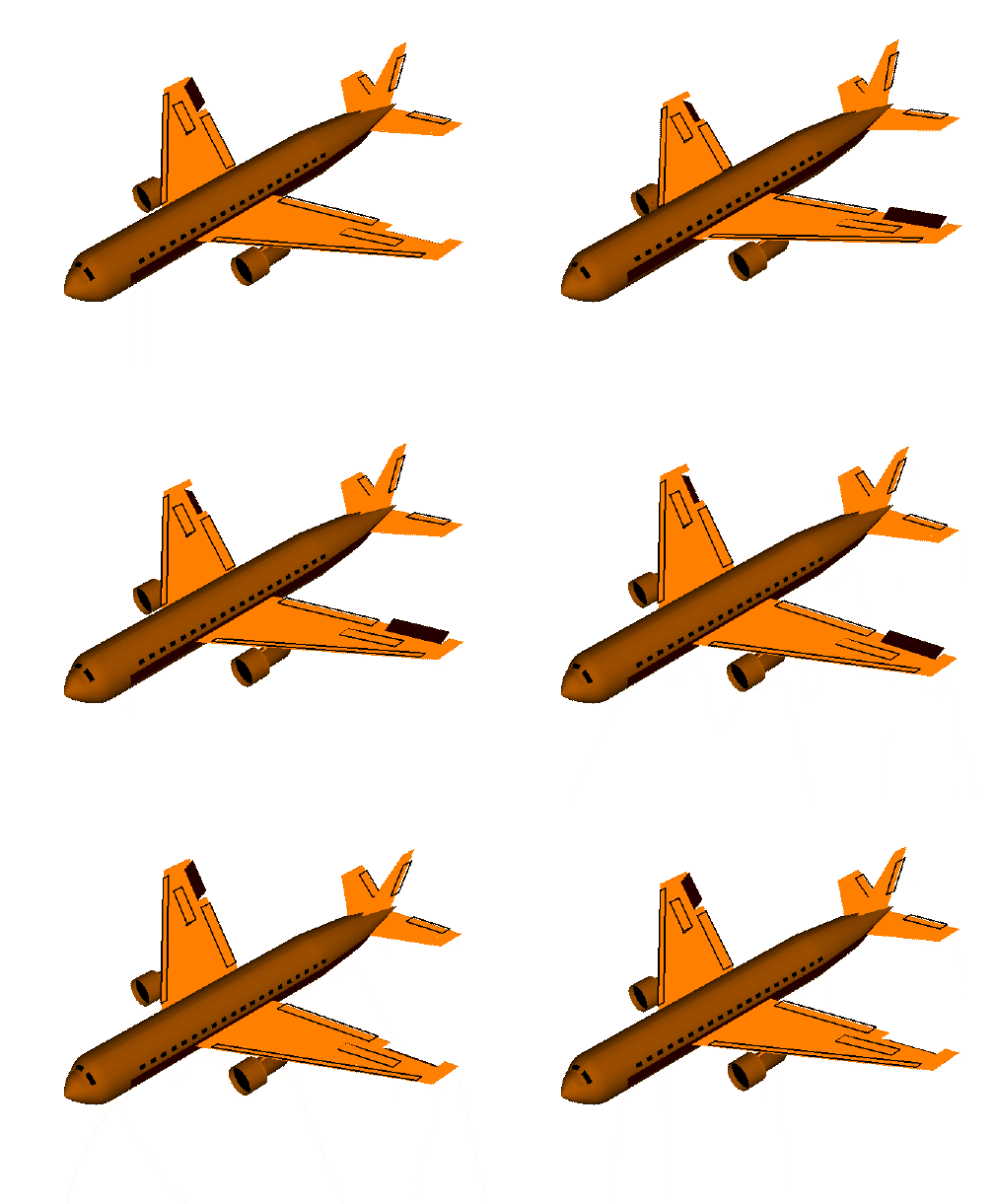
. The ailerons are used to control the aircraft in roll
Flight dynamics
Flight dynamics is the science of air vehicle orientation and control in three dimensions. The three critical flight dynamics parameters are the angles of rotation in three dimensions about the vehicle's center of mass, known as pitch, roll and yaw .Aerospace engineers develop control systems for...
, which results in a change in heading due to the tilting of the lift vector. The two ailerons are typically interconnected so that one goes down when the other goes up: the down-going aileron increases the lift
Lift (force)
A fluid flowing past the surface of a body exerts a surface force on it. Lift is the component of this force that is perpendicular to the oncoming flow direction. It contrasts with the drag force, which is the component of the surface force parallel to the flow direction...
on its wing while the up-going aileron reduces the lift on its wing, producing a rolling moment
Moment (physics)
In physics, the term moment can refer to many different concepts:*Moment of force is the tendency of a force to twist or rotate an object; see the article torque for details. This is an important, basic concept in engineering and physics. A moment is valued mathematically as the product of the...
about the aircraft's longitudinal axis. Ailerons are usually situated near the wing tip, but may sometimes be situated nearer the wing root. The terms "outboard aileron" and "inboard aileron" are used to describe these positions respectively. The word aileron is French for "little wing".
An unwanted side effect of aileron operation is adverse yaw
Adverse yaw
Adverse yaw is a yaw moment on an aircraft which results from an aileron deflection and a roll rate, such as when entering or exiting a turn. It is called "adverse" because it acts opposite to the yaw moment needed to execute the desired turn. Adverse yaw has three mechanisms, listed below in...
—a yawing moment in the opposite direction to the roll. Using the ailerons to roll an aircraft to the right produces a yawing motion to the left. As the aircraft rolls, adverse yaw is caused primarily by the change in drag
Drag (physics)
In fluid dynamics, drag refers to forces which act on a solid object in the direction of the relative fluid flow velocity...
on the left and right wing. The rising wing generates increased lift, which causes increased induced drag. The descending wing generates reduced lift, which causes reduced induced drag. The difference in drag on each wing produces the adverse yaw
Adverse yaw
Adverse yaw is a yaw moment on an aircraft which results from an aileron deflection and a roll rate, such as when entering or exiting a turn. It is called "adverse" because it acts opposite to the yaw moment needed to execute the desired turn. Adverse yaw has three mechanisms, listed below in...
. There is also often an additional adverse yaw contribution from a difference in profile drag between the up-aileron and down-aileron.
Adverse yaw is effectively compensated by the use of the rudder
Rudder
A rudder is a device used to steer a ship, boat, submarine, hovercraft, aircraft or other conveyance that moves through a medium . On an aircraft the rudder is used primarily to counter adverse yaw and p-factor and is not the primary control used to turn the airplane...
, which results in a sideforce on the vertical tail that opposes the adverse yaw by creating a favorable yawing moment. Another method of compensation is differential ailerons, which have been rigged such that the downgoing aileron deflects less than the upgoing one. In this case the opposing yaw moment is generated by a difference in profile drag between the left and right wingtips.
Frise ailerons accentuate this profile drag imbalance by protruding beneath the wing of an upward-deflected aileron, most often by being hinged slightly behind the leading edge and near the bottom of the surface, with the lower section of the leading edge protruding slightly below the wing's undersurface when the aileron is deflected upwards, substantially increasing profile drag on that side. Ailerons may also be designed to use a combination of these methods.
With ailerons in the neutral position, the wing on the outside of the turn develops more lift than the opposite wing due to the variation in airspeed across the wing span, which tends to cause the aircraft to continue to roll. Once the desired angle of bank (degree of rotation on the longitudinal axis) is obtained, the pilot uses opposite aileron to prevent the angle of bank from increasing due to this variation in lift across the wing span. This minor opposite use of the control must be maintained throughout the turn. The pilot also uses a slight amount of rudder
Rudder
A rudder is a device used to steer a ship, boat, submarine, hovercraft, aircraft or other conveyance that moves through a medium . On an aircraft the rudder is used primarily to counter adverse yaw and p-factor and is not the primary control used to turn the airplane...
in the same direction as the turn to counteract adverse yaw and to produce a "coordinated" turn wherein the fuselage
Fuselage
The fuselage is an aircraft's main body section that holds crew and passengers or cargo. In single-engine aircraft it will usually contain an engine, although in some amphibious aircraft the single engine is mounted on a pylon attached to the fuselage which in turn is used as a floating hull...
is parallel to the flight path. A simple gauge on the instrument panel called the slip indicator
Turn indicator
A turn indicator is an aircraft flight instrument that shows the rate of turn. It is used by the pilot to maintain control when flying under Instrument flight rules.-Types:...
, also known as "the ball", indicates when this coordination is achieved.
History
The aileron came into widespread use well after the rudder and elevatorElevator (aircraft)
Elevators are flight control surfaces, usually at the rear of an aircraft, which control the aircraft's orientation by changing the pitch of the aircraft, and so also the angle of attack of the wing. In simplified terms, they make the aircraft nose-up or nose-down...
. The Wright Brothers
Wright brothers
The Wright brothers, Orville and Wilbur , were two Americans credited with inventing and building the world's first successful airplane and making the first controlled, powered and sustained heavier-than-air human flight, on December 17, 1903...
used wing warping
Wing warping
Wing warping was an early system for lateral control of a fixed-wing aircraft. The technique, used and patented by the Wright brothers, consisted of a system of pulleys and cables to twist the trailing edges of the wings in opposite directions...
instead of ailerons for roll control, and initially, their aircraft had much better control in the air than aircraft that used movable surfaces; however, as aileron designs were refined, and aircraft became larger and heavier, it became clear that they were much more effective and practical for most aircraft.
There are conflicting claims over who first invented the aileron. In 1868, before the advent of powered aircraft, English inventor Matthew Piers Watt Boulton patented the first aileron-type device for lateral control via 'flexed' wings. Boulton's patent, No. 392, awarded in 1868 some 40 years before ailerons were 'reinvented', became forgotten until the aileron was in general use. If the Boulton device had been revealed at the time of the Wright Brother's patent filings, they may not have been able to claim priority of invention for lateral control of flying machines.
New Zealander Richard Pearse
Richard Pearse
Richard William Pearse , son of Cornish immigrants from St Columb near Newquay, a New Zealand farmer and inventor who performed pioneering experiments in aviation....
may have made a powered flight in a monoplane that included small ailerons as early as 1902, but his claims are controversial (and sometimes inconsistent), and, even by his own reports, his aircraft were not well controlled.
Robert Esnault-Pelterie
Robert Esnault-Pelterie
Robert Albert Charles Esnault-Pelterie was a pioneering French aircraft designer and spaceflight theorist. He was born in Paris, the son of a textile industrialist...
, a Frenchman, built a Wright-style glider in 1904 that used ailerons in lieu of wing-warping. Although Boulton had described and patented ailerons in 1868, no one had actually built them until Esnault-Pelterie’s glider, almost 40 years later.
The 14 Bis airplane, by Santos Dumont, was modified to add ailerons in late 1906, though it was never fully controllable in flight, likely due to its unconventional wing form.
Henry Farman
Henry Farman
Henri Farman Henri Farman Henri Farman (26 May 1874 – 17 July 1958 was a French pilot, aviator and aircraft designer and manufacturer with his brother Maurice Farman. His family was British and he took French nationality in 1937.-Biography:...
's ailerons on the Farman III were the first to resemble ailerons on modern aircraft, and have a reasonable claim as the ancestor of the modern aileron.
In 1908 U.S. inventor, businessman and engine builder Glenn Curtiss
Glenn Curtiss
Glenn Hammond Curtiss was an American aviation pioneer and a founder of the U.S. aircraft industry. He began his career as a bicycle then motorcycle builder and racer, later also manufacturing engines for airships as early as 1906...
flew an aileron-controlled aircraft. However Curtiss had previously been a member of the Aerial Experiment Association
Aerial Experiment Association
The Aerial Experiment Association was a Canadian aeronautical research group formed on 30 September 1907, under the tutelage of Dr. Alexander Graham Bell...
, headed by Alexander Graham Bell
Alexander Graham Bell
Alexander Graham Bell was an eminent scientist, inventor, engineer and innovator who is credited with inventing the first practical telephone....
. The Association had previously developed ailerons for their aircraft. The AEA members were later dismayed when Curtiss dropped out of their organization, patented their innovation and reportedly sold the patent to the United States Government.
Another contestant includes Dr. William Whitney Christmas of the U.S., who claimed to have invented an aileron in the 1914 patent for what would become the Christmas Bullet, which was built in 1918.
Aileron spades
These are flat metal plates, usually attached to the aileron lower surface, ahead of the aileron hinge, by a lever arm. They reduce the force needed by the pilot to deflect the aileron and are often seen on aerobatic aircraft. As the aileron is deflected upward, the spade produces a downward aerodynamic force, which tends to rotate the whole assembly so as to further deflect the aileron upward. The size of the spade (and its lever arm) determine how much force the pilot needs to apply to deflect the aileron.Aileron balance weights (or Mass Balances)
To prevent control surface flutter (aeroelastic flutter), the center of lift of the control surface should be behind the center of gravityCenter of gravity
In physics, a center of gravity of a material body is a point that may be used for a summary description of gravitational interactions. In a uniform gravitational field, the center of mass serves as the center of gravity...
of that surface. To achieve this, lead weights may be added to the front of the aileron. In some aircraft the aileron construction may be too heavy to allow this system to work without huge weight increases. In this case, the weight may be added to a lever arm to move the weight well out in front to the aileron body. These balance weights are tear drop shapes (to reduce drag), which make them appear quite different from spades, although both project forward and below the aileron. In addition to reducing flutter, mass balances also reduce the stick forces required to move the control surface in flight.
Single Acting Ailerons
Used during the First World War and before, these ailerons were each controlled by a single cable, which pulled the aileron up. When the aircraft was at rest, the ailerons hung vertically down. This type of aileron was used on the Short 166. One of the disadvantages of this setup was a greater tendency to yaw than even with basic interconnected ailerons. During the 1930's a number of light aircraft used single acting controls but used springs to return the ailerons to their neutral positions when the stick was released.Frise Ailerons
Engineer Leslie George Frise (1897–1979) developed an aileron shape that is often used due to its ability to counteract adverse yaw. The Frise aileron is pivoted at about its 25 to 30% chord line and near its bottom surface.When the aileron is deflected up (to make its wing go down), the leading edge of the aileron dips into the airflow beneath the wing. The moment of the leading edge in the airflow helps to move up the trailing edge, decreasing the stick force.
The down-moving aileron also adds energy to the boundary layer by the airflow from the under-side of the wing that scoops air by the edge of the aileron that follows the upper surface of the aileron and creates a lifting force on the upper surface of the aileron aiding the lift of the wing. That reduces the needed deflection angle of the aileron.
If the leading edge of the aileron is sharp or bluntly rounded, that adds significant drag to that wing and help the aircraft to yaw (turn) in the desired direction, but adds some unpleasant or potentially dangerous aerodynamic vibration (flutter).
Differential Ailerons
By careful design of the mechanical linkages, the up aileron can be made to deflect more than the down aileron (e.g., US patent 1565097). This helps reduce the likelihood of a wing tip stallStall (flight)
In fluid dynamics, a stall is a reduction in the lift coefficient generated by a foil as angle of attack increases. This occurs when the critical angle of attack of the foil is exceeded...
when aileron deflections are made at high angles of attack. The idea is that the loss of lift associated with the up aileron carries no penalty while the increase in lift associated with the down aileron is minimized. The rolling couple
Couple (mechanics)
In mechanics, a couple is a system of forces with a resultant moment but no resultant force. Another term for a couple is a pure moment. Its effect is to create rotation without translation, or more generally without any acceleration of the centre of mass.The resultant moment of a couple is called...
on the aircraft is always the difference in lift between the two wings.
The de Havilland Tiger Moth
De Havilland Tiger Moth
The de Havilland DH 82 Tiger Moth is a 1930s biplane designed by Geoffrey de Havilland and was operated by the Royal Air Force and others as a primary trainer. The Tiger Moth remained in service with the RAF until replaced by the de Havilland Chipmunk in 1952, when many of the surplus aircraft...
classic British biplane
Biplane
A biplane is a fixed-wing aircraft with two superimposed main wings. The Wright brothers' Wright Flyer used a biplane design, as did most aircraft in the early years of aviation. While a biplane wing structure has a structural advantage, it produces more drag than a similar monoplane wing...
is one of the best-known aircraft, and one of the earliest, to use differential ailerons.
Combinations with other control surfaces
- A control surface that combines an aileron and flapFlap (aircraft)Flaps are normally hinged surfaces mounted on the trailing edges of the wings of a fixed-wing aircraft to reduce the speed an aircraft can be safely flown at and to increase the angle of descent for landing without increasing air speed. They shorten takeoff and landing distances as well as...
is called a flaperonFlaperonA flaperon is a type of aircraft control surface that combines aspects of both flaps and ailerons. In addition to controlling the roll or bank of an aircraft as do conventional ailerons, both flaperons can be lowered together to function similarly to a dedicated set of flaps...
. A single surface on each wing serves both purposes: Used as an aileron, the flaperons left and right are actuated differentially; when used as a flap, both flaperons are actuated downwards. When a flaperon is actuated downward (i.e., used as a flap), there is enough freedom of movement left to be able to still use the aileron function.
Some aircraft have used differentially controlled spoilers
Spoiler (aeronautics)
In aeronautics, a spoiler is a device intended to reduce lift in an aircraft. Spoilers are plates on the top surface of a wing which can be extended upward into the airflow and spoil it. By doing so, the spoiler creates a carefully controlled stall over the portion of the wing behind it, greatly...
or spoilerons
Spoileron
In aeronautics spoilerons are flight control surfaces, specifically spoilers that can be used asymmetrically to achieve the effect of ailerons, i.e. to roll an aircraft by reducing the lift of one wing but unlike ailerons not increasing the lift of the other wing...
to provide roll instead of conventional ailerons. The advantage is that the entire trailing edge of the wing may be devoted to flaps, providing better low speed control. The Northrop P-61 Black Widow used spoilers in this manner, in conjunction with full span zap flaps and some modern airliners use spoilers to assist the ailerons
- In a delta-winged aircraft, the ailerons are combined with the elevators to form an elevonElevonElevons are aircraft control surfaces that combine the functions of the elevator and the aileron , hence the name. They are frequently used on tailless aircraft such as flying wings. An elevon that is not part of the main wing, but instead is a separate tail surface, is a stabilator...
. - Several modern fighter aircraft may have no ailerons on the wings at all, and combine roll control with an all moving tailplane. This is a stabilatorStabilatorA stabilator is an aircraft control surface that combines the functions of an elevator and a horizontal stabilizer...
or a rolling tail.
Wing Warping
On the earliest aircraft, such as the Wright FlyerWright Flyer
The Wright Flyer was the first powered aircraft, designed and built by the Wright brothers. They flew it four times on December 17, 1903 near the Kill Devil Hills, about four miles south of Kitty Hawk, North Carolina, U.S.The U.S...
, lateral control was effected by twisting the outboard portion of the wing so as to increase or decrease lift by changing the angle of attack. This had the disadvantages of stressing the structure, being heavy on the controls, and of risking stalling the side with the increased angle of attack during a maneuver. By 1915, few aircraft used wing warping.
Differential Spoilers
SpoilersSpoiler (aeronautics)
In aeronautics, a spoiler is a device intended to reduce lift in an aircraft. Spoilers are plates on the top surface of a wing which can be extended upward into the airflow and spoil it. By doing so, the spoiler creates a carefully controlled stall over the portion of the wing behind it, greatly...
are devices that when extended into the airflow over a wing, disrupt the airflow and reduce the amount of lift generated. A small number of aircraft have used spoilers in lieu of, or to supplement ailerons, such as the Northrop P-61 Black Widow, whose entire trailling edge was occupied with full span flaps.
Research
Several technology research and development efforts exist to integrate the functions of aircraft flight control systems such as ailerons, elevatorsElevator (aircraft)
Elevators are flight control surfaces, usually at the rear of an aircraft, which control the aircraft's orientation by changing the pitch of the aircraft, and so also the angle of attack of the wing. In simplified terms, they make the aircraft nose-up or nose-down...
, elevon
Elevon
Elevons are aircraft control surfaces that combine the functions of the elevator and the aileron , hence the name. They are frequently used on tailless aircraft such as flying wings. An elevon that is not part of the main wing, but instead is a separate tail surface, is a stabilator...
s, flap
Flap (aircraft)
Flaps are normally hinged surfaces mounted on the trailing edges of the wings of a fixed-wing aircraft to reduce the speed an aircraft can be safely flown at and to increase the angle of descent for landing without increasing air speed. They shorten takeoff and landing distances as well as...
s, and flaperon
Flaperon
A flaperon is a type of aircraft control surface that combines aspects of both flaps and ailerons. In addition to controlling the roll or bank of an aircraft as do conventional ailerons, both flaperons can be lowered together to function similarly to a dedicated set of flaps...
s into wings to perform the aerodynamic purpose with the advantages of less: mass, cost, drag, inertia
Inertia
Inertia is the resistance of any physical object to a change in its state of motion or rest, or the tendency of an object to resist any change in its motion. It is proportional to an object's mass. The principle of inertia is one of the fundamental principles of classical physics which are used to...
(for faster, stronger control response), complexity (mechanically simpler, fewer moving parts or surfaces, less maintenance), and radar cross section
Radar cross section
Radar cross section is a measure of how detectable an object is with a radar. A larger RCS indicates that an object is more easily detected.An object reflects a limited amount of radar energy...
for stealth
Stealth technology
Stealth technology also termed LO technology is a sub-discipline of military tactics and passive electronic countermeasures, which cover a range of techniques used with personnel, aircraft, ships, submarines, and missiles, to make them less visible to radar, infrared, sonar and other detection...
. These may be used in many unmanned aerial vehicle
Unmanned aerial vehicle
An unmanned aerial vehicle , also known as a unmanned aircraft system , remotely piloted aircraft or unmanned aircraft, is a machine which functions either by the remote control of a navigator or pilot or autonomously, that is, as a self-directing entity...
s (UAVs) and 6th generation fighter aircraft
Fighter aircraft
A fighter aircraft is a military aircraft designed primarily for air-to-air combat with other aircraft, as opposed to a bomber, which is designed primarily to attack ground targets...
. Two promising approaches are flexible wings, and fluidics.
In flexible wings, much or all of a wing surface can change shape in flight to deflect air flow. The X-53 Active Aeroelastic Wing is a NASA
NASA
The National Aeronautics and Space Administration is the agency of the United States government that is responsible for the nation's civilian space program and for aeronautics and aerospace research...
effort. The Adaptive Compliant Wing
Adaptive Compliant Wing
The Adaptive Compliant Wing is a wing design developed by FlexSys, Inc., which is flexible so that aspects of its shape can be changed in flight....
is a military and commercial effort.
In fluidics
Fluidics
Fluidics or Fluidic logic is the use of a fluid to perform analog or digital operations similar to those performed with electronics.The physical basis of fluidics is pneumatics and hydraulics, based on the theoretical foundation of fluid dynamics...
, forces in vehicles occur via circulation control, in which larger more complex mechanical parts are replaced by smaller simpler fluidic systems (slots that emit air flows) where larger forces in fluids are diverted by smaller jets or flows of fluid intermittently, to change the direction of vehicles. In this use, fluidics promises lower mass, costs (up to 50% less), and very low inertia
Inertia
Inertia is the resistance of any physical object to a change in its state of motion or rest, or the tendency of an object to resist any change in its motion. It is proportional to an object's mass. The principle of inertia is one of the fundamental principles of classical physics which are used to...
and response times, and simplicity.
External links
- NASA Glenn Research Center aileron article with Java demo and more pictures