

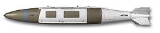
Joint Direct Attack Munition

Encyclopedia
 |
|
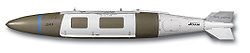
| Joint Direct Attack Munition (JDAM) | |
| Use: | Fixed target, precision strike, Moving Vehicle |
| Length: | 9.9–12.75 ft (3–3.9 m) |
| Wingspan: | 19.6 to 25 in (497.8 to 635 mm) |
| Range: | Up to 15 nautical miles (27.8 km) |
| Cost: Each Weapon | $35,000+ for the GBU-38 $70,000+ for the GBU-31 |
The Joint Direct Attack Munition (JDAM) is a guidance kit that converts unguided bombs, or "dumb bombs" into all-weather "smart" munitions. JDAM-equipped bombs are guided by an integrated inertial guidance system coupled to a Global Positioning System
Global Positioning System
The Global Positioning System is a space-based global navigation satellite system that provides location and time information in all weather, anywhere on or near the Earth, where there is an unobstructed line of sight to four or more GPS satellites...
(GPS) receiver, giving them a published range of up to 15 nautical miles (27.8 km). The guidance system was developed by the United States Air Force
United States Air Force
The United States Air Force is the aerial warfare service branch of the United States Armed Forces and one of the American uniformed services. Initially part of the United States Army, the USAF was formed as a separate branch of the military on September 18, 1947 under the National Security Act of...
and United States Navy
United States Navy
The United States Navy is the naval warfare service branch of the United States Armed Forces and one of the seven uniformed services of the United States. The U.S. Navy is the largest in the world; its battle fleet tonnage is greater than that of the next 13 largest navies combined. The U.S...
, hence the "joint" in JDAM. The JDAM was meant to improve upon laser-guided bomb
Laser-guided bomb
A laser-guided bomb is a guided bomb that uses semi-active laser homing to strike a designated target with greater accuracy than an unguided bomb. LGBs are one of the most common and widespread guided bombs, used by a large number of the world's air forces.- Overview :Laser-guided munitions use a...
and imaging infrared technology, which can be hindered by bad ground and weather conditions. Laser seekers are now being fitted to some JDAMs.
Overview
The JDAM is not a stand alone weapon system, rather it is a "bolt-on" guidance package that converts unguided gravity bombs into Precision-Guided MunitionsPrecision-guided munition
A precision-guided munition is a guided munition intended to precisely hit a specific target, and to minimize damage to things other than the target....
, or PGMs. The key components of the system consist of a tail section with aerodynamic control surfaces, a (body) strake kit, and a combined inertial guidance system and GPS
Global Positioning System
The Global Positioning System is a space-based global navigation satellite system that provides location and time information in all weather, anywhere on or near the Earth, where there is an unobstructed line of sight to four or more GPS satellites...
guidance control unit. It is typically installed by Naval Aviation Ordnancemen or Air Force Munition Systems Specialists shortly prior to loading onto the delivery aircraft.
JDAM-equipped bombs range from 500 pounds (226.8 kg) to 2000 pounds (907.2 kg). When installed on a bomb, the JDAM kit is given a GBU (Guided Bomb Unit) nomenclature, superseding the Mark 80 or BLU (Bomb, Live Unit) nomenclature of the bomb to which it is attached.
History and development
The Air Force's initial bombing efforts during 1991's Operation Desert Storm suffered for the lack of an air-to-surface weapon that could work regardless of smokeSmoke
Smoke is a collection of airborne solid and liquid particulates and gases emitted when a material undergoes combustion or pyrolysis, together with the quantity of air that is entrained or otherwise mixed into the mass. It is commonly an unwanted by-product of fires , but may also be used for pest...
, fog
Fog
Fog is a collection of water droplets or ice crystals suspended in the air at or near the Earth's surface. While fog is a type of stratus cloud, the term "fog" is typically distinguished from the more generic term "cloud" in that fog is low-lying, and the moisture in the fog is often generated...
, dust
Dust
Dust consists of particles in the atmosphere that arise from various sources such as soil dust lifted up by wind , volcanic eruptions, and pollution...
, and cloud
Cloud
A cloud is a visible mass of liquid droplets or frozen crystals made of water and/or various chemicals suspended in the atmosphere above the surface of a planetary body. They are also known as aerosols. Clouds in Earth's atmosphere are studied in the cloud physics branch of meteorology...
cover. Research, development, testing and evaluation (RDT&E) of an "adverse weather precision guided munition" began in 1992. Several proposals were considered, including a radical concept that used GPS. At the time, there were few GPS satellites and the idea of using satellite navigation for real-time weapon guidance was untested and controversial. To identify the technical risk associated with an INS/GPS guided weapon, the Air Force created in early 1992 a rapid-response High Gear program called the “JDAM Operational Concept Demonstration” (OCD) at Eglin Air Force Base. Honeywell
Honeywell
Honeywell International, Inc. is a major conglomerate company that produces a variety of consumer products, engineering services, and aerospace systems for a wide variety of customers, from private consumers to major corporations and governments....
, Interstate Electronics Corporation, Sverdrup Technology, and McDonnell Douglas
McDonnell Douglas
McDonnell Douglas was a major American aerospace manufacturer and defense contractor, producing a number of famous commercial and military aircraft. It formed from a merger of McDonnell Aircraft and Douglas Aircraft in 1967. McDonnell Douglas was based at Lambert-St. Louis International Airport...
were hired to help the USAF 46 Test Wing demonstrate the feasibility of a GPS weapon within one year. The OCD program fitted a GBU-15 guided bomb with an INS/GPS guidance kit and on 10 February 1993, dropped the first INS/GPS weapon from an Air Force F-16 on a target 88000 feet (26.8 km) downrange. Five more tests were run in various weather conditions, altitudes, and ranges. The OCD program demonstrated an 11-meter Circular Error Probable
Circular error probable
In the military science of ballistics, circular error probable is an intuitive measure of a weapon system's precision...
(CEP).

In addition, there have been tests involving multiple weapon drops with each weapon being individually targeted.
JDAM and the B-2 Spirit
B-2 Spirit
The Northrop Grumman B-2 Spirit is an American heavy bomber with low observable stealth technology designed to penetrate dense anti-aircraft defenses and deploy both conventional and nuclear weapons. The bomber has a crew of two and can drop up to eighty -class JDAM GPS-guided bombs, or sixteen ...
stealth bomber made their combat debuts during Operation Allied Force
Operation Allied Force
The NATO bombing of Yugoslavia was NATO's military operation against the Federal Republic of Yugoslavia during the Kosovo War. The strikes lasted from March 24, 1999 to June 10, 1999...
. The B-2s, flying 30-hour, nonstop, round-trip flights from Whiteman Air Force Base
Whiteman Air Force Base
Whiteman Air Force Base is a United States Air Force base located approximately south of Knob Noster, Missouri; east-southeast of Kansas City, Missouri....
, Missouri
Missouri
Missouri is a US state located in the Midwestern United States, bordered by Iowa, Illinois, Kentucky, Tennessee, Arkansas, Oklahoma, Kansas and Nebraska. With a 2010 population of 5,988,927, Missouri is the 18th most populous state in the nation and the fifth most populous in the Midwest. It...
, delivered more than 650 JDAMs during Allied Force. An article published in a military acquisition journal in 2002 cites that "[d]uring Operation Allied Force ... B-2s launched 651 JDAMs with 96% reliability and hit 87% of intended targets..." Due to the operational success of the original JDAM, the program expanded to the 500 pounds (226.8 kg) Mark 82 and 1000 pounds (453.6 kg) Mark 83
Mark 83 bomb
The Mark 83 is part of the Mark 80 series of low-drag general-purpose bombs in United States service.-Development & deployment:The nominal weight of the bomb is 1,000 lb , although its actual weight varies between 985 lb and 1,030 lb , depending on fuze options, and fin configuration...
, beginning development in late 1999. As a result of lessons learned during Operation Enduring Freedom and Operation Iraqi Freedom, the Navy and Air Force are both pursuing enhancements to the kits such as improved GPS accuracy as well as a precision seeker for terminal guidance for use against moving targets.
JDAM bombs are inexpensive compared to alternatives such as cruise missiles. The original cost estimate was $40,000 each for the tail kits, but after competitive bidding, contracts were signed with McDonnell Douglas
McDonnell Douglas
McDonnell Douglas was a major American aerospace manufacturer and defense contractor, producing a number of famous commercial and military aircraft. It formed from a merger of McDonnell Aircraft and Douglas Aircraft in 1967. McDonnell Douglas was based at Lambert-St. Louis International Airport...
(later taken over by Boeing
Boeing
The Boeing Company is an American multinational aerospace and defense corporation, founded in 1916 by William E. Boeing in Seattle, Washington. Boeing has expanded over the years, merging with McDonnell Douglas in 1997. Boeing Corporate headquarters has been in Chicago, Illinois since 2001...
) for delivery at $18,000 each. Unit costs have since increased to $21,000 in 2004 and are expected to reach $31,000 by 2011. For comparison, the newest Tomahawk cruise missile, dubbed the Tactical Tomahawk
BGM-109 Tomahawk
The Tomahawk is a long-range, all-weather, subsonic cruise missile. Introduced by General Dynamics in the 1970s, it was designed as a medium- to long-range, low-altitude missile that could be launched from a surface platform. It has been improved several times and, by way of corporate divestitures...
, costs nearly $730,000 a piece.
Operational use
.jpg)
Global Positioning System
The Global Positioning System is a space-based global navigation satellite system that provides location and time information in all weather, anywhere on or near the Earth, where there is an unobstructed line of sight to four or more GPS satellites...
-aided inertial navigation system
Inertial navigation system
An inertial navigation system is a navigation aid that uses a computer, motion sensors and rotation sensors to continuously calculate via dead reckoning the position, orientation, and velocity of a moving object without the need for external references...
(INS). The navigation system is initialized by transfer alignment from the aircraft that provides position and velocity vectors from the aircraft systems. Once released from the aircraft, the JDAM autonomously navigates to the designated target coordinates. Target coordinates can be loaded into the aircraft before takeoff, manually altered by the aircrew in flight prior to weapon release, or entered by a datalink from onboard targeting equipment, such as the LITENING II
LITENING targeting pod
The AN/AAQ-28 LITENING targeting pod is a precision targeting pod system currently operational with a wide variety of combat aircraft. LITENING significantly increases the combat effectiveness of the aircraft during day, night and under-the-weather conditions in the attack of ground and air...
or "Sniper"
Lockheed Martin Sniper XR
The Lockheed Martin Sniper Advanced Targeting Pod , designated AN/AAQ-33 in U.S. Military Service, provides positive target identification, autonomous tracking, coordinate generation, and precise weapons guidance from extended standoff ranges. The Sniper ATP is used on the F-15E Strike Eagle, F-16...
targeting pods. In its most accurate mode, the JDAM system will provide a minimum weapon accuracy CEP of 13 meters or less when a GPS signal is available, though Boeing and the Air Forces report less than 10 meters CEP in testing. If the GPS signal is jammed or lost, the JDAM can still achieve a 30 meter CEP or less for free flight times up to 100 seconds.
The introduction of GPS guidance to weapons brought several improvements to air-to-ground warfare. The first is a real all-weather capability since GPS is not affected by rain, clouds, fog, smoke, or man-made obscurants. Previous precision guided weapons relied on seekers using infrared, visual light, or a reflected laser spot to “see” the ground target. These seekers were not effective when the target was obscured by fog and low altitude clouds and rain (as encountered in Kosovo), or by dust and smoke (as encountered in Desert Storm).
The second advantage is an expanded launch acceptance region (LAR). The LAR defines the region that the aircraft must be within to launch the weapon and hit the target. Non-GPS based precision guided weapons using seekers to guide to the target have significant restrictions on the launch envelope due to the seeker field of view. Some of these systems (such as the Paveway
Paveway
Paveway is a generic term for Laser Guided Bombs .Pave or PAVE is sometimes used as an acronym for precision avionics vectoring equipment; literally, electronics for controlling the speed and direction of aircraft...
I, II, and III) must be launched so that the target remains in the seeker field of view throughout the weapon trajectory (or for lock-on-after-launch engagements, the weapon must be launched so that the target is in the field of view during the terminal flight). This requires the aircraft to fly generally straight at the target when launching the weapon. This restriction is eased in some other systems (such as the GBU-15
GBU-15
Guided Bomb Unit 15 is an unpowered, glide weapon used to destroy high-value enemy targets. It was designed for use with F-15E Strike Eagle, F-111 'Aardvark' and F-4 Phantom II aircraft, but the United States Air Force is currently only deploying it from the F-15E. The GBU-15 has long-range...
and the AGM-130
AGM-130
The AGM-130 is a missile developed by the United States of America.-Overview:The AGM-130 is a powered air-to-surface missile designed for strikes at long range against various targets...
) through the ability of a Weapon System Operator (WSO) in the aircraft to manually steer the weapon to the target. Using a WSO requires a data link between the weapon and the controlling aircraft and requires the controlling aircraft to remain in the area (and possibly vulnerable to defensive fire) as long as the weapon is under manual control. Since GPS-based flight control systems know the weapon current location and the target location, these weapons can autonomously adjust the trajectory to hit the target. This allows the launch aircraft to release the weapon at very large off-axis angles including releasing weapons to attack targets behind the aircraft.
The third advantage is a true “fire-and-forget
Fire-and-forget
Fire-and-forget is a third-generation method of missile guidance. The military uses the term for a type of missile which does not require further guidance after launch such as illumination of the target or wire guidance , and can hit its target without the launcher being in line-of-sight of the...
” capability in which the weapon does not require any support after being launched. This allows the launching aircraft to leave the target area and proceed to its next mission immediately after launching the GPS guided weapon.
Another important capability provided by GPS-based guidance is the ability to completely tailor a flight trajectory to meet criteria other than simply hitting a target. Weapon trajectories can be controlled so that a target can be impacted at precise headings and vertical angles. This provides the ability to impact perpendicular to a target surface and minimizing the angle of attack (maximizing penetration), detonating the warhead at a the optimum angle to maximize the warhead effectiveness, having the weapon fly into the target area from a different heading than the launch aircraft (decreases the risk of detection of the aircraft). GPS also provides an accurate time source common to all systems. This allows multiple weapons to loiter and impact targets at preplanned times and intervals.
In recognition of these advantages, most weapons including the Paveway, GBU-15, and the AGM-130 have been upgraded with a GPS capability. This enhancement combines the flexibility of GPS with the superior accuracy of seeker guidance.
Despite their precision, JDAM employment does not come without risk. On 5 December 2001, a JDAM dropped by a B-52 in Afghanistan
Afghanistan
Afghanistan , officially the Islamic Republic of Afghanistan, is a landlocked country located in the centre of Asia, forming South Asia, Central Asia and the Middle East. With a population of about 29 million, it has an area of , making it the 42nd most populous and 41st largest nation in the world...
nearly killed Hamid Karzai
Hamid Karzai
Hamid Karzai, GCMG is the 12th and current President of Afghanistan, taking office on 7 December 2004. He became a dominant political figure after the removal of the Taliban regime in late 2001...
, while he was leading anti-Taliban forces near Sayd Alim Kalay alongside a US Army Special Forces (SF) team. A large force of Taliban soldier
Soldier
A soldier is a member of the land component of national armed forces; whereas a soldier hired for service in a foreign army would be termed a mercenary...
s had engaged the combined force of Karzai's men and their American SF counterparts, nearly overwhelming them. The SF commander requested Close Air Support
Close air support
In military tactics, close air support is defined as air action by fixed or rotary winged aircraft against hostile targets that are close to friendly forces, and which requires detailed integration of each air mission with fire and movement of these forces.The determining factor for CAS is...
(CAS) to strike the Taliban positions in an effort to stop their advance. A JDAM was subsequently dropped, but instead of striking the Taliban positions, it struck the Afghan/American position. An investigation of the incident determined that the U.S. Air Force Tactical Control Party (TACP) attached to the Special Forces team had changed the battery in the GPS receiver
Precision Lightweight GPS Receiver
The Precision Lightweight GPS Receiver is a ruggedized, hand-held, single-frequency GPS receiver fielded by the US military...
at some point during the battle, thereby causing the device to return to "default" and "display its own coordinates." Not realizing that this had occurred, the TACP relayed his own coordinates to the delivery aircraft.
Upgrades
Experience during Operation Enduring Freedom and Operation Iraqi Freedom led US air power planners to seek additional capabilities in one package, resulting in ongoing program upgrades to place a precision terminal guidance seeker in the JDAM kit. The Laser JDAM (LJDAM), as this upgrade is known, adds a laser seeker to the nose of a JDAM equipped bomb, giving the ability to engage moving targets to the JDAM. The Laser Seeker is a cooperative development between BoeingBoeing
The Boeing Company is an American multinational aerospace and defense corporation, founded in 1916 by William E. Boeing in Seattle, Washington. Boeing has expanded over the years, merging with McDonnell Douglas in 1997. Boeing Corporate headquarters has been in Chicago, Illinois since 2001...
Integrated Defense Systems and Israel's Elbit Systems
Elbit Systems
Elbit Systems Ltd. is one of the world's largest defense electronics manufacturers and integrators. Established in 1967, and based in Haifa, Israel, Elbit employs 11,000 people worldwide....
. It is called Precision Laser Guidance Set (PLGS) by Boeing and consists of the Laser Seeker itself, now known as DSU-38/B, and a wire harness fixed under the bomb body to connect the DSU-38/B with the tailkit. During FY2004, Boeing and the U.S. Air Force began testing of the laser guidance
Laser guidance
Laser guidance is a technique of guiding a missile or other projectile or vehicle to a target by means of a laser beam. Some laser guided systems utilise beam riding guidance, but most operate more similarly to semi-active radar homing . This technique is sometimes called SALH, for Semi-Active...
capability for JDAM, with these tests demonstrating that the system is capable of targeting and destroying moving targets. This dual guidance system retains the ability to operate on GPS/INS alone, if laser guidance is unavailable, with the same accuracy of the earlier JDAM.
On 11 June 2007, Boeing
Boeing
The Boeing Company is an American multinational aerospace and defense corporation, founded in 1916 by William E. Boeing in Seattle, Washington. Boeing has expanded over the years, merging with McDonnell Douglas in 1997. Boeing Corporate headquarters has been in Chicago, Illinois since 2001...
announced that it had been awarded a $28 million contract by the U.S. Air Force to deliver 600 laser seekers (400 to the Air Force and 200 to the Navy) by June 2009. According to the Boeing Corporation, in tests at Nellis Air Force Base
Nellis Air Force Base
Nellis Air Force Base is a United States Air Force Base, located approximately northeast of Las Vegas, Nevada. It is under the jurisdiction of Air Combat Command .-Overview:...
, Nevada
Nevada
Nevada is a state in the western, mountain west, and southwestern regions of the United States. With an area of and a population of about 2.7 million, it is the 7th-largest and 35th-most populous state. Over two-thirds of Nevada's people live in the Las Vegas metropolitan area, which contains its...
, Air Force F-16 Fighting Falcon
F-16 Fighting Falcon
The General Dynamics F-16 Fighting Falcon is a multirole jet fighter aircraft originally developed by General Dynamics for the United States Air Force . Designed as an air superiority day fighter, it evolved into a successful all-weather multirole aircraft. Over 4,400 aircraft have been built since...
s and F-15E Strike Eagles
F-15 Eagle
The McDonnell Douglas F-15 Eagle is a twin-engine, all-weather tactical fighter designed by McDonnell Douglas to gain and maintain air superiority in aerial combat. It is considered among the most successful modern fighters with over 100 aerial combat victories with no losses in dogfights...
dropped twelve (12) 500 pounds (226.8 kg) LJDAMs that successfully struck high-speed moving targets. Using onboard targeting equipment, the launch aircraft self-designated, and self-guided their bombs to impact on the targets. In addition to the LJDAM kits, Boeing is also testing under a Navy development contract, an anti-jamming system for the JDAM, with development expected to be completed during 2007, with deliveries to commence in 2008. The system is known as the Integrated GPS Anti-Jam System (IGAS).
Boeing announced on 15 September 2008, that it had conducted demonstration flights with the LJDAM loaded aboard a B-52H.
On 24 July 2008 Germany
Germany
Germany , officially the Federal Republic of Germany , is a federal parliamentary republic in Europe. The country consists of 16 states while the capital and largest city is Berlin. Germany covers an area of 357,021 km2 and has a largely temperate seasonal climate...
signed a contract with Boeing to become the first international customer of LJDAM. Deliveries for the German Luftwaffe
Luftwaffe
Luftwaffe is a generic German term for an air force. It is also the official name for two of the four historic German air forces, the Wehrmacht air arm founded in 1935 and disbanded in 1946; and the current Bundeswehr air arm founded in 1956....
began in mid-2009. The order also includes the option for further kits in 2009.
JDAM Extended Range
In 2006, the Australian Defence Science and Technology OrganisationDefence Science and Technology Organisation
The Defence Science and Technology Organisation is a branch of the Australian Department of Defence which researches and develops technologies for use in the Australian defence industry....
in conjunction with Boeing Australia
Boeing Australia
Boeing Australia Holdings Pty Ltd, or simply Boeing Australia, is Boeing's largest footprint outside the United States. Established in 2002, the company oversees its seven wholly owned subsidiaries, consolidating and co-ordinating Boeing’s businesses and operations in Australia.Boeing has played an...
successfully tested extended range JDAM variants at Woomera Test Range
Woomera Test Range
The RAAF Woomera Test Range is a weapons testing range operated by the Royal Australian Air Force Aerospace Operational Support Group...
.
In 2009, Boeing announced that it will jointly develop the Joint Direct Attack Munition Extended Range (JDAM-ER) with South Korea
South Korea
The Republic of Korea , , is a sovereign state in East Asia, located on the southern portion of the Korean Peninsula. It is neighbored by the People's Republic of China to the west, Japan to the east, North Korea to the north, and the East China Sea and Republic of China to the south...
. The guidance kit will triple the range of JDAM to 80 km for the same accuracy, and will cost $10,000 per unit. The first prototypes are to be completed in 2010 or 2011.
Integration
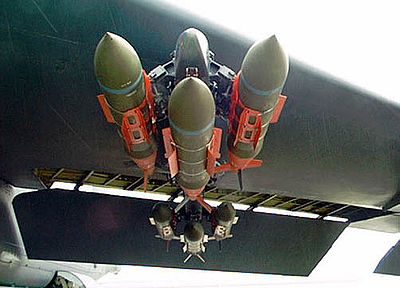
Current
JDAM is currently compatible with:- A-4 SkyhawkA-4 SkyhawkThe Douglas A-4 Skyhawk is a carrier-capable ground-attack aircraft designed for the United States Navy and United States Marine Corps. The delta winged, single-engined Skyhawk was designed and produced by Douglas Aircraft Company, and later McDonnell Douglas. It was originally designated the A4D...
- AV-8B Harrier IIAV-8B Harrier IIThe McDonnell Douglas AV-8B Harrier II is a second-generation vertical/short takeoff and landing ground-attack aircraft. An Anglo-American development of the British Hawker Siddeley Harrier, the Harrier II is the final member of the Harrier family that started with the Hawker Siddeley P.1127 in...
- A-10 Thunderbolt IIA-10 Thunderbolt IIThe Fairchild Republic A-10 Thunderbolt II is an American single-seat, twin-engine, straight-wing jet aircraft developed by Fairchild-Republic in the early 1970s. The A-10 was designed for a United States Air Force requirement to provide close air support for ground forces by attacking tanks,...
- AMX International AMXAMX International AMX|-See also:-References:NotesBibliography*Braybrook, Roy. "Assessing the AMX". Air International, June 1989, Vol 36 No 6. Bromley, UK:Fine Scroll. ISSN 0306-5634. pp. 267–278....
- B-1B LancerB-1 LancerThe Rockwell B-1 LancerThe name "Lancer" is only applied to the B-1B version, after the program was revived. is a four-engine variable-sweep wing strategic bomber used by the United States Air Force...
- B-2A SpiritB-2 SpiritThe Northrop Grumman B-2 Spirit is an American heavy bomber with low observable stealth technology designed to penetrate dense anti-aircraft defenses and deploy both conventional and nuclear weapons. The bomber has a crew of two and can drop up to eighty -class JDAM GPS-guided bombs, or sixteen ...
- B-52H StratofortressB-52 StratofortressThe Boeing B-52 Stratofortress is a long-range, subsonic, jet-powered strategic bomber operated by the United States Air Force since the 1950s. The B-52 was designed and built by Boeing, who have continued to provide maintainence and upgrades to the aircraft in service...
- F-15E Strike EagleF-15E Strike EagleThe McDonnell Douglas F-15E Strike Eagle is an all-weather multirole fighter, derived from the McDonnell Douglas F-15 Eagle. The F-15E was designed in the 1980s for long-range, high speed interdiction without relying on escort or electronic warfare aircraft. United States Air Force F-15E Strike...
- F-16C Fighting Falcon
- CF-18 Hornet
- F/A-18A+/C/D HornetF/A-18 HornetThe McDonnell Douglas F/A-18 Hornet is a supersonic, all-weather carrier-capable multirole fighter jet, designed to dogfight and attack ground targets . Designed by McDonnell Douglas and Northrop, the F/A-18 was derived from the latter's YF-17 in the 1970s for use by the United States Navy and...
- F/A-18E/F Super HornetF/A-18E/F Super HornetThe Boeing F/A-18E/F Super Hornet is a twin-engine carrier-based multirole fighter aircraft. The F/A-18E single-seat variant and F/A-18F tandem-seat variant are larger and more advanced derivatives of the F/A-18C and D Hornet. The Super Hornet has an internal 20 mm gun and can carry air-to-air...
- F-22 RaptorF-22 RaptorThe Lockheed Martin/Boeing F-22 Raptor is a single-seat, twin-engine fifth-generation supermaneuverable fighter aircraft that uses stealth technology. It was designed primarily as an air superiority fighter, but has additional capabilities that include ground attack, electronic warfare, and signals...
- F-35 Lightning IIF-35 Lightning IIThe Lockheed Martin F-35 Lightning II is a family of single-seat, single-engine, fifth generation multirole fighters under development to perform ground attack, reconnaissance, and air defense missions with stealth capability...
- MQ-9 ReaperMQ-9 ReaperThe General Atomics MQ-9 Reaper is an unmanned aerial vehicle , capable of remote controlled or autonomous flight operations, developed by General Atomics Aeronautical Systems for use by the United States Air Force, the United States Navy, the CIA, U.S. Customs and Border Protection, the Royal...
- Mitsubishi F-2Mitsubishi F-2The Mitsubishi F-2 is a multirole fighter manufactured by Mitsubishi Heavy Industries and Lockheed Martin for the Japan Air Self-Defense Force, with a 60/40 split in manufacturing between Japan and the USA. Production started in 1996 and the first aircraft entered service in 2000. The first 76...
- Panavia TornadoPanavia TornadoThe Panavia Tornado is a family of twin-engine, variable-sweep wing combat aircraft, which was jointly developed and manufactured by the United Kingdom, West Germany and Italy...
- Mirage F-1
- Eurofighter TyphoonEurofighter TyphoonThe Eurofighter Typhoon is a twin-engine, canard-delta wing, multirole combat aircraft, designed and built by a consortium of three companies: EADS, Alenia Aeronautica and BAE Systems; working through a holding company, Eurofighter GmbH, which was formed in 1986...
Past
JDAM was compatible with the following aircraft:- F-14A/B/D TomcatF-14 TomcatThe Grumman F-14 Tomcat is a supersonic, twin-engine, two-seat, variable-sweep wing fighter aircraft. The Tomcat was developed for the United States Navy's Naval Fighter Experimental program following the collapse of the F-111B project...
– retired - F-117 NighthawkF-117 NighthawkThe Lockheed F-117 Nighthawk was a single-seat, twin-engine stealth ground-attack aircraft formerly operated by the United States Air Force . The F-117A's first flight was in 1981, and it achieved initial operating capability status in October 1983...
– retired - S-3 VikingS-3 VikingThe Lockheed S-3 Viking is a four-seat twin-engine jet aircraft that was used by the U.S. Navy to identify, track, and destroy enemy submarines. In the late 1990s, the S-3B's mission focus shifted to surface warfare and aerial refueling. The Viking also provided electronic warfare and surface...
– retired
Export
The U.S. Government has approved the JDAM for export sale under the Arms Export Control ActArms Export Control Act
The Arms Export Control Act of 1976 gives the President of the United States the authority to control the import and export of defense articles and defense services. It requires governments that receive weapons from the United States to use them for legitimate self-defense...
, though in limited numbers to only a few countries. Outstanding requests for purchase are under review.
Export customers
The Royal Canadian Air ForceRoyal Canadian Air Force
The history of the Royal Canadian Air Force begins in 1920, when the air force was created as the Canadian Air Force . In 1924 the CAF was renamed the Royal Canadian Air Force and granted royal sanction by King George V. The RCAF existed as an independent service until 1968...
has used their first JDAM during Operation Mobile
Operation Mobile
Operation Mobile was the name given to Canadian Forces activities in the 2011 military intervention in Libya. The United States' counterpart to this was Operation Odyssey Dawn, the French counterpart was Opération Harmattan and the British counterpart was Operation Ellamy...
in 2011 (first international customer of LJDAM) Between 900 and 1000 GBU-31 and GBU-32 were produced in Italy
Italy
Italy , officially the Italian Republic languages]] under the European Charter for Regional or Minority Languages. In each of these, Italy's official name is as follows:;;;;;;;;), is a unitary parliamentary republic in South-Central Europe. To the north it borders France, Switzerland, Austria and...
for the Aeronautica Militare
Aeronautica Militare
The Italian Air Force is the air force of the Italian Republic. It has held a prominent role in modern Italian military history...
by Oto Melara
Oto Melara
Oto Melara is an Italian defence company with factories in Brescia and La Spezia. It was founded in 1905 as a joint venture of Vickers and Terni. During World War I, Vickers Terni produced many weapons with calibre 40 mm and upwards. In 1929 the company was renamed Odero Terni Orlando with the...
(+ LJDAM)
General characteristics
- Primary function: Guided air-to-surface weapon
- Contractor: BoeingBoeingThe Boeing Company is an American multinational aerospace and defense corporation, founded in 1916 by William E. Boeing in Seattle, Washington. Boeing has expanded over the years, merging with McDonnell Douglas in 1997. Boeing Corporate headquarters has been in Chicago, Illinois since 2001...
- Length: (JDAM and warhead) GBU-31 (v) 1/B: 152.7 inches (3,878.6 mm); GBU-31 (v) 3/B: 148.6 inches (3,774.4 mm); GBU-32 (v) 1/B: 119.5 inches (3,035.3 mm)
- Launch weight: (JDAM and warhead) GBU-31 (v) 1/B: 2036 pounds (923.5 kg); GBU-31 (v) 3/B: 2115 pounds (959.3 kg); GBU-32 (v) 1/B: 1,013 lb 1013 pounds (459.5 kg)
- Wingspan: GBU-31: 25 inches (635 mm); GBU-32: 19.6 inches (497.8 mm)
- Range: Up to 15 nautical miles (27.8 km)
- Ceiling: 45000 feet (13,716 m)
- Guidance system: GPS/INS
- Unit cost: Approximately $21,000 per tailkit (FY 01 dollars)
- Date deployed: 1999
- Inventory: The tailkit is in full-rate production. Projected inventory is approximately 240,000 total, 158,000 for the US Air Force and 82,000 for the US Navy. (As of October 2005)
Variants
.jpg)
- 2,000 lb (900 kg) nominal weight
- GBU-31(V)1/B (USAF) Mk-84Mark 84 bombThe Mark 84 is an American general-purpose bomb, it is also the largest of the Mark 80 series of weapons. Entering service during the Vietnam War, it became a commonly used US heavy unguided bomb to be dropped, second only to the BLU-82 "Daisy Cutter" then in service and presently third only to...
- GBU-31(V)2/B (USN/USMC) Mk-84Mark 84 bombThe Mark 84 is an American general-purpose bomb, it is also the largest of the Mark 80 series of weapons. Entering service during the Vietnam War, it became a commonly used US heavy unguided bomb to be dropped, second only to the BLU-82 "Daisy Cutter" then in service and presently third only to...
- GBU-31(V)3/B (USAF) BLU-109BLU-109 bombThe BLU-109/B is a hardened penetration bomb used by the United States Air Force . As other "bunker busters", it is intended to smash through concrete shelters and other hardened structures before exploding...
- GBU-31(V)4/B (USN/USMC) BLU-109BLU-109 bombThe BLU-109/B is a hardened penetration bomb used by the United States Air Force . As other "bunker busters", it is intended to smash through concrete shelters and other hardened structures before exploding...
- GBU-31(V)1/B (USAF) Mk-84
- 1,000 lb (450 kg) nominal weight
- GBU-32(V)1/B (USAF) Mk-83Mark 83 bombThe Mark 83 is part of the Mark 80 series of low-drag general-purpose bombs in United States service.-Development & deployment:The nominal weight of the bomb is 1,000 lb , although its actual weight varies between 985 lb and 1,030 lb , depending on fuze options, and fin configuration...
- GBU-32(V)2/B (USN/USMC) Mk-83Mark 83 bombThe Mark 83 is part of the Mark 80 series of low-drag general-purpose bombs in United States service.-Development & deployment:The nominal weight of the bomb is 1,000 lb , although its actual weight varies between 985 lb and 1,030 lb , depending on fuze options, and fin configuration...
- GBU-35(V)1/B (USN/USMC) BLU-110Mark 83 bombThe Mark 83 is part of the Mark 80 series of low-drag general-purpose bombs in United States service.-Development & deployment:The nominal weight of the bomb is 1,000 lb , although its actual weight varies between 985 lb and 1,030 lb , depending on fuze options, and fin configuration...
- GBU-32(V)1/B (USAF) Mk-83
- 500 lb (225 kg) nominal weight
- GBU-38/B (USAF) Mk-82,(USN/USMC)Mk-82 and BLU-111Mark 82 bombThe Mark 82 is an unguided, low-drag general-purpose bomb, part of the U.S. Mark 80 series. The explosive filling is tritonal.-Development and deployment:...
- GBU-54/B LaserJDAM (MK-82)
- GBU-38/B (USAF) Mk-82,(USN/USMC)Mk-82 and BLU-111
Similar systems
- HGK (bomb) designed and developed by Turkish Defence Institute TUBITAK-SAGE
- Spice (munition)Spice (munition)The "SPICE" is an Israeli-developed, EO/GPS-guided guidance kit for converting air-droppable unguided bombs into precision guided bombs....
- The Tail Subassembly (TSA) of the B61 nuclear bombB61 nuclear bombThe B61 nuclear bomb is the primary thermonuclear weapon in the U.S. Enduring Stockpile following the end of the Cold War. It is an intermediate yield strategic and tactical nuclear weapon featuring a two-stage radiation implosion design....
mod-12, will give this tactical and strategic weapon J-DAM levels of accuracy.
External links
- Boeing: Joint Direct Attack Munition (JDAM)
- Boeing (McDonnell Douglas) JDAM - Designation Systems
- Product Update: JDAM
- Precision Strike Weapons
- Diamond Back Range Extension Kit
- How Smart Bombs Work
- DAMASK Overview
- Safeguarding GPS 14 April 2003 Scientific AmericanScientific AmericanScientific American is a popular science magazine. It is notable for its long history of presenting science monthly to an educated but not necessarily scientific public, through its careful attention to the clarity of its text as well as the quality of its specially commissioned color graphics...
- Joint Direct Attack Munition (JDAM)
- Boeing JDAM gallery
- JDAM Matures (Australian Aviation)
- JDAM-ER (Extended Range) 15 October 2008 Defence Science and Technology OrganisationDefence Science and Technology OrganisationThe Defence Science and Technology Organisation is a branch of the Australian Department of Defence which researches and develops technologies for use in the Australian defence industry....