

Lorica segmentata

Encyclopedia
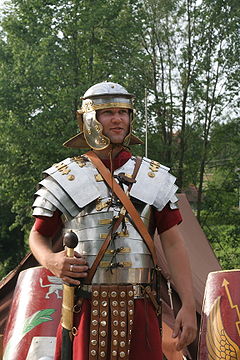
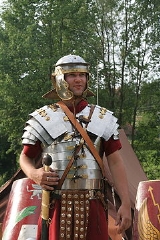
The lōrīca segmentāta (segmented plates) was a type of segmented armour
Armour
Armour or armor is protective covering used to prevent damage from being inflicted to an object, individual or a vehicle through use of direct contact weapons or projectiles, usually during combat, or from damage caused by a potentially dangerous environment or action...
almost exclusively used in the Roman Empire
Roman Empire
The Roman Empire was the post-Republican period of the ancient Roman civilization, characterised by an autocratic form of government and large territorial holdings in Europe and around the Mediterranean....
, but the Latin
Latin
Latin is an Italic language originally spoken in Latium and Ancient Rome. It, along with most European languages, is a descendant of the ancient Proto-Indo-European language. Although it is considered a dead language, a number of scholars and members of the Christian clergy speak it fluently, and...
name was first used in the 16th century (the ancient form is unknown, although it is possible that the Romans referred to the armour as "lorica laminata"). The armour itself consisted of broad ferrous (originally iron, but steel in modern recreations) strips ('girth hoops') fastened to internal leather
Leather
Leather is a durable and flexible material created via the tanning of putrescible animal rawhide and skin, primarily cattlehide. It can be produced through different manufacturing processes, ranging from cottage industry to heavy industry.-Forms:...
straps. The strips were arranged horizontally on the body, overlapping downwards, and they surrounded the torso in two halves, being fastened at the front and back. The upper body and shoulders were protected by additional strips ('shoulder guards') and breast- and backplates. The form of the armour allowed it to be stored very compactly, since it was possible to separate it into four sections. The fitments that closed the various plate sections together (buckles, lobate hinges, hinged straps, tie-hooks, tie-rings, etc.) were, however, made of brass
Brass
Brass is an alloy of copper and zinc; the proportions of zinc and copper can be varied to create a range of brasses with varying properties.In comparison, bronze is principally an alloy of copper and tin...
. However in later variants dating from around 75-80 A.D. the fastenings of the armor were simplified. Bronze hinges were removed in favor of simple rivets, belt fastenings utilized small hooks, and the lowest two girdle plates were replaced by one broad plate.
History
During the time of their use, this style of armor evolved and changed a number of times and ways, the currently recognised types being the KalkrieseKalkriese
Kalkriese is a 157-m high hill in Lower Saxony, Germany. It is hard to pass along Kalkriese's northern slope because one has to cross many deep brooks and rivulets. To the north of the Kalkriese is a large wetland, which stretches north for a large distance. It is a presumed archaeological site of...
, Corbridge
Corbridge
Corbridge is a village in Northumberland, England, situated west of Newcastle and east of Hexham. Villages in the vicinity include Halton, Acomb, Aydon and Sandhoe.-Roman fort and town:...
and Newstead
Newstead, Scottish Borders
Newstead is a village in the Scottish Borders, just east of Melrose, coordinates 55.599704, -2.691987. It has a population of approximately 260, according to the 2001 census.It is reputedly the oldest continually inhabited settlement in Scotland...
types, named after their places of discovery. There was, however, a considerable overlap between these types in use and the Corbridge and Newstead types are often found at the same site (e.g. at Caerleon
Caerleon
Caerleon is a suburban village and community, situated on the River Usk in the northern outskirts of the city of Newport, South Wales. Caerleon is a site of archaeological importance, being the site of a notable Roman legionary fortress, Isca Augusta, and an Iron Age hill fort...
in Wales
Wales
Wales is a country that is part of the United Kingdom and the island of Great Britain, bordered by England to its east and the Atlantic Ocean and Irish Sea to its west. It has a population of three million, and a total area of 20,779 km²...
, Carnuntum
Carnuntum
Carnuntum was a Roman army camp on the Danube in the Noricum province and after the 1st century the capital of the Upper Pannonia province...
in Austria
Austria
Austria , officially the Republic of Austria , is a landlocked country of roughly 8.4 million people in Central Europe. It is bordered by the Czech Republic and Germany to the north, Slovakia and Hungary to the east, Slovenia and Italy to the south, and Switzerland and Liechtenstein to the...
, Carlisle in England and León
León, Spain
León is the capital of the province of León in the autonomous community of Castile and León, situated in the northwest of Spain. Its city population of 136,985 makes it the largest municipality in the province, accounting for more than one quarter of the province's population...
in Spain
Spain
Spain , officially the Kingdom of Spain languages]] under the European Charter for Regional or Minority Languages. In each of these, Spain's official name is as follows:;;;;;;), is a country and member state of the European Union located in southwestern Europe on the Iberian Peninsula...
). It is possible that there was a fourth type, a hybrid of the banded armour together with scale
Scale armour
Scale armour is an early form of armour sometimes erroneously called scale mail consisting of many individual small armour scales of various shapes attached to each other and to a backing of cloth or leather in overlapping rows. Scale armour was worn by warriors of many different cultures as well...
shoulder defences. However, this is only known from one badly damaged statue originating at Alba Iulia
Alba Iulia
Alba Iulia is a city in Alba County, Transylvania, Romania with a population of 66,747, located on the Mureş River. Since the High Middle Ages, the city has been the seat of Transylvania's Roman Catholic diocese. Between 1541 and 1690 it was the capital of the Principality of Transylvania...
in Romania
Romania
Romania is a country located at the crossroads of Central and Southeastern Europe, on the Lower Danube, within and outside the Carpathian arch, bordering on the Black Sea...
. The currently accepted range for the use of the armour is from about 9 B.C. (Dangstetten) to the late 3rd century A.D. (León). Its use was geographically widespread but mail
Mail (armour)
Mail is a type of armour consisting of small metal rings linked together in a pattern to form a mesh.-History:Mail was a highly successful type of armour and was used by nearly every metalworking culture....
may have been more common at all times.
Uses
The question as to precisely who used the armour is debated. There is a clear difference in armour between the two corps shown on Trajan's ColumnTrajan's Column
Trajan's Column is a Roman triumphal column in Rome, Italy, which commemorates Roman emperor Trajan's victory in the Dacian Wars. It was probably constructed under the supervision of the architect Apollodorus of Damascus at the order of the Roman Senate. It is located in Trajan's Forum, built near...
. This is a monument erected in 113 in Rome to commemorate the conquest of Dacia
Dacia
In ancient geography, especially in Roman sources, Dacia was the land inhabited by the Dacians or Getae as they were known by the Greeks—the branch of the Thracians north of the Haemus range...
by Emperor Trajan
Trajan
Trajan , was Roman Emperor from 98 to 117 AD. Born into a non-patrician family in the province of Hispania Baetica, in Spain Trajan rose to prominence during the reign of emperor Domitian. Serving as a legatus legionis in Hispania Tarraconensis, in Spain, in 89 Trajan supported the emperor against...
(ruled 98-117): its bas-reliefs are a key source for Roman military equipment. Auxilia are generally shown wearing chain mail (lorica hamata
Lorica hamata
The lorica hamata is a type of mail armour used by the Roman Republic and the Roman Empire. During the 1st century it was starting to be supplemented by lorica segmentata, but had been reintroduced as sole standard-issue armor by the 4th century. It was issued for both primary Legionary and...
) cuirasses or simple leather corslets, and carrying oval shields. Legionaries are uniformly depicted wearing lorica segmentata and with curved rectangular shields. On this basis, it has long been supposed that lorica segmentata was used by legionaries only.
The view that auxilia were light troops originates from Vegetius' comment that "auxilia are always joined as light troops with the legions in the line". It is true that some specialist units in the auxilia, such as Syrian archers and Numidian cavalry
Numidian cavalry
Numidian cavalry was a type of light cavalry developed by the Numidians, most notably used by Hannibal during the Second Punic War. They were described by the Roman historian Livy as "by far the best horsemen in Africa."...
wore light armour (or none). But they were a small minority of the auxilia. Most auxiliary cohortes contained heavy infantry similar to legionaries.
However, on another Trajanic monument (the Adamclisi Tropaeum
Tropaeum Traiani
The Tropaeum Traiani is a monument in Roman Civitas Tropaensium , built in 109 in then Moesia Inferior, to commemorate Roman Emperor Trajan's victory over the Dacians, in 102, in the Battle of Tapae. The monument was erected on the place where legio XXI Rapax had previously been defeated in 92...
) the lorica segmentata does not appear at all, and legionaries and auxilia alike are depicted wearing either mail or scales (lorica squamata
Lorica squamata
The Lorica squamata is a type of scale armour used by the ancient Roman military during the Roman Republic and at later periods. It was made from small metal scales sewn to a fabric backing. It is typically seen on depictions of standard bearers, musicians, centurions, cavalry troops, and even...
). Some experts are of the opinion that the Adamclisi monument is a more accurate portrayal of normality, with the segmentata used rarely, maybe only for set-piece battles and parades. This viewpoint considers the figures in Trajan's Column to be highly stereotyped, in order to distinguish clearly between different types of troops. In any event, both corps were equipped with the same weapons: gladius
Gladius
Gladius was the Latin word for sword, and is used to represent the primary sword of Ancient Roman soldiers. Early ancient Roman swords were similar to those used by the Greeks. From the 3rd century BC, the Romans adopted swords similar to those used by the Celtiberians and others during the early...
(a close-combat stabbing sword) and javelins, although the type of javelin known as pilum
Pilum
The pilum was a javelin commonly used by the Roman army in ancient times. It was generally about two metres long overall, consisting of an iron shank about 7 mm in diameter and 60 cm long with pyramidal head...
seems to have been provided to legionaries only. Goldsworthy points out that the equipment of both corps were roughly equal in weight.
In recent years archaeology has found fittings of lorica segmentata in many fort sites that are thought to have been garrisoned by only auxiliary troops, i.e., where the legions were not based. If the legions were, indeed, broken up and distributed around all these small bases, then it implies a tactical use of the legions that has not previously been considered. Hitherto, the legions were regarded as shock troops employed only en masse and not broken up into penny packets. M.C. Bishop, however, has argued that we need to examine the way in which the various troop types were armed and deduce from this what their battle roles were, rather than trying to consider who-wore-what. Succinctly put, the legions were armed and trained for close-order combat while the auxiliary forces, just as numerous, were more accustomed to open order fighting, although they could be employed as the legions were (e.g. at Mons Graupius) if circumstances demanded this.
Last uses and disappearance
During the 3rd century, all peregrini were granted Roman citizenshipRoman citizenship
Citizenship in ancient Rome was a privileged political and legal status afforded to certain free-born individuals with respect to laws, property, and governance....
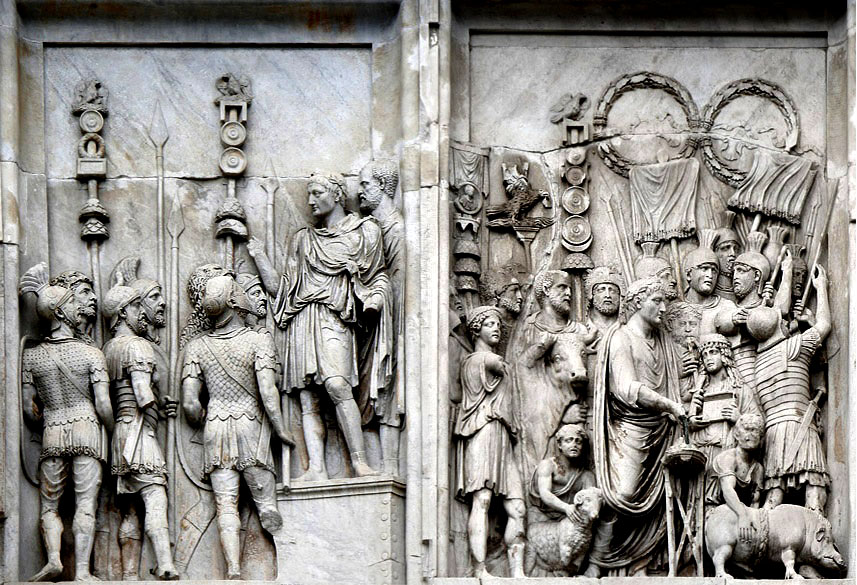
, and therefore legionaries lost their social superiority. The lorica segmentata eventually disappeared from Roman use, most likely due to its high cost and difficult maintenance despite its good qualities, although it appears to have still been in use in early 4th century, being depicted in the Arch of Constantine
Arch of Constantine
The Arch of Constantine is a triumphal arch in Rome, situated between the Colosseum and the Palatine Hill. It was erected to commemorate Constantine I's victory over Maxentius at the Battle of Milvian Bridge on October 28, 312...
erected in 315
315
Year 315 was a common year starting on Saturday of the Julian calendar. At the time, it was known as the Year of the Consulship of Constantinus and Licinianus...
during the reign of Constantine I
Constantine I
Constantine the Great , also known as Constantine I or Saint Constantine, was Roman Emperor from 306 to 337. Well known for being the first Roman emperor to convert to Christianity, Constantine and co-Emperor Licinius issued the Edict of Milan in 313, which proclaimed religious tolerance of all...
to commemorate his military achievements http://www.rome101.com/Portraiture/Constantine/pix/AtticS34_L.jpg. (However, it has been argued that these depictions are from an earlier monument by Marcus Aurelius, from which Constantine incorporated portions into his Arch.) Recently there has been evidence of a lorica segmentata found in Spain, dating from the third century.http://www.romanarmytalk.com/rat/viewtopic.php?f=17&t=26427 What is more surprising is that it was found in an area where, as far as we know, only limitanei
Limitanei
The limitanei, meaning "the soldiers in frontier districts" The limitanei, meaning "the soldiers in frontier districts" The limitanei, meaning "the soldiers in frontier districts" (from the Latin phrase limes, denoting the military districts of the frontier provinces established in the late third...
operated. (Limitanei are seen as poorer-quality troops than the contemporary mobile field armies of the comitatenses
Comitatenses
Comitatenses is the Latin plural of comitatensis, originally the adjective derived from comitatus , itself rooting in Comes .However, historically it became the accepted name for...
.)
Similar armouring techniques were used during the 16th century, employing sliding rivet
Rivet
A rivet is a permanent mechanical fastener. Before being installed a rivet consists of a smooth cylindrical shaft with a head on one end. The end opposite the head is called the buck-tail. On installation the rivet is placed in a punched or pre-drilled hole, and the tail is upset, or bucked A rivet...
s. This was known as anima.
Pop Culture
Lorica Segmentata has come to be viewed as synonymous with the Roman legions in pop culture depictions. This tendency even extends to time periods where its employment is so early as to be anachronistic such as in the computer game Rome: Total WarRome: Total War
Rome: Total War is a PC strategy game developed by The Creative Assembly and released on by Activision...
where the armour is available as early as the 3rd century BC.
External links
- Lorica Segmentata Volume I: A Handbook of Articulated Roman Plate Armour, M.C. Bishop, Armatura Press (November 1, 2002) (online version)
- Roman Army website, showing the third century finds of segmentata in spain (downloadable PDF)
- Ancient originals on the pages of the Roman Military Equipment Web Museum
See also
- Manica - roman armguard of similar construction
- Laminar armourLaminar armourLaminar armour , sometimes confusingly referred to as "banded mail", is an armour made from horizontal overlapping rows of solid armour plates as opposed to lamellar armour which is made from individual armor scales laced together to form a solid looking strip of armor.Prominent examples of such...