

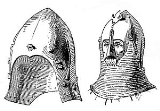
Bascinet

Encyclopedia
Europe
Europe is, by convention, one of the world's seven continents. Comprising the westernmost peninsula of Eurasia, Europe is generally 'divided' from Asia to its east by the watershed divides of the Ural and Caucasus Mountains, the Ural River, the Caspian and Black Seas, and the waterways connecting...
an open-faced military
Military
A military is an organization authorized by its greater society to use lethal force, usually including use of weapons, in defending its country by combating actual or perceived threats. The military may have additional functions of use to its greater society, such as advancing a political agenda e.g...
helmet
Helmet
A helmet is a form of protective gear worn on the head to protect it from injuries.Ceremonial or symbolic helmets without protective function are sometimes used. The oldest known use of helmets was by Assyrian soldiers in 900BC, who wore thick leather or bronze helmets to protect the head from...
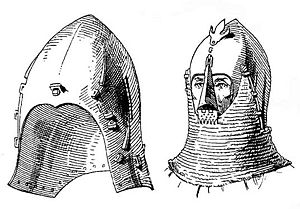
, typically fitted with an aventail
Aventail
An aventail or camail is a flexible curtain of mail on a helmet that extends to cover the neck and shoulders. The mail could be attached to the helm by threading a leather cord through brass rings at the edge of the helm. Aventails were most commonly seen on bascinets in the 14th century and...
and hinge
Hinge
A hinge is a type of bearing that connects two solid objects, typically allowing only a limited angle of rotation between them. Two objects connected by an ideal hinge rotate relative to each other about a fixed axis of rotation. Hinges may be made of flexible material or of moving components...
d visor
Visor
A visor is a surface that protects the eyes, such as shading them from the sun or other bright light or protecting them from objects....
. The term is also written as bassinet or basinet.
Early versions
The earliest versions of the bascinet, at the beginning of the 14th century, had no visors, and were worn underneath larger "great helmGreat helm
The great helm or heaume, also called pot helm, bucket helm and barrel helm, of the High Middle Ages arose in the late twelfth century in the context of the crusades and remained in use until the fourteenth century...
s." After the initial clash of lance
Lance
A Lance is a pole weapon or spear designed to be used by a mounted warrior. The lance is longer, stout and heavier than an infantry spear, and unsuited for throwing, or for rapid thrusting. Lances did not have tips designed to intentionally break off or bend, unlike many throwing weapons of the...
s, the great helm was often discarded during fierce hand-to-hand combat
Combat
Combat, or fighting, is a purposeful violent conflict meant to establish dominance over the opposition, or to terminate the opposition forever, or drive the opposition away from a location where it is not wanted or needed....
, as it impeded breathing and vision. Thus, having a smaller helmet underneath was a real advantage.
The bascinet would be fitted with small holes around the face opening and base, so it could be laced onto the chainmail
Chainmail
Mail is a type of armour consisting of small metal rings linked together in a pattern to form a mesh.-History:Mail was a highly successful type of armour and was used by nearly every metalworking culture....
of the hauberk
Hauberk
A hauberk is a shirt of chainmail. The term is usually used to describe a shirt reaching at least to mid-thigh and including sleeves. Haubergeon generally refers to a shorter variant with partial sleeves, but the terms are often used interchangeably.- History :The word hauberk is derived from the...
to give continuous protection to the chin, neck and shoulders.
Developments
Small "nasals" were developed to protect the nose and part of the face after the great helm was discarded. By the middle of the 14th century, most knightKnight
A knight was a member of a class of lower nobility in the High Middle Ages.By the Late Middle Ages, the rank had become associated with the ideals of chivalry, a code of conduct for the perfect courtly Christian warrior....
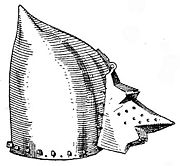
s discarded the great helm altogether in favor of a fully visored bascinet. The visor was often conical, giving the appearance of a muzzle or a beak
Beak
The beak, bill or rostrum is an external anatomical structure of birds which is used for eating and for grooming, manipulating objects, killing prey, fighting, probing for food, courtship and feeding young...
. They were sometimes called "dog faced" (medievally known as a hounskull
Hounskull
A hounskull was a form of steel helmet worn in Europe in the Middle Ages, almost invariably by knights and other mounted men-at-arms, from the middle of the 14th century until approximately 1420...
) or "pig faced" (a common but strictly modern term). The early versions sometimes had a neck defence of mail
Mail
Mail, or post, is a system for transporting letters and other tangible objects: written documents, typically enclosed in envelopes, and also small packages are delivered to destinations around the world. Anything sent through the postal system is called mail or post.In principle, a postal service...
called a camail or aventail
Aventail
An aventail or camail is a flexible curtain of mail on a helmet that extends to cover the neck and shoulders. The mail could be attached to the helm by threading a leather cord through brass rings at the edge of the helm. Aventails were most commonly seen on bascinets in the 14th century and...
, while later versions (at the end of the 14th century) often protected the neck with a separate but attached plate assembly, the gorget
Gorget
A gorget originally was a steel or leather collar designed to protect the throat. It was a feature of older types of armour and intended to protect against swords and other non-projectile weapons...
. The aventail was attached to a leather band, which was in turn attached to the lower border of the bascinet by a series of staples called vervelles
Vervelles
Vervelles are small metal staples used in Medieval armour to attach an aventail to a helmet. A leather cord would be woven through the top row of rings and the vervelles, securing the two together....
. Holes in the leather band were passed over the vervelles, and a waxed cord was passed through the holes in the vervelles to secure it.
Liner
The helmet also had a series of small holes around the bottom edge of the helmet and the face hole. These holes were used to sew a padded liner inside the helmet. The liner was made of linenLinen
Linen is a textile made from the fibers of the flax plant, Linum usitatissimum. Linen is labor-intensive to manufacture, but when it is made into garments, it is valued for its exceptional coolness and freshness in hot weather....
or a linen blend cloth stuffed with wool
Wool
Wool is the textile fiber obtained from sheep and certain other animals, including cashmere from goats, mohair from goats, qiviut from muskoxen, vicuña, alpaca, camel from animals in the camel family, and angora from rabbits....
or horsehair
Horsehair
Horsehair is the long, coarse hair growing on the manes and tails of horses. It is used for various purposes, including upholstery, brushes, the bows of musical instruments, a hard-wearing fabric called haircloth, and for horsehair plaster, a wallcovering material formerly used in the construction...
. The top of the liner was a series of lobes which were gathered by a cord to adjust how high the helmet rode on the wearer's head. While no known chin straps were used, the bascinet was often prevented from being lifted off the wearer's head by tying or strapping the camail to the surcoat
Surcoat
A surcoat was an outer garment commonly worn in the Middle Ages by both men and women. It can either refer to a coat worn over other garments or the outer garment of a person...
or armour
Armour
Armour or armor is protective covering used to prevent damage from being inflicted to an object, individual or a vehicle through use of direct contact weapons or projectiles, usually during combat, or from damage caused by a potentially dangerous environment or action...
.
Use
The bascinet, both with and without a visor (visors were often removable for better visibility and ventilation), was the most common helmet worn in Europe during the latter portions of the 14th and early 15th centuries, including during the Hundred Years' WarHundred Years' War
The Hundred Years' War was a series of separate wars waged from 1337 to 1453 by the House of Valois and the House of Plantagenet, also known as the House of Anjou, for the French throne, which had become vacant upon the extinction of the senior Capetian line of French kings...
. Contemporary illustrations show nearly every knight
Knight
A knight was a member of a class of lower nobility in the High Middle Ages.By the Late Middle Ages, the rank had become associated with the ideals of chivalry, a code of conduct for the perfect courtly Christian warrior....
and man-at-arms
Man-at-arms
Man-at-arms was a term used from the High Medieval to Renaissance periods to describe a soldier, almost always a professional warrior in the sense of being well-trained in the use of arms, who served as a fully armoured heavy cavalryman...
wearing one of a few variants of the basic hounskull helmet. The basic design was intended to direct blows from weapon
Weapon
A weapon, arm, or armament is a tool or instrument used with the aim of causing damage or harm to living beings or artificial structures or systems...
s downward and away from the skull and face of the wearer.
On the other hand, the helmet was still widely used without the visor for the 16th century in Hungary
Hungary
Hungary , officially the Republic of Hungary , is a landlocked country in Central Europe. It is situated in the Carpathian Basin and is bordered by Slovakia to the north, Ukraine and Romania to the east, Serbia and Croatia to the south, Slovenia to the southwest and Austria to the west. The...
, proof of that is the sculpture of the sarcophagus from the tomb of the Hungarian nobleman Lőrinc Újlaki (1459–1524). His statue was sculpted wearing a bascinet without visor.
Later versions
Over the course of the late 14th to early 15th centuries, the bascinet evolved from a shorter form with a shorter point (or no point at all) to its more pointed form—some so severe as to have a vertical back. In GermanyGermany
Germany , officially the Federal Republic of Germany , is a federal parliamentary republic in Europe. The country consists of 16 states while the capital and largest city is Berlin. Germany covers an area of 357,021 km2 and has a largely temperate seasonal climate...
a more bulbous version also appeared in the beginning of the 15th century. During the first half of the 15th century, more plates were added to protect the throat better, producing a form called the "great bascinet". Both the portion covering the skull and the hinged visor over the face became less angular and more rounded, until by the mid to late 15th century, the great bascinet had evolved into the armet
Armet
Armet is the name of a type of helmet developed in the 15th century, most likely in Italy, France, Spain and Hungary. It was distinguished by being the first helmet of its era to completely enclose the head while being compact and light enough to move with the wearer...
.
Visors
Italy
Italy , officially the Italian Republic languages]] under the European Charter for Regional or Minority Languages. In each of these, Italy's official name is as follows:;;;;;;;;), is a unitary parliamentary republic in South-Central Europe. To the north it borders France, Switzerland, Austria and...
armours.
It is documented that some seasoned knights often wore their bascinets without visors for better visibility and breathing during hand-to-hand combat, and to avoid heat exhaustion.
External links
- Spotlight: The 14th Century Bascinet (myArmoury.com article)