


Hauberk

Encyclopedia
Shirt
A shirt is a cloth garment for the upper body. Originally an undergarment worn exclusively by men, it has become, in American English, a catch-all term for almost any garment other than outerwear such as sweaters, coats, jackets, or undergarments such as bras, vests or base layers...
of chainmail
Chainmail
Mail is a type of armour consisting of small metal rings linked together in a pattern to form a mesh.-History:Mail was a highly successful type of armour and was used by nearly every metalworking culture....
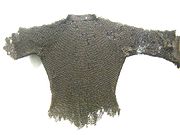
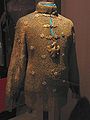
. The term is usually used to describe a shirt reaching at least to mid-thigh and including sleeves. Haubergeon ("little hauberk") generally refers to a shorter variant with partial sleeves, but the terms are often used interchangeably.
History
Old Frankish
Old Frankish is an extinct West Germanic language, once spoken by the Franks. It is the parent language of the Franconian languages, of which Dutch and Afrikaans are the most known descendants...
word halsberg, which originally described a small piece of mail that protects ("bergen", lit. "to give protection, to save, to rescue") the throat and the neck (the "Hals"). The Roman author Varro attributes the invention of mail to the Celts. The earliest extant example was found in Ciumeşti in modern Romania and is dated to the 4th-5th centuries BC. Roman armies adopted similar technology
Lorica hamata
The lorica hamata is a type of mail armour used by the Roman Republic and the Roman Empire. During the 1st century it was starting to be supplemented by lorica segmentata, but had been reintroduced as sole standard-issue armor by the 4th century. It was issued for both primary Legionary and...
after encountering it. Mail armour spread throughout the Mediterranean Basin
Mediterranean Basin
In biogeography, the Mediterranean Basin refers to the lands around the Mediterranean Sea that have a Mediterranean climate, with mild, rainy winters and hot, dry summers, which supports characteristic Mediterranean forests, woodlands, and scrub vegetation...
with the expansion of the Romans. It was quickly adopted by virtually every iron-using culture in the world, with the exception of the Chinese. The Chinese used it rarely, despite being heavily exposed to it from other cultures.
The short-hemmed, short-sleeved hauberk may have originated from the medieval Islamic world
Islamic Golden Age
During the Islamic Golden Age philosophers, scientists and engineers of the Islamic world contributed enormously to technology and culture, both by preserving earlier traditions and by adding their own inventions and innovations...
. The Bayeux Tapestry
Bayeux Tapestry
The Bayeux Tapestry is an embroidered cloth—not an actual tapestry—nearly long, which depicts the events leading up to the Norman conquest of England concerning William, Duke of Normandy and Harold, Earl of Wessex, later King of England, and culminating in the Battle of Hastings...
illustrates Norman soldiers
Normans
The Normans were the people who gave their name to Normandy, a region in northern France. They were descended from Norse Viking conquerors of the territory and the native population of Frankish and Gallo-Roman stock...
wearing a knee-length version of the hauberk, with three-quarter length sleeves and a split from hem to crotch. Such armor was quite expensive — both in materials (iron wire) and time/skill required to manufacture it — so common foot soldiers rarely were so equipped.
The hauberk stored in the Prague Cathedral, dating from the 12th century, is one of the earliest surviving examples from Central Europe and was supposedly owned by Saint Wenceslaus
Wenceslaus I, Duke of Bohemia
Wenceslaus I , or Wenceslas I, was the duke of Bohemia from 921 until his assassination in 935, purportedly in a plot by his own brother, Boleslav the Cruel....
. In Europe, use of mail hauberks continued up through the 14th century, when plate armor began to supplant it. In parts of Central Asia, it continued to be used longer.
In Japan
Japan
Japan is an island nation in East Asia. Located in the Pacific Ocean, it lies to the east of the Sea of Japan, China, North Korea, South Korea and Russia, stretching from the Sea of Okhotsk in the north to the East China Sea and Taiwan in the south...
, a form of hauberk called kusari katabira (chain jacket) was commonly worn by the samurai
Samurai
is the term for the military nobility of pre-industrial Japan. According to translator William Scott Wilson: "In Chinese, the character 侍 was originally a verb meaning to wait upon or accompany a person in the upper ranks of society, and this is also true of the original term in Japanese, saburau...
class and their retainers.
Construction
The hauberk is typically a type of mailMail (armour)
Mail is a type of armour consisting of small metal rings linked together in a pattern to form a mesh.-History:Mail was a highly successful type of armour and was used by nearly every metalworking culture....
armour which is constructed of interlocking loops of metal woven into a tunic or shirt. The sleeves sometimes only went to the elbow, but often were full arm length, with some covering the hands with a supple glove leather face on the palm of the hand, or even full mail gloves. It was usually thigh or knee length, with a split in the front and back to the groin so the wearer could ride a horse. It sometimes incorporated a hood, or coif
Coif
A coif is a close fitting cap that covers the top, back, and sides of the head.- History :Coifs were worn by all classes in England and Scotland from the Middle Ages to the early seventeenth century .Tudor and earlier coifs are usually made of unadorned white linen and tied under...
.