


Ancient Egyptian architecture

Encyclopedia
Nile
The Nile is a major north-flowing river in North Africa, generally regarded as the longest river in the world. It is long. It runs through the ten countries of Sudan, South Sudan, Burundi, Rwanda, Democratic Republic of the Congo, Tanzania, Kenya, Ethiopia, Uganda and Egypt.The Nile has two major...
valley has been the site of one of the most influential civilization
Civilization
Civilization is a sometimes controversial term that has been used in several related ways. Primarily, the term has been used to refer to the material and instrumental side of human cultures that are complex in terms of technology, science, and division of labor. Such civilizations are generally...
s which developed a vast array of diverse structures encompassing ancient Egypt
Ancient Egypt
Ancient Egypt was an ancient civilization of Northeastern Africa, concentrated along the lower reaches of the Nile River in what is now the modern country of Egypt. Egyptian civilization coalesced around 3150 BC with the political unification of Upper and Lower Egypt under the first pharaoh...
ian architecture. The architectural monuments, which include the Great Pyramid of Giza
Great Pyramid of Giza
The Great Pyramid of Giza is the oldest and largest of the three pyramids in the Giza Necropolis bordering what is now El Giza, Egypt. It is the oldest of the Seven Wonders of the Ancient World, and the only one to remain largely intact...
and the Great Sphinx of Giza
Great Sphinx of Giza
The Great Sphinx of Giza , commonly referred to as the Sphinx, is a limestone statue of a reclining or couchant sphinx that stands on the Giza Plateau on the west bank of the Nile in Giza, Egypt....
, are among the largest and most famous.
Characteristics
Due to the scarcity of wood, the two predominant building materials used in ancient Egypt were sun-baked mud brick and stoneRock (geology)
In geology, rock or stone is a naturally occurring solid aggregate of minerals and/or mineraloids.The Earth's outer solid layer, the lithosphere, is made of rock. In general rocks are of three types, namely, igneous, sedimentary, and metamorphic...
, mainly limestone, but also sandstone and granite in considerable quantities. From the Old Kingdom
Old Kingdom
Old Kingdom is the name given to the period in the 3rd millennium BC when Egypt attained its first continuous peak of civilization in complexity and achievement – the first of three so-called "Kingdom" periods, which mark the high points of civilization in the lower Nile Valley .The term itself was...
onward, stone was generally reserved for tomb
Tomb
A tomb is a repository for the remains of the dead. It is generally any structurally enclosed interment space or burial chamber, of varying sizes...
s and temple
Egyptian temple
Egyptian temples were built for the official worship of the gods and commemoration of pharaohs in Ancient Egypt and in regions under Egyptian control. These temples were seen as houses for the gods or kings to whom they were dedicated...
s, while bricks were used even for royal palaces, fortresses, the walls of temple precincts and towns, and for subsidiary buildings in temple complexes. The core of the pyramids came from stone quarried in the area already while the limestone, now eroded away, that was used to face the pyramids came from the other side of the Nile River and had to be quarried, ferried across, and cut during the dry season before they could be pulled into place on the pyramid.
Ancient Egyptian houses were made out of mud collected from the Nile river. It was placed in molds and left to dry in the hot sun to harden for use in construction.
Many Egyptian towns have disappeared because they were situated near the cultivated area of the Nile Valley and were flooded as the river bed slowly rose during the millennia, or the mud bricks of which they were built were used by peasants as fertilizer. Others are inaccessible, new buildings having been erected on ancient ones. Fortunately, the dry, hot climate of Egypt preserved some mud brick structures. Examples include the village Deir al-Madinah
Deir al-Madinah
Deir el-Medina is an ancient Egyptian village which was home to the artisans who worked on the tombs in the Valley of the Kings during the 18th to 20th dynasties of the New Kingdom period The settlement's ancient name was "Set Maat" , and the workmen who lived there were called “Servants in the...
, the Middle Kingdom town at Kahun
El-Lahun
Located in the Faiyum, Egypt, el-Lahun or Kahun is the workers' village associated with the pyramid of Senusret II . It is located near the modern village of el-Lahun , and is often known by that name...
, and the fortresses at Buhen
Buhen
Buhen was an ancient Egyptian settlement situated on the West bank of the Nile below the Second Cataract. It is well known for its fortress, probably constructed during the rule of Senusret III, around the year 1860 BC . The site may have been first established as an outpost in Nubia during the...
and Mirgissa. Also, many temples and tombs have survived because they were built on high ground unaffected by the Nile flood and were constructed of stone.
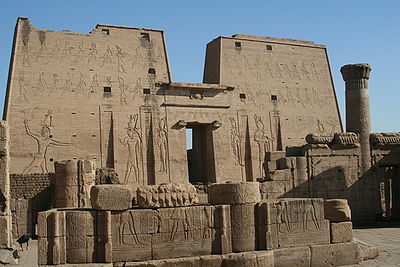
Thus, our understanding of ancient Egyptian architecture is based mainly on religious monuments, massive structures characterized by thick, sloping walls with few openings, possibly echoing a method of construction used to obtain stability in mud walls. In a similar manner, the incised and flatly modeled surface adornment of the stone buildings may have derived from mud wall ornamentation. Although the use of the arch
Arch
An arch is a structure that spans a space and supports a load. Arches appeared as early as the 2nd millennium BC in Mesopotamian brick architecture and their systematic use started with the Ancient Romans who were the first to apply the technique to a wide range of structures.-Technical aspects:The...
was developed during the fourth dynasty
Fourth dynasty of Egypt
The fourth dynasty of ancient Egypt is characterized as a "golden age" of the Old Kingdom. Dynasty IV lasted from ca. 2613 to 2494 BC...
, all monumental buildings are post and lintel
Post and lintel
Post and lintel, or in contemporary usage Post and beam, is a simple construction method using a lintel, header, or architrave as the horizontal member over a building void supported at its ends by two vertical columns, pillars, or posts...
constructions, with flat roofs constructed of huge stone blocks supported by the external walls and the closely spaced columns.
Exterior and interior walls, as well as the column
Column
A column or pillar in architecture and structural engineering is a vertical structural element that transmits, through compression, the weight of the structure above to other structural elements below. For the purpose of wind or earthquake engineering, columns may be designed to resist lateral forces...
s and piers
Pier (architecture)
In architecture, a pier is an upright support for a superstructure, such as an arch or bridge. Sections of wall between openings function as piers. The simplest cross section of the pier is square, or rectangular, although other shapes are also common, such as the richly articulated piers of Donato...
, were covered with hieroglyph
Egyptian hieroglyphs
Egyptian hieroglyphs were a formal writing system used by the ancient Egyptians that combined logographic and alphabetic elements. Egyptians used cursive hieroglyphs for religious literature on papyrus and wood...
ic and pictorial frescoes and carvings painted in brilliant colors. Many motifs of Egyptian ornamentation are symbol
Symbol
A symbol is something which represents an idea, a physical entity or a process but is distinct from it. The purpose of a symbol is to communicate meaning. For example, a red octagon may be a symbol for "STOP". On a map, a picture of a tent might represent a campsite. Numerals are symbols for...
ic, such as the scarab, or sacred beetle, the solar disk, and the vulture
Vulture
Vulture is the name given to two groups of convergently evolved scavenging birds, the New World Vultures including the well-known Californian and Andean Condors, and the Old World Vultures including the birds which are seen scavenging on carcasses of dead animals on African plains...
. Other common motifs include palm leaves, the papyrus
Papyrus
Papyrus is a thick paper-like material produced from the pith of the papyrus plant, Cyperus papyrus, a wetland sedge that was once abundant in the Nile Delta of Egypt....
plant, and the buds and flowers of the lotus
Nymphaea caerulea
Nymphaea caerulea, also known as the Blue Egyptian water lily or sacred blue lily, is a water-lily in the genus Nymphaea.-Distribution:Its original habitat may have been along the Nile and other locations in East Africa...
. Hieroglyphs
Egyptian hieroglyphs
Egyptian hieroglyphs were a formal writing system used by the ancient Egyptians that combined logographic and alphabetic elements. Egyptians used cursive hieroglyphs for religious literature on papyrus and wood...
were inscribed for decorative purposes as well as to record historic events or spells. In addition, these pictorial frescoes and carvings allow us to understand how the Ancient Egyptians lived, statuses, wars that were fought and their beliefs. This was especially true when exploring the tombs of Ancient Egyptian officials in recent years.
Ancient Egyptian temples were aligned with astronomically significant events, such as solstice
Solstice
A solstice is an astronomical event that happens twice each year when the Sun's apparent position in the sky, as viewed from Earth, reaches its northernmost or southernmost extremes...
s and equinox
Equinox
An equinox occurs twice a year, when the tilt of the Earth's axis is inclined neither away from nor towards the Sun, the center of the Sun being in the same plane as the Earth's equator...
es, requiring precise measurements at the moment of the particular event. Measurements at the most significant temples may have been ceremonially undertaken by the Pharaoh
Pharaoh
Pharaoh is a title used in many modern discussions of the ancient Egyptian rulers of all periods. The title originates in the term "pr-aa" which means "great house" and describes the royal palace...
himself.
The Giza pyramid complex
The Giza Necropolis stands on the Giza PlateauGiza Plateau
The Giza Plateau is a plateau that is located in Giza, Egypt. The famous Giza Necropolis is located in this geographical area, which is characterized by a sandy, desert climate and terrain with little vegetation....
, on the outskirts of Cairo
Cairo
Cairo , is the capital of Egypt and the largest city in the Arab world and Africa, and the 16th largest metropolitan area in the world. Nicknamed "The City of a Thousand Minarets" for its preponderance of Islamic architecture, Cairo has long been a centre of the region's political and cultural life...
, Egypt
Egypt
Egypt , officially the Arab Republic of Egypt, Arabic: , is a country mainly in North Africa, with the Sinai Peninsula forming a land bridge in Southwest Asia. Egypt is thus a transcontinental country, and a major power in Africa, the Mediterranean Basin, the Middle East and the Muslim world...
. This complex of ancient monuments is located some 8 kilometres (5 mi) inland into the desert from the old town of Giza on the Nile, some 20 kilometers (12 mi) southwest of Cairo city center. This Ancient Egypt
Ancient Egypt
Ancient Egypt was an ancient civilization of Northeastern Africa, concentrated along the lower reaches of the Nile River in what is now the modern country of Egypt. Egyptian civilization coalesced around 3150 BC with the political unification of Upper and Lower Egypt under the first pharaoh...
ian necropolis
Necropolis
A necropolis is a large cemetery or burial ground, usually including structural tombs. The word comes from the Greek νεκρόπολις - nekropolis, literally meaning "city of the dead"...
consists of the Pyramid of Khufu (also known as the Great Pyramid
Great Pyramid of Giza
The Great Pyramid of Giza is the oldest and largest of the three pyramids in the Giza Necropolis bordering what is now El Giza, Egypt. It is the oldest of the Seven Wonders of the Ancient World, and the only one to remain largely intact...
and the Pyramid of Cheops), the somewhat smaller Pyramid of Khafre (or Kephren/Chefren), and the relatively modest-sized Pyramid of Menkaure (or Mykerinus/Mycerinus), along with a number of smaller satellite edifices, known as "queens" pyramids, and the Great Sphinx.

Great Pyramid of Giza
The Great Pyramid of Giza is the oldest and largest of the three pyramids in the Giza Necropolis bordering what is now El Giza, Egypt. It is the oldest of the Seven Wonders of the Ancient World, and the only one to remain largely intact...
, which was probably completed c. 2580 BC, is the oldest and largest of the pyramids, and is the only surviving monument of the Seven Wonders of the Ancient World
Seven Wonders of the Ancient World
The Seven Wonders of the World refers to remarkable constructions of classical antiquity listed by various authors in guidebooks popular among the ancient Hellenic tourists, particularly in the 1st and 2nd centuries BC...
. The pyramid of Khafre is believed to have been completed around 2532 BC, at the end of Khafre's reign. Khafre ambitiously placed his pyramid next to his fathers. It is not as tall as his father's pyramid but he was able to give it the impression of appearing taller by building it on a site with a foundation 33 feet higher than his father's. Along with building his pyramid, Chefren commissioned the building of the giant Sphinx as guardian over his tomb. The face of a human, possibly a depiction of the pharaoh, on a lion's body was seen as a symbol of divinity among the Greeks fifteen hundred years later. The Great Sphinx is carved out of huge blocks of sandstone and stands about sixty-five feet tall. Menkaure's pyramid dates to circa 2490 BC and stands 213 feet high making it the smallest of the Great Pyramids.
Popular culture leads people to believe that Pyramids are highly confusing, with many tunnels within the pyramid to create confusion for grave robbers. This is not true. The shafts of pyramids are quite simple, mostly leading directly to the tomb. The immense size of the pyramids attracted robbers to the wealth that lay inside which caused the tombs to be robbed relatively soon after the tomb was sealed in some cases. However, there are sometimes additional tunnels, but these were used for the builders to understand how far they could dig the tomb into the crust of the Earth. Also, it is popular thought that due to grave robbers, future Kings were buried in the Valley of the Kings to help keep them hidden. This is also false, as the Pyramid construction continued for many Dynasties, just on a smaller scale. Finally, the pyramid construction was stopped due to economic factors, not theft.
It is widely believed that the pyramids were able to be constructed due to slave labor. Some scholars believe that they were essentially built by farmers during the off season. Either way, the pyramids represent a lifestyle of the nobles that could not exist without the presence of slave labor.
Karnak
The temple complex of Karnak is located on the banks of the River Nile some 2.5 kilometers (1.5 mi) north of LuxorLuxor
Luxor is a city in Upper Egypt and the capital of Luxor Governorate. The population numbers 487,896 , with an area of approximately . As the site of the Ancient Egyptian city of Thebes, Luxor has frequently been characterized as the "world's greatest open air museum", as the ruins of the temple...
. It consists of four main parts, the Precinct of Amon-Re
Precinct of Amon-Re
The Precinct of Amun-Re, located near Luxor, Egypt, is one of the four main temple enclosures that make up the immense Karnak Temple Complex. The precinct is by far the largest of these and the only one that is open to the general public...
, the Precinct of Montu
Precinct of Montu
The Precinct of Montu, located near Luxor, Egypt, is one of the four main temple enclosures that make up the immense Karnak Temple Complex. It is dedicated to the Egyptian god Montu, the child of Amun and Mut. The area covers about 20,000 m²...
, the Precinct of Mut
Precinct of Mut
The Precinct of Mut, located near Luxor, Egypt, is one of the four main temple enclosures that make up the immense Karnak Temple Complex and occupies some 150,000 m². It is dedicated to the Egyptian goddess Mut, the mother goddess. The area in which the precinct is located, originally was known as...
and the Temple of Amenhotep IV
Temple of Amenhotep IV
The structures within the Temple of Amenhotep IV at Karnak in Luxor, Egypt, were used during the first four years of the reign of the Egyptian Pharaoh Akhenaten, when he still referred to himself as Amenhotep IV, although they may have been constructed at the end of the reign of Amenhotep III, and...
(dismantled), as well as a few smaller temples and sanctuaries located outside the enclosing walls of the four main parts, and several avenues of ram-headed sphinxes connecting the Precinct of Mut, the Precinct of Amon-Re and Luxor Temple.

16th century BC
The 16th century BC is a century which lasted from 1600 BC to 1501 BC.-Events:* 1700 BC – 1500 BC: Hurrian conquests.* 1595 BC: Sack of Babylon by the Hittite king Mursilis I....
. Approximately 30 pharaohs contributed to the buildings, enabling it to reach a size, complexity and diversity not seen elsewhere. Few of the individual features of Karnak are unique, but the size and number of features is overwhelming.
Luxor Temple
The Luxor Temple is a huge ancient EgyptAncient Egypt
Ancient Egypt was an ancient civilization of Northeastern Africa, concentrated along the lower reaches of the Nile River in what is now the modern country of Egypt. Egyptian civilization coalesced around 3150 BC with the political unification of Upper and Lower Egypt under the first pharaoh...
ian temple complex located on the east bank of the River Nile
Nile
The Nile is a major north-flowing river in North Africa, generally regarded as the longest river in the world. It is long. It runs through the ten countries of Sudan, South Sudan, Burundi, Rwanda, Democratic Republic of the Congo, Tanzania, Kenya, Ethiopia, Uganda and Egypt.The Nile has two major...
in the city today known as Luxor
Luxor
Luxor is a city in Upper Egypt and the capital of Luxor Governorate. The population numbers 487,896 , with an area of approximately . As the site of the Ancient Egyptian city of Thebes, Luxor has frequently been characterized as the "world's greatest open air museum", as the ruins of the temple...
(ancient Thebes). Construction work on the temple began during the reign of Amenhotep III
Amenhotep III
Amenhotep III also known as Amenhotep the Magnificent was the ninth pharaoh of the Eighteenth dynasty. According to different authors, he ruled Egypt from June 1386 to 1349 BC or June 1388 BC to December 1351 BC/1350 BC after his father Thutmose IV died...
in the 14th century BC
14th century BC
The 14th century BC is a century which lasted from the year 1400 BC until 1301 BC.-Events:* 1397 BC: Pandion I, legendary King of Athens, dies after a reign of 40 years and is succeeded by his son Erechtheus II of Athens....
. Horemheb
Horemheb
Horemheb was the last Pharaoh of the 18th Dynasty from either 1319 BC to late 1292 BC, or 1306 to late 1292 BC although he was not related to the preceding royal family and is believed to have been of common birth.Before he became pharaoh, Horemheb was the commander in chief...
and Tutankhamun
Tutankhamun
Tutankhamun , Egyptian , ; approx. 1341 BC – 1323 BC) was an Egyptian pharaoh of the 18th dynasty , during the period of Egyptian history known as the New Kingdom...
added columns, statues, and friezes – and Akhenaten
Akhenaten
Akhenaten also spelled Echnaton,Ikhnaton,and Khuenaten;meaning "living spirit of Aten") known before the fifth year of his reign as Amenhotep IV , was a Pharaoh of the Eighteenth dynasty of Egypt who ruled for 17 years and died perhaps in 1336 BC or 1334 BC...
had earlier obliterated his father's cartouche
Cartouche
In Egyptian hieroglyphs, a cartouche is an ellipse with a horizontal line at one end, indicating that the text enclosed is a royal name, coming into use during the beginning of the Fourth Dynasty under Pharaoh Sneferu, replacing the earlier serekh...
s and installed a shrine to the Aten
Aten
Aten is the disk of the sun in ancient Egyptian mythology, and originally an aspect of Ra. The deified Aten is the focus of the monolatristic, henotheistic, or monotheistic religion of Atenism established by Amenhotep IV, who later took the name Akhenaten in worship in recognition of Aten...
– but the only major expansion effort took place under Ramesses II
Ramesses II
Ramesses II , referred to as Ramesses the Great, was the third Egyptian pharaoh of the Nineteenth dynasty. He is often regarded as the greatest, most celebrated, and most powerful pharaoh of the Egyptian Empire...
some 100 years after the first stones were put in place. Luxor is thus unique among the main Egyptian temple complexes in having only two pharaohs leave their mark on its architectural structure.

Pylon (architecture)
Pylon is the Greek term for a monumental gateway of an Egyptian temple It consists of two tapering towers, each surmounted by a cornice, joined by a less elevated section which enclosed the entrance between them. The entrance was generally about half the height of the towers...
, built by Ramesses II. The pylon was decorated with scenes of Ramesses's military triumphs (particularly the Battle of Qadesh); later pharaohs, particularly those of the Nubia
Nubia
Nubia is a region along the Nile river, which is located in northern Sudan and southern Egypt.There were a number of small Nubian kingdoms throughout the Middle Ages, the last of which collapsed in 1504, when Nubia became divided between Egypt and the Sennar sultanate resulting in the Arabization...
n and Ethiopia
Ethiopia
Ethiopia , officially known as the Federal Democratic Republic of Ethiopia, is a country located in the Horn of Africa. It is the second-most populous nation in Africa, with over 82 million inhabitants, and the tenth-largest by area, occupying 1,100,000 km2...
n dynasties, also recorded their victories there. This main entrance to the temple complex was originally flanked by six colossal statues of Ramesses – four seated, and two standing – but only two (both seated) have survived. Modern visitors can also see a 25 metre (82 ft) tall pink granite obelisk
Obelisk
An obelisk is a tall, four-sided, narrow tapering monument which ends in a pyramid-like shape at the top, and is said to resemble a petrified ray of the sun-disk. A pair of obelisks usually stood in front of a pylon...
: this one of a matching pair until 1835, when the other one was taken to Paris
Paris
Paris is the capital and largest city in France, situated on the river Seine, in northern France, at the heart of the Île-de-France region...
where it now stands in the centre of the Place de la Concorde
Place de la Concorde
The Place de la Concorde in area, it is the largest square in the French capital. It is located in the city's eighth arrondissement, at the eastern end of the Champs-Élysées.- History :...
.
Through the pylon gateway leads into a peristyle courtyard, also built by Ramesses II. This area, and the pylon, were built at an oblique angle to the rest of the temple, presumably to accommodate the three pre-existing barque shrines located in the northwest corner. After the peristyle courtyard comes the processional colonnade built by Amenhotep III – a 100 metre (328 ft) corridor lined by 14 papyrus
Papyrus
Papyrus is a thick paper-like material produced from the pith of the papyrus plant, Cyperus papyrus, a wetland sedge that was once abundant in the Nile Delta of Egypt....
-capital
Capital (architecture)
In architecture the capital forms the topmost member of a column . It mediates between the column and the load thrusting down upon it, broadening the area of the column's supporting surface...
columns. Friezes on the wall describe the stages in the Opet Festival, from sacrifices at Karnak at the top left, through Amun
Amun
Amun, reconstructed Egyptian Yamānu , was a god in Egyptian mythology who in the form of Amun-Ra became the focus of the most complex system of theology in Ancient Egypt...
's arrival at Luxor at the end of that wall, and concluding with his return on the opposite side. The decorations were put in place by Tutankhamun: the boy pharaoh is depicted, but his names have been replaced with those of Horemheb.
Beyond the colonnade is a peristyle courtyard, which also dates back to Amenhotep's original construction. The best preserved columns are on the eastern side, where some traces of original colour can be seen. The southern side of this courtyard is made up of a 36-column hypostyle court that leads into the inner sanctums of the temple, which begin with a dark chamber not achechamber.
See also
- Center for Documentation of Cultural and Natural Heritage
- EdfuEdfuEdfu is an Egyptian city, located on the west bank of the Nile River between Esna and Aswan, with a population of approximately sixty thousand people. For the ancient history of the city, see below...
- Egyptian pyramidsEgyptian pyramidsThe Egyptian pyramids are ancient pyramid-shaped masonry structures located in Egypt.There are 138 pyramids discovered in Egypt as of 2008. Most were built as tombs for the country's Pharaohs and their consorts during the Old and Middle Kingdom periods.The earliest known Egyptian pyramids are found...
- Egyptian Revival architectureEgyptian Revival architectureEgyptian Revival is an architectural style that uses the motifs and imagery of ancient Egypt. It is attributed generally to the public awareness of ancient Egyptian monuments generated by Napoleon's conquest of Egypt and Admiral Nelson's defeat of Napoleon at the Battle of the Nile during 1798....
- Egyptian revival decorative artsEgyptian revival decorative artsEgyptian revival decorative arts is an early nineteenth century movement in which Egyptian motifs were applied to a wide variety of Decorative arts objects....
- ImhotepImhotepImhotep , fl. 27th century BC was an Egyptian polymath, who served under the Third Dynasty king Djoser as chancellor to the pharaoh and high priest of the sun god Ra at Heliopolis...
- List of ancient Egyptian sites
- KarnakKarnakThe Karnak Temple Complex—usually called Karnak—comprises a vast mix of decayed temples, chapels, pylons, and other buildings, notably the Great Temple of Amun and a massive structure begun by Pharaoh Ramses II . Sacred Lake is part of the site as well. It is located near Luxor, some...
- Medinet HabuMedinet Habu (temple)Medinet Habu is the name commonly given to the Mortuary Temple of Ramesses III, an important New Kingdom period structure in the location of the same name on the West Bank of Luxor in Egypt...
- Urban planning in ancient EgyptUrban planning in ancient EgyptThe use of urban planning in ancient Egypt is a matter of continuous debate. Because ancient sites usually survive only in fragments, and many ancient Egyptian cities have been continuously inhabited since their original forms, relatively little is actually understood about the general designs of...
Further reading
- Arnold, Dieter. The encyclopedia of ancient Egyptian architecture. Cairo: American University in Cairo Press, 2003.
- Fletcher, BanisterBanister FletcherSir Banister Flight Fletcher was an English architect and architectural historian, as was his father, also named Banister Fletcher....
; Cruickshank, Dan, Sir Banister Fletcher's a History of Architecture, Architectural Press, 20th edition, 1996 (first published 1896). ISBN 0750622679. Cf. Part One, Chapter 3.