


Buhen

Encyclopedia
Cataracts of the Nile
The cataracts of the Nile are shallow lengths of the Nile between Aswan and Khartoum where the surface of the water is broken by many small boulders and stones protruding out of the river bed, as well as many rocky islets. Aswan is also the Southern boundary of Upper Egypt...
. It is well known for its fortress, probably constructed during the rule of Senusret III
Senusret III
Khakhaure Senusret III was a pharaoh of Egypt. He ruled from 1878 BC to 1839 BC, and was the fifth monarch of the Twelfth Dynasty of the Middle Kingdom. Among his achievements was the building of the Sisostris Canal...
, around the year 1860 BC (12th dynasty
Twelfth dynasty of Egypt
The twelfth dynasty of ancient Egypt is often combined with Dynasties XI, XIII and XIV under the group title Middle Kingdom.-Rulers:Known rulers of the twelfth dynasty are as follows :...
). The site may have been first established as an outpost in Nubia
Nubia
Nubia is a region along the Nile river, which is located in northern Sudan and southern Egypt.There were a number of small Nubian kingdoms throughout the Middle Ages, the last of which collapsed in 1504, when Nubia became divided between Egypt and the Sennar sultanate resulting in the Arabization...
during the reign of Sneferu
Sneferu
Sneferu, also spelled as Snephru, Snefru or Snofru , was the founder of the Fourth dynasty of Egypt. Estimates of his reign vary, with for instance The Oxford History of Ancient Egypt suggesting a reign from around 2613 BC to 2589 BC, a reign of 24 years, while Rolf Krauss suggests a 30-year reign...
(4th dynasty
Fourth dynasty of Egypt
The fourth dynasty of ancient Egypt is characterized as a "golden age" of the Old Kingdom. Dynasty IV lasted from ca. 2613 to 2494 BC...
). Graffiti
Graffito (archaeology)
A Graffito , in an archaeological context, is a deliberate mark made by scratching or engraving on a large surface such as a wall. The marks may form an image or writing...
and other inscribed items from the site show that the Egyptians stayed about 200 years, until late in the 5th dynasty
Fifth dynasty of Egypt
The fifth dynasty of ancient Egypt is often combined with Dynasties III, IV and VI under the group title the Old Kingdom. Dynasty V dates approximately from 2494 to 2345 BC.-Rulers:...
, when they were probably forced out by immigration from the south.
Senusret III conducted four campaigns into Kush
Kingdom of Kush
The native name of the Kingdom was likely kaš, recorded in Egyptian as .The name Kash is probably connected to Cush in the Hebrew Bible , son of Ham ....
and established a line of forts within signalling distance of one another; Buhen was the northernmost of these. The other forts along the banks were Mirgissa, Shalfak, Uronarti
Uronarti
Uronarti was an ancient Egyptian settlement located on an island in the Nile above the Second Cataract. It is well known for its triangular-shaped fortress, constructed between the reigns of Middle Kingdom rulers Senusret I and Senusret III, in the nineteenth century BCE...
, Askut, Dabenarti, Semna, and Kumma
Kumma
Kumma is a village in Kehtna Parish, Rapla County in northern-central Estonia....
. The Kushites captured Buhen during the 13th dynasty
Thirteenth dynasty of Egypt
The thirteenth dynasty of ancient Egypt is often combined with Dynasties XI, XII and XIV under the group title Middle Kingdom. Other writers separate it from these dynasties and join it to Dynasties XIV through XVII as part of the Second Intermediate Period...
, and held it until Ahmose I
Ahmose I
Ahmose I was a pharaoh of ancient Egypt and the founder of the Eighteenth dynasty. He was a member of the Theban royal house, the son of pharaoh Tao II Seqenenre and brother of the last pharaoh of the Seventeenth dynasty, King Kamose...
recaptured it at the beginning of the 18th dynasty
Eighteenth dynasty of Egypt
The eighteenth dynasty of ancient Egypt is perhaps the best known of all the dynasties of ancient Egypt...
. It was stormed and recaptured by indigenous forces at the end of Egypt's 20th dynasty
Twentieth dynasty of Egypt
The Eighteenth, Nineteenth, and Twentieth Dynasties of ancient Egypt are often combined under the group title, New Kingdom. This dynasty is considered to be the last one of the New Kingdom of Egypt, and was followed by the Third Intermediate Period....
.
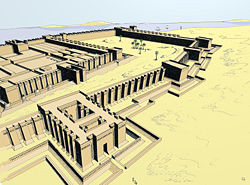
The fortress itself extended more than 150 metres along the West bank of the Nile. It covered 13,000 square metres, and had within its wall a small town laid out in a grid system. At its peak it probably had a population of around 3500 people. The fortress also included the administration for the whole fortified region of the Second Cataract. Its fortifications included a moat three metres deep, drawbridge
Drawbridge
A drawbridge is a type of movable bridge typically associated with the entrance of a castle surrounded by a moat. The term is often used to describe all different types of movable bridges, like bascule bridges and lift bridges.-Castle drawbridges:...
s, bastion
Bastion
A bastion, or a bulwark, is a structure projecting outward from the main enclosure of a fortification, situated in both corners of a straight wall , facilitating active defence against assaulting troops...
s, buttress
Buttress
A buttress is an architectural structure built against or projecting from a wall which serves to support or reinforce the wall...
es, rampart
Defensive wall
A defensive wall is a fortification used to protect a city or settlement from potential aggressors. In ancient to modern times, they were used to enclose settlements...
s, battlement
Battlement
A battlement in defensive architecture, such as that of city walls or castles, comprises a parapet , in which portions have been cut out at intervals to allow the discharge of arrows or other missiles. These cut-out portions form crenels...
s, loophole
Loophole
A loophole is a weakness that allows a system to be circumvented.Loophole may also refer to:*Arrowslit, a slit in a castle wall*Loophole , a short science fiction story by Arthur C...
s, and a catapult
Catapult
A catapult is a device used to throw or hurl a projectile a great distance without the aid of explosive devices—particularly various types of ancient and medieval siege engines. Although the catapult has been used since ancient times, it has proven to be one of the most effective mechanisms during...
. The walls of the fort were about five metres thick and ten metres high.
The fortress at Buhen today has been covered by Lake Nasser
Lake Nasser
Lake Nasser is a vast reservoir in southern Egypt, and northern Sudan, and is one of the largest man-made lakes in the world. Strictly, "Lake Nasser" refers only to the much larger portion of the lake that is in Egyptian territory , with the Sudanese preferring to call their smaller body of water...
created by the Aswan Dam
Aswan Dam
The Aswan Dam is an embankment dam situated across the Nile River in Aswan, Egypt. Since the 1950s, the name commonly refers to the High Dam, which is larger and newer than the Aswan Low Dam, which was first completed in 1902...
in 1964. Before the site was covered with water, the site was excavated by a team led by Walter Bryan Emery.
Buhen also boasted a temple of Horus
Horus
Horus is one of the oldest and most significant deities in the Ancient Egyptian religion, who was worshipped from at least the late Predynastic period through to Greco-Roman times. Different forms of Horus are recorded in history and these are treated as distinct gods by Egyptologists...
built by Hatshepsut
Hatshepsut
Hatshepsut also Hatchepsut; meaning Foremost of Noble Ladies;1508–1458 BC) was the fifth pharaoh of the eighteenth dynasty of Ancient Egypt...
, which was moved to Khartoum
Khartoum
Khartoum is the capital and largest city of Sudan and of Khartoum State. It is located at the confluence of the White Nile flowing north from Lake Victoria, and the Blue Nile flowing west from Ethiopia. The location where the two Niles meet is known as "al-Mogran"...
prior to the flooding of Lake Nasser
Lake Nasser
Lake Nasser is a vast reservoir in southern Egypt, and northern Sudan, and is one of the largest man-made lakes in the world. Strictly, "Lake Nasser" refers only to the much larger portion of the lake that is in Egyptian territory , with the Sudanese preferring to call their smaller body of water...
.