
All Topics  
Sallust


   Email Print
   Bookmark   Link


Sallust


For the philosopher, see Sallustius
Sallustius

Sallustius or Sallust was a 4th-century writer and friend of the Emperor Julian the Apostate. He wrote the treatise On the Gods and the Cosmos, a kind of catechism of 4th-century Hellenic polytheism....
; for other uses, see Sallust (disambiguation)
Sallust (disambiguation)

The names Sallustius/Saloustios and their vernacular variants Sallust have been borne by many people:* Sallust or Gaius Sallustius Crispus, historian of the 1st century BCE...
.


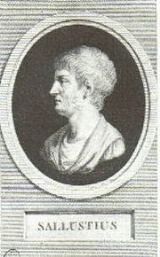
Gaius Sallustius Crispus, generally known simply as Sallust, (86-34 BC), a Roman
Roman Republic

The Roman Republic was the phase of the Ancient Rome characterized by a republican form of government; a period which began with the overthrow of the Roman Roman Kingdom, c....
 historian, belonged to a well-known plebeian family, and was born at Amiternum
Amiternum

Amiternum, a traditional cradle of the Sabines, is an ancient Sabine prefecture in the Abruzzo region of modern Italy at 9 km from L'Aquila. Amiternum was the birthplace of the historian Sallust ....
 in the country of the Sabine
Sabine

The Sabines were an Ancient Italic peoples tribe that lived in ancient Italy, inhabiting Latium before the founding of Rome. Their language belonged to the Osco-Umbrian languages subgroup of Italic languages and shows some similarities to Oscan language and Umbrian language....
s. Throughout his career Sallust always stood by his principle as a populares
Populares

Populares were aristocratic leaders in the late Roman Republic who tended to use the Roman assemblies and Tribune in an effort to break the stranglehold of the Roman Senate on political power....
, an opposer of Pompey
Pompey

Gnaeus Pompeius Magnus, commonly known as Pompey /'p?mpi/, Pompey the Great or Pompey the Triumvir , was a distinguished military and political leader of the late Roman Republic....
's party and the old aristocracy
Patrician

The term "patrician" originally referred to a group of elitism citizens in ancient Rome, including both their natural and adopted members. In the late Roman empire, the class was broadened to include high council officials, and after the fall of the Western Empire became a term for Byzantine Imperial governors in the West....
 of Rome.

Biography
After an ill-spent youth, Sallust entered public life
Cursus honorum

The cursus honorum was the Sequence order of public offices held by aspiring politicians in both the Roman Republic and the early Roman Empire....
 and won election as Quaestor
Quaestor

Quaestor is a type of public official.In the Roman Republic a quaestor was an elected official who supervised the treasury and financial affairs of the state, its armies and its officers....
 in 55 and one of the tribunes of the people in 52, the year in which the followers of Milo
Titus Annius Milo

Titus Annius Milo Papianus was a Roman Republic political agitator, the son of Gaius Papius Celsus, but adopted by his maternal grandfather, Titus Annius Luscus....
 killed Clodius
Publius Clodius Pulcher

Publius Clodius Pulcher , was a Roman Republic politician of the Populares cause, who passed several significant laws but was chiefly remembered for his feuds with Titus Annius Milo and Marcus Tullius Cicero and for his introduction of the grain dole....
 in a street brawl.


Discussion
Ask a question about 'Sallust'
Start a new discussion about 'Sallust'
Answer questions from other users
Full Discussion Forum


Quotations


Nam divitiarum et formae gloria fluxa atque fragilis est, virtus clara aeternaque habetur. (I).

"For the glory of wealth and beauty is fleeting and perishable; that of the mind is illustrious and immortal."

Sed multi mortales dediti ventri atque somno, indocti incultique vitam sicuti peregrinantes transiere. (II).

"Yet many human beings, resigned to sensuality and indolence, un-instructed and unimproved, have passed through life like travellers in a strange country."

Nam idem velle atque idem nolle, ea demum firma amicitia est. (XX.4).

"For to like the same things and to dislike the same things, only this is a strong friendship."

Omnes homines, patres conscripti, qui de rebus dubiis consultant, ab odio, amicitia, ira atque misericordia vacuos esse decet. (LI.1).

"It becomes all men, Senators, who deliberate on dubious matters, to be influenced neither by hatred, affection, anger, nor pity."= Bellum Iugurthinum ===

Nam concordia parvae res crescunt, discordia maxumae dilabuntur. (X.6).

"For harmony makes small states great, while discord undermines the mightiest empires."= Histories ===

Namque pauci libertatem, pars magna iustos dominos volunt (iv.69.18).

Few men desire freedom, the greater part desire just masters., Only a few prefer liberty, the majority seek nothing more than fair masters. (alternative translation)= Epistulae ad Caesarem senem ===


Encyclopedia


For the philosopher, see Sallustius
Sallustius

Sallustius or Sallust was a 4th-century writer and friend of the Emperor Julian the Apostate. He wrote the treatise On the Gods and the Cosmos, a kind of catechism of 4th-century Hellenic polytheism....
; for other uses, see Sallust (disambiguation)
Sallust (disambiguation)

The names Sallustius/Saloustios and their vernacular variants Sallust have been borne by many people:* Sallust or Gaius Sallustius Crispus, historian of the 1st century BCE...
.


Gaius Sallustius Crispus, generally known simply as Sallust, (86-34 BC), a Roman
Roman Republic

The Roman Republic was the phase of the Ancient Rome characterized by a republican form of government; a period which began with the overthrow of the Roman Roman Kingdom, c....
 historian, belonged to a well-known plebeian family, and was born at Amiternum
Amiternum

Amiternum, a traditional cradle of the Sabines, is an ancient Sabine prefecture in the Abruzzo region of modern Italy at 9 km from L'Aquila. Amiternum was the birthplace of the historian Sallust ....
 in the country of the Sabine
Sabine

The Sabines were an Ancient Italic peoples tribe that lived in ancient Italy, inhabiting Latium before the founding of Rome. Their language belonged to the Osco-Umbrian languages subgroup of Italic languages and shows some similarities to Oscan language and Umbrian language....
s. Throughout his career Sallust always stood by his principle as a populares
Populares

Populares were aristocratic leaders in the late Roman Republic who tended to use the Roman assemblies and Tribune in an effort to break the stranglehold of the Roman Senate on political power....
, an opposer of Pompey
Pompey

Gnaeus Pompeius Magnus, commonly known as Pompey /'p?mpi/, Pompey the Great or Pompey the Triumvir , was a distinguished military and political leader of the late Roman Republic....
's party and the old aristocracy
Patrician

The term "patrician" originally referred to a group of elitism citizens in ancient Rome, including both their natural and adopted members. In the late Roman empire, the class was broadened to include high council officials, and after the fall of the Western Empire became a term for Byzantine Imperial governors in the West....
 of Rome.

Biography


After an ill-spent youth, Sallust entered public life
Cursus honorum

The cursus honorum was the Sequence order of public offices held by aspiring politicians in both the Roman Republic and the early Roman Empire....
 and won election as Quaestor
Quaestor

Quaestor is a type of public official.In the Roman Republic a quaestor was an elected official who supervised the treasury and financial affairs of the state, its armies and its officers....
 in 55 and one of the tribunes of the people in 52, the year in which the followers of Milo
Titus Annius Milo

Titus Annius Milo Papianus was a Roman Republic political agitator, the son of Gaius Papius Celsus, but adopted by his maternal grandfather, Titus Annius Luscus....
 killed Clodius
Publius Clodius Pulcher

Publius Clodius Pulcher , was a Roman Republic politician of the Populares cause, who passed several significant laws but was chiefly remembered for his feuds with Titus Annius Milo and Marcus Tullius Cicero and for his introduction of the grain dole....
 in a street brawl. Sallust then supported the following prosecution of Milo. He also had hostilities with the famous orator Cicero
Cicero

Marcus Tullius Cicero was a Ancient Rome philosopher, statesman, lawyer, political theorist, and Constitution of the Roman Republic. Cicero is widely considered one of Rome's greatest rhetoric and prose stylists....
.

From the beginning of his public career, Sallust operated as a decided partisan of Caesar
Julius Caesar

'Gaius Julius Caesar' , July 13, 100 BC ? March 15, 44 BC,) was a Roman Republic military and political leader. He played a critical role in the transformation of the Roman Republic into the Roman Empire....
, to whom he owed such political advancement as he attained. In 50 the censor Appius Claudius Pulcher
Appius Claudius Pulcher

Appius Claudius Pulcher may refer to several members of the Claudius during the Roman Republic:* Appius Claudius Pulcher , consul of 212 BC* Appius Claudius Pulcher , consul of 185 BC...
 removed him from the Senate
Roman Senate

The Senate of the Roman Republic was a political institution in the ancient Roman Republic. According to the Greek historian Polybius, our principal source on the Constitution of the Roman Republic, the Roman Senate was the predominant branch of government....
 on the grounds of gross immorality (probably really because of his friendship with Caesar). In the following year, no doubt through Caesar's influence, he was reinstated.

In 46 he served as a praetor
Praetor

Praetor was a Title#Titles_for_heads_of_state granted by the government of Ancient Rome to men acting in one of two official capacities: the commander of an army, either before it was mustered or more typically in the field, or an elected Magistratus assigned duties that varied depending on the historical period....
 and accompanied Caesar in his African campaign
Caesar's civil war

The Roman civil war of 49 BC, sometimes called Caesar's Civil War, is one of the last conflicts within the Roman Republic. It was a series of political and military confrontations between Julius Caesar, his political supporters, and his Roman legion, against the traditionalist conservative faction in the Roman Senate, sometimes known as the O...
, which ended in the decisive defeat of the remains of the Pompeian war party at Thapsus
Battle of Thapsus

The Battle of Thapsus took place on April 6 46 BC near Thapsus . The Conservative Republican Army, led by Cato the Younger and Quintus Caecilius Metellus Pius Scipio Nasica clashed with the forces of Julius Caesar, who eventually won the battle....
. As a reward for his services, Sallust gained appointment as governor of the province of Africa Nova
Numidia

Numidia was an ancient Berber people kingdom in present-day Algeria and part of Tunisia that later alternated between being a Roman province and being a Roman client state, and is no longer in existence today....
. In this capacity he committed such oppression and extortion that only the influence of Caesar enabled him to escape condemnation. On his return to Rome he purchased and began laying out in great splendour the famous gardens on the Quirinal
Quirinal Hill

The Quirinal Hill is one of the Seven Hills of Rome, at the north-east of the city center. It is the location of the official residence of the Italian Head of State, who resides in the Quirinal Palace....
 known as the Horti Sallustiani or Gardens of Sallust
Gardens of Sallust

The Gardens of Sallust were Roman gardens developed by the Ancient Rome historian Sallust in the 1st century BC using his wealth extorted as governor of the province of Africa Nova ....
. These gardens would later belong to the emperors.

Sallust then retired from public life and devoted himself to historical literature, and further developing his Gardens of Sallust
Gardens of Sallust

The Gardens of Sallust were Roman gardens developed by the Ancient Rome historian Sallust in the 1st century BC using his wealth extorted as governor of the province of Africa Nova ....
, upon which he spent much of his accumulated wealth.

Works

Sallust's account of the Catiline
Catiline

Lucius Sergius Catilina , known in English language as Catiline, was a Roman Republic politician of the 1st century BC who is best known for the Catiline conspiracy, an attempt to overthrow the Roman Republic, and in particular the power of the aristocratic Roman Senate....
 conspiracy (De coniuratione Catilinae or Bellum Catilinae) and of the Jugurthine War
Jugurthine War

The Jugurthine War takes its name from Jugurtha, nephew and later adopted son of Micipsa, King of Numidia....
 (Bellum Iugurthinum) have come down to us complete, together with fragments of his larger and most important work (Historiae), a history of Rome from 78-67 BC, intended as a continuation of Cornelius Sisenna
Lucius Cornelius Sisenna

Lucius Cornelius Sisenna was a Roman soldier, historian, and annalists. He was killed in action during Pompey's campaign against pirates after the Third Mithridatic War....
's work.

The Conspiracy of Catiline

The Conspiracy of Catiline (Sallust's first published work) contains the history of the memorable year 63. Sallust adopts the usually accepted view of Catiline
Catiline

Lucius Sergius Catilina , known in English language as Catiline, was a Roman Republic politician of the 1st century BC who is best known for the Catiline conspiracy, an attempt to overthrow the Roman Republic, and in particular the power of the aristocratic Roman Senate....
, and describes him as the deliberate foe of law, order and morality
Morality

Morality has three principal meanings.In its first, descriptive usage, morality means a code of conduct which is held to be authoritative in matters of right and wrong....
, and does not give a comprehensive explanation of his views and intentions. (Note that Catiline had supported the party of Sulla, which Sallust had opposed.) Mommsen
Theodor Mommsen

Christian Matthias Theodor Mommsen was a Germany classics, historian, jurist, journalist, politician, archaeologist, and writer generally regarded as the greatest classicist of the 19th century....
's suggestion — that Sallust particularly wished to clear his patron
Patronus

Latin translation: the protector. In archaic Latin: the father .Patronus was part of the social customs of Ancient Rome, a social term that referred to the senior party in one of several social relationships....
 (Caesar) of all complicity in the conspiracy — may have contained some truth.

In writing about the conspiracy of Catiline, Sallust's tone, style, and descriptions of aristocratic behavior show him as deeply troubled by the moral decline of Rome. While he inveighs against Catiline's depraved character and vicious actions, he does not fail to state that the man had many noble traits — indeed all that a Roman man needed to succeed. In particular, Sallust shows Catiline as deeply courageous in his final battle.

This subject gave Sallust the opportunity of showing off his rhetoric
Rhetoric

Rhetoric is the art of using language as a means to persuade. Along with logic and dialectic, rhetoric is one of the three ancient arts of discourse....
 at the expense of the old Roman aristocracy, whose degeneracy he delighted to paint in the blackest colours. On the whole, he does not treat Cicero
Cicero

Marcus Tullius Cicero was a Ancient Rome philosopher, statesman, lawyer, political theorist, and Constitution of the Roman Republic. Cicero is widely considered one of Rome's greatest rhetoric and prose stylists....
 unfairly.

Jugurthine War

Sallust's Jugurthine War is a brief monograph recording the war in Numidia c.112 B.C.. Its true value lies in the introduction of Marius and Sulla to the Roman political scene and the beginning of their rivalry. Sallust's time as governor of Africa Nova ought to have let the author develop a solid geographical and ethnographical background to the war, however, this is not evident in the monograph despite a diversion on the subject because Sallust's priority in the "Jugurthine War", as with the "Catiline Conspiracy", is to use history as a vehicle for his judgement on the slow destruction of Roman morality and politics.

Other works

The extant fragments of the Histories (some discovered in 1886) show sufficiently well the political partisan, who took a keen pleasure in describing the reaction against Sulla's policy and legislation after the dictator's death. Historians regret the loss of the work, as it must have thrown much light on a very eventful period, embracing the war against Sertorius (died 72 BC), the campaigns of Lucullus
Lucullus

Lucius Licinius Lucullus , is one of the canonical great men of Roman history, always included in the biographical collections of leading generals and politicians, two of which survive today despite the slender surviving literature from the antiquity....
 against Mithradates VI of Pontus (75 - 66 BC), and the victories of Pompey
Pompey

Gnaeus Pompeius Magnus, commonly known as Pompey /'p?mpi/, Pompey the Great or Pompey the Triumvir , was a distinguished military and political leader of the late Roman Republic....
 in the East (66 - 62 BC).

Two letters (Duae epistolae de republica ordinanda), letters of political counsel and advice addressed to Caesar, and an attack upon Cicero (Invectiva or Declamatio in Ciceronem), frequently attributed to Sallust, are thought by modern scholars to have probably come from the pen of the rhetorician Marcus Porcius Latro
Marcus Porcius Latro

Marcus Porcius Latro was during the reign of Augustus a celebrated Roman rhetorician considered one of the founders of scholastic rhetoric. He was a Hispania by birth, and a friend and contemporary of Seneca the Elder, with whom he studied under Marillius, and by whom he is frequently mentioned....
, also the supposed author of a counter-invective attributed to Cicero.

Significance

On the whole, antiquity looked favourably on Sallust as an historian. Tacitus
Tacitus

Publius Cornelius Tacitus was a Roman Senate and a historian of the Roman Empire. The surviving portions of his two major works—the Annals and the Histories —examine the reigns of the Roman Emperors Tiberius, Claudius, Nero and those that reigned in the Year of the Four Emperors....
 speaks highly of him (Annals
Annals (Tacitus)

The Annals is a history book by Tacitus covering the reign of the four Roman Emperors succeeding to Caesar Augustus. The parts of the work that survived from antiquity cover the reigns of Tiberius and Nero....
, iii. 30); and Quintilian
Quintilian

Marcus Fabius Quintilianus was a Roman Empire rhetorician from Hispania, widely referred to in Middle ages schools of rhetoric and in Renaissance writing....
, does not hesitate to put him on a level with Thucydides
Thucydides

Thucydides was a Greeks history and author of the History of the Peloponnesian War, which recounts the 5th century B.C. war between Sparta and Athens to the year 411 B.C....
 (), and declares that he is a greater historian than Livy
Livy

Titus Livius , known as Livy in English language, was a Ancient Rome historian who wrote a monumental history of Rome, Ab Urbe Condita, from its founding through the reign of Augustus in Livy's own time....
 ().

Sallust struck out for himself practically a new line in literature, his predecessors having functioned as little better than mere dry-as-dust chronicle
Chronicle

Generally a chronicle is a historical account of facts and events ranged in chronology order. Typically, equal weight is given for historically important events and local events, the purpose being the recording of events that occurred, seen from the perspective of the chronicler....
rs, whereas he endeavoured to explain the connection and meaning of events and successfully delineated character. The contrast between his early life and the high moral tone adopted by him in his writings has frequently made him a subject of reproach, but history gives no reason why he should not have reformed.

In any case, his knowledge of his own former weaknesses may have led him to take a pessimistic view of the morality of his fellow-men, and to judge them severely. He took as his model Thucydides, whom he imitated in his truthfulness and impartiality, in the introduction of philosophizing reflections and speeches, and in the brevity of his style, sometimes bordering upon obscurity. Some readers have ridiculed his fondness for old words and phrases (in which he imitated his contemporary Cato the younger
Cato the Younger

File:Silver_denarius_of_Cato_47_46_BCE.jpgMarcus Porcius Cato Uticensis , known as Cato the Younger to distinguish him from his great-grandfather , was a politician and statesman in the late Roman Republic, and a follower of the Stoicism philosophy....
) as an affectation, but this very affectation and his rhetorical exaggerations made Sallust a favourite author in the 2nd century and later.

Nietzsche, in Twilight of the Idols (Section 13.1) credits Sallust for his epigrammatic style: "My sense of style, for the epigram as a style, was awakened almost instantly when I came into contact with Sallust." and praises him for being "compact, severe, with as much substance as possible, a cold sarcasm against 'beautiful words' and 'beautiful sentiments'."

Footnotes


External links


Latin with English translation

  • (J. C. Rolfe, 1921):
    • Bellum Catilinae
    • Bellum Iugurthinum
    • Invectiva in Ciceronem (uncertain authorship, sometimes attributed to Sallust)
    • Oratio ad Caesarem (uncertain authorship)


    • Bellum Catilinae
    • Bellum Iugurthinum
  • :
    • Bellum Catilinae
    • Bellum Iugurthinum
  • (2007)
    • Bellum Catilinae


Latin only

  • (unknown edition):
    • Bellum Catilinae
    • Bellum Iugurthinum
    • Fragmenta Historiarum
    • Epistolae ad Caesarem
    • Invectiva in Ciceronem


English translation only