

6th millennium BC

Encyclopedia
During the 6th millennium BC, agriculture
spread from the Balkans
to Italy
and Eastern Europe
, and also from Mesopotamia
to Egypt
. World population
was essentially stable at approximately 5 million, though some speculate up to 7 million.
Agriculture
Agriculture is the cultivation of animals, plants, fungi and other life forms for food, fiber, and other products used to sustain life. Agriculture was the key implement in the rise of sedentary human civilization, whereby farming of domesticated species created food surpluses that nurtured the...
spread from the Balkans
Balkans
The Balkans is a geopolitical and cultural region of southeastern Europe...
to Italy
Italy
Italy , officially the Italian Republic languages]] under the European Charter for Regional or Minority Languages. In each of these, Italy's official name is as follows:;;;;;;;;), is a unitary parliamentary republic in South-Central Europe. To the north it borders France, Switzerland, Austria and...
and Eastern Europe
Eastern Europe
Eastern Europe is the eastern part of Europe. The term has widely disparate geopolitical, geographical, cultural and socioeconomic readings, which makes it highly context-dependent and even volatile, and there are "almost as many definitions of Eastern Europe as there are scholars of the region"...
, and also from Mesopotamia
Mesopotamia
Mesopotamia is a toponym for the area of the Tigris–Euphrates river system, largely corresponding to modern-day Iraq, northeastern Syria, southeastern Turkey and southwestern Iran.Widely considered to be the cradle of civilization, Bronze Age Mesopotamia included Sumer and the...
to Egypt
Egypt
Egypt , officially the Arab Republic of Egypt, Arabic: , is a country mainly in North Africa, with the Sinai Peninsula forming a land bridge in Southwest Asia. Egypt is thus a transcontinental country, and a major power in Africa, the Mediterranean Basin, the Middle East and the Muslim world...
. World population
World population
The world population is the total number of living humans on the planet Earth. As of today, it is estimated to be billion by the United States Census Bureau...
was essentially stable at approximately 5 million, though some speculate up to 7 million.
Events
- A massive volcanic landslide off of Mt. Etna, SicilySicilySicily is a region of Italy, and is the largest island in the Mediterranean Sea. Along with the surrounding minor islands, it constitutes an autonomous region of Italy, the Regione Autonoma Siciliana Sicily has a rich and unique culture, especially with regard to the arts, music, literature,...
caused a megatsunamiMegatsunamiMegatsunami is an informal term to describe a tsunami that has initial wave heights that are much larger than normal tsunamis...
which devastated the eastern Mediterranean coastline on three continents. - c. 6000 BC: The MehrgarhMehrgarhMehrgarh , one of the most important Neolithic sites in archaeology, lies on the "Kachi plain" of Balochistan, Pakistan...
culture reaches its height c. 6000 BC. The Mehrgarh site is one of the most important NeolithicNeolithicThe Neolithic Age, Era, or Period, or New Stone Age, was a period in the development of human technology, beginning about 9500 BC in some parts of the Middle East, and later in other parts of the world. It is traditionally considered as the last part of the Stone Age...
sites in the world. It is located in present-day PakistanPakistanPakistan , officially the Islamic Republic of Pakistan is a sovereign state in South Asia. It has a coastline along the Arabian Sea and the Gulf of Oman in the south and is bordered by Afghanistan and Iran in the west, India in the east and China in the far northeast. In the north, Tajikistan...
(Baluchistan ProvinceBalochistan (Pakistan)Balochistan is one of the four provinces or federating units of Pakistan. With an area of 134,051 mi2 or , it is the largest province of Pakistan, constituting approximately 44% of the total land mass of Pakistan. According to the 1998 population census, Balochistan had a population of...
). - c. 6000 BC: The entire 6th Millennium was a part of the Holocene climatic optimumHolocene climatic optimumThe Holocene Climate Optimum was a warm period during roughly the interval 9,000 to 5,000 years B.P.. This event has also been known by many other names, including: Hypsithermal, Altithermal, Climatic Optimum, Holocene Optimum, Holocene Thermal Maximum, and Holocene Megathermal.This warm period...
(so were the 4th4th millennium BCThe 4th millennium BC saw major changes in human culture. It marked the beginning of the Bronze Age and of writing.The city states of Sumer and the kingdom of Egypt were established and grew to prominence. Agriculture spread widely across Eurasia...
, 5th5th millennium BCThe 5th millennium BC saw the spread of agriculture from the Near East throughout southern and central Europe.Urban cultures in Mesopotamia and Anatolia flourished, developing the wheel. Copper ornaments became more common, marking the Chalcolithic. Animal husbandry spread throughout Eurasia,...
, and 7th7th millennium BCDuring the 7th millennium BC, agriculture spreads from Anatolia to the Balkans.World population was essentially stable at around 5 million people, living mostly scattered across the globe in small hunting-gathering tribes...
Millennia). This was a warm period also known as the Atlantic periodAtlantic (period)The Atlantic in palaeoclimatology was the warmest and moistest Blytt-Sernander period, pollen zone and chronozone of Holocene northern Europe. The climate was generally warmer than today. It was preceded by the Boreal, with a climate similar to today’s, and was followed by the Sub-Boreal, a...
. This period was characterized by minimal glaciation and high sea levels. (McEvedy) - c. 6000 BC: Records of the Mosyllonian civilization in SomaliaSomaliaSomalia , officially the Somali Republic and formerly known as the Somali Democratic Republic under Socialist rule, is a country located in the Horn of Africa. Since the outbreak of the Somali Civil War in 1991 there has been no central government control over most of the country's territory...
- c. 6000 BC: The Copper AgeCopper AgeThe Chalcolithic |stone]]") period or Copper Age, also known as the Eneolithic/Æneolithic , is a phase of the Bronze Age in which the addition of tin to copper to form bronze during smelting remained yet unknown by the metallurgists of the times...
comes to the Fertile CrescentFertile CrescentThe Fertile Crescent, nicknamed "The Cradle of Civilization" for the fact the first civilizations started there, is a crescent-shaped region containing the comparatively moist and fertile land of otherwise arid and semi-arid Western Asia. The term was first used by University of Chicago...
. (Roux 1980) First use of copperCopperCopper is a chemical element with the symbol Cu and atomic number 29. It is a ductile metal with very high thermal and electrical conductivity. Pure copper is soft and malleable; an exposed surface has a reddish-orange tarnish...
in Middle East. (Bailey 1973) - c. 6000 BC: Fully NeolithicNeolithicThe Neolithic Age, Era, or Period, or New Stone Age, was a period in the development of human technology, beginning about 9500 BC in some parts of the Middle East, and later in other parts of the world. It is traditionally considered as the last part of the Stone Age...
agricultureAgricultureAgriculture is the cultivation of animals, plants, fungi and other life forms for food, fiber, and other products used to sustain life. Agriculture was the key implement in the rise of sedentary human civilization, whereby farming of domesticated species created food surpluses that nurtured the...
has spread through AnatoliaAnatoliaAnatolia is a geographic and historical term denoting the westernmost protrusion of Asia, comprising the majority of the Republic of Turkey...
to the BalkansBalkansThe Balkans is a geopolitical and cultural region of southeastern Europe...
. (1967 McEvedy) - c. 6000 BC: Equids disappear from the AmericasAmericasThe Americas, or America , are lands in the Western hemisphere, also known as the New World. In English, the plural form the Americas is often used to refer to the landmasses of North America and South America with their associated islands and regions, while the singular form America is primarily...
. - c. 6000 BC: JunglefowlJunglefowlJunglefowl are the four living species of bird from the genus Gallus in the Gallinaceous bird order, which occur in India, Sri Lanka, Southeast Asia and Indonesia....
kept in India. - c. 6000 BC: Female figurines holding serpents are fashioned on CreteCreteCrete is the largest and most populous of the Greek islands, the fifth largest island in the Mediterranean Sea, and one of the thirteen administrative regions of Greece. It forms a significant part of the economy and cultural heritage of Greece while retaining its own local cultural traits...
and may have been associated with water, regenerative power and protection of the home. - c. 5900 BC: Prehistoric Vinca cultureVinca cultureThe Vinča culture is a Neolithic archaeological culture in Southeastern Europe, dated to the period 5500–4500 BCE. Named for its type site, Vinča-Belo Brdo, a large tell settlement discovered by Serbian archaeologist Miloje Vasić in 1908, it represents the material remains of a prehistoric society...
emerges on the shores of lower DanubeDanubeThe Danube is a river in the Central Europe and the Europe's second longest river after the Volga. It is classified as an international waterway....
. - c. 5800 BC: Beginning of the Dadiwan cultureDadiwan cultureThe Dadiwan culture was a Neolithic culture found primarily in Gansu and western Shaanxi, China. The culture takes its name from the earliest layer found at the type site at Dadiwan. The remains of millet and pigs were found in sites associated with the culture...
in ChinaChinaChinese civilization may refer to:* China for more general discussion of the country.* Chinese culture* Greater China, the transnational community of ethnic Chinese.* History of China* Sinosphere, the area historically affected by Chinese culture...
. - c. 5800 BC: The HassunaHassunaHassuna or Tell Hassuna is an ancient Mesopotamian site situated in the Ninawa Governorate of Iraq west of the Tigris river, south of Mosul and about 35 km southwest of Nineveh.-History:...
Period in MesopotamiaMesopotamiaMesopotamia is a toponym for the area of the Tigris–Euphrates river system, largely corresponding to modern-day Iraq, northeastern Syria, southeastern Turkey and southwestern Iran.Widely considered to be the cradle of civilization, Bronze Age Mesopotamia included Sumer and the...
, with the earliest version of stamp seal Stamp sealThe stamp seal is a carved object, usually stone, first made in the 4th millennium BC, and probably earlier. They were used to impress their picture or inscription into soft, prepared clay....
s. (Roux 1980) - c. 5760 BC: The volcanoVolcano2. Bedrock3. Conduit 4. Base5. Sill6. Dike7. Layers of ash emitted by the volcano8. Flank| 9. Layers of lava emitted by the volcano10. Throat11. Parasitic cone12. Lava flow13. Vent14. Crater15...
Puy-de-DômePuy-de-Dôme (mountain)Puy de Dôme is a large lava dome and one of the youngest volcanoes in the Chaîne des Puys region of Massif Central in south-central France. This chain of volcanoes including numerous cinder cones, lava domes, and maars is located far from the edge of any tectonic plate. Puy de Dôme is located...
in France erupts. - c. 5677 BC: Cataclysmic volcanic explosion of 12000 feet (3,657.6 m) high Mount MazamaMount MazamaMount Mazama is a destroyed stratovolcano in the Oregon part of the Cascade Volcanic Arc and the Cascade Range. The volcano's collapsed caldera holds Crater Lake, and the entire mountain is located within Crater Lake National Park....
creates OregonOregonOregon is a state in the Pacific Northwest region of the United States. It is located on the Pacific coast, with Washington to the north, California to the south, Nevada on the southeast and Idaho to the east. The Columbia and Snake rivers delineate much of Oregon's northern and eastern...
's Crater LakeCrater LakeCrater Lake is a caldera lake located in the south-central region of the U.S. state of Oregon. It is the main feature of Crater Lake National Park and famous for its deep blue color and water clarity. The lake partly fills a nearly deep caldera that was formed around 7,700 years agoby the...
when the resulting caldera fills with water. With a Volcanic Explosivity IndexVolcanic Explosivity IndexThe Volcanic Explosivity Index was devised by Chris Newhall of the U.S. Geological Survey and Stephen Self at the University of Hawaii in 1982 to provide a relative measure of the explosiveness of volcanic eruptions....
of 7, it remains the largest single Holocene eruption in history of the Cascade RangeCascade RangeThe Cascade Range is a major mountain range of western North America, extending from southern British Columbia through Washington and Oregon to Northern California. It includes both non-volcanic mountains, such as the North Cascades, and the notable volcanoes known as the High Cascades...
. - c. 5600 BC: Beginning of the desertification of North AfricaNorth AfricaNorth Africa or Northern Africa is the northernmost region of the African continent, linked by the Sahara to Sub-Saharan Africa. Geopolitically, the United Nations definition of Northern Africa includes eight countries or territories; Algeria, Egypt, Libya, Morocco, South Sudan, Sudan, Tunisia, and...
, which ultimately lead to the creation of the SaharaSaharaThe Sahara is the world's second largest desert, after Antarctica. At over , it covers most of Northern Africa, making it almost as large as Europe or the United States. The Sahara stretches from the Red Sea, including parts of the Mediterranean coasts, to the outskirts of the Atlantic Ocean...
desert. It's possible this process pushed some natives into migrating to the region of the NileNileThe Nile is a major north-flowing river in North Africa, generally regarded as the longest river in the world. It is long. It runs through the ten countries of Sudan, South Sudan, Burundi, Rwanda, Democratic Republic of the Congo, Tanzania, Kenya, Ethiopia, Uganda and Egypt.The Nile has two major...
in the east, thereby laying the groundwork for the rise of EgyptianAncient EgyptAncient Egypt was an ancient civilization of Northeastern Africa, concentrated along the lower reaches of the Nile River in what is now the modern country of Egypt. Egyptian civilization coalesced around 3150 BC with the political unification of Upper and Lower Egypt under the first pharaoh...
civilization. - c. 5600 BC: The Red Paint PeopleRed Paint PeopleThe Red Paint People are a pre-Columbian culture indigenous to the New England and Atlantic Canada regions of North America. They were named after their burials, which used large quantities of ochre, normally red, to cover both bodies and grave goods...
become established in the region from present-day LabradorLabradorLabrador is the distinct, northerly region of the Canadian province of Newfoundland and Labrador. It comprises the mainland portion of the province, separated from the island of Newfoundland by the Strait of Belle Isle...
to New YorkNew YorkNew York is a state in the Northeastern region of the United States. It is the nation's third most populous state. New York is bordered by New Jersey and Pennsylvania to the south, and by Connecticut, Massachusetts and Vermont to the east...
state. - 5509 BC: The Byzantine calendarByzantine calendarThe Byzantine calendar, also "Creation Era of Constantinople," or "Era of the World" was the calendar used by the Eastern Orthodox Church from c. 691 to 1728 in the Ecumenical Patriarchate. It was also the official calendar of the Byzantine Empire from 988 to 1453, and in Russia from c...
dates creation to 1 September of this year. - c. 5500 BC: Beginning of the Cucuteni-Trypillian culture in the region of modern-day RomaniaRomaniaRomania is a country located at the crossroads of Central and Southeastern Europe, on the Lower Danube, within and outside the Carpathian arch, bordering on the Black Sea...
, MoldovaMoldovaMoldova , officially the Republic of Moldova is a landlocked state in Eastern Europe, located between Romania to the West and Ukraine to the North, East and South. It declared itself an independent state with the same boundaries as the preceding Moldavian Soviet Socialist Republic in 1991, as part...
, and southwestern UkraineUkraineUkraine is a country in Eastern Europe. It has an area of 603,628 km², making it the second largest contiguous country on the European continent, after Russia... - c. 5500 BC: Beginning of the Xinle cultureXinle cultureThe Xinle Civilization was a Neolithic culture in northeast China, found primarily around the lower Liao River on the Liaodong Peninsula in Liaoning. The culture showed evidence of millet cultivation and pig domestication...
in China. - c. 5500 BC: AgricultureAgricultureAgriculture is the cultivation of animals, plants, fungi and other life forms for food, fiber, and other products used to sustain life. Agriculture was the key implement in the rise of sedentary human civilization, whereby farming of domesticated species created food surpluses that nurtured the...
started in Ancient EgyptAncient EgyptAncient Egypt was an ancient civilization of Northeastern Africa, concentrated along the lower reaches of the Nile River in what is now the modern country of Egypt. Egyptian civilization coalesced around 3150 BC with the political unification of Upper and Lower Egypt under the first pharaoh...
. - c. 5500 BC: Predynastic period (Neolithic) starts in Ancient Egypt (other date is 4350 BC).
- c. 5450 BC: VolcanoVolcano2. Bedrock3. Conduit 4. Base5. Sill6. Dike7. Layers of ash emitted by the volcano8. Flank| 9. Layers of lava emitted by the volcano10. Throat11. Parasitic cone12. Lava flow13. Vent14. Crater15...
HeklaHeklaHekla is a stratovolcano located in the south of Iceland with a height of . Hekla is one of Iceland's most active volcanoes; over 20 eruptions have occurred in and around the volcano since 874. During the Middle Ages, Icelanders called the volcano the "Gateway to Hell."Hekla is part of a volcanic...
eruption. - c. 5400 BC: Beginning of the Zhaobaogou cultureZhaobaogou cultureThe Zhaobaogou culture was a Neolithic culture in northeast China, found primarily in the Luan River valley in Inner Mongolia and northern Hebei. The culture produced sand-tempered, incised pottery vessels with geometric and zoomorphic designs...
in China. - c. 5400 BC: IrrigationIrrigationIrrigation may be defined as the science of artificial application of water to the land or soil. It is used to assist in the growing of agricultural crops, maintenance of landscapes, and revegetation of disturbed soils in dry areas and during periods of inadequate rainfall...
and the beginning of the SumerSumerSumer was a civilization and historical region in southern Mesopotamia, modern Iraq during the Chalcolithic and Early Bronze Age....
ian civilization in Southern IraqIraqIraq ; officially the Republic of Iraq is a country in Western Asia spanning most of the northwestern end of the Zagros mountain range, the eastern part of the Syrian Desert and the northern part of the Arabian Desert....
. - c. 5400 BC: Watson BrakeWatson BrakeWatson Brake is an archaeological site in Ouachita Parish, Louisiana from the Archaic period. Dated to about 5400 years ago , Watson Brake is considered the earliest mound complex in North America. It is the earliest dated, complex construction in the Americas...
mound complex constructed in present-day Louisiana. - c. 5300 BC: Beginning of the Beixin cultureBeixin cultureThe Beixin culture was a Neolithic culture in Shandong, China. 50 sites from the culture have been discovered. The culture showed evidence of millet cultivation and water buffalo domestication....
in China. - c. 5200 BC: Beginning of human inhabitation and settlements in MaltaMaltaMalta , officially known as the Republic of Malta , is a Southern European country consisting of an archipelago situated in the centre of the Mediterranean, south of Sicily, east of Tunisia and north of Libya, with Gibraltar to the west and Alexandria to the east.Malta covers just over in...
. - c. 5000 BC: Beginning of the Hemudu cultureHemudu cultureThe Hemudu culture was a Neolithic culture that flourished just south of the Hangzhou Bay in Jiangnan in modern Yuyao, Zhejiang, China. The site at Hemudu, 22 km north-west of Ningbo, was discovered in 1973...
in China. - c. 5000 BC: Beginning of the Daxi cultureDaxi cultureThe Daxi culture was a Neolithic culture centered in the Three Gorges region, around the middle Yangtze River, China. The culture ranged from western Hubei to eastern Sichuan and the Pearl River Delta. The site at Daxi, located in the Qutang Gorge around Wushan, Chongqing, was discovered by Nels...
in China. - c. 5000 BC: Beginning of the Majiabang cultureMajiabang cultureThe Majiabang culture was a Neolithic culture that existed at the mouth of the Yangtze River, primarily around the Taihu area and north of Hangzhou Bay in China. The culture was spread throughout southern Jiangsu and northern Zhejiang from around 5000 BC to 3000 BC...
in China. - c. 5000 BC: Beginning of the Yangshao cultureYangshao cultureThe Yangshao culture was a Neolithic culture that existed extensively along the central Yellow River in China. The Yangshao culture is dated from around 5000 BC to 3000 BC. The culture is named after Yangshao, the first excavated representative village of this culture, which was discovered in 1921...
in China. - c. 5000 BC: Farming reached central and north EuropeEuropeEurope is, by convention, one of the world's seven continents. Comprising the westernmost peninsula of Eurasia, Europe is generally 'divided' from Asia to its east by the watershed divides of the Ural and Caucasus Mountains, the Ural River, the Caspian and Black Seas, and the waterways connecting...
.
Environmental changes
- c. 7000 BC: Beginning the Holocene climatic optimumHolocene climatic optimumThe Holocene Climate Optimum was a warm period during roughly the interval 9,000 to 5,000 years B.P.. This event has also been known by many other names, including: Hypsithermal, Altithermal, Climatic Optimum, Holocene Optimum, Holocene Thermal Maximum, and Holocene Megathermal.This warm period...
. - c. 6000 BC: The land bridgeDoggerlandDoggerland is a name given by archaeologists and geologists to a former landmass in the southern North Sea that connected the island of Great Britain to mainland Europe during and after the last Ice Age, surviving until about 6,500 or 6,200 BCE, though gradually being swallowed by rising sea levels...
connecting England with the rest of EuropeEuropeEurope is, by convention, one of the world's seven continents. Comprising the westernmost peninsula of Eurasia, Europe is generally 'divided' from Asia to its east by the watershed divides of the Ural and Caucasus Mountains, the Ural River, the Caspian and Black Seas, and the waterways connecting...
disappears beneath the waters of the North SeaNorth SeaIn the southwest, beyond the Straits of Dover, the North Sea becomes the English Channel connecting to the Atlantic Ocean. In the east, it connects to the Baltic Sea via the Skagerrak and Kattegat, narrow straits that separate Denmark from Norway and Sweden respectively...
and the English ChannelEnglish ChannelThe English Channel , often referred to simply as the Channel, is an arm of the Atlantic Ocean that separates southern England from northern France, and joins the North Sea to the Atlantic. It is about long and varies in width from at its widest to in the Strait of Dover...
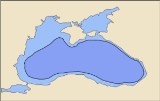
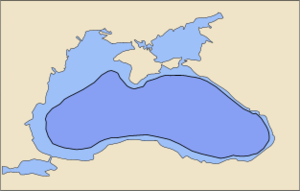
. - c. 5600 BC: According to the Black Sea deluge theoryBlack Sea deluge theoryThe Black Sea deluge is a hypothesized catastrophic rise in the level of the Black Sea circa 5600 BC due to waters from the Mediterranean Sea breaching a sill in the Bosporus Strait. The hypothesis made headlines when The New York Times published it in December 1996, shortly before it was published...
, the Black SeaBlack SeaThe Black Sea is bounded by Europe, Anatolia and the Caucasus and is ultimately connected to the Atlantic Ocean via the Mediterranean and the Aegean seas and various straits. The Bosphorus strait connects it to the Sea of Marmara, and the strait of the Dardanelles connects that sea to the Aegean...
floods with salt water. Some 3000 cubic miles (12,500 km³) of salt water is added, significantly expanding it and transforming it from a fresh-water landlocked lake into a salt water sea.
Inventions, discoveries, introductions
- c. 6000 BC: Cycladic people started to use a coarse, poor-quality local clay to make a variety of objects.
- c. 6000 BC: BrickBrickA brick is a block of ceramic material used in masonry construction, usually laid using various kinds of mortar. It has been regarded as one of the longest lasting and strongest building materials used throughout history.-History:...
building was taking place at modern-day ÇatalhöyükÇatalhöyükÇatalhöyük was a very large Neolithic and Chalcolithic settlement in southern Anatolia, which existed from approximately 7500 BCE to 5700 BCE...
, TurkeyTurkeyTurkey , known officially as the Republic of Turkey , is a Eurasian country located in Western Asia and in East Thrace in Southeastern Europe...
. - AgricultureAgricultureAgriculture is the cultivation of animals, plants, fungi and other life forms for food, fiber, and other products used to sustain life. Agriculture was the key implement in the rise of sedentary human civilization, whereby farming of domesticated species created food surpluses that nurtured the...
appears in the valley of the NileNileThe Nile is a major north-flowing river in North Africa, generally regarded as the longest river in the world. It is long. It runs through the ten countries of Sudan, South Sudan, Burundi, Rwanda, Democratic Republic of the Congo, Tanzania, Kenya, Ethiopia, Uganda and Egypt.The Nile has two major...
. - RiceRiceRice is the seed of the monocot plants Oryza sativa or Oryza glaberrima . As a cereal grain, it is the most important staple food for a large part of the world's human population, especially in East Asia, Southeast Asia, South Asia, the Middle East, and the West Indies...
cultivated in AsiaAsiaAsia is the world's largest and most populous continent, located primarily in the eastern and northern hemispheres. It covers 8.7% of the Earth's total surface area and with approximately 3.879 billion people, it hosts 60% of the world's current human population...
. - PloughPloughThe plough or plow is a tool used in farming for initial cultivation of soil in preparation for sowing seed or planting. It has been a basic instrument for most of recorded history, and represents one of the major advances in agriculture...
invented. - c. 6000–5000 BC: WineWineWine is an alcoholic beverage, made of fermented fruit juice, usually from grapes. The natural chemical balance of grapes lets them ferment without the addition of sugars, acids, enzymes, or other nutrients. Grape wine is produced by fermenting crushed grapes using various types of yeast. Yeast...
is created for the first time in Persia. - c. 5000 BC: Agriculture began in the Americas perhaps this early, in complete isolation from the Old World.
- Artifacts of stone were supplemented by those of metal, and the crafts of basketry, pottery, weaving (AfricaAfricaAfrica is the world's second largest and second most populous continent, after Asia. At about 30.2 million km² including adjacent islands, it covers 6% of the Earth's total surface area and 20.4% of the total land area...
). - Dead were buried in a fetal position, surrounded by the burial offerings and artifacts, facing west (AfricaAfricaAfrica is the world's second largest and second most populous continent, after Asia. At about 30.2 million km² including adjacent islands, it covers 6% of the Earth's total surface area and 20.4% of the total land area...
). - Decorated, black-topped clay pots and vases; bone and ivory combs, figurines, and tableware, are found in great numbers (AfricaAfricaAfrica is the world's second largest and second most populous continent, after Asia. At about 30.2 million km² including adjacent islands, it covers 6% of the Earth's total surface area and 20.4% of the total land area...
). - Jewelry of all types and materials (AfricaAfricaAfrica is the world's second largest and second most populous continent, after Asia. At about 30.2 million km² including adjacent islands, it covers 6% of the Earth's total surface area and 20.4% of the total land area...
). - Objects began to be made not only with a function, but also with an aesthetic value. (AfricaAfricaAfrica is the world's second largest and second most populous continent, after Asia. At about 30.2 million km² including adjacent islands, it covers 6% of the Earth's total surface area and 20.4% of the total land area...
) - Organized, permanent settlements focused around agriculture. (AfricaAfricaAfrica is the world's second largest and second most populous continent, after Asia. At about 30.2 million km² including adjacent islands, it covers 6% of the Earth's total surface area and 20.4% of the total land area...
)
Cultural landmarks
- c. 5700 BC: Samarran CultureSamarraSāmarrā is a city in Iraq. It stands on the east bank of the Tigris in the Salah ad-Din Governorate, north of Baghdad and, in 2003, had an estimated population of 348,700....
at MesopotamiaMesopotamiaMesopotamia is a toponym for the area of the Tigris–Euphrates river system, largely corresponding to modern-day Iraq, northeastern Syria, southeastern Turkey and southwestern Iran.Widely considered to be the cradle of civilization, Bronze Age Mesopotamia included Sumer and the...
(present day IraqIraqIraq ; officially the Republic of Iraq is a country in Western Asia spanning most of the northwestern end of the Zagros mountain range, the eastern part of the Syrian Desert and the northern part of the Arabian Desert....
) begins (c. 5700–4900 BC C-14Radiocarbon datingRadiocarbon dating is a radiometric dating method that uses the naturally occurring radioisotope carbon-14 to estimate the age of carbon-bearing materials up to about 58,000 to 62,000 years. Raw, i.e. uncalibrated, radiocarbon ages are usually reported in radiocarbon years "Before Present" ,...
, 6640–5816 BC calBC). - c. 5500 BC: potteryPotteryPottery is the material from which the potteryware is made, of which major types include earthenware, stoneware and porcelain. The place where such wares are made is also called a pottery . Pottery also refers to the art or craft of the potter or the manufacture of pottery...
at MehrgarhMehrgarhMehrgarh , one of the most important Neolithic sites in archaeology, lies on the "Kachi plain" of Balochistan, Pakistan...
in current-day BaluchistanBalochistan (Pakistan)Balochistan is one of the four provinces or federating units of Pakistan. With an area of 134,051 mi2 or , it is the largest province of Pakistan, constituting approximately 44% of the total land mass of Pakistan. According to the 1998 population census, Balochistan had a population of...
, PakistanPakistanPakistan , officially the Islamic Republic of Pakistan is a sovereign state in South Asia. It has a coastline along the Arabian Sea and the Gulf of Oman in the south and is bordered by Afghanistan and Iran in the west, India in the east and China in the far northeast. In the north, Tajikistan...
. - c. 5100 BC: TempleTempleA temple is a structure reserved for religious or spiritual activities, such as prayer and sacrifice, or analogous rites. A templum constituted a sacred precinct as defined by a priest, or augur. It has the same root as the word "template," a plan in preparation of the building that was marked out...
s founded in South MesopotamiaMesopotamiaMesopotamia is a toponym for the area of the Tigris–Euphrates river system, largely corresponding to modern-day Iraq, northeastern Syria, southeastern Turkey and southwestern Iran.Widely considered to be the cradle of civilization, Bronze Age Mesopotamia included Sumer and the...
. - Mediterranean Old European cultures.