

Holocene climatic optimum

Encyclopedia
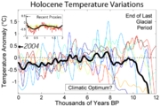
The Holocene Climate Optimum (HCO) was a warm period during roughly the interval 9,000 to 5,000 years B.P.
. This event has also been known by many other names, including: Hypsithermal, Altithermal, Climatic Optimum, Holocene Optimum, Holocene Thermal Maximum, and Holocene Megathermal.
This warm period was followed by a gradual decline until about two millennia ago.
 The Holocene Climate Optimum warm event consisted of increases of up to 4 °C near the North Pole
(in one study, winter warming of 3 to 9 °C and summer of 2 to 6 °C in northern central Siberia
). Northwestern Europe experienced warming, while there was cooling in the south [the south of what?]. The average temperature change appears to have declined rapidly with latitude so that essentially no change in mean temperature is reported at low and mid latitudes. Tropical reefs tend to show temperature increases of less than 1 °C; the tropical ocean surface at the Great Barrier Reef
~5350 years ago was 1°C warmer and enriched in 18O by 0.5 per mil relative to modern seawater. In terms of the global average, temperatures were probably colder than present day (depending on estimates of latitude dependence and seasonality in response patterns). While temperatures in the Northern Hemisphere were warmer than average during the summers, the tropics and areas of the Southern Hemisphere were colder than average which comprised an average global temperature still overall lower than present day temperatures.
Of 140 sites across the western Arctic, there is clear evidence for warmer-than-present conditions at 120 sites. At 16 sites where quantitative estimates have been obtained, local HTM temperatures were on average 1.6±0.8 °C higher than present. Northwestern North America
had peak warmth first, from 11,000 to 9,000 years ago, while the Laurentide ice sheet
still chilled the continent. Northeastern North America experienced peak warming 4,000 years later. Along the Arctic Coastal Plain in Alaska, there are indications of summer temperatures 2–3C warmer than present. Research indicates that the Arctic had substantially less sea ice during this period compared to present.
Current desert regions of Central Asia
were extensively forested due to higher rainfall, and the warm temperate forest belts in China and Japan were extended northwards.
West African sediments additionally record the "African Humid Period", an interval between 16,000 and 6,000 years ago when Africa
was much wetter due to a strengthening of the African monsoon by changes in summer radiation resulting from long-term variations in the Earth's orbit around the sun. During this period, the "Green Sahara" was dotted with numerous lakes containing typical African lake crocodile
and hippopotamus
fauna. A curious discovery from the marine sediments is that the transitions into and out of this wet period occurred within decades, not millennia as previously thought.
In the far southern hemisphere (e.g. New Zealand
and Antarctica), the warmest period during the Holocene appears to have been roughly 8,000 to 10,500 years ago, immediately following the end of the last ice age. By 6,000 years ago, the time normally associated with the Holocene Climatic Optimum in the Northern Hemisphere, these regions had reached temperatures similar to those existing in the modern era, and did not participate in the temperature changes of the North. However, some authors have used the term "Holocene Climatic Optimum" to describe this earlier southern warm period as well.
, West Antarctica (2164 m ice core recovered, 1968) and Camp Century, Northwest Greenland, shows the post glacial climatic optimum. Points of correlation indicate that in these two locations the Holocene climatic optimum (post glacial climatic optimum) probably occurred at the same time. A similar comparison is evident between the Dye 3 1979 and Camp Century 1963 cores regarding this period.
The Hans Tausen ice cap in Peary Land
(northern Greenland
) was drilled in 1977 with a new deep drill to 325 m. The ice core contained distinct melt layers all the way to bedrock indicating that Hans Tausen contains no ice from the last glaciation; i.e., the world’s northernmost ice cap melted away during the post-glacial climatic optimum and was rebuilt when the climate got colder some 4000 years ago.
From the delta-profile, the Renland ice cap in the Scoresbysund Fiord has always been separated from the inland ice, yet all the delta-leaps revealed in the Camp Century 1963 core recurred in the Renland 1985 ice core. The Renland ice core from East Greenland apparently covers a full glacial cycle from the Holocene into the previous Eemian interglacial. The Renland ice core is 325 m long.
Although the depths are different, the GRIP and NGRIP cores also contain this climatic optimum at very similar times.
 This climatic event was probably a result of predictable changes in the Earth's orbit (Milankovitch cycles
) and a continuation of changes that caused the end of the last glacial period
.
The effect would have had maximum Northern Hemisphere heating 9,000 years ago when axial tilt was 24° and nearest approach to the Sun (perihelion) was during boreal summer. The calculated Milankovitch forcing would have provided 8% more solar radiation (+40W/m²) to the Northern Hemisphere in summer, tending to cause greater heating at that time. There does seem to have been the predicted southward shift in the global band of thunderstorms called the Intertropical convergence zone
.
However, orbital forcing would predict maximum climate response several thousand years earlier than those observed in the Northern Hemisphere. This delay may be a result of the continuing changes in climate as the Earth emerged from the last glacial period and related to ice feedbacks. It should also be noted that different sites often show climate changes at somewhat different times and lasting for different durations. At some locations, climate changes associated with this event may have begun as early as 11,000 years ago, or persisted until 4,000 years before present. As noted above, the warmest interval in the far south significantly preceded warming in the North.
, Australia
and Japan
, and desert-like conditions in the Midwestern United States
. Areas around the Amazon
in South America
show temperature increases and drier conditions.
Before Present
Before Present years is a time scale used in archaeology, geology, and other scientific disciplines to specify when events in the past occurred. Because the "present" time changes, standard practice is to use AD 1950 as the origin of the age scale, reflecting the fact that radiocarbon...
. This event has also been known by many other names, including: Hypsithermal, Altithermal, Climatic Optimum, Holocene Optimum, Holocene Thermal Maximum, and Holocene Megathermal.
This warm period was followed by a gradual decline until about two millennia ago.
- For other temperature fluctuations see: Temperature recordTemperature recordThe temperature record shows the fluctuations of the temperature of the atmosphere and the oceans through various spans of time. The most detailed information exists since 1850, when methodical thermometer-based records began. There are numerous estimates of temperatures since the end of the...
- For other past climate fluctuation see: PaleoclimatologyPaleoclimatologyPaleoclimatology is the study of changes in climate taken on the scale of the entire history of Earth. It uses a variety of proxy methods from the Earth and life sciences to obtain data previously preserved within rocks, sediments, ice sheets, tree rings, corals, shells and microfossils; it then...
- For the pollen zonePollen zonePollen zones are a system of subdividing the last glacial period and Holocene paleoclimate using the data from pollen cores. The sequence provides a global chronological structure to a wide variety of scientists, such as geologists, climatologisists, geographists and archaeologists, who study the...
and Blytt-SernanderBlytt-SernanderThe Blytt-Sernander classification, or sequence, is a series of north European climatic periods or phases based on the study of Danish peat bogs by Axel Blytt and Rutger Sernander...
period associated with the climate optimum, see: Atlantic (period)Atlantic (period)The Atlantic in palaeoclimatology was the warmest and moistest Blytt-Sernander period, pollen zone and chronozone of Holocene northern Europe. The climate was generally warmer than today. It was preceded by the Boreal, with a climate similar to today’s, and was followed by the Sub-Boreal, a...
Global effects
North Pole
The North Pole, also known as the Geographic North Pole or Terrestrial North Pole, is, subject to the caveats explained below, defined as the point in the northern hemisphere where the Earth's axis of rotation meets its surface...
(in one study, winter warming of 3 to 9 °C and summer of 2 to 6 °C in northern central Siberia
Siberia
Siberia is an extensive region constituting almost all of Northern Asia. Comprising the central and eastern portion of the Russian Federation, it was part of the Soviet Union from its beginning, as its predecessor states, the Tsardom of Russia and the Russian Empire, conquered it during the 16th...
). Northwestern Europe experienced warming, while there was cooling in the south [the south of what?]. The average temperature change appears to have declined rapidly with latitude so that essentially no change in mean temperature is reported at low and mid latitudes. Tropical reefs tend to show temperature increases of less than 1 °C; the tropical ocean surface at the Great Barrier Reef
Great Barrier Reef
The Great Barrier Reef is the world'slargest reef system composed of over 2,900 individual reefs and 900 islands stretching for over 2,600 kilometres over an area of approximately...
~5350 years ago was 1°C warmer and enriched in 18O by 0.5 per mil relative to modern seawater. In terms of the global average, temperatures were probably colder than present day (depending on estimates of latitude dependence and seasonality in response patterns). While temperatures in the Northern Hemisphere were warmer than average during the summers, the tropics and areas of the Southern Hemisphere were colder than average which comprised an average global temperature still overall lower than present day temperatures.
Of 140 sites across the western Arctic, there is clear evidence for warmer-than-present conditions at 120 sites. At 16 sites where quantitative estimates have been obtained, local HTM temperatures were on average 1.6±0.8 °C higher than present. Northwestern North America
North America
North America is a continent wholly within the Northern Hemisphere and almost wholly within the Western Hemisphere. It is also considered a northern subcontinent of the Americas...
had peak warmth first, from 11,000 to 9,000 years ago, while the Laurentide ice sheet
Laurentide ice sheet
The Laurentide Ice Sheet was a massive sheet of ice that covered hundreds of thousands of square miles, including most of Canada and a large portion of the northern United States, multiple times during Quaternary glacial epochs. It last covered most of northern North America between c. 95,000 and...
still chilled the continent. Northeastern North America experienced peak warming 4,000 years later. Along the Arctic Coastal Plain in Alaska, there are indications of summer temperatures 2–3C warmer than present. Research indicates that the Arctic had substantially less sea ice during this period compared to present.
Current desert regions of Central Asia
Central Asia
Central Asia is a core region of the Asian continent from the Caspian Sea in the west, China in the east, Afghanistan in the south, and Russia in the north...
were extensively forested due to higher rainfall, and the warm temperate forest belts in China and Japan were extended northwards.
West African sediments additionally record the "African Humid Period", an interval between 16,000 and 6,000 years ago when Africa
Africa
Africa is the world's second largest and second most populous continent, after Asia. At about 30.2 million km² including adjacent islands, it covers 6% of the Earth's total surface area and 20.4% of the total land area...
was much wetter due to a strengthening of the African monsoon by changes in summer radiation resulting from long-term variations in the Earth's orbit around the sun. During this period, the "Green Sahara" was dotted with numerous lakes containing typical African lake crocodile
Crocodile
A crocodile is any species belonging to the family Crocodylidae . The term can also be used more loosely to include all extant members of the order Crocodilia: i.e...
and hippopotamus
Hippopotamus
The hippopotamus , or hippo, from the ancient Greek for "river horse" , is a large, mostly herbivorous mammal in sub-Saharan Africa, and one of only two extant species in the family Hippopotamidae After the elephant and rhinoceros, the hippopotamus is the third largest land mammal and the heaviest...
fauna. A curious discovery from the marine sediments is that the transitions into and out of this wet period occurred within decades, not millennia as previously thought.
In the far southern hemisphere (e.g. New Zealand
New Zealand
New Zealand is an island country in the south-western Pacific Ocean comprising two main landmasses and numerous smaller islands. The country is situated some east of Australia across the Tasman Sea, and roughly south of the Pacific island nations of New Caledonia, Fiji, and Tonga...
and Antarctica), the warmest period during the Holocene appears to have been roughly 8,000 to 10,500 years ago, immediately following the end of the last ice age. By 6,000 years ago, the time normally associated with the Holocene Climatic Optimum in the Northern Hemisphere, these regions had reached temperatures similar to those existing in the modern era, and did not participate in the temperature changes of the North. However, some authors have used the term "Holocene Climatic Optimum" to describe this earlier southern warm period as well.
Comparison of ice cores
A comparison of the delta profiles at Byrd StationByrd Station
Byrd Station refers to a research station established by the United States during the International Geophysical Year by the U.S. Navy during Operation Deep Freeze II in West Antarctica at 80°, 120°W...
, West Antarctica (2164 m ice core recovered, 1968) and Camp Century, Northwest Greenland, shows the post glacial climatic optimum. Points of correlation indicate that in these two locations the Holocene climatic optimum (post glacial climatic optimum) probably occurred at the same time. A similar comparison is evident between the Dye 3 1979 and Camp Century 1963 cores regarding this period.
The Hans Tausen ice cap in Peary Land
Peary Land
Peary Land is a peninsula in northern Greenland, extending into the Arctic Ocean. It reaches from Victoria Fjord in the west to Independence Fjord in the south and southeast, and to the Arctic Ocean in the north, with Cape Morris Jesup, the northernmost point of Greenland's mainland, and Cape...
(northern Greenland
Greenland
Greenland is an autonomous country within the Kingdom of Denmark, located between the Arctic and Atlantic Oceans, east of the Canadian Arctic Archipelago. Though physiographically a part of the continent of North America, Greenland has been politically and culturally associated with Europe for...
) was drilled in 1977 with a new deep drill to 325 m. The ice core contained distinct melt layers all the way to bedrock indicating that Hans Tausen contains no ice from the last glaciation; i.e., the world’s northernmost ice cap melted away during the post-glacial climatic optimum and was rebuilt when the climate got colder some 4000 years ago.
From the delta-profile, the Renland ice cap in the Scoresbysund Fiord has always been separated from the inland ice, yet all the delta-leaps revealed in the Camp Century 1963 core recurred in the Renland 1985 ice core. The Renland ice core from East Greenland apparently covers a full glacial cycle from the Holocene into the previous Eemian interglacial. The Renland ice core is 325 m long.
Although the depths are different, the GRIP and NGRIP cores also contain this climatic optimum at very similar times.
Milankovitch cycles
Milankovitch cycles
Milankovitch theory describes the collective effects of changes in the Earth's movements upon its climate, named after Serbian civil engineer and mathematician Milutin Milanković, who worked on it during First World War internment...
) and a continuation of changes that caused the end of the last glacial period
Ice age
An ice age or, more precisely, glacial age, is a generic geological period of long-term reduction in the temperature of the Earth's surface and atmosphere, resulting in the presence or expansion of continental ice sheets, polar ice sheets and alpine glaciers...
.
The effect would have had maximum Northern Hemisphere heating 9,000 years ago when axial tilt was 24° and nearest approach to the Sun (perihelion) was during boreal summer. The calculated Milankovitch forcing would have provided 8% more solar radiation (+40W/m²) to the Northern Hemisphere in summer, tending to cause greater heating at that time. There does seem to have been the predicted southward shift in the global band of thunderstorms called the Intertropical convergence zone
Intertropical Convergence Zone
The Intertropical Convergence Zone , known by sailors as The Doldrums, is the area encircling the earth near the equator where winds originating in the northern and southern hemispheres come together....
.
However, orbital forcing would predict maximum climate response several thousand years earlier than those observed in the Northern Hemisphere. This delay may be a result of the continuing changes in climate as the Earth emerged from the last glacial period and related to ice feedbacks. It should also be noted that different sites often show climate changes at somewhat different times and lasting for different durations. At some locations, climate changes associated with this event may have begun as early as 11,000 years ago, or persisted until 4,000 years before present. As noted above, the warmest interval in the far south significantly preceded warming in the North.
Other changes
While there do not appear to have been significant temperature changes at most low latitude sites, other climate changes have been reported. These include significantly wetter conditions in AfricaAfrica
Africa is the world's second largest and second most populous continent, after Asia. At about 30.2 million km² including adjacent islands, it covers 6% of the Earth's total surface area and 20.4% of the total land area...
, Australia
Australia
Australia , officially the Commonwealth of Australia, is a country in the Southern Hemisphere comprising the mainland of the Australian continent, the island of Tasmania, and numerous smaller islands in the Indian and Pacific Oceans. It is the world's sixth-largest country by total area...
and Japan
Japan
Japan is an island nation in East Asia. Located in the Pacific Ocean, it lies to the east of the Sea of Japan, China, North Korea, South Korea and Russia, stretching from the Sea of Okhotsk in the north to the East China Sea and Taiwan in the south...
, and desert-like conditions in the Midwestern United States
Midwestern United States
The Midwestern United States is one of the four U.S. geographic regions defined by the United States Census Bureau, providing an official definition of the American Midwest....
. Areas around the Amazon
Amazon Basin
The Amazon Basin is the part of South America drained by the Amazon River and its tributaries that drains an area of about , or roughly 40 percent of South America. The basin is located in the countries of Bolivia, Brazil, Colombia, Ecuador, Guyana, Peru, and Venezuela...
in South America
South America
South America is a continent situated in the Western Hemisphere, mostly in the Southern Hemisphere, with a relatively small portion in the Northern Hemisphere. The continent is also considered a subcontinent of the Americas. It is bordered on the west by the Pacific Ocean and on the north and east...
show temperature increases and drier conditions.
See also
- 8.2 kiloyear event8.2 kiloyear eventThe 8.2 kiloyear event is the term that climatologists have adopted for a sudden decrease in global temperatures that occurred approximately 8,200 years before the present, or c. 6,200 BCE, and which lasted for the next two to four centuries...
- Ice core brittle zone
- Medieval Warm PeriodMedieval Warm PeriodThe Medieval Warm Period , Medieval Climate Optimum, or Medieval Climatic Anomaly was a time of warm climate in the North Atlantic region, that may also have been related to other climate events around the world during that time, including in China, New Zealand, and other countries lasting from...
- Little Ice AgeLittle Ice AgeThe Little Ice Age was a period of cooling that occurred after the Medieval Warm Period . While not a true ice age, the term was introduced into the scientific literature by François E. Matthes in 1939...
- Timeline of environmental eventsTimeline of environmental eventsThe timeline lists geological, astronomical, and climatological events in relation to events in human history which they influenced. For the history of humanity's perspective on these events, see timeline of the history of environmentalism...
- Younger DryasYounger DryasThe Younger Dryas stadial, also referred to as the Big Freeze, was a geologically brief period of cold climatic conditions and drought between approximately 12.8 and 11.5 ka BP, or 12,800 and 11,500 years before present...