

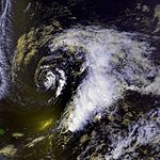
1992 Atlantic hurricane season

Encyclopedia
The 1992 Atlantic hurricane season had one of the latest dates on record for the first named storm. The season
officially began on June 1, 1992, and lasted until November 30, 1992. It was the least active hurricane season in nine years
due to a strong El Niño. The first storm, an unnamed subtropical storm, developed in the central Atlantic on April 21, over a month before the official start of hurricane season. The most significant storm of the season was Hurricane Andrew
, which at the time was the costliest United States hurricane. After crossing the Bahamas, the hurricane made landfall
in Florida and Louisiana
. It caused US$26 billion in damage, mostly in Florida, and 65 fatalities. Andrew was also the strongest hurricane of the season, reaching winds of 175 mph (280 km/h) while approaching Florida. Unusually, Hurricanes Bonnie
and Charley
produced tropical storm force winds in the Azores
, and the former hurricane caused one fatality. Tropical Storm Danielle
was one of few tropical cyclones known to make landfall on the Delmarva Peninsula
. The storm caused minor damage and two fatalities in the Mid-Atlantic
and New England
regions of the United States
. One other hurricane in the season – Frances
– did not significantly affect land. Frances developed in the central Atlantic, and tracked well away from land, and brought only light rainfall to Newfoundland
. In addition to the 7 storms, there were three non-developing tropical depressions
. The first depression
of the season caused flooding in Cuba
and Florida
while the other two depressions did not affect any land.
Forecasts of hurricane activity are issued before each hurricane season by noted hurricane experts such as Dr. William M. Gray
and his associates at Colorado State University
(CSU). A normal season as defined by the National Oceanic and Atmospheric Administration
(NOAA), has 12.1 named storms, of which 6.4 reach hurricane strength, and 2.7 become a major hurricane. In December 1991, the team at CSU predicted that there would be eight named storms, four hurricanes, and one major hurricane in the upcoming season. Later in April 1992, a forecast indicating the same amount of activity was issued. which is Category 3 or higher on the Saffir-Simpson scale
. Two months later, Gray issued another seasonal prediction, though there were no revisions from the previous forecast in April. By August, Gray released another prediction for the amount of activity during the season and it also remained the same as in April and June. Prior to the season, the Weather Research Center (WRC) predicted six named storm, with three of those becoming a hurricane. However, there was no forecast on the number of major hurricanes.
. Only two hurricanes and one tropical storm made landfall during the season. However, damage from Hurricane Andrew
was astronomical, causing most of the season's 106 deaths and $26.5 billion (1992 USD) damage toll. The last storm of the season, Hurricane Frances
, became extratropical on October 27, over a month before the official end of the season on November 30.
Tropical cyclogenesis
in the 1992 Atlantic hurricane season began with the development of Subtropical Storm One on April 21. However, over the next three months, minimal activity occurred, with only two depressions developing, one in June and the other in July. The month of August also inactive was it produced only one tropical cyclone. However, that one tropical cyclone, Hurricane Andrew, was the strongest and costliest of the season. Though September is the climatological peak of hurricane season, an increase in wind shear prevented tropical cyclogenesis in the first half of the month. After September 16, however, five tropical cyclones developed in a span of nine days, from September 17 to September 26. Thereafter, activity abruptly halted, and only one tropical cyclone developed in October, Hurricane Frances. By October 27, Frances became extratropical, which was more than a month before the official end of the season on November 30.
The season's activity was reflected with an accumulated cyclone energy
(ACE) rating of 76. ACE is, broadly speaking, a measure of the power of the hurricane multiplied by the length of time it existed, so storms that last a long time, as well as particularly strong hurricanes, have high ACEs. ACE is only calculated for full advisories on tropical systems at or exceeding 34 knots (39 mph, 63 km/h) or tropical storm strength. Subtropical cyclone
s, such as the first storm, are excluded from the total.
southeast of Bermuda on April 21. The depression tracked northwestward and intensified into Subtropical Storm One on the following day. However, the National Hurricane Center
did not initiate advisories on the subtropical storm until 1500 UTC on April 22. Due to an approaching trough
, the subtropical storm decelerated as it continued northwestward. On April 23, wind shear began increasing on the system, which caused it to weakened back to a subtropical depression later that day.
Later on April 23, the depression curved abruptly eastward, although many computer models believed it would track east-northeastward or northeastward and transition into an extratropical storm on April 26. The subtropical depression continued tracking into an area of unfavorable wind shear, and by early on April 24, satellite imagery showed no deep convection within several hundred miles of the center. Shortly thereafter, the National Hurricane Center discontinued advisories on the depression, reporting that it had degenerated into a low-level cloud swirl. This was, according to the NHC, the first recorded storm to form in April; there would be Tropical Storm Ana
in April 2003
. During its duration, the subtropical storm exhibited some tropical characteristics, including a warm core and some convection consolidated near the center. As a result, the system was nearly re-classified as a tropical cyclone.
emerged off the western coast of Africa
on June 12, and eventually developed into Tropical Depression One in the southeastern Gulf of Mexico
. Operationally, the National Hurricane Center designated this system as Tropical Depression Two, which lead to confusion because of Subtropical Storm One in April, and then another Tropical Depression Two in July. Outflow from Hurricane Celia in the Pacific Ocean and a trough in the Gulf of Mexico generated wind shear on the depression, which prevented it from intensifying into a tropical storm. The depression curved north-northeastward and eventually made landfall in near Tampa
, Florida
on June 26 around 1500 UTC. As it was moving ashore, the National Hurricane Center noted that the depression was too poorly organized to locate the center of circulation, and discontinued advisories on the system.
The depression dropped heavy rainfall in Cuba
, peaking at 33.43 inches (849.1 mm). Large amounts of precipitation resulted in flooding, which damaged or destroyed hundreds of homes and caused two fatalities in provinces
of Pinar del Río
and La Habana
. As the system was only a tropical depression, light winds were reported, however, a peak gust of 56 mph (90 km/h) was reported at MacDill Air Force Base
. Heavy rainfall fell on the west coast of Florida, with local amounts exceeded 20 inches (508 mm). Precipitation throughout the state peaked at 25 inches (635 mm) in Arcadia Tower. Heavy rainfall caused flooding in portions of Florida, which in turn, damaged 4,000 houses and destroyed 70 houses. In addition, five homes destroyed and twelve were damage by a tornado spawned in Nokomis
. Severe crop damage to orange trees was also reported. The depression caused two fatalities in Florida and damage totaled to $2.6 million (1992 USD).
and southern New England
formed a mesoscale convective vortex, which fired new thunderstorm activity each day as it moved within the westerlies
across the northern Atlantic. Once it reached mid-ocean, an increasingly northerly steering flow dropped the system down into the subtropics to the east of Bermuda
, and it maintained decent organization. By 2100 UTC on July 24, the National Hurricane Center began classifying the system as Tropical Depression Two. In the first advisory on the depression, it was noted that the previous tropical depression was erroneously classified as Tropical Depression Two.
Due to northeasterly wind shear, the depression failed to intensified or organize further, as predicted. Instead, the depression weakened by late on July 25, with satellite imagery indicating that much of the deep convection was removed from the surface circulation. By July 26, the National Hurricane Center issued its final advisory, noting that it was "too weak to classify and is rapidly losing its identity". The depression dissipated about three hours later.
on August 14, and organized into Tropical Depression Three on August 16 while located about halfway between the Windward Islands
and the coast of Africa. It moved to the west-northwest, and strengthened into Tropical Storm Andrew on August 17. After reaching winds of 50 mph (85 km/h), strong southwesterly shear weakened the storm, and by August 20 it weakened to a minimal storm with a pressure of 1015 mbar (30 inHg). It bypassed the Lesser Antilles
completely, and turned to the west in response to the building of a high pressure system to the north. Upon turning to the west, a trough of low pressure positioned to the southwest of Andrew created an environment with little vertical shear and well-defined outflow. The storm quickly intensified due to its small size, and became a hurricane on August 22. Andrew rapidly intensified under ideal conditions for development, and on August 23 the hurricane peaked with winds of 175 mph (280 km/h). It crossed the Bahamas at that intensity, weakened slightly, and re-intensified to a 165 mph (270 km/h) Category 5 hurricane before making landfall near Homestead, Florida
. It weakened slightly over the state to a 135 mph (215 km/h) hurricane, but restrengthened to a 145 mph (235 km/h) hurricane over the Gulf of Mexico. A strong mid-latitude trough turned Andrew northward, where it greatly weakened before hitting west of Morgan City, Louisiana
on August 26 as a 115 mph (185 km/h) Category 3 hurricane. It turned northeastward, and dissipated over Tennessee
on August 28.
In the Bahamas, Andrew brought high tides, hurricane force winds, and tornadoes, which caused significant damage in the archipelago, especially on Cat Cays. At least 800 houses were destroyed and left damage to the transport, communications, water, sanitation, agriculture, and fishing sectors. Overall, Andrew caused four fatalities and $250 million (1992 USD) in damage in the Bahamas. Throughout the southern portions of Florida, Andrew brought very high winds; a wind gust of 177 mph (282 km/h) was reported at a house in Perrine, Florida
. High winds caused catastrophic damage in Florida, especially in Miami-Dade County
, where approximately 117,000 houses were either severely damaged or destroyed. In the Everglades
, 70,000 acres (280 km2) of trees were knocked down and about 182 million fish were killed. Rainfall in Florida was moderate, peaking at 13.98 inches (355.1 mm) in western Miami-Dade County. Significant damage to oil platforms
was reported, with one company losing 13 platforms, had 104 structures damaged, and five drilling wells blown off course. In Louisiana, Andrew produced hurricane force winds along its path, which left about 152,000 without electricity, downed 80% of trees in the Atchafalaya River
Basin, and caused significant agricultural damage. An F3 tornado in St. John the Baptist Parish
damaged or destroyed 163 structures. 17 fatalities were reported in Louisiana, six of which were drowning victims offshore. Elsewhere, the storm spawned at least 28 tornadoes, especially in Alabama
, Georgia
, and Mississippi
. Overall, Andrew caused 65 fatalities and $26 billion (1992 USD) in damage, making it the third costliest hurricane in U.S. history, behind only Hurricane Katrina
in 2005 and Hurricane Ike
in 2008.
moved off the East Coast of the United States
, and eventually became stationary, with the western end near Bermuda. An area of cloudiness detached from the front on September 17 and quickly organized. By 1800 UTC on that day, Tropical Depression Four developed about 340 miles (547.2 km) east-northeast of Bermuda. The depression intensified, and was upgraded to Tropical Storm Bonnie early on September 18. Due to light vertical wind shear, Bonnie rapidly strengthened, and became a hurricane only twelve hours later. While tracking east-northeastward or northeastward on September 19, Bonnie developed a somewhat well-defined eye feature. Though the eye became indistinct on September 20, it re-developed by September 21. At 1800 UTC, Bonnie peaked as a 110 mph (175 km/h) Category 2 hurricane. Thereafter, Bonnie became nearly stationary for almost 24 hours. Satellite images indicated that the low-level center became exposed, indicating that Bonnie was significantly weakening while tracking southward. It is estimated that Bonnie weakened to a tropical storm by late on September 24. Bonnie further deteriorated to tropical depression status on September 26, though it re-strengthened to a tropical storm later that day.
By 1500 UTC on September 27, the National Hurricane Center declared Bonnie extratropical, since it was losing tropical characteristics. Bonnie re-acquired tropical characteristics, and the National Hurricane Center resumed advisories on the storm by 2100 UTC on September 28. However, post-analysis indicated that Bonnie remained tropical during that time period. Bonnie re-strengthened to a strong tropical storm before vertical wind shear weakened it while approaching the Azores. Shortly before becoming extratropical on September 30, Bonnie passed through the Azores as a moderately weak tropical storm. One location in the Azores reported tropical storm force winds. In addition, one man was killed by a rock fall on the island of São Miguel
. No damage was reported in association with Bonnie.
Thereafter, Charley turned eastward and then east-northeastward while tracking over decreasing sea surface temperatures (SST's). Early on September 27, Charley was downgraded to a tropical storm. Later that day, Charley crossed over Terceira Island
in the Azores with winds of 65 mph (100 km/h). Charley gradually lost tropical characteristic, and by 1800 UTC on September 27, it had transitioned into an extratropical storm. While passing through the Azores, Charley produced tropical storm force winds, with the Lajes AFB
reporting sustained winds of 53 mph (85 km/h) and gusts reaching 82 mph (132 km/h). No other affects from Charley were reported in the Azores.
on September 22 from the merger of a surface trough, a tropical wave, and a cold front. The depression quickly intensified and was upgraded to Tropical Storm Danielle six hours later. An approaching trough caused a northeastward movement, but later a high pressure system forced the storm to northwestward, which caused Danielle to execute a small anti-cyclonic loop on September 23–24. While offshore of North Carolina
on September 25, Danielle reached its peak intensity as a moderately strong tropical storm with maximum sustained winds of 65 mph (100 km/h). It was initially predicted that Danielle would make landfall in North Carolina, however, the storm curved north-northwestward and made landfall in Virginia
on the eastern shore of the Delmarva Peninsula
at the same intensity. Danielle continued inland and weakened and dissipated over eastern Pennsylvania
on September 26.
Danielle was one of only three tropical cyclones to make landfall on the Delmarva Peninsula, the others were Tropical Storm Bret
in 1981 and Tropical Storm Dean
in 1983. Danielle caused severe beach erosion in North Carolina, Virginia, and Maryland, which resulted in overwash, which in turn, damage or destroyed several businesses and houses in the coastal portions of the three states. In addition, street flooding also closed several roads in the region, most notably, North Carolina Highway 12. Many states in the Mid-Atlantic
and New England
also reported rainfall, although rarely exceeding 3 inches (76.2 mm). In addition high seas offshore of New Jersey
capsized a sailboat, causing two people to drown. Overall, damage from the storm was minimal, with the exception of the damage or destroyed businesses and houses in North Carolina, Virginia, and Maryland.
By September 28, the organization of the depression deteriorated further due to strong vertical wind shear. The center of the depression again became difficult to location by infrared images early on September 29. Later that day, a few computer models indicated a decrease in wind shear over the depression within two days, thus, it was predicted to strengthen into a tropical storm. However, wind shear exposed the center of the depression again by early on September 30, though it was still forecast to intensify to tropical storm status. By late on October 1, satellite imagery noted that the depression dissipated, and the National Hurricane Center issued its final advisory on the system.
. The depression tracked west-northwestward toward the Bahamas, and remained below tropical storm status. However, a cold front moving across the Eastern United States
caused the depression to become nearly stationary over the Gulf Stream
. As a result, further intensification occurred, and the depression was upgraded to Tropical Storm Earl by 1200 UTC on September 29 while veering away from Florida.
The cold front then forced Earl eastward, and the storm continued to slowly intensify. While tracking east-southeastward on October 2, Earl peaked as a 65 mph (100 km/h) tropical storm. Thereafter, Earl began weakened, and was downgraded to a tropical depression on the following day. By 1800 UTC on October 3, Earl had lost tropical characteristics and was declared extratropical while centered well south of Bermuda. As Earl remained offshore, impact was generally minor. Throughout Florida, Earl spawned 11 tornadoes and brought moderately heavy rainfall, peaking at 9.38 inches (238.3 mm) near Canal Point, Florida
. In addition, light amounts of precipitation were also reported in Georgia
and North Carolina.
After reaching peak intensity, Frances began tracking over cooler SST's, which gradually weakened the storm. The eye featured became indistinct and by late on October 25, Frances was downgraded to a tropical storm. Over the next two days, Frances began losing tropical characteristics, and was declared extratropical by early on October 27. One sailor was reported missing, however, it is unknown if it was as a result of Frances. In addition, one person on a sailboat suffered injuries during an encounter with Frances. On land, Frances caused minimal impact, limited to light rainfall across Newfoundland.
, as a result, the subtropical cyclone in April 1992 did not receive a name. The names not retired from this list were used again in the 1998 season
. This is the same list used for the 1986 season
. Names that were not assigned are marked in . After the season had ended
the World Meteorological Organization
's Hurricane committee decided to retire one name from the naming lists: Andrew. It was replaced in the 1998 season
with Alex.
Atlantic hurricane season
The Atlantic hurricane season is the period in a year when hurricanes usually form in the Atlantic Ocean. Tropical cyclones in the North Atlantic are called hurricanes, tropical storms, or tropical depressions. In addition, there have been several storms over the years that have not been fully...
officially began on June 1, 1992, and lasted until November 30, 1992. It was the least active hurricane season in nine years
1983 Atlantic hurricane season
The 1983 Atlantic hurricane season was the least active Atlantic hurricane season in 53 years, with only four tropical storms forming. The season officially began on June 1, 1983, and lasted until November 30, 1983. These dates conventionally delimit the period of each year when most storms...
due to a strong El Niño. The first storm, an unnamed subtropical storm, developed in the central Atlantic on April 21, over a month before the official start of hurricane season. The most significant storm of the season was Hurricane Andrew
Hurricane Andrew
Hurricane Andrew was the third Category 5 hurricane to make landfall in the United States, after the Labor Day Hurricane of 1935 and Hurricane Camille in 1969. Andrew was the first named storm and only major hurricane of the otherwise inactive 1992 Atlantic hurricane season...
, which at the time was the costliest United States hurricane. After crossing the Bahamas, the hurricane made landfall
Landfall (meteorology)
Landfall is the event of a tropical cyclone or a waterspout coming onto land after being over water. When a waterspout makes landfall it is reclassified as a tornado, which can then cause damage inland...
in Florida and Louisiana
Louisiana
Louisiana is a state located in the southern region of the United States of America. Its capital is Baton Rouge and largest city is New Orleans. Louisiana is the only state in the U.S. with political subdivisions termed parishes, which are local governments equivalent to counties...
. It caused US$26 billion in damage, mostly in Florida, and 65 fatalities. Andrew was also the strongest hurricane of the season, reaching winds of 175 mph (280 km/h) while approaching Florida. Unusually, Hurricanes Bonnie
Hurricane Bonnie (1992)
Hurricane Bonnie was a long-lived storm in the 1992 Atlantic hurricane season. It was the third tropical storm and second hurricane of the 1992 season. Bonnie formed at high latitudes in the central Atlantic on September 17...
and Charley
Hurricane Charley (1992)
Hurricane Charley was the fifth tropical cyclone, third named storm, and the third hurricane of the 1992 Atlantic hurricane season. Charley was relatively unusual, as it was one of two tropical cyclone to cross through the Azores in 1992. It developed from an area of convection seen on METEOSAT...
produced tropical storm force winds in the Azores
Azores
The Archipelago of the Azores is composed of nine volcanic islands situated in the middle of the North Atlantic Ocean, and is located about west from Lisbon and about east from the east coast of North America. The islands, and their economic exclusion zone, form the Autonomous Region of the...
, and the former hurricane caused one fatality. Tropical Storm Danielle
Tropical Storm Danielle (1992)
Tropical Storm Danielle was a weak tropical storm that made landfall on Virginia in the 1992 Atlantic hurricane season. The fourth storm of the season, Danielle was one of two Atlantic storms in the year to make landfall in the United States, the other being Hurricane Andrew. It formed out of a...
was one of few tropical cyclones known to make landfall on the Delmarva Peninsula
Delmarva Peninsula
The Delmarva Peninsula is a large peninsula on the East Coast of the United States, occupied by most of Delaware and portions of Maryland and Virginia...
. The storm caused minor damage and two fatalities in the Mid-Atlantic
Mid-Atlantic States
The Mid-Atlantic states, also called middle Atlantic states or simply the mid Atlantic, form a region of the United States generally located between New England and the South...
and New England
New England
New England is a region in the northeastern corner of the United States consisting of the six states of Maine, New Hampshire, Vermont, Massachusetts, Rhode Island, and Connecticut...
regions of the United States
United States
The United States of America is a federal constitutional republic comprising fifty states and a federal district...
. One other hurricane in the season – Frances
Hurricane Frances (1992)
Hurricane Frances was the final named storm of 1992 Atlantic hurricane season. The ninth tropical cyclone, sixth named storm, and fourth hurricane of the season, Frances developed on October 23 from an area of low pressure southeast of Bermuda. Immediately developing into a tropical storm, Frances...
– did not significantly affect land. Frances developed in the central Atlantic, and tracked well away from land, and brought only light rainfall to Newfoundland
Newfoundland
Newfoundland usually refers to either:* Newfoundland, the former name of Newfoundland and Labrador, a Canadian province in the eastern part of Canada* Newfoundland , an island that forms part of the province of Newfoundland and Labrador...
. In addition to the 7 storms, there were three non-developing tropical depressions
Tropical cyclone scales
Tropical systems are officially ranked on one of several tropical cyclone scales according to their maximum sustained winds and in what oceanic basin they are located...
. The first depression
Tropical Depression One (1992)
Tropical Depression One in June 1992 produced 100-year floods in portions of southwestern Florida. The first tropical depression and second tropical cyclone of the 1992 Atlantic hurricane season, the depression developed on June 25 from a tropical wave...
of the season caused flooding in Cuba
Cuba
The Republic of Cuba is an island nation in the Caribbean. The nation of Cuba consists of the main island of Cuba, the Isla de la Juventud, and several archipelagos. Havana is the largest city in Cuba and the country's capital. Santiago de Cuba is the second largest city...
and Florida
Florida
Florida is a state in the southeastern United States, located on the nation's Atlantic and Gulf coasts. It is bordered to the west by the Gulf of Mexico, to the north by Alabama and Georgia and to the east by the Atlantic Ocean. With a population of 18,801,310 as measured by the 2010 census, it...
while the other two depressions did not affect any land.
Pre-season forecasts
| Source | Date | Named storms | Hurricanes | Major hurricanes | |
|---|---|---|---|---|---|
| 12.1 | 6.4 | 2.7 | |||
| 28 2005 Atlantic hurricane season The 2005 Atlantic hurricane season was the most active Atlantic hurricane season in recorded history, repeatedly shattering numerous records. The impact of the season was widespread and ruinous with an estimated 3,913 deaths and record damage of about $159.2 billion... |
15 2005 Atlantic hurricane season The 2005 Atlantic hurricane season was the most active Atlantic hurricane season in recorded history, repeatedly shattering numerous records. The impact of the season was widespread and ruinous with an estimated 3,913 deaths and record damage of about $159.2 billion... |
8 1950 Atlantic hurricane season The 1950 Atlantic hurricane season was the first year in which tropical cyclones were given official names in the Atlantic basin. Names were taken from the Joint Army/Navy Phonetic Alphabet, with the first named storm being designated "Able", the second "Baker", and so on. It was an active season... |
|||
| 4 1983 Atlantic hurricane season The 1983 Atlantic hurricane season was the least active Atlantic hurricane season in 53 years, with only four tropical storms forming. The season officially began on June 1, 1983, and lasted until November 30, 1983. These dates conventionally delimit the period of each year when most storms... |
2 1982 Atlantic hurricane season The 1982 Atlantic hurricane season officially began on June 1, 1982 and lasted until November 30, 1982, and was a below average season. These dates conventionally delimit the period of each year when most tropical cyclones form in the Atlantic basin... |
0 1994 Atlantic hurricane season The 1994 Atlantic hurricane seasonofficially began June 1, 1994, and officially ended November 30, 1994. These dates conventionally delimit the period of each year when most tropical cyclones form in the Atlantic basin.... |
|||
| ––––––––––––––––––––––––––––––––––––––––––––––––––––––– | |||||
| CSU Colorado State University Colorado State University is a public research university located in Fort Collins, Colorado. The university is the state's land grant university, and the flagship university of the Colorado State University System.The enrollment is approximately 29,932 students, including resident and... |
December 1991 | 8 | 4 | 1 | |
| WRC | Early 1992 | 6 | 3 | N/A | |
| CSU Colorado State University Colorado State University is a public research university located in Fort Collins, Colorado. The university is the state's land grant university, and the flagship university of the Colorado State University System.The enrollment is approximately 29,932 students, including resident and... |
April 1992 | 8 | 4 | 1 | |
| CSU | June 1992 | 8 | 4 | 1 | |
| CSU | August 1992 | 8 | 4 | 1 | |
| ––––––––––––––––––––––––––––––––––––––––––––––––––––––– | |||||
| Actual activity | 8 | 4 | 1 | ||
Forecasts of hurricane activity are issued before each hurricane season by noted hurricane experts such as Dr. William M. Gray
William M. Gray
William M. "Bill" Gray is Emeritus Professor of Atmospheric Science at Colorado State University , and head of the Tropical Meteorology Project at CSU's Department of Atmospheric Sciences. He is a pioneer in the science of forecasting hurricanes and one of the world's leading experts on tropical...
and his associates at Colorado State University
Colorado State University
Colorado State University is a public research university located in Fort Collins, Colorado. The university is the state's land grant university, and the flagship university of the Colorado State University System.The enrollment is approximately 29,932 students, including resident and...
(CSU). A normal season as defined by the National Oceanic and Atmospheric Administration
National Oceanic and Atmospheric Administration
The National Oceanic and Atmospheric Administration , pronounced , like "noah", is a scientific agency within the United States Department of Commerce focused on the conditions of the oceans and the atmosphere...
(NOAA), has 12.1 named storms, of which 6.4 reach hurricane strength, and 2.7 become a major hurricane. In December 1991, the team at CSU predicted that there would be eight named storms, four hurricanes, and one major hurricane in the upcoming season. Later in April 1992, a forecast indicating the same amount of activity was issued. which is Category 3 or higher on the Saffir-Simpson scale
Saffir-Simpson Hurricane Scale
The Saffir–Simpson Hurricane Scale , or the Saffir–Simpson Hurricane Wind Scale , classifies hurricanes — Western Hemisphere tropical cyclones that exceed the intensities of tropical depressions and tropical storms — into five categories distinguished by the intensities of their sustained winds...
. Two months later, Gray issued another seasonal prediction, though there were no revisions from the previous forecast in April. By August, Gray released another prediction for the amount of activity during the season and it also remained the same as in April and June. Prior to the season, the Weather Research Center (WRC) predicted six named storm, with three of those becoming a hurricane. However, there was no forecast on the number of major hurricanes.
Season activity
The Atlantic hurricane season officially began on June 1, but activity in 1992 began more than a month earlier with the formation of Subtropical Storm One on April 21. It was a below average season in which 10 tropical depressions formed. Seven of the depressions attained tropical storm status, and four of these attained hurricane status. In addition, one tropical cyclone eventually attained major hurricane status, which is below the 1981–2010 average of 2.7 per season. The low amount of activity is attributed to an El Niño that persisted since the previous season1991 Atlantic hurricane season
The 1991 Atlantic hurricane season was the first season in over 24 years in which no hurricanes developed from tropical waves, which are the source for most North Atlantic tropical cyclones. The hurricane season officially began on June 1, and ended on November 30. It was the least...
. Only two hurricanes and one tropical storm made landfall during the season. However, damage from Hurricane Andrew
Hurricane Andrew
Hurricane Andrew was the third Category 5 hurricane to make landfall in the United States, after the Labor Day Hurricane of 1935 and Hurricane Camille in 1969. Andrew was the first named storm and only major hurricane of the otherwise inactive 1992 Atlantic hurricane season...
was astronomical, causing most of the season's 106 deaths and $26.5 billion (1992 USD) damage toll. The last storm of the season, Hurricane Frances
Hurricane Frances (1992)
Hurricane Frances was the final named storm of 1992 Atlantic hurricane season. The ninth tropical cyclone, sixth named storm, and fourth hurricane of the season, Frances developed on October 23 from an area of low pressure southeast of Bermuda. Immediately developing into a tropical storm, Frances...
, became extratropical on October 27, over a month before the official end of the season on November 30.
Tropical cyclogenesis
Tropical cyclogenesis
Tropical cyclogenesis is the term that describes the development and strengthening of a tropical cyclone in the atmosphere. The mechanisms through which tropical cyclogenesis occurs are distinctly different from those through which mid-latitude cyclogenesis occurs...
in the 1992 Atlantic hurricane season began with the development of Subtropical Storm One on April 21. However, over the next three months, minimal activity occurred, with only two depressions developing, one in June and the other in July. The month of August also inactive was it produced only one tropical cyclone. However, that one tropical cyclone, Hurricane Andrew, was the strongest and costliest of the season. Though September is the climatological peak of hurricane season, an increase in wind shear prevented tropical cyclogenesis in the first half of the month. After September 16, however, five tropical cyclones developed in a span of nine days, from September 17 to September 26. Thereafter, activity abruptly halted, and only one tropical cyclone developed in October, Hurricane Frances. By October 27, Frances became extratropical, which was more than a month before the official end of the season on November 30.
The season's activity was reflected with an accumulated cyclone energy
Accumulated cyclone energy
Accumulated cyclone energy is a measure used by the National Oceanic and Atmospheric Administration to express the activity of individual tropical cyclones and entire tropical cyclone seasons, particularly the North Atlantic hurricane season. It uses an approximation of the energy used by a...
(ACE) rating of 76. ACE is, broadly speaking, a measure of the power of the hurricane multiplied by the length of time it existed, so storms that last a long time, as well as particularly strong hurricanes, have high ACEs. ACE is only calculated for full advisories on tropical systems at or exceeding 34 knots (39 mph, 63 km/h) or tropical storm strength. Subtropical cyclone
Subtropical cyclone
A subtropical cyclone is a weather system that has some characteristics of a tropical and an extratropical cyclone. As early as the 1950s, meteorologists were unclear whether they should be characterized as tropical or extratropical cyclones. They were officially recognized by the National...
s, such as the first storm, are excluded from the total.
Subtropical Storm One
The first storm of the 1992 Atlantic hurricane season was a subtropical depression that developed from a low pressure areaLow pressure area
A low-pressure area, or "low", is a region where the atmospheric pressure at sea level is below that of surrounding locations. Low-pressure systems form under areas of wind divergence which occur in upper levels of the troposphere. The formation process of a low-pressure area is known as...
southeast of Bermuda on April 21. The depression tracked northwestward and intensified into Subtropical Storm One on the following day. However, the National Hurricane Center
National Hurricane Center
The National Hurricane Center , located at Florida International University in Miami, Florida, is the division of the National Weather Service responsible for tracking and predicting weather systems within the tropics between the Prime Meridian and the 140th meridian west poleward to the 30th...
did not initiate advisories on the subtropical storm until 1500 UTC on April 22. Due to an approaching trough
Trough (meteorology)
A trough is an elongated region of relatively low atmospheric pressure, often associated with fronts.Unlike fronts, there is not a universal symbol for a trough on a weather chart. The weather charts in some countries or regions mark troughs by a line. In the United States, a trough may be marked...
, the subtropical storm decelerated as it continued northwestward. On April 23, wind shear began increasing on the system, which caused it to weakened back to a subtropical depression later that day.
Later on April 23, the depression curved abruptly eastward, although many computer models believed it would track east-northeastward or northeastward and transition into an extratropical storm on April 26. The subtropical depression continued tracking into an area of unfavorable wind shear, and by early on April 24, satellite imagery showed no deep convection within several hundred miles of the center. Shortly thereafter, the National Hurricane Center discontinued advisories on the depression, reporting that it had degenerated into a low-level cloud swirl. This was, according to the NHC, the first recorded storm to form in April; there would be Tropical Storm Ana
Tropical Storm Ana (2003)
Tropical Storm Ana was the only tropical cyclone on record in the Atlantic basin to form during the month of April. The first tropical cyclone of the season, it developed as a subtropical cyclone from a non-tropical low on April 20 to the west of Bermuda...
in April 2003
2003 Atlantic hurricane season
The 2003 Atlantic hurricane season was an active Atlantic hurricane season with tropical activity before and after the official bounds of the season – the first such occurrence in 50 years. The season produced 21 tropical cyclones, of which 16 developed into named storms; seven...
. During its duration, the subtropical storm exhibited some tropical characteristics, including a warm core and some convection consolidated near the center. As a result, the system was nearly re-classified as a tropical cyclone.
Tropical Depression One
A tropical waveTropical wave
Tropical waves, easterly waves, or tropical easterly waves, also known as African easterly waves in the Atlantic region, are a type of atmospheric trough, an elongated area of relatively low air pressure, oriented north to south, which move from east to west across the tropics causing areas of...
emerged off the western coast of Africa
Africa
Africa is the world's second largest and second most populous continent, after Asia. At about 30.2 million km² including adjacent islands, it covers 6% of the Earth's total surface area and 20.4% of the total land area...
on June 12, and eventually developed into Tropical Depression One in the southeastern Gulf of Mexico
Gulf of Mexico
The Gulf of Mexico is a partially landlocked ocean basin largely surrounded by the North American continent and the island of Cuba. It is bounded on the northeast, north and northwest by the Gulf Coast of the United States, on the southwest and south by Mexico, and on the southeast by Cuba. In...
. Operationally, the National Hurricane Center designated this system as Tropical Depression Two, which lead to confusion because of Subtropical Storm One in April, and then another Tropical Depression Two in July. Outflow from Hurricane Celia in the Pacific Ocean and a trough in the Gulf of Mexico generated wind shear on the depression, which prevented it from intensifying into a tropical storm. The depression curved north-northeastward and eventually made landfall in near Tampa
Tâmpa
Tâmpa may refer to several villages in Romania:* Tâmpa, a village in Băcia Commune, Hunedoara County* Tâmpa, a village in Miercurea Nirajului, Mureş County* Tâmpa, a mountain in Braşov city...
, Florida
Florida
Florida is a state in the southeastern United States, located on the nation's Atlantic and Gulf coasts. It is bordered to the west by the Gulf of Mexico, to the north by Alabama and Georgia and to the east by the Atlantic Ocean. With a population of 18,801,310 as measured by the 2010 census, it...
on June 26 around 1500 UTC. As it was moving ashore, the National Hurricane Center noted that the depression was too poorly organized to locate the center of circulation, and discontinued advisories on the system.
The depression dropped heavy rainfall in Cuba
Cuba
The Republic of Cuba is an island nation in the Caribbean. The nation of Cuba consists of the main island of Cuba, the Isla de la Juventud, and several archipelagos. Havana is the largest city in Cuba and the country's capital. Santiago de Cuba is the second largest city...
, peaking at 33.43 inches (849.1 mm). Large amounts of precipitation resulted in flooding, which damaged or destroyed hundreds of homes and caused two fatalities in provinces
Provinces of Cuba
Administratively, Cuba is divided into 15 provinces and one special municipality not included in any province. The last modification was approved in August 2010 , splitting Havana province into two new provinces: Artemisa and Mayabeque...
of Pinar del Río
Pinar del Río Province
Pinar del Río is one of the provinces of Cuba. It is at the western end of the island of Cuba.-Geography:The Pinar del Río province is Cuba's westernmost province and contains one of Cuba's three main mountain ranges, the Cordillera de Guaniguanico, divided into the easterly Sierra del Rosario and...
and La Habana
La Habana Province
Havana Province was one of the provinces of Cuba, prior to being divided into two new provinces of Artemisa and Mayabeque on January 1, 2011. It had 711,066 people in the 2002 census. The largest city was Artemisa .-Geography:...
. As the system was only a tropical depression, light winds were reported, however, a peak gust of 56 mph (90 km/h) was reported at MacDill Air Force Base
MacDill Air Force Base
MacDill Air Force Base is an active United States Air Force base located approximately south-southwest of downtown Tampa, Florida...
. Heavy rainfall fell on the west coast of Florida, with local amounts exceeded 20 inches (508 mm). Precipitation throughout the state peaked at 25 inches (635 mm) in Arcadia Tower. Heavy rainfall caused flooding in portions of Florida, which in turn, damaged 4,000 houses and destroyed 70 houses. In addition, five homes destroyed and twelve were damage by a tornado spawned in Nokomis
Nokomis, Florida
Nokomis is a census-designated place in Sarasota County, Florida, United States. The population was 3,334 at the 2000 census. It is part of the Bradenton–Sarasota–Venice Metropolitan Statistical Area....
. Severe crop damage to orange trees was also reported. The depression caused two fatalities in Florida and damage totaled to $2.6 million (1992 USD).
Tropical Depression Two
A squall line which moved offshore New YorkNew York
New York is a state in the Northeastern region of the United States. It is the nation's third most populous state. New York is bordered by New Jersey and Pennsylvania to the south, and by Connecticut, Massachusetts and Vermont to the east...
and southern New England
New England
New England is a region in the northeastern corner of the United States consisting of the six states of Maine, New Hampshire, Vermont, Massachusetts, Rhode Island, and Connecticut...
formed a mesoscale convective vortex, which fired new thunderstorm activity each day as it moved within the westerlies
Westerlies
The Westerlies, anti-trades, or Prevailing Westerlies, are the prevailing winds in the middle latitudes between 30 and 60 degrees latitude, blowing from the high pressure area in the horse latitudes towards the poles. These prevailing winds blow from the west to the east, and steer extratropical...
across the northern Atlantic. Once it reached mid-ocean, an increasingly northerly steering flow dropped the system down into the subtropics to the east of Bermuda
Bermuda
Bermuda is a British overseas territory in the North Atlantic Ocean. Located off the east coast of the United States, its nearest landmass is Cape Hatteras, North Carolina, about to the west-northwest. It is about south of Halifax, Nova Scotia, Canada, and northeast of Miami, Florida...
, and it maintained decent organization. By 2100 UTC on July 24, the National Hurricane Center began classifying the system as Tropical Depression Two. In the first advisory on the depression, it was noted that the previous tropical depression was erroneously classified as Tropical Depression Two.
Due to northeasterly wind shear, the depression failed to intensified or organize further, as predicted. Instead, the depression weakened by late on July 25, with satellite imagery indicating that much of the deep convection was removed from the surface circulation. By July 26, the National Hurricane Center issued its final advisory, noting that it was "too weak to classify and is rapidly losing its identity". The depression dissipated about three hours later.
Hurricane Andrew
A tropical wave moved off the coast of AfricaAfrica
Africa is the world's second largest and second most populous continent, after Asia. At about 30.2 million km² including adjacent islands, it covers 6% of the Earth's total surface area and 20.4% of the total land area...
on August 14, and organized into Tropical Depression Three on August 16 while located about halfway between the Windward Islands
Windward Islands
The Windward Islands are the southern islands of the Lesser Antilles, within the West Indies.-Name and geography:The Windward Islands are called such because they were more windward to sailing ships arriving in the New World than the Leeward Islands, given that the prevailing trade winds in the...
and the coast of Africa. It moved to the west-northwest, and strengthened into Tropical Storm Andrew on August 17. After reaching winds of 50 mph (85 km/h), strong southwesterly shear weakened the storm, and by August 20 it weakened to a minimal storm with a pressure of 1015 mbar (30 inHg). It bypassed the Lesser Antilles
Lesser Antilles
The Lesser Antilles are a long, partly volcanic island arc in the Western Hemisphere. Most of its islands form the eastern boundary of the Caribbean Sea with the Atlantic Ocean, with the remainder located in the southern Caribbean just north of South America...
completely, and turned to the west in response to the building of a high pressure system to the north. Upon turning to the west, a trough of low pressure positioned to the southwest of Andrew created an environment with little vertical shear and well-defined outflow. The storm quickly intensified due to its small size, and became a hurricane on August 22. Andrew rapidly intensified under ideal conditions for development, and on August 23 the hurricane peaked with winds of 175 mph (280 km/h). It crossed the Bahamas at that intensity, weakened slightly, and re-intensified to a 165 mph (270 km/h) Category 5 hurricane before making landfall near Homestead, Florida
Homestead, Florida
Homestead is a city in Miami-Dade County, Florida, United States nestled between Biscayne National Park to the east and Everglades National Park to the west. Homestead is primarily a Miami suburb and a major agricultural area....
. It weakened slightly over the state to a 135 mph (215 km/h) hurricane, but restrengthened to a 145 mph (235 km/h) hurricane over the Gulf of Mexico. A strong mid-latitude trough turned Andrew northward, where it greatly weakened before hitting west of Morgan City, Louisiana
Morgan City, Louisiana
Morgan City is a city in St. Martin and St. Mary parishes in the U.S. state of Louisiana. The population was 12,404 at the 2010 census....
on August 26 as a 115 mph (185 km/h) Category 3 hurricane. It turned northeastward, and dissipated over Tennessee
Tennessee
Tennessee is a U.S. state located in the Southeastern United States. It has a population of 6,346,105, making it the nation's 17th-largest state by population, and covers , making it the 36th-largest by total land area...
on August 28.
In the Bahamas, Andrew brought high tides, hurricane force winds, and tornadoes, which caused significant damage in the archipelago, especially on Cat Cays. At least 800 houses were destroyed and left damage to the transport, communications, water, sanitation, agriculture, and fishing sectors. Overall, Andrew caused four fatalities and $250 million (1992 USD) in damage in the Bahamas. Throughout the southern portions of Florida, Andrew brought very high winds; a wind gust of 177 mph (282 km/h) was reported at a house in Perrine, Florida
Perrine, Florida
Perrine, Florida was an unincorporated community in Miami-Dade County about midway between Miami and Homestead. It is located at The community was named after Dr...
. High winds caused catastrophic damage in Florida, especially in Miami-Dade County
Miami-Dade County, Florida
Miami-Dade County is a county located in the southeastern part of the state of Florida. As of 2010 U.S. Census, the county had a population of 2,496,435, making it the most populous county in Florida and the eighth-most populous county in the United States...
, where approximately 117,000 houses were either severely damaged or destroyed. In the Everglades
Everglades
The Everglades are subtropical wetlands in the southern portion of the U.S. state of Florida, comprising the southern half of a large watershed. The system begins near Orlando with the Kissimmee River, which discharges into the vast but shallow Lake Okeechobee...
, 70,000 acres (280 km2) of trees were knocked down and about 182 million fish were killed. Rainfall in Florida was moderate, peaking at 13.98 inches (355.1 mm) in western Miami-Dade County. Significant damage to oil platforms
Oil platform
An oil platform, also referred to as an offshore platform or, somewhat incorrectly, oil rig, is a lаrge structure with facilities to drill wells, to extract and process oil and natural gas, and to temporarily store product until it can be brought to shore for refining and marketing...
was reported, with one company losing 13 platforms, had 104 structures damaged, and five drilling wells blown off course. In Louisiana, Andrew produced hurricane force winds along its path, which left about 152,000 without electricity, downed 80% of trees in the Atchafalaya River
Atchafalaya River
The Atchafalaya River is a distributary of the Mississippi River and Red River in south central Louisiana in the United States. It flows south, just west of the Mississippi River....
Basin, and caused significant agricultural damage. An F3 tornado in St. John the Baptist Parish
St. John the Baptist Parish, Louisiana
St. John the Baptist Parish is a parish located in the U.S. state of Louisiana.The parish seat is Edgard, an unincorporated area and the unofficial parish captial is LaPlace, an unincorporated area. St. John the Baptist is one of the original 19 parishes in Louisiana. In 2010, its population was...
damaged or destroyed 163 structures. 17 fatalities were reported in Louisiana, six of which were drowning victims offshore. Elsewhere, the storm spawned at least 28 tornadoes, especially in Alabama
Alabama
Alabama is a state located in the southeastern region of the United States. It is bordered by Tennessee to the north, Georgia to the east, Florida and the Gulf of Mexico to the south, and Mississippi to the west. Alabama ranks 30th in total land area and ranks second in the size of its inland...
, Georgia
Georgia (U.S. state)
Georgia is a state located in the southeastern United States. It was established in 1732, the last of the original Thirteen Colonies. The state is named after King George II of Great Britain. Georgia was the fourth state to ratify the United States Constitution, on January 2, 1788...
, and Mississippi
Mississippi
Mississippi is a U.S. state located in the Southern United States. Jackson is the state capital and largest city. The name of the state derives from the Mississippi River, which flows along its western boundary, whose name comes from the Ojibwe word misi-ziibi...
. Overall, Andrew caused 65 fatalities and $26 billion (1992 USD) in damage, making it the third costliest hurricane in U.S. history, behind only Hurricane Katrina
Hurricane Katrina
Hurricane Katrina of the 2005 Atlantic hurricane season was a powerful Atlantic hurricane. It is the costliest natural disaster, as well as one of the five deadliest hurricanes, in the history of the United States. Among recorded Atlantic hurricanes, it was the sixth strongest overall...
in 2005 and Hurricane Ike
Hurricane Ike
Hurricane Ike was the second-costliest hurricane ever to make landfall in the United States, the costliest hurricane ever to impact Cuba and the second most active hurricane to reach the Canadian mainland in the Great Lakes Region after Hurricane Hazel in 1954...
in 2008.
Hurricane Bonnie
A cold frontCold front
A cold front is defined as the leading edge of a cooler mass of air, replacing a warmer mass of air.-Development of cold front:The cooler and denser air wedges under the less-dense warmer air, lifting it...
moved off the East Coast of the United States
East Coast of the United States
The East Coast of the United States, also known as the Eastern Seaboard, refers to the easternmost coastal states in the United States, which touch the Atlantic Ocean and stretch up to Canada. The term includes the U.S...
, and eventually became stationary, with the western end near Bermuda. An area of cloudiness detached from the front on September 17 and quickly organized. By 1800 UTC on that day, Tropical Depression Four developed about 340 miles (547.2 km) east-northeast of Bermuda. The depression intensified, and was upgraded to Tropical Storm Bonnie early on September 18. Due to light vertical wind shear, Bonnie rapidly strengthened, and became a hurricane only twelve hours later. While tracking east-northeastward or northeastward on September 19, Bonnie developed a somewhat well-defined eye feature. Though the eye became indistinct on September 20, it re-developed by September 21. At 1800 UTC, Bonnie peaked as a 110 mph (175 km/h) Category 2 hurricane. Thereafter, Bonnie became nearly stationary for almost 24 hours. Satellite images indicated that the low-level center became exposed, indicating that Bonnie was significantly weakening while tracking southward. It is estimated that Bonnie weakened to a tropical storm by late on September 24. Bonnie further deteriorated to tropical depression status on September 26, though it re-strengthened to a tropical storm later that day.
By 1500 UTC on September 27, the National Hurricane Center declared Bonnie extratropical, since it was losing tropical characteristics. Bonnie re-acquired tropical characteristics, and the National Hurricane Center resumed advisories on the storm by 2100 UTC on September 28. However, post-analysis indicated that Bonnie remained tropical during that time period. Bonnie re-strengthened to a strong tropical storm before vertical wind shear weakened it while approaching the Azores. Shortly before becoming extratropical on September 30, Bonnie passed through the Azores as a moderately weak tropical storm. One location in the Azores reported tropical storm force winds. In addition, one man was killed by a rock fall on the island of São Miguel
São Miguel Island
São Miguel Island , nicknamed "The Green Island", is the largest and most populous island in the Portuguese Azores archipelago. The island covers and has around 140,000 inhabitants, 45,000 of these people located in the largest city in the archipelago: Ponta Delgada.-History:In 1427, São Miguel...
. No damage was reported in association with Bonnie.
Hurricane Charley
On September 20, METEOSAT imagery indicated an area of convection becoming concentrated while well south of the Azores. It is possible that a mid to upper-level cyclonic circulation interacted with the northern portion of a tropical wave. By the following day, satellite imagery noted a well-defined low-level circulation had developed, and the system was classified as Tropical Depression Five while centered about 633 miles (1,018.7 km) south of the Azores. The depression tracked northwestward and satellite imagery began to indicate banding features. As a result, the depression was upgraded to Tropical Storm Charley on September 22. An eye developed as Charley tracked north-northwestward, and it became a hurricane on September 23. Further strengthening occurred, and by late on September 24, Charley peaked as a 110 mph (175 km/h) Category 2 hurricane.Thereafter, Charley turned eastward and then east-northeastward while tracking over decreasing sea surface temperatures (SST's). Early on September 27, Charley was downgraded to a tropical storm. Later that day, Charley crossed over Terceira Island
Terceira Island
Referred to as the “Ilha Lilás” , Terceira is an island in the Azores archipelago, in the middle of the North Atlantic Ocean. It is one of the larger islands of the archipelago, with a population of 56,000 inhabitants in an area of approximately 396.75 km²...
in the Azores with winds of 65 mph (100 km/h). Charley gradually lost tropical characteristic, and by 1800 UTC on September 27, it had transitioned into an extratropical storm. While passing through the Azores, Charley produced tropical storm force winds, with the Lajes AFB
Lajes Field
Lajes Field or Lajes Air Base , officially designated Air Base No. 4 , is a multi-use air field, home to the Portuguese Air Force Base Aérea Nº4 and Azores Air Zone Command , a United States Air Force detachment , and a regional air passenger terminal located near Lajes...
reporting sustained winds of 53 mph (85 km/h) and gusts reaching 82 mph (132 km/h). No other affects from Charley were reported in the Azores.
Tropical Storm Danielle
The sixth tropical depression developed offshore of the Southeastern United StatesSoutheastern United States
The Southeastern United States, colloquially referred to as the Southeast, is the eastern portion of the Southern United States. It is one of the most populous regions in the United States of America....
on September 22 from the merger of a surface trough, a tropical wave, and a cold front. The depression quickly intensified and was upgraded to Tropical Storm Danielle six hours later. An approaching trough caused a northeastward movement, but later a high pressure system forced the storm to northwestward, which caused Danielle to execute a small anti-cyclonic loop on September 23–24. While offshore of North Carolina
North Carolina
North Carolina is a state located in the southeastern United States. The state borders South Carolina and Georgia to the south, Tennessee to the west and Virginia to the north. North Carolina contains 100 counties. Its capital is Raleigh, and its largest city is Charlotte...
on September 25, Danielle reached its peak intensity as a moderately strong tropical storm with maximum sustained winds of 65 mph (100 km/h). It was initially predicted that Danielle would make landfall in North Carolina, however, the storm curved north-northwestward and made landfall in Virginia
Virginia
The Commonwealth of Virginia , is a U.S. state on the Atlantic Coast of the Southern United States. Virginia is nicknamed the "Old Dominion" and sometimes the "Mother of Presidents" after the eight U.S. presidents born there...
on the eastern shore of the Delmarva Peninsula
Delmarva Peninsula
The Delmarva Peninsula is a large peninsula on the East Coast of the United States, occupied by most of Delaware and portions of Maryland and Virginia...
at the same intensity. Danielle continued inland and weakened and dissipated over eastern Pennsylvania
Pennsylvania
The Commonwealth of Pennsylvania is a U.S. state that is located in the Northeastern and Mid-Atlantic regions of the United States. The state borders Delaware and Maryland to the south, West Virginia to the southwest, Ohio to the west, New York and Ontario, Canada, to the north, and New Jersey to...
on September 26.
Danielle was one of only three tropical cyclones to make landfall on the Delmarva Peninsula, the others were Tropical Storm Bret
Tropical Storm Bret (1981)
Tropical Storm Bret was a rare landfall by a tropical cyclone on the Delmarva Peninsula in the latter portions of June 1981. The storm, the third tracked cyclone of the 1981 Atlantic hurricane season, formed from a frontal cloud development near Bermuda on June 27. The storm progressed...
in 1981 and Tropical Storm Dean
Tropical Storm Dean (1983)
Tropical Storm Dean was one of only three tropical cyclones to make landfall on the Delmarva Peninsula. The seventh tropical cyclone and fourth and final named storm the 1983 Atlantic hurricane season, Dean developed from a frontal low to the northeast of the Bahamas on September 26...
in 1983. Danielle caused severe beach erosion in North Carolina, Virginia, and Maryland, which resulted in overwash, which in turn, damage or destroyed several businesses and houses in the coastal portions of the three states. In addition, street flooding also closed several roads in the region, most notably, North Carolina Highway 12. Many states in the Mid-Atlantic
Mid-Atlantic
Mid-Atlantic can refer to:*Mid-Atlantic English, a mix between British English and American English*Mid-Atlantic Region , one of the United States geographic divisions of the Little League World Series...
and New England
New England
New England is a region in the northeastern corner of the United States consisting of the six states of Maine, New Hampshire, Vermont, Massachusetts, Rhode Island, and Connecticut...
also reported rainfall, although rarely exceeding 3 inches (76.2 mm). In addition high seas offshore of New Jersey
New Jersey
New Jersey is a state in the Northeastern and Middle Atlantic regions of the United States. , its population was 8,791,894. It is bordered on the north and east by the state of New York, on the southeast and south by the Atlantic Ocean, on the west by Pennsylvania and on the southwest by Delaware...
capsized a sailboat, causing two people to drown. Overall, damage from the storm was minimal, with the exception of the damage or destroyed businesses and houses in North Carolina, Virginia, and Maryland.
Tropical Depression Seven
A poorly organized tropical wave emerged off the west coast of Africa on September 23 and quickly developed into Tropical Depression Seven on September 25, while centered 777 miles (1,250.5 km) southwest of Cape Verde. Because the depression was tracking over warm SST's, it was predicted to intensify into a tropical storm. However, wind shear exposed the center as indicated by visible satellite images on September 26, and the National Hurricane Center noted on September 26 that "the depression could be downgraded to a tropical wave later today". Early on September 27, the center of the depression became difficult to locate on satellite imagery.By September 28, the organization of the depression deteriorated further due to strong vertical wind shear. The center of the depression again became difficult to location by infrared images early on September 29. Later that day, a few computer models indicated a decrease in wind shear over the depression within two days, thus, it was predicted to strengthen into a tropical storm. However, wind shear exposed the center of the depression again by early on September 30, though it was still forecast to intensify to tropical storm status. By late on October 1, satellite imagery noted that the depression dissipated, and the National Hurricane Center issued its final advisory on the system.
Tropical Storm Earl
A tropical wave exited off the west coast of Africa and into the Atlantic on September 18. The system remained disorganized until it began interacting with an upper-level trough while approaching the Lesser Antilles. By September 26, the system developed into Tropical Depression Eight while centered 345 miles (555.2 km) north of HispaniolaHispaniola
Hispaniola is a major island in the Caribbean, containing the two sovereign states of the Dominican Republic and Haiti. The island is located between the islands of Cuba to the west and Puerto Rico to the east, within the hurricane belt...
. The depression tracked west-northwestward toward the Bahamas, and remained below tropical storm status. However, a cold front moving across the Eastern United States
Eastern United States
The Eastern United States, the American East, or simply the East is traditionally defined as the states east of the Mississippi River. The first two tiers of states west of the Mississippi have traditionally been considered part of the West, but can be included in the East today; usually in...
caused the depression to become nearly stationary over the Gulf Stream
Gulf Stream
The Gulf Stream, together with its northern extension towards Europe, the North Atlantic Drift, is a powerful, warm, and swift Atlantic ocean current that originates at the tip of Florida, and follows the eastern coastlines of the United States and Newfoundland before crossing the Atlantic Ocean...
. As a result, further intensification occurred, and the depression was upgraded to Tropical Storm Earl by 1200 UTC on September 29 while veering away from Florida.
The cold front then forced Earl eastward, and the storm continued to slowly intensify. While tracking east-southeastward on October 2, Earl peaked as a 65 mph (100 km/h) tropical storm. Thereafter, Earl began weakened, and was downgraded to a tropical depression on the following day. By 1800 UTC on October 3, Earl had lost tropical characteristics and was declared extratropical while centered well south of Bermuda. As Earl remained offshore, impact was generally minor. Throughout Florida, Earl spawned 11 tornadoes and brought moderately heavy rainfall, peaking at 9.38 inches (238.3 mm) near Canal Point, Florida
Canal Point, Florida
The unincorporated community of Canal Point is a census-designated place in Palm Beach County, Florida, United States. The population was 525 at the 2000 census.-Geography:Canal Point is located at ....
. In addition, light amounts of precipitation were also reported in Georgia
Georgia (U.S. state)
Georgia is a state located in the southeastern United States. It was established in 1732, the last of the original Thirteen Colonies. The state is named after King George II of Great Britain. Georgia was the fourth state to ratify the United States Constitution, on January 2, 1788...
and North Carolina.
Hurricane Frances
A low pressure area developed along the end of a quasi-stationary frontal trough. Initially, vertical wind shear prevented deep convection from forming on the western portion of the system. After wind shear decreased, the system became a gale center late on October 22. By early on the following day, the gale center had transitioned into a tropical storm, and it is estimated that Tropical Storm Frances developed at 0600 UTC on October 23. Frances quickly strengthened after becoming a tropical storm, and was upgraded to a hurricane by 1800 UTC on that same day. After becoming a hurricane, Frances curved northeastward, and remained well east of Bermuda. By midday on October 24, Frances peaked as a 85 mph (140 km/h) Category 1 hurricane.After reaching peak intensity, Frances began tracking over cooler SST's, which gradually weakened the storm. The eye featured became indistinct and by late on October 25, Frances was downgraded to a tropical storm. Over the next two days, Frances began losing tropical characteristics, and was declared extratropical by early on October 27. One sailor was reported missing, however, it is unknown if it was as a result of Frances. In addition, one person on a sailboat suffered injuries during an encounter with Frances. On land, Frances caused minimal impact, limited to light rainfall across Newfoundland.
Storm names
The following names were used for named storms that formed in the north Atlantic in 1992. Subtropical storms were unnamed until 20022002 Atlantic hurricane season
The 2002 Atlantic hurricane season was an average Atlantic hurricane season, officially starting on June 1, 2002 and ending on November 30, dates which conventionally limit the period of each year when tropical cyclones in the Atlantic Ocean tend to form...
, as a result, the subtropical cyclone in April 1992 did not receive a name. The names not retired from this list were used again in the 1998 season
1998 Atlantic hurricane season
The 1998 Atlantic hurricane season officially began on June 1, 1998, and lasted until November 30, 1998. These dates conventionally delimit the period of each year when most tropical cyclones form in the Atlantic basin; however, the season extended through December 1 as Hurricane Nicole remained...
. This is the same list used for the 1986 season
1986 Atlantic hurricane season
The 1986 Atlantic hurricane season officially began on June 1, 1986, and lasted until November 30, 1986. These dates conventionally delimit the period of each year when most tropical cyclones form in the Atlantic basin...
. Names that were not assigned are marked in . After the season had ended
the World Meteorological Organization
World Meteorological Organization
The World Meteorological Organization is an intergovernmental organization with a membership of 189 Member States and Territories. It originated from the International Meteorological Organization , which was founded in 1873...
's Hurricane committee decided to retire one name from the naming lists: Andrew. It was replaced in the 1998 season
1998 Atlantic hurricane season
The 1998 Atlantic hurricane season officially began on June 1, 1998, and lasted until November 30, 1998. These dates conventionally delimit the period of each year when most tropical cyclones form in the Atlantic basin; however, the season extended through December 1 as Hurricane Nicole remained...
with Alex.
|
Season effects
This is a table of all of the storms that formed in the 1992 Atlantic hurricane season. It includes their duration, names, landfall(s) – denoted by bold location names – damages, and death totals. Deaths in parentheses are additional and indirect (an example of an indirect death would be a traffic accident), but are still related to that storm. Damage and deaths include totals while the storm was extratropical or a wave or low, and all of the damage figures are in 1992 USD.See also
- List of Atlantic hurricanes
- List of Atlantic hurricane seasons
- 1992 Pacific hurricane season1992 Pacific hurricane seasonThe 1992 Pacific hurricane season was the most active Pacific hurricane season on record. The most notable storm was Hurricane Iniki, which caused billions of dollars of damage to the Hawaiian Islands. Hurricanes Lester, Virgil, Winifred, and Orlene also made landfall and killed several people, but...
- 1992 Pacific typhoon season1992 Pacific typhoon seasonOne person was killed and eight others were reported missing when the storm moved through the Philippines. Extensive damage took place in China with losses amounting to $235 million.-Typhoon Gary :At least 48 people were killed by Typhoon Gary...
- 1992 North Indian Ocean cyclone season
- Southern Hemisphere tropical cyclone seasons: 1991–92, 1992–93
External links
- Monthly Weather Review
- [ftp://ftp.nhc.noaa.gov/pub/storm_archives/atlantic/atl1992/ Detailed information on storms from the 1992 Atlantic hurricane season]
- U.S. Rainfall information concerning 1992 tropical cyclones
- Clips of Weather Channel coverage of 1992 Atlantic hurricane season