
Encyclopedia
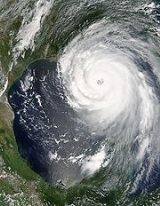
Hurricane Katrina was the costliest and one of the deadliest
hurricanes in the history of the
United States. It was the sixth-strongest
Atlantic hurricane ever recorded and the third-strongest landfalling U.S. hurricane ever recorded. Katrina formed in late August during the
2005 Atlantic hurricane season and devastated much of the north-central
Gulf Coast of the United States. Most notable in media coverage were
the catastrophic effects on the city of
New Orleans, Louisiana, and in coastal
Mississippi. Katrina's sheer size devastated the
Gulf Coast over 100 miles away from its center.
Katrina was the eleventh named storm, fifth hurricane, third
major hurricane, and second Category 5 hurricane of the 2005 Atlantic season. It formed over the
Bahamas on August 23, 2005, and crossed southern
Florida as a moderate Category 1 hurricane, causing some deaths and flooding there, before strengthening rapidly in the
Gulf of Mexico and becoming one of the strongest hurricanes on record. The storm weakened considerably before making its second and third landfalls as a Category 3 storm on the morning of August 29 in southeast Louisiana and at the Louisiana/Mississippi state line, respectively.
The storm surge caused severe or catastrophic damage along the Gulf coast, devastating the cities of
Mobile, Alabama,
Waveland and
Biloxi/
Gulfport in Mississippi, and
Slidell and other towns in Louisiana.
Levees separating
Lake Pontchartrain from New Orleans were breached by the surge, ultimately flooding 80% of the city and many areas of neighboring
parishes for weeks. Severe wind damage was reported well inland.
Katrina is estimated to be responsible for $81.2 billion in damages, making it the costliest natural disaster in
U.S. history. The storm killed at least 1,836 people, making it the deadliest U.S. hurricane since the
1928 Okeechobee Hurricane. Criticism of the federal, state and local governments' reaction to the storm was widespread and resulted in an investigation by the
United States Congress and the resignation of
FEMA head
Michael Brown.
Storm history
Hurricane Katrina formed as Tropical Depression Twelve over the southeastern Bahamas on August 23, 2005 as the result of an interaction of a tropical wave and the remains of
Tropical Depression Ten. The system was upgraded to
tropical storm status on the morning of August 24 and at this point, the storm was given the name
Katrina. The tropical storm continued to move towards Florida, and became a hurricane only two hours before it made landfall between
Hallandale Beach and
Aventura, Florida on the morning of August 25. The storm weakened over land, but it regained hurricane status about one hour after entering the
Gulf of Mexico.
The storm
rapidly intensified after entering the Gulf, partly because of the storm's movement over the warm
waters of the
Loop Current. On August 27, the storm reached Category 3 intensity on the Saffir-Simpson Hurricane Scale, becoming the third
major hurricane of the season. An
eyewall replacement cycle disrupted the intensification, but caused the storm to nearly double in size. Katrina again rapidly intensified, attaining Category 5 status on the morning of August 28 and reached its peak strength at 1:00 p.m. CDT that day, with maximum sustained winds of 175 mph and a minimum central
pressure of 902 mbar. The pressure measurement made Katrina the fourth most intense
Atlantic hurricane on record at the time, only to be surpassed by Hurricanes
Rita and
Wilma later in the season; it was also the strongest hurricane ever recorded in the Gulf of Mexico at the time as well . The NHC maintained the coastal warnings until late on August 29, by which time Hurricane Katrina was over central Mississippi. This scenario was considered a potential catastrophe because 80% of the city of New Orleans and 20% of the New Orleans metropolitan area is below sea level along
Lake Pontchartrain. Since the storm surge produced by the hurricane's right-front quadrant was forecast to be 28 feet , emergency management officials in New Orleans feared that the storm surge could go over the tops of levees protecting the city, causing major flooding. This risk of devastation was well known; previous studies by
FEMA and the
Army Corps of Engineers had warned that a direct hurricane strike on New Orleans could lead to massive flooding, which would lead to thousands of drowning deaths, as well as many more suffering from disease and dehydration as the flood waters slowly receded from the city.
At a news conference at 10:00 a.m. on August 28, shortly after Katrina was upgraded to a Category 5 storm, New Orleans mayor
Ray Nagin ordered the first ever mandatory evacuation of the city, calling Katrina "a storm that most of us have long feared". The city government also established several "refuges of last resort" for citizens who could not leave the city, including the massive
Louisiana Superdome, which sheltered approximately 26,000 people and provided them with food and water for several days as the storm came ashore.
Impact
On August 29, Katrina's
storm surge caused several breaches in
levees around
New Orleans. Most of the city was subsequently
flooded, as the breached drainage and navigation canals allowed water to flow from the lake into low areas of the city and
Saint Bernard Parish. Storm surge also devastated the coasts of
Mississippi and
Alabama, making Katrina the most destructive and costliest natural disaster in the history of the
United States, and the deadliest hurricane since the
1928 Okeechobee Hurricane. The total damage from Katrina is estimated at $81.2 billion , nearly double the cost of the previously most expensive storm,
Hurricane Andrew, when adjusted for inflation. However, 705 people remain categorized as missing in Louisiana, so this number is not final even a year after the storm. Many of the deaths are indirect, but it is almost impossible to determine the exact cause of some of the fatalities.
Federal disaster declarations covered 90,000 square miles of the United States, an area almost as large as the
United Kingdom. The hurricane left an estimated three million people without electricity. On September 3, 2005, Homeland Security Secretary
Michael Chertoff described the aftermath of Hurricane Katrina as "probably the worst catastrophe, or set of catastrophes," in the country's history, referring to the hurricane itself plus the flooding of New Orleans.
South Florida and Cuba
Hurricane Katrina first made landfall on August 25 in
South Florida where it hit as a Category 1 hurricane, with 80 mph winds. Rainfall was heavy in places and exceeded 14 inches in
Homestead, Florida, Some survivors and evacuees reported seeing dead bodies lying in city streets and floating in still-flooded sections, especially in the east of the city. The advanced state of decomposition of many corpses, some of which were left in the water or sun for days before being collected, hindered efforts by coroners to identify many of the dead.
The first deaths reported from the city were reported shortly before midnight on August 28, as three nursing home patients died during an evacuation to
Baton Rouge, most likely from dehydration. While there were also early reports of fatalities amid mayhem at the Superdome, only six deaths were confirmed there, with four of these originating from natural causes, one from a drug overdose, and one a suicide. At the Convention Center, four bodies were recovered. One out of these four is believed to be the result of a homicide.
Mississippi
The Gulf Coast of
Mississippi suffered massive damage from the impact of Hurricane Katrina on August 29, leaving 238 people dead, 67 missing, and billions of dollars in damages. Afterward, the lower forty-seven counties in Mississippi were declared disaster areas for federal assistance.
After making a brief initial landfall in
Louisiana, Katrina made its final landfall near the state line and the eyewall passed over the cities of
Bay St. Louis and
Waveland as a Category 3 hurricane with sustained winds of 120 mph . Katrina's powerful right-front quadrant passed over the west and central Mississippi coast causing a powerful 27 foot
storm surge, which penetrated 6 miles inland in many areas and up to 12 miles inland along bays and rivers; in some areas, the surge crossed Interstate 10 for several miles.
Environmental effects
Katrina also had a profound impact on the environment. The storm surge caused substantial
beach erosion, in some cases completely devastating coastal areas. In
Dauphin Island, approximately 150 km to the east of the point where the hurricane made landfall, the sand that comprised the
barrier island was transported across the island into the
Mississippi Sound, pushing the island towards land. The storm surge and waves from Katrina also obliterated the
Chandeleur Islands, which had been affected by
Hurricane Ivan the previous year.
The lands that were lost were also breeding grounds for marine mammals, brown
pelicans,
turtles, and
fish, as well as migratory species such as
redhead ducks.
In Texas, where more than 300,000 evacuees are located, local officials have run 20,000 criminal background checks on the evacuees, as well as on the relief workers helping them and people who have opened up their homes. Most of the checks have found little for police to be concerned about. The number of homicides in
Houston from September 2005 through February 22 2006 went up by 23% relative to the same period a year before; 29 of the 170 murders involved displaced Louisianans as a victim, a suspect, or both.
Government response
Within the
United States and as delineated in the National Response Plan, disaster response and planning is first and foremost a local government responsibility. When local government exhausts its resources, it then requests specific additional resources from the county level. The request process proceeds similarly from the county to the state to the federal government as additional resource needs are identified. Many of the the problems that arose developed from inadequate planning and back-up communications systems at various levels.
Some disaster recovery response to Katrina began before the storm, with
Federal Emergency Management Agency preparations that ranged from logistical supply deployments to a mortuary team with refrigerated trucks. A network of volunteers began rendering assistance to local residents and residents emerging from New Orleans and surrounding Parishes as soon as the storm made landfall, and has continued for more than six months after the storm.
Of the 60,000 people stranded in New Orleans, the Coast Guard rescued over 33,500 . Congress recognized the Coast Guard's response with an official entry in the Congressional Record, and the
Armed Service was awarded the Presidential Unit Citation.
The
United States Northern Command established Joint Task Force Katrina based out of
Camp Shelby,
Mississippi, to act as the military's on-scene command on Sunday, August 28. Approximately 58,000
National Guard personnel were activated to deal with the storm's aftermath, with troops coming from all 50 states. The
Department of Defense also activated volunteer members of the
Civil Air Patrol.
Michael Chertoff,
Secretary of the
Department of Homeland Security, decided to take over the federal, state, and local operations officially on August 30, 2005, citing the National Response Plan. Early in September, Congress authorized a total of $62.3 billion in aid for victims. Additionally, President Bush enlisted the help of former presidents
Bill Clinton and
George H.W. Bush to raise additional voluntary contributions, much as they did after the
2004 Indian Ocean earthquake and
tsunami.
FEMA provided housing assistance to over 700,000 applicants - families and individuals. However, only one-fifth of the trailers requested in Orleans Parish have been supplied resulting in an enormous housing shortage in the city of New Orleans. To provide for additional housing, FEMA has also paid for the hotel costs of 12,000 individuals and families displaced by Katrina through February 7, 2006, when a final deadline was set for the end of hotel cost coverage. After this deadline, evacuees were still eligible to receive federal assistance, which could be used towards either apartment rent, additional hotel stays, or fixing their ruined homes, although FEMA no longer paid for hotels directly. As of early July 2006, there are still about 100,000 people living in 37,745 FEMA-provided trailers.
Law enforcement and public safety agencies, from across the
United States, provided a "mutual aid" response to
Louisiana and
New Orleans in the weeks following the disaster. Many agencies responded with manpower and equipment from as far away as
California,
Michigan,
Nevada,
New York, and
Texas. This response was welcomed by local
Louisiana authorities as their staff were either becoming fatigued, stretched too thin, or even quitting from the job.
Two weeks after the storm, over half of the states were involved in providing shelter for evacuees. By four weeks after the storm, evacuees had been registered in all 50 states and in 18,700 zip codes - half of the nation's residential postal zones. Most evacuees had stayed within 250 miles, but 240,000 households went to Houston and other cities over 250 miles away and another 60,000 households went over 750 miles away.
International response
Over seventy countries pledged monetary donations or other assistance.
Kuwait made the largest single pledge, $500 million; other large donations were made by
Qatar ,
South Korea ,
India,
China ,
Pakistan , and
Bangladesh .
Countries like
Sri Lanka, which was still recovering from the
Indian Ocean Tsunami,
Cuba and
Venezuela , also offered to help. Countries including
Canada,
Mexico,
Singapore, and
Germany sent supplies, relief personnel, troops, ships and water pumps to aid in the disaster recovery. Britain's donation of 350,000 emergency meals did not reach victims because of laws regarding mad cow disease.
Russia's
initial offer of two jets was declined by the U.S. State Department but accepted later. The
French offer was also declined and requested later.
Despite receiving aid from around the world, there was also a heavy dose of criticism from around the world describing the racism that was revealed at the international level across global press. Quotations from the UK Mirror such as "Many things about the United States are wonderful, but it has a vile underbelly which is usually kept well out of sight. Now in New Orleans it has been exposed to the world." were common.
Non-government organization response
The
American Red Cross,
Salvation Army,
Oxfam,
Common Ground Collective,
Emergency Communities, and many other charitable organizations provided housing, food, and water to the victims of the storm. These organizations also provided an infrastructure for shelters throughout Louisiana and other states that held thousands of evacuees. They were not, however, allowed into New Orleans proper by the National Guard for several days after the storm because of safety concerns. These organizations raised $4.25 billion in donations by the public, with the Red Cross receiving over half of the donations.
Volunteers from
amateur radio's emergency service wing, the
Amateur Radio Emergency Service, provided emergency communications for federal, state and local officials. Over 1,000 volunteer operators traveled to affected areas to provide communications in areas where the communications infrastructure had been damaged or totally destroyed, relaying everything from 911 traffic to messages home. In
Hancock County, Mississippi, ham radio operators provided the only communications into or out of the area, and even served as 911 dispatchers.
Many corporations also contributed to relief efforts. On September 13, it was reported that corporate donations to the relief effort were $409 million, and were expected to exceed $1 billion.
During and after the Hurricanes Katrina, Wilma and Rita, the
American Red Cross had opened 1,470 different shelters across and registered 3.8 million overnight stays. A total of 244,000 Red Cross workers were utilized to provide sheltering, casework, communication and assessment services throughout these three hurricanes. In addition, 346,980 comfort kits and 205,360 clean up kits were distributed. For mass care, the organization served 68 million snacks and meals to victims of the disasters and to rescue workers. The Red Cross also had their Disaster Health services meet 596,810 contacts, and Disaster Mental Health services met 826,590 contacts. Red Cross emergency financial assistance was provided to 1.4 million families, which encompassed a total of 4 million people. Hurricane Katrina was the first natural disaster in the United States that the American Red Cross utilized their "Safe and Well" family location website.
In the year since Hurricane Katrina struck the Gulf Coast, The
Salvation Army has allocated donations of more than $365 million to serve more than 1.7 million people in nearly every state. The Army’s immediate response to Hurricane Katrina included the mobilization of more than 178 canteen feeding units and 11 field kitchens which together have served more than 5.7 million hot meals, 8.3 million sandwiches, snacks & drinks. Its SATERN network of amateur ham-radio operators picked up where modern communications left off to help locate more than 25,000 survivors. And, Salvation Army pastoral care counselors were on hand to comfort the emotional and spiritual needs of 277,000 individuals. As part of the overall effort, Salvation Army officers, employees and volunteers have contributed more than 900,000 hours of service.
Analysis of New Orleans levee failures
New Orleans' levee failures were found to be primarily the result of system design flaws, combined with the lack of adequate maintenance. Those responsible for the conception, design, construction, and maintenance of the region's flood-control system apparently failed to pay sufficient attention to public safety, according to an investigation by the
National Science Foundation.
According to new modeling and field observations by a team from
Louisiana State University, the
Mississippi River Gulf Outlet , a 200-meter wide canal designed to provide a shortcut from New Orleans to the Gulf of Mexico, helped provide a funnel for the storm surge, making it 20% higher and 100%-200% faster as it crashed into the city. St. Bernard Parish, one of the more devastated areas, lies just south of the MRGO. The
Army Corps of Engineers disputes this causality and maintains Katrina would have overwhelmed the levees with or without the contributing effect of the MRGO.
On April 5, 2006, months after independent investigators had demonstrated that levee failures were not caused by natural forces beyond intended design strength, Lieutenant General Carl Strock testified before the United States Senate Subcommittee on Energy and Water that "We have now concluded we had problems with the design of the structure." He also testified that the U.S. Army Corps of Engineers did not know of this mechanism of failure prior to August 29, 2005. The claim of ignorance is refuted, however, by the National Science Foundation investigators hired by the Army Corps of Engineers, who point to a 1986 study by the Corps itself that such separations were possible in the I-wall design.
Criticism of government response
The criticisms of the government's response to Hurricane Katrina primarily consisted of condemnations of mismanagement and lack of leadership in the relief efforts in response to the storm and its aftermath. More specifically, the criticism focused on the delayed response to the flooding of
New Orleans, and the subsequent state of chaos in the Crescent City. The neologism
Katrinagate was coined to refer to this controversy, and was even a runner-up for "2005 word of the year."
Within days of Katrina's August 29, 2005 landfall, public debate arose about the local, state and federal governments' role in the preparations for and response to the hurricane. Criticism was prompted largely by televised images of visibly shaken and frustrated political leaders and of residents who remained in New Orleans without
water,
food or shelter. The deaths of citizens by
thirst, exhaustion, and violence days after the storm itself had passed also fueled the criticism, as did the treatment of people who had been evacuated to facilities such as the
Superdome. Others alleged that
race,
class, and other factors could have contributed to delays in government response. The percentage of black victims among storm-related deaths was below their proportion in the area's population ; nonetheless, criticisms focused mostly on the response
after the initial flooding .
The government was accused of making things worse, instead of making things better—perhaps even deliberately—by preventing help by others while delaying its own response. In accordance with federal law, President
George W. Bush directed the
Secretary of the Department of Homeland Security,
Michael Chertoff, to coordinate the Federal response. Chertoff designated
Michael D. Brown, head of the
Federal Emergency Management Agency, as the Principal Federal Official to lead the deployment and coordination of all federal response resources and forces in the Gulf Coast region. However, the President and Secretary Chertoff initially came under harsh criticism for what some perceived as a lack of planning and coordination. Eight days later, Brown was recalled to Washington and Coast Guard Vice Admiral
Thad W. Allen replaced him as chief of hurricane relief operations. Three days after the recall, Michael D. Brown resigned as director of FEMA in spite of having received praise from Bush with the now-well-known phrase,
"Brownie, you're doing a heck of a job."Subsequently, criticism from politicians, activists, pundits and journalists of all stripes has been directed at the local and state and governments headed by Mayor
Ray Nagin of New Orleans and Louisiana Governor
Kathleen Blanco. Nagin and Blanco were criticized for failing to implement New Orleans' evacuation plan and for ordering residents to a shelter of last resort without any provisions for food, water, security, or sanitary conditions. Perhaps the most important criticism of Nagin is that he delayed his emergency evacuation order until 19 hours before landfall, which led to hundreds of deaths of people who could not find any way out of the city..
Retirement
Because of the large loss of life and property along the
Gulf Coast, the name Katrina was officially retired on April 6, 2006 by the
World Meteorological Organization at the request of the U.S. government. It was replaced by Katia on List III of the Atlantic hurricane naming lists, which will next be used in the 2011 Atlantic hurricane season.
See also
References
External links
Disaster recovery
-
-
-
-
-
-
- - An article in the City Journal
- , JURIST
Survivor and eyewitness accounts