


2003 Atlantic hurricane season

Encyclopedia
The 2003 Atlantic hurricane season was an active Atlantic hurricane season
with tropical activity
before and after the official bounds of the season – the first such occurrence in 50 years. The season produced 21 tropical cyclone
s, of which 16 developed into named storms; seven cyclones attained hurricane status, of which three reached major hurricane status
. With sixteen storms, the season was tied for the sixth most active Atlantic hurricane season on record. The strongest hurricane of the season was Hurricane Isabel
, which reached Category 5 status on the Saffir-Simpson Hurricane Scale
northeast of the Lesser Antilles
; Isabel later struck North Carolina
as a Category 2 hurricane, causing $3.6 billion in damage (2003 USD, $ USD) and a total of 51 deaths across the Mid-Atlantic region of the United States.
The season began with Subtropical Storm Ana
on April 20, prior to the official start of the season; the bounds of the season are from June 1 to November 30, which conventionally delimit the period of each year when most tropical cyclones form in the Atlantic basin. In early September, Hurricane Fabian
struck Bermuda
as a Category 3
hurricane, where it was the worst hurricane since 1926
; on the island it caused four deaths and $300 million in damage (2003 USD, $ USD). Hurricane Juan
caused considerable destruction to Nova Scotia
, particularly Halifax
, as a Category 2 hurricane, the first hurricane of significant strength to hit the province since 1893
. Additionally, Hurricanes Claudette
and Erika
struck Texas
and Mexico, respectively, as minimal hurricanes.
forecasters issued a 55% probability of above normal activity. The forecasters predicted 11–15 tropical storms, 6–9 of those becoming hurricanes, and 2–4 of those hurricanes reaching at least Category 3 strength on the Saffir-Simpson Hurricane Scale
. The above normal activity predicted was due to the likelihood of La Niña
developing in the season.
Noted hurricane expert Dr. William M. Gray
on April 4 predicted twelve named storms, with eight reaching hurricane strength and three of the eight reaching Category 3 strength. The prediction issued on May 30 was similar, increasing the named storms to fourteen. The synoptic pattern of the season prior to June 1 resembled other previous seasons, with the 1952
, 1954
, 1964
, 1966
, and 1998
seasons considered the best analogs for the season. The prediction also included a 68% probability for a hurricane landfall along the United States.
A normal season, as defined by NOAA, has 6–14 tropical storms, 4–8 of which reach hurricane strength, and 1–3 of those reaching Category 3 strength.
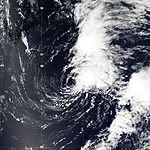 The official beginning of the season was on June 1, 2003, though Subtropical Storm Ana
formed on April 20, well before the start to the season. When Ana transitioned into a tropical cyclone the next day, it became the first Atlantic tropical storm on record in the month of April. The storm caused two deaths in Florida
from increased waves and rip currents.
Starting at the official start of the season, the National Hurricane Center
began issuing five-day forecasts, extending from the three-day forecasts issued since 1964. Officials conducted tests during the previous two seasons, indicating the new five-day forecasts would be as accurate as the three-day forecasts were 15 years earlier. The tropics were active and well ahead of climatology in the early portion of the season, with the seventh tropical depression forming by the end of July.
Within the first week of the official start of the season, a tropical wave
moved off the coast of Africa, and on June 11 developed into Tropical Depression Two; unfavorable conditions prevailed, and it dissipated within 24 hours of developing.
By the end of June, the third tropical depression of the season developed near the Yucatán Peninsula
; it tracked northward, strengthening into Tropical Storm Bill
before striking the southern Louisiana
coast on June 30. The storm caused moderate rainfall and a tornado outbreak across the southern United States, resulting in four deaths and $30 million in damage (2003 USD, $ USD).
 On July 8, a well organized tropical wave in the Caribbean Sea
organized into Tropical Storm Claudette
. Its intensity fluctuated while crossing the basin, attaining hurricane status before weakening and striking the Yucatán Peninsula as a tropical storm. Claudette re-intensified to hurricane status and struck southeastern Texas
on July 15, causing a total of three deaths, one of which directly, and $180 million in damage (2003 USD, $ USD).
Hurricane Danny
formed on July 16 from a tropical wave well to the east of Bermuda
. It strengthened while tracking around an anticyclone
, and attained hurricane status further north than any other Atlantic tropical cyclone in July. It turned to the east and dissipated without affecting land.
Tropical Depression Six developed on July 19 in the tropical Atlantic Ocean, and was initially forecast to attain hurricane status. However, it tracked quickly westward, and degenerated into an open tropical wave on July 21 near the Lesser Antilles
.
The tropical wave that spawned the previous tropical depression developed an area of convection further to the north, which organized into Tropical Depression Seven
on July 25 off the coast of Florida. It failed to develop, and made landfall on Georgia
as a tropical depression before dissipating on July 27.
 After a short respite in activity, a westward-moving tropical disturbance organized near Florida and developed into Tropical Storm Erika
in the Gulf of Mexico on August 14. It continued quickly across the body of water, and made landfall in the Mexican state of Tamaulipas
as a hurricane on August 17. The hurricane caused two deaths from floodwater drowning in Mexico, as well as minor damage in southern Texas.
Tropical Depression Nine
formed on August 21 in the eastern Caribbean Sea from a tropical wave. Despite predictions of it intensifying to a strong tropical storm, it failed to strengthen due to strong wind shear
, and on August 22 the depression dissipated.
Hurricane Fabian
developed from a tropical wave on August 27 in the tropical Atlantic Ocean. Tracking west-northwestward around the subtropical ridge
, it encountered favorable conditions, and steadily intensified to reach peak winds of 145 mph (230 km/h) on September 1. Fabian turned to the north and gradually weakened, passing just west of Bermuda on September 5 as a major hurricane
. On September 8, it became an extratropical cyclone
after causing four deaths and $300 million (2003 USD, $ USD) in damage on Bermuda; there, it was considered the worst hurricane in nearly 80 years. Elsewhere, rough waves from the hurricane killed a surfer in North Carolina
and three fishermen off Newfoundland
.
A tropical disturbance organized into Tropical Storm Grace
in the Gulf of Mexico on August 30; with a nearby upper-level low causing unfavorable wind shear, the storm failed to organize significantly, and it moved ashore along Texas. The storm dropped moderate rainfall across much of the southern United States.
formed in the Gulf of Mexico on September 3, and it crossed central Florida without causing significant damage or flooding. On September 8 it degenerated into a remnant low pressure area, which dropped heavy rainfall in the Mid-Atlantic States
. Flooding from the storm's remnants caused about $19.6 million in damage (2003 USD, $ USD), which was compounded by the effects of Hurricane Isabel a week later.
A tropical wave spawned Hurricane Isabel
on September 6 in the tropical Atlantic Ocean. Encountering favorable conditions, it gradually intensified while tracking generally west-northwestward, and on September 11 Isabel attained peak winds of 165 mph (270 km/h), the strongest storm of the season. After fluctuating in intensity for the subsequent four days, it weakened and struck North Carolina
as a on the Saffir-Simpson hurricane scale. Across the East Coast of the United States
, Isabel caused a total of 51 fatalities and $3.6 billion in damage (2003 USD, $ USD).
Brief Tropical Depression Fourteen formed on September 8 just off the coast of Africa. An upper-level low hindered its development and changed its motion to the north-northwest, and on September 10 the depression dissipated after passing near the Cape Verde
islands.
On September 24 a tropical depression developed southeast of Bermuda, and while tracking northward it quickly intensified to become Hurricane Juan
. Juan maintained its strength as it accelerated northward, and on September 29 it struck Halifax, Nova Scotia
with winds of 100 mph (160 km/h). The hurricane caused a total of 8 fatalities, as well as $150 million in damage (2003 USD, $ USD). It was considered one of the worst hurricanes on modern record in Halifax.
A tropical wave spawned a tropical depression on September 25, which tracked northwestward before turning to the northeast and becoming Hurricane Kate
. The hurricane then turned sharply westward, reaching major hurricane
status before turning northward and becoming extratropical on October 7. It did not have a significant effect on land.
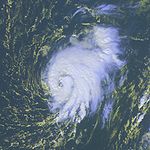 An extratropical storm
formed in the Bay of Campeche on September 30, and remaining nearly stationary it transitioned into Tropical Storm Larry
by October 1. The storm drifted southward, reaching peak winds of 65 mph (100 mph) before moving ashore along the Mexican state of Tabasco
. Larry caused five deaths in Mexico, as well as heavy rainfall and mudslides.
On October 10, a tropical disturbance organized into Tropical Storm Mindy just off the northeast coast of the Dominican Republic
. After moving northwestward, it turned sharply eastward and dissipated on October 14, after earlier dropping light to moderate rainfall across the Greater Antilles
.
Tropical Storm Nicholas
developed from a tropical wave on October 13 in the tropical Atlantic Ocean. The storm strengthened to near-hurricane intensity before weakening while turning northward and later to the northwest. On October 24, Nicholas transitioned into an extratropical low, which, after executing an anticyclonic loop, meandered erratically before being absorbed by a non-tropical low to the southwest of Bermuda on November 1.
Early in November, the system that absorbed Nicholas tracked westward across the Atlantic Ocean, nearly developing into a subtropical cyclone
before crossing Florida and dissipating on November 5. The season officially ended on November 30, 2003, although Tropical Storm Odette
formed on December 4 to the northwest of Colombia from a tropical disturbance; it became the second December tropical storm on record to form in the Caribbean Sea, after a hurricane in 1822
.
The final storm of the season, Tropical Storm Peter, formed on December 7 in the eastern Atlantic Ocean. It strengthened to near hurricane status, but rapidly weakened due to increased wind shear and dissipated on December 11.
 No cyclones in the season had a significant impact on South America or Central America. However, a total of eight tropical cyclones made landfall
on Mexico from either the Atlantic or the Pacific Ocean, which was the greatest total since the record of nine in 1971. A total of seven deaths occurred in Mexico from Atlantic hurricanes. Much of the Caribbean
did not receive significant impact from tropical cyclones during the season. However, Tropical Storm Odette
caused eight direct deaths, as well as two indirect deaths, when it crossed the Dominican Republic
in December. The storm damaged or destroyed over 1,000 homes, and heavy damage was reported to the banana crop.
Six tropical cyclones made landfall along the coast of the United States during the season, including two hurricanes. The first, Claudette
, caused locally heavy damage in southeastern Texas in July; two deaths were reported in the state, while earlier in its duration it caused an indirect death from rough waves in Florida. In September, Hurricane Isabel
caused deaths and damage from North Carolina through southern Canada. The worst damage from the hurricane occurred in Virginia, where it was the costliest disaster in the history of the state; there, damage totaled $1.85 billion (2003 USD, $ USD), and there were 32 fatalities, ten of which were caused directly by the hurricane. Hurricane Isabel caused deaths in seven states and one Canadian province, and about 6 million people were left without power as a result of the storm.
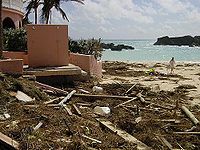 Several cyclones impacted Bermuda
during the season, most significantly Hurricane Fabian
. On the island, its passage proved to be the costliest and resulted in the first death since a hurricane in 1926
. The hurricane killed four on the island when its strong waves and storm surge washed two cars off the causeway
between St. George's Parish
and St. David's Island
. Damage from the hurricane totaled $300 million (2003 USD, $ USD). Elsewhere, Hurricane Juan
was considered among the most damaging in the history of Halifax, Nova Scotia
, where strong winds downed thousands of trees and left low-lying areas flooded from a record storm surge to the city. The hurricane caused a total of eight deaths and damage estimated at $200 million (2003 CAD
, $150 million 2003 USD, $ USD).
The season is one of only four with a storm before and after the official bounds of the season; the others are 1887
, 1953
, and 2007
. When Tropical Storm Peter formed on December 7, the season became the second on record with two December storms. The 235 days between the development of the first storm, Tropical Storm Ana
, and the dissipation of the last storm, Peter, made the 2003 season the longest season since 1952
. The season was the sixth most active on record, behind the 2005
, 1933
, 2010
, 1995
, 1887
, and 1969
seasons, and tied with the 1936
and 2008
seasons.
. This is the same list used for the 1997 season
. Storms were named Larry, Mindy, Nicholas, Odette, and Peter for the first time in 2003. Names that were not assigned are marked in . Ana became the first name in the six list rotation to be used five times. Both Ana and Claudette were used in 1979, 1985, 1991, 1997, 2003 and 2009.
retired three names in the spring of 2004: Fabian, Isabel, and Juan. They were replaced in the 2009 season
by Fred, Ida, and Joaquin respectively.
Atlantic hurricane season
The Atlantic hurricane season is the period in a year when hurricanes usually form in the Atlantic Ocean. Tropical cyclones in the North Atlantic are called hurricanes, tropical storms, or tropical depressions. In addition, there have been several storms over the years that have not been fully...
with tropical activity
Tropical cyclone
A tropical cyclone is a storm system characterized by a large low-pressure center and numerous thunderstorms that produce strong winds and heavy rain. Tropical cyclones strengthen when water evaporated from the ocean is released as the saturated air rises, resulting in condensation of water vapor...
before and after the official bounds of the season – the first such occurrence in 50 years. The season produced 21 tropical cyclone
Tropical cyclone
A tropical cyclone is a storm system characterized by a large low-pressure center and numerous thunderstorms that produce strong winds and heavy rain. Tropical cyclones strengthen when water evaporated from the ocean is released as the saturated air rises, resulting in condensation of water vapor...
s, of which 16 developed into named storms; seven cyclones attained hurricane status, of which three reached major hurricane status
Tropical cyclone scales
Tropical systems are officially ranked on one of several tropical cyclone scales according to their maximum sustained winds and in what oceanic basin they are located...
. With sixteen storms, the season was tied for the sixth most active Atlantic hurricane season on record. The strongest hurricane of the season was Hurricane Isabel
Hurricane Isabel
Hurricane Isabel was the costliest and deadliest hurricane in the 2003 Atlantic hurricane season. The ninth named storm, fifth hurricane, and second major hurricane of the season, Isabel formed near the Cape Verde Islands from a tropical wave on September 6 in the tropical Atlantic Ocean...
, which reached Category 5 status on the Saffir-Simpson Hurricane Scale
Saffir-Simpson Hurricane Scale
The Saffir–Simpson Hurricane Scale , or the Saffir–Simpson Hurricane Wind Scale , classifies hurricanes — Western Hemisphere tropical cyclones that exceed the intensities of tropical depressions and tropical storms — into five categories distinguished by the intensities of their sustained winds...
northeast of the Lesser Antilles
Lesser Antilles
The Lesser Antilles are a long, partly volcanic island arc in the Western Hemisphere. Most of its islands form the eastern boundary of the Caribbean Sea with the Atlantic Ocean, with the remainder located in the southern Caribbean just north of South America...
; Isabel later struck North Carolina
North Carolina
North Carolina is a state located in the southeastern United States. The state borders South Carolina and Georgia to the south, Tennessee to the west and Virginia to the north. North Carolina contains 100 counties. Its capital is Raleigh, and its largest city is Charlotte...
as a Category 2 hurricane, causing $3.6 billion in damage (2003 USD, $ USD) and a total of 51 deaths across the Mid-Atlantic region of the United States.
The season began with Subtropical Storm Ana
Tropical Storm Ana (2003)
Tropical Storm Ana was the only tropical cyclone on record in the Atlantic basin to form during the month of April. The first tropical cyclone of the season, it developed as a subtropical cyclone from a non-tropical low on April 20 to the west of Bermuda...
on April 20, prior to the official start of the season; the bounds of the season are from June 1 to November 30, which conventionally delimit the period of each year when most tropical cyclones form in the Atlantic basin. In early September, Hurricane Fabian
Hurricane Fabian
Hurricane Fabian was a powerful Cape Verde-type hurricane that hit Bermuda in early September during the 2003 Atlantic hurricane season. Fabian, the sixth named storm, fourth hurricane, and first major hurricane of the season, developed from a tropical wave in the tropical Atlantic Ocean on August 25...
struck Bermuda
Bermuda
Bermuda is a British overseas territory in the North Atlantic Ocean. Located off the east coast of the United States, its nearest landmass is Cape Hatteras, North Carolina, about to the west-northwest. It is about south of Halifax, Nova Scotia, Canada, and northeast of Miami, Florida...
as a Category 3
Saffir-Simpson Hurricane Scale
The Saffir–Simpson Hurricane Scale , or the Saffir–Simpson Hurricane Wind Scale , classifies hurricanes — Western Hemisphere tropical cyclones that exceed the intensities of tropical depressions and tropical storms — into five categories distinguished by the intensities of their sustained winds...
hurricane, where it was the worst hurricane since 1926
1926 Atlantic hurricane season
A Cape Verde-type hurricane reached Category 4 strength over the open Atlantic Ocean on September. It turned to the northeast, looped, and became extratropical on September 21...
; on the island it caused four deaths and $300 million in damage (2003 USD, $ USD). Hurricane Juan
Hurricane Juan
Hurricane Juan was a significant hurricane that struck the southern part of Atlantic Canada in late September 2003. It was the tenth named storm and the sixth hurricane of the 2003 Atlantic hurricane season. Juan formed southeast of Bermuda on September 24, 2003 out of a tropical wave that tracked...
caused considerable destruction to Nova Scotia
Nova Scotia
Nova Scotia is one of Canada's three Maritime provinces and is the most populous province in Atlantic Canada. The name of the province is Latin for "New Scotland," but "Nova Scotia" is the recognized, English-language name of the province. The provincial capital is Halifax. Nova Scotia is the...
, particularly Halifax
Halifax Regional Municipality, Nova Scotia
Halifax Regional Municipality is the capital of the province of Nova Scotia, Canada. The Regional Municipality had a 2006 census population of 372,679, while the metropolitan area had a 2010 estimated population of 403,188, and the urban area of Halifax had a population of 282,924...
, as a Category 2 hurricane, the first hurricane of significant strength to hit the province since 1893
1893 Atlantic hurricane season
The 1893 Atlantic hurricane season ran through the summer and the first half of fall in 1893. The 1893 season was fairly active, with 12 tropical storms forming, 10 of which became hurricanes. Of those, 5 became major hurricanes...
. Additionally, Hurricanes Claudette
Hurricane Claudette (2003)
Hurricane Claudette was the third tropical storm and first hurricane of the 2003 Atlantic hurricane season. A fairly long-lived July Atlantic hurricane, Claudette began as a tropical wave in the eastern Caribbean. It moved quickly westward, brushing past the Yucatán Peninsula before moving...
and Erika
Hurricane Erika (2003)
Hurricane Erika was a weak hurricane that struck extreme northeastern Mexico near the Texas-Tamaulipas border in mid-August of the 2003 Atlantic hurricane season. Erika was the eighth tropical cyclone, fifth tropical storm, and third hurricane of the season...
struck Texas
Texas
Texas is the second largest U.S. state by both area and population, and the largest state by area in the contiguous United States.The name, based on the Caddo word "Tejas" meaning "friends" or "allies", was applied by the Spanish to the Caddo themselves and to the region of their settlement in...
and Mexico, respectively, as minimal hurricanes.
Seasonal forecasts
| Source | Date | b>Tropical storms |
b>Hurricanes | b>Major hurricanes |
| CSU Colorado State University Colorado State University is a public research university located in Fort Collins, Colorado. The university is the state's land grant university, and the flagship university of the Colorado State University System.The enrollment is approximately 29,932 students, including resident and... |
i>Average (1950–2000) | 9.6 | 5.9 | 2.3 |
| NOAA National Oceanic and Atmospheric Administration The National Oceanic and Atmospheric Administration , pronounced , like "noah", is a scientific agency within the United States Department of Commerce focused on the conditions of the oceans and the atmosphere... |
Average | 11 | 6 | 2 |
| NOAA | May 19, 2003 | 11–15 | 6–9 | 2–4 |
| CSU | April 4, 2003 | 12 | 8 | 3 |
| CSU | May 30, 2003 | 14 | 8 | 3 |
| CSU | August 6, 2003 | 14 | 8 | 3 |
| Actual activity | 16 | 7 | 3 | |
Pre-season outlook
On May 19, prior to the start of the season, NOAANational Oceanic and Atmospheric Administration
The National Oceanic and Atmospheric Administration , pronounced , like "noah", is a scientific agency within the United States Department of Commerce focused on the conditions of the oceans and the atmosphere...
forecasters issued a 55% probability of above normal activity. The forecasters predicted 11–15 tropical storms, 6–9 of those becoming hurricanes, and 2–4 of those hurricanes reaching at least Category 3 strength on the Saffir-Simpson Hurricane Scale
Saffir-Simpson Hurricane Scale
The Saffir–Simpson Hurricane Scale , or the Saffir–Simpson Hurricane Wind Scale , classifies hurricanes — Western Hemisphere tropical cyclones that exceed the intensities of tropical depressions and tropical storms — into five categories distinguished by the intensities of their sustained winds...
. The above normal activity predicted was due to the likelihood of La Niña
La Niña
La Niña is a coupled ocean-atmosphere phenomenon that is the counterpart of El Niño as part of the broader El Niño-Southern Oscillation climate pattern. During a period of La Niña, the sea surface temperature across the equatorial Eastern Central Pacific Ocean will be lower than normal by 3–5 °C...
developing in the season.
Noted hurricane expert Dr. William M. Gray
William M. Gray
William M. "Bill" Gray is Emeritus Professor of Atmospheric Science at Colorado State University , and head of the Tropical Meteorology Project at CSU's Department of Atmospheric Sciences. He is a pioneer in the science of forecasting hurricanes and one of the world's leading experts on tropical...
on April 4 predicted twelve named storms, with eight reaching hurricane strength and three of the eight reaching Category 3 strength. The prediction issued on May 30 was similar, increasing the named storms to fourteen. The synoptic pattern of the season prior to June 1 resembled other previous seasons, with the 1952
1952 Atlantic hurricane season
The 1952 Atlantic hurricane season was the most recent season in which all named storms attained hurricane status, although it was the least active since 1946. The season officially started on June 15; however, a pre-season unnamed storm formed on Groundhog Day, becoming the only storm on...
, 1954
1954 Atlantic hurricane season
The 1954 Atlantic hurricane season caused over $750 million in damage, the most of any season at the time. The season officially began on June 15, and nine days later the first named storm developed. Hurricane Alice developed in the Gulf of Mexico and moved inland along the Rio Grande,...
, 1964
1964 Atlantic hurricane season
The 1964 Atlantic hurricane season officially began on June 15, 1964, and lasted until November 15, 1964. These dates conventionally delimit the period of each year when most tropical cyclones form in the Atlantic basin...
, 1966
1966 Atlantic hurricane season
The 1966 Atlantic hurricane season officially began on June 1, 1966, and lasted until November 30, 1966. These dates conventionally delimit the period of each year when most tropical cyclones form in the Atlantic basin. The 1966 season was near normal with eleven tropical storms...
, and 1998
1998 Atlantic hurricane season
The 1998 Atlantic hurricane season officially began on June 1, 1998, and lasted until November 30, 1998. These dates conventionally delimit the period of each year when most tropical cyclones form in the Atlantic basin; however, the season extended through December 1 as Hurricane Nicole remained...
seasons considered the best analogs for the season. The prediction also included a 68% probability for a hurricane landfall along the United States.
Mid-season outlook
On August 6, Dr. Gray announced he had maintained his previous prediction; with an active start of the season, the rest of the season was forecast to have been only slightly above average, due to an anticipated overall less favorable environment across the Atlantic Ocean. A day later, NOAA released an updated prediction as well, with a 60% probability of above normal activity, with 12–15 named storms, 7–9 hurricanes, and 3–4 major hurricanes expected.A normal season, as defined by NOAA, has 6–14 tropical storms, 4–8 of which reach hurricane strength, and 1–3 of those reaching Category 3 strength.
Storms
April through July
Tropical Storm Ana (2003)
Tropical Storm Ana was the only tropical cyclone on record in the Atlantic basin to form during the month of April. The first tropical cyclone of the season, it developed as a subtropical cyclone from a non-tropical low on April 20 to the west of Bermuda...
formed on April 20, well before the start to the season. When Ana transitioned into a tropical cyclone the next day, it became the first Atlantic tropical storm on record in the month of April. The storm caused two deaths in Florida
Florida
Florida is a state in the southeastern United States, located on the nation's Atlantic and Gulf coasts. It is bordered to the west by the Gulf of Mexico, to the north by Alabama and Georgia and to the east by the Atlantic Ocean. With a population of 18,801,310 as measured by the 2010 census, it...
from increased waves and rip currents.
Starting at the official start of the season, the National Hurricane Center
National Hurricane Center
The National Hurricane Center , located at Florida International University in Miami, Florida, is the division of the National Weather Service responsible for tracking and predicting weather systems within the tropics between the Prime Meridian and the 140th meridian west poleward to the 30th...
began issuing five-day forecasts, extending from the three-day forecasts issued since 1964. Officials conducted tests during the previous two seasons, indicating the new five-day forecasts would be as accurate as the three-day forecasts were 15 years earlier. The tropics were active and well ahead of climatology in the early portion of the season, with the seventh tropical depression forming by the end of July.
Within the first week of the official start of the season, a tropical wave
Tropical wave
Tropical waves, easterly waves, or tropical easterly waves, also known as African easterly waves in the Atlantic region, are a type of atmospheric trough, an elongated area of relatively low air pressure, oriented north to south, which move from east to west across the tropics causing areas of...
moved off the coast of Africa, and on June 11 developed into Tropical Depression Two; unfavorable conditions prevailed, and it dissipated within 24 hours of developing.
By the end of June, the third tropical depression of the season developed near the Yucatán Peninsula
Yucatán Peninsula
The Yucatán Peninsula, in southeastern Mexico, separates the Caribbean Sea from the Gulf of Mexico, with the northern coastline on the Yucatán Channel...
; it tracked northward, strengthening into Tropical Storm Bill
Tropical Storm Bill (2003)
Tropical Storm Bill was a tropical storm that affected the Gulf Coast of the United States in the summer of 2003. The second storm of the 2003 Atlantic hurricane season, Bill developed from a tropical wave on June 29 to the north of the Yucatán Peninsula...
before striking the southern Louisiana
Louisiana
Louisiana is a state located in the southern region of the United States of America. Its capital is Baton Rouge and largest city is New Orleans. Louisiana is the only state in the U.S. with political subdivisions termed parishes, which are local governments equivalent to counties...
coast on June 30. The storm caused moderate rainfall and a tornado outbreak across the southern United States, resulting in four deaths and $30 million in damage (2003 USD, $ USD).
Caribbean Sea
The Caribbean Sea is a sea of the Atlantic Ocean located in the tropics of the Western hemisphere. It is bounded by Mexico and Central America to the west and southwest, to the north by the Greater Antilles, and to the east by the Lesser Antilles....
organized into Tropical Storm Claudette
Hurricane Claudette (2003)
Hurricane Claudette was the third tropical storm and first hurricane of the 2003 Atlantic hurricane season. A fairly long-lived July Atlantic hurricane, Claudette began as a tropical wave in the eastern Caribbean. It moved quickly westward, brushing past the Yucatán Peninsula before moving...
. Its intensity fluctuated while crossing the basin, attaining hurricane status before weakening and striking the Yucatán Peninsula as a tropical storm. Claudette re-intensified to hurricane status and struck southeastern Texas
Texas
Texas is the second largest U.S. state by both area and population, and the largest state by area in the contiguous United States.The name, based on the Caddo word "Tejas" meaning "friends" or "allies", was applied by the Spanish to the Caddo themselves and to the region of their settlement in...
on July 15, causing a total of three deaths, one of which directly, and $180 million in damage (2003 USD, $ USD).
Hurricane Danny
Hurricane Danny (2003)
Hurricane Danny was the fourth tropical storm and second hurricane of the 2003 Atlantic hurricane season. Forming from a tropical wave at a high latitude on July 16, Danny initially was not expected to strengthen past minimal storm intensity...
formed on July 16 from a tropical wave well to the east of Bermuda
Bermuda
Bermuda is a British overseas territory in the North Atlantic Ocean. Located off the east coast of the United States, its nearest landmass is Cape Hatteras, North Carolina, about to the west-northwest. It is about south of Halifax, Nova Scotia, Canada, and northeast of Miami, Florida...
. It strengthened while tracking around an anticyclone
Ridge (meteorology)
A ridge is an elongated region of relatively high atmospheric pressure, the opposite of a trough....
, and attained hurricane status further north than any other Atlantic tropical cyclone in July. It turned to the east and dissipated without affecting land.
Tropical Depression Six developed on July 19 in the tropical Atlantic Ocean, and was initially forecast to attain hurricane status. However, it tracked quickly westward, and degenerated into an open tropical wave on July 21 near the Lesser Antilles
Lesser Antilles
The Lesser Antilles are a long, partly volcanic island arc in the Western Hemisphere. Most of its islands form the eastern boundary of the Caribbean Sea with the Atlantic Ocean, with the remainder located in the southern Caribbean just north of South America...
.
The tropical wave that spawned the previous tropical depression developed an area of convection further to the north, which organized into Tropical Depression Seven
Tropical Depression Seven (2003)
Tropical Depression Seven of the 2003 Atlantic hurricane season was a weak tropical depression that formed off the northeast Florida coast. The seventh tropical cyclone of the season, the depression formed on July 25 from the same tropical wave that spawned previous Tropical Depression Six...
on July 25 off the coast of Florida. It failed to develop, and made landfall on Georgia
Georgia (U.S. state)
Georgia is a state located in the southeastern United States. It was established in 1732, the last of the original Thirteen Colonies. The state is named after King George II of Great Britain. Georgia was the fourth state to ratify the United States Constitution, on January 2, 1788...
as a tropical depression before dissipating on July 27.
August
Hurricane Erika (2003)
Hurricane Erika was a weak hurricane that struck extreme northeastern Mexico near the Texas-Tamaulipas border in mid-August of the 2003 Atlantic hurricane season. Erika was the eighth tropical cyclone, fifth tropical storm, and third hurricane of the season...
in the Gulf of Mexico on August 14. It continued quickly across the body of water, and made landfall in the Mexican state of Tamaulipas
Tamaulipas
Tamaulipas officially Estado Libre y Soberano de Tamaulipas is one of the 31 states which, with the Federal District, comprise the 32 Federal Entities of Mexico. It is divided in 43 municipalities and its capital city is Ciudad Victoria. The capital city was named after Guadalupe Victoria, the...
as a hurricane on August 17. The hurricane caused two deaths from floodwater drowning in Mexico, as well as minor damage in southern Texas.
Tropical Depression Nine
Tropical Depression Nine (2003)
Tropical Depression Nine was a weak tropical depression that developed and dissipated in the eastern Caribbean Sea in August 2003. It formed from a tropical wave on August 21 to the south of Puerto Rico, and was initially forecast to strengthen to tropical storm status, due to the favorable...
formed on August 21 in the eastern Caribbean Sea from a tropical wave. Despite predictions of it intensifying to a strong tropical storm, it failed to strengthen due to strong wind shear
Wind shear
Wind shear, sometimes referred to as windshear or wind gradient, is a difference in wind speed and direction over a relatively short distance in the atmosphere...
, and on August 22 the depression dissipated.
Hurricane Fabian
Hurricane Fabian
Hurricane Fabian was a powerful Cape Verde-type hurricane that hit Bermuda in early September during the 2003 Atlantic hurricane season. Fabian, the sixth named storm, fourth hurricane, and first major hurricane of the season, developed from a tropical wave in the tropical Atlantic Ocean on August 25...
developed from a tropical wave on August 27 in the tropical Atlantic Ocean. Tracking west-northwestward around the subtropical ridge
Subtropical ridge
The subtropical ridge is a significant belt of high pressure situated around the latitudes of 30°N in the Northern Hemisphere and 30°S in the Southern Hemisphere. It is characterized by mostly calm winds, which acts to reduce air quality under its axis by causing fog overnight, and haze during...
, it encountered favorable conditions, and steadily intensified to reach peak winds of 145 mph (230 km/h) on September 1. Fabian turned to the north and gradually weakened, passing just west of Bermuda on September 5 as a major hurricane
Tropical cyclone scales
Tropical systems are officially ranked on one of several tropical cyclone scales according to their maximum sustained winds and in what oceanic basin they are located...
. On September 8, it became an extratropical cyclone
Extratropical cyclone
Extratropical cyclones, sometimes called mid-latitude cyclones or wave cyclones, are a group of cyclones defined as synoptic scale low pressure weather systems that occur in the middle latitudes of the Earth having neither tropical nor polar characteristics, and are connected with fronts and...
after causing four deaths and $300 million (2003 USD, $ USD) in damage on Bermuda; there, it was considered the worst hurricane in nearly 80 years. Elsewhere, rough waves from the hurricane killed a surfer in North Carolina
North Carolina
North Carolina is a state located in the southeastern United States. The state borders South Carolina and Georgia to the south, Tennessee to the west and Virginia to the north. North Carolina contains 100 counties. Its capital is Raleigh, and its largest city is Charlotte...
and three fishermen off Newfoundland
Newfoundland and Labrador
Newfoundland and Labrador is the easternmost province of Canada. Situated in the country's Atlantic region, it incorporates the island of Newfoundland and mainland Labrador with a combined area of . As of April 2011, the province's estimated population is 508,400...
.
A tropical disturbance organized into Tropical Storm Grace
Tropical Storm Grace (2003)
Tropical Storm Grace was a weak tropical storm that struck Texas in the 2003 Atlantic hurricane season. The eleventh tropical depression and the seventh tropical storm of the season, Grace was also the weakest storm of the season. On August 30 the storm developed from a long-track tropical wave in...
in the Gulf of Mexico on August 30; with a nearby upper-level low causing unfavorable wind shear, the storm failed to organize significantly, and it moved ashore along Texas. The storm dropped moderate rainfall across much of the southern United States.
September
Tropical Storm HenriTropical Storm Henri (2003)
Tropical Storm Henri was weak a tropical storm that formed in the 2003 Atlantic hurricane season. The eighth storm of the season, Henri was one of six tropical cyclones to hit the United States in the year. Henri formed from a tropical wave in the Gulf of Mexico in early September, and crossed over...
formed in the Gulf of Mexico on September 3, and it crossed central Florida without causing significant damage or flooding. On September 8 it degenerated into a remnant low pressure area, which dropped heavy rainfall in the Mid-Atlantic States
Mid-Atlantic States
The Mid-Atlantic states, also called middle Atlantic states or simply the mid Atlantic, form a region of the United States generally located between New England and the South...
. Flooding from the storm's remnants caused about $19.6 million in damage (2003 USD, $ USD), which was compounded by the effects of Hurricane Isabel a week later.
A tropical wave spawned Hurricane Isabel
Hurricane Isabel
Hurricane Isabel was the costliest and deadliest hurricane in the 2003 Atlantic hurricane season. The ninth named storm, fifth hurricane, and second major hurricane of the season, Isabel formed near the Cape Verde Islands from a tropical wave on September 6 in the tropical Atlantic Ocean...
on September 6 in the tropical Atlantic Ocean. Encountering favorable conditions, it gradually intensified while tracking generally west-northwestward, and on September 11 Isabel attained peak winds of 165 mph (270 km/h), the strongest storm of the season. After fluctuating in intensity for the subsequent four days, it weakened and struck North Carolina
North Carolina
North Carolina is a state located in the southeastern United States. The state borders South Carolina and Georgia to the south, Tennessee to the west and Virginia to the north. North Carolina contains 100 counties. Its capital is Raleigh, and its largest city is Charlotte...
as a on the Saffir-Simpson hurricane scale. Across the East Coast of the United States
East Coast of the United States
The East Coast of the United States, also known as the Eastern Seaboard, refers to the easternmost coastal states in the United States, which touch the Atlantic Ocean and stretch up to Canada. The term includes the U.S...
, Isabel caused a total of 51 fatalities and $3.6 billion in damage (2003 USD, $ USD).
Brief Tropical Depression Fourteen formed on September 8 just off the coast of Africa. An upper-level low hindered its development and changed its motion to the north-northwest, and on September 10 the depression dissipated after passing near the Cape Verde
Cape Verde
The Republic of Cape Verde is an island country, spanning an archipelago of 10 islands located in the central Atlantic Ocean, 570 kilometres off the coast of Western Africa...
islands.
On September 24 a tropical depression developed southeast of Bermuda, and while tracking northward it quickly intensified to become Hurricane Juan
Hurricane Juan
Hurricane Juan was a significant hurricane that struck the southern part of Atlantic Canada in late September 2003. It was the tenth named storm and the sixth hurricane of the 2003 Atlantic hurricane season. Juan formed southeast of Bermuda on September 24, 2003 out of a tropical wave that tracked...
. Juan maintained its strength as it accelerated northward, and on September 29 it struck Halifax, Nova Scotia
Nova Scotia
Nova Scotia is one of Canada's three Maritime provinces and is the most populous province in Atlantic Canada. The name of the province is Latin for "New Scotland," but "Nova Scotia" is the recognized, English-language name of the province. The provincial capital is Halifax. Nova Scotia is the...
with winds of 100 mph (160 km/h). The hurricane caused a total of 8 fatalities, as well as $150 million in damage (2003 USD, $ USD). It was considered one of the worst hurricanes on modern record in Halifax.
A tropical wave spawned a tropical depression on September 25, which tracked northwestward before turning to the northeast and becoming Hurricane Kate
Hurricane Kate (2003)
Hurricane Kate was the second-longest tropical cyclone in the 2003 Atlantic hurricane season. The eleventh tropical storm, fifth hurricane, and third major hurricane of the season, Kate developed from a tropical wave in the central tropical Atlantic on September 25. Its unusual track included four...
. The hurricane then turned sharply westward, reaching major hurricane
Tropical cyclone scales
Tropical systems are officially ranked on one of several tropical cyclone scales according to their maximum sustained winds and in what oceanic basin they are located...
status before turning northward and becoming extratropical on October 7. It did not have a significant effect on land.
October through December
Extratropical cyclone
Extratropical cyclones, sometimes called mid-latitude cyclones or wave cyclones, are a group of cyclones defined as synoptic scale low pressure weather systems that occur in the middle latitudes of the Earth having neither tropical nor polar characteristics, and are connected with fronts and...
formed in the Bay of Campeche on September 30, and remaining nearly stationary it transitioned into Tropical Storm Larry
Tropical Storm Larry (2003)
Tropical Storm Larry was the twelfth tropical storm in the 2003 Atlantic hurricane season. It was one of eight storms to impact Mexico from either the Pacific or Atlantic Oceans in the season, a near-record. Larry formed in early October from an extratropical storm in the Bay of Campeche, and...
by October 1. The storm drifted southward, reaching peak winds of 65 mph (100 mph) before moving ashore along the Mexican state of Tabasco
Tabasco
Tabasco officially Estado Libre y Soberano de Tabasco is one of the 31 states which, with the Federal District, comprise the 32 Federal Entities of Mexico. It is divided in 17 municipalities and its capital city is Villahermosa....
. Larry caused five deaths in Mexico, as well as heavy rainfall and mudslides.
On October 10, a tropical disturbance organized into Tropical Storm Mindy just off the northeast coast of the Dominican Republic
Dominican Republic
The Dominican Republic is a nation on the island of La Hispaniola, part of the Greater Antilles archipelago in the Caribbean region. The western third of the island is occupied by the nation of Haiti, making Hispaniola one of two Caribbean islands that are shared by two countries...
. After moving northwestward, it turned sharply eastward and dissipated on October 14, after earlier dropping light to moderate rainfall across the Greater Antilles
Greater Antilles
The Greater Antilles are one of three island groups in the Caribbean. Comprising Cuba, Jamaica, Hispaniola , and Puerto Rico, the Greater Antilles constitute almost 90% of the land mass of the entire West Indies.-Greater Antilles in context :The islands of the Caribbean Sea, collectively known as...
.
Tropical Storm Nicholas
Tropical Storm Nicholas (2003)
Tropical Storm Nicholas was a long-lived tropical storm in October and November of the 2003 Atlantic hurricane season. Forming from a tropical wave on October 13 in the central tropical Atlantic Ocean, Nicholas slowly developed due to moderate levels of wind shear throughout its lifetime...
developed from a tropical wave on October 13 in the tropical Atlantic Ocean. The storm strengthened to near-hurricane intensity before weakening while turning northward and later to the northwest. On October 24, Nicholas transitioned into an extratropical low, which, after executing an anticyclonic loop, meandered erratically before being absorbed by a non-tropical low to the southwest of Bermuda on November 1.
Early in November, the system that absorbed Nicholas tracked westward across the Atlantic Ocean, nearly developing into a subtropical cyclone
Subtropical cyclone
A subtropical cyclone is a weather system that has some characteristics of a tropical and an extratropical cyclone. As early as the 1950s, meteorologists were unclear whether they should be characterized as tropical or extratropical cyclones. They were officially recognized by the National...
before crossing Florida and dissipating on November 5. The season officially ended on November 30, 2003, although Tropical Storm Odette
Tropical Storm Odette (2003)
Tropical Storm Odette was a rare off-season tropical storm that affected the Caribbean Sea in December 2003. The 15th tropical storm of the 2003 Atlantic hurricane season, Odette formed near the coast of Panama a few days after the official end of the Atlantic hurricane season, and ultimately made...
formed on December 4 to the northwest of Colombia from a tropical disturbance; it became the second December tropical storm on record to form in the Caribbean Sea, after a hurricane in 1822
1820-1829 Atlantic hurricane seasons
1800s 1810s 1820s 1830s 1840s-1820 Atlantic hurricane season:I. A minimal hurricane moved from Florida on September 8 northward to hit near the border of North Carolina and South Carolina on September 10. It caused only minor damage.II...
.
The final storm of the season, Tropical Storm Peter, formed on December 7 in the eastern Atlantic Ocean. It strengthened to near hurricane status, but rapidly weakened due to increased wind shear and dissipated on December 11.
Impact and records
Landfall (meteorology)
Landfall is the event of a tropical cyclone or a waterspout coming onto land after being over water. When a waterspout makes landfall it is reclassified as a tornado, which can then cause damage inland...
on Mexico from either the Atlantic or the Pacific Ocean, which was the greatest total since the record of nine in 1971. A total of seven deaths occurred in Mexico from Atlantic hurricanes. Much of the Caribbean
Caribbean
The Caribbean is a crescent-shaped group of islands more than 2,000 miles long separating the Gulf of Mexico and the Caribbean Sea, to the west and south, from the Atlantic Ocean, to the east and north...
did not receive significant impact from tropical cyclones during the season. However, Tropical Storm Odette
Tropical Storm Odette (2003)
Tropical Storm Odette was a rare off-season tropical storm that affected the Caribbean Sea in December 2003. The 15th tropical storm of the 2003 Atlantic hurricane season, Odette formed near the coast of Panama a few days after the official end of the Atlantic hurricane season, and ultimately made...
caused eight direct deaths, as well as two indirect deaths, when it crossed the Dominican Republic
Dominican Republic
The Dominican Republic is a nation on the island of La Hispaniola, part of the Greater Antilles archipelago in the Caribbean region. The western third of the island is occupied by the nation of Haiti, making Hispaniola one of two Caribbean islands that are shared by two countries...
in December. The storm damaged or destroyed over 1,000 homes, and heavy damage was reported to the banana crop.
Six tropical cyclones made landfall along the coast of the United States during the season, including two hurricanes. The first, Claudette
Hurricane Claudette (2003)
Hurricane Claudette was the third tropical storm and first hurricane of the 2003 Atlantic hurricane season. A fairly long-lived July Atlantic hurricane, Claudette began as a tropical wave in the eastern Caribbean. It moved quickly westward, brushing past the Yucatán Peninsula before moving...
, caused locally heavy damage in southeastern Texas in July; two deaths were reported in the state, while earlier in its duration it caused an indirect death from rough waves in Florida. In September, Hurricane Isabel
Hurricane Isabel
Hurricane Isabel was the costliest and deadliest hurricane in the 2003 Atlantic hurricane season. The ninth named storm, fifth hurricane, and second major hurricane of the season, Isabel formed near the Cape Verde Islands from a tropical wave on September 6 in the tropical Atlantic Ocean...
caused deaths and damage from North Carolina through southern Canada. The worst damage from the hurricane occurred in Virginia, where it was the costliest disaster in the history of the state; there, damage totaled $1.85 billion (2003 USD, $ USD), and there were 32 fatalities, ten of which were caused directly by the hurricane. Hurricane Isabel caused deaths in seven states and one Canadian province, and about 6 million people were left without power as a result of the storm.
Bermuda
Bermuda is a British overseas territory in the North Atlantic Ocean. Located off the east coast of the United States, its nearest landmass is Cape Hatteras, North Carolina, about to the west-northwest. It is about south of Halifax, Nova Scotia, Canada, and northeast of Miami, Florida...
during the season, most significantly Hurricane Fabian
Hurricane Fabian
Hurricane Fabian was a powerful Cape Verde-type hurricane that hit Bermuda in early September during the 2003 Atlantic hurricane season. Fabian, the sixth named storm, fourth hurricane, and first major hurricane of the season, developed from a tropical wave in the tropical Atlantic Ocean on August 25...
. On the island, its passage proved to be the costliest and resulted in the first death since a hurricane in 1926
1926 Atlantic hurricane season
A Cape Verde-type hurricane reached Category 4 strength over the open Atlantic Ocean on September. It turned to the northeast, looped, and became extratropical on September 21...
. The hurricane killed four on the island when its strong waves and storm surge washed two cars off the causeway
The Causeway, Bermuda
The Causeway is a narrow strip of reclaimed land and bridges in the north of Bermuda linking Hamilton Parish on the mainland in the southwest and Bermuda International Airport on St. David's Island in St. George's Parish in the northeast, which are otherwise divided by Castle Harbour.The need for...
between St. George's Parish
St. George's Parish, Bermuda
St. George's Parish is one of the nine parishes of Bermuda. It is named after the founder of the Bermuda colony, Admiral Sir George Somers.It is located in the north-easternmost part of the island chain, containing a small part of the main island around Tucker's Town and the Tucker's Town...
and St. David's Island
St. David's Island, Bermuda
St. David's Island is one of the main islands of Bermuda. It is located in the far north of the territory, one of the two similarly sized islands that makeup the majority of St...
. Damage from the hurricane totaled $300 million (2003 USD, $ USD). Elsewhere, Hurricane Juan
Hurricane Juan
Hurricane Juan was a significant hurricane that struck the southern part of Atlantic Canada in late September 2003. It was the tenth named storm and the sixth hurricane of the 2003 Atlantic hurricane season. Juan formed southeast of Bermuda on September 24, 2003 out of a tropical wave that tracked...
was considered among the most damaging in the history of Halifax, Nova Scotia
Nova Scotia
Nova Scotia is one of Canada's three Maritime provinces and is the most populous province in Atlantic Canada. The name of the province is Latin for "New Scotland," but "Nova Scotia" is the recognized, English-language name of the province. The provincial capital is Halifax. Nova Scotia is the...
, where strong winds downed thousands of trees and left low-lying areas flooded from a record storm surge to the city. The hurricane caused a total of eight deaths and damage estimated at $200 million (2003 CAD
Canadian dollar
The Canadian dollar is the currency of Canada. As of 2007, the Canadian dollar is the 7th most traded currency in the world. It is abbreviated with the dollar sign $, or C$ to distinguish it from other dollar-denominated currencies...
, $150 million 2003 USD, $ USD).
The season is one of only four with a storm before and after the official bounds of the season; the others are 1887
1887 Atlantic hurricane season
Another May storm formed south of Jamaica on May 17, way outside of the season and moved generally northward. It crossed Cuba on the 19th as a tropical storm, and moved out to sea. Two peaked at twice, once on May 18 and May 20. Two dissipated on the 21st in the Atlantic Ocean...
, 1953
1953 Atlantic hurricane season
The 1953 Atlantic hurricane season was the first time an organized list of female names was used to name Atlantic storms. It officially began on June 15, and lasted until November 15, although activity occurred both before and after the season's limits...
, and 2007
2007 Atlantic hurricane season
The 2007 Atlantic hurricane season was an active Atlantic hurricane season that produced 17 tropical cyclones, 15 tropical storms, six hurricanes, and two major hurricanes. It officially started on June 1 and ended on November 30, dates which conventionally delimit the...
. When Tropical Storm Peter formed on December 7, the season became the second on record with two December storms. The 235 days between the development of the first storm, Tropical Storm Ana
Tropical Storm Ana (2003)
Tropical Storm Ana was the only tropical cyclone on record in the Atlantic basin to form during the month of April. The first tropical cyclone of the season, it developed as a subtropical cyclone from a non-tropical low on April 20 to the west of Bermuda...
, and the dissipation of the last storm, Peter, made the 2003 season the longest season since 1952
1952 Atlantic hurricane season
The 1952 Atlantic hurricane season was the most recent season in which all named storms attained hurricane status, although it was the least active since 1946. The season officially started on June 15; however, a pre-season unnamed storm formed on Groundhog Day, becoming the only storm on...
. The season was the sixth most active on record, behind the 2005
2005 Atlantic hurricane season
The 2005 Atlantic hurricane season was the most active Atlantic hurricane season in recorded history, repeatedly shattering numerous records. The impact of the season was widespread and ruinous with an estimated 3,913 deaths and record damage of about $159.2 billion...
, 1933
1933 Atlantic hurricane season
The 1933 Atlantic hurricane season was the second most active Atlantic hurricane season on record, with 21 storms forming during that year in the northwest Atlantic Ocean. The season ran through the summer and the first half of fall in 1933, and was surpassed in total number of tropical cyclones by...
, 2010
2010 Atlantic hurricane season
The 2010 Atlantic hurricane season was the third most active Atlantic hurricane season on record, tying with the 1887 Atlantic hurricane season, 1995 Atlantic hurricane season and the 2011 Atlantic hurricane season. It had the most number of named storms since the 2005 season and also ties with the...
, 1995
1995 Atlantic hurricane season
The 1995 Atlantic hurricane season was the third most active Atlantic hurricane season on record. It officially began on June 1, 1995, and lasted until November 30, 1995. These dates conventionally delimit the period of each year when most tropical cyclones form in the north Atlantic ocean...
, 1887
1887 Atlantic hurricane season
Another May storm formed south of Jamaica on May 17, way outside of the season and moved generally northward. It crossed Cuba on the 19th as a tropical storm, and moved out to sea. Two peaked at twice, once on May 18 and May 20. Two dissipated on the 21st in the Atlantic Ocean...
, and 1969
1969 Atlantic hurricane season
The 1969 Atlantic hurricane season officially began on June 1, 1969, and lasted until November 30, 1969. These dates conventionally delimit the period of each year when most tropical cyclones form in the Atlantic basin. The season was among the most active on record, with 18 tropical cyclones, 12...
seasons, and tied with the 1936
1936 Atlantic hurricane season
The 1936 Atlantic hurricane season officially began on June 16, 1936, and lasted until October 31, 1936. These dates conventionally delimit the period of each year when most tropical cyclones form in the Atlantic basin....
and 2008
2008 Atlantic hurricane season
The 2008 Atlantic hurricane season was a very active hurricane season with sixteen named storms formed, including eight that became hurricanes and five that became major hurricanes. The season officially started on June 1 and ended on November 30. These dates conventionally delimit the period of...
seasons.
Season impact
Storm names
The following names were used for named storms that formed in the north Atlantic in 2003. The names not retired from this list were used again in the 2009 season2009 Atlantic hurricane season
The 2009 Atlantic hurricane season was a below-average year, unlike the 2009 Pacific hurricane season, which was above average, both due to a moderate El Niño. During this year, nine tropical storms formed, the fewest since the 1997 season.An average season has ten tropical storms, six hurricanes...
. This is the same list used for the 1997 season
1997 Atlantic hurricane season
The 1997 Atlantic hurricane season is the most recent Atlantic hurricane season to feature no tropical cyclones in August. The season officially began on June 1, 1997, and lasted until November 30, 1997...
. Storms were named Larry, Mindy, Nicholas, Odette, and Peter for the first time in 2003. Names that were not assigned are marked in . Ana became the first name in the six list rotation to be used five times. Both Ana and Claudette were used in 1979, 1985, 1991, 1997, 2003 and 2009.
|
Tropical Storm Henri (2003) Tropical Storm Henri was weak a tropical storm that formed in the 2003 Atlantic hurricane season. The eighth storm of the season, Henri was one of six tropical cyclones to hit the United States in the year. Henri formed from a tropical wave in the Gulf of Mexico in early September, and crossed over... Hurricane Isabel Hurricane Isabel was the costliest and deadliest hurricane in the 2003 Atlantic hurricane season. The ninth named storm, fifth hurricane, and second major hurricane of the season, Isabel formed near the Cape Verde Islands from a tropical wave on September 6 in the tropical Atlantic Ocean... Hurricane Juan Hurricane Juan was a significant hurricane that struck the southern part of Atlantic Canada in late September 2003. It was the tenth named storm and the sixth hurricane of the 2003 Atlantic hurricane season. Juan formed southeast of Bermuda on September 24, 2003 out of a tropical wave that tracked... Hurricane Kate (2003) Hurricane Kate was the second-longest tropical cyclone in the 2003 Atlantic hurricane season. The eleventh tropical storm, fifth hurricane, and third major hurricane of the season, Kate developed from a tropical wave in the central tropical Atlantic on September 25. Its unusual track included four... Tropical Storm Larry (2003) Tropical Storm Larry was the twelfth tropical storm in the 2003 Atlantic hurricane season. It was one of eight storms to impact Mexico from either the Pacific or Atlantic Oceans in the season, a near-record. Larry formed in early October from an extratropical storm in the Bay of Campeche, and... Tropical Storm Nicholas (2003) Tropical Storm Nicholas was a long-lived tropical storm in October and November of the 2003 Atlantic hurricane season. Forming from a tropical wave on October 13 in the central tropical Atlantic Ocean, Nicholas slowly developed due to moderate levels of wind shear throughout its lifetime... |
Tropical Storm Odette (2003) Tropical Storm Odette was a rare off-season tropical storm that affected the Caribbean Sea in December 2003. The 15th tropical storm of the 2003 Atlantic hurricane season, Odette formed near the coast of Panama a few days after the official end of the Atlantic hurricane season, and ultimately made... |
Retirement
The World Meteorological OrganizationWorld Meteorological Organization
The World Meteorological Organization is an intergovernmental organization with a membership of 189 Member States and Territories. It originated from the International Meteorological Organization , which was founded in 1873...
retired three names in the spring of 2004: Fabian, Isabel, and Juan. They were replaced in the 2009 season
2009 Atlantic hurricane season
The 2009 Atlantic hurricane season was a below-average year, unlike the 2009 Pacific hurricane season, which was above average, both due to a moderate El Niño. During this year, nine tropical storms formed, the fewest since the 1997 season.An average season has ten tropical storms, six hurricanes...
by Fred, Ida, and Joaquin respectively.
See also
- List of Atlantic hurricanes
- List of Atlantic hurricane seasons
- 2003 Pacific hurricane season2003 Pacific hurricane seasonThe 2003 Pacific hurricane season produced an unusually large number of tropical cyclones which affected Mexico. The most notable cyclones the year were Hurricanes Ignacio and Marty, which killed 2 and 12 people in Mexico, respectively, and were collectively responsible for about...
- 2003 Pacific typhoon season2003 Pacific typhoon seasonThe 2003 Pacific typhoon season has no official bounds; it ran year-round in 2003, but most tropical cyclones tend to form in the northwestern Pacific Ocean between May and November...
- 2003 North Indian Ocean cyclone season2003 North Indian Ocean cyclone seasonThe 2003 North Indian Ocean cyclone season had no bounds, but cyclones tend to form between April and December, with peaks in May and November. These dates conventionally delimit the period of each year when most tropical cyclones form in the northern Indian Ocean.-Season summary:Three tropical...
- South-West Indian Ocean cyclone seasons: 2002–03, 2003–04
- Australian region cyclone seasons: 2002–03, 2003–04
- South Pacific cyclone seasons: 2002–03, 2003–04