

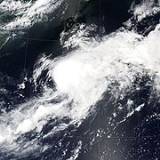
2002 Atlantic hurricane season

Encyclopedia
The 2002 Atlantic hurricane season was an average Atlantic hurricane season
, officially starting on June 1, 2002 and ending on November 30, dates which conventionally limit the period of each year when tropical cyclones in the Atlantic Ocean tend to form. The season produced 14 tropical cyclone
s, of which 12 developed into named storms; four cyclones attained hurricane status, of which two reached major hurricane status
. The season began on July 14, over a month past the official start, but tied with the 2007 Atlantic hurricane season
and the 2010 Atlantic hurricane season
with a record eight storms forming in the month of September. It ended early however, with no tropical storms forming after September 21—a rare occurrence caused partly by El Niño
conditions. The most intense hurricane of the season was Hurricane Isidore
with a minimum central pressure of 934 mbar, although Hurricane Lili
attained higher winds and peaked at Category 4 status on the Saffir-Simpson Hurricane Scale
.
The season was less destructive than average, causing an estimated $2.6 billion (2002 USD, $ USD) in property damage and 23 fatalities, mostly due to Isidore and Lili. In September, Hurricane Gustav
moved ashore on Nova Scotia
as it was transitioning into an extratropical cyclone
, lashing the region with high winds for several days. Isidore struck the Yucatan Peninsula
and later the United States, causing about $970 million (2002 USD, $ USD) in damage, and killing a total of seven. Several other storms directly affected land during August and September, including the longest lived of the season, Hurricane Kyle
. In early October, Hurricane Lili
made landfall in Louisiana
, where it caused $860 million (2002 USD, $ USD) in damage and 15 deaths.
Noted hurricane expert William M. Gray
and his associates at Colorado State University
issue forecasts of hurricane activity
each year, separately from the National Oceanic and Atmospheric Administration
(NOAA). Gray's team determined the average number of storms per season between 1950 and 2000 to be 9.6 tropical storms, 5.9 hurricanes, and 2.3 major hurricanes (storms exceeding Category 3 on the Saffir-Simpson Hurricane Scale
). A normal season, as defined by NOAA, has 9 to 12 named storms, of which 5 to 7 reach hurricane strength and 1 to 3 become major hurricanes.
, including the Florida peninsula, and a 43 percent chance of at least one such strike on the Gulf Coast
from the Florida Panhandle
westward. The potential for major hurricane activity in the Caribbean
was forecast to be above average.
On April 5 a new forecast was issued, calling for 12 named storms, 7 hurricanes and 3 intense hurricanes. The decrease in the forecast was attributed to the further intensification of El Niño conditions. The estimated potential for at least one major hurricane to affect the U.S. was decreased to 75 percent; the East Coast potential decreased slightly to 57 percent, and from the Florida Panhandle westward to Brownsville, Texas
, the probability remained the same.
anomalies were on a decreasing trend.
On August 8, 2002, NOAA
revised its season estimate to 7–10 named storms, with 4–6 becoming hurricanes and 1–3 becoming major hurricanes. The reduction was attributed to less favorable environmental conditions and building El Niño
conditions.
(ACE) rating of 67. ACE is, broadly speaking, a measure of the power of the hurricane multiplied by the length of time it existed, so storms that last a long time, as well as particularly strong hurricanes, have high ACEs. ACE is only calculated for full advisories on tropical systems at or exceeding 34 knots (39 mph, 63 km/h) or tropical storm strength. Subtropical cyclone
s, including the early portions of the tracks of Gustav and Kyle, are excluded from the total.
on July 14 from a decaying frontal zone. It then moved out to sea, strengthening slightly into a tropical storm on July 15. On July, Arthur reached a peak of 60 mph (96.6 km/h) winds, but cooler waters and upper level shear caused it to weaken. By July 17, Arthur had become extratropical, and moved north over Newfoundland. It proceeded to weaken below gale strength. The precursor system produced up to 4.49 in (114 mm) of rainfall in Weston, Florida
. Later, one person drowned in the Conne River in Newfoundland due to Arthur.
on August 7, where proximity to land and dry air prevented further strengthening. Bertha moved westward, and made a second landfall near Kingsville, Texas
on August 9, having made no significant gain in strength.
Across the Gulf Coast of the United States
, Bertha dropped light to moderate rainfall; most areas received less than 3 inches (76.2 mm). Precipitation from the storm peaked at 10.25 inches (260.4 mm) in Norwood, Louisiana
. Minor flooding was reported, which caused light damage to a few businesses, 15 to 25 houses, and some roadways. Overall, damage was very minor, totaling to $200,000 (2002 USD, $ USD) in damage. In addition, one death was reported due to Bertha, a drowning due to heavy surf in Florida
.
from a surface trough of low pressure – the same trough that spawned Tropical Storm Bertha in the Gulf of Mexico. Under a southerly flow, the depression drifted southward, where dry air and wind shear inhibited significant development. On August 7, it became Tropical Storm Cristobal, and reached a peak of 50 mph (80.5 km/h) on August 8. The storm meandered eastward and was absorbed by a front on August 9.
The interaction between the extratropical remnant and a high pressure system produced strong rip currents along the coastline of Long Island
. The storm also caused waves of three to four ft (1.2 m) in height. Three people drowned from the rip currents and waves in New York
.
. Despite dry air and moderate upper level shear, Edouard strengthened to a peak of 65 mph (104.6 km/h) winds, but the unfavorable conditions caught up with it. The storm weakened as it turned west-southwestward, and made landfall near Ormond Beach, Florida
on September 5 as a minimal tropical storm. Edouard crossed Florida, and emerged over the Gulf of Mexico as a minimal depression. Outflow from the stronger Tropical Storm Fay caused Tropical Depression Edouard to weaken further, and Edouard was eventually absorbed by Fay.
Tropical Storm Edouard dropped moderate rainfall across Florida, peaking at 7.64 inches (194 mm) in DeSoto County
, Though it was a tropical storm at landfall, winds were light across the path of the storm over land. Several roads were flooded from moderate precipitation. No casualties were reported, and damage was minimal.
, to the southeast of Galveston
. The depression drifted south-southwest while strengthening into Tropical Storm Fay, reaching its peak strength of 60 mi/h on the morning of September 6. The system then abruptly turned to the west-northwest, and remained steady in strength and course until landfall the next day, near Matagorda
. It quickly degenerated into a remnant low, which itself moved slowly southwestward over Texas. The low eventually dissipated on September 11 over northeastern Mexico.
The storm brought heavy rainfall in Mexico and Texas. The storm also caused six tornadoes, up to 20 in (508 mm) of rain, and extended periods of tropical storm force winds. The storm caused moderate flooding in some areas due to high rainfall amounts, which left about 400 homes with some form of damage. In total, 400 houses sustained damage from flooding. 1,575 houses were damaged from the flooding or tornadic damage, 23 severely, amounting to $4.5 million (2002 USD, $ USD) in damage. No deaths are attributed to Fay.
existed Africa
on September 1, and after initial development became disorganized. It moved west-northwestward for a week, reorganizing enough by September 7 to be declared Tropical Depression Seven about 1155 mi (1855 km) east-southeast of Bermuda
. At the time, the depression had persistent convection around a small circulation, and it moved steadily westward due to a ridge
to its north. Shortly after forming, strong wind shear
diminished the convection and left the center partially exposed. By September 8, there was no remaining thunderstorm activity, and the depression degenerated into a remnant low-pressure area
. The storm dissipated shortly after as strong wind shear continued to cause the storm to deteriorate while located 980 mi (1580 mi) southeast of Bermuda. The depression never affected land.
of North Carolina as a tropical storm before moving northeastward and making two landfalls in Atlantic Canada
as a Category 1 hurricane on September 12.
The storm was responsible for one death and $100,000 (2002 USD) in damage, mostly in North Carolina. The interaction between Gustav and a non-tropical system produced strong winds that caused an additional $240,000 (2002 USD) in damage in New England, but this damage was not directly attributed to the hurricane. In Atlantic Canada, the hurricane and its remnants brought heavy rain, tropical storm and hurricane force winds, as well as storm surges for several days. Localized flooding was reported in areas of Prince Edward Island
, and 4,000 people in Halifax, Nova Scotia and Charlottetown, Prince Edward Island were left without power.
Because most of the associated convective activity was east of the center of circulation, minimal damage was reported in Louisiana and Mississippi
. To the east on Dauphin Island, Alabama
, the storm caused coastal flooding which closed roads and forced the evacuation of residents. Florida received high wind gusts, heavy rainfall, and strong surf that resulted in the deaths of three swimmers. Throughout the state, 20,000 homes lost electricity. The heavy rainfall progressed into Georgia, where significant flooding occurred. Crop damage was extensive, and over 300 structures were damaged by the flooding. The storm caused a total of about $20 million (2002 USD) in damage and three fatalities.
, and it developed into Tropical Storm Isidore. On September 19, it intensified into a hurricane, and Isidore made landfall in western Cuba
as a Category 1 storm. Just before landfall near Puerto Telchac on September 22, Isidore reached its peak intensity, with wind speeds of 125 miles per hour (201.2 km/h), making it a strong Category 3 storm. After returning to the Gulf of Mexico as a tropical storm, Isidore's final landfall was near Grand Isle, Louisiana
on September 26, where the storm weakened to a depression.
Isidore made landfall on the Yucatan Peninsula
of southern Mexico as a Category 3 hurricane on the Saffir-Simpson Hurricane Scale
, leaving $640 million (2002 USD, $ USD) in damage in the country. Despite dropping over 30 inches (760 mm) of rainfall among other effects, only two indirect deaths were reported there. As a tropical storm, Isidore produced a maximum of 15.97 inches (406 mm) of rainfall in the United States at Metairie, Louisiana
. The rainfall was responsible for flooding that caused moderate crop damage, with a total of $330 million in damage (2002 USD, $ USD).
, and initially the depression did not have significant deep convection. A wind report early on September 18 indicated the depression intensified into Tropical Storm Josephine. The storm continued generally northeastward, steered between a subtropical high to the northeast and a frontal system approaching from the west. Josephine maintained a well-defined circulation, but its deep convection remained intermittent. Early on September 19 the storm began being absorbed by the cold front, and as a tropical cyclone its winds never surpassed 40 mph (75 km/h). Later that day Josephine transitioned into an extratropical cyclone and suddenly intensified to winds of 60 mph (95 km/h). The extratropical low was quickly absorbed by another larger extratropical system on the afternoon of September 19.
. While skirting the coastline of the Carolinas, it moved back over water, and made a second landfall near Long Beach, North Carolina
later the same day. Kyle continued out to sea where it merged with a cold front on October 12, becoming the fourth longest-lived Atlantic hurricane.
Kyle brought light precipitation to Bermuda, but no significant damage was reported there. Moderate rainfall accompanied its two landfalls in the United States, causing localized flash flooding and road closures. Floodwaters forced the evacuation of a nursing home and several mobile homes in South Carolina. Kyle spawned at least four tornadoes, the costliest of which struck Georgetown, South Carolina; it damaged 106 buildings and destroyed seven others, causing eight injuries. Overall damage totaled about $5 million (2002 USD, $ USD), and no direct deaths were reported. However, the remnants of Kyle contributed to one indirect death in the British Isles.
on September 20. The next day, the system had become sufficiently organized to classify the system as a tropical depression about 900 nautical miles (1,666.8 km) east of the Windward Islands
. On September 30 Lili became a hurricane while passing over the Cayman Islands
. The storm attained Category 4 status in the Gulf of Mexico before making landfall on the Louisiana
coast on October 2. The next day, it was absorbed by an extratropical low near the Tennessee
– Arkansas
border.
In Louisiana, wind gusts reaching 120 mph (190 km/h), coupled with over 6 inches (150 mm) of rainfall and a storm surge of 12 feet (3.7 m), caused over $860 million (2002 USD, $ USD) in damage. A total of 237,000 people lost power, and oil rigs offshore were shut down for up to a week.
, Cuba with winds of 30 mph (45 km/h). While crossing the island, the depression was absorbed by a cold front early on October 17. Minimal impact was reported, which was limited to locally heavy rains over portions of Jamaica
, Cuba, and the Cayman Islands
.
These names were used for storms that formed in the north Atlantic in 2002. The names not retired from this list will be used again in the 2008 season. This is the same list used for the 1996 Atlantic hurricane season
except for Cristobal, Fay, and Hanna, which replaced Cesar, Fran
, and Hortense
. The names Cristobal, Fay, and Hanna were used for the first time. Names that were not used are marked in .
retired two names in the spring of 2003; Isidore and Lili. They were replaced in the 2008 Atlantic hurricane season
by Ike
and Laura
.
Atlantic hurricane season
The Atlantic hurricane season is the period in a year when hurricanes usually form in the Atlantic Ocean. Tropical cyclones in the North Atlantic are called hurricanes, tropical storms, or tropical depressions. In addition, there have been several storms over the years that have not been fully...
, officially starting on June 1, 2002 and ending on November 30, dates which conventionally limit the period of each year when tropical cyclones in the Atlantic Ocean tend to form. The season produced 14 tropical cyclone
Tropical cyclone
A tropical cyclone is a storm system characterized by a large low-pressure center and numerous thunderstorms that produce strong winds and heavy rain. Tropical cyclones strengthen when water evaporated from the ocean is released as the saturated air rises, resulting in condensation of water vapor...
s, of which 12 developed into named storms; four cyclones attained hurricane status, of which two reached major hurricane status
Tropical cyclone scales
Tropical systems are officially ranked on one of several tropical cyclone scales according to their maximum sustained winds and in what oceanic basin they are located...
. The season began on July 14, over a month past the official start, but tied with the 2007 Atlantic hurricane season
2007 Atlantic hurricane season
The 2007 Atlantic hurricane season was an active Atlantic hurricane season that produced 17 tropical cyclones, 15 tropical storms, six hurricanes, and two major hurricanes. It officially started on June 1 and ended on November 30, dates which conventionally delimit the...
and the 2010 Atlantic hurricane season
2010 Atlantic hurricane season
The 2010 Atlantic hurricane season was the third most active Atlantic hurricane season on record, tying with the 1887 Atlantic hurricane season, 1995 Atlantic hurricane season and the 2011 Atlantic hurricane season. It had the most number of named storms since the 2005 season and also ties with the...
with a record eight storms forming in the month of September. It ended early however, with no tropical storms forming after September 21—a rare occurrence caused partly by El Niño
Enso
Ensō is a Japanese word meaning "circle" and a concept strongly associated with Zen. Ensō is one of the most common subjects of Japanese calligraphy even though it is a symbol and not a character. It symbolizes the Absolute enlightenment, strength, elegance, the Universe, and the void; it can...
conditions. The most intense hurricane of the season was Hurricane Isidore
Hurricane Isidore
Hurricane Isidore was the ninth named storm and the second hurricane in the 2002 Atlantic hurricane season. Isidore was the fifth of eight named storms to occur in September. The tropical cyclone peaked as a Category 3 hurricane, causing damage as well as four fatalities in Jamaica, Cuba, Mexico,...
with a minimum central pressure of 934 mbar, although Hurricane Lili
Hurricane Lili
Hurricane Lili was the deadliest and costliest hurricane of the 2002 Atlantic hurricane season for the United States. Lili was the twelfth named storm, fourth hurricane, and second major hurricane of the 2002 Atlantic hurricane season. The storm developed from a tropical disturbance in the open...
attained higher winds and peaked at Category 4 status on the Saffir-Simpson Hurricane Scale
Saffir-Simpson Hurricane Scale
The Saffir–Simpson Hurricane Scale , or the Saffir–Simpson Hurricane Wind Scale , classifies hurricanes — Western Hemisphere tropical cyclones that exceed the intensities of tropical depressions and tropical storms — into five categories distinguished by the intensities of their sustained winds...
.
The season was less destructive than average, causing an estimated $2.6 billion (2002 USD, $ USD) in property damage and 23 fatalities, mostly due to Isidore and Lili. In September, Hurricane Gustav
Hurricane Gustav (2002)
Hurricane Gustav was a Category 2 hurricane that paralleled the East Coast of the United States in September during the 2002 Atlantic hurricane season. It was the seventh named storm and first hurricane of the season...
moved ashore on Nova Scotia
Nova Scotia
Nova Scotia is one of Canada's three Maritime provinces and is the most populous province in Atlantic Canada. The name of the province is Latin for "New Scotland," but "Nova Scotia" is the recognized, English-language name of the province. The provincial capital is Halifax. Nova Scotia is the...
as it was transitioning into an extratropical cyclone
Extratropical cyclone
Extratropical cyclones, sometimes called mid-latitude cyclones or wave cyclones, are a group of cyclones defined as synoptic scale low pressure weather systems that occur in the middle latitudes of the Earth having neither tropical nor polar characteristics, and are connected with fronts and...
, lashing the region with high winds for several days. Isidore struck the Yucatan Peninsula
Yucatán Peninsula
The Yucatán Peninsula, in southeastern Mexico, separates the Caribbean Sea from the Gulf of Mexico, with the northern coastline on the Yucatán Channel...
and later the United States, causing about $970 million (2002 USD, $ USD) in damage, and killing a total of seven. Several other storms directly affected land during August and September, including the longest lived of the season, Hurricane Kyle
Hurricane Kyle (2002)
Hurricane Kyle was the fourth longest-lived Atlantic tropical or subtropical cyclone on record. The eleventh named storm and third hurricane of the 2002 Atlantic hurricane season, Kyle developed as a subtropical cyclone on September 20 to the east-southeast of Bermuda. Looping westward, it...
. In early October, Hurricane Lili
Hurricane Lili
Hurricane Lili was the deadliest and costliest hurricane of the 2002 Atlantic hurricane season for the United States. Lili was the twelfth named storm, fourth hurricane, and second major hurricane of the 2002 Atlantic hurricane season. The storm developed from a tropical disturbance in the open...
made landfall in Louisiana
Louisiana
Louisiana is a state located in the southern region of the United States of America. Its capital is Baton Rouge and largest city is New Orleans. Louisiana is the only state in the U.S. with political subdivisions termed parishes, which are local governments equivalent to counties...
, where it caused $860 million (2002 USD, $ USD) in damage and 15 deaths.
Seasonal forecasts
| Source | Date | b>Named storms |
b>Hurricanes | b>Major hurricanes |
| CSU Colorado State University Colorado State University is a public research university located in Fort Collins, Colorado. The university is the state's land grant university, and the flagship university of the Colorado State University System.The enrollment is approximately 29,932 students, including resident and... |
i>Average (1950–2000) | 9.6 | 5.9 | 2.3 |
| NOAA National Oceanic and Atmospheric Administration The National Oceanic and Atmospheric Administration , pronounced , like "noah", is a scientific agency within the United States Department of Commerce focused on the conditions of the oceans and the atmosphere... |
i>Average (1950–2005) | 11.0 | 6.2 | 2.7 |
| Record high activity | 28 2005 Atlantic hurricane season The 2005 Atlantic hurricane season was the most active Atlantic hurricane season in recorded history, repeatedly shattering numerous records. The impact of the season was widespread and ruinous with an estimated 3,913 deaths and record damage of about $159.2 billion... |
15 2005 Atlantic hurricane season The 2005 Atlantic hurricane season was the most active Atlantic hurricane season in recorded history, repeatedly shattering numerous records. The impact of the season was widespread and ruinous with an estimated 3,913 deaths and record damage of about $159.2 billion... |
8 1950 Atlantic hurricane season The 1950 Atlantic hurricane season was the first year in which tropical cyclones were given official names in the Atlantic basin. Names were taken from the Joint Army/Navy Phonetic Alphabet, with the first named storm being designated "Able", the second "Baker", and so on. It was an active season... |
|
| Record low activity | 4 1983 Atlantic hurricane season The 1983 Atlantic hurricane season was the least active Atlantic hurricane season in 53 years, with only four tropical storms forming. The season officially began on June 1, 1983, and lasted until November 30, 1983. These dates conventionally delimit the period of each year when most storms... |
2 1982 Atlantic hurricane season The 1982 Atlantic hurricane season officially began on June 1, 1982 and lasted until November 30, 1982, and was a below average season. These dates conventionally delimit the period of each year when most tropical cyclones form in the Atlantic basin... |
0 | |
| –––––––––––––––––––––––––––––––––––––––––– | ||||
| CSU | December 7, 2001 | 13 | 8 | 4 |
| CSU | April 5, 2002 | 12 | 7 | 3 |
| NOAA | May 20, 2002 | 9–13 | 6–8 | 2–3 |
| CSU | August 7, 2002 | 9 | 4 | 1 |
| NOAA | August 8, 2002 | 7–10 | 4–6 | 1–3 |
| –––––––––––––––––––––––––––––––––––––––––– | ||||
| Actual activity | 12 | 4 | 2 | |
Noted hurricane expert William M. Gray
William M. Gray
William M. "Bill" Gray is Emeritus Professor of Atmospheric Science at Colorado State University , and head of the Tropical Meteorology Project at CSU's Department of Atmospheric Sciences. He is a pioneer in the science of forecasting hurricanes and one of the world's leading experts on tropical...
and his associates at Colorado State University
Colorado State University
Colorado State University is a public research university located in Fort Collins, Colorado. The university is the state's land grant university, and the flagship university of the Colorado State University System.The enrollment is approximately 29,932 students, including resident and...
issue forecasts of hurricane activity
Tropical cyclone seasonal forecasting
Tropical cyclone seasonal forecasting is the process of predicting the number of tropical cyclones in one of the world's seven tropical cyclone basins during a particular tropical cyclone season. In the north Atlantic Ocean, one of the most widely publicized annual predictions comes from the...
each year, separately from the National Oceanic and Atmospheric Administration
National Oceanic and Atmospheric Administration
The National Oceanic and Atmospheric Administration , pronounced , like "noah", is a scientific agency within the United States Department of Commerce focused on the conditions of the oceans and the atmosphere...
(NOAA). Gray's team determined the average number of storms per season between 1950 and 2000 to be 9.6 tropical storms, 5.9 hurricanes, and 2.3 major hurricanes (storms exceeding Category 3 on the Saffir-Simpson Hurricane Scale
Saffir-Simpson Hurricane Scale
The Saffir–Simpson Hurricane Scale , or the Saffir–Simpson Hurricane Wind Scale , classifies hurricanes — Western Hemisphere tropical cyclones that exceed the intensities of tropical depressions and tropical storms — into five categories distinguished by the intensities of their sustained winds...
). A normal season, as defined by NOAA, has 9 to 12 named storms, of which 5 to 7 reach hurricane strength and 1 to 3 become major hurricanes.
Pre-season forecasts
On December 7, 2001, Gray's team issued its first extended-range forecast for the 2002 season, predicting above-average activity (13 named storms, 8 hurricanes, and about 2 of Category 3 or higher). It listed an 86 percent chance of at least one major hurricane striking the U.S. mainland. This included a 58 percent chance of at least one major hurricane strike on the East CoastEast Coast of the United States
The East Coast of the United States, also known as the Eastern Seaboard, refers to the easternmost coastal states in the United States, which touch the Atlantic Ocean and stretch up to Canada. The term includes the U.S...
, including the Florida peninsula, and a 43 percent chance of at least one such strike on the Gulf Coast
Gulf Coast of the United States
The Gulf Coast of the United States, sometimes referred to as the Gulf South, South Coast, or 3rd Coast, comprises the coasts of American states that are on the Gulf of Mexico, which includes Texas, Louisiana, Mississippi, Alabama, and Florida and are known as the Gulf States...
from the Florida Panhandle
Florida Panhandle
The Florida Panhandle, an informal, unofficial term for the northwestern part of Florida, is a strip of land roughly 200 miles long and 50 to 100 miles wide , lying between Alabama on the north and the west, Georgia also on the north, and the Gulf of Mexico to the south. Its eastern boundary is...
westward. The potential for major hurricane activity in the Caribbean
Caribbean
The Caribbean is a crescent-shaped group of islands more than 2,000 miles long separating the Gulf of Mexico and the Caribbean Sea, to the west and south, from the Atlantic Ocean, to the east and north...
was forecast to be above average.
On April 5 a new forecast was issued, calling for 12 named storms, 7 hurricanes and 3 intense hurricanes. The decrease in the forecast was attributed to the further intensification of El Niño conditions. The estimated potential for at least one major hurricane to affect the U.S. was decreased to 75 percent; the East Coast potential decreased slightly to 57 percent, and from the Florida Panhandle westward to Brownsville, Texas
Brownsville, Texas
Brownsville is a city in the southernmost tip of the state of Texas, in the United States. It is located on the northern bank of the Rio Grande, directly north and across the border from Matamoros, Tamaulipas, Mexico. Brownsville is the 16th largest city in the state of Texas with a population of...
, the probability remained the same.
Mid-season forecasts
On August 7, 2002, Gray's team lowered its season estimate to 9 named storms, with 4 becoming hurricanes and 1 becoming a major hurricane, noting that conditions had become less favorable for storms than they had been earlier in the year. The sea-level pressure and trade wind strength in the tropical Atlantic were reported to be above normal, while sea surface temperatureSea surface temperature
Sea surface temperature is the water temperature close to the oceans surface. The exact meaning of surface varies according to the measurement method used, but it is between and below the sea surface. Air masses in the Earth's atmosphere are highly modified by sea surface temperatures within a...
anomalies were on a decreasing trend.
On August 8, 2002, NOAA
National Oceanic and Atmospheric Administration
The National Oceanic and Atmospheric Administration , pronounced , like "noah", is a scientific agency within the United States Department of Commerce focused on the conditions of the oceans and the atmosphere...
revised its season estimate to 7–10 named storms, with 4–6 becoming hurricanes and 1–3 becoming major hurricanes. The reduction was attributed to less favorable environmental conditions and building El Niño
Enso
Ensō is a Japanese word meaning "circle" and a concept strongly associated with Zen. Ensō is one of the most common subjects of Japanese calligraphy even though it is a symbol and not a character. It symbolizes the Absolute enlightenment, strength, elegance, the Universe, and the void; it can...
conditions.
Season activity
The season's activity, in which most were weak tropical storms, was reflected with a low cumulative accumulated cyclone energyAccumulated cyclone energy
Accumulated cyclone energy is a measure used by the National Oceanic and Atmospheric Administration to express the activity of individual tropical cyclones and entire tropical cyclone seasons, particularly the North Atlantic hurricane season. It uses an approximation of the energy used by a...
(ACE) rating of 67. ACE is, broadly speaking, a measure of the power of the hurricane multiplied by the length of time it existed, so storms that last a long time, as well as particularly strong hurricanes, have high ACEs. ACE is only calculated for full advisories on tropical systems at or exceeding 34 knots (39 mph, 63 km/h) or tropical storm strength. Subtropical cyclone
Subtropical cyclone
A subtropical cyclone is a weather system that has some characteristics of a tropical and an extratropical cyclone. As early as the 1950s, meteorologists were unclear whether they should be characterized as tropical or extratropical cyclones. They were officially recognized by the National...
s, including the early portions of the tracks of Gustav and Kyle, are excluded from the total.
Tropical Storm Arthur
Arthur formed out of a tropical depression off the coast of North CarolinaNorth Carolina
North Carolina is a state located in the southeastern United States. The state borders South Carolina and Georgia to the south, Tennessee to the west and Virginia to the north. North Carolina contains 100 counties. Its capital is Raleigh, and its largest city is Charlotte...
on July 14 from a decaying frontal zone. It then moved out to sea, strengthening slightly into a tropical storm on July 15. On July, Arthur reached a peak of 60 mph (96.6 km/h) winds, but cooler waters and upper level shear caused it to weaken. By July 17, Arthur had become extratropical, and moved north over Newfoundland. It proceeded to weaken below gale strength. The precursor system produced up to 4.49 in (114 mm) of rainfall in Weston, Florida
Weston, Florida
Weston is a suburb of South Florida located in Broward County, Florida, USA. Established as a city in 1996, much of the community was developed by Arvida/JMB Realty and is located near the western developmental boundary of Broward County. It is the most western city in Broward County, and its...
. Later, one person drowned in the Conne River in Newfoundland due to Arthur.
Tropical Storm Bertha
A surface trough of low pressure that would later spawn Tropical Storm Cristobal developed a tropical depression in the northern Gulf of Mexico on August 4. It quickly strengthened into a minimal tropical storm early on August 5, and made landfall near Boothville, Louisiana just two hours later. Bertha weakened to a tropical depression, but retained its circulation over Louisiana. A high pressure system built southward, unexpectedly forcing the depression to the southwest. It emerged back over the Gulf of MexicoGulf of Mexico
The Gulf of Mexico is a partially landlocked ocean basin largely surrounded by the North American continent and the island of Cuba. It is bounded on the northeast, north and northwest by the Gulf Coast of the United States, on the southwest and south by Mexico, and on the southeast by Cuba. In...
on August 7, where proximity to land and dry air prevented further strengthening. Bertha moved westward, and made a second landfall near Kingsville, Texas
Kingsville, Texas
As of the census of 2000, there were 25,575 people, 8,943 households, and 6,134 families residing in the city. The population density was 1,848.8 people per square mile . There were 10,427 housing units at an average density of 753.8 per square mile...
on August 9, having made no significant gain in strength.
Across the Gulf Coast of the United States
Gulf Coast of the United States
The Gulf Coast of the United States, sometimes referred to as the Gulf South, South Coast, or 3rd Coast, comprises the coasts of American states that are on the Gulf of Mexico, which includes Texas, Louisiana, Mississippi, Alabama, and Florida and are known as the Gulf States...
, Bertha dropped light to moderate rainfall; most areas received less than 3 inches (76.2 mm). Precipitation from the storm peaked at 10.25 inches (260.4 mm) in Norwood, Louisiana
Norwood, Louisiana
Norwood is a village in East Feliciana Parish, Louisiana, United States. The population was 337 at the 2000 census. It is part of the Baton Rouge Metropolitan Statistical Area.-Geography:...
. Minor flooding was reported, which caused light damage to a few businesses, 15 to 25 houses, and some roadways. Overall, damage was very minor, totaling to $200,000 (2002 USD, $ USD) in damage. In addition, one death was reported due to Bertha, a drowning due to heavy surf in Florida
Florida
Florida is a state in the southeastern United States, located on the nation's Atlantic and Gulf coasts. It is bordered to the west by the Gulf of Mexico, to the north by Alabama and Georgia and to the east by the Atlantic Ocean. With a population of 18,801,310 as measured by the 2010 census, it...
.
Tropical Storm Cristobal
On August 5, Tropical Depression Three formed off the coast of South CarolinaSouth Carolina
South Carolina is a state in the Deep South of the United States that borders Georgia to the south, North Carolina to the north, and the Atlantic Ocean to the east. Originally part of the Province of Carolina, the Province of South Carolina was one of the 13 colonies that declared independence...
from a surface trough of low pressure – the same trough that spawned Tropical Storm Bertha in the Gulf of Mexico. Under a southerly flow, the depression drifted southward, where dry air and wind shear inhibited significant development. On August 7, it became Tropical Storm Cristobal, and reached a peak of 50 mph (80.5 km/h) on August 8. The storm meandered eastward and was absorbed by a front on August 9.
The interaction between the extratropical remnant and a high pressure system produced strong rip currents along the coastline of Long Island
Long Island
Long Island is an island located in the southeast part of the U.S. state of New York, just east of Manhattan. Stretching northeast into the Atlantic Ocean, Long Island contains four counties, two of which are boroughs of New York City , and two of which are mainly suburban...
. The storm also caused waves of three to four ft (1.2 m) in height. Three people drowned from the rip currents and waves in New York
New York
New York is a state in the Northeastern region of the United States. It is the nation's third most populous state. New York is bordered by New Jersey and Pennsylvania to the south, and by Connecticut, Massachusetts and Vermont to the east...
.
Tropical Storm Dolly
A tropical wave exited the African coast on August 27, and with low favorable conditions the system organized into Tropical Depression Four on August 29 about 630 mi (1,020 km) southwest of Cape Verde. Six hours later, the depression was upgraded to Tropical Storm Dolly after developing sufficient outflow and curved banding features. The storm continued to intensify as more convection developed, and Dolly reached peaked winds of 60 mph (95 km/h) on August 30. After peaking in intensity, the storm suddenly lost organization, and the winds decreased to minimal tropical storm force. After a brief re-intensification trend, Dolly again weakened due to wind shear. On September 4 Dolly weakened to a tropical depression, and later that day was absorbed by the trough; it never affected land.Tropical Storm Edouard
Edouard formed out of an area of disturbed weather north of the Bahamas on September 2. It drifted northward, then executed a clockwise loop off the coast of FloridaFlorida
Florida is a state in the southeastern United States, located on the nation's Atlantic and Gulf coasts. It is bordered to the west by the Gulf of Mexico, to the north by Alabama and Georgia and to the east by the Atlantic Ocean. With a population of 18,801,310 as measured by the 2010 census, it...
. Despite dry air and moderate upper level shear, Edouard strengthened to a peak of 65 mph (104.6 km/h) winds, but the unfavorable conditions caught up with it. The storm weakened as it turned west-southwestward, and made landfall near Ormond Beach, Florida
Ormond Beach, Florida
Ormond Beach is a city in Volusia County, Florida, United States. The population was 36,301 at the 2000 census. As of 2004, the population recorded by the U.S. Census Bureau is 37,929. Ormond Beach is the northern neighbor of Daytona Beach and is home to Tomoka State Park.-History:Ormond Beach was...
on September 5 as a minimal tropical storm. Edouard crossed Florida, and emerged over the Gulf of Mexico as a minimal depression. Outflow from the stronger Tropical Storm Fay caused Tropical Depression Edouard to weaken further, and Edouard was eventually absorbed by Fay.
Tropical Storm Edouard dropped moderate rainfall across Florida, peaking at 7.64 inches (194 mm) in DeSoto County
DeSoto County, Florida
DeSoto County is a county located in the U.S. state of Florida. As of 2000, the population was 32,209. The U.S. Census Bureau 2005 estimate for the county is 35,406 . Its county seat is Arcadia, Florida. The county comprises the Arcadia, Florida Micropolitan Statistical Area.- History :DeSoto...
, Though it was a tropical storm at landfall, winds were light across the path of the storm over land. Several roads were flooded from moderate precipitation. No casualties were reported, and damage was minimal.
Tropical Storm Fay
In early September, a low pressure center developed along a trough of low pressure, and on September 5, the system had gained sufficient organization to be a tropical depressionTropical cyclone
A tropical cyclone is a storm system characterized by a large low-pressure center and numerous thunderstorms that produce strong winds and heavy rain. Tropical cyclones strengthen when water evaporated from the ocean is released as the saturated air rises, resulting in condensation of water vapor...
, to the southeast of Galveston
Galveston, Texas
Galveston is a coastal city located on Galveston Island in the U.S. state of Texas. , the city had a total population of 47,743 within an area of...
. The depression drifted south-southwest while strengthening into Tropical Storm Fay, reaching its peak strength of 60 mi/h on the morning of September 6. The system then abruptly turned to the west-northwest, and remained steady in strength and course until landfall the next day, near Matagorda
Matagorda
Matagorda may refer to:Geography*Matagorda Bay, on the coast of Texas*Matagorda County, Texas*Matagorda Independent School District in Matagorda County, Texas*Matagorda Island, a barrier island on the coast of Texas...
. It quickly degenerated into a remnant low, which itself moved slowly southwestward over Texas. The low eventually dissipated on September 11 over northeastern Mexico.
The storm brought heavy rainfall in Mexico and Texas. The storm also caused six tornadoes, up to 20 in (508 mm) of rain, and extended periods of tropical storm force winds. The storm caused moderate flooding in some areas due to high rainfall amounts, which left about 400 homes with some form of damage. In total, 400 houses sustained damage from flooding. 1,575 houses were damaged from the flooding or tornadic damage, 23 severely, amounting to $4.5 million (2002 USD, $ USD) in damage. No deaths are attributed to Fay.
Tropical Depression Seven
A tropical waveTropical wave
Tropical waves, easterly waves, or tropical easterly waves, also known as African easterly waves in the Atlantic region, are a type of atmospheric trough, an elongated area of relatively low air pressure, oriented north to south, which move from east to west across the tropics causing areas of...
existed Africa
Africa
Africa is the world's second largest and second most populous continent, after Asia. At about 30.2 million km² including adjacent islands, it covers 6% of the Earth's total surface area and 20.4% of the total land area...
on September 1, and after initial development became disorganized. It moved west-northwestward for a week, reorganizing enough by September 7 to be declared Tropical Depression Seven about 1155 mi (1855 km) east-southeast of Bermuda
Bermuda
Bermuda is a British overseas territory in the North Atlantic Ocean. Located off the east coast of the United States, its nearest landmass is Cape Hatteras, North Carolina, about to the west-northwest. It is about south of Halifax, Nova Scotia, Canada, and northeast of Miami, Florida...
. At the time, the depression had persistent convection around a small circulation, and it moved steadily westward due to a ridge
High pressure area
A high-pressure area is a region where the atmospheric pressure at the surface of the planet is greater than its surrounding environment. Winds within high-pressure areas flow outward due to the higher density air near their center and friction with land...
to its north. Shortly after forming, strong wind shear
Wind shear
Wind shear, sometimes referred to as windshear or wind gradient, is a difference in wind speed and direction over a relatively short distance in the atmosphere...
diminished the convection and left the center partially exposed. By September 8, there was no remaining thunderstorm activity, and the depression degenerated into a remnant low-pressure area
Low pressure area
A low-pressure area, or "low", is a region where the atmospheric pressure at sea level is below that of surrounding locations. Low-pressure systems form under areas of wind divergence which occur in upper levels of the troposphere. The formation process of a low-pressure area is known as...
. The storm dissipated shortly after as strong wind shear continued to cause the storm to deteriorate while located 980 mi (1580 mi) southeast of Bermuda. The depression never affected land.
Hurricane Gustav
An area of unsettled weather developed between the Bahamas and Bermuda on September 6, and over the next few days convection increased in intensity and coverage. On September 8, the system gained sufficient organization to be declared a subtropical depression off the Southeast United States coast; later that day, the system was named Subtropical Storm Gustav. After attaining tropical characteristics on September 10, Gustav passed slightly to the east of the Outer BanksOuter Banks
The Outer Banks is a 200-mile long string of narrow barrier islands off the coast of North Carolina, beginning in the southeastern corner of Virginia Beach on the east coast of the United States....
of North Carolina as a tropical storm before moving northeastward and making two landfalls in Atlantic Canada
Atlantic Canada
Atlantic Canada is the region of Canada comprising the four provinces located on the Atlantic coast, excluding Quebec: the three Maritime provinces – New Brunswick, Prince Edward Island, and Nova Scotia – and Newfoundland and Labrador...
as a Category 1 hurricane on September 12.
The storm was responsible for one death and $100,000 (2002 USD) in damage, mostly in North Carolina. The interaction between Gustav and a non-tropical system produced strong winds that caused an additional $240,000 (2002 USD) in damage in New England, but this damage was not directly attributed to the hurricane. In Atlantic Canada, the hurricane and its remnants brought heavy rain, tropical storm and hurricane force winds, as well as storm surges for several days. Localized flooding was reported in areas of Prince Edward Island
Prince Edward Island
Prince Edward Island is a Canadian province consisting of an island of the same name, as well as other islands. The maritime province is the smallest in the nation in both land area and population...
, and 4,000 people in Halifax, Nova Scotia and Charlottetown, Prince Edward Island were left without power.
Tropical Storm Hanna
In early September, a tropical wave merged with a trough of low pressure in the Gulf of Mexico and spawned a low pressure system. Convection steadily deepened on September 11 east of the upper level low and the surface low; it was classified as Tropical Depression Nine the next day. The disorganized storm moved westward, then northward, where it strengthened into Tropical Storm Hanna later that day. After reaching a peak with winds of 55 mph (90 km/h), it made two landfalls on the Gulf Coast, eventually dissipating on September 15 over Georgia.Because most of the associated convective activity was east of the center of circulation, minimal damage was reported in Louisiana and Mississippi
Mississippi
Mississippi is a U.S. state located in the Southern United States. Jackson is the state capital and largest city. The name of the state derives from the Mississippi River, which flows along its western boundary, whose name comes from the Ojibwe word misi-ziibi...
. To the east on Dauphin Island, Alabama
Alabama
Alabama is a state located in the southeastern region of the United States. It is bordered by Tennessee to the north, Georgia to the east, Florida and the Gulf of Mexico to the south, and Mississippi to the west. Alabama ranks 30th in total land area and ranks second in the size of its inland...
, the storm caused coastal flooding which closed roads and forced the evacuation of residents. Florida received high wind gusts, heavy rainfall, and strong surf that resulted in the deaths of three swimmers. Throughout the state, 20,000 homes lost electricity. The heavy rainfall progressed into Georgia, where significant flooding occurred. Crop damage was extensive, and over 300 structures were damaged by the flooding. The storm caused a total of about $20 million (2002 USD) in damage and three fatalities.
Hurricane Isidore
On September 9, a tropical wave moved off the coast of Africa, and by September 14 it was classified as a tropical depression. The next day the storm was located just south of JamaicaJamaica
Jamaica is an island nation of the Greater Antilles, in length, up to in width and 10,990 square kilometres in area. It is situated in the Caribbean Sea, about south of Cuba, and west of Hispaniola, the island harbouring the nation-states Haiti and the Dominican Republic...
, and it developed into Tropical Storm Isidore. On September 19, it intensified into a hurricane, and Isidore made landfall in western Cuba
Cuba
The Republic of Cuba is an island nation in the Caribbean. The nation of Cuba consists of the main island of Cuba, the Isla de la Juventud, and several archipelagos. Havana is the largest city in Cuba and the country's capital. Santiago de Cuba is the second largest city...
as a Category 1 storm. Just before landfall near Puerto Telchac on September 22, Isidore reached its peak intensity, with wind speeds of 125 miles per hour (201.2 km/h), making it a strong Category 3 storm. After returning to the Gulf of Mexico as a tropical storm, Isidore's final landfall was near Grand Isle, Louisiana
Grand Isle, Louisiana
Grand Isle is a town in Jefferson Parish, Louisiana, located on a barrier island of the same name in the Gulf of Mexico. The island is at the mouth of Barataria Bay where it meets the gulf. As of the 2000 census, the town population was 1,541; during summers, the population sometimes increases to...
on September 26, where the storm weakened to a depression.
Isidore made landfall on the Yucatan Peninsula
Yucatán Peninsula
The Yucatán Peninsula, in southeastern Mexico, separates the Caribbean Sea from the Gulf of Mexico, with the northern coastline on the Yucatán Channel...
of southern Mexico as a Category 3 hurricane on the Saffir-Simpson Hurricane Scale
Saffir-Simpson Hurricane Scale
The Saffir–Simpson Hurricane Scale , or the Saffir–Simpson Hurricane Wind Scale , classifies hurricanes — Western Hemisphere tropical cyclones that exceed the intensities of tropical depressions and tropical storms — into five categories distinguished by the intensities of their sustained winds...
, leaving $640 million (2002 USD, $ USD) in damage in the country. Despite dropping over 30 inches (760 mm) of rainfall among other effects, only two indirect deaths were reported there. As a tropical storm, Isidore produced a maximum of 15.97 inches (406 mm) of rainfall in the United States at Metairie, Louisiana
Metairie, Louisiana
Metairie is a census-designated place in Jefferson Parish, Louisiana, United States and is a major part of the New Orleans Metropolitan Area. Metairie is the largest community in Jefferson Parish. It is an unincorporated area that would be larger than most of the state's cities if it were...
. The rainfall was responsible for flooding that caused moderate crop damage, with a total of $330 million in damage (2002 USD, $ USD).
Tropical Storm Josephine
A non-tropical low developed along a dissipating stationary front on September 16 in the central Atlantic and drifted north-northeastward. The National Hurricane Center classified it as Tropical Depression Eleven on September 17 about 710 mi (1,150 km) east of BermudaBermuda
Bermuda is a British overseas territory in the North Atlantic Ocean. Located off the east coast of the United States, its nearest landmass is Cape Hatteras, North Carolina, about to the west-northwest. It is about south of Halifax, Nova Scotia, Canada, and northeast of Miami, Florida...
, and initially the depression did not have significant deep convection. A wind report early on September 18 indicated the depression intensified into Tropical Storm Josephine. The storm continued generally northeastward, steered between a subtropical high to the northeast and a frontal system approaching from the west. Josephine maintained a well-defined circulation, but its deep convection remained intermittent. Early on September 19 the storm began being absorbed by the cold front, and as a tropical cyclone its winds never surpassed 40 mph (75 km/h). Later that day Josephine transitioned into an extratropical cyclone and suddenly intensified to winds of 60 mph (95 km/h). The extratropical low was quickly absorbed by another larger extratropical system on the afternoon of September 19.
Hurricane Kyle
A non-tropical low formed into Subtropical Depression Twelve, well east-southeast of Bermuda on September 20. It became Subtropical Storm Kyle the next day, and Tropical Storm Kyle on September 22. Kyle drifted slowly westward, slowly strengthening, and reached hurricane strength on September 25; it weakened back into a tropical storm on September 28. The cyclone's strength continued to fluctuate between tropical depression and tropical storm several times. Its movement was also extremely irregular, as it shifted sharply north and south along its generally westward path. On October 11, Kyle reached land and made its first landfall near McClellanville, South CarolinaMcClellanville, South Carolina
McClellanville is a small fishing town in Charleston County, South Carolina, United States. The population was 459 at the 2000 census. It is situated on the Atlantic coast, on land surrounded by Francis Marion National Forest and has traditionally derived its livelihood from the sea and coastal...
. While skirting the coastline of the Carolinas, it moved back over water, and made a second landfall near Long Beach, North Carolina
Long Beach, North Carolina
Long Beach, North Carolina is a coastal neighborhood that is incorporated into Oak Island, North Carolina in the year of 1955. Located on Oak Island, it is well known for the total devastation it sustained during Hurricane Hazel in 1954; only five of the 357 buildings survived the storm...
later the same day. Kyle continued out to sea where it merged with a cold front on October 12, becoming the fourth longest-lived Atlantic hurricane.
Kyle brought light precipitation to Bermuda, but no significant damage was reported there. Moderate rainfall accompanied its two landfalls in the United States, causing localized flash flooding and road closures. Floodwaters forced the evacuation of a nursing home and several mobile homes in South Carolina. Kyle spawned at least four tornadoes, the costliest of which struck Georgetown, South Carolina; it damaged 106 buildings and destroyed seven others, causing eight injuries. Overall damage totaled about $5 million (2002 USD, $ USD), and no direct deaths were reported. However, the remnants of Kyle contributed to one indirect death in the British Isles.
Hurricane Lili
On September 16, a tropical wave moved off the coast of Africa and across the Atlantic. It developed a low level cloud circulation midway between Africa and the Lesser AntillesLesser Antilles
The Lesser Antilles are a long, partly volcanic island arc in the Western Hemisphere. Most of its islands form the eastern boundary of the Caribbean Sea with the Atlantic Ocean, with the remainder located in the southern Caribbean just north of South America...
on September 20. The next day, the system had become sufficiently organized to classify the system as a tropical depression about 900 nautical miles (1,666.8 km) east of the Windward Islands
Windward Islands
The Windward Islands are the southern islands of the Lesser Antilles, within the West Indies.-Name and geography:The Windward Islands are called such because they were more windward to sailing ships arriving in the New World than the Leeward Islands, given that the prevailing trade winds in the...
. On September 30 Lili became a hurricane while passing over the Cayman Islands
Cayman Islands
The Cayman Islands is a British Overseas Territory and overseas territory of the European Union located in the western Caribbean Sea. The territory comprises the three islands of Grand Cayman, Cayman Brac, and Little Cayman, located south of Cuba and northwest of Jamaica...
. The storm attained Category 4 status in the Gulf of Mexico before making landfall on the Louisiana
Louisiana
Louisiana is a state located in the southern region of the United States of America. Its capital is Baton Rouge and largest city is New Orleans. Louisiana is the only state in the U.S. with political subdivisions termed parishes, which are local governments equivalent to counties...
coast on October 2. The next day, it was absorbed by an extratropical low near the Tennessee
Tennessee
Tennessee is a U.S. state located in the Southeastern United States. It has a population of 6,346,105, making it the nation's 17th-largest state by population, and covers , making it the 36th-largest by total land area...
– Arkansas
Arkansas
Arkansas is a state located in the southern region of the United States. Its name is an Algonquian name of the Quapaw Indians. Arkansas shares borders with six states , and its eastern border is largely defined by the Mississippi River...
border.
In Louisiana, wind gusts reaching 120 mph (190 km/h), coupled with over 6 inches (150 mm) of rainfall and a storm surge of 12 feet (3.7 m), caused over $860 million (2002 USD, $ USD) in damage. A total of 237,000 people lost power, and oil rigs offshore were shut down for up to a week.
Tropical Depression Fourteen
A weak tropical wave moved through the Lesser Antilles on October 9. As the system reached the southwestern Caribbean Sea on October 12, convection increased, and a broad low pressure area formed later that day. Over the next two days, the low significantly organized, and became Tropical Depression Fourteen at 1200 UTC on October 14. The depression initially tracked west-northwestward, but then curved to the north-northeast. Due to vertical wind shear, the depression was unable to intensify, and remained below tropical storm status during its duration. By 1600 UTC on October 16, the depression made landfall near CienfuegosCienfuegos
Cienfuegos is a city on the southern coast of Cuba, capital of Cienfuegos Province. It is located about from Havana, and has a population of 150,000. The city is dubbed La Perla del Sur...
, Cuba with winds of 30 mph (45 km/h). While crossing the island, the depression was absorbed by a cold front early on October 17. Minimal impact was reported, which was limited to locally heavy rains over portions of Jamaica
Jamaica
Jamaica is an island nation of the Greater Antilles, in length, up to in width and 10,990 square kilometres in area. It is situated in the Caribbean Sea, about south of Cuba, and west of Hispaniola, the island harbouring the nation-states Haiti and the Dominican Republic...
, Cuba, and the Cayman Islands
Cayman Islands
The Cayman Islands is a British Overseas Territory and overseas territory of the European Union located in the western Caribbean Sea. The territory comprises the three islands of Grand Cayman, Cayman Brac, and Little Cayman, located south of Cuba and northwest of Jamaica...
.
Storm names
|
Tropical Storm Hanna (2002) Tropical Storm Hanna was a moderately strong tropical storm that affected the Gulf Coast and Southeastern regions of the United States. The tenth tropical cyclone and ninth named storm of the 2002 Atlantic hurricane season, Hanna formed through the complex interaction of a surface trough, a... Hurricane Isidore Hurricane Isidore was the ninth named storm and the second hurricane in the 2002 Atlantic hurricane season. Isidore was the fifth of eight named storms to occur in September. The tropical cyclone peaked as a Category 3 hurricane, causing damage as well as four fatalities in Jamaica, Cuba, Mexico,... Hurricane Kyle (2002) Hurricane Kyle was the fourth longest-lived Atlantic tropical or subtropical cyclone on record. The eleventh named storm and third hurricane of the 2002 Atlantic hurricane season, Kyle developed as a subtropical cyclone on September 20 to the east-southeast of Bermuda. Looping westward, it... Hurricane Lili Hurricane Lili was the deadliest and costliest hurricane of the 2002 Atlantic hurricane season for the United States. Lili was the twelfth named storm, fourth hurricane, and second major hurricane of the 2002 Atlantic hurricane season. The storm developed from a tropical disturbance in the open... |
These names were used for storms that formed in the north Atlantic in 2002. The names not retired from this list will be used again in the 2008 season. This is the same list used for the 1996 Atlantic hurricane season
1996 Atlantic hurricane season
The 1996 Atlantic hurricane season was the first season since 1965 in which all tropical cyclones reached tropical storm status. It officially began on June 1, 1996, and lasted until November 30, 1996...
except for Cristobal, Fay, and Hanna, which replaced Cesar, Fran
Hurricane Fran
Hurricane Fran was a powerful Cape Verde-type hurricane of the 1996 Atlantic hurricane season that made landfall near Cape Fear in North Carolina at Category 3 strength. Throughout the eastern United States, early statistics on Fran reported 27 deaths and $3.2 billion in damage...
, and Hortense
Hurricane Hortense
Hurricane Hortense was the eighth tropical storm, sixth hurricane, and second Category 4 hurricane of the 1996 Atlantic hurricane season. Lasting from September 3 to September 16, Hortense brought torrential flooding as it moved through the Lesser Antilles, Puerto Rico, and Dominican Republic...
. The names Cristobal, Fay, and Hanna were used for the first time. Names that were not used are marked in .
Retirement
The World Meteorological OrganizationWorld Meteorological Organization
The World Meteorological Organization is an intergovernmental organization with a membership of 189 Member States and Territories. It originated from the International Meteorological Organization , which was founded in 1873...
retired two names in the spring of 2003; Isidore and Lili. They were replaced in the 2008 Atlantic hurricane season
2008 Atlantic hurricane season
The 2008 Atlantic hurricane season was a very active hurricane season with sixteen named storms formed, including eight that became hurricanes and five that became major hurricanes. The season officially started on June 1 and ended on November 30. These dates conventionally delimit the period of...
by Ike
Hurricane Ike
Hurricane Ike was the second-costliest hurricane ever to make landfall in the United States, the costliest hurricane ever to impact Cuba and the second most active hurricane to reach the Canadian mainland in the Great Lakes Region after Hurricane Hazel in 1954...
and Laura
Tropical Storm Laura (2008)
Tropical Storm Laura was a short lived tropical cyclone that developed over the north-central Atlantic Ocean in late September during the 2008 Atlantic hurricane season. The 12th named storm of the season, Laura formed out of a large extratropical area of low pressure located about 1015 miles ...
.
See also
- List of storms in the 2002 Atlantic hurricane season
- List of Atlantic hurricanes
- List of Atlantic hurricane seasons
- 2002 Pacific hurricane season2002 Pacific hurricane seasonThe 2002 Pacific hurricane season was an event in tropical cyclone meteorology. The most notable storm that year was Hurricane Kenna, which reached Category 5 on the Saffir-Simpson Hurricane Scale. It made landfall near Puerto Vallarta, in the Mexican state of Jalisco, on October 25...
- 2002 Pacific typhoon season2002 Pacific typhoon seasonA Tropical Cyclone Formation Alert was issued on July 19 for a Tropical Disturbance that was located east of the international Date Line. The Next day the Disturbance crossed the international date line and was classified as a Tropical Depression by the JMA. The JMA then upgraded the depression to...
- 2002 North Indian Ocean cyclone season2002 North Indian Ocean cyclone seasonThe 2002 North Indian Ocean cyclone season had no bounds, but cyclones tend to form between April and December, with peaks in May and November. These dates conventionally delimit the period of each year when most tropical cyclones form in the northern Indian Ocean.-Season summary:Four tropical...
- South-West Indian Ocean cyclone seasons: 2001–02, 2002–03
- Australian region cyclone seasons: 2001–02, 2002–03
- South Pacific cyclone seasons: 2001–02, 2002–03