


Colorado State University

Encyclopedia
Colorado State University (also referred to as Colorado State and CSU) is a public research university located in Fort Collins
, Colorado
. The university is the state's land grant university, and the flagship university of the Colorado State University System.
The enrollment is approximately 29,932 students, including resident and non-resident instruction students. The university has approximately 1,540 faculty in eight colleges and 55 academic departments. Bachelor's degrees are offered in 65 fields of study, with Master's degrees in 55 fields. Colorado State confers doctoral degrees in 40 fields of study, in addition to a professional degree in veterinary medicine.
CSU received more than $300 million in sponsored research in 2010, ranking the university in the top 3 percent of institutions without a medical school for research expenditures.
The university has operated under four different names:
governor Edward M. McCook
in 1870. However, during its first years the university existed only on paper. While a board of 12 trustees was formed to "purchase and manage property, erect buildings, establish basic rules for governing the institutions and employ buildings," the near complete lack of funding by the territorial legislature for this mission severely hampered progress.
The first 30 acres (121,405.8 m²) parcel of land for the campus was deeded in 1871 by Robert Dazell. In 1872, the Larimer County Land Improvement Company contributed a second 80-acre (320,000 m²) parcel. The first $1000 to erect buildings was finally allocated by the territorial legislature in 1874. The funds were not sufficient, however, and trustees were required to find a matching amount, which they eventually obtained from local citizens and businesses.
 Among the institutions which donated matching funds was the local Grange, which was heavily involved in the early establishment of the university. As part of this effort, in the spring of 1874 Grange No. 7 held a picnic and planting event at the corner of College Avenue and West Laurel Street, and later plowed and seeded 20 acres (80,000 m²) of wheat
on a nearby field. Within several months, the university's first building, a 16 feet (4.9 m)-by-24-foot red brick building nicknamed the "Claim Shanty" was finished, providing the first tangible presence of the institution in Fort Collins.
After Colorado
achieved statehood in 1876, the territorial law establishing the college was required to be reauthorized. In 1877, the state legislature
created the eight-member State Board of Agriculture to govern the school. Early in the 21st century, the governing board was renamed the Board of Governors of the Colorado State University System. The legislature also authorized a railroad right-of-way across the campus and a mill levy to raise money for construction of the campus' first main building, Old Main, which was completed in December 1878. Despite wall cracks and other structural problems suffered during its first year, the building was opened in time for the welcoming of the first five students on September 1, 1879 by university president Elijah Evan Edwards.
During Colorado Agricultural College's first term in fall 1879, the school functioned more as a college-prep school than a college because of the lack of trained students. Consequently, the first course offerings were arithmetic, English, U.S. history, natural philosophy, horticulture and farm economy. Students also labored on the college farm and attended daily chapel services. The spring term provided the first true college-level instruction. Despite his accomplishments, Edwards resigned in spring 1882 because of conflicts with the State Board of Agriculture, a young faculty member, and with students. The board's next appointee as president was Charles Ingersoll, a graduate and former faculty member at Michigan Agricultural College, who began his nine years of service at CAC with just two full-time faculty members and 67 students, 24 of whom were women.
President Ingersoll believed the school neglected special programs for women. Despite the reluctance of the institution's governing board, CAC began opening the door to liberal arts in 1885, and by Ingersoll's last year at CAC the college had instituted a "Ladies Course" that offered junior and senior women classes in drawing, stenography and typewriting, foreign languages, landscape gardening and psychology. Ingersoll's belief in liberal yet practical education conflicted with the narrower focus of the State Board of Agriculture, and a final clash in April 1891 led to his resignation. In 1884, CAC would celebrate the commencement of its first three graduates.
 Alston Ellis encountered limited funding and decided rapidly in 1895 to reduce the number of Experiment Stations. Female students grew in number from 44 in 1892 to 112 in 1896, and by fall 1895, the college's new domestic-economy program was in place. Football
had a one-year stint at CAC in 1893, but Ellis was not a supporter of extracurricular activities and was especially hostile towards football.
Barton Aylesworth became the school's fourth president in 1899, and the combination of his non-confrontational style with the presence of the vocal Colorado Cattle and Horse Growers Association on the governing board allowed ranching and farming interests to take the college's agricultural programs to new heights, greatly influencing the development of the entire school. Initially, the influence of ranching interests brought tremendous progress to CAC's agricultural programs. Enrollment quadrupled, studies in veterinary medicine were re-established, and CAC's Experiment Station benefited from lobbying that finally secured state appropriations. Eventually, conflicts with agricultural interests may have prompted Aylesworth to begin promoting a more balanced curriculum at CAC, which he then fought hard to defend. The conflict also led him to tire and negotiate his resignation.
Aylesworth was a big supporter of extracurricular activities. Football returned to the college in fall 1899, but baseball
was the school's most popular sport. In 1903, the women's basketball team won CAC's first unofficial athletic championship, culminating with a victory over the University of Colorado
. New clubs, fraternities, and sororities also emerged. By 1905, the school had a fledgling music department, which two years later became the Conservatory of Music.
The onset of World War I
influenced all aspects of CAC, but nowhere was the impact more apparent than in the institution's programs for farmers. World War I
created demands for American agricultural products, and CAC established new food production committees, information services and cultivation projects to help improve food production and conservation in Colorado. World War I
also drew men from campus to Europe's battlefields. In June 1916, the National Defense Act created the Reserve Officers Training Corps. A few months later CAC applied to establish an ROTC unit in Fort Collins and resurrected a defunct National Guard unit on campus.
During the early 1930s, CAC's community-wide activities were greatly influenced by the Great Depression
and the Dust Bowl
. The Extension Service organized relief programs for inhabitants of Eastern Colorado, of whom a survey found 20,000 to be urgently in need of food, and helped sustain cropland threatened by pests and drought. President Lory sought to help Colorado
farmers by pushing for major tax reforms to relieve them of high tax burdens, and played a significant role in a 1930s project that supplied irrigation
water for agricultural development in Eastern Colorado.
Lory and the State Board had challenges of their own back on campus. In response to claims that the university was falling behind national standards, the board retired or demoted several senior professors and administrators deemed past the peak of their proficiency, and hired new doctorate-holding personnel while consolidating sections of lecture courses. A student petition led to the governing-board to change the college's name to more accurately reflect the diversity of its academic programs, and in 1935 the school became the Colorado State College of Agriculture and Mechanic Arts, or Colorado A&M. After 31 years of leadership, President Lory announced his retirement in 1938.
, Colorado A&M began to look like a military post, with the college serving as many as 1,500 servicemen. New President Roy Green tried to prepare for the sudden departure of students and arrival of servicemen by improving ROTC facilities, and introducing military-training programs. Although servicemen filed onto campus, student enrollment at Colorado A&M, 1,637 in fall 1942, dropped to 701 by fall 1943, and female students outnumbered their male counterparts for the first time. When the war ceased in 1945, soldiers returning from Europe and the Pacific filled U.S. higher-education institutions. Nearly 1,040 students attended the college in fall 1946, and about 1,600 students enrolled by spring 1946. Close to 80 former Aggies died in World War II
including football talent Lewis "Dude" Dent. President Green did not live long enough to enjoy more stable days at Colorado A&M, his life taken by a heart attack in 1948.
Academic offerings grew to include advanced degrees. The State Board of Agriculture approved a doctoral degree in civil engineering in 1951, and three years later allowed other qualified departments to offer doctorates. Morgan believed students earning this advanced degree should hold it from a university, and so began a campaign to change the name of Colorado A&M. In 1957, the Colorado General Assembly
approved the new name of Colorado State University.
during the 1960s and early 1970s. The reduction of strict campus regulations for women was among the early targets of student activists, coming to the forefront in 1964 when a 21-year-old female student moved into unapproved off-campus housing to accommodate her late hours as editor of the student newspaper. Continual student protests eventually led to the loosening of curfews for women and the opportunity for junior and senior coeds to live off campus.
The civil-rights movement on campus also picked up momentum and visibility. In spring 1969, shortly before Morgan's retirement, Mexican-American and African-American student organizations presented a list of demands to university officials primarily urging increased recruitment of minority students and employees. The demonstrators' occupation of the Administration Building continued to the front lawn of Morgan's home. Students and university representatives took their concerns to state officials, but Colorado legislators rejected a subsequent university request for funds to support minority recruitment. Civil rights tension resurfaced in January 1970 during a peaceful student demonstration before a Colorado State-Brigham Young University basketball game in protest of alleged racist practices of the LDS Church. The demonstration became violent and clashes with riot police ensued.
Anti-military protest took place in dramatic form at Colorado State from 1968–70. On March 5, 1968, several hundred students and faculty with anti-war sentiments marched to Fort Collins' downtown War Memorial and wiped blood on a placard tied to the memorial. Hecklers and blockaders created such a disturbance that police had to disperse the non-marchers. In May, 1970, as campus peace activists held the second day of a student strike in the gymnasium in response to the U.S. invasion of Cambodia
and the student deaths at Kent State University
, one or more arsonists set Old Main ablaze, destroying the 92-year-old cornerstone of Colorado State.
has particular expertise and connect research results to the marketplace. Initial Superclusters in infectious disease
and in cancer research
have been launched, and an upcoming clean energy Supercluster dovetails with an overall emphasis on campus sustainability. A wind farm
is being built to power the main campus, and new residence halls have been constructed according to national green building
standards. A sustainability advisory committee has been charged to coordinate green activities at Colorado State.
While maintaining historic ties to local agriculture
, administration officials have also emphasized the desire to better connect with the local community. Currently, CSU is party to UniverCity, a multi-organization initiative that links the school with city government, community and business associations to expand and synchronize working relationships. Another goal set by the university is to improve undergraduate education. Essential tasks, according to Penley, are access and graduation rates, particularly for qualified low-income and minority students, and an education international in scope suited to a global economy. Facilities improvements underway include a new biocontainment research lab, a campus center for the arts, and a new computer science
building. With state financial support declining, CSU has also put a focus on alternate funding models based on market-based financial strategies and increased forms of private support. Marketing and public relations have also become part of university strategy to attract quality students and increase public awareness of Colorado State.
trees. Designed in 1909, the Oval remains a center of activity and a major landmark at CSU. The Administration Building, constructed in 1924, faces the Oval from the south end, while several academic and administrative buildings occupy its perimeter
. The Music Building, once the university library
, currently houses the Institute for Learning and Teaching, which provides academic and career counseling as well as other student-focused programs. The music department moved to the University Center for the Arts upon its opening in 2008. At the northeast corner of the Oval is Ammons Hall, formerly the women's recreational center and now home to the University Welcome Center. Just to the east of Ammons stands Guggenheim Hall, which currently houses the Department of Manufacturing Technology and Construction Management. The building was constructed in 1910 as a gift from U.S. Senator Simon F. Guggenheim to promote the study of home economics, and was recently renovated according to green building
standards. Rounding out the Oval are the Weber Building, the Statistics Building, the Occupational Therapy Building, and Laurel Hall.
Another campus focal point is the main plaza, around which can be found Lory Student Center and Morgan Library, as well as several academic buildings. The Lory Student Center, named for former CSU president Charles Lory, houses Student Media, numerous organization offices, Student Government, and spaces to eat, drink and study. The Morgan Library was originally constructed in 1965 and named for former CSU president William E. Morgan. Following the flood of '97, this facility went through an extensive improvement project that included an addition to the main building and a renovation of the existing structure, with works completed in 1998 . Current holdings include more than 2 million books, bound journals, and government documents. Morgan Library is currently undergoing a 13,000 square-foot addition and renovation project designed to provide more seating, computing and study space.
Colorado State University's oldest existing building is Spruce Hall, constructed in 1881. Originally a dormitory that played a vital role in the early growth of the school's student enrollment, Spruce now houses the Division of Continuing Education and the Office of Admissions. The newest academic building on campus is the Behavioral Science building, which was completed in summer 2010. Other recent projects include the 2006 Transit Center addition to the north end of Lory Student Center (certified LEED Gold), an expansion of the Student Recreation Center, and the new Computer Science Building, completed in 2008.
In 2008 CSU also opened its University Center for the Arts, located in the old Fort Collins High School. CSU purchased this historic building in 1995 and has since converted it into a new home for its programs in music, dance, theatre and the visual arts. The three-phase building project included a 318-seat University Theatre, a 100-seat Studio Theatre, and the 24,000 square-foot Runyon Music Hall, an adaptable rehearsal and performance space created out of the old high school gymnasium. The Center also houses the University Art Museum, the Avenir Museum of Design and Merchandising, a 285-seat organ recital hall, and the 200-seat University Dance Theatre.
. Among these is the Pingree Park campus situated in the Mummy Range
53 miles (85.3 km) northwest of town. It was initially selected by former CSU president Charles A. Lory and began classes for Civil Engineering and Forestry students in 1913 and 1915, respectively. In the summertime, Pingree Park hosts educational programs for students in the College of Natural Resources
, and is also used as a conference space for numerous corporations, government and private organizations, and universities.
, as well as several research and outreach centers. The Center for Disease Control, Engineering Research Center, B.W. Pickett Equine Center, Cooperative Institute for Research in the Atmosphere
(CIRA), the Colorado Division of Wildlife, and the Animal Reproduction Biotechnology Lab can all be found at the Foothills Campus. The Department of Mechanical Engineering has converted an aircraft manufacturing facility near Christman Field into a Motorsport Research facility.
A new addition to the Foothills Campus, the Regional Biocontainment Laboratory, opened in Fall of 2007 as an addition to the Judson M. Harper (former Vice President of Research) Research Complex. It houses some of the University's top research facilities including three high-security containment "pods." This laboratory is among few in the United States to have level-three biocontainment security.
The current, and 14th president of Colorado State University is Anthony A. Frank. A 13 member Board of Governors oversees the Colorado State University System. Joe Zimlich, President and CEO of Bohemian Companies, serves as the current Chairman of the Board of Governors.
At its December 2008 public meeting, the Board of Governors of the CSU System decided it was in the best interest of all CSU system campuses to separate what had previously been a conjoined position of CSU System chancellor and CSU Fort Collins president. On May 5, 2009 Joe Blake was named the finalist for the chancellor position.
.
In 2005, college faculty generated $50 million in research expenditures, exceeding an average of $500K per faculty member. The College is home to four recognized Colorado State University Programs of Research and Scholarly Excellence: the Department of Atmospheric Science, the Center for Extreme Ultraviolet Science and Technology, the Engines and Energy Conversion Laboratory, and the Environmental and Water Resources Engineering Program.
The College has traditionally been very involved in supporting the local farming community. The Colorado Natural Heritage Program (CNHP) tracks Colorado's rare and imperiled species and habitats, and Colorado Water Knowledge provides water information of all kinds. The Environmental Learning Center, located three miles (5 km) east of campus on the Poudre River, hosts many CSU research projects and educational programs. The Western Center for Integrated Resource Management works on sustainability and profitability with graduate students and local farmers. On an international scale, the college provides technical assistance, training, and research opportunities for protected area managers and students in over 28 sites in Latin America, Asia, and the United States.
The College of Veterinary Medicine and Biomedical Sciences at Colorado State University has the largest research program of any college of veterinary medicine in the world. Research facilities and programs include the Robert H. and Mary G. Flint Animal Cancer Center, and the Equine Orthopedic Research Center. The Environmental Health Advanced Systems Laboratory researches the use of computer-based technology in environmental health studies. Over the last 10 years, The EHASL has worked with the US Environmental Protection Agency, National Cancer Institute, and Centers for Disease Control.
(CIRA)
ISTeC (The Information Science & Technology Center at Colorado State University)
US News and World Report America's Best Graduate Schools Rankings:
Top Graduate Programs (ranked in 2010):
Biological Sciences- 82nd
Chemistry- 45th
Earth Science- 69th
Mathematics- 76th
Physics- 70th
Top Engineering Schools- 63rd (ranked in 2010)
Civil Engineering- 39th
Electrical Engineering- 66th
Environmental/Environmental Health Engineering- 42nd
Mechanical Engineering- 67th
Top Graduate Programs (ranked in 2009):
Psychology- 91st
Social Work- 60th
Top Graduate Programs (ranked in 2008):
Occupational Therapy Master's- 8th
Princeton Review: Considers CSU one of the "Best 373 Colleges," and named the University a "Best Western College", which refers to schools that stand out in their region. The Review also includes CSU's College of Business as one of the 301 "Best Business Schools" in the country, and in 2007 named CSU's MBA program as one of the 10 best administered programs nationwide.
Business Week: Includes CSU's undergraduate business program among the best in the country in 2011, ranked at #89
Consumers Digest: One of the top 50 best values for public universities
National Science Foundation: CSU is among the nation's top 5% universities in terms of federal research dollars received for engineering and the sciences.
The Faculty Scholarly Productivity Index, based on faculty publications, federal grant dollars awarded, and honors and awards.
Announced by Academic analytics in 2007, high ranking departments at Colorado State:
Department of Agricultural and Resource Economics: 1
Department of Biology: 2
Department of Atmospheric Sciences: 3
Department of Fish, Wildlife, and Conservation Biology: 5
Department of Food Science and Human Nutrition: 8
Department of Soil and Crop Sciences/soil science: 9
Department of Soil and Crop Sciences/agronomy: 10
Department of Electrical and Computer Engineering: 10
represent an 3% increase over 2008, and a 38% increase over the past 5 years. Historically, CSU faculty were at the forefront of radiation treatment for cancer, environmental and animal ethics, and weather forecasting. A 1961 feasibility study at CSU was crucial for the establishment of the Peace Corps.
CSU faculty members are noted for their research on great global challenges including the reemergence of tuberculosis, the brown cloud of air pollution in Asian cities, severe weather forecasting, nutrition and wellness, and bio-terrorism. CSU researchers in the Department of Atmospheric Sciences process and manage incoming data from a new satellite called CloudSat, which enables scientists to see cloud properties and vertical structure. Since its launch, CloudSat has made 5,307 orbits around the Earth. Abound Solar (formerly known as AVA Solar), a start-up formed by a CSU engineering professor, is commercializing a method for manufacturing low-cost, high-efficiency solar panels. Another recent research project has taken CSU faculty to Mexico to study dengue fever. Research in the Engines and Energy Conversion Laboratory has created a technological solution to limit pollutants from single-stroke engines, and is now in widespread use in the Philippines.
Outlying campuses cater to a range of research activities including crops research, animal reproduction, public health and watershed management. The Colorado Agricultural Experiment Station (CAES) was established in 1888 in accordance with provisions of the Hatch Act
calling for experiment stations at land-grant universities. State and federal funds support CAES research programs. In 2007, research activities included pest management, food safety and nutrition, environmental quality, plant and animal production systems, and community and rural development. The NSF Engineering Research Center for Extreme Ultra Violet Science and Technology, funded by the National Science Foundation, partners industry with Colorado State University, CU-Boulder, and the University of California-Berkeley. The center has three research thrusts in Engineered EUV Sources, Imaging, Patterning, and Metrology, and Novel Linear and Non-Linear Spectroscopies
The Colorado Center for Biorefining
and Biofuels (C2B2) is the first research center created under the umbrella of the new Colorado Renewable Energy Collaboratory, involving CSU, CU
, Colorado School of Mines
, and the National Renewable Energy Laboratory. The center develops biofuels and bio-refining technologies.
Colorado State's new research Supercluster model brings together researchers across disciplines to work on topics of global concern in which CSU has a demonstrated expertise. Research results are connected to the marketplace through transfer, patenting and licensing activities carried out by experts with a focus on each research area. CSU has established Superclusters in Infectious Disease and Cancer Research and Treatment. A third, in clean energy, is being developed.
CSU has a well established research program in infectious disease. The new Regional Biocontainment Laboratory, funded by the National Institutes of Health
, is home to scientists developing vaccines and drugs for some world's most devastating diseases. The Biocontainment Laboratory also houses one of 10 US Regional Centers of Excellence for Biodefense and Emerging Infectious Diseases, funded by a $40 million grant from the National Institute of Allergy and Infectious Diseases
. Much of the Cancer Supercluster, which involves the collaboration of 5 colleges, is based around the work of the university's Animal Cancer Center, the largest center of its kind in the world.
, indoor track, outdoor track, volleyball
, basketball
, golf
, tennis
, swimming
, softball
, and water polo
) and six for men (football
, cross country
, indoor track, outdoor track, basketball
, and golf
). Colorado State's athletic teams compete along with 8 other institutions in the Mountain West Conference
, which is an NCAA
Division I conference and sponsors Division I FBS football. The Conference was formed in 1999, splitting from the former 16-member Western Athletic Conference. CSU has won 9 MWC tournament championships and won or shared 11 regular season titles. Rams football teams won or shared the Mountain West title in 1999, 2000 and 2002.
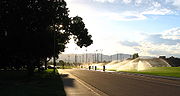 Fort Collins is located 65 miles (104.6 km) north of Denver, approximately 2 hours from major ski resorts and 45 minutes from Rocky Mountain National Park
. There are opportunities for students to be active, with bike trails and hiking nearby. In 2006, Money
ranked Fort Collins as the "Best Place to Live" in the United States.
. CSU also has a student-run campus television station
and a student radio station
, KCSU FM.
Women's Lacrosse (2008, 2010);
Baseball (2004,2005,2006,2008,2009,2010);
Men's Lacrosse (1999,2001,2003,2006).
The sport clubs at Colorado State University include: Alpine Ski Team, Baseball, Bowling (Coed), Crew, Cycling, Field Hockey, Horse Polo (Men's and Women's), Ice Hockey (Men's and Women's), In-Line Hockey, Lacrosse (Men's and Women's), Logging Sports, Rodeo (Men's and Women's), Rugby (Men's and Women's), Shotgun Sports (Men's and Women's), Snowboard, Soccer (Men's and Women's), Synchronized Ice Skating, Triathlon (Coed), Ultimate Frisbee Summer League, Ultimate Frisbee (Men's and Women's), Volleyball, Water Polo (Men's and Women's), and Wrestling (Men's and Women's)
KCSU is Colorado State's student run station, with a format focusing on alternative and college rock music, including indie rock
, punk, hip-hop and electronic music. News, sports and weather updates along with talk programs and specialty shows round out the programming schedule. Broadcasting at 10,000 watt
s, KCSU is among the larger college stations in the country, reaching approximately 250,000 listeners.
KCSU first began broadcasting in 1964 as a station owned, operated and financed by students. Following a long period as a professional station, KCSU again became student run in 1995, at which time the current format was adopted. As with the Collegian and CTV, KCSU was hit hard by the 1997 flood, and for a time was forced to broadcast from remote locations. Now back in its original Lory Student Center location, KCSU has benefited from revamped production facilities and updated equipment.
CTV is CSU's student-run television station, that allows students to hone their media skills- reporting, writing, producing, shooting, editing- in an educational environment. The station is a winner of fourteen Rocky Mountain Collegiate Media Association awards and a Student Emmy Award from the National Academy of Television Arts and Sciences Heartland Chapter. Content includes news shows on Tuesdays – Thursdays, a sports show on Mondays, and "The Colorado Music Lounge," a coproduction with KCSU that profiles local bands performing live, which airs weekly. CTV was founded in 1989, and currently broadcasts weeknights on the university cable station (Comcast channel 11) at 9pm, with reruns at 9am and 12 noon the next day.
Student-run magazine College Avenue was founded in 2005 with the goal, as put forth by its founding editors, of giving students a new forum to address controversial issues affecting the campus community from their own vantage point. Since its first issue in fall 2005, the magazine has been released quarterly, the most recent issue released in Fall 2011.
From 1932 until 1949, Colorado State University was home to the Eta chapter of Phrateres
, a philanthropic-social organization for female college students. Eta was the 7th chapter installed and Phrateres eventually had over 20 chapters in Canada
and the United States
. (The chapter name "Eta" was reused for the chapter installed at Arizona State University
in 1958.)
CSU Honors Program participants have the opportunity to live in the Honors Living Community. The new Academic Village, which opened in fall 2007, houses Living Learning Communities for 180 Honors and 240 Engineering students. Students in the College of Natural Sciences can choose to live in the Ingersoll Residential College.
residents, and within the student population 50 states and 79 countries are represented. 52% of undergraduates are women, 13.2% of undergraduates are ethnic minorities (excluding international students), and 3% of undergraduates are 30 and over. Of minority students, 48% are Hispanic
, 24% Asian American
, 16% African American
, and 12% Native American
. Over the past ten years, minority
enrollment has increased 35%, from 2,361 to 3,178, an increase from 10.9% to 13.2% of the student population. Though progress has been made, increasing minority enrollment at CSU has been a challenge for school administrators, one made yet more difficult by high dropout rates in many Colorado high schools with concentrated minority populations.
, Ernesto Zedillo
, Mikhail Gorbachev
, Madeleine Albright
, General
Norman Schwarzkopf, Archbishop Desmond Tutu, and most recently, Greg Mortenson
, Colin Powell
and Bobby Bowden
.
winners, astronauts, CEOs, and two former governors of Colorado.
Barry Beaty,
Department of Microbiology, Immunology, and Pathology, College of Veterinary Medicine and Biomedical Sciences.
Leading infectious disease researcher.
Patrick J. Brennan, Department of Microbiology, Immunology, and Pathology, College of Veterinary Medicine and Biomedical Sciences
Notable researcher in bacterial diseases and vaccines.
Edward A. Hoover,
Department of Microbiology, Immunology, and Pathology, College of Veterinary Medicine and Biomedical Sciences
Expert on experimental leukemia treatments.
Jan Leach, Bioagricultural Sciences & Pest Management
Karolin Luger, Biochemistry & Molecular Biology
C. Wayne McIlwraith, Clinical Sciences
Ian Orme, Microbiology, Immunology & Pathology
Jorge Rocca, Electrical & Computer Engineering & Physics
Bernard E. Rollin, Department of Philosophy, College of Liberal Arts; Department of Biomedical Sciences, College of Veterinary Medicine and Biomedical Sciences; and Department of Animal Sciences, College of Agricultural Sciences
Leader in the field of animal ethics.
George E. Seidel, Jr.,
Department of Biomedical Sciences, College of Veterinary Medicine and Biomedical Sciences
Focuses on the fertilization and culture of cattle and horse embryos.
Gary C. Smith,
Department of Animal Sciences, College of Agricultural Sciences
Works towards improving the safety, quality and profitability of red meat.
John Sofos, Animal Sciences
Graeme Stephens, Department of Atmospheric Science, College of Engineering
Principal investigator of NASA's CloudSat mission since 1993, focuses on atmospheric radiation and climate research.
Thomas H. Vonder Haar,
Department of Atmospheric Science, College of Engineering
Investigates the fundamental components of the energy and water cycles in the climate system and directs the Cooperative Institute for Research in the Atmosphere.
Diana Wall, School of Global Environmental Sustainability, Biology, Natural Resource Ecology Lab
Robert M. Williams,
Department of Chemistry, College of Natural Sciences
Notable research on synthetic organic chemistry, microbiology, biochemistry, and molecular biology.
Dr. Stephen J. Withrow,
Department of Clinical Sciences, College of Veterinary Medicine and Biomedical Science
Director of the Animal Cancer Center, has gained international status and acclaim for cancer research.
Fort Collins, Colorado
Fort Collins is a Home Rule Municipality situated on the Cache La Poudre River along the Colorado Front Range, and is the county seat and most populous city of Larimer County, Colorado, United States. Fort Collins is located north of the Colorado State Capitol in Denver. With a 2010 census...
, Colorado
Colorado
Colorado is a U.S. state that encompasses much of the Rocky Mountains as well as the northeastern portion of the Colorado Plateau and the western edge of the Great Plains...
. The university is the state's land grant university, and the flagship university of the Colorado State University System.
The enrollment is approximately 29,932 students, including resident and non-resident instruction students. The university has approximately 1,540 faculty in eight colleges and 55 academic departments. Bachelor's degrees are offered in 65 fields of study, with Master's degrees in 55 fields. Colorado State confers doctoral degrees in 40 fields of study, in addition to a professional degree in veterinary medicine.
CSU received more than $300 million in sponsored research in 2010, ranking the university in the top 3 percent of institutions without a medical school for research expenditures.
History
Colorado State University is a land-grant institution classified as a Carnegie Doctoral/Research University-Extensive. CSU was founded as Colorado Agricultural College in 1870, six years before the Colorado Territory gained statehood. It was one of 68 land-grant colleges established under the Morrill Act of 1862. Doors opened to a freshman class of 5 students in 1879.The university has operated under four different names:
- 1879: Agricultural College of Colorado
- 1935: Colorado College of Agricultural and Mechanic Arts (Colorado A&M)
- 1944: Colorado Agricultural and Mechanical College (Colorado A&M)
- 1957: Colorado State University
Early years
Arising from the Morrill Act, the act to create the university was signed by Colorado TerritoryColorado Territory
The Territory of Colorado was an organized incorporated territory of the United States that existed from February 28, 1861, until August 1, 1876, when it was admitted to the Union as the State of Colorado....
governor Edward M. McCook
Edward M. McCook
Edward Moody McCook was a lawyer, politician, distinguished Union cavalry general in the American Civil War, American diplomat, and Governor of the Territory of Colorado. He was a member of the famed "Fighting McCook" family of Ohio...
in 1870. However, during its first years the university existed only on paper. While a board of 12 trustees was formed to "purchase and manage property, erect buildings, establish basic rules for governing the institutions and employ buildings," the near complete lack of funding by the territorial legislature for this mission severely hampered progress.
The first 30 acres (121,405.8 m²) parcel of land for the campus was deeded in 1871 by Robert Dazell. In 1872, the Larimer County Land Improvement Company contributed a second 80-acre (320,000 m²) parcel. The first $1000 to erect buildings was finally allocated by the territorial legislature in 1874. The funds were not sufficient, however, and trustees were required to find a matching amount, which they eventually obtained from local citizens and businesses.
Wheat
Wheat is a cereal grain, originally from the Levant region of the Near East, but now cultivated worldwide. In 2007 world production of wheat was 607 million tons, making it the third most-produced cereal after maize and rice...
on a nearby field. Within several months, the university's first building, a 16 feet (4.9 m)-by-24-foot red brick building nicknamed the "Claim Shanty" was finished, providing the first tangible presence of the institution in Fort Collins.
After Colorado
Colorado
Colorado is a U.S. state that encompasses much of the Rocky Mountains as well as the northeastern portion of the Colorado Plateau and the western edge of the Great Plains...
achieved statehood in 1876, the territorial law establishing the college was required to be reauthorized. In 1877, the state legislature
Colorado General Assembly
The Colorado General Assembly is the state legislature of the State of Colorado.-Constitutional definition:The Colorado Constitution establishes a system of government based on the separation of powers doctrine with power divided among three "departments": executive, legislative and judicial...
created the eight-member State Board of Agriculture to govern the school. Early in the 21st century, the governing board was renamed the Board of Governors of the Colorado State University System. The legislature also authorized a railroad right-of-way across the campus and a mill levy to raise money for construction of the campus' first main building, Old Main, which was completed in December 1878. Despite wall cracks and other structural problems suffered during its first year, the building was opened in time for the welcoming of the first five students on September 1, 1879 by university president Elijah Evan Edwards.
During Colorado Agricultural College's first term in fall 1879, the school functioned more as a college-prep school than a college because of the lack of trained students. Consequently, the first course offerings were arithmetic, English, U.S. history, natural philosophy, horticulture and farm economy. Students also labored on the college farm and attended daily chapel services. The spring term provided the first true college-level instruction. Despite his accomplishments, Edwards resigned in spring 1882 because of conflicts with the State Board of Agriculture, a young faculty member, and with students. The board's next appointee as president was Charles Ingersoll, a graduate and former faculty member at Michigan Agricultural College, who began his nine years of service at CAC with just two full-time faculty members and 67 students, 24 of whom were women.
President Charles Ingersoll
Agricultural research would grow rapidly under Ingersoll. The Hatch Act of 1887 provided federal funds to establish and maintain experiment stations at land-grant colleges. Ainsworth Blount, CAC's first professor of practical agriculture and manager of the College Farm, had become known as a "one man experiment station", and the Hatch Act expanded his original station to five Colorado locations. The curriculum expanded as well, introducing coursework in engineering, animal science, and liberal arts. New faculty members brought expertise in botany, horticulture, entomology, and irrigation engineering. CAC made its first attempts at animal science during 1883–84, when it hired veterinary surgeon George Faville. Faville conducted free weekly clinics for student instruction and treatment of local citizen's diseased or injured animals. Veterinary science at the college languished for many years following Faville's departure in 1886.President Ingersoll believed the school neglected special programs for women. Despite the reluctance of the institution's governing board, CAC began opening the door to liberal arts in 1885, and by Ingersoll's last year at CAC the college had instituted a "Ladies Course" that offered junior and senior women classes in drawing, stenography and typewriting, foreign languages, landscape gardening and psychology. Ingersoll's belief in liberal yet practical education conflicted with the narrower focus of the State Board of Agriculture, and a final clash in April 1891 led to his resignation. In 1884, CAC would celebrate the commencement of its first three graduates.
Turn of the 20th century
American football
American football is a sport played between two teams of eleven with the objective of scoring points by advancing the ball into the opposing team's end zone. Known in the United States simply as football, it may also be referred to informally as gridiron football. The ball can be advanced by...
had a one-year stint at CAC in 1893, but Ellis was not a supporter of extracurricular activities and was especially hostile towards football.
Barton Aylesworth became the school's fourth president in 1899, and the combination of his non-confrontational style with the presence of the vocal Colorado Cattle and Horse Growers Association on the governing board allowed ranching and farming interests to take the college's agricultural programs to new heights, greatly influencing the development of the entire school. Initially, the influence of ranching interests brought tremendous progress to CAC's agricultural programs. Enrollment quadrupled, studies in veterinary medicine were re-established, and CAC's Experiment Station benefited from lobbying that finally secured state appropriations. Eventually, conflicts with agricultural interests may have prompted Aylesworth to begin promoting a more balanced curriculum at CAC, which he then fought hard to defend. The conflict also led him to tire and negotiate his resignation.
Aylesworth was a big supporter of extracurricular activities. Football returned to the college in fall 1899, but baseball
Baseball
Baseball is a bat-and-ball sport played between two teams of nine players each. The aim is to score runs by hitting a thrown ball with a bat and touching a series of four bases arranged at the corners of a ninety-foot diamond...
was the school's most popular sport. In 1903, the women's basketball team won CAC's first unofficial athletic championship, culminating with a victory over the University of Colorado
University of Colorado at Boulder
The University of Colorado Boulder is a public research university located in Boulder, Colorado...
. New clubs, fraternities, and sororities also emerged. By 1905, the school had a fledgling music department, which two years later became the Conservatory of Music.
President Charles Lory
Taking office in 1909, CAC President Charles Lory oversaw the school's maturation and reconciled longstanding conflicts between supporters of a broad or specialized curriculum. He embarked on a demanding schedule of personal appearances to make Colorado Agricultural College known as an institution that served the state's needs. Another of Lory's notable achievements was putting the school on solid fiscal ground, meeting rising construction costs and freeing the institution of debt.The onset of World War I
World War I
World War I , which was predominantly called the World War or the Great War from its occurrence until 1939, and the First World War or World War I thereafter, was a major war centred in Europe that began on 28 July 1914 and lasted until 11 November 1918...
influenced all aspects of CAC, but nowhere was the impact more apparent than in the institution's programs for farmers. World War I
World War I
World War I , which was predominantly called the World War or the Great War from its occurrence until 1939, and the First World War or World War I thereafter, was a major war centred in Europe that began on 28 July 1914 and lasted until 11 November 1918...
created demands for American agricultural products, and CAC established new food production committees, information services and cultivation projects to help improve food production and conservation in Colorado. World War I
World War I
World War I , which was predominantly called the World War or the Great War from its occurrence until 1939, and the First World War or World War I thereafter, was a major war centred in Europe that began on 28 July 1914 and lasted until 11 November 1918...
also drew men from campus to Europe's battlefields. In June 1916, the National Defense Act created the Reserve Officers Training Corps. A few months later CAC applied to establish an ROTC unit in Fort Collins and resurrected a defunct National Guard unit on campus.
During the early 1930s, CAC's community-wide activities were greatly influenced by the Great Depression
Great Depression
The Great Depression was a severe worldwide economic depression in the decade preceding World War II. The timing of the Great Depression varied across nations, but in most countries it started in about 1929 and lasted until the late 1930s or early 1940s...
and the Dust Bowl
Dust Bowl
The Dust Bowl, or the Dirty Thirties, was a period of severe dust storms causing major ecological and agricultural damage to American and Canadian prairie lands from 1930 to 1936...
. The Extension Service organized relief programs for inhabitants of Eastern Colorado, of whom a survey found 20,000 to be urgently in need of food, and helped sustain cropland threatened by pests and drought. President Lory sought to help Colorado
Colorado
Colorado is a U.S. state that encompasses much of the Rocky Mountains as well as the northeastern portion of the Colorado Plateau and the western edge of the Great Plains...
farmers by pushing for major tax reforms to relieve them of high tax burdens, and played a significant role in a 1930s project that supplied irrigation
Irrigation
Irrigation may be defined as the science of artificial application of water to the land or soil. It is used to assist in the growing of agricultural crops, maintenance of landscapes, and revegetation of disturbed soils in dry areas and during periods of inadequate rainfall...
water for agricultural development in Eastern Colorado.
Lory and the State Board had challenges of their own back on campus. In response to claims that the university was falling behind national standards, the board retired or demoted several senior professors and administrators deemed past the peak of their proficiency, and hired new doctorate-holding personnel while consolidating sections of lecture courses. A student petition led to the governing-board to change the college's name to more accurately reflect the diversity of its academic programs, and in 1935 the school became the Colorado State College of Agriculture and Mechanic Arts, or Colorado A&M. After 31 years of leadership, President Lory announced his retirement in 1938.
From World War II into the modern era
Soon after Pearl HarborPearl Harbor
Pearl Harbor, known to Hawaiians as Puuloa, is a lagoon harbor on the island of Oahu, Hawaii, west of Honolulu. Much of the harbor and surrounding lands is a United States Navy deep-water naval base. It is also the headquarters of the U.S. Pacific Fleet...
, Colorado A&M began to look like a military post, with the college serving as many as 1,500 servicemen. New President Roy Green tried to prepare for the sudden departure of students and arrival of servicemen by improving ROTC facilities, and introducing military-training programs. Although servicemen filed onto campus, student enrollment at Colorado A&M, 1,637 in fall 1942, dropped to 701 by fall 1943, and female students outnumbered their male counterparts for the first time. When the war ceased in 1945, soldiers returning from Europe and the Pacific filled U.S. higher-education institutions. Nearly 1,040 students attended the college in fall 1946, and about 1,600 students enrolled by spring 1946. Close to 80 former Aggies died in World War II
World War II
World War II, or the Second World War , was a global conflict lasting from 1939 to 1945, involving most of the world's nations—including all of the great powers—eventually forming two opposing military alliances: the Allies and the Axis...
including football talent Lewis "Dude" Dent. President Green did not live long enough to enjoy more stable days at Colorado A&M, his life taken by a heart attack in 1948.
Colorado A&M becomes a University under Bill Morgan
Colorado A&M shed its image as a narrow technical college and became a university in appearance and title during the 1950s under president Bill Morgan. Providing adequate student housing for an increasing number of youth approaching college age and improving cramped instructional facilities were among the first tests of Morgan's leadership. He responded, and five new residence halls were completed between 1953–1957. Colorado A&M took advantage of a new mill levy won through aggressive lobbying to construct several new academic facilities, among them Morgan Library, completed in 1964.Academic offerings grew to include advanced degrees. The State Board of Agriculture approved a doctoral degree in civil engineering in 1951, and three years later allowed other qualified departments to offer doctorates. Morgan believed students earning this advanced degree should hold it from a university, and so began a campaign to change the name of Colorado A&M. In 1957, the Colorado General Assembly
Colorado General Assembly
The Colorado General Assembly is the state legislature of the State of Colorado.-Constitutional definition:The Colorado Constitution establishes a system of government based on the separation of powers doctrine with power divided among three "departments": executive, legislative and judicial...
approved the new name of Colorado State University.
The 1960s: Student activism
Colorado State became a scene of intense student activismActivism
Activism consists of intentional efforts to bring about social, political, economic, or environmental change. Activism can take a wide range of forms from writing letters to newspapers or politicians, political campaigning, economic activism such as boycotts or preferentially patronizing...
during the 1960s and early 1970s. The reduction of strict campus regulations for women was among the early targets of student activists, coming to the forefront in 1964 when a 21-year-old female student moved into unapproved off-campus housing to accommodate her late hours as editor of the student newspaper. Continual student protests eventually led to the loosening of curfews for women and the opportunity for junior and senior coeds to live off campus.
The civil-rights movement on campus also picked up momentum and visibility. In spring 1969, shortly before Morgan's retirement, Mexican-American and African-American student organizations presented a list of demands to university officials primarily urging increased recruitment of minority students and employees. The demonstrators' occupation of the Administration Building continued to the front lawn of Morgan's home. Students and university representatives took their concerns to state officials, but Colorado legislators rejected a subsequent university request for funds to support minority recruitment. Civil rights tension resurfaced in January 1970 during a peaceful student demonstration before a Colorado State-Brigham Young University basketball game in protest of alleged racist practices of the LDS Church. The demonstration became violent and clashes with riot police ensued.
Anti-military protest took place in dramatic form at Colorado State from 1968–70. On March 5, 1968, several hundred students and faculty with anti-war sentiments marched to Fort Collins' downtown War Memorial and wiped blood on a placard tied to the memorial. Hecklers and blockaders created such a disturbance that police had to disperse the non-marchers. In May, 1970, as campus peace activists held the second day of a student strike in the gymnasium in response to the U.S. invasion of Cambodia
Cambodia
Cambodia , officially known as the Kingdom of Cambodia, is a country located in the southern portion of the Indochina Peninsula in Southeast Asia...
and the student deaths at Kent State University
Kent State University
Kent State University is a public research university located in Kent, Ohio, United States. The university has eight campuses around the northeast Ohio region with the main campus in Kent being the largest...
, one or more arsonists set Old Main ablaze, destroying the 92-year-old cornerstone of Colorado State.
The 2000s: CSU under President Penley
In his welcoming address for the fall 2007 semester, former CSU President Larry Edward Penley called for CSU to set the standard for the 21st century public land-grant research university. He has identified as the heart of this ideal the contribution to the prosperity and quality of life of the local and international community, in part through fostering relationships and collaborations with federal research partners, the business community and key industries. A part of this approach is Colorado State's new Supercluster research model, designed to utilize interdisciplinary, issue-based research on pressing global issues in which the universityUniversity
A university is an institution of higher education and research, which grants academic degrees in a variety of subjects. A university is an organisation that provides both undergraduate education and postgraduate education...
has particular expertise and connect research results to the marketplace. Initial Superclusters in infectious disease
Infectious disease
Infectious diseases, also known as communicable diseases, contagious diseases or transmissible diseases comprise clinically evident illness resulting from the infection, presence and growth of pathogenic biological agents in an individual host organism...
and in cancer research
Cancer research
Cancer research is basic research into cancer in order to identify causes and develop strategies for prevention, diagnosis, treatments and cure....
have been launched, and an upcoming clean energy Supercluster dovetails with an overall emphasis on campus sustainability. A wind farm
Wind farm
A wind farm is a group of wind turbines in the same location used to produce electric power. A large wind farm may consist of several hundred individual wind turbines, and cover an extended area of hundreds of square miles, but the land between the turbines may be used for agricultural or other...
is being built to power the main campus, and new residence halls have been constructed according to national green building
Green building
Green building refers to a structure and using process that is environmentally responsible and resource-efficient throughout a building's life-cycle: from siting to design, construction, operation, maintenance, renovation, and demolition...
standards. A sustainability advisory committee has been charged to coordinate green activities at Colorado State.
While maintaining historic ties to local agriculture
Agriculture
Agriculture is the cultivation of animals, plants, fungi and other life forms for food, fiber, and other products used to sustain life. Agriculture was the key implement in the rise of sedentary human civilization, whereby farming of domesticated species created food surpluses that nurtured the...
, administration officials have also emphasized the desire to better connect with the local community. Currently, CSU is party to UniverCity, a multi-organization initiative that links the school with city government, community and business associations to expand and synchronize working relationships. Another goal set by the university is to improve undergraduate education. Essential tasks, according to Penley, are access and graduation rates, particularly for qualified low-income and minority students, and an education international in scope suited to a global economy. Facilities improvements underway include a new biocontainment research lab, a campus center for the arts, and a new computer science
Computer science
Computer science or computing science is the study of the theoretical foundations of information and computation and of practical techniques for their implementation and application in computer systems...
building. With state financial support declining, CSU has also put a focus on alternate funding models based on market-based financial strategies and increased forms of private support. Marketing and public relations have also become part of university strategy to attract quality students and increase public awareness of Colorado State.
Campus
Colorado State University is located in Fort Collins, Colorado, a mid-size city of approximately 142,000 residents at the base of the Rocky Mountains. The university's 583 acres (2.4 km²) main campus is located in central Fort Collins, and includes a 101 acre (0.40873286 km²) veterinary teaching hospital. CSU is also home to a 1438 acres (5.8 km²) Foothills Campus, a 1575 acres (6.4 km²) agricultural campus, and the 1177 acres (4.8 km²) Pingree Park mountain campus. CSU utilizes 4043 acres (16.4 km²) for research centers and Colorado State Forest Service stations outside of Larimer County.Main campus
At the heart of the CSU campus lies the Oval, an expansive green area 2065 feet (629.4 m) around, lined with 65 American ElmAmerican Elm
Ulmus americana, generally known as the American Elm or, less commonly, as the White Elm or Water Elm, is a species native to eastern North America, occurring from Nova Scotia west to Alberta and Montana, and south to Florida and central Texas. The American elm is an extremely hardy tree that can...
trees. Designed in 1909, the Oval remains a center of activity and a major landmark at CSU. The Administration Building, constructed in 1924, faces the Oval from the south end, while several academic and administrative buildings occupy its perimeter
Perimeter
A perimeter is a path that surrounds an area. The word comes from the Greek peri and meter . The term may be used either for the path or its length - it can be thought of as the length of the outline of a shape. The perimeter of a circular area is called circumference.- Practical uses :Calculating...
. The Music Building, once the university library
Library
In a traditional sense, a library is a large collection of books, and can refer to the place in which the collection is housed. Today, the term can refer to any collection, including digital sources, resources, and services...
, currently houses the Institute for Learning and Teaching, which provides academic and career counseling as well as other student-focused programs. The music department moved to the University Center for the Arts upon its opening in 2008. At the northeast corner of the Oval is Ammons Hall, formerly the women's recreational center and now home to the University Welcome Center. Just to the east of Ammons stands Guggenheim Hall, which currently houses the Department of Manufacturing Technology and Construction Management. The building was constructed in 1910 as a gift from U.S. Senator Simon F. Guggenheim to promote the study of home economics, and was recently renovated according to green building
Green building
Green building refers to a structure and using process that is environmentally responsible and resource-efficient throughout a building's life-cycle: from siting to design, construction, operation, maintenance, renovation, and demolition...
standards. Rounding out the Oval are the Weber Building, the Statistics Building, the Occupational Therapy Building, and Laurel Hall.
Another campus focal point is the main plaza, around which can be found Lory Student Center and Morgan Library, as well as several academic buildings. The Lory Student Center, named for former CSU president Charles Lory, houses Student Media, numerous organization offices, Student Government, and spaces to eat, drink and study. The Morgan Library was originally constructed in 1965 and named for former CSU president William E. Morgan. Following the flood of '97, this facility went through an extensive improvement project that included an addition to the main building and a renovation of the existing structure, with works completed in 1998 . Current holdings include more than 2 million books, bound journals, and government documents. Morgan Library is currently undergoing a 13,000 square-foot addition and renovation project designed to provide more seating, computing and study space.
Colorado State University's oldest existing building is Spruce Hall, constructed in 1881. Originally a dormitory that played a vital role in the early growth of the school's student enrollment, Spruce now houses the Division of Continuing Education and the Office of Admissions. The newest academic building on campus is the Behavioral Science building, which was completed in summer 2010. Other recent projects include the 2006 Transit Center addition to the north end of Lory Student Center (certified LEED Gold), an expansion of the Student Recreation Center, and the new Computer Science Building, completed in 2008.
In 2008 CSU also opened its University Center for the Arts, located in the old Fort Collins High School. CSU purchased this historic building in 1995 and has since converted it into a new home for its programs in music, dance, theatre and the visual arts. The three-phase building project included a 318-seat University Theatre, a 100-seat Studio Theatre, and the 24,000 square-foot Runyon Music Hall, an adaptable rehearsal and performance space created out of the old high school gymnasium. The Center also houses the University Art Museum, the Avenir Museum of Design and Merchandising, a 285-seat organ recital hall, and the 200-seat University Dance Theatre.
Veterinary hospital
The James L. Voss Veterinary Teaching Hospital complex was constructed in 1979 and consists of four main buildings, the Main Hospital, the Horse and Food Animal Hospital, the Large Animal Isolation Facility, and the Raptor Facility. Located south of the main campus in Fort Collins, the Main Hospital is a full service hospital divided into small and large animal clinics that annually serve 19,000 small animals and 2,700 large animals from around the world. The Veterinary program at Colorado State is one of the most respected in the country.Pingree Park
In addition to university property in Fort Collins, large tracts of land for research exist in CSU's name throughout the state of ColoradoColorado
Colorado is a U.S. state that encompasses much of the Rocky Mountains as well as the northeastern portion of the Colorado Plateau and the western edge of the Great Plains...
. Among these is the Pingree Park campus situated in the Mummy Range
Mummy Range
The Mummy Range is a mountain range in the Rocky Mountains of northern Colorado in the United States. The range is a short subrange of the Front Range located in southwestern Larimer County northwest of the town of Estes Park...
53 miles (85.3 km) northwest of town. It was initially selected by former CSU president Charles A. Lory and began classes for Civil Engineering and Forestry students in 1913 and 1915, respectively. In the summertime, Pingree Park hosts educational programs for students in the College of Natural Resources
Natural Resources
Natural Resources is a soul album released by Motown girl group Martha Reeves and the Vandellas in 1970 on the Gordy label. The album is significant for the Vietnam War ballad "I Should Be Proud" and the slow jam, "Love Guess Who"...
, and is also used as a conference space for numerous corporations, government and private organizations, and universities.
Foothills Campus
The 1705 acres (6.9 km²) Foothills Campus, located on northwest edge of Fort Collins, is home to the department of atmospheric sciencesAtmospheric sciences
Atmospheric sciences is an umbrella term for the study of the atmosphere, its processes, the effects other systems have on the atmosphere, and the effects of the atmosphere on these other systems. Meteorology includes atmospheric chemistry and atmospheric physics with a major focus on weather...
, as well as several research and outreach centers. The Center for Disease Control, Engineering Research Center, B.W. Pickett Equine Center, Cooperative Institute for Research in the Atmosphere
Cooperative Institute for Research in the Atmosphere
The Cooperative Institute for Research in the Atmosphere provides a mechanism to link the scientific and technical resources of the National Oceanic and Atmospheric Administration /Office of Oceanic and Atmospheric Research and Colorado State University.The CIRA research themes are:* Global and...
(CIRA), the Colorado Division of Wildlife, and the Animal Reproduction Biotechnology Lab can all be found at the Foothills Campus. The Department of Mechanical Engineering has converted an aircraft manufacturing facility near Christman Field into a Motorsport Research facility.
A new addition to the Foothills Campus, the Regional Biocontainment Laboratory, opened in Fall of 2007 as an addition to the Judson M. Harper (former Vice President of Research) Research Complex. It houses some of the University's top research facilities including three high-security containment "pods." This laboratory is among few in the United States to have level-three biocontainment security.
Administration
Colorado State University is a public land-grant institution and Carnegie Doctoral/Research University Extensive. The Board of Governors presides over the Colorado State University System, which comprises Colorado State University, Colorado State University-Pueblo, and CSU-Global Campus. The Board consists of nine voting members appointed by the Governor of Colorado and confirmed by the Colorado State Senate, and four elected non-voting members. Voting members are community leaders from many fields, including agriculture, business, and public service. A student and faculty representative from each university act as non-voting Board members.The current, and 14th president of Colorado State University is Anthony A. Frank. A 13 member Board of Governors oversees the Colorado State University System. Joe Zimlich, President and CEO of Bohemian Companies, serves as the current Chairman of the Board of Governors.
At its December 2008 public meeting, the Board of Governors of the CSU System decided it was in the best interest of all CSU system campuses to separate what had previously been a conjoined position of CSU System chancellor and CSU Fort Collins president. On May 5, 2009 Joe Blake was named the finalist for the chancellor position.
Academic programs
Colorado State offers 150 programs of study across 8 colleges and 55 departments. In addition to its notable programs in biomedical sciences, engineering, environmental science, agriculture, and human health and nutrition, CSU offers professional programs in disciplines including business, journalism, and construction management as well as in the liberal and performing arts, humanities, and social sciences.Facts and figures
Colorado State employs a total of 1,540 faculty members, with 1,000 on tenure-track appointments. The student:faculty ratio is 17:1. CSU awarded 6,090 degrees in 2009–2010, including 4,336 bachelor's degrees, 1,420 master's degrees, 203 doctoral degrees, and 131 Doctor in Veterinary Medicine degrees. CSU's current president is Anthony Frank.College of Agricultural Sciences
Preparing students in land stewardship and natural resources, the College of Agricultural Sciences offers majors in traditional disciplines such as agronomy, animal science, and horticulture and Landscape Architecture, in addition to Organic Agriculture and Agribusiness degrees suited to contemporary developments. College facilities include greenhouses, farms, ranches, and an equine center. In conjunction with the School of Education, the College of Agricultural Sciences provides an interdisciplinary program that leads to a Bachelor of Science and a teaching license in Agricultural Education. The College offers master's degrees in Agricultural Education, Agricultural Extension Education, Integrated Resource Management, and the Peace Corps Masters International Program. The college-sponsored Specialty Crops Program aims to help local growers master production systems, and explore marketing opportunities for their specialty crops.College of Applied Human Sciences
With programs in education, individual and family development, health, housing, or design, studies in the College of Applied Human Sciences are human-centered, focused on social problems and quality of life issues. CAHS is one of the largest on campus with more than 4,000 undergraduate students and over 850 graduate students. Extension specialists, such as in the Department of Food Science and Human Nutrition, provide valuable health, nutrition, and food safety information to the public. The Human Performance Clinical Research Laboratory in the Department of Health and Exercise Science provides heart attack prevention evaluations to underserved populations, and the Center for Community Partnerships works with citizens with disabilities. The college also has a role in the new Colorado School of Public Health, to be jointly operated with UC Denver Health Sciences Center and the University of Northern Colorado.College of Business
Colorado State University's College of Business offers a Bachelor of Science in Business Administration with 6 concentrations, Accounting, Computer Information Systems, Finance, Marketing, Organization and Innovation Management, and Real Estate. Colorado State's on-campus Master of Business Administration (MBA) began in 1968, and offers several distinctive degrees. The Computer Information Systems concentration within the Master of Science in Business Administration is one of the oldest CIS degrees in the country. The new Global and Sustainable Enterprise MSBA takes on environmental conservation, microfinance, public health, alternative energy and agriculture from a business perspective. Each student completes a summer of fieldwork, typically in a developing country. The Denver-based Executive MBA Program instructs professionals, emerging business leaders and mid-to-senior level managers. For over 40 years, CSU has also provided a well-regarded Distance MBA Program.College of Engineering
The College of Engineering, originally the first engineering program in the state of Colorado, contains the departments of Atmospheric Science, Chemical and Biological Engineering, Civil and Environmental Engineering, Electrical and Computer Engineering, and Mechanical Engineering. A new degree concentration in International Engineering is available as a dual degree in the Liberal Arts and Engineering Science. College of Engineering students are engaged in international service projects through groups such as Engineers Without BordersEngineers Without Borders
Engineers Without Borders – International is an international association of some national EWB/ISF groups, whose mission is to facilitate collaboration, exchange of information, and assistance among its member groups that have applied to become part of the association...
.
In 2005, college faculty generated $50 million in research expenditures, exceeding an average of $500K per faculty member. The College is home to four recognized Colorado State University Programs of Research and Scholarly Excellence: the Department of Atmospheric Science, the Center for Extreme Ultraviolet Science and Technology, the Engines and Energy Conversion Laboratory, and the Environmental and Water Resources Engineering Program.
College of Liberal Arts
Liberal Arts is the largest college at Colorado State, with 12 departments and one center, more than 4600 undergraduate students and 550 graduate students. The following 12 departments comprise the College of Liberal Arts: School of the Arts, Anthropology, Economics, English, Foreign Languages and Literatures, History, Journalism and Technical Communication, Performing Arts, Philosophy, Political Science, Sociology, Speech Communication, and the Center for Applied Studies in American Ethnicity. Interdisciplinary programs offered are Intensive English, Women's Studies, International Studies and Environmental Affairs.Warner College of Natural Resources
The origins of the Warner College of Natural Resources can be traced to CSU's first forestry course in 1904. Over the following 100 years the College has grown to become a comprehensive natural resources college, with academic programs and research in forest sciences, fisheries, wildlife and conservation biology, geosciences, rangeland ecology, recreation and tourism, watershed management and environmental sciences.The College has traditionally been very involved in supporting the local farming community. The Colorado Natural Heritage Program (CNHP) tracks Colorado's rare and imperiled species and habitats, and Colorado Water Knowledge provides water information of all kinds. The Environmental Learning Center, located three miles (5 km) east of campus on the Poudre River, hosts many CSU research projects and educational programs. The Western Center for Integrated Resource Management works on sustainability and profitability with graduate students and local farmers. On an international scale, the college provides technical assistance, training, and research opportunities for protected area managers and students in over 28 sites in Latin America, Asia, and the United States.
College of Natural Sciences
The College of Natural Sciences had the third highest enrollment of all colleges on CSU's campus with 3,684 students and the third largest undergraduate major, psychology. One quarter of participants in the CSU Honors Program are in Natural Sciences, and the college provides students the opportunity to participate in a Living Learning Community in Ingersoll Residential College. Graduate and undergraduate students complete their coursework the departments of Biochemistry, Biology, Chemistry, Computer Science, Mathematics, Physics, Psychology, Statistics, Zoology, and the Center for Science Math and Technology Education. Interdisciplinary degree programs cover Cellular and Molecular Biology, Ecology, Neuroscience, and Biomedical Engineering.College of Veterinary Medicine and Biomedical Sciences
The College of Veterinary Medicine and Biomedical Sciences is home to the No. 2 ranked veterinary medicine program in the nation, according to U.S. News and World Report. The program is an integral part of the four departments that along with the James L. Voss Veterinary Medical Center and the Veterinary Diagnostic Laboratory comprise the college. Two faculty members are members of the National Academy of Sciences, five faculty members are University Distinguished Professors, and one faculty member is a University Distinguished Teaching Scholar. Undergraduate programs are offered in Biomedical Sciences, Environmental Health and Microbiology. The college houses a variety of graduate programs at both the M.S. and Ph.D. levels, many of which also require the doctor of veterinary medicine degree. Interdisciplinary programs explore biotechnology, neuroscience, resource and livestock management.The College of Veterinary Medicine and Biomedical Sciences at Colorado State University has the largest research program of any college of veterinary medicine in the world. Research facilities and programs include the Robert H. and Mary G. Flint Animal Cancer Center, and the Equine Orthopedic Research Center. The Environmental Health Advanced Systems Laboratory researches the use of computer-based technology in environmental health studies. Over the last 10 years, The EHASL has worked with the US Environmental Protection Agency, National Cancer Institute, and Centers for Disease Control.
Institutes and Centers
Cooperative Institute for Research in the AtmosphereCooperative Institute for Research in the Atmosphere
The Cooperative Institute for Research in the Atmosphere provides a mechanism to link the scientific and technical resources of the National Oceanic and Atmospheric Administration /Office of Oceanic and Atmospheric Research and Colorado State University.The CIRA research themes are:* Global and...
(CIRA)
ISTeC (The Information Science & Technology Center at Colorado State University)
Program rankings
US News and World Report: The Professional Veterinary Medicine program is currently ranked second in the nation by US News and World Report and first in the country in federal research dollars. In the 2011 edition, US News and World Report's "Best Colleges" ranked CSU as #124 among public and private national universities and 60th among public universities.US News and World Report America's Best Graduate Schools Rankings:
Top Graduate Programs (ranked in 2010):
Biological Sciences- 82nd
Chemistry- 45th
Earth Science- 69th
Mathematics- 76th
Physics- 70th
Top Engineering Schools- 63rd (ranked in 2010)
Civil Engineering- 39th
Electrical Engineering- 66th
Environmental/Environmental Health Engineering- 42nd
Mechanical Engineering- 67th
Top Graduate Programs (ranked in 2009):
Psychology- 91st
Social Work- 60th
Top Graduate Programs (ranked in 2008):
Occupational Therapy Master's- 8th
Princeton Review: Considers CSU one of the "Best 373 Colleges," and named the University a "Best Western College", which refers to schools that stand out in their region. The Review also includes CSU's College of Business as one of the 301 "Best Business Schools" in the country, and in 2007 named CSU's MBA program as one of the 10 best administered programs nationwide.
Business Week: Includes CSU's undergraduate business program among the best in the country in 2011, ranked at #89
Consumers Digest: One of the top 50 best values for public universities
National Science Foundation: CSU is among the nation's top 5% universities in terms of federal research dollars received for engineering and the sciences.
The Faculty Scholarly Productivity Index, based on faculty publications, federal grant dollars awarded, and honors and awards.
Announced by Academic analytics in 2007, high ranking departments at Colorado State:
Department of Agricultural and Resource Economics: 1
Department of Biology: 2
Department of Atmospheric Sciences: 3
Department of Fish, Wildlife, and Conservation Biology: 5
Department of Food Science and Human Nutrition: 8
Department of Soil and Crop Sciences/soil science: 9
Department of Soil and Crop Sciences/agronomy: 10
Department of Electrical and Computer Engineering: 10
Notable areas of research
In 2009, total research expenditures were $312 million, of which $217 million comes from federal research funds. The figuresrepresent an 3% increase over 2008, and a 38% increase over the past 5 years. Historically, CSU faculty were at the forefront of radiation treatment for cancer, environmental and animal ethics, and weather forecasting. A 1961 feasibility study at CSU was crucial for the establishment of the Peace Corps.
CSU faculty members are noted for their research on great global challenges including the reemergence of tuberculosis, the brown cloud of air pollution in Asian cities, severe weather forecasting, nutrition and wellness, and bio-terrorism. CSU researchers in the Department of Atmospheric Sciences process and manage incoming data from a new satellite called CloudSat, which enables scientists to see cloud properties and vertical structure. Since its launch, CloudSat has made 5,307 orbits around the Earth. Abound Solar (formerly known as AVA Solar), a start-up formed by a CSU engineering professor, is commercializing a method for manufacturing low-cost, high-efficiency solar panels. Another recent research project has taken CSU faculty to Mexico to study dengue fever. Research in the Engines and Energy Conversion Laboratory has created a technological solution to limit pollutants from single-stroke engines, and is now in widespread use in the Philippines.
Outlying campuses cater to a range of research activities including crops research, animal reproduction, public health and watershed management. The Colorado Agricultural Experiment Station (CAES) was established in 1888 in accordance with provisions of the Hatch Act
Hatch Act
Hatch Act may refer to:*Hatch Act of 1887, United States federal legislation that created agricultural experiment stations*Hatch Act of 1939, tightened in 1940, United States federal legislation aimed at corrupt political practices, prevented federal civil servants from campaigning...
calling for experiment stations at land-grant universities. State and federal funds support CAES research programs. In 2007, research activities included pest management, food safety and nutrition, environmental quality, plant and animal production systems, and community and rural development. The NSF Engineering Research Center for Extreme Ultra Violet Science and Technology, funded by the National Science Foundation, partners industry with Colorado State University, CU-Boulder, and the University of California-Berkeley. The center has three research thrusts in Engineered EUV Sources, Imaging, Patterning, and Metrology, and Novel Linear and Non-Linear Spectroscopies
The Colorado Center for Biorefining
Biorefining
Biorefining is the process of "refining" multiple products from biomass as a feedstock or raw material much like a petroleum refinery that is currently in use...
and Biofuels (C2B2) is the first research center created under the umbrella of the new Colorado Renewable Energy Collaboratory, involving CSU, CU
University of Colorado System
The University of Colorado system is a system of public universities in Colorado consisting of three universities in four campuses: University of Colorado Boulder, University of Colorado Colorado Springs, and University of Colorado Denver in downtown Denver and at the Anschutz Medical Campus in...
, Colorado School of Mines
Colorado School of Mines
The Colorado School of Mines is a small public teaching and research university devoted to engineering and applied science, with special expertise in the development and stewardship of the Earth's natural resources. Located in Golden, Colorado, CSM was ranked 29th, in America among national...
, and the National Renewable Energy Laboratory. The center develops biofuels and bio-refining technologies.
Colorado State's new research Supercluster model brings together researchers across disciplines to work on topics of global concern in which CSU has a demonstrated expertise. Research results are connected to the marketplace through transfer, patenting and licensing activities carried out by experts with a focus on each research area. CSU has established Superclusters in Infectious Disease and Cancer Research and Treatment. A third, in clean energy, is being developed.
CSU has a well established research program in infectious disease. The new Regional Biocontainment Laboratory, funded by the National Institutes of Health
National Institutes of Health
The National Institutes of Health are an agency of the United States Department of Health and Human Services and are the primary agency of the United States government responsible for biomedical and health-related research. Its science and engineering counterpart is the National Science Foundation...
, is home to scientists developing vaccines and drugs for some world's most devastating diseases. The Biocontainment Laboratory also houses one of 10 US Regional Centers of Excellence for Biodefense and Emerging Infectious Diseases, funded by a $40 million grant from the National Institute of Allergy and Infectious Diseases
National Institute of Allergy and Infectious Diseases
The National Institute of Allergy and Infectious Diseases is one of the 27 institutes and centers that make up the National Institutes of Health , an agency of the United States Department of Health and Human Services...
. Much of the Cancer Supercluster, which involves the collaboration of 5 colleges, is based around the work of the university's Animal Cancer Center, the largest center of its kind in the world.
International programs
Approximately 950 students per year participate in educational programs abroad, and nearly 1,300 foreign students and scholars from more than 85 countries are engaged in academic work and research on campus. The initial pilot studies for the Peace Corps were conducted by Colorado State faculty, and the university is consistently one of the top-ranking institutions in the nation for the recruitment of Peace Corps volunteers. Since 1988, CSU and the Peace Corps have participated in four cooperative master's degree programs in English, Food Science and Human Nutrition, Natural Resources, and Agriculture. The program involves at least 2 semesters of course work at CSU combined with time abroad as a Peace Corps volunteer. Colorado State offers various programs on campus for students interested in international issues. Regional specializations with core courses and electives are available in Asian Studies, Middle Eastern Studies, Latin American and Caribbean Studies, or Russian, Eastern and Central Europe Studies. The Global Village Living Learning Community is a housing option for students with international interests.Honors Program
The Honors Program provides challenging and enriching programs for high achieving students in all majors through two academic tracks. One track is designed for students aiming to complete their general education requirements within the Honors Program, and a second is composed of upper division courses, usually appropriate for currently enrolled or transfer students. The Academic Village, which opened in fall 2007, offers 180 Honor students the opportunity to live in the Honors Living Learning Community. 1,126 students participated in the Honors Program in fall 2007.Athletics
Colorado State University competes in 16 sponsored intercollegiate sports, including 10 for women (cross countryCross country running
Cross country running is a sport in which people run a race on open-air courses over natural terrain. The course, typically long, may include surfaces of grass and earth, pass through woodlands and open country, and include hills, flat ground and sometimes gravel road...
, indoor track, outdoor track, volleyball
Volleyball
Volleyball is a team sport in which two teams of six players are separated by a net. Each team tries to score points by grounding a ball on the other team's court under organized rules.The complete rules are extensive...
, basketball
Basketball
Basketball is a team sport in which two teams of five players try to score points by throwing or "shooting" a ball through the top of a basketball hoop while following a set of rules...
, golf
Golf
Golf is a precision club and ball sport, in which competing players use many types of clubs to hit balls into a series of holes on a golf course using the fewest number of strokes....
, tennis
Tennis
Tennis is a sport usually played between two players or between two teams of two players each . Each player uses a racket that is strung to strike a hollow rubber ball covered with felt over a net into the opponent's court. Tennis is an Olympic sport and is played at all levels of society at all...
, swimming
Swimming (sport)
Swimming is a sport governed by the Fédération Internationale de Natation .-History: Competitive swimming in Europe began around 1800 BCE, mostly in the form of the freestyle. In 1873 Steve Bowyer introduced the trudgen to Western swimming competitions, after copying the front crawl used by Native...
, softball
Softball
Softball is a bat-and-ball sport played between two teams of 10 to 14 players. It is a direct descendant of baseball although there are some key differences: softballs are larger than baseballs, and the pitches are thrown underhand rather than overhand...
, and water polo
Water polo
Water polo is a team water sport. The playing team consists of six field players and one goalkeeper. The winner of the game is the team that scores more goals. Game play involves swimming, treading water , players passing the ball while being defended by opponents, and scoring by throwing into a...
) and six for men (football
American football
American football is a sport played between two teams of eleven with the objective of scoring points by advancing the ball into the opposing team's end zone. Known in the United States simply as football, it may also be referred to informally as gridiron football. The ball can be advanced by...
, cross country
Cross country running
Cross country running is a sport in which people run a race on open-air courses over natural terrain. The course, typically long, may include surfaces of grass and earth, pass through woodlands and open country, and include hills, flat ground and sometimes gravel road...
, indoor track, outdoor track, basketball
Basketball
Basketball is a team sport in which two teams of five players try to score points by throwing or "shooting" a ball through the top of a basketball hoop while following a set of rules...
, and golf
Golf
Golf is a precision club and ball sport, in which competing players use many types of clubs to hit balls into a series of holes on a golf course using the fewest number of strokes....
). Colorado State's athletic teams compete along with 8 other institutions in the Mountain West Conference
Mountain West Conference
The Mountain West Conference , popularly known as the Mountain West, is the youngest of the college athletic conferences affiliated with the NCAA’s Division I FBS . The MWC officially began operations in July 1999...
, which is an NCAA
National Collegiate Athletic Association
The National Collegiate Athletic Association is a semi-voluntary association of 1,281 institutions, conferences, organizations and individuals that organizes the athletic programs of many colleges and universities in the United States...
Division I conference and sponsors Division I FBS football. The Conference was formed in 1999, splitting from the former 16-member Western Athletic Conference. CSU has won 9 MWC tournament championships and won or shared 11 regular season titles. Rams football teams won or shared the Mountain West title in 1999, 2000 and 2002.
Student life
Rocky Mountain National Park
Rocky Mountain National Park is a national park located in the north-central region of the U.S. state of Colorado.It features majestic mountain views, a variety of wildlife, varied climates and environments—from wooded forests to mountain tundra—and easy access to back-country trails...
. There are opportunities for students to be active, with bike trails and hiking nearby. In 2006, Money
Money (magazine)
Money is published by Time Inc. Its first issue was published in October 1972. Its articles cover the gamut of personal finance topics ranging from investing, saving, retirement and taxes to family finance issues like paying for college, credit, career and home improvement...
ranked Fort Collins as the "Best Place to Live" in the United States.
Clubs and activities
There are 325 student organizations and 34 honor societies at CSU. 60% of undergraduates participate in intramural sports while 5% join one of 19 fraternities and 14 sororities. There are 27 club sports, including cycling, baseball, water polo, triathlon,Wrestling, and Rugby. 300 music, theatre and dance performances, exhibitions, and other arts events take place on campus each year. The student government is the Associated Students of Colorado State University. CSU's daily newspaper is the Rocky Mountain CollegianRocky Mountain Collegian
-Overview:"The Rocky Mountain Collegian" is a daily newspaper representing the student voice of Colorado State University. Founded in 1891, the paper is one of the oldest daily student newspapers west of the Mississippi River and is the only student-run daily newspaper in the state of Colorado...
. CSU also has a student-run campus television station
Television station
A television station is a business, organisation or other such as an amateur television operator that transmits content over terrestrial television. A television transmission can be by analog television signals or, more recently, by digital television. Broadcast television systems standards are...
and a student radio station
Radio station
Radio broadcasting is a one-way wireless transmission over radio waves intended to reach a wide audience. Stations can be linked in radio networks to broadcast a common radio format, either in broadcast syndication or simulcast or both...
, KCSU FM.
Sport clubs
Sport Clubs at Colorado State University were established in 1978. They are run and funded by student fees and team fundraisers and compete with other colleges and universities but not at the NCAA level. There are currently 27 Sport Club teams. Every year the clubs take a combined 150 trips. There are over 1,000 students associated with the program. Last year 23 of these teams competed at regional and national championships. The programs have enjoyed a significant amount of recent success with National Championships in: Men's Ice Hockey (1995)Women's Lacrosse (2008, 2010);
Baseball (2004,2005,2006,2008,2009,2010);
Men's Lacrosse (1999,2001,2003,2006).
The sport clubs at Colorado State University include: Alpine Ski Team, Baseball, Bowling (Coed), Crew, Cycling, Field Hockey, Horse Polo (Men's and Women's), Ice Hockey (Men's and Women's), In-Line Hockey, Lacrosse (Men's and Women's), Logging Sports, Rodeo (Men's and Women's), Rugby (Men's and Women's), Shotgun Sports (Men's and Women's), Snowboard, Soccer (Men's and Women's), Synchronized Ice Skating, Triathlon (Coed), Ultimate Frisbee Summer League, Ultimate Frisbee (Men's and Women's), Volleyball, Water Polo (Men's and Women's), and Wrestling (Men's and Women's)
Student media
The Rocky Mountain Collegian is CSU's student-run daily newspaper, where students have complete control over editorial decisions. The paper was founded in 1891, and was a weekly publication by the 1930s. During the 1940s and 1950s, the paper earned disrepute in the local community for its unpopular support of women's rights and anti-racism stance. By the 1970s, the Collegian was consistently publishing daily. Editorial quality and financial support have varied over the years, at times rising among elite college newspapers and at others struggling to publish. During the 1990s, the paper was twice selected as one of the top 12 daily student papers in the country. In late 2007, the Collegian published a staff article that incited national debate about free speech. The article read, in its entirety, "Taser This...Fuck Bush." This event, as well as president Penley's considerations of "partnering" out the Collegian by Gannett in January 2008, lead to proposals in making CSU's student media, including the Rocky Mountain Collegian, a not-for-profit organization independent from the university. This resulted in the entirety of CSU Student Media to separate from the university to operate under an independent company, the Rocky Mountain Student Media Corporation.KCSU is Colorado State's student run station, with a format focusing on alternative and college rock music, including indie rock
Indie rock
Indie rock is a genre of alternative rock that originated in the United Kingdom and the United States in the 1980s. Indie rock is extremely diverse, with sub-genres that include lo-fi, post-rock, math rock, indie pop, dream pop, noise rock, space rock, sadcore, riot grrrl and emo, among others...
, punk, hip-hop and electronic music. News, sports and weather updates along with talk programs and specialty shows round out the programming schedule. Broadcasting at 10,000 watt
Watt
The watt is a derived unit of power in the International System of Units , named after the Scottish engineer James Watt . The unit, defined as one joule per second, measures the rate of energy conversion.-Definition:...
s, KCSU is among the larger college stations in the country, reaching approximately 250,000 listeners.
KCSU first began broadcasting in 1964 as a station owned, operated and financed by students. Following a long period as a professional station, KCSU again became student run in 1995, at which time the current format was adopted. As with the Collegian and CTV, KCSU was hit hard by the 1997 flood, and for a time was forced to broadcast from remote locations. Now back in its original Lory Student Center location, KCSU has benefited from revamped production facilities and updated equipment.
CTV is CSU's student-run television station, that allows students to hone their media skills- reporting, writing, producing, shooting, editing- in an educational environment. The station is a winner of fourteen Rocky Mountain Collegiate Media Association awards and a Student Emmy Award from the National Academy of Television Arts and Sciences Heartland Chapter. Content includes news shows on Tuesdays – Thursdays, a sports show on Mondays, and "The Colorado Music Lounge," a coproduction with KCSU that profiles local bands performing live, which airs weekly. CTV was founded in 1989, and currently broadcasts weeknights on the university cable station (Comcast channel 11) at 9pm, with reruns at 9am and 12 noon the next day.
Student-run magazine College Avenue was founded in 2005 with the goal, as put forth by its founding editors, of giving students a new forum to address controversial issues affecting the campus community from their own vantage point. Since its first issue in fall 2005, the magazine has been released quarterly, the most recent issue released in Fall 2011.
Greek life
Greek life at Colorado State began in the fall of 1915. Currently 5% of undergraduates join one of CSUs 19 fraternities and 14 sororities. The CSU Inter-Fraternity Council acts as the governing body for the 19 fraternities, each with a delegate representative. Similarly, the CSU Panhellenic Council governs the sororities. CSU Greek organizations are involved in a number of philanthropic activities around campus, among them CSUnity, Cans around the Oval, Habitat for Humanity and RamRide. The governing bodies recently raised $25,000 towards the sponsorship of a Habitat for Humanity home.From 1932 until 1949, Colorado State University was home to the Eta chapter of Phrateres
Phrateres
Phrateres is a philanthropic-social organization for female college students.- History :Phrateres was founded at UCLA in 1924 by the Dean of Women, Helen Matthewson Laughlin. The intention was to bring "independent" women students into a collective group for the purposes of socialization and...
, a philanthropic-social organization for female college students. Eta was the 7th chapter installed and Phrateres eventually had over 20 chapters in Canada
Canada
Canada is a North American country consisting of ten provinces and three territories. Located in the northern part of the continent, it extends from the Atlantic Ocean in the east to the Pacific Ocean in the west, and northward into the Arctic Ocean...
and the United States
United States
The United States of America is a federal constitutional republic comprising fifty states and a federal district...
. (The chapter name "Eta" was reused for the chapter installed at Arizona State University
Arizona State University
Arizona State University is a public research university located in the Phoenix Metropolitan Area of the State of Arizona...
in 1958.)
Residence halls
13 residence halls provide on campus living for about 5,300 students. 718 apartments for students with families and 190 apartments for older or graduate students are other living options. CSU offers theme floors for people with shared interests. The halls also have a number of Living-Learning communities that directly link the on-campus living environment with a specific academic focus in Honors, engineering, natural sciences, health and wellness, equine sciences, leadership development, or pre-veterinary medicine. The Key Academic and Key Service Communities creates an academically focused residential community for freshmen who share a desire for academic achievement, active involvement in classes, community service, campus activities, and appreciation of diversity. Residents share classes and take advantage of yearlong service opportunities with a close knit group of 19 other students.CSU Honors Program participants have the opportunity to live in the Honors Living Community. The new Academic Village, which opened in fall 2007, houses Living Learning Communities for 180 Honors and 240 Engineering students. Students in the College of Natural Sciences can choose to live in the Ingersoll Residential College.
Apartment Life
Students, faculty, and staff may choose to live in the University Apartments. Colorado State University Apartment Life oversees University Village, International House, Lory Apartments, and Aggie Village. Known as a “global community” Apartment Life's mission to diversity shows in the fact that approximately 60 percent of residents and staff are from 80 different nations. Residents and CSU and Fort Collins community members enjoy a diverse amount of enrichment programs offered through the Apartment Life staff.Student demographics
In fall 2007, CSU opened its doors to 24,983 students, among them 20,765 undergraduates, 2,332 master's students, 1,347 doctoral students, and 539 professional students in the College of Biomedical and Veterinary Medicine. 80% of undergraduates are ColoradoColorado
Colorado is a U.S. state that encompasses much of the Rocky Mountains as well as the northeastern portion of the Colorado Plateau and the western edge of the Great Plains...
residents, and within the student population 50 states and 79 countries are represented. 52% of undergraduates are women, 13.2% of undergraduates are ethnic minorities (excluding international students), and 3% of undergraduates are 30 and over. Of minority students, 48% are Hispanic
Hispanic
Hispanic is a term that originally denoted a relationship to Hispania, which is to say the Iberian Peninsula: Andorra, Gibraltar, Portugal and Spain. During the Modern Era, Hispanic sometimes takes on a more limited meaning, particularly in the United States, where the term means a person of ...
, 24% Asian American
Asian American
Asian Americans are Americans of Asian descent. The U.S. Census Bureau definition of Asians as "Asian” refers to a person having origins in any of the original peoples of the Far East, Southeast Asia, or the Indian subcontinent, including, for example, Cambodia, China, India, Indonesia, Japan,...
, 16% African American
African American
African Americans are citizens or residents of the United States who have at least partial ancestry from any of the native populations of Sub-Saharan Africa and are the direct descendants of enslaved Africans within the boundaries of the present United States...
, and 12% Native American
Native Americans in the United States
Native Americans in the United States are the indigenous peoples in North America within the boundaries of the present-day continental United States, parts of Alaska, and the island state of Hawaii. They are composed of numerous, distinct tribes, states, and ethnic groups, many of which survive as...
. Over the past ten years, minority
Minority group
A minority is a sociological group within a demographic. The demographic could be based on many factors from ethnicity, gender, wealth, power, etc. The term extends to numerous situations, and civilizations within history, despite the misnomer of minorities associated with a numerical statistic...
enrollment has increased 35%, from 2,361 to 3,178, an increase from 10.9% to 13.2% of the student population. Though progress has been made, increasing minority enrollment at CSU has been a challenge for school administrators, one made yet more difficult by high dropout rates in many Colorado high schools with concentrated minority populations.
Major speakers
The Monfort Lecture Series has brought important speakers to campus. Past Lecturers include Jane GoodallJane Goodall
Dame Jane Morris Goodall, DBE , is a British primatologist, ethologist, anthropologist, and UN Messenger of Peace. Considered to be the world's foremost expert on chimpanzees, Goodall is best known for her 45-year study of social and family interactions of wild chimpanzees in Gombe Stream National...
, Ernesto Zedillo
Ernesto Zedillo
Ernesto Zedillo Ponce de León is a Mexican economist and politician. He served as President of Mexico from December 1, 1994 to November 30, 2000, as the last of the uninterrupted seventy year line of Mexican presidents from the Institutional Revolutionary Party...
, Mikhail Gorbachev
Mikhail Gorbachev
Mikhail Sergeyevich Gorbachev is a former Soviet statesman, having served as General Secretary of the Communist Party of the Soviet Union from 1985 until 1991, and as the last head of state of the USSR, having served from 1988 until its dissolution in 1991...
, Madeleine Albright
Madeleine Albright
Madeleine Korbelová Albright is the first woman to become a United States Secretary of State. She was appointed by U.S. President Bill Clinton on December 5, 1996, and was unanimously confirmed by a U.S. Senate vote of 99–0...
, General
General
A general officer is an officer of high military rank, usually in the army, and in some nations, the air force. The term is widely used by many nations of the world, and when a country uses a different term, there is an equivalent title given....
Norman Schwarzkopf, Archbishop Desmond Tutu, and most recently, Greg Mortenson
Greg Mortenson
Greg Mortenson, SPk is an American humanitarian, professional speaker, writer, and former mountaineer. He is the co-founder and executive director of the non-profit Central Asia Institute as well as the founder of the educational charity Pennies for Peace...
, Colin Powell
Colin Powell
Colin Luther Powell is an American statesman and a retired four-star general in the United States Army. He was the 65th United States Secretary of State, serving under President George W. Bush from 2001 to 2005. He was the first African American to serve in that position. During his military...
and Bobby Bowden
Bobby Bowden
Robert Cleckler "Bobby" Bowden is a retired college football coach. He coached the Florida State Seminoles football team from the 1976 to 2009 seasons...
.
Notable alumni
CSU has 169,935 living alumni with 50 active alumni chapters (14 in Colorado and 37 out of state) and 9 national interest groups. CSU graduates include Pulitzer PrizePulitzer Prize
The Pulitzer Prize is a U.S. award for achievements in newspaper and online journalism, literature and musical composition. It was established by American publisher Joseph Pulitzer and is administered by Columbia University in New York City...
winners, astronauts, CEOs, and two former governors of Colorado.
- Jack ChristiansenJack Christiansen-External links:*Pro Football Hall of Fame: *...
, Detroit LionsDetroit LionsThe Detroit Lions are a professional American football team based in Detroit, Michigan. They are members of the North Division of the National Football Conference in the National Football League , and play their home games at Ford Field in Downtown Detroit.Originally based in Portsmouth, Ohio and...
(1951–1958), member Pro football Hall of Fame - Jim DavidJim DavidJim David is an American stand-up comedian, actor and writer. He is originally from Asheville, North Carolina, and lives in New York City. He performs stand-up comedy at comedy clubs and other venues worldwide...
, Detroit LionsDetroit LionsThe Detroit Lions are a professional American football team based in Detroit, Michigan. They are members of the North Division of the National Football Conference in the National Football League , and play their home games at Ford Field in Downtown Detroit.Originally based in Portsmouth, Ohio and...
(1952–1959) - Wayne AllardWayne AllardAlan Wayne Allard is a member of the Republican Party, and was a United States Senator from Colorado. He did not seek re-election in 2008.-Early life:...
, United States Senator from ColoradoColoradoColorado is a U.S. state that encompasses much of the Rocky Mountains as well as the northeastern portion of the Colorado Plateau and the western edge of the Great Plains...
(1997–2009) - Dr. Ibrahim Abdulaziz Al-Assaf, Finance Minister – Saudi Arabia
- John AmosJohn AmosJohn Amos is an American actor and former football player. His television work includes roles in The Mary Tyler Moore Show, Good Times, the miniseries Roots, and a recurring role in The West Wing. He has also appeared on Broadway and in numerous motion pictures in a career that spans four decades...
, actor - David Anderson, professional football player
- Robert AndersonRobert Anderson-Arts and entertainment:*Robert Anderson , Scottish literary scholar and editor*Robert Rowand Anderson , Scottish architect*Robert Alexander Anderson , American composer...
, 1943, Former Rockwell InternationalRockwell InternationalRockwell International was a major American manufacturing conglomerate in the latter half of the 20th century, involved in aircraft, the space industry, both defense-oriented and commercial electronics, automotive and truck components, printing presses, valves and meters, and industrial automation....
chief executive - Anwar al-AwlakiAnwar al-AwlakiAnwar al-Awlaki was an American and Yemeni imam who was an engineer and educator by training. According to U.S. government officials, he was a senior talent recruiter and motivator who was involved with planning operations for the Islamist militant group al-Qaeda...
, A notorious terrorist, former Head of Al-Qaeda in the Arabian Peninsula - Al "Bubba" Baker, professional football player
- Randy BeverlyRandy BeverlyRandy Beverly is a former professional American football player. He played cornerback for the American Football League's New York Jets and is best known for making two key interceptions that helped the Jets to their historic victory in Super Bowl III in 1969.-Early career:Beverly grew up in...
, professional football player - Baxter BlackBaxter BlackBaxter Black is an American cowboy, poet, philosopher, former large-animal veterinarian, and radio commentator.Black grew up in Las Cruces, New Mexico. He was trained as a large-animal veterinarian at New Mexico State University and Colorado State University, but began writing and speaking in the...
, cowboy poet - Susan Butcher, dog-sled racer
- Keith CarradineKeith CarradineKeith Ian Carradine is an American actor who has had success on stage, film and television. In addition, he is a Golden Globe and Oscar winning songwriter. As a member of the Carradine family, he is part of an acting "dynasty" that began with his father, John Carradine.-Early life:Keith...
, Academy Award-winning actor - Mary L. CleaveMary L. CleaveMary Louise Cleave is an American engineer and a former NASA astronaut. She also served from 2004 to 2007 as NASA Associate Administrator for the Science Mission Directorate.-Personal :...
, astronaut - Dominique DunneDominique DunneDominique Ellen Dunne was an American actress.Dunne made appearances in several made for television movies, television series, and films, and played a supporting role as the oldest daughter, Dana Freeling, in the 1982 film Poltergeist...
, actress - Steve FairchildSteve Fairchild-Personal life:Fairchild graduated from Colorado State University in 1980 with a degree in economics.-References:...
, former NFL offensive coordinator, current Colorado State University football head coach. - Martin J. FettmanMartin J. FettmanMartin Joseph Fettman is an American pathologist and researcher who flew on NASA Space Shuttle mission STS-58 aboard the Space Shuttle Columbia as a Payload Specialist.-Personal data:...
, astronaut - Sherwood FriesSherwood FriesSherwood Marshall Fries was a guard in the National Football League.-Biography:Fries was born on November 24, 1920 in Los Angeles, California. Fries was the son of Keystone Kops actor Otto Fries.-Career:...
, professional football player - Clark HaggansClark HaggansClark Cromwell Haggans is an American football linebacker for the Arizona Cardinals of the National Football League. He was drafted by the Pittsburgh Steelers in the fifth round of the 2000 NFL Draft...
, professional football player, member of 2006 Super Bowl champion Pittsburgh Steelers - Becky HammonBecky HammonRebecca Lynn "Becky" Hammon is a professional basketball player currently under contract with the San Antonio Silver Stars of the WNBA.-Early life:...
, professional basketball player - Caleb HanieCaleb HanieCaleb Jeffrey Hanie is an American football quarterback for the Chicago Bears of the National Football League. He was signed by the Bears as an undrafted free agent in 2008. He played high school football for Forney High School in Forney, Texas and led his team to consecutive top 3 finishes in...
, Chicago Bears quarterback - John Howell, professional football player
- Mark KnudsonMark KnudsonMark Richard Knudson is a former right-handed professional baseball pitcher. He played all or part of eight seasons in Major League Baseball, between 1985 and 1993, primarily for the Milwaukee Brewers.- Astros :...
, former Major League Baseball Pitcher - Yusef KomunyakaaYusef KomunyakaaYusef Komunyakaa is an American poet who currently teaches at New York University and is a member of the Fellowship of Southern Writers. Komunyakaa is a recipient of the 1994 Kingsley Tufts Poetry Award, for Neon Vernacular and the 1994 Pulitzer Prize for Poetry. He also received the Ruth Lilly...
, MA, 1981, Pulitzer Prize-winning poet - Kim LyonsKim Lyons (personal trainer)Kimberly Lyn "Kim" Lyons is an American athlete, personal trainer, nutritionist, and fitness model who has appeared several times on the covers of many health and fitness magazines and has also starred on the United States version of the competitive reality television show, The Biggest Loser...
, an athlete and personal trainerPersonal trainerA personal trainer is a fitness professional involved in exercise prescription and instruction. They motivate clients by setting goals and providing feedback and accountability to clients. Trainers also measure their client's strengths and weaknesses with fitness assessments...
on The Biggest Loser - George MarsagliaGeorge MarsagliaGeorge Marsaglia was an American mathematician and computer scientist. He established the lattice structure of congruential random number generators in the paper "Random numbers fall mainly in the planes". This phenomenon is sometimes called the Marsaglia effect...
, computer scientist - Stan MatsunakaStan MatsunakaStanley Toshi Matsunaka is a former Democratic member of the State Senate of the U.S. state of Colorado, serving from 1995 to 2003. He served as President of the Senate for two years...
, politician - Thurman "Fum" McGraw, Hall of Fame Football Player
- Keli McGregorKeli McGregorKeli McGregor was a professional football player in the NFL and was president of the Colorado Rockies from 2001 until his death.-School sport:...
, President of the Colorado RockiesColorado RockiesThe Colorado Rockies are a Major League Baseball team based in Denver, Colorado. Established in 1991, they started play in 1993 and are in the West Division of the National League. The team is named after the Rocky Mountains...
and professional football player - Glenn MorrisGlenn MorrisGlenn Edgar Morris was a U.S. track and field athlete. He won a gold medal in the Olympic decathlon in 1936, setting new world and Olympic records....
, 1935, Gold medal winner in the 1936 Olympics in Berlin - Mike MontgomeryMike MontgomeryMike Montgomery is an American college basketball coach and the current head coach of the California Golden Bears men's basketball team. He was also the men's basketball coach of at Stanford from 1986 to 2004 and at the University of Montana for eight seasons prior to coaching at Stanford...
, professional basketball coach - Sean MoranSean MoranSean Farrell Moran was an American football defensive lineman in the National Football League for the Buffalo Bills, St. Louis Rams, and the San Francisco 49ers. He played college football at Colorado State University. Moran attended Overland High School.-External links:...
, professional football player - Marilyn MusgraveMarilyn MusgraveMarilyn Neoma Musgrave , American politician, is a former Republican member of the United States House of Representatives who served from 2003 to 2009, representing the 4th District of Colorado....
, politician - Jürgen MulertJürgen MulertJürgen Mulert was an economist, Fulbright Scholar, and Acting Director General of the German-American Fulbright Program.The "Mulert Memorial Award on Mutual Understanding" is granted annually in his honor....
, economist, Fulbright scholar, founder of the German Fulbright Alumni Association - Clint OldenburgClint OldenburgClint Steven Oldenburg is an American football offensive tackle for the Virginia Destroyers of the United Football League. He was drafted by the New England Patriots in the fifth round of the 2007 NFL Draft. He played college football at Colorado State.Oldenburg has also been a member of the New...
, professional football player - Angie PaccioneAngie PaccioneAngela Veronica "Angie" Paccione is a former Colorado legislator and was a 2006 Congressional candidate.A college basketball player at Stanford and professional basketball player in the 1980s, Paccione became a high school coach, teacher and administrator before earning a Ph.D...
, politician - Milt PalacioMilt PalacioMilton Sigmund Palacio , referred to as Milt Palacio, is a Belizean American professional basketball player. He currently plays with the pro club Obradoiro CAB in Spain. He was born and raised in Los Angeles, California, to Belizean parents and is a Belizean citizen.-College career:Palacio attended...
, professional basketball player - Erik PearsErik PearsErik Anders Pears is an American football offensive tackle for the Buffalo Bills of the National Football League. He was signed by the Denver Broncos as an undrafted free agent in 2005...
, professional football player - Joey PorterJoey PorterJoseph "Joey" Eugene Porter is an American football linebacker for the Arizona Cardinals of the National Football League. He was drafted by the Pittsburgh Steelers in the third round of the 1999 NFL Draft. He played college football at Colorado State.A four-time Pro Bowl selection, Porter earned a...
, professional football player, member of 2006 Super Bowl champion Pittsburgh Steelers - J. Wayne ReitzJ. Wayne ReitzJulius Wayne Reitz was an American agricultural economist, professor and university president. Reitz was a native of Kansas, and earned bachelor's, master's and doctorate degrees in his chosen field. After working as an agricultural economist, university professor and U.S...
, fifth president of the University of FloridaUniversity of FloridaThe University of Florida is an American public land-grant, sea-grant, and space-grant research university located on a campus in Gainesville, Florida. The university traces its historical origins to 1853, and has operated continuously on its present Gainesville campus since September 1906...
(1955–1967) - Bill RitterBill Ritter (politician)August William "Bill" Ritter is an American politician of the Democratic Party, and was the 41st Governor of the state of Colorado, from 2007 to 2011. Before his election in 2006, he served as the district attorney for Denver...
, governor of ColoradoGovernor of ColoradoThe Governor of Colorado is the head of the executive branch of Colorado's government and the commander-in-chief of the state's military forces. The governor has a duty to enforce state laws, and the power to either approve or veto bills passed by the Colorado General Assembly, to convene the...
, former Denver District Attorney - Roy R. Romer, former Colorado governor
- Kent RomingerKent RomingerKent Vernon "Rommel" Rominger is a former American astronaut, former Chief of the NASA Astronaut Office at Johnson Space Center, and a Captain in the United States Navy. He joined ATK Launch Systems Group in 2006 as Vice President of Advanced Programs.- History :Kent Rominger was born in Del...
, 1978, Former NASA astronaut and shuttle commander - Jon RubinsteinJon RubinsteinJonathan J. Rubinstein is an American computer scientist and electrical engineer who helped create the iPod, the portable music and video device first sold by Apple Computer Inc. in 2001...
, American computer scientist, helped create the iPodIPodiPod is a line of portable media players created and marketed by Apple Inc. The product line-up currently consists of the hard drive-based iPod Classic, the touchscreen iPod Touch, the compact iPod Nano, and the ultra-compact iPod Shuffle... - George R. Salisbury, Jr.George R. Salisbury, Jr.George Ralph Salisbury, Jr. , was the patriarch of the Ladder Ranch, a cattle and sheep operation in Carbon County in southern Wyoming, and a Democratic member of the Wyoming House of Representatives from 1975 to 1986...
, rancher from Carbon CountyCarbon County, WyomingCarbon County is a county located in the U.S. state of Wyoming. As of 2010, the population was 15,885. Its county seat is Rawlins.- History :Carbon County was organized in 1868....
, WyomingWyomingWyoming is a state in the mountain region of the Western United States. The western two thirds of the state is covered mostly with the mountain ranges and rangelands in the foothills of the Eastern Rocky Mountains, while the eastern third of the state is high elevation prairie known as the High...
, and member of the Wyoming House of RepresentativesWyoming House of RepresentativesThe Wyoming House of Representatives is the lower house of the Wyoming State Legislature. There are 60 Representatives in the House, representing an equal amount of single-member constituent districts across the state, each with a population of at least 9,000. The House convenes at the Wyoming...
from 1975–1986 - Bailey J. Santistevan, Sr.Bailey J. Santistevan, Sr.Bailey Joseph Santistevan, Sr. - was a baseball coach who was born in Las Animas, Colorado in 1901.His father was John F. Santistevan and Teresina Hartt of Taos, New Mexico...
, lengendary coach featured in the July 5, 2000 edition of Sports Illustrated. - Walter Scott, Jr.Walter Scott, Jr.Walter Scott, Jr. is an American civil engineer, philanthropist, and former CEO of Peter Kiewit Sons' Incorporated. Scott was the 1997 recipient of the Horatio Alger Award and consistently ranks among the wealthiest Americans. He sits on the Board of Berkshire Hathaway, and is a childhood friend...
, Former CEO Peter Kiewit Sons' Incorporated, Level 3 CommunicationsLevel 3 CommunicationsLevel 3 Communications is a telecommunications and Internet service provider headquartered in Broomfield, Colorado.It operates a Tier 1 network. The company provides core transport, IP, voice, video and content delivery for most of the medium to large Internet carriers in North America and Europe...
& Berkshire HathawayBerkshire HathawayBerkshire Hathaway Inc. is an American multinational conglomerate holding company headquartered in Omaha, Nebraska, United States, that oversees and manages a number of subsidiary companies. The company averaged an annual growth in book value of 20.3% to its shareholders for the last 44 years,...
Chairman - Isaac SladeIsaac SladeIsaac Edward Slade is the lead vocalist, main songwriter, pianist, and co-founder of Denver-based piano rock band The Fray.-Early years:...
, professional musician and lead singer of The FrayThe Fray-Literature:*Fray, a phenomenon in Terry Pratchett's The Carpet People*Fray , a comic book series by Joss Whedon**Melaka Fray, titular character of the comic book series-Music:*"Fray", a song from the album 14 Shades of Grey by Staind... - Brady SmithBrady Smith (American football)Brady McKay Smith is a former American football defensive end in the National Football League. He was drafted by the New Orleans Saints in the third round of the 1996 NFL Draft...
, professional football player - Jason Smith, professional basketball player
- George E. StaplesGeorge E. StaplesGeorge E. Staples was a veterinary researcher in animal nutrition and diarheal treatment, and the author of three publications of the Cooperative Extension Service, North Dakota State University...
, veterinary researcher and animal nutrition pioneer - Kim Ung-yongKim Ung-YongKim Ung-Yong is a Korean former child prodigy. Kim was listed in the Guinness Book of World Records under "Highest IQ"; the book estimated the boy's score at about 210....
, highest IQ (Guinness Book of Records) - Amy Van DykenAmy Van DykenAmy Van Dyken is an American swimmer who has six career Olympic gold medals. Four of these gold medals came in the 1996 Summer Olympics, making her the first American woman to accomplish such a feat and the most successful athlete at the 1996 Summer Olympics...
, Olympic swimmer and gold medalist - James Van HoftenJames van HoftenJames Dougal Adrianus "Ox" van Hoften is a former NASA Astronaut.-Personal data:Van Hoften was born June 11, 1944, in Fresno, California. He was active in the Boy Scouts of America where he achieved its second highest rank, Life Scout. He considers Burlingame, California, to be his hometown. ...
, astronaut - Bradlee Van PeltBradlee Van PeltBradlee Van Pelt is an American football quarterback and safety who currently plays for Leicester Falcons in the United Kingdom. He was drafted by the Denver Broncos in the seventh round of the 2004 NFL Draft, and was also a member of the Houston Texans...
, professional football player - Carol VoisinCarol VoisinCarol Voisin is a member of the faculty at Southern Oregon University, where she teaches ethics, critical thinking, and writing. A peace activist in the Vietnam War era, she has long been active in Democratic Party politics....
, ethics professor and former candidate for Congress - Lew Walt, decorated U.S. Marine
- Van WolvertonVan Wolverton-Van Wolverton:The widespread proliferation of the personal computer, or PC, in the developed world has had a profound impact. In the early days of the PC Van Wolverton wrote the book Running MS-DOS for Microsoft Press, first published in 1984, and since then written in 27 different languages and...
, author of Running MS-DOS and other technical books - Salvatore Augustine Giunta, a former staff sergeant in the United States Army and recipient of the Medal of HonorMedal of HonorThe Medal of Honor is the highest military decoration awarded by the United States government. It is bestowed by the President, in the name of Congress, upon members of the United States Armed Forces who distinguish themselves through "conspicuous gallantry and intrepidity at the risk of his or her...
Notable faculty
- Maurice Albertson, civil engineer, Peace Corps co-founder
- Raj Chandra BoseRaj Chandra BoseRaj Chandra Bose was an Indian mathematician and statistician best known for his work in design theory and the theory of error-correcting codes in which the class of BCH codes is partly named after him. He was notable for his work along with S. S. Shrikhande and E. T...
, statistician - Henry P. Caulfield, Jr.Henry P. Caulfield, Jr.Henry P. Caulfield, Jr."The epic"' was an American political scientist who had a long and distinguished career in public service with the U.S. Department of the Interior, culminating as the first Director of its U.S. Water Resources Council, before becoming Professor of Political Science at...
, political science - Robert E. GloverRobert E. GloverRobert Ellsworth Glover , was an American engineer, who was an instructor at Colorado State University, and who worked at the United States Bureau of Reclamation from 1920-1954....
, groundwater engineer - William M. GrayWilliam M. GrayWilliam M. "Bill" Gray is Emeritus Professor of Atmospheric Science at Colorado State University , and head of the Tropical Meteorology Project at CSU's Department of Atmospheric Sciences. He is a pioneer in the science of forecasting hurricanes and one of the world's leading experts on tropical...
, atmospheric sciences - Temple GrandinTemple GrandinTemple Grandin is an American doctor of animal science and professor at Colorado State University, bestselling author, and consultant to the livestock industry on animal behavior...
, animal sciences - Thomas Sutherland, former hostage in Lebanon
- Holmes Rolston IIIHolmes Rolston IIIHolmes Rolston III is University Distinguished Professor of philosophy at Colorado State University. He is best known for his contributions to environmental ethics and science and religion. Among other honors, Rolston won the 2003 Templeton Prize, awarded by Prince Philip in Buckingham Palace...
, father of environmental ethics - Bernard RollinBernard RollinBernard E. Rollin is an American philosopher who specializes in animal rights and animal consciousness. He is a professor of philosophy, animal sciences, and biomedical sciences at Colorado State University....
, animal ethics advocate
University Distinguished Professors
The highest academic recognition awarded by the University, the title "University Distinguished Professor", is bestowed on the basis of outstanding scholarship and achievement.Barry Beaty,
Department of Microbiology, Immunology, and Pathology, College of Veterinary Medicine and Biomedical Sciences.
Leading infectious disease researcher.
Patrick J. Brennan, Department of Microbiology, Immunology, and Pathology, College of Veterinary Medicine and Biomedical Sciences
Notable researcher in bacterial diseases and vaccines.
Edward A. Hoover,
Department of Microbiology, Immunology, and Pathology, College of Veterinary Medicine and Biomedical Sciences
Expert on experimental leukemia treatments.
Jan Leach, Bioagricultural Sciences & Pest Management
Karolin Luger, Biochemistry & Molecular Biology
C. Wayne McIlwraith, Clinical Sciences
Ian Orme, Microbiology, Immunology & Pathology
Jorge Rocca, Electrical & Computer Engineering & Physics
Bernard E. Rollin, Department of Philosophy, College of Liberal Arts; Department of Biomedical Sciences, College of Veterinary Medicine and Biomedical Sciences; and Department of Animal Sciences, College of Agricultural Sciences
Leader in the field of animal ethics.
George E. Seidel, Jr.,
Department of Biomedical Sciences, College of Veterinary Medicine and Biomedical Sciences
Focuses on the fertilization and culture of cattle and horse embryos.
Gary C. Smith,
Department of Animal Sciences, College of Agricultural Sciences
Works towards improving the safety, quality and profitability of red meat.
John Sofos, Animal Sciences
Graeme Stephens, Department of Atmospheric Science, College of Engineering
Principal investigator of NASA's CloudSat mission since 1993, focuses on atmospheric radiation and climate research.
Thomas H. Vonder Haar,
Department of Atmospheric Science, College of Engineering
Investigates the fundamental components of the energy and water cycles in the climate system and directs the Cooperative Institute for Research in the Atmosphere.
Diana Wall, School of Global Environmental Sustainability, Biology, Natural Resource Ecology Lab
Robert M. Williams,
Department of Chemistry, College of Natural Sciences
Notable research on synthetic organic chemistry, microbiology, biochemistry, and molecular biology.
Dr. Stephen J. Withrow,
Department of Clinical Sciences, College of Veterinary Medicine and Biomedical Science
Director of the Animal Cancer Center, has gained international status and acclaim for cancer research.
See also
- Colorado State University OnlinePlusColorado State University OnlinePlusColorado State University OnlinePlus is a service provider of online and distance education, as well as face-to-face classes at Learning Centers along Colorado’s Front Range...
- List of forestry universities and colleges
Further reading
- Hansen II, J. E. (1977). Democracy's college in the centennial state: a history of Colorado State University. Salt Lake City, Utah: Publisher's Press.
- Hansen II, J. E. (2007). Democracy's university: a history of Colorado State University, 1970–2003. Canada.