


Xbox

Encyclopedia
The Xbox is a sixth-generation
video game console
manufactured by Microsoft
. It was released on November 15, 2001 in North America, February 22, 2002 in Japan, and March 14, 2002 in Australia and Europe and is the predecessor to the Xbox 360
. It was Microsoft's first foray into the gaming console market, and competed with Sony
's PlayStation 2
, Sega
's Dreamcast, and Nintendo
's GameCube
. The integrated Xbox Live
service allowed players to play games online
.
The Xbox was discontinued in late 2006, although the final Xbox game, Madden NFL 09
was released in August 2008. Support for out-of-warranty Xbox consoles was discontinued on March 2, 2009; any in-warranty repair now needed will not be undertaken and faulty consoles will be replaced with an Xbox 360 instead. Xbox Live support was discontinued on April 15, 2010.
’s DirectX
team, Kevin Bachus, Seamus Blackley, Ted Hase and DirectX team leader Otto Berkes, disassembled some Dell
laptop computers to construct a prototype
Microsoft Windows
-based video game console
. The team hoped to create a console to compete with the Sony
PlayStation 2
, which was luring game developers away from the Windows platform. The team approached Ed Fries
, the leader of Microsoft’s game publishing business at the time, and pitched their “DirectX Box” console based on the DirectX graphics technology developed by Berkes’ team. Fries decided to support the team’s idea of creating a Windows DirectX based console.
During development, the original DirectX box name was shortened to Xbox. Microsoft’s marketing department did not like the Xbox name, and suggested many alternatives. During focus testing, the Xbox name was left on the list of possible names to demonstrate how unpopular the Xbox name would be with consumers. However, consumer testing revealed that Xbox was preferred by far over the other suggested names and “Xbox” became the official name of the product.
The Xbox was Microsoft
's first video game console after collaborating with Sega
to port Windows CE to the Dreamcast console. Microsoft repeatedly delayed the console, which was first mentioned publicly in late 1999 during interviews with then-Microsoft CEO Bill Gates. Gates stated that a gaming/multimedia device was essential for multimedia convergence in the new times. When Bill Gates unveiled the Xbox at the Game Developers Conference in 2000, audiences were impressed by the console's technology. At the time of Gates' announcement, Sega's Dreamcast sales were diminishing and Sony's PlayStation 2 was just going on sale in Japan.
Concentrating on making a big splash in Japan, Microsoft delayed its European launch, though Europe later proved to be the more receptive market.
Some of Microsoft's plans proved effective. In preparation for its launch, Microsoft acquired Bungie and used Halo: Combat Evolved
as its launch title. At the time, GoldenEye 007 for Nintendo 64 had been one of the few hit FPS
games to appear on a console, some of other ones being Perfect Dark and Medal of Honor. Halo: Combat Evolved proved a good application to drive the Xbox's sales. In 2002, Microsoft made the second place slot in consoles sold in North America.
Popular launch games for the console included Dead or Alive 3
, Amped: Freestyle Snowboarding
, Halo: Combat Evolved
, Fuzion Frenzy
, Project Gotham Racing
and Jet Set Radio Future
.
and released in North America on November 22, 2005. Nvidia
ceased production of the Xbox's GPU in August 2005, which marked the end of Xbox production.
When equipped with a removable hard drive add-on, the Xbox 360 supports a limited number of the Xbox's game library through emulation. As the architectures of the Xbox and Xbox 360 are different, software emulation is the only way to enable compatibility without including hardware from the original Xbox. Emulation adds support for anti-aliasing
as well as upscaling of the still standard definition image. These emulators are periodically updated to add compatibility for older games and are available free through Xbox Live or as a file download to be burned to a DVD-R from the Xbox web site. These updates are also available monthly as part of the demo disc that comes with each issue of Official Xbox Magazine
.
s (although some older consoles, such as the TurboGrafx-CD, Sega CD and Sega Saturn
had featured built-in battery backup memory prior to 2001). An Xbox user could rip
music from standard audio CDs
to the hard drive, and these songs were used for the custom soundtracks in some games.
The Xbox was the first gaming product to feature Dolby Interactive Content-Encoding Technology, which allows real-time Dolby Digital encoding in game consoles. Previous game consoles could only use Dolby Digital 5.1 during non-interactive "cut scene" playback.
The Xbox is based on commodity PC hardware and is much larger and heavier than its contemporaries. This is largely due to a bulky tray-loading DVD-ROM
drive and the standard-size 3.5 inch hard drive. The Xbox has also pioneered safety features, such as breakaway cables for the controllers to prevent the console from being pulled from the surface it rests on.
Several internal hardware revisions have been made in an ongoing battle to discourage modding
(hackers continually updated modchip
designs in an attempt to defeat them), to cut manufacturing costs, and to make the DVD-ROM drive more reliable (some of the early units' drives gave Disc Reading Errors due to the unreliable Thomson DVD-ROM drives used). Later generation units that used the Thomson TGM-600 DVD-ROM drives and the Philips VAD6011 DVD-ROM drives were still vulnerable to failure that rendered the consoles either unable to read newer discs or caused them to halt the console with an error code usually indicating a PIO
/DMA
identification failure, respectively. These units were not covered under the extended warranty.
In 2002 Microsoft and Nvidia
entered arbitration over a dispute on the pricing of Nvidia's chips for the Xbox. Nvidia's filing with the SEC indicated that Microsoft was seeking a US$13 million discount on shipments for NVIDIA's fiscal year 2002. Microsoft alleged violations of the agreement the two companies entered, sought reduced chipset pricing, and sought to ensure that Nvidia fulfill Microsoft's chipset orders without limits on quantity. The matter was privately settled on February 6, 2003.
Launch-era Xbox gaming units were made in Hungary
and the controllers made mostly in Indonesia
.
s, a pressure sensitive directional pad, two analog triggers, a Back button, a Start button, two accessory slots and six 8-bit analog action buttons (A/Green, B/Red, X/Blue, Y/Yellow, and Black and White buttons). The standard Xbox controller (also nicknamed the "Fatty" or the "Duke") was originally the controller bundled with Xbox systems for all territories except Japan. The controller has been criticized for being bulky compared to other video game controllers; it was awarded "Blunder of the Year" by Game Informer
in 2001, a Guinness World Record for the biggest controller in Guinness World Records Gamer's Edition
2008, and was ranked the second worst video game controller ever by IGN
editor Craig Harris. The "Controller S" (codenamed "Akebono"), a smaller, lighter Xbox controller, was originally the standard Xbox controller only in Japan, designed for users with smaller hands. The "Controller S" was later released in other territories by popular demand and by 2002 replaced the standard controller in the Xbox's retail package, with the larger original controller remaining available as an accessory.
An 8 MB removable solid state
memory card
can be plugged into the controllers, onto which game saves can either be copied from the hard drive when in the Xbox dashboard's memory manager or saved during a game. Most Xbox game saves can be copied to the memory unit and moved to another console but some Xbox saves are digitally signed; each console has a unique signing key, and some games (e.g. Ninja Gaiden and Dead or Alive Xtreme Beach Volleyball
) will not load saved games signed by a different Xbox, limiting the utility of the memory card. Some game saves can be tagged as uncopyable or simply padded to over 8 MB (Star Wars: Knights of the Old Republic
). The signing mechanism has been reverse-engineered by the Xbox hacking community, who have developed tools to modify savegames to work in a different console, though the signing key of the recipient Xbox (the "HDkey") and the ramped-up title key of the game (the "authkey") must be known. It is also possible to save an Xbox Live account on a memory unit, to simplify its use on more than one Xbox.
The Xbox includes a standard AV cable which provides composite video
and monaural
or stereo audio
to TVs equipped with RCA
inputs. European Xboxes also included an RCA jack to SCART
converter block as well as the standard AV cable.
which was once believed to be a modified version of the Windows 2000
kernel
. It exposes API
s similar to APIs found in Microsoft Windows
, such as DirectX
8.1. The system software may have been based on the Windows NT
architecture that powered Windows 2000
; it is not a modified version of either.
The user interface
for the Xbox is called the Xbox Dashboard. It features a media player that can be used to play music CDs, rip CDs to the Xbox's built-in hard drive and play music that has been ripped to the hard drive; it also let users manage game saves, music, and downloaded content from Xbox LIVE, and lets Xbox LIVE users sign in and manage their account. The dashboard is only available when the user is not watching a movie or playing a game. It uses many shades of green and black for the user interface, to be consistent with the physical Xbox color scheme. When the Xbox was released in 2001 the LIVE service was not online yet, so the dashboard's LIVE feature was unusable.
Xbox LIVE was released in 2002, but in order to access it users had to buy the Xbox LIVE starter kit containing a headset
, a subscription, and supplemental. While the Xbox was still being supported by Microsoft, the Xbox Dashboard was updated via Xbox LIVE several times to reduce cheating and add features.

On November 15, 2002, Microsoft launched its Xbox Live online gaming service, allowing subscribers to play online Xbox games with other subscribers around the world and download new content directly to the system's hard drive. The online service works only with a broadband
Internet connection. Approximately 250,000 subscribers signed up within two months of Xbox Live's launch. In July 2004, Microsoft announced that Xbox Live had reached one million subscribers; in July 2005, membership reached two million, and by July 2007 there were more than 3 million subscribers. By May 2009, the number had ballooned to 20 million current subscribers. On February 5, 2010, Marc Whitten posted on gamerscoreblog that Xbox Live support for the original Xbox games would be discontinued as of April 14, 2010. Services were discontinued on schedule, but a group of 20 gamers continued to play for almost a month afterwards by simply leaving their consoles on connected to Halo 2. APACHE N4SIR was the final user to play on the original Xbox's Live Service and was finally disconnected on at 01:58 EDT
(UTC-4).
 The Xbox launched in North America on November 15, 2001. Its most successful launch game was Halo: Combat Evolved
. Its sequel, Halo 2
, is the best-selling Xbox game worldwide. Although there were several more popular second-party launch titles, including NFL Fever 2002
, Project Gotham Racing
, and Dead or Alive 3
, the early public reputation of the Xbox was damaged by the failure of Azurik: Rise of Perathia
and other games designed and marketed by Microsoft.
Although the console gained strong third party support from its inception, many early Xbox games did not fully use its powerful hardware, with few additional features or graphical improvements to distinguish them from the PS2 version, thus negating one of the Xbox's main selling points. Sony countered the Xbox for a short time by temporarily securing PlayStation 2 exclusives for highly anticipated games such as the Grand Theft Auto series
and Metal Gear Solid 2: Sons of Liberty
.
In 2002 and 2003, several releases helped the Xbox gain momentum and distinguish itself from the PS2. The Xbox Live
online service was launched in late 2002 alongside pilot titles MotoGP, MechAssault
and Tom Clancy's Ghost Recon
. Several best-selling and critically praised titles for the Xbox were published, such as Tom Clancy's Splinter Cell
, Ninja Gaiden and LucasArts
' Star Wars: Knights of the Old Republic
. Take-Two Interactive
's exclusivity deal with Sony
was amended to allow Grand Theft Auto III
and its sequels
to be published for the Xbox. Many other publishers got into the trend of releasing the Xbox version alongside the PS2 version, instead of delaying it for months.
In 2004 Halo 2
became the highest-grossing release in entertainment history, making over $125 million in its first day and becoming Xbox Live's first killer app
. That year Microsoft made a deal to put Electronic Arts
's popular titles on Xbox Live
.
The last game released on the Xbox was Madden NFL 09
, on August 12, 2008. It was also the only Xbox game released in 2008.

On November 15, 2001, Xbox launched in North America and quickly sold out.
The Xbox has sold 24 million units worldwide as of May 10, 2006, according to Microsoft. This is divided out to 16 million units sold in North America, six million units in Europe, and two million units sold in Asia.
(ITC) banned a television advertisement for the Xbox in the United Kingdom
after complaints that it was highly distasteful, violent, scary and upsetting. It depicted a mother giving birth to a small boy who was fired like a projectile through a hospital window and who aged rapidly as he flew through the air yelling. As he soared across a large area, he passed quickly through stages of his life as though time was passing him by. After aging into an old man, he crash-landed into his own grave. Dust and smoke poured from the grave. The advertisement ended with the slogan Life is short. Play more.
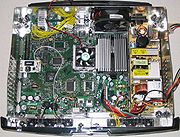 The popularity of the Xbox, as well as (in the United States) its comparatively short 90-day warranty, inspired efforts to circumvent the built-in hardware and software security mechanisms, a practice informally known as modding
. Within a few months of its release the initial layer of security on the Xbox BIOS (which relied heavily on obfuscation) was broken by MIT student Andrew Huang
and the contents of the "hidden" boot ROM embedded on the MCPx chip was extracted using some custom built hardware. Once this information was available, the code was soon modified so that it would skip digital signature checks and media flags, allowing unsigned code, Xbox game backups, etc., to be run. This was possible due to flaws in the Xbox's security. Modding an Xbox in any manner will void its warranty, as it may require disassembly of the console. Having a modified Xbox may also disallow it from accessing Xbox Live, if detected by Microsoft, as it contravenes the Xbox Live Terms of Use, But most modchips can be disabled, allowing the Xbox to boot in a "stock" configuration. Softmods can be disabled by "coldbooting" a game (having the game in the DVD drive before turning the console on, so the softmod is not loaded) or by using a multiboot configuration.
There are four main methods of modding the Xbox:
There are also distributions of Linux developed specifically for the Xbox, including those based on Gentoo
, Debian
, Damn Small Linux
and Dyne:bolic
.
List of alternative operating systems:
History of video game consoles (sixth generation)
The sixth-generation era refers to the computer and video games, video game consoles, and video game handhelds available at the turn of the 21st century. Platforms of the sixth generation include the Sega Dreamcast, Sony PlayStation 2, Nintendo GameCube, and Microsoft Xbox...
video game console
Video game console
A video game console is an interactive entertainment computer or customized computer system that produces a video display signal which can be used with a display device to display a video game...
manufactured by Microsoft
Microsoft
Microsoft Corporation is an American public multinational corporation headquartered in Redmond, Washington, USA that develops, manufactures, licenses, and supports a wide range of products and services predominantly related to computing through its various product divisions...
. It was released on November 15, 2001 in North America, February 22, 2002 in Japan, and March 14, 2002 in Australia and Europe and is the predecessor to the Xbox 360
Xbox 360
The Xbox 360 is the second video game console produced by Microsoft and the successor to the Xbox. The Xbox 360 competes with Sony's PlayStation 3 and Nintendo's Wii as part of the seventh generation of video game consoles...
. It was Microsoft's first foray into the gaming console market, and competed with Sony
Sony
, commonly referred to as Sony, is a Japanese multinational conglomerate corporation headquartered in Minato, Tokyo, Japan and the world's fifth largest media conglomerate measured by revenues....
's PlayStation 2
PlayStation 2
The PlayStation 2 is a sixth-generation video game console manufactured by Sony as part of the PlayStation series. Its development was announced in March 1999 and it was first released on March 4, 2000, in Japan...
, Sega
Sega
, usually styled as SEGA, is a multinational video game software developer and an arcade software and hardware development company headquartered in Ōta, Tokyo, Japan, with various offices around the world...
's Dreamcast, and Nintendo
Nintendo
is a multinational corporation located in Kyoto, Japan. Founded on September 23, 1889 by Fusajiro Yamauchi, it produced handmade hanafuda cards. By 1963, the company had tried several small niche businesses, such as a cab company and a love hotel....
's GameCube
Nintendo GameCube
The , officially abbreviated to NGC in Japan and GCN in other regions, is a sixth generation video game console released by Nintendo on September 15, 2001 in Japan, November 18, 2001 in North America, May 3, 2002 in Europe, and May 17, 2002 in Australia...
. The integrated Xbox Live
Xbox Live
Xbox Live is an online multiplayer gaming and digital media delivery service created and operated by Microsoft Corporation. It is currently the only online gaming service on consoles that charges users a fee to play multiplayer gaming. It was first made available to the Xbox system in 2002...
service allowed players to play games online
Online game
An online game is a game played over some form of computer network. This almost always means the Internet or equivalent technology, but games have always used whatever technology was current: modems before the Internet, and hard wired terminals before modems...
.
The Xbox was discontinued in late 2006, although the final Xbox game, Madden NFL 09
Madden NFL 09
Madden NFL 09 is an American football video game based on the NFL that was published by EA Sports and developed by EA Tiburon. It is the 20th annual installment in the Madden NFL video game franchise. This game is known for its realistic graphics and big hits...
was released in August 2008. Support for out-of-warranty Xbox consoles was discontinued on March 2, 2009; any in-warranty repair now needed will not be undertaken and faulty consoles will be replaced with an Xbox 360 instead. Xbox Live support was discontinued on April 15, 2010.
History
In 1998 four engineers from MicrosoftMicrosoft
Microsoft Corporation is an American public multinational corporation headquartered in Redmond, Washington, USA that develops, manufactures, licenses, and supports a wide range of products and services predominantly related to computing through its various product divisions...
’s DirectX
DirectX
Microsoft DirectX is a collection of application programming interfaces for handling tasks related to multimedia, especially game programming and video, on Microsoft platforms. Originally, the names of these APIs all began with Direct, such as Direct3D, DirectDraw, DirectMusic, DirectPlay,...
team, Kevin Bachus, Seamus Blackley, Ted Hase and DirectX team leader Otto Berkes, disassembled some Dell
Dell
Dell, Inc. is an American multinational information technology corporation based in 1 Dell Way, Round Rock, Texas, United States, that develops, sells and supports computers and related products and services. Bearing the name of its founder, Michael Dell, the company is one of the largest...
laptop computers to construct a prototype
Prototype
A prototype is an early sample or model built to test a concept or process or to act as a thing to be replicated or learned from.The word prototype derives from the Greek πρωτότυπον , "primitive form", neutral of πρωτότυπος , "original, primitive", from πρῶτος , "first" and τύπος ,...
Microsoft Windows
Microsoft Windows
Microsoft Windows is a series of operating systems produced by Microsoft.Microsoft introduced an operating environment named Windows on November 20, 1985 as an add-on to MS-DOS in response to the growing interest in graphical user interfaces . Microsoft Windows came to dominate the world's personal...
-based video game console
Video game console
A video game console is an interactive entertainment computer or customized computer system that produces a video display signal which can be used with a display device to display a video game...
. The team hoped to create a console to compete with the Sony
Sony
, commonly referred to as Sony, is a Japanese multinational conglomerate corporation headquartered in Minato, Tokyo, Japan and the world's fifth largest media conglomerate measured by revenues....
PlayStation 2
PlayStation 2
The PlayStation 2 is a sixth-generation video game console manufactured by Sony as part of the PlayStation series. Its development was announced in March 1999 and it was first released on March 4, 2000, in Japan...
, which was luring game developers away from the Windows platform. The team approached Ed Fries
Ed Fries
Ed Fries was vice president of game publishing at Microsoft during much of the Xbox's lifecycle. He was a prime evangelist of the platform to game developers and had an important role in the acquisition of developers Bungie Studios, Ensemble Studios and Rare....
, the leader of Microsoft’s game publishing business at the time, and pitched their “DirectX Box” console based on the DirectX graphics technology developed by Berkes’ team. Fries decided to support the team’s idea of creating a Windows DirectX based console.
During development, the original DirectX box name was shortened to Xbox. Microsoft’s marketing department did not like the Xbox name, and suggested many alternatives. During focus testing, the Xbox name was left on the list of possible names to demonstrate how unpopular the Xbox name would be with consumers. However, consumer testing revealed that Xbox was preferred by far over the other suggested names and “Xbox” became the official name of the product.
The Xbox was Microsoft
Microsoft
Microsoft Corporation is an American public multinational corporation headquartered in Redmond, Washington, USA that develops, manufactures, licenses, and supports a wide range of products and services predominantly related to computing through its various product divisions...
's first video game console after collaborating with Sega
Sega
, usually styled as SEGA, is a multinational video game software developer and an arcade software and hardware development company headquartered in Ōta, Tokyo, Japan, with various offices around the world...
to port Windows CE to the Dreamcast console. Microsoft repeatedly delayed the console, which was first mentioned publicly in late 1999 during interviews with then-Microsoft CEO Bill Gates. Gates stated that a gaming/multimedia device was essential for multimedia convergence in the new times. When Bill Gates unveiled the Xbox at the Game Developers Conference in 2000, audiences were impressed by the console's technology. At the time of Gates' announcement, Sega's Dreamcast sales were diminishing and Sony's PlayStation 2 was just going on sale in Japan.
Concentrating on making a big splash in Japan, Microsoft delayed its European launch, though Europe later proved to be the more receptive market.
Some of Microsoft's plans proved effective. In preparation for its launch, Microsoft acquired Bungie and used Halo: Combat Evolved
Halo: Combat Evolved
Halo: Combat Evolved, frequently referred to as Halo: CE, or Halo 1, is a first-person shooter video game developed by Bungie and published by Microsoft Game Studios. The first game of the Halo franchise, it was released on November 15, 2001 as a launch title for the Xbox gaming system, and is...
as its launch title. At the time, GoldenEye 007 for Nintendo 64 had been one of the few hit FPS
First-person shooter
First-person shooter is a video game genre that centers the gameplay on gun and projectile weapon-based combat through first-person perspective; i.e., the player experiences the action through the eyes of a protagonist. Generally speaking, the first-person shooter shares common traits with other...
games to appear on a console, some of other ones being Perfect Dark and Medal of Honor. Halo: Combat Evolved proved a good application to drive the Xbox's sales. In 2002, Microsoft made the second place slot in consoles sold in North America.
Popular launch games for the console included Dead or Alive 3
Dead or Alive 3
Dead or Alive 3 is a fighting game in the Dead or Alive series. It was released exclusively on the Xbox as a launch title.-Gameplay:...
, Amped: Freestyle Snowboarding
Amped: Freestyle Snowboarding
Amped: Freestyle Snowboarding is an Xbox exclusive snowboarding video game. It is the first of the Amped video game series....
, Halo: Combat Evolved
Halo: Combat Evolved
Halo: Combat Evolved, frequently referred to as Halo: CE, or Halo 1, is a first-person shooter video game developed by Bungie and published by Microsoft Game Studios. The first game of the Halo franchise, it was released on November 15, 2001 as a launch title for the Xbox gaming system, and is...
, Fuzion Frenzy
Fuzion Frenzy
Fuzion Frenzy is a launch title for the Microsoft Xbox. At its core, Fuzion Frenzy is a four-player party game featuring 45 different mini-games . A demo of the game was included with some other launch titles in the US, including Halo, Munch's Oddysee and Amped...
, Project Gotham Racing
Project Gotham Racing
Project Gotham Racing is a racing game, the first in its series, developed by Bizarre Creations and published by Microsoft Game Studios for the Xbox gaming console, and released on 9th November 2001 in North America, and 14th March 2002 in Europe.The first title in the franchise, Project Gotham...
and Jet Set Radio Future
Jet Set Radio Future
Jet Set Radio Future is a video game developed by Smilebit and the sequel to Jet Set Radio. The game is also known as Jet Grind Radio. It was published by Sega. It was released on February 25, 2002 in the United States, near the beginning of the Xbox's lifespan...
.
Discontinuation and successor
The Xbox's successor, the Xbox 360, was officially unveiled announced on May 12, 2005 on MTVMTV
MTV, formerly an initialism of Music Television, is an American network based in New York City that launched on August 1, 1981. The original purpose of the channel was to play music videos guided by on-air hosts known as VJs....
and released in North America on November 22, 2005. Nvidia
NVIDIA
Nvidia is an American global technology company based in Santa Clara, California. Nvidia is best known for its graphics processors . Nvidia and chief rival AMD Graphics Techonologies have dominated the high performance GPU market, pushing other manufacturers to smaller, niche roles...
ceased production of the Xbox's GPU in August 2005, which marked the end of Xbox production.
When equipped with a removable hard drive add-on, the Xbox 360 supports a limited number of the Xbox's game library through emulation. As the architectures of the Xbox and Xbox 360 are different, software emulation is the only way to enable compatibility without including hardware from the original Xbox. Emulation adds support for anti-aliasing
Anti-aliasing
In digital signal processing, spatial anti-aliasing is the technique of minimizing the distortion artifacts known as aliasing when representing a high-resolution image at a lower resolution...
as well as upscaling of the still standard definition image. These emulators are periodically updated to add compatibility for older games and are available free through Xbox Live or as a file download to be burned to a DVD-R from the Xbox web site. These updates are also available monthly as part of the demo disc that comes with each issue of Official Xbox Magazine
Official Xbox Magazine
Official Xbox Magazine is a monthly video game magazine which started in November 2001 around the launch of the original Xbox. A preview issue was released for E3 2001, with another preview issue for November 2001. The magazine is bundled with a disc that includes game demos, preview videos and...
.
Hardware
The Xbox was the first video game console to feature a built-in hard disk drive, used primarily for storing game saves and content downloaded from Xbox Live. This eliminated the need for separate memory cardMemory card
A memory card or flash card is an electronic flash memory data storage device used for storing digital information. They are commonly used in many electronic devices, including digital cameras, mobile phones, laptop computers, MP3 players, and video game consoles...
s (although some older consoles, such as the TurboGrafx-CD, Sega CD and Sega Saturn
Sega Saturn
The is a 32-bit fifth-generation video game console that was first released by Sega on November 22, 1994 in Japan, May 11, 1995 in North America, and July 8, 1995 in Europe...
had featured built-in battery backup memory prior to 2001). An Xbox user could rip
Ripping
Ripping is the process of copying audio or video content to a hard disk, typically from removable media. The word is used to refer to all forms of media. Despite the name, neither the media nor the data is damaged after extraction....
music from standard audio CDs
Red Book (audio CD standard)
Red Book is the standard for audio CDs . It is named after one of the Rainbow Books, a series of books that contain the technical specifications for all CD and CD-ROM formats.The first edition of the Red Book was released in 1980 by Philips and Sony; it was adopted by the Digital Audio Disc...
to the hard drive, and these songs were used for the custom soundtracks in some games.
The Xbox was the first gaming product to feature Dolby Interactive Content-Encoding Technology, which allows real-time Dolby Digital encoding in game consoles. Previous game consoles could only use Dolby Digital 5.1 during non-interactive "cut scene" playback.
The Xbox is based on commodity PC hardware and is much larger and heavier than its contemporaries. This is largely due to a bulky tray-loading DVD-ROM
DVD
A DVD is an optical disc storage media format, invented and developed by Philips, Sony, Toshiba, and Panasonic in 1995. DVDs offer higher storage capacity than Compact Discs while having the same dimensions....
drive and the standard-size 3.5 inch hard drive. The Xbox has also pioneered safety features, such as breakaway cables for the controllers to prevent the console from being pulled from the surface it rests on.
Several internal hardware revisions have been made in an ongoing battle to discourage modding
Modding
Modding is a slang expression that is derived from the verb "modify". Modding refers to the act of modifying a piece of hardware or software or anything else for that matter, to perform a function not originally conceived or intended by the designer...
(hackers continually updated modchip
Modchip
A modchip is a small electronic device used to modify or disable built-in restrictions and limitations of computers, specifically videogame consoles...
designs in an attempt to defeat them), to cut manufacturing costs, and to make the DVD-ROM drive more reliable (some of the early units' drives gave Disc Reading Errors due to the unreliable Thomson DVD-ROM drives used). Later generation units that used the Thomson TGM-600 DVD-ROM drives and the Philips VAD6011 DVD-ROM drives were still vulnerable to failure that rendered the consoles either unable to read newer discs or caused them to halt the console with an error code usually indicating a PIO
Programmed input/output
Programmed input/output is a method of transferring data between the CPU and a peripheral such as a network adapter or an ATA storage device....
/DMA
Direct memory access
Direct memory access is a feature of modern computers that allows certain hardware subsystems within the computer to access system memory independently of the central processing unit ....
identification failure, respectively. These units were not covered under the extended warranty.
In 2002 Microsoft and Nvidia
NVIDIA
Nvidia is an American global technology company based in Santa Clara, California. Nvidia is best known for its graphics processors . Nvidia and chief rival AMD Graphics Techonologies have dominated the high performance GPU market, pushing other manufacturers to smaller, niche roles...
entered arbitration over a dispute on the pricing of Nvidia's chips for the Xbox. Nvidia's filing with the SEC indicated that Microsoft was seeking a US$13 million discount on shipments for NVIDIA's fiscal year 2002. Microsoft alleged violations of the agreement the two companies entered, sought reduced chipset pricing, and sought to ensure that Nvidia fulfill Microsoft's chipset orders without limits on quantity. The matter was privately settled on February 6, 2003.
Launch-era Xbox gaming units were made in Hungary
Hungary
Hungary , officially the Republic of Hungary , is a landlocked country in Central Europe. It is situated in the Carpathian Basin and is bordered by Slovakia to the north, Ukraine and Romania to the east, Serbia and Croatia to the south, Slovenia to the southwest and Austria to the west. The...
and the controllers made mostly in Indonesia
Indonesia
Indonesia , officially the Republic of Indonesia , is a country in Southeast Asia and Oceania. Indonesia is an archipelago comprising approximately 13,000 islands. It has 33 provinces with over 238 million people, and is the world's fourth most populous country. Indonesia is a republic, with an...
.
Controllers & Accessories
The Xbox controller features two analog stickAnalog stick
An analog stick, sometimes called a control stick or thumbstick, is an input device for a controller that is used for two-dimensional input. An analog stick is a variation of a joystick, consisting of a protrusion from the controller; input is based on the position of this protrusion in relation...
s, a pressure sensitive directional pad, two analog triggers, a Back button, a Start button, two accessory slots and six 8-bit analog action buttons (A/Green, B/Red, X/Blue, Y/Yellow, and Black and White buttons). The standard Xbox controller (also nicknamed the "Fatty" or the "Duke") was originally the controller bundled with Xbox systems for all territories except Japan. The controller has been criticized for being bulky compared to other video game controllers; it was awarded "Blunder of the Year" by Game Informer
Game Informer
Game Informer is an American-based monthly magazine featuring articles, news, strategy, and reviews of popular video games and associated consoles. It was formed in August 1991, when FuncoLand started publishing a six-page magazine, free in all its retail locations...
in 2001, a Guinness World Record for the biggest controller in Guinness World Records Gamer's Edition
Guinness World Records Gamer's Edition
Guinness World Records Gamer's Edition is a Guinness World Records book dedicated to video games. The first edition was released in February 2008 in association with the video games world records' tracking organization Twin Galaxies. The second edition was released in 2009...
2008, and was ranked the second worst video game controller ever by IGN
IGN
IGN is an entertainment website that focuses on video games, films, music and other media. IGN's main website comprises several specialty sites or "channels", each occupying a subdomain and covering a specific area of entertainment...
editor Craig Harris. The "Controller S" (codenamed "Akebono"), a smaller, lighter Xbox controller, was originally the standard Xbox controller only in Japan, designed for users with smaller hands. The "Controller S" was later released in other territories by popular demand and by 2002 replaced the standard controller in the Xbox's retail package, with the larger original controller remaining available as an accessory.
An 8 MB removable solid state
Solid-state drive
A solid-state drive , sometimes called a solid-state disk or electronic disk, is a data storage device that uses solid-state memory to store persistent data with the intention of providing access in the same manner of a traditional block i/o hard disk drive...
memory card
Memory card
A memory card or flash card is an electronic flash memory data storage device used for storing digital information. They are commonly used in many electronic devices, including digital cameras, mobile phones, laptop computers, MP3 players, and video game consoles...
can be plugged into the controllers, onto which game saves can either be copied from the hard drive when in the Xbox dashboard's memory manager or saved during a game. Most Xbox game saves can be copied to the memory unit and moved to another console but some Xbox saves are digitally signed; each console has a unique signing key, and some games (e.g. Ninja Gaiden and Dead or Alive Xtreme Beach Volleyball
Dead or Alive Xtreme Beach Volleyball
is a beach volleyball game by Tecmo released in 2003 exclusively for the Xbox. The game is a departure from the rest of the Dead or Alive series which otherwise consists of fighting games and marks the first game in the series to have a Mature rating due to the very revealing swimsuits featured in...
) will not load saved games signed by a different Xbox, limiting the utility of the memory card. Some game saves can be tagged as uncopyable or simply padded to over 8 MB (Star Wars: Knights of the Old Republic
Star Wars: Knights of the Old Republic
Star Wars: Knights of the Old Republic is a role-playing video game developed by BioWare and published by LucasArts. It was released for the Xbox on July 15, 2003, for Microsoft Windows on November 19, 2003, and on September 7, 2004 for Mac OS X. The Xbox version is playable on Xbox 360 with its...
). The signing mechanism has been reverse-engineered by the Xbox hacking community, who have developed tools to modify savegames to work in a different console, though the signing key of the recipient Xbox (the "HDkey") and the ramped-up title key of the game (the "authkey") must be known. It is also possible to save an Xbox Live account on a memory unit, to simplify its use on more than one Xbox.
The Xbox includes a standard AV cable which provides composite video
Composite video
Composite video is the format of an analog television signal before it is combined with a sound signal and modulated onto an RF carrier. In contrast to component video it contains all required video information, including colors in a single line-level signal...
and monaural
Monaural
Monaural or monophonic sound reproduction is single-channel. Typically there is only one microphone, one loudspeaker, or channels are fed from a common signal path...
or stereo audio
Stereophonic sound
The term Stereophonic, commonly called stereo, sound refers to any method of sound reproduction in which an attempt is made to create an illusion of directionality and audible perspective...
to TVs equipped with RCA
RCA connector
An RCA connector, sometimes called a phono connector or cinch connector, is a type of electrical connector commonly used to carry audio and video signals...
inputs. European Xboxes also included an RCA jack to SCART
SCART
SCART is a French-originated standard and associated 21-pin connector for connecting audio-visual equipment together...
converter block as well as the standard AV cable.
Operating system
The Xbox runs a custom operating systemOperating system
An operating system is a set of programs that manage computer hardware resources and provide common services for application software. The operating system is the most important type of system software in a computer system...
which was once believed to be a modified version of the Windows 2000
Windows 2000
Windows 2000 is a line of operating systems produced by Microsoft for use on personal computers, business desktops, laptops, and servers. Windows 2000 was released to manufacturing on 15 December 1999 and launched to retail on 17 February 2000. It is the successor to Windows NT 4.0, and is the...
kernel
Kernel (computing)
In computing, the kernel is the main component of most computer operating systems; it is a bridge between applications and the actual data processing done at the hardware level. The kernel's responsibilities include managing the system's resources...
. It exposes API
Application programming interface
An application programming interface is a source code based specification intended to be used as an interface by software components to communicate with each other...
s similar to APIs found in Microsoft Windows
Microsoft Windows
Microsoft Windows is a series of operating systems produced by Microsoft.Microsoft introduced an operating environment named Windows on November 20, 1985 as an add-on to MS-DOS in response to the growing interest in graphical user interfaces . Microsoft Windows came to dominate the world's personal...
, such as DirectX
DirectX
Microsoft DirectX is a collection of application programming interfaces for handling tasks related to multimedia, especially game programming and video, on Microsoft platforms. Originally, the names of these APIs all began with Direct, such as Direct3D, DirectDraw, DirectMusic, DirectPlay,...
8.1. The system software may have been based on the Windows NT
Windows NT
Windows NT is a family of operating systems produced by Microsoft, the first version of which was released in July 1993. It was a powerful high-level-language-based, processor-independent, multiprocessing, multiuser operating system with features comparable to Unix. It was intended to complement...
architecture that powered Windows 2000
Windows 2000
Windows 2000 is a line of operating systems produced by Microsoft for use on personal computers, business desktops, laptops, and servers. Windows 2000 was released to manufacturing on 15 December 1999 and launched to retail on 17 February 2000. It is the successor to Windows NT 4.0, and is the...
; it is not a modified version of either.
The user interface
User interface
The user interface, in the industrial design field of human–machine interaction, is the space where interaction between humans and machines occurs. The goal of interaction between a human and a machine at the user interface is effective operation and control of the machine, and feedback from the...
for the Xbox is called the Xbox Dashboard. It features a media player that can be used to play music CDs, rip CDs to the Xbox's built-in hard drive and play music that has been ripped to the hard drive; it also let users manage game saves, music, and downloaded content from Xbox LIVE, and lets Xbox LIVE users sign in and manage their account. The dashboard is only available when the user is not watching a movie or playing a game. It uses many shades of green and black for the user interface, to be consistent with the physical Xbox color scheme. When the Xbox was released in 2001 the LIVE service was not online yet, so the dashboard's LIVE feature was unusable.
Xbox LIVE was released in 2002, but in order to access it users had to buy the Xbox LIVE starter kit containing a headset
Headset (telephone/computer)
A headset is headphones combined with a microphone, or one headphone with a microphone. Headsets provide the equivalent functionality of a telephone handset with hands-free operation. Headsets typically have only one speaker like a telephone, but also come with speakers for both ears...
, a subscription, and supplemental. While the Xbox was still being supported by Microsoft, the Xbox Dashboard was updated via Xbox LIVE several times to reduce cheating and add features.
Xbox Live
On November 15, 2002, Microsoft launched its Xbox Live online gaming service, allowing subscribers to play online Xbox games with other subscribers around the world and download new content directly to the system's hard drive. The online service works only with a broadband
Broadband
The term broadband refers to a telecommunications signal or device of greater bandwidth, in some sense, than another standard or usual signal or device . Different criteria for "broad" have been applied in different contexts and at different times...
Internet connection. Approximately 250,000 subscribers signed up within two months of Xbox Live's launch. In July 2004, Microsoft announced that Xbox Live had reached one million subscribers; in July 2005, membership reached two million, and by July 2007 there were more than 3 million subscribers. By May 2009, the number had ballooned to 20 million current subscribers. On February 5, 2010, Marc Whitten posted on gamerscoreblog that Xbox Live support for the original Xbox games would be discontinued as of April 14, 2010. Services were discontinued on schedule, but a group of 20 gamers continued to play for almost a month afterwards by simply leaving their consoles on connected to Halo 2. APACHE N4SIR was the final user to play on the original Xbox's Live Service and was finally disconnected on at 01:58 EDT
Eastern Time Zone
The Eastern Time Zone of the United States and Canada is a time zone that falls mostly along the east coast of North America. Its UTC time offset is −5 hrs during standard time and −4 hrs during daylight saving time...
(UTC-4).
Games
Halo: Combat Evolved
Halo: Combat Evolved, frequently referred to as Halo: CE, or Halo 1, is a first-person shooter video game developed by Bungie and published by Microsoft Game Studios. The first game of the Halo franchise, it was released on November 15, 2001 as a launch title for the Xbox gaming system, and is...
. Its sequel, Halo 2
Halo 2
Halo 2 is a first-person shooter video game developed by Bungie Studios. Released for the Xbox video game console on November 9, 2004, the game is the second installment in the Halo franchise and the sequel to 2001's critically acclaimed Halo: Combat Evolved...
, is the best-selling Xbox game worldwide. Although there were several more popular second-party launch titles, including NFL Fever 2002
NFL Fever 2002
NFL Fever 2002 is an American Football video game published and developed by Microsoft Game Studios. It was originally released on November 15, 2001, for the Xbox video game console. The game was followed by NFL Fever 2003.- External links :...
, Project Gotham Racing
Project Gotham Racing
Project Gotham Racing is a racing game, the first in its series, developed by Bizarre Creations and published by Microsoft Game Studios for the Xbox gaming console, and released on 9th November 2001 in North America, and 14th March 2002 in Europe.The first title in the franchise, Project Gotham...
, and Dead or Alive 3
Dead or Alive 3
Dead or Alive 3 is a fighting game in the Dead or Alive series. It was released exclusively on the Xbox as a launch title.-Gameplay:...
, the early public reputation of the Xbox was damaged by the failure of Azurik: Rise of Perathia
Azurik: Rise of Perathia
Azurik: Rise of Perathia is an action-adventure game developed by Adrenium Games and published by Microsoft Game Studios in 2001. Azurik was released early in the Xbox console's life and features a score by game composer Jeremy Soule.-Gameplay:...
and other games designed and marketed by Microsoft.
Although the console gained strong third party support from its inception, many early Xbox games did not fully use its powerful hardware, with few additional features or graphical improvements to distinguish them from the PS2 version, thus negating one of the Xbox's main selling points. Sony countered the Xbox for a short time by temporarily securing PlayStation 2 exclusives for highly anticipated games such as the Grand Theft Auto series
Grand Theft Auto (series)
Grand Theft Auto is a multi-award-winning British video game series created in the United Kingdom by Dave Jones, then later by brothers Dan Houser and Sam Houser, and game designer Zachary Clarke. It is primarily developed by Edinburgh based Rockstar North and published by Rockstar Games...
and Metal Gear Solid 2: Sons of Liberty
Metal Gear Solid 2: Sons of Liberty
is a stealth action video game directed by Hideo Kojima, developed by Konami Computer Entertainment Japan and published by Konami for the PlayStation 2 in 2001....
.
In 2002 and 2003, several releases helped the Xbox gain momentum and distinguish itself from the PS2. The Xbox Live
Xbox Live
Xbox Live is an online multiplayer gaming and digital media delivery service created and operated by Microsoft Corporation. It is currently the only online gaming service on consoles that charges users a fee to play multiplayer gaming. It was first made available to the Xbox system in 2002...
online service was launched in late 2002 alongside pilot titles MotoGP, MechAssault
MechAssault
MechAssault was the first BattleMech video game published for the Xbox. Developed by Day 1 Studios and published by Microsoft, MechAssault was initiated when Denny Thorley of Day 1 Studios approached Jon Kimmich of Microsoft about developing an original BattleTech game built from the ground up to...
and Tom Clancy's Ghost Recon
Tom Clancy's Ghost Recon
Tom Clancy's Ghost Recon is a tactical shooter video game developed by Red Storm Entertainment, a Ubisoft subsidiary, and published by Ubisoft in 2001 for the PC. It was ported to the Mac, PlayStation 2 and Xbox in 2002 and to the GameCube in 2003...
. Several best-selling and critically praised titles for the Xbox were published, such as Tom Clancy's Splinter Cell
Tom Clancy's Splinter Cell
Tom Clancy's Splinter Cell is an action-adventure stealth game, developed by Ubisoft Montreal and built on the Unreal Engine 2. It is the first Splinter Cell game in the series endorsed by author Tom Clancy, and follows the activities of American NSA Black Operation, "Black Ops", agent Sam Fisher....
, Ninja Gaiden and LucasArts
LucasArts
LucasArts Entertainment Company, LLC is an American video game developer and publisher. The company was once famous for its innovative line of graphic adventure games, the critical and commercial success of which peaked in the mid 1990s...
' Star Wars: Knights of the Old Republic
Star Wars: Knights of the Old Republic
Star Wars: Knights of the Old Republic is a role-playing video game developed by BioWare and published by LucasArts. It was released for the Xbox on July 15, 2003, for Microsoft Windows on November 19, 2003, and on September 7, 2004 for Mac OS X. The Xbox version is playable on Xbox 360 with its...
. Take-Two Interactive
Take-Two Interactive
Take-Two Interactive Software, Inc. is a major American publisher, developer, and distributor of video games and video game peripherals. Take-Two wholly owns 2K Games and Rockstar Games. The company's headquarters are in New York City, with international headquarters in Windsor, United Kingdom...
's exclusivity deal with Sony
Sony Computer Entertainment
Sony Computer Entertainment, Inc. is a major video game company specializing in a variety of areas in the video game industry, and is a wholly owned subsidiary and part of the Consumer Products & Services Group of Sony...
was amended to allow Grand Theft Auto III
Grand Theft Auto III
Grand Theft Auto III is a 2001 open world action computer and video game developed by DMA Design in the United Kingdom, and published by Rockstar Games. It is the first 3D title in the Grand Theft Auto series. It was released in October 2001 for the PlayStation 2, May 2002 for Microsoft Windows,...
and its sequels
Grand Theft Auto (series)
Grand Theft Auto is a multi-award-winning British video game series created in the United Kingdom by Dave Jones, then later by brothers Dan Houser and Sam Houser, and game designer Zachary Clarke. It is primarily developed by Edinburgh based Rockstar North and published by Rockstar Games...
to be published for the Xbox. Many other publishers got into the trend of releasing the Xbox version alongside the PS2 version, instead of delaying it for months.
In 2004 Halo 2
Halo 2
Halo 2 is a first-person shooter video game developed by Bungie Studios. Released for the Xbox video game console on November 9, 2004, the game is the second installment in the Halo franchise and the sequel to 2001's critically acclaimed Halo: Combat Evolved...
became the highest-grossing release in entertainment history, making over $125 million in its first day and becoming Xbox Live's first killer app
Killer application
A killer application , in the jargon of marketing teams, has been used to refer to any computer program that is so necessary or desirable that it proves the core value of some larger technology, such as computer hardware, gaming console, software, or an operating system...
. That year Microsoft made a deal to put Electronic Arts
Electronic Arts
Electronic Arts, Inc. is a major American developer, marketer, publisher and distributor of video games. Founded and incorporated on May 28, 1982 by Trip Hawkins, the company was a pioneer of the early home computer games industry and was notable for promoting the designers and programmers...
's popular titles on Xbox Live
Xbox Live
Xbox Live is an online multiplayer gaming and digital media delivery service created and operated by Microsoft Corporation. It is currently the only online gaming service on consoles that charges users a fee to play multiplayer gaming. It was first made available to the Xbox system in 2002...
.
The last game released on the Xbox was Madden NFL 09
Madden NFL 09
Madden NFL 09 is an American football video game based on the NFL that was published by EA Sports and developed by EA Tiburon. It is the 20th annual installment in the Madden NFL video game franchise. This game is known for its realistic graphics and big hits...
, on August 12, 2008. It was also the only Xbox game released in 2008.
Technical specifications
- CPUCentral processing unitThe central processing unit is the portion of a computer system that carries out the instructions of a computer program, to perform the basic arithmetical, logical, and input/output operations of the system. The CPU plays a role somewhat analogous to the brain in the computer. The term has been in...
: 32-bit 733 MHzHertzThe hertz is the SI unit of frequency defined as the number of cycles per second of a periodic phenomenon. One of its most common uses is the description of the sine wave, particularly those used in radio and audio applications....
, custom Intel Pentium IIIPentium IIIThe Pentium III brand refers to Intel's 32-bit x86 desktop and mobile microprocessors based on the sixth-generation P6 microarchitecture introduced on February 26, 1999. The brand's initial processors were very similar to the earlier Pentium II-branded microprocessors...
Coppermine-based processor in a Micro-PGA2Micro-PGA2The Micro-PGA2, also known as the μPGA2, is Intel's pin grid array package for their Pentium III and some later Celeron mobile processors. It replaced its predecessor, Micro-PGA1, which was used in Pentium II and early Celeron mobile processors....
package (though soldered to the mainboard using BGABall grid arrayA ball grid array is a type of surface-mount packaging used for integrated circuits.- Description :The BGA is descended from the pin grid array , which is a package with one face covered with pins in a grid pattern. These pins conduct electrical signals from the integrated circuit to the printed...
). 180 nmNanometreA nanometre is a unit of length in the metric system, equal to one billionth of a metre. The name combines the SI prefix nano- with the parent unit name metre .The nanometre is often used to express dimensions on the atomic scale: the diameter...
process.
-
- SSEStreaming SIMD ExtensionsIn computing, Streaming SIMD Extensions is a SIMD instruction set extension to the x86 architecture, designed by Intel and introduced in 1999 in their Pentium III series processors as a reply to AMD's 3DNow! . SSE contains 70 new instructions, most of which work on single precision floating point...
floating pointFloating pointIn computing, floating point describes a method of representing real numbers in a way that can support a wide range of values. Numbers are, in general, represented approximately to a fixed number of significant digits and scaled using an exponent. The base for the scaling is normally 2, 10 or 16...
SIMDSIMDSingle instruction, multiple data , is a class of parallel computers in Flynn's taxonomy. It describes computers with multiple processing elements that perform the same operation on multiple data simultaneously...
. Four single-precision floating point numbers per clock cycle. - MMX integerIntegerThe integers are formed by the natural numbers together with the negatives of the non-zero natural numbers .They are known as Positive and Negative Integers respectively...
SIMD - 133 MHz 64-bit GTL+ front-side bus to GPU
- 32 KBKilobyteThe kilobyte is a multiple of the unit byte for digital information. Although the prefix kilo- means 1000, the term kilobyte and symbol KB have historically been used to refer to either 1024 bytes or 1000 bytes, dependent upon context, in the fields of computer science and information...
L1 cacheCPU cacheA CPU cache is a cache used by the central processing unit of a computer to reduce the average time to access memory. The cache is a smaller, faster memory which stores copies of the data from the most frequently used main memory locations...
. 128 KB on-die L2 cache
- SSE
- Shared memoryShared memoryIn computing, shared memory is memory that may be simultaneously accessed by multiple programs with an intent to provide communication among them or avoid redundant copies. Depending on context, programs may run on a single processor or on multiple separate processors...
subsystem- 64 MBMegabyteThe megabyte is a multiple of the unit byte for digital information storage or transmission with two different values depending on context: bytes generally for computer memory; and one million bytes generally for computer storage. The IEEE Standards Board has decided that "Mega will mean 1 000...
DDR SDRAMDDR SDRAMDouble data rate synchronous dynamic random access memory is a class of memory integrated circuits used in computers. DDR SDRAM has been superseded by DDR2 SDRAM and DDR3 SDRAM, neither of which are either forward or backward compatible with DDR SDRAM, meaning that DDR2 or DDR3 memory modules...
at 200 MHz; in dual-channel 128-bit configuration giving 6400 MBMegabyteThe megabyte is a multiple of the unit byte for digital information storage or transmission with two different values depending on context: bytes generally for computer memory; and one million bytes generally for computer storage. The IEEE Standards Board has decided that "Mega will mean 1 000...
/s - Supplied by HynixHynixHynix Semiconductor Inc. chips and flash memory chips. Founded in 1983, Hynix is the world's second-largest memory chipmaker, the largest being Samsung Electronics. Formerly known as Hyundai Electronics, the company has manufacturing sites in Korea, the U.S., China and Taiwan...
or SamsungSamsung GroupThe Samsung Group is a South Korean multinational conglomerate corporation headquartered in Samsung Town, Seoul, South Korea...
depending on manufacture date and location
- 64 MB
- GPUGraphics processing unitA graphics processing unit or GPU is a specialized circuit designed to rapidly manipulate and alter memory in such a way so as to accelerate the building of images in a frame buffer intended for output to a display...
and system chipsetChipsetA chipset, PC chipset, or chip set refers to a group of integrated circuits, or chips, that are designed to work together. They are usually marketed as a single product.- Computers :...
: 233 MHz "NV2A" ASICApplication-specific integrated circuitAn application-specific integrated circuit is an integrated circuit customized for a particular use, rather than intended for general-purpose use. For example, a chip designed solely to run a cell phone is an ASIC...
. Co-developed by Microsoft and NvidiaNVIDIANvidia is an American global technology company based in Santa Clara, California. Nvidia is best known for its graphics processors . Nvidia and chief rival AMD Graphics Techonologies have dominated the high performance GPU market, pushing other manufacturers to smaller, niche roles...
.- Geometry engine: 115 million verticesVertex (geometry)In geometry, a vertex is a special kind of point that describes the corners or intersections of geometric shapes.-Of an angle:...
/second, 125 million particleParticle systemThe term particle system refers to a computer graphics technique to simulate certain fuzzy phenomena, which are otherwise very hard to reproduce with conventional rendering techniques...
s/second (peak) - 4 pixel pipelines with 2 texture unitsTexture mapping unitA texture mapping unit is a component in modern graphics processing units , historically it is a separate physical processor. A TMU is able to rotate and resize a bitmap to be placed onto an arbitrary plane of a given 3D object as a texture...
each - 932 megapixelPixelIn digital imaging, a pixel, or pel, is a single point in a raster image, or the smallest addressable screen element in a display device; it is the smallest unit of picture that can be represented or controlled....
s/second (233 MHz × 4 pipelines), 1,864 megatexelsTexel (graphics)A texel, or texture element is the fundamental unit of texture space, used in computer graphics. Textures are represented by arrays of texels, just as pictures are represented by arrays of pixels....
/second (932 MP × 2 texture units) (peak)- Peak triangle performance (32pixel divided from filrate): 29,125,000 32-pixel triangles/s raw or w. 2 textures and lit.
- 485,416 triangles per frame at 60 frame/s
- 970,833 triangles per frame at 30 frame/s
- Peak triangle performance (32pixel divided from filrate): 29,125,000 32-pixel triangles/s raw or w. 2 textures and lit.
- 8 textures per pass, texture compressionS3 Texture CompressionS3 Texture Compression is a group of related lossy texture compression algorithms originally developed by Iourcha et al. of S3 Graphics, Ltd. for use in their Savage 3D computer graphics accelerator...
, full scene anti-aliasingAnti-aliasingIn digital signal processing, spatial anti-aliasing is the technique of minimizing the distortion artifacts known as aliasing when representing a high-resolution image at a lower resolution...
(NV QuincunxQuincunxA quincunx is a geometric pattern consisting of five points arranged in a cross, that is five coplanar points, four of them forming a square or rectangle and a fifth at its center...
, supersamplingSupersamplingSupersampling is an antialiasing technique, the process of eliminating jagged and pixelated edges . It is a method of smoothing images rendered in computer games or other programs that generate imagery.-Overview:...
, multisamplingMultisample Anti-AliasingMultisample anti-aliasing is a type of anti-aliasing, a technique used in computer graphics to improve image quality.- Definition :The term generally refers to a special case of supersampling. Initial implementations of full-scene anti-aliasing worked conceptually by simply rendering a scene at a...
) - BilinearBilinear filteringBilinear filtering is a texture filtering method used to smooth textures when displayed larger or smaller than they actually are.Most of the time, when drawing a textured shape on the screen, the texture is not displayed exactly as it is stored, without any distortion...
, trilinearTrilinear filteringTrilinear filtering is an extension of the bilinear texture filtering method, which also performs linear interpolation between mipmaps.Bilinear filtering has several weaknesses that make it an unattractive choice in many cases: using it on a full-detail texture when scaling to a very small size...
, and anisotropicAnisotropic filteringIn 3D computer graphics, anisotropic filtering is a method of enhancing the image quality of textures on surfaces that are at oblique viewing angles with respect to the camera where the projection of the texture appears to be non-orthogonal In 3D computer graphics, anisotropic filtering...
texture filteringTexture filteringIn computer graphics, texture filtering or texture smoothing is the method used to determine the texture color for a texture mapped pixel, using the colors of nearby texels . Mathematically, texture filtering is a type of anti-aliasing, but it filters out high frequencies from the texture fill... - Similar to the GeForce 3 Ti500 PC GPU in performance
- Geometry engine: 115 million vertices
- Storage media
- 2×–5× (2.6 MB/s–6.6 MB/s) CAVConstant angular velocityIn optical storage, constant angular velocity is a qualifier for the rated speed of an optical disc drive, and may also be applied to the writing speed of recordable discs...
DVD-ROMDVDA DVD is an optical disc storage media format, invented and developed by Philips, Sony, Toshiba, and Panasonic in 1995. DVDs offer higher storage capacity than Compact Discs while having the same dimensions.... - 8 or 10 GBGigabyteThe gigabyte is a multiple of the unit byte for digital information storage. The prefix giga means 109 in the International System of Units , therefore 1 gigabyte is...
, 3.5 in, 5,400 RPMRevolutions per minuteRevolutions per minute is a measure of the frequency of a rotation. It annotates the number of full rotations completed in one minute around a fixed axis...
hard disk. FormattedDisk formattingDisk formatting is the process of preparing a hard disk drive or flexible disk medium for data storage. In some cases, the formatting operation may also create one or more new file systems...
to 8 GB. FATX file systemFile systemA file system is a means to organize data expected to be retained after a program terminates by providing procedures to store, retrieve and update data, as well as manage the available space on the device which contain it. A file system organizes data in an efficient manner and is tuned to the...
. - Optional 8 MB memory card for saved game file transfer.
- 2×–5× (2.6 MB/s–6.6 MB/s) CAV
- Audio processor: NVIDIA "MCPX" (a.k.a. SoundStormSoundStormSoundStorm was an advanced integrated 5.1 sound technology certification developed by Nvidia for the nForce and nForce2 platforms based on the nForce audio processing unit .-Certification:...
"NVAPU")- 64 3D sound channels (up to 256 stereoStereophonic soundThe term Stereophonic, commonly called stereo, sound refers to any method of sound reproduction in which an attempt is made to create an illusion of directionality and audible perspective...
voices) - HRTFHead-related transfer functionA head-related transfer function is a response that characterizes how an ear receives a sound from a point in space; a pair of HRTFs for two ears can be used to synthesize a binaural sound that seems to come from a particular point in space. Some consumer home entertainment products designed to...
SensauraSensauraSensaura, a division of Creative Technology, provides sophisticated 3D audio technology for the interactive entertainment industry.Following its origin as a research project at THORN EMI Central Research Laboratories in 1991, Sensaura evolved to become the leading worldwide supplier of 3D audio...
3D enhancement - MIDIMusical Instrument Digital InterfaceMIDI is an industry-standard protocol, first defined in 1982 by Gordon Hall, that enables electronic musical instruments , computers and other electronic equipment to communicate and synchronize with each other...
DLS2 Support - MonauralMonauralMonaural or monophonic sound reproduction is single-channel. Typically there is only one microphone, one loudspeaker, or channels are fed from a common signal path...
, StereoStereophonic soundThe term Stereophonic, commonly called stereo, sound refers to any method of sound reproduction in which an attempt is made to create an illusion of directionality and audible perspective...
, Dolby SurroundDolby SurroundDolby Surround was the earliest consumer version of Dolby's multichannel analog film sound decoding format Dolby Stereo introduced to the public in 1982 during the time home video recording formats were introducing Stereo and HiFi capability...
, Dolby Digital Live 5.1Dolby DigitalDolby Digital is the name for audio compression technologies developed by Dolby Laboratories. It was originally called Dolby Stereo Digital until 1994. Except for Dolby TrueHD, the audio compression is lossy. The first use of Dolby Digital was to provide digital sound in cinemas from 35mm film prints...
, and DTS Surround (DVD movies only) audio output options
- 64 3D sound channels (up to 256 stereo
- Integrated 10/100BASE-TX wired ethernetEthernetEthernet is a family of computer networking technologies for local area networks commercially introduced in 1980. Standardized in IEEE 802.3, Ethernet has largely replaced competing wired LAN technologies....
- DVD movie playback (Add-on required)
- A/V outputs: composite videoComposite videoComposite video is the format of an analog television signal before it is combined with a sound signal and modulated onto an RF carrier. In contrast to component video it contains all required video information, including colors in a single line-level signal...
, S-VideoS-VideoSeparate Video, more commonly known as S-Video and Y/C, is often referred to by JVC as both an S-VHS connector and as Super Video. It is an analog video transmission scheme, in which video information is encoded on two channels: luma and chroma...
, component videoComponent videoComponent video is a video signal that has been split into two or more component channels. In popular use, it refers to a type of component analog video information that is transmitted or stored as three separate signals...
, SCARTSCARTSCART is a French-originated standard and associated 21-pin connector for connecting audio-visual equipment together...
, Digital Optical TOSLINKTOSLINKTOSLINK is a standardized optical fiber connection system. Also known generically as an "optical audio cable," its most common use is in consumer audio equipment , where it carries a digital audio stream from components such as MiniDisc, CD and DVD players, DAT recorders, computers, and modern...
, and stereo RCA analog audioRCA connectorAn RCA connector, sometimes called a phono connector or cinch connector, is a type of electrical connector commonly used to carry audio and video signals... - Resolutions: 480i480i480i is the shorthand name for a video mode, namely the US NTSC television system or digital television systems with the same characteristics. The i, which is sometimes uppercase, stands for interlaced, the 480 for a vertical frame resolution of 480 lines containing picture information; while NTSC...
, 480p480p480p is the shorthand name for a video display resolution. The p stands for progressive scan, i.e. non-interlaced. The 480 denotes a vertical resolution of 480 pixel high vertically scanning lines, usually with a horizontal resolution of 640 pixels and 4:3 aspect ratio or a horizontal resolution of...
, 576i576i576i is a standard-definition video mode used in PAL and SECAM countries. In digital applications it is usually referred to as "576i", in analogue contexts it is often quoted as "625 lines"...
, 576p576p576p is the shorthand name for a video display resolution. The p stands for progressive scan, i.e. non-interlaced, the 576 for a vertical resolution of 576 lines, usually with a horizontal resolution of 720 or 704 pixels. The frame rate can be given explicitly after the letter.-576p25:In other...
, 720p720p720p is the shorthand name for 1280x720, a category of High-definition television video modes having a resolution of 1080 or 720p and a progressive scan...
, 1080i1080i1080i is the shorthand name for a high-definition television mode. The i means interlaced video; 1080i differs from 1080p, in which the p stands for progressive scan. The term 1080i assumes a widescreen aspect ratio of 16:9, implying a frame size of 1920×1080 pixels... - Controller ports: 4 proprietary USBUniversal Serial BusUSB is an industry standard developed in the mid-1990s that defines the cables, connectors and protocols used in a bus for connection, communication and power supply between computers and electronic devices....
1.1 ports - Weight: 3.86 kg (8.5 lbPound (mass)The pound or pound-mass is a unit of mass used in the Imperial, United States customary and other systems of measurement...
) - Dimensions: 320 × 100 × 260 mm (12.5 × 4 × 10.5 in)
Sales
| Region | Units sold (as of May 10, 2006) |
First available |
|---|---|---|
| North America | 16 million | November 15, 2001 |
| Europe | 6 million | March 14, 2002 |
| Asia | 2 million | February 22, 2002 |
| Worldwide | 24 million |
On November 15, 2001, Xbox launched in North America and quickly sold out.
The Xbox has sold 24 million units worldwide as of May 10, 2006, according to Microsoft. This is divided out to 16 million units sold in North America, six million units in Europe, and two million units sold in Asia.
UK advertising controversy
In 2002 the Independent Television CommissionIndependent Television Commission
The Independent Television Commission licensed and regulated commercial television services in the United Kingdom between 1 January 1991 and 28 December 2003....
(ITC) banned a television advertisement for the Xbox in the United Kingdom
United Kingdom
The United Kingdom of Great Britain and Northern IrelandIn the United Kingdom and Dependencies, other languages have been officially recognised as legitimate autochthonous languages under the European Charter for Regional or Minority Languages...
after complaints that it was highly distasteful, violent, scary and upsetting. It depicted a mother giving birth to a small boy who was fired like a projectile through a hospital window and who aged rapidly as he flew through the air yelling. As he soared across a large area, he passed quickly through stages of his life as though time was passing him by. After aging into an old man, he crash-landed into his own grave. Dust and smoke poured from the grave. The advertisement ended with the slogan Life is short. Play more.
Modding
Modding
Modding is a slang expression that is derived from the verb "modify". Modding refers to the act of modifying a piece of hardware or software or anything else for that matter, to perform a function not originally conceived or intended by the designer...
. Within a few months of its release the initial layer of security on the Xbox BIOS (which relied heavily on obfuscation) was broken by MIT student Andrew Huang
Andrew Huang
Andrew "bunnie" Huang is an American hacker, who holds a Ph.D in electrical engineering from MIT and is the author of the 2003 book Hacking the Xbox: An Introduction to Reverse Engineering...
and the contents of the "hidden" boot ROM embedded on the MCPx chip was extracted using some custom built hardware. Once this information was available, the code was soon modified so that it would skip digital signature checks and media flags, allowing unsigned code, Xbox game backups, etc., to be run. This was possible due to flaws in the Xbox's security. Modding an Xbox in any manner will void its warranty, as it may require disassembly of the console. Having a modified Xbox may also disallow it from accessing Xbox Live, if detected by Microsoft, as it contravenes the Xbox Live Terms of Use, But most modchips can be disabled, allowing the Xbox to boot in a "stock" configuration. Softmods can be disabled by "coldbooting" a game (having the game in the DVD drive before turning the console on, so the softmod is not loaded) or by using a multiboot configuration.
There are four main methods of modding the Xbox:
- ModchipModchipA modchip is a small electronic device used to modify or disable built-in restrictions and limitations of computers, specifically videogame consoles...
: installing a modchip inside the Xbox that bypasses the original BIOS, with a hacked BIOS to circumvent the security mechanisms. - TSOPThin small-outline packageThin small-outline packages, or TSOPs are a type of surface mount IC package. They are notably very low-profile and have tight lead spacing ....
flashing: reflashing the onboard BIOS chip with a hacked BIOS to circumvent the security mechanisms. The Xbox BIOS is contained on a commodity EEPROMEEPROMEEPROM stands for Electrically Erasable Programmable Read-Only Memory and is a type of non-volatile memory used in computers and other electronic devices to store small amounts of data that must be saved when power is removed, e.g., calibration...
(the 'TSOP'), which can be made writable by the Xbox by bridging points on the motherboard. Flashing is usually carried out by using a specially crafted gamesave (see 'Game save exploit', below) to flash the onboard TSOP, but the TSOP can also be de-soldered and re-written in a standard EEPROM programmer. This method only works on 1.0 to 1.5 Xboxes, as later versions replace the commodity TSOP with an LPC ROM contained within a proprietary chip. - SoftmodSoftmodA softmod is a method of using software to modify the intended behaviour of hardware, such as video cards, sound cards, or game consoles in a way that can overcome restrictions of the firmware, or install custom firmware.-Video card softmods:...
s: installing additional software files to the Xbox hard drive, which exploit programming errors in the Dashboard to gain control of the system, and overwrite the in-memory copy of the BIOS. Soft modification is known to be safe for Xbox Live if the user enables multibooting with the Microsoft dashboard and an original game disc is used. (See also: Xbox softmodsXbox softmodsXbox softmod is a term used to refer to modifying a Xbox without altering the hardware ....
)- Game save exploit: using select official game releases to load game saves that exploit buffer overflows in the save game handling. When these special game saves are loaded, they access an interface with scripts for installing the necessary softmod files. Disassembly of the Xbox is not required when installing most game save exploits.
- Hot swappingHot swappingHot swapping and hot plugging are terms used to describe the functions of replacing computer system components without shutting down the system...
: using a computer to change the data on the hard drive. This requires having the Xbox unlock the hard drive when it is turned on, then swapping the powered hard drive into a running computer. By using a Linux-based Live CD, data on the hard drive can be read, altered, and deleted. In most cases, an automated script will automatically install the softmod files directly to the Xbox hard drive. This technique has been used extensively to harbor cheating on many online games. Disassembly of the console is required to perform a hot swap.
Alternative operating systems
Beyond gaming, a modded Xbox can be used as a media center with XBMC.There are also distributions of Linux developed specifically for the Xbox, including those based on Gentoo
Gentoo Linux
Gentoo Linux is a computer operating system built on top of the Linux kernel and based on the Portage package management system. It is distributed as free and open source software. Unlike a conventional software distribution, the user compiles the source code locally according to their chosen...
, Debian
Debian
Debian is a computer operating system composed of software packages released as free and open source software primarily under the GNU General Public License along with other free software licenses. Debian GNU/Linux, which includes the GNU OS tools and Linux kernel, is a popular and influential...
, Damn Small Linux
Damn Small Linux
Damn Small Linux or DSL is a computer operating system for the x86 family of personal computers. It is free and open source software under the terms of GNU GPL and other free and open source licenses. It was designed to run graphical applications on older PC hardware—for example, machines with...
and Dyne:bolic
Dyne:bolic
dyne:bolic is a Live CD/DVD based on the Linux kernel with a focus on multimedia production, and is distributed with a large assortment of applications for audio and video manipulation...
.
List of alternative operating systems:
- Xbox LinuxXbox LinuxXbox Linux is a project that ported the Linux operating system to the Xbox video game console. Because the Xbox uses a digital signature system to prevent the public from running unsigned code, one must either use a modchip, or a softmod. Originally, modchips were the only option; however, it was...
is a project that ported LinuxLinuxLinux is a Unix-like computer operating system assembled under the model of free and open source software development and distribution. The defining component of any Linux system is the Linux kernel, an operating system kernel first released October 5, 1991 by Linus Torvalds...
to the Xbox. - FreeBSDFreeBSDFreeBSD is a free Unix-like operating system descended from AT&T UNIX via BSD UNIX. Although for legal reasons FreeBSD cannot be called “UNIX”, as the direct descendant of BSD UNIX , FreeBSD’s internals and system APIs are UNIX-compliant...
and NetBSDNetBSDNetBSD is a freely available open source version of the Berkeley Software Distribution Unix operating system. It was the second open source BSD descendant to be formally released, after 386BSD, and continues to be actively developed. The NetBSD project is primarily focused on high quality design,...
have also been ported to Xbox. - Windows CE
- ReactOSReactOSReactOS is an open source computer operating system intended to be binary compatible with application software and device drivers made for Microsoft Windows NT versions 5.x and up...
- A partial port of Windows XPWindows XPWindows XP is an operating system produced by Microsoft for use on personal computers, including home and business desktops, laptops and media centers. First released to computer manufacturers on August 24, 2001, it is the second most popular version of Windows, based on installed user base...
is available on some modding websites but this usually involves removing the CPU and resoldering a different Pentium III as well as a heavily modified bios. One advantage over a regular, unmodded Xbox, is the ability to use a trainer.