


Hot swapping

Encyclopedia
Hot swapping and hot plugging are terms used to describe the functions of replacing computer system components without shutting down the system. More specifically, hot swapping describes replacing components without significant interruption to the system, while hot plugging describes the addition of components that would expand the system without significant interruption to the operation of the system.
Once the appropriate software is installed on the computer, a user can plug and unplug the component without rebooting
. A well-known example of this functionality is the Universal Serial Bus
(USB) that allows users to add or remove peripheral components such as a mouse, keyboard, or printer.
Hot swapping may be used to add or remove peripherals or components, to allow a device to synchronize data with a computer, and to replace faulty modules without interrupting equipment operation.
Equipment may be designed with redundancy
so that in the event of the failure of a component, other parts of the system carry out its functions while the faulty component is removed and a replacement connected. For example, computer RAID
disk arrays allow a faulty disk to be hot-swapped for a new one; the new one is configured to become part of the array automatically or by user command. A machine may have dual power supplies
, each adequate to power the machine; a faulty one may be hot-swapped.
Hot swapping can also be used as a means for circumventing security measures preventing the execution of unsigned code, a common example of this is hot swapping the Microsoft Xbox Console hard drive.
Additional guide slots, pins, notches, or holes may be used to aid in proper insertion of a component between other live components, while mechanical engagement latches, handles, or levers may be used to assist in proper insertion and removal of devices that either require large amounts of force to connect or disconnect, or to assist in the proper mating and holding together of power and communications connectors.
and lower-end SCSI
devices. This is sometimes called cold plugging. However, if the system can detect and respond to addition or removal of hardware, it is referred to as true hot plugging. Examples include USB, FireWire and higher-end SCSI
devices.
Some implementations require a component shutdown procedure prior to removal. This simplifies the design, but such devices are not robust in the case of component failure. If a component is removed while it is being used, the operations to that device fail and the user is responsible for retrying if necessary, although this is not usually considered to be a problem.
More complex implementations may recommend but do not require that the component be shut down, with sufficient redundancy
in the system to allow operation to continue if a component is removed without being shut down. In these systems hot swap is normally used for regular maintenance to the computer, or to replace a broken component.
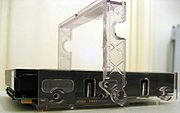 Most modern hot-swap methods use a specialized connector with staggered pins, so that certain pins are certain to be connected before others. Most staggered-pin designs have ground pins longer than the others, ensuring that no sensitive circuitry is connected before there is a reliable system ground. The other pins may all be the same length, but in some cases three pin lengths are used so that the incoming device is grounded first, data lines connected second, and power applied third, in rapid succession as the device is inserted.
At one time staggered pins were thought to be an expensive solution, but many contemporary connector families now come with staggered pins as standard; for example, they are used on all modern serial SCSI disk-drives. Specialized hot-plug power connector pins are now commercially available with repeatable DC current interruption ratings of up to 16 A. Printed circuit board
s are made with staggered edge-fingers for direct hot-plugging into a backplane connector.
Although the speed of plugging cannot be controlled precisely, practical considerations will provide limits that can be used to determine worst-case conditions. For a typical staggered pin design where the length difference is 0.5 mm, the elapsed time between long and short pin contact is between 25 ms and 250 ms. It is quite practical to design hot-swap circuits that can operate over that dynamic range. Pins of the same nominal length do not necessarily make contact at exactly the same time due to mechanical tolerances, and angling of the connector when inserted.
As long as the hot-swap connector is sufficiently rigid, one of the four corner pins will always be the first to engage. For a typical two-row connector arrangement this provides four first-to-make corner pins that are usually used for grounds. Other pins near the corners can be used for functions that would also benefit from this effect, for example sensing when the connector is fully seated. This diagram illustrates good practice where the grounds are in the corners and the power pins are near the center. Two sense pins are located in opposite corners so that fully seated detection is confirmed only when both of them are in contact with the slot. The remaining pins are used for all the other data signals.
d by dedicated long pins that make contact before the main power pins. These pre-charge pins are protected by a circuit that limits the inrush current to an acceptable value that cannot damage the pins nor disturb the supply voltage to adjacent slots. The pre-charge circuit might be a simple series resistor, a negative temperature coefficient (NTC) resistor, or a current-limiter circuit. Further protection can be provided by a "soft-start" circuit that provides a managed ramp-up of the internal DC supply voltages within the component.
A typical sequence for a hot-swap component being plugged into a slot could be as follows:
Hot-swap power circuits can now be purchased commercially in specially designed ASICs
called hot-swap power managers (HSPMs).
In the mid-1990s, several radio transmitter manufactures in the US started offering swappable high power RF transistor modules.
The reintroduction of power modules has been good for the radio transmitter industry, as it has fostered innovation. Modular transmitters have proven to be more reliable than tube transmitters, when the transmitter is properly chosen for the conditions at the transmitting site.
Power limitations
Companies that produce transmitters using power modules
(ESD). This usually takes the form of clamp diodes to ground and to the DC power supply voltage. ESD effects can be reduced by careful design of the mechanical package around the hot-swap component, perhaps by coating it with a thin film of conductive material.
Particular care must be taken when designing systems with bussed signals which are wired to more than one hot-swap component. When a hot-swap component is inserted its input and output signal pins will represent a temporary short-circuit to ground. This can cause unwanted ground-level pulses on the signals which can disturb the operation of other hot-swap components in the system. This was a problem for early parallel SCSI
disk-drives. One common design solution is to protect bussed signal pins with series diodes or resistors. CMOS buffer devices are now available with specialized inputs and outputs that minimize disturbance of bussed signals during the hot-swap operation. If all else fails, another solution is to quiesce
the operation of all components during the hot-swap operation.
It was supposedly the aforementioned reason Stop 'N' Swop was taken out of the Banjo-Kazooie series.
is a programming paradigm
that makes extensive use of hot swapping, so the programming activity becomes part of the program flow itself.
Only a few programming language
s support hot swapping natively, including Pike, Lisp, Erlang, Smalltalk
, and Java
. Microsoft Visual Studio
supports a kind of hot swapping called Edit and Continue, which is supported by C#, VB.NET and C
/C++
when running under a debugger.
Some web-based frameworks, such as Django, support detecting module changes and reloading them on the fly. However, although the same as hotswapping for most intents and purposes, this is technically just a cache
purge, triggered by a new file. Note that this does not apply to markup and programming languages such as HTML
and PHP
respectively, in the general case, as these file are normally re-interpreted on each use by default. There are a few CMS
's and other PHP-based frameworks (such as Drupal
) that employ caching, however. In these cases, similar abilities and exceptions apply.
Hot swapping also facilitates developing systems where large amounts of data are being processed, as in entire genomes in bioinformatics algorithms.
Once the appropriate software is installed on the computer, a user can plug and unplug the component without rebooting
Booting
In computing, booting is a process that begins when a user turns on a computer system and prepares the computer to perform its normal operations. On modern computers, this typically involves loading and starting an operating system. The boot sequence is the initial set of operations that the...
. A well-known example of this functionality is the Universal Serial Bus
Universal Serial Bus
USB is an industry standard developed in the mid-1990s that defines the cables, connectors and protocols used in a bus for connection, communication and power supply between computers and electronic devices....
(USB) that allows users to add or remove peripheral components such as a mouse, keyboard, or printer.
Reasons for hot-swapping
Hot swapping is used whenever it is desirable to change the configuration or repair a working system without interrupting its operation. It may simply be for convenience, to avoid the delay and nuisance of shutting down and then restarting complex equipment, or because it is essential that the equipment be permanently available.Hot swapping may be used to add or remove peripherals or components, to allow a device to synchronize data with a computer, and to replace faulty modules without interrupting equipment operation.
Equipment may be designed with redundancy
Redundancy (engineering)
In engineering, redundancy is the duplication of critical components or functions of a system with the intention of increasing reliability of the system, usually in the case of a backup or fail-safe....
so that in the event of the failure of a component, other parts of the system carry out its functions while the faulty component is removed and a replacement connected. For example, computer RAID
RAID
RAID is a storage technology that combines multiple disk drive components into a logical unit...
disk arrays allow a faulty disk to be hot-swapped for a new one; the new one is configured to become part of the array automatically or by user command. A machine may have dual power supplies
Power supply
A power supply is a device that supplies electrical energy to one or more electric loads. The term is most commonly applied to devices that convert one form of electrical energy to another, though it may also refer to devices that convert another form of energy to electrical energy...
, each adequate to power the machine; a faulty one may be hot-swapped.
Hot swapping can also be used as a means for circumventing security measures preventing the execution of unsigned code, a common example of this is hot swapping the Microsoft Xbox Console hard drive.
System considerations
Machines that support hot swapping need to be able to modify their operation for the changed configuration, either automatically on detecting the change, or by user intervention. All electrical and mechanical connections associated with hot-swapping must be designed so that neither the equipment nor the user can be harmed while hot-swapping. Other components in the system must be designed so that the removal of a hot-swappable component does not interrupt operation.Mechanical design
Protective covering plates, shields, or bezels may be used on either the removable components or the overall system chassis, to prevent operator contact with live powered circuitry, to provide antistatic protection for components being added or removed, or to prevent the removable components from accidentally touching and shorting out the powered components in the operating device.Additional guide slots, pins, notches, or holes may be used to aid in proper insertion of a component between other live components, while mechanical engagement latches, handles, or levers may be used to assist in proper insertion and removal of devices that either require large amounts of force to connect or disconnect, or to assist in the proper mating and holding together of power and communications connectors.
System/Operational design
There are two slightly differing meanings of the term hot swapping. It may refer only to the ability to add or remove hardware without powering down the system, while the system software may have to be notified by the user of the event in order to cope with it. Examples include RS-232RS-232
In telecommunications, RS-232 is the traditional name for a series of standards for serial binary single-ended data and control signals connecting between a DTE and a DCE . It is commonly used in computer serial ports...
and lower-end SCSI
SCSI
Small Computer System Interface is a set of standards for physically connecting and transferring data between computers and peripheral devices. The SCSI standards define commands, protocols, and electrical and optical interfaces. SCSI is most commonly used for hard disks and tape drives, but it...
devices. This is sometimes called cold plugging. However, if the system can detect and respond to addition or removal of hardware, it is referred to as true hot plugging. Examples include USB, FireWire and higher-end SCSI
SCSI
Small Computer System Interface is a set of standards for physically connecting and transferring data between computers and peripheral devices. The SCSI standards define commands, protocols, and electrical and optical interfaces. SCSI is most commonly used for hard disks and tape drives, but it...
devices.
Some implementations require a component shutdown procedure prior to removal. This simplifies the design, but such devices are not robust in the case of component failure. If a component is removed while it is being used, the operations to that device fail and the user is responsible for retrying if necessary, although this is not usually considered to be a problem.
More complex implementations may recommend but do not require that the component be shut down, with sufficient redundancy
Redundancy (engineering)
In engineering, redundancy is the duplication of critical components or functions of a system with the intention of increasing reliability of the system, usually in the case of a backup or fail-safe....
in the system to allow operation to continue if a component is removed without being shut down. In these systems hot swap is normally used for regular maintenance to the computer, or to replace a broken component.
Connectors
At one time staggered pins were thought to be an expensive solution, but many contemporary connector families now come with staggered pins as standard; for example, they are used on all modern serial SCSI disk-drives. Specialized hot-plug power connector pins are now commercially available with repeatable DC current interruption ratings of up to 16 A. Printed circuit board
Printed circuit board
A printed circuit board, or PCB, is used to mechanically support and electrically connect electronic components using conductive pathways, tracks or signal traces etched from copper sheets laminated onto a non-conductive substrate. It is also referred to as printed wiring board or etched wiring...
s are made with staggered edge-fingers for direct hot-plugging into a backplane connector.
Although the speed of plugging cannot be controlled precisely, practical considerations will provide limits that can be used to determine worst-case conditions. For a typical staggered pin design where the length difference is 0.5 mm, the elapsed time between long and short pin contact is between 25 ms and 250 ms. It is quite practical to design hot-swap circuits that can operate over that dynamic range. Pins of the same nominal length do not necessarily make contact at exactly the same time due to mechanical tolerances, and angling of the connector when inserted.
As long as the hot-swap connector is sufficiently rigid, one of the four corner pins will always be the first to engage. For a typical two-row connector arrangement this provides four first-to-make corner pins that are usually used for grounds. Other pins near the corners can be used for functions that would also benefit from this effect, for example sensing when the connector is fully seated. This diagram illustrates good practice where the grounds are in the corners and the power pins are near the center. Two sense pins are located in opposite corners so that fully seated detection is confirmed only when both of them are in contact with the slot. The remaining pins are used for all the other data signals.
Power electronics
The DC power supplies to a hot-swap component are usually pre-chargePre-charge
Pre-charge of the powerline voltages in a high voltage DC application is a preliminary mode which current-limits the power source such that a controlled rise time of the system voltage during power up is achieved....
d by dedicated long pins that make contact before the main power pins. These pre-charge pins are protected by a circuit that limits the inrush current to an acceptable value that cannot damage the pins nor disturb the supply voltage to adjacent slots. The pre-charge circuit might be a simple series resistor, a negative temperature coefficient (NTC) resistor, or a current-limiter circuit. Further protection can be provided by a "soft-start" circuit that provides a managed ramp-up of the internal DC supply voltages within the component.
A typical sequence for a hot-swap component being plugged into a slot could be as follows:
- Long ground pins make contact; basic electrical safety and ESD protection becomes available.
- Long (or medium) pre-charge pins make contact; decoupling capacitors start to charge up.
- Real time delay of tens of milliseconds.
- Short power/signal pins make contact.
- Connector becomes fully seated; power-on reset signal asserted within component
- Soft-start circuit starts to apply power to the component.
- Real time delay of tens of milliseconds.
- Soft-start circuit completes sequence; power-on reset circuit deasserted
- Component begins normal operation.
Hot-swap power circuits can now be purchased commercially in specially designed ASICs
Application-specific integrated circuit
An application-specific integrated circuit is an integrated circuit customized for a particular use, rather than intended for general-purpose use. For example, a chip designed solely to run a cell phone is an ASIC...
called hot-swap power managers (HSPMs).
Radio transmitters
Modern day radio transmitters (and some TV transmitters as well) use high power RF transistor power modules instead of tubes. Hot swapping power modules is not a new technology, as many of the radio transmitters manufactured in the 1930s were capable of having power tubes swapped out while the transmitter was running—but this feature was not universally adopted due to the introduction of more reliable high power tubes.In the mid-1990s, several radio transmitter manufactures in the US started offering swappable high power RF transistor modules.
- There was no industry standard for the design of the swappable power modules at the time.
- Early module designs had only limited patent protection.
- By the early 2000s, many transmitter models were available that used many different kinds of power modules.
The reintroduction of power modules has been good for the radio transmitter industry, as it has fostered innovation. Modular transmitters have proven to be more reliable than tube transmitters, when the transmitter is properly chosen for the conditions at the transmitting site.
Power limitations
- lowest power modular transmitter: generally 1.0 kW, using 600 W modules.
- highest power modular transmitter: 1.0 MW (for LWLongwaveIn radio, longwave refers to parts of radio spectrum with relatively long wavelengths. The term is a historic one dating from the early 20th century, when the radio spectrum was considered to consist of long, medium and short wavelengths...
, MWMediumwaveMedium wave is the part of the medium frequency radio band used mainly for AM radio broadcasting. For Europe the MW band ranges from 526.5 kHz to 1606.5 kHz...
). - highest power modular transmitter: 45 kW (FM, TV).
Companies that produce transmitters using power modules
- Harris Broadcast (US)
- Telefunken (Germany)
- Thales (Western Europe)
- RIZ (Croatia)
Signal electronics
Circuitry attached to signal pins in a hot-swap component should include some protection against electrostatic dischargeElectrostatic discharge
Electrostatic discharge is a serious issue in solid state electronics, such as integrated circuits. Integrated circuits are made from semiconductor materials such as silicon and insulating materials such as silicon dioxide...
(ESD). This usually takes the form of clamp diodes to ground and to the DC power supply voltage. ESD effects can be reduced by careful design of the mechanical package around the hot-swap component, perhaps by coating it with a thin film of conductive material.
Particular care must be taken when designing systems with bussed signals which are wired to more than one hot-swap component. When a hot-swap component is inserted its input and output signal pins will represent a temporary short-circuit to ground. This can cause unwanted ground-level pulses on the signals which can disturb the operation of other hot-swap components in the system. This was a problem for early parallel SCSI
Parallel SCSI
Parallel SCSI is one of the interface implementations in the SCSI family. In addition to being a data bus, SPI is a parallel electrical bus: There is one set of electrical connections stretching from one end of the SCSI bus to the other. A SCSI device attaches to the bus but does not interrupt it...
disk-drives. One common design solution is to protect bussed signal pins with series diodes or resistors. CMOS buffer devices are now available with specialized inputs and outputs that minimize disturbance of bussed signals during the hot-swap operation. If all else fails, another solution is to quiesce
Quiesce
Quiesce is used to describe pausing or altering the state of running processes on a computer, particularly those that might modify information stored on disk during a backup, in order to guarantee a consistent and usable backup...
the operation of all components during the hot-swap operation.
Gaming
Hot swapping capability was more recognized among older generation video game systems. Although today many different systems can interchange games and multimedia (i.e. Blu-ray discs) without powering down the system, this was not often the case with early-generation systems. For example, Sony PlayStation and PlayStation 2 could eject a game disc with the system powered on. However similar systems of the time, such as the Nintendo Game Boy Advance and the Nintendo 64, would freeze up and could potentially become corrupt if the game cartridge was removed with the power on; therefore manufacturers specifically warned against such practices in the owner's manual.It was supposedly the aforementioned reason Stop 'N' Swop was taken out of the Banjo-Kazooie series.
Software
Hot swapping can also refer to the ability to alter the running code of a program without needing to interrupt its execution. Interactive programmingInteractive programming
Interactive programming is the procedure of writing parts of a program while it is already active. This focuses on the program text as the main interface for a running process, rather than an interactive application, where the program is designed in development cycles and used thereafter...
is a programming paradigm
Programming paradigm
A programming paradigm is a fundamental style of computer programming. Paradigms differ in the concepts and abstractions used to represent the elements of a program and the steps that compose a computation A programming paradigm is a fundamental style of computer programming. (Compare with a...
that makes extensive use of hot swapping, so the programming activity becomes part of the program flow itself.
Only a few programming language
Programming language
A programming language is an artificial language designed to communicate instructions to a machine, particularly a computer. Programming languages can be used to create programs that control the behavior of a machine and/or to express algorithms precisely....
s support hot swapping natively, including Pike, Lisp, Erlang, Smalltalk
Smalltalk
Smalltalk is an object-oriented, dynamically typed, reflective programming language. Smalltalk was created as the language to underpin the "new world" of computing exemplified by "human–computer symbiosis." It was designed and created in part for educational use, more so for constructionist...
, and Java
Java (programming language)
Java is a programming language originally developed by James Gosling at Sun Microsystems and released in 1995 as a core component of Sun Microsystems' Java platform. The language derives much of its syntax from C and C++ but has a simpler object model and fewer low-level facilities...
. Microsoft Visual Studio
Microsoft Visual Studio
Microsoft Visual Studio is an integrated development environment from Microsoft. It is used to develop console and graphical user interface applications along with Windows Forms applications, web sites, web applications, and web services in both native code together with managed code for all...
supports a kind of hot swapping called Edit and Continue, which is supported by C#, VB.NET and C
C (programming language)
C is a general-purpose computer programming language developed between 1969 and 1973 by Dennis Ritchie at the Bell Telephone Laboratories for use with the Unix operating system....
/C++
C++
C++ is a statically typed, free-form, multi-paradigm, compiled, general-purpose programming language. It is regarded as an intermediate-level language, as it comprises a combination of both high-level and low-level language features. It was developed by Bjarne Stroustrup starting in 1979 at Bell...
when running under a debugger.
Some web-based frameworks, such as Django, support detecting module changes and reloading them on the fly. However, although the same as hotswapping for most intents and purposes, this is technically just a cache
Cache
In computer engineering, a cache is a component that transparently stores data so that future requests for that data can be served faster. The data that is stored within a cache might be values that have been computed earlier or duplicates of original values that are stored elsewhere...
purge, triggered by a new file. Note that this does not apply to markup and programming languages such as HTML
HTML
HyperText Markup Language is the predominant markup language for web pages. HTML elements are the basic building-blocks of webpages....
and PHP
PHP
PHP is a general-purpose server-side scripting language originally designed for web development to produce dynamic web pages. For this purpose, PHP code is embedded into the HTML source document and interpreted by a web server with a PHP processor module, which generates the web page document...
respectively, in the general case, as these file are normally re-interpreted on each use by default. There are a few CMS
Content management system
A content management system is a system providing a collection of procedures used to manage work flow in a collaborative environment. These procedures can be manual or computer-based...
's and other PHP-based frameworks (such as Drupal
Drupal
Drupal is a free and open-source content management system and content management framework written in PHP and distributed under the GNU General Public License. It is used as a back-end system for at least 1.5% of all websites worldwide ranging from personal blogs to corporate, political, and...
) that employ caching, however. In these cases, similar abilities and exceptions apply.
Hot swapping also facilitates developing systems where large amounts of data are being processed, as in entire genomes in bioinformatics algorithms.