
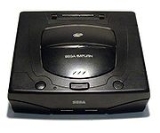
The is a
32-bitThe range of integer values that can be stored in 32 bits is 0 through 4,294,967,295. Hence, a processor with 32-bit memory addresses can directly access 4 GB of byte-addressable memory....
fifth-generationThe fifth-generation era refers to the computer and video games, video game consoles, and video game handhelds available at stores...
video game consoleA video game console is an interactive entertainment computer or customized computer system that produces a video display signal which can be used with a display device to display a video game...
that was first released by
Sega, usually styled as SEGA, is a multinational video game software developer and an arcade software and hardware development company headquartered in Ōta, Tokyo, Japan, with various offices around the world...
on November 22, 1994 in
JapanJapan is an island nation in East Asia. Located in the Pacific Ocean, it lies to the east of the Sea of Japan, China, North Korea, South Korea and Russia, stretching from the Sea of Okhotsk in the north to the East China Sea and Taiwan in the south...
, May 11, 1995 in
North AmericaNorth America is a continent wholly within the Northern Hemisphere and almost wholly within the Western Hemisphere. It is also considered a northern subcontinent of the Americas...
, and July 8, 1995 in
EuropeEurope is, by convention, one of the world's seven continents. Comprising the westernmost peninsula of Eurasia, Europe is generally 'divided' from Asia to its east by the watershed divides of the Ural and Caucasus Mountains, the Ural River, the Caspian and Black Seas, and the waterways connecting...
. The system was discontinued in
North AmericaNorth America is a continent wholly within the Northern Hemisphere and almost wholly within the Western Hemisphere. It is also considered a northern subcontinent of the Americas...
and
EuropeEurope is, by convention, one of the world's seven continents. Comprising the westernmost peninsula of Eurasia, Europe is generally 'divided' from Asia to its east by the watershed divides of the Ural and Caucasus Mountains, the Ural River, the Caspian and Black Seas, and the waterways connecting...
in 1998, and in 2000 in
JapanJapan is an island nation in East Asia. Located in the Pacific Ocean, it lies to the east of the Sea of Japan, China, North Korea, South Korea and Russia, stretching from the Sea of Okhotsk in the north to the East China Sea and Taiwan in the south...
.
While it was popular in Japan, the Saturn failed to gain a similar market share in North America and Europe against its main competitors:
Sony's, commonly referred to as Sony, is a Japanese multinational conglomerate corporation headquartered in Minato, Tokyo, Japan and the world's fifth largest media conglomerate measured by revenues....
PlayStation and the
Nintendo 64The , often referred to as N64, was Nintendo′s third home video game console for the international market. Named for its 64-bit CPU, it was released in June 1996 in Japan, September 1996 in North America, March 1997 in Europe and Australia, September 1997 in France and December 1997 in Brazil...
.
The Saturn sold 9.5 million units worldwide. 6 million were sold in Japan, and just 1.5 million in North America and Europe.
In 2009, video game website
IGNIGN is an entertainment website that focuses on video games, films, music and other media. IGN's main website comprises several specialty sites or "channels", each occupying a subdomain and covering a specific area of entertainment...
chose the Saturn to be their 18th best video game console of all time, out of their list of 25.
Development
Sega, usually styled as SEGA, is a multinational video game software developer and an arcade software and hardware development company headquartered in Ōta, Tokyo, Japan, with various offices around the world...
's 27-member Away Team, comprising employees from hardware engineering, product development and marketing, worked for two years beginning in February 1993 to design the Sega Saturn's hardware. Since the project was top secret, Hayao Nakayama dubbed the project "Aurora". The Saturn was a powerful machine for the time, but its design, with two CPUs and six other processors, made harnessing this power extremely difficult. Also, many of the ancillary chips in the system were "off the shelf" components, increasing the complexity of the system because the components were not specifically designed to work together. Rumors suggest that the original design called for a single central processor, but upon hearing of the PlayStation's capabilities, a second processor was added late in development to increase potential performance. At the roll out of
3DOThe 3DO Interactive Multiplayer is a video game console originally produced by Panasonic in 1993. Further renditions of the hardware were released in 1994 by Sanyo and Goldstar. The consoles were manufactured according to specifications created by The 3DO Company, and were originally designed by...
in 1993, Sega of America president Tom Kalinske boasted that "we have a more powerful machine waiting in the wings, but the time's not ready yet." However, one major design change was forced on Sega, and the culprit was the Sony PlayStation.
Third-party development was initially hindered by the lack of useful software libraries and
development toolsA programming tool or software development tool is a program or application that software developers use to create, debug, maintain, or otherwise support other programs and applications...
, requiring developers to write in
assembly languageAn assembly language is a low-level programming language for computers, microprocessors, microcontrollers, and other programmable devices. It implements a symbolic representation of the machine codes and other constants needed to program a given CPU architecture...
to achieve good performance. At least during early Saturn development, programming in assembly could offer a two to fivefold speed increase over the
C languageC is a general-purpose computer programming language developed between 1969 and 1973 by Dennis Ritchie at the Bell Telephone Laboratories for use with the Unix operating system....
. To save development costs and time, some programmers would utilize only one CPU, such as with
Alien TrilogyAlien Trilogy is a 3D first-person shooter based on the first three movies in the Alien film series. It was released for the MS-DOS, PlayStation, and Sega Saturn platforms.-Plot:...
.
The Saturn's dual-CPU architecture was the source of some difficulty for developers. The biggest disadvantage was that both processors shared the same bus and had problems accessing the main system RAM at the same time. The 4
KBThe kilobyte is a multiple of the unit byte for digital information. Although the prefix kilo- means 1000, the term kilobyte and symbol KB have historically been used to refer to either 1024 bytes or 1000 bytes, dependent upon context, in the fields of computer science and information...
of
cache memoryA CPU cache is a cache used by the central processing unit of a computer to reduce the average time to access memory. The cache is a smaller, faster memory which stores copies of the data from the most frequently used main memory locations...
in each CPU was critical to maintaining performance. In general, very careful division of processing, in addition to the already-challenging task of
parallelizingParallel computing is a form of computation in which many calculations are carried out simultaneously, operating on the principle that large problems can often be divided into smaller ones, which are then solved concurrently . There are several different forms of parallel computing: bit-level,...
the code, was required to get the most out of the Saturn. One example of how the Saturn was utilized was with
Virtua Fighter's use of one CPU for each character.
Many of the Saturn's developers, such as
Lobotomy SoftwareLobotomy Software was an American video game company, best known for the game PowerSlave as well as the successful Sega Saturn ports of Duke Nukem 3D and Quake.The company is no longer active.-History:...
programmer Ezra Dreisbach, found it difficult to develop for compared to the
PlayStationThe is a 32-bit fifth-generation video game console first released by Sony Computer Entertainment in Japan on December 3, .The PlayStation was the first of the PlayStation series of consoles and handheld game devices. The PlayStation 2 was the console's successor in 2000...
because of its more complex graphics hardware. In order to port
Duke Nukem 3DDuke Nukem 3D is a first-person shooter computer game developed by 3D Realms and published by GT Interactive Software. The full version was released for the PC . It is a sequel to the platform games Duke Nukem and Duke Nukem II published by Apogee...
and
PowerSlavePowerslave is the fifth studio album by the English heavy metal band Iron Maiden, released on 3 September 1984 on EMI in Europe and its sister label Capitol Records in the US ....
/
Exhumed to the Saturn, Lobotomy Software had to almost entirely rewrite the
Build engineThe Build engine is a first-person shooter engine created by Ken Silverman for 3D Realms. Like the Doom engine, the Build engine represents its world on a two-dimensional grid using closed 2D shapes called sectors, and uses simple flat objects called sprites to populate the world geometry with...
to take advantage of the Saturn's unconventional hardware. Also, during testing of an unreleased
Quake port for the PlayStation, the Saturn's performance was found to be notably inferior for the game. However, some developers have contested that the Saturn's shortcomings in these respects are overstated at best.
WARPWARP is a now-defunct video game developer. Founded by Japanese musician, Kenji Eno, WARP was composed of five members and was dedicated to creating interactive cinema. Their most successful series of games, the D series, featured the same lead character, Laura, and were known for their musical...
leader
Kenji Enois a musician and video game designer based in Japan. He is best-known for his cult survival horror series, the D games and his audio game series, Real Sound.-Childhood and early years:...
, when asked how WARP managed to produce the impressive 3D visuals of
Enemy Zerois a 1997 video game for Sega Saturn, developed by WARP and directed by Kenji Eno. After its Saturn release, it was ported to Microsoft Windows. It was the second game to star the digital actress Laura.-Gameplay:...
(a game originally developed for the PlayStation) on the Saturn, replied, "...the PlayStation and the Saturn aren't that different, so moving it[Enemy Zero] to Saturn wasn't too difficult."
Moreover, later programming techniques employed by Sega's AM2 saw an improvement in performance. Video exists of a canceled version of
Shenmueis a 1999 open-world adventure video game developed by Sega AM2 and published by Sega for the Dreamcast, produced and directed by Yu Suzuki. Suzuki coined a genre title, "FREE" , for the game, based on the interactivity and freedom he wanted to give to the player...
- later released on the
Sega DreamcastThe is a 128-bit video game console which was released by Sega in late 1998 in Japan and from September 1999 in other territories. It was the first entry in the sixth generation of video game consoles, preceding Sony's PlayStation 2, Microsoft's Xbox and the Nintendo GameCube.Dreamcast sales were...
- running on a stock Sega Saturn. The video was included in the Dreamcast title
Shenmue IIis a adventure game for the Dreamcast and Xbox. It is the sequel to Shenmue, and was produced and directed by Yu Suzuki of Sega AM2.Due to exclusivity rights obtained by Microsoft, the North American Dreamcast version was cancelled. Because of this, no English dub was recorded for the Dreamcast...
.
Unlike the PlayStation and
Nintendo 64The , often referred to as N64, was Nintendo′s third home video game console for the international market. Named for its 64-bit CPU, it was released in June 1996 in Japan, September 1996 in North America, March 1997 in Europe and Australia, September 1997 in France and December 1997 in Brazil...
which used triangles as its basic geometric primitive, the Saturn rendered
quadrilateralIn Euclidean plane geometry, a quadrilateral is a polygon with four sides and four vertices or corners. Sometimes, the term quadrangle is used, by analogy with triangle, and sometimes tetragon for consistency with pentagon , hexagon and so on...
s. This proved to be a hindrance because most of the industry's standard design tools were based on triangles. One of the challenges brought forth by quadrilateral-based rendering was problems with making some shapes, notably triangular objects. This can be seen in the Saturn version of
Tomb Raider, in which triangular rocks are not rendered as well as other systems' versions of the game. The hardware also lacked light sourcing and hardware video decompression support, the latter being a major disadvantage during a time when full-motion video was quite popular.
If used correctly, the quadrilateral rendering of the Saturn had advantages. It could potentially reduce the texture distortion common in PlayStation titles, as demonstrated by several cross-platform titles such as
Wipeout and
Destruction DerbyDestruction Derby is a 1995 video game developed by Reflections and published by Psygnosis, the former of which would later develop the successful Driver series. It was released for PlayStation, Sega Saturn, and MS-DOS...
. The quadrilateral-focused hardware and a 50% greater amount of video memory also gave the Saturn an advantage for 2D game engines and attracted many developers of
role-playing video gameRole-playing video games are a video game genre with origins in pen-and-paper role-playing games such as Dungeons & Dragons, using much of the same terminology, settings and game mechanics. The player in RPGs controls one character, or several adventuring party members, fulfilling one or many quests...
s,
arcade gameAn arcade game is a coin-operated entertainment machine, usually installed in public businesses such as restaurants, bars, and amusement arcades. Most arcade games are video games, pinball machines, electro-mechanical games, redemption games, and merchandisers...
s and traditional 2D fighting games. With creative programming, later games like
Burning RangersBurning Rangers is a video game developed by Sonic Team for the Sega Saturn. The player takes on the role of a new recruit to the futuristic firefighting organization of the title, and must explore locations where various emergencies have taken place, extinguishing fires and rescuing survivors.The...
were able to achieve true transparency effects on hardware that used simple polygon
stipplesStippling is the creation of a pattern simulating varying degrees of solidity or shading by using small dots. Such a pattern may occur in nature and these effects are frequently emulated by artists.-Art:...
as a replacement for transparency effects in the past.
The cartridge slot gave the potential for adding extra RAM or storage devices for saving games to the system. Two ROM cartridges were released with Sega Saturn games: one with
King of Fighters '95 and the other with
Ultraman: Hikari no Kyojin Densetsu. The ROM cartridges contained part of the game data because not enough system RAM was available. Two different RAM cartridges were released for the system; a 1 MB RAM cart by
SNKSNK is a former name of SNK Playmore, a Japanese video game company . This may also refer to:* SNK European Democrats* SNK Union of Independents* Southeast Airlines ICAO code...
for
King of Fighters '96 and a 4 MB RAM cart by
Capcomis a Japanese developer and publisher of video games, known for creating multi-million-selling franchises such as Devil May Cry, Chaos Legion, Street Fighter, Mega Man and Resident Evil. Capcom developed and published Bionic Commando, Lost Planet and Dark Void too, but they are less known. Its...
for
X-Men vs. Street FighterX-Men vs. Street Fighter is a fighting game originally released as a coin-operated arcade game in . It is Capcom's third fighting game to feature Marvel Comics characters and the first game to match them against their own, with characters from Marvel's X-Men franchise being matched against the cast...
and
Marvel Super Heroes vs. Street Fighteris the fourth Marvel Comics-licensed fighting game produced by Capcom . It is a sequel to X-Men vs. Street Fighter which replaces most of the X-Men characters with characters from Marvel Super Heroes. In an attempt to balance the previous games' problems, the game engine was altered, although it...
. A RAM expansion cartridge was also required for the games
Groove on Fight &
Final Fight Revengeis a 1999 American-developed 3D one-on-one fighting game. The game was produced by the American division of Capcom , the same team that later produced Maximo: Ghosts to Glory and Final Fight: Streetwise. Final Fight Revenge was released for the arcades on July 1999 and ran on the Sega ST-V arcade...
. Both companies were known for their sprite-based 2D competitive fighting games and many of their subsequent games utilized their respective cartridges. (such as "Vampire Saviour" & "Cotton 2" [by Takara]).
Japan
The Japanese Saturn was released in November 1994, just six weeks ahead of its rival, Sony's
PlayStationThe is a 32-bit fifth-generation video game console first released by Sony Computer Entertainment in Japan on December 3, .The PlayStation was the first of the PlayStation series of consoles and handheld game devices. The PlayStation 2 was the console's successor in 2000...
. Approximately 170,000 machines were sold the first day the console went on sale.
Many of the games that made the Saturn popular in Japan, such as the
Sakura Taisenis a Japanese media franchise created by Ouji Hiroi, and is developed and owned by Sega and licensed by Red Entertainment and Sega. The franchise centers on a series of dramatic fantasy and science-fantasy tactical role-playing adventure video games, which consist of tactical wargame and dating sim...
series and various
role-playing video gameRole-playing video games are a video game genre with origins in pen-and-paper role-playing games such as Dungeons & Dragons, using much of the same terminology, settings and game mechanics. The player in RPGs controls one character, or several adventuring party members, fulfilling one or many quests...
s, were never released in foreign territories as it was assumed at Sega of America and Sega of Europe that they were not appealing to a Western audience.
The last commercial licensed release in Japan and last official game for the system was
Yuukyuu Gensoukyoku Hozonban Perpetual Collection, released by
MediaWorkswas a Japanese publishing company in the Kadokawa Group known for their brand magazines and book labels. These included such well-known magazines as Dengeki Daioh, and Dengeki G's Magazine, along with MediaWorks' main light novel publishing imprint Dengeki Bunko. The company was merged with ASCII...
on December 4, 2000.
North America
By the end of 1994, the 16-bit video game era was in twilight in North America and gamers were eagerly anticipating the new 32-bit machines from Japan. In early 1995, Sega of America president
Tom KalinskeThomas "Tom" Kalinske is an American businessman and currently the Executive Chairman of Moonshoot. He is best known as the president and CEO of Sega of America from 1990 to 1996, and Mattel before that...
announced that the Saturn would launch in the U.S. on "Saturnday", (Saturday) September 2, 1995. This date was greatly anticipated by gamers and the media. It also allowed Sony to announce that the PlayStation release date would be one week later on September 9, 1995.
However, on May 11, 1995, at the first Electronic Entertainment Expo (E3), Kalinske announced that the "Saturnday" date was a ruse and that the system was being released nationwide by four select retailers (Toys "R" Us, Babbage's, Software Etc. and
Electronics BoutiqueEB Games is an American computer and video games retailer. First established as an American company in 1977 by Emmanuel Baxter with a single electronics-focused location in the King of Prussia Mall near Philadelphia, the company has grown into an international corporation...
) immediately. It appeared that Sega had a real opportunity to take a commanding 4-month lead in the 32-bit race by beating the PlayStation to the market.
The surprise launch backfired on Sega for several reasons. The Saturn was released at a high price point of
US$The United States dollar , also referred to as the American dollar, is the official currency of the United States of America. It is divided into 100 smaller units called cents or pennies....
399, while Sony announced a US$299 price for the PlayStation at E3 itself, as a response to the Saturn's earlier release.
The early launch also meant that the Saturn had only 6 games available at launch, as most third party games were slated to be completed and rolled out around the original September 2 launch date, and as many successful Japanese titles were not imported. Third party publishers, particularly those based in North America, were angered as the surprise launch prevented them from capitalizing on the momentum inherent in an anticipated, planned release. Essentially the only software available on the shelves at launch was software released by Sega. Many within the gaming industry viewed the early launch as a calculated move to give Sega larger sales of Saturn software at the expense of independent developers.
In addition, the retailers who were not included in the early launch (most notably
Wal-MartWal-Mart Stores, Inc. , branded as Walmart since 2008 and Wal-Mart before then, is an American public multinational corporation that runs chains of large discount department stores and warehouse stores. The company is the world's 18th largest public corporation, according to the Forbes Global 2000...
and
KB ToysK·B Toys was a chain of mall-based retail toy stores in the United States. It was founded in 1922 by the Kaufman brothers. K·B operated 605 stores in 44 U.S. states, Puerto Rico as well as Guam. It was privately held in Pittsfield, Massachusetts...
) felt betrayed, with some retaliating by supporting Sega's rivals. This resulted in Sega having difficulties with these distributors for the Saturn (and also for its successor, the Dreamcast). For example, Sega's actions so angered KB Toys that they refused to release the Saturn at all, and actually went as far as having some retailers remove anything Sega-related in stores to provide more retail space for the Saturn's competition instead.
By the time of the PlayStation's release on September 9, 1995, the Saturn had sold approximately 80,000 systems. The PlayStation, on the other hand, managed to sell over 100,000 units in its first weekend of availability in the U.S.
From 1995 to 1997 the Saturn became the "other" system, running a distant third behind the
Nintendo 64The , often referred to as N64, was Nintendo′s third home video game console for the international market. Named for its 64-bit CPU, it was released in June 1996 in Japan, September 1996 in North America, March 1997 in Europe and Australia, September 1997 in France and December 1997 in Brazil...
and the PlayStation. However, it was the preferred system for many arcade and import gamers. Sales of the Saturn would generally spike as new arcade ports were released, but would die off again shortly after. By the end of 1997, Sega had announced that it would develop a successor (the Dreamcast), causing console sales and game releases to drop dramatically.
The Saturn's commercial failure caused Sega to lose
US$The United States dollar , also referred to as the American dollar, is the official currency of the United States of America. It is divided into 100 smaller units called cents or pennies....
267.9 million and lay off 30% of its workforce.
Europe
Despite the success of Sega's previous consoles in Europe and although the Sega Saturn was launched in Europe in July 1995—a few months before the newcomer
PlayStationThe is a 32-bit fifth-generation video game console first released by Sony Computer Entertainment in Japan on December 3, .The PlayStation was the first of the PlayStation series of consoles and handheld game devices. The PlayStation 2 was the console's successor in 2000...
's release—the momentum for Sony's console amongst consumers began to build rapidly, stalling Saturn sales in the region. As a result, the Sega Saturn never enjoyed the success it achieved in Japan or even the post-launch hype the machine was awarded in North America, leaving the market almost solely in the competition's hands. By the time that the
Nintendo 64The , often referred to as N64, was Nintendo′s third home video game console for the international market. Named for its 64-bit CPU, it was released in June 1996 in Japan, September 1996 in North America, March 1997 in Europe and Australia, September 1997 in France and December 1997 in Brazil...
hit European shelves in early 1997, the Saturn's sales had long since stagnated.
The last commercial licensed release in Europe was a survival horror game called
Deep FearDeep Fear is a 1998 survival horror video game for the Sega Saturn. It is notable for being the last Saturn game released in Europe.It borrows many aspects from Capcom's Resident Evil such as the use of first-aid sprays as the player's sole healing item and a significant dependency on firearms...
, released by Sega Europe in November 1998.
However, support for the Sega Saturn in the
UKThe United Kingdom of Great Britain and Northern IrelandIn the United Kingdom and Dependencies, other languages have been officially recognised as legitimate autochthonous languages under the European Charter for Regional or Minority Languages...
was bolstered by the successful publication of
Sega Saturn MagazineSega Saturn Magazine was a monthly UK magazine dedicated to the Sega Saturn. It held the official Saturn magazine license for the UK, and as such some issues included a demo CD created by Sega, called Sega Flash, which included playable games and game footage...
.
End of an era
As price drops continued throughout the
32-bitThe range of integer values that can be stored in 32 bits is 0 through 4,294,967,295. Hence, a processor with 32-bit memory addresses can directly access 4 GB of byte-addressable memory....
era, the system board design of the Saturn was not as easy to condense in a cost-saving manner and Sega fell behind after price drops offered by Nintendo and Sony. As a marketing strategy, Sega bundled three of its best selling games (
Daytona USA,
Virtua Cop,
Virtua Fighter 2) with the system in order to keep the more expensive Saturn competitive with its rivals. This gave the console a boost in sales, but it wasn't enough to cause any significant impact in the console race.
By early 1997, the Saturn was trailing the
Nintendo 64The , often referred to as N64, was Nintendo′s third home video game console for the international market. Named for its 64-bit CPU, it was released in June 1996 in Japan, September 1996 in North America, March 1997 in Europe and Australia, September 1997 in France and December 1997 in Brazil...
and
PlayStationThe is a 32-bit fifth-generation video game console first released by Sony Computer Entertainment in Japan on December 3, .The PlayStation was the first of the PlayStation series of consoles and handheld game devices. The PlayStation 2 was the console's successor in 2000...
in both
North AmericaNorth America is a continent wholly within the Northern Hemisphere and almost wholly within the Western Hemisphere. It is also considered a northern subcontinent of the Americas...
and
EuropeEurope is, by convention, one of the world's seven continents. Comprising the westernmost peninsula of Eurasia, Europe is generally 'divided' from Asia to its east by the watershed divides of the Ural and Caucasus Mountains, the Ural River, the Caspian and Black Seas, and the waterways connecting...
to such an extent that senior management began planning a new platform and, by
E3The history of the E3 began with its creation in 1995 and has continued through the latest expo in 2011 The conference was known as the Electronic Entertainment Expo from 1995 to 2006. In 2007 and 2008, the conference was known as the E3 Media and Business Summit...
in 1997, had begun talk of the system called the Katana (which would later be named the Dreamcast). Sega of America President
Bernie StolarBernard "Bernie" Stolar is an American businessman who worked in the video game industry for several important companies. His career started at Atari where he worked initially in the coin-op arcade division and eventually moved over to the home division in charge of platforms like Atari Lynx. He...
, who was strongly in favor of the upcoming console, announced "The Saturn is not our [SEGA's] future."
As Sega began public discussion about their next generation system, barely two years after having launched the Saturn, it became a
self-defeating prophecyA self-defeating prophecy is the complementary opposite of a self-fulfilling prophecy: a prediction that prevents what it predicts from happening. This is also known as the "prophet's dilemma"....
, some citing it as an example of the
Osborne effectThe Osborne effect is a term referring to the unintended consequence of the announcement of a future product ahead of its availability and its impact upon the sales of the current product....
. This move, combined with Sega's recent history of short-lived consoles, particularly the Sega CD and
32XThe Sega 32X, codenamed Project Mars, is an add-on for the Mega Drive/Genesis video game console by Sega. Its aim was to increase the lifespan of the aging Mega Drive/Genesis system, which was facing stiff competition from the SNES...
which were considered ill-conceived "stopgaps" that turned off gamers and developers alike, led to a chain reaction that quickly caused the Saturn's future to collapse. Immediately following the announcement, sales of the console and software substantially tapered off in the second half of 1997, while many planned games were canceled, causing the console's life expectancy to shorten substantially. While this let Sega focus on bringing out its successor, premature demise of the Saturn caused them financial problems. Even though the Dreamcast did address many of the problems with the Saturn, Sega's damaged reputation caused customers and publishers to be skeptical and hold out to see how it would fare against Sony's
PlayStation 2The PlayStation 2 is a sixth-generation video game console manufactured by Sony as part of the PlayStation series. Its development was announced in March 1999 and it was first released on March 4, 2000, in Japan...
.
The aggressive move to replace the Saturn resulted in a rift between Sega and many of their third-party developers and publishers. North American developers were already hostile to the Saturn because it was difficult to program for, and because they were left out by its early release, so the future project alienated what remaining support Sega had in that region. However, many Japanese developers had strongly supported the Saturn in its homeland and saw little reason for Sega to rush another platform to market. The announcement caused a substantial drop in software sales, causing frustrated third parties to cancel many planned releases. The early abandonment of the Saturn hurt third party software support not only for that system, but also for Sega in general. Several major publishers such as
Electronic ArtsElectronic Arts, Inc. is a major American developer, marketer, publisher and distributor of video games. Founded and incorporated on May 28, 1982 by Trip Hawkins, the company was a pioneer of the early home computer games industry and was notable for promoting the designers and programmers...
declined to support the upcoming Dreamcast, which played a part in its discontinuation as well.
Several games intended for release in North America or Europe were canceled. These titles include
Sonic X-tremeSonic X-treme is a canceled platform video game in the Sonic the Hedgehog series. Early version were considered for several systems until ending up as being developed by Sega for the Sega Saturn, with the intended release being around Christmas of 1996. However, after getting stuck in development...
,
Policenautsis a cinematic adventure game with a hard science fiction storyline, written and directed by Hideo Kojima, and published by Konami. It was initially released for the PC-9821 computer platform in 1994, followed by remade versions for the 3DO in 1995, and the PlayStation and Sega Saturn in 1996...
and
Lunar: Silver Star Story, the latter two remaining as Japanese market exclusives. Further cancellations in 1998 followed cutting the western release lists down to titles such as
Steep Slope Slidersis a console game made for the Sega Saturn, published in 1997. It was developed by a collaboration of Victor Interactive Software, and the Cave Company and was published by Sega. This game was a port from the Sega Titan ST-V arcade system...
,
Panzer Dragoon Sagais a critically acclaimed role-playing video game released exclusively for the Sega Saturn in 1998. It was the third game released in the Panzer Dragoon series , and so far remains the only game in the series that is not a rail shooter...
,
Burning RangersBurning Rangers is a video game developed by Sonic Team for the Sega Saturn. The player takes on the role of a new recruit to the futuristic firefighting organization of the title, and must explore locations where various emergencies have taken place, extinguishing fires and rescuing survivors.The...
,
The House of the DeadThe House of the Dead is a first-person, light gun arcade game developed in 1996 and released in 1997 by Sega.Players assume the role of agents Thomas Rogan and "G" in their efforts to combat the products of the dangerous, inhumane experiments of Dr. Curien, a madman.-Gameplay:The House of the Dead...
,
Shining Force IIIis a video game designed for the Sega Saturn by Camelot Software Planning. It is a continuation of the Shining series. Comprising three separate but overlapping storylines, the Japanese version of Shining Force III was released in three volumes, known as:...
,
Magic Knight RayearthMagic Knight Rayearth is an action/adventure video game that was made and published by Sega for the Sega Saturn. It is based on the anime series of the same name . The game was released in North America by the now defunct Working Designs; it was the last Saturn game released in the US region...
(North America) and
Deep FearDeep Fear is a 1998 survival horror video game for the Sega Saturn. It is notable for being the last Saturn game released in Europe.It borrows many aspects from Capcom's Resident Evil such as the use of first-aid sprays as the player's sole healing item and a significant dependency on firearms...
(Europe).
The Saturn was discontinued in 1998 in most countries, and in 2000 in Japan.
Asian models
In Japan, Sega licensed the rights to produce Saturns to their hardware partners –
Hitachiis a Japanese multinational conglomerate headquartered in Marunouchi 1-chome, Chiyoda, Tokyo, Japan. The company is the parent of the Hitachi Group as part of the larger DKB Group companies...
, who provided the CPUs and several other chips, and
JVC, usually referred to as JVC, is a Japanese international consumer and professional electronics corporation based in Yokohama, Japan which was founded in 1927...
who produced the CD drives for most models, although functionally identical
Sanyois a major electronics company and member of the Fortune 500 whose headquarters is located in Moriguchi, Osaka prefecture, Japan. Sanyo targets the middle of the market and has over 230 Subsidiaries and Affiliates....
drives were sometimes used. SunSeibu released a model with a seven CD-changer for use in hotels, called the SGX. The concept of a multi-game player for
hotelA hotel is an establishment that provides paid lodging on a short-term basis. The provision of basic accommodation, in times past, consisting only of a room with a bed, a cupboard, a small table and a washstand has largely been replaced by rooms with modern facilities, including en-suite bathrooms...
use is very common in Japan.
| Manufacturer and model | Case color | Button color | Type of buttons | Notes |
| Sega HST-3200 |
Gray |
Blue |
Oval |
The original Japanese Saturn. This model had a black cartridge flap and came in a box labeled HST-0001. The power cord is un-notched and this machine has a drive access light. |
| Sega HST-3210 |
Gray |
Blue |
Oval |
Second model. It looks the same as the HST-3200 but the inside layout is similar to the early model HST-3220. Production was ended in favor of the White Saturn. |
| Sega HST-3220 |
White |
Gray/Pink |
Round |
Sega switched from blue to gray & pink buttons during the production run. This controller was a matching white with multi-colored buttons similar to a Super FamicomThe Super Nintendo Entertainment System is a 16-bit video game console that was released by Nintendo in North America, Europe, Australasia , and South America between 1990 and 1993. In Japan and Southeast Asia, the system is called the , or SFC for short... controller with the bottom row buttons colored green, yellow, and blue. The 'white' plastic is a very light gray and shares its color with the later Dreamcast. The cartridge flap is visibly gray. Limited models of the Saturn had oval buttons. Later units have some compatibility problems. |
| Sega Skeleton Saturn (HST-3220) |
Translucent black |
Black |
Round |
Included a matching translucent black controller. Both controller and system had "This is cool" printed on them. Only around 50,000 were produced. Has some compatibility problems, notably with Metal Slugis a run and gun video game for the Neo-Geo console/arcade platform developed by Nazca Corporation and published by SNK. It was originally released in 1996 for the MVS arcade platform. The game is widely known for its sense of humor, fluid hand-drawn animation, and fast paced two-player action... , Out Runis an arcade game released by Sega in 1986. It was designed by Yu Suzuki and Sega-AM2. The game was a critical and commercial success. It is notable for its innovative hardware , pioneering graphics and music, a choice in both soundtrack and route, and its strong theme of luxury and relaxation... , and Space Harrieris a third-person rail shooter game, released by Sega in 1985. It was produced by Yu Suzuki, responsible for many popular Sega games. It spawned several sequels: Space Harrier 3-D , Space Harrier II , and the spin-off Planet Harriers .... . |
| Sega Derby Saturn (HST-3220) |
Translucent blue |
Black |
Round |
Released on March 25, 1999, this model was only available as part of a promotion with ASCII's popular horse racing sim, Derby StallionThe - also known in Japan as - video games are a series of genre-merging horse-racing and business simulation games originally created by ASCII Entertainment, and released by Nintendo... . It came with the same translucent black controller as the Skeleton Saturn but did not have "This is cool" printed on the system. After limited supplies of the Skeleton Saturn, the Derby Saturn was quickly bought in bulk by exporters and for a time was easier to find outside Japan than inside. Shares the compatibility problems of the Skeleton Saturn.
Uses BIOS 1.0.1. |
| Hitachi Hi-Saturn (MMP-11 and MMP-1) |
Charcoal |
Khaki |
Round/Oval |
This machine appears similar in color to the European and North American Saturn without close inspection. Hi-Saturn is printed on the CD drive lid. Controllers have the same color layout as the unit with pinkish-beige and dark bluish/gray buttons. The Hitachi logo appears on them. The machine was packaged in an almost all-black box with a light-gray/white border. Excepting some limited promotional bundles, the Hi-Saturn came packaged with an MPEG plug-in card allowing Video CDBefore the advent of DVD and Blu-ray, the Video CD became the first format for distributing films on standard 120 mm optical discs. The format is a standard digital format for storing video on a Compact Disc... playback. The start-up screen differs slightly from other models – instead of a shower of pieces forming the Saturn logo, the word "Hi-Saturn" shoots out from the middle of the screen and then flips around until it is readable. |
| Hitachi Hi-Saturn Navi (MMP-1000NV) |
Charcoal |
Khaki |
Round |
This is the only consumer Saturn to differ in functionality or shape. It is much thinner, and is flat instead of curved on top, in order to accommodate a folding LCD monitor that clips to the rear. It includes GPS capability, and has a standard port on the rear for use with an included antenna. Navi-ken CDs are used for map data. Since Navi-ken was only available in Japan, only Japanese maps are available. |
| JVC/Victor V-Saturn RG-JX1 |
Gray |
Blue/Gray |
Oval |
Resembles the first Japanese Sega Saturn with oval buttons and access light. "V-Saturn" is printed on top of the machine. Features a V-Saturn logo in place of the Sega Saturn logo at boot-up. |
| JVC/Victor V-Saturn RG-JX2 |
Light Gray/Dark Gray |
Blue/Green/Pink |
Round |
Resembles the white Japanese Sega Saturn with round buttons. Case is light gray on top, with a darker gray base. Features a V-Saturn logo in place of the Sega Saturn logo at boot-up. |
Samsung Saturn (삼성새턴) |
Black |
| Oval |
Intended only for South Korea, this machine combines the older style oval-button shell with the smaller and newer mainboard which normally comes with a round-button shell. The Japanese language option was removed from the setup screen on some models. |
North American models
All North American models are black in color and were produced by Sega.
| Model | Type of Buttons | Manufacturing Period | Notes |
| MK-80000 |
Oval |
4/95 – 4/96 |
Identical to the Grey Japanese Saturn except for color: the U.S. model is black. A few have been found with the backend molding of the MK-80000A and the notched power cord using the 1.00a BIOS version. |
| MK-80000A |
Round |
4/96 – 10/96 |
Features a notched power cord, no drive access light and a 1.00a BIOS. Internal jumper locations are changed. |
| MK-80001 |
Round |
7/96 – 98 |
Similar in appearance to the MK-80000A, this machine has some changed internal jumper locations. |
Early models came packaged with a redesigned controller that was slightly bigger than the Japanese variant. Eventually the Japanese controller was adopted.
European models
European Saturns are identical as both regions share the same AC voltage and TV standard. There is no internal variation between
PALPAL, short for Phase Alternating Line, is an analogue television colour encoding system used in broadcast television systems in many countries. Other common analogue television systems are NTSC and SECAM. This page primarily discusses the PAL colour encoding system...
and
SÉCAMSECAM, also written SÉCAM , is an analog color television system first used in France....
machines as all were shipped with
SCARTSCART is a French-originated standard and associated 21-pin connector for connecting audio-visual equipment together...
leads. All models are black and externally quite similar to the North American variations. PAL and SECAM machines will have "PAL" next to the BIOS revision number on the system settings screen instead of "NTSC".
| Model | Type of Buttons | Notes |
| MK-08200-03 |
Oval |
Drive access LED and black buttons. |
| MK-80200-50 |
Oval |
Version 1.01a BIOS. |
| MK-80200A-50 |
Round |
Lacks a drive access LED. Buttons are grey. |
Processors
- Two Hitachi SuperH-2
SuperH is a 32-bit reduced instruction set computer instruction set architecture developed by Hitachi. It is implemented by microcontrollers and microprocessors for embedded systems....
7604 32-bit RISC processors at 28.63 MHz (25 MIPS)—each has 4 kBThe kilobyte is a multiple of the unit byte for digital information. Although the prefix kilo- means 1000, the term kilobyte and symbol KB have historically been used to refer to either 1024 bytes or 1000 bytes, dependent upon context, in the fields of computer science and information...
on-chip cache (4-way associative), of which 2 kB can alternatively be used as directly addressable Scratchpad RAMScratchpad memory , also known as scratchpad, scatchpad RAM or local store in computer terminology, is a high-speed internal memory used for temporary storage of calculations, data, and other work in progress...
- Custom VDP 1 32-bit video display processor (running at 28.63 MHz on NTSC and PAL Systems) for sprites/polygons
- Custom VDP 2 32-bit video display processor (running at 28.63 MHz on NTSC and PAL Systems) for backgrounds/video out
- Custom System Control Unit (SCU) with DSP for geometry processing and DMA controller (running at 14.3 MHz)
- Motorola 68EC000 sound controller (running at 11.3 MHz / 1.5 MIPS)
- Yamaha FH1 DSP
A digital signal processor is a specialized microprocessor with an architecture optimized for the fast operational needs of digital signal processing.-Typical characteristics:...
sound processor, "Saturn Custom Sound Processor" (SCSP), running at 22.6 MHz
- SH-1
SuperH is a 32-bit reduced instruction set computer instruction set architecture developed by Hitachi. It is implemented by microcontrollers and microprocessors for embedded systems....
32-bit RISC microcontroller (for the CD-ROM and CD security checks; uses preprogrammed embedded ROM, not programmable by software)
- Hitachi 4-bit MCU, "System Manager & Peripheral Control" (SMPC)
Memory
- 1 MB SDRAM
Synchronous dynamic random access memory is dynamic random access memory that is synchronized with the system bus. Classic DRAM has an asynchronous interface, which means that it responds as quickly as possible to changes in control inputs...
as work RAM for both SH-2 CPUs (faster)
- 1 MB DRAM
Dram or DRAM may refer to:As a unit of measure:* Dram , an imperial unit of mass and volume* Armenian dram, a monetary unit* Dirham, a unit of currency in several Arab nationsOther uses:...
as work RAM for both SH-2 CPUs (slower)
- 512K VDP1 SDRAM
Synchronous dynamic random access memory is dynamic random access memory that is synchronized with the system bus. Classic DRAM has an asynchronous interface, which means that it responds as quickly as possible to changes in control inputs...
for 3D graphics (Texture data for polygon/sprites and drawing command lists)
- 2x 256K VDP1 SDRAM
Synchronous dynamic random access memory is dynamic random access memory that is synchronized with the system bus. Classic DRAM has an asynchronous interface, which means that it responds as quickly as possible to changes in control inputs...
for 3D graphics (Two framebuffers for double-buffered polygon/sprite rendering)
- 512K VDP2 SDRAM
Synchronous dynamic random access memory is dynamic random access memory that is synchronized with the system bus. Classic DRAM has an asynchronous interface, which means that it responds as quickly as possible to changes in control inputs...
for 2D graphics (Texture data for the background layers and display lists)
- 4 KB VDP2 SRAM for color palette data and rotation coefficient data (local, on-chip SRAM)
- 512 KB DRAM
Dram or DRAM may refer to:As a unit of measure:* Dram , an imperial unit of mass and volume* Armenian dram, a monetary unit* Dirham, a unit of currency in several Arab nationsOther uses:...
for sound. (Multiplexed as sound CPU work RAM, SCSP DSP RAM, and SCSP wavetable RAM)
- 512 KB DRAM
Dram or DRAM may refer to:As a unit of measure:* Dram , an imperial unit of mass and volume* Armenian dram, a monetary unit* Dirham, a unit of currency in several Arab nationsOther uses:...
as work RAM for the CD-ROMA CD-ROM is a pre-pressed compact disc that contains data accessible to, but not writable by, a computer for data storage and music playback. The 1985 “Yellow Book” standard developed by Sony and Philips adapted the format to hold any form of binary data....
subsystem's SH-1The SH-1 is a small Chinese developed long range Miniature UAV that was first unveiled at the 2008 Zhuhai Air Show. It is being marketed by ADIC Technology Pte of Singapore.The UAV is hand ejected like a kite or use rocket-assisted firing....
CPU
- 32 KB SRAM with battery back-up for data retention.
- 512 KB Mask ROM
Mask ROM is a type of read-only memory whose contents are programmed by the integrated circuit manufacturer...
for the SH-2 BIOS
Audio
Audio generation was provided via a specialized multifunction sound chip developed by Yamaha, the
YMF292, also known as the
Saturn Custom Sound Processor or SCSP. The SCSP included 32 sound channels with both
FMA 220 Hz carrier tone modulated by a 440 Hz modulating tone with various choices of modulation index, β. The time domain signals are illustrated above, and the corresponding spectra are shown below ....
and
PCMPulse-code modulation is a method used to digitally represent sampled analog signals. It is the standard form for digital audio in computers and various Blu-ray, Compact Disc and DVD formats, as well as other uses such as digital telephone systems...
(up to 44.1 kHz sampling rate) functionality and fully configurable channel linking for modulation purposes, a 128-step DSP, and internal
DACIn electronics, a digital-to-analog converter is a device that converts a digital code to an analog signal . An analog-to-digital converter performs the reverse operation...
. The SCSP was used in conjunction with the Saturn's Motorola 68EC000 co-processor and dedicated audio RAM, and MIDI compliance allowed use of an external MIDI controller, such as a keyboard.
Video
The Sega Saturn is equipped with dual custom VDP chips for graphics processing. The VDP1 chip is primarily responsible for sprite generation. Polygon generation is accomplished through manipulation of the sprite engine. Texture mapping and Gouraud shading is also handled by the VDP1.
The VDP1 renders primitives to two 256 kB frame buffers that is most commonly configured as 512x256x16 with a 320x240 visible area. For medium and high resolution games, a 1024x256x8 frame buffer is used. Games running at 30 frame/s, like Virtua Fighter Remix and Die Hard Arcade, this gives a visible area of 640x240. For games running at 60 frame/s, like Virtua Fighter 2 and Dead or Alive, taking advantage of interlacing allows the two frame buffers to be combined for an effective size of 1024x512 per frame, with a visible area of 640x480. Having two separate frame buffers allows double buffering of the display and provides more time for rendering. The active framebuffer is read out to the display by the VDP2, which can apply data from a coefficient table to modify the scanning process, for effects like rotation, scaling, and general distortion of the entire frame buffer as a single entity.
The SCU (system bus control unit) provides DMA across a dedicated bus commonly labeled as the "B-bus" that the VDP2 and VDP1 are connected to, allowing transfer of data from them to and from main memory. Keep note that transferring data from and to the same bus is prohibited by all 3 SCU DMA levels.
- Rendering engine for command tables: textured and non-textured polygons, untextured "polygons," "polylines," and lines along with command tables that controls the frame buffer.
- "Sprites" are textured polygons with specific rendering modes:
- Normal sprite (one point), shrunk/scaled sprite (two points), distorted sprite (four points)
- Other rendering modes:
- Overwrite (replace frame buffer contents)
- Shadow (underlying frame buffer pixels rewritten with 1/2 brightness, primitive not drawn)
- Half luminosity (primitive rendered with 1/2 brightness)
- Half transparency (primitive and underlying framebuffer pixels averaged together)
- Gouraud shading
Gouraud shading, named after Henri Gouraud, is an interpolation method used in computer graphics to produce continuous shading of surfaces represented by polygon meshes...
for RGB-format textures only
- Dual 256KB frame buffers
- Programmable frame buffer depth of 8 or 16 bits per pixel
- Automatic erase feature to clear framebuffer with single color
Some commonly quoted specifications are highly dependent on the rendering modes for the polygons and other factors that burden the system load:
- 200,000 texture-mapped polygons per second
- 500,000 flat-shaded polygons per second
- 60 frames of animation per second
In order to better understand the differences between the PlayStation GPU and Saturn VDP1 rendering capabilities, here are some varying factors:
PlayStation GPU
- The GPU has a unified 1 MB block of memory for the texture data and frame buffers. This allows for complex effects where the framebuffer is in turn applied as a texture again.
- The GPU has a 2 kB texture cache.
- The framebuffer portion of the GPU RAM must be manually erased.
- Commands are sent to the GPU via DMA, buffered in a FIFO, and executed in the order of being sent.
Saturn VDP1
- VDP1 memory is split: 512 kB for texture data / command lists, 256 kB for one frame buffer and 256 kB for another. Because of the split, it is not possible to use the frame buffer as a texture.
- The VDP1 has no texture cache, but since texture memory and the frame buffer have separate buses and can be accessed simultaneously, there isn't a speed penalty.
- The two frame buffers have a high-speed auto-erase feature.
- Commands are stored in a linked list in RAM, multiple lists can be stored, the list can be processed by the VDP1 without wasting a DMA channel.
The VDP 2 serves as the Sega Saturn's background processor. Certain special effects such as texture transparency and playfield rotation and scrolling (up to five fields at any given time) are handled here.
Both the VDP2 and VDP1 32-bit video display processor have direct access to the both
SH-2s, as well as direct memory access (DMA) to both the main and video RAM.
- Background engine
- Four simultaneous scrolling backgrounds
- Uses 8x8 or 16x16 tiles or bitmap
In computer graphics, a bitmap or pixmap is a type of memory organization or image file format used to store digital images. The term bitmap comes from the computer programming terminology, meaning just a map of bits, a spatially mapped array of bits. Now, along with pixmap, it commonly refers to...
display per background
- Programmable memory access controller for VDP2 VRAM
- Two simultaneous rotating playfields
- VDP2 can rotate VDP1 framebuffer position while scanning out to display for rotation effects
- Color RAM supports 15-bit (32768 colors) and 24-bit (16.7 million colors) display modes
- Programmable priority at the per-background / per-tile / per-pixel levels
- Background color tinting/fading, and transparency effects
- Background blur effect (gradation) to simulate distance
Programmable display resolution:
- Horizontal sizes of 320, 352, 640, 704 pixels
- Vertical sizes of 224, 240, 256 scanlines, non-interlaced
- Vertical sizes of 448, 480, 512 scanlines, interlaced (only PAL consoles support 256 and 512 scanline displays)
- Hi-Vision (EDTV
EDtv is a 1999 American comedy film directed by Ron Howard. An adaptation of the Quebec film Louis 19, le roi des ondes , it stars Matthew McConaughey, Jenna Elfman, Woody Harrelson, Ellen DeGeneres, Martin Landau, Rob Reiner, Sally Kirkland, Elizabeth Hurley, Clint Howard, and Dennis Hopper.The...
) and 31 kHz (VGA) display support:
- 31 kHz: 320×480 or 640×480, non-interlaced (progressive scan
Progressive scanning is a way of displaying, storing, or transmitting moving images in which all the lines of each frame are drawn in sequence...
)
- Hi-Vision: 352×480 or 704×480, non-interlaced (progressive scan
Progressive scanning is a way of displaying, storing, or transmitting moving images in which all the lines of each frame are drawn in sequence...
)
Storage
The
Sega Saturn video game consoleA video game console is an interactive entertainment computer or customized computer system that produces a video display signal which can be used with a display device to display a video game...
features a
double speed CD-ROM drive manufactured by JVC-Victor (some models may have been manufactured by Hitachi or
Sanyo). The drive has a transfer rate of 320 KB/s, and a 512 KB data cache. Drive related functions are controlled via a single
Hitachi SH1 32-bit RISCSuperH is a 32-bit reduced instruction set computer instruction set architecture developed by Hitachi. It is implemented by microcontrollers and microprocessors for embedded systems....
processor operating at 20 MHz.
- Audio CD
Red Book is the standard for audio CDs . It is named after one of the Rainbow Books, a series of books that contain the technical specifications for all CD and CD-ROM formats.The first edition of the Red Book was released in 1980 by Philips and Sony; it was adopted by the Digital Audio Disc...
compatible
- CD+G compatible
- CD+EG compatible
- CD single (8 cm CD) compatible
- Video CD
Before the advent of DVD and Blu-ray, the Video CD became the first format for distributing films on standard 120 mm optical discs. The format is a standard digital format for storing video on a Compact Disc...
(required optional MPEG add-on), Photo CDPhoto CD is a system designed by Kodak for digitizing and saving photos in a CD. Launched in 1992, the discs were designed to hold nearly 100 high quality images, scanned prints and slides using special proprietary encoding. Photo CDs are defined in the Beige Book and conform to the CD-ROM XA and...
, Electronic Books, digital karaoke (optional)
Input/output
- Two 7-bit bidirectional parallel I/O
In computing, input/output, or I/O, refers to the communication between an information processing system , and the outside world, possibly a human, or another information processing system. Inputs are the signals or data received by the system, and outputs are the signals or data sent from it...
ports (controller ports)
- High-speed serial communications port (Both SH2 SCI channels and SCSP MIDI, also used for the Serial port)
- Cartridge connector
- Internal expansion port for optional MPEG adapter card (different models available from Sega, JVC, and Hitachi)
- Composite video/audio (standard)
- NTSC
NTSC, named for the National Television System Committee, is the analog television system that is used in most of North America, most of South America , Burma, South Korea, Taiwan, Japan, the Philippines, and some Pacific island nations and territories .Most countries using the NTSC standard, as...
/PALPAL, short for Phase Alternating Line, is an analogue television colour encoding system used in broadcast television systems in many countries. Other common analogue television systems are NTSC and SECAM. This page primarily discusses the PAL colour encoding system...
RF (optional RF adapter required)
- S-Video
Separate Video, more commonly known as S-Video and Y/C, is often referred to by JVC as both an S-VHS connector and as Super Video. It is an analog video transmission scheme, in which video information is encoded on two channels: luma and chroma...
compatible (optional cable required)
- RGB compatible (optional cable required)
- EDTV
Enhanced-definition television, or extended-definition television, is a United States Consumer Electronics Association marketing shorthand term for certain digital television formats and devices...
/Hi-Vision compatible (custom cable required, not commonly available)
While the Saturn graphics hardware is capable of VGA (progressive/non-interlaced) video, no existing retail software ever used this mode and the system cannot force any such software to run in this mode. Moreover, neither Sega nor third-party manufacturers produced or sold the cables required to support such high-resolution modes on any type of display.
Power source
- AC120 volts; 60 Hz (US)
- AC240 volts; 50 Hz (EU/Asia)
- AC100 volts; 50/60 Hz (JP/TW)
- 3 volt CR2032 lithium battery to power non-volatile RAM
Non-volatile random-access memory is random-access memory that retains its information when power is turned off, which is described technically as being non-volatile...
and SMPC internal real-time clockA real-time clock is a computer clock that keeps track of the current time. Although the term often refers to the devices in personal computers, servers and embedded systems, RTCs are present in almost any electronic device which needs to keep accurate time.-Terminology:The term is used to avoid...
- Power Consumption: 25 W
- Power Consumption: 12 W (JP)
Dimensions (US/European model)
- Width: 260 mm (10.2 in)
- Length: 230 mm (9.0 in)
- Height: 83 mm (3.2 in)
Errata
A VDP1 transparency rendering quirk causes strips of pixels to be rewritten to framebuffer for 2-point (scaled) and 4-point (quadrangle) "sprites", applying the transparency effect multiple times. Rarely seen in commercial games (
Robotica explosions), later titles implemented software transparency via direct framebuffer access to correctly render polygons (Dural in
Virtua Fighter KidsVirtua Fighter Kids is an installment in the Sega-AM2 Virtua Fighter fighting game series. It was released in the arcade and on the Sega Saturn in 1996....
).
Another technique developed for pseudo-hardware transparency was to rasterize polygons using one or two pixel tall sprites with transparency enabled to fill in horizontal spans. Because 2 of the 4 quadrangle points were identical, there was no framebuffer rewrite during rendering.
Compatibility
In addition to playing games, all of the Saturn models could play music CDs,
CD+GCD+G is an extension of the compact disc standard that can present low-resolution graphics alongside the audio data on the disc when played on a compatible device...
, and CD+EG discs. A software disc was sold by Sega to allow the playing of PhotoCDs ('Photo CD Operating System'). An MPEG decoding hardware module was released by Sega,
JVC, usually referred to as JVC, is a Japanese international consumer and professional electronics corporation based in Yokohama, Japan which was founded in 1927...
and
HitachiHitachi is a multinational corporation specializing in high-technology.Hitachi may also refer to:*Hitachi, Ibaraki, Japan*Hitachi province, former province of Japan*Prince Hitachi and Princess Hitachi, members of the Japanese imperial family...
, allowing VideoCD playback. JVC later released a VideoCD module that included the software for displaying PhotoCDs, eliminating the need for a software disc. However, these modules were released in Japan and Europe only due to the popularity of the Video CD Format. In order to use one on a North American Saturn, a region converter must be used.
There were some titles that could be played on both North American and Japanese consoles, with
Street Fighter Alpha 2Street Fighter Alpha 2, known as in Japan, Asia and South America, is a fighting game originally released for the CPS II arcade hardware by Capcom. The game is both a sequel and a remake to the previous years Street Fighter Alpha: Warriors' Dreams, which is itself a prequel to the Street Fighter...
being one of the titles that could be played on both regions systems without a converter.
Scud: The Disposable Assassin, which was only released in the North America, was compatible with both European and Japanese Saturns, in addition to North American Saturns.
Marketing techniques
In 1996, Sega started a marketing campaign that featured a naked woman with blonde hair and blue eyes. It used screenshots from the games to cover her breasts and pubic area. It was very successful, and
Electronic Gaming MonthlyElectronic Gaming Monthly is a bimonthly American video game magazine. It has been published by EGM Media, LLC. since relaunching in April of 2010. Its previous run, which ended in January 2009, was published by Ziff Davis...
selected the campaign as the best ad during the 1997 Buyer's Guide.
For a time, Sega mailed out videotapes containing an infomercial advertising its system to potential customers. It ran roughly eight minutes long and featured gameplay footage and a collection of Saturn commercials. It has become somewhat infamous for its bizarre content (a bald woman with a ring around her head, a dancing slacker, etc.). The launch advertising campaign in the United States, titled "The Theater of the Eye", was also in this unusual style, describing psychological effects of playing the Saturn.
One marketing technique used by Sega to promote the Saturn was , a parody of
Sanshiro Sugatawas the directorial debut of the Academy Award-winning Japanese film director Akira Kurosawa. First released in Japan on 25 March 1943 by Toho film studios, the film was eventually released in the United States on 28 April 1974. The film is based on the novel of the same name written by Tsuneo...
portrayed by
Hiroshi Fujioka, better known by his stage name , is a Japanese actor known for playing the hero Takeshi Hongo in the tokusatsu superhero series Kamen Rider, and later the Sega Saturn mascot Segata Sanshiro. Fujioka is a cultural icon in Japan, even having the minor planet 12408 Fujioka, discovered by Akimasa...
. He is a
Judois a modern martial art and combat sport created in Japan in 1882 by Jigoro Kano. Its most prominent feature is its competitive element, where the object is to either throw or takedown one's opponent to the ground, immobilize or otherwise subdue one's opponent with a grappling maneuver, or force an...
master who tracks down and punishes those who do not play the Sega Saturn. He uses two catch phrases, and , which sound similar to his name. Sanshiro lives as a hermit high on a mountain, devoting his life to intensive Sega Saturn training. He trains physically every day by carrying around a giant Sega Saturn on his back and punching buttons on its giant controller, as well as mentally by breaking stacks of
Nintendo 64The , often referred to as N64, was Nintendo′s third home video game console for the international market. Named for its 64-bit CPU, it was released in June 1996 in Japan, September 1996 in North America, March 1997 in Europe and Australia, September 1997 in France and December 1997 in Brazil...
cartridges with his head. The character dies in his final commercial, where he sacrifices himself to stop a missile launched at the
Tokyo, ; officially , is one of the 47 prefectures of Japan. Tokyo is the capital of Japan, the center of the Greater Tokyo Area, and the largest metropolitan area of Japan. It is the seat of the Japanese government and the Imperial Palace, and the home of the Japanese Imperial Family...
headquarters of Sega. He appears in the games
Segata Sanshirō Shinken Yūgiis a Sega Saturn video game based on the television commercials of its lead character, Segata Sanshiro. This game is actually a collection of mini games, each one based on the commercials he starred in, and include side-scrolling platform, memorization, button mashing and puzzle sequences...
and
Rent-a-Hero No. 1 and was also considered for
Sonic & Sega All-Stars RacingSonic & Sega All-Stars Racing is a racing game in the Sega Superstars series produced for Wii, Xbox 360, PlayStation 3, Nintendo DS and Microsoft Windows, featuring characters from many Sega franchises. It is being published by Sega and developed by Sumo Digital...
. He was received with critical acclaim in Japan. The Sanshiro character was originally planned to be in the Dreamcast title
Segagagais a console role-playing game developed by Tez Okano of Sega and released solely in Japan for the Sega Dreamcast on March 29, 2001, towards the end of the console lifespan....
, but licensing issues prevented this from happening.
Another notable commercial was released right after the Nintendo 64's launch. It consisted of Nintendo 64s launched into the air like
clay pigeonsClay pigeon shooting, also known as clay target shooting, and formally known as Inanimate Bird Shooting, is the art of shooting at special flying targets, known as clay pigeons or clay targets, with a shotgun or any type of firearm....
and then shot one at a time. It was referred to as a "Pretendo" and at the end of the commercial the narrator said, "Face it Pretendo, you weren't worth waiting for."
During the first year-and-a-half of the Saturn's US life, Sega also had a marketing campaign similar to the one used for the Sega Genesis in the early 1990s, where they would directly attack the PlayStation through a series of aggressive MTV-styled ads. Typically, they would showcase a Saturn exclusive like
Nights Into Dreams... and end with a reminder that such a game was "not on PlayStation." In some advertisements for the core Saturn system, Sega also boasted that the system had two 32-bit processors while the PlayStation only had one.
A device resembling a Saturn appears briefly in
Neon Genesis Evangelion episode 23, with a Sega-badged TV. Sega was a sponsor of the program and the movies. Another device resembling a Saturn also appears briefly in
You're Under Arrest episode 48, with the case opened and being repaired by
Miyukiis a fictional character and protagonist in the You're Under Arrest! franchise. Her Japanese seiyu was portrayed by Akiko Hiramatsu. Her English voice, however, was provided by two voice actors. The OVA version was done by Jo Ann Luzzatto and the rest was done by Juliet Cesario...
. A Sega Saturn can be seen in the movies,
Mallrats,
First Kid, and
Dead man on Campus. Also in the Jet Li movie
Black MaskBlack Mask is a 1996 Hong Kong action film starring Jet Li, Lau Ching-Wan, Karen Mok and Anthony Wong Chau-Sang. It was directed by Daniel Lee and produced by Tsui Hark and his production company Film Workshop....
, Tracy Lee is playing a Sega Saturn with various games while she is being held hostage by Tsui Chik, with two of the games being
Virtua Fighter and
Darius Gaidenis a shoot'em up arcade game, developed and released by Taito in 1994. It is the third arcade installment of the Darius series.-Gameplay:...
.
The Sega Saturn was also prominently featured atop Drew Carey's TV in
The Drew Carey ShowThe Drew Carey Show is an American sitcom that aired on ABC from 1995 to 2004. The show was set in Cleveland, Ohio, and revolved around the retail office and home life of "everyman" Drew Carey, a fictionalized version of the actor....
for some time, even after its discontinuation. Eventually, in Season 6, it was replaced with a Dreamcast. In
Shenmueis a 1999 open-world adventure video game developed by Sega AM2 and published by Sega for the Dreamcast, produced and directed by Yu Suzuki. Suzuki coined a genre title, "FREE" , for the game, based on the interactivity and freedom he wanted to give to the player...
for the Dreamcast, a Sega Saturn can be seen in Ryo's TV Room in his house, which can be played on later in the game. In
Choukou Senshi Changerionis a Tokusatsu series created by Toei Company. The series aired from April 3, 1996 to December 25, 1996. It was originally planned to run for a full 52 episodes before being cut down to 39 due to low ratings...
, the main character owned a Sega Saturn that was prominently displayed on top of his TV; this was done also because the toys and show were sponsored by Sega. In
Neon Genesis Evangelion, commonly referred to as Evangelion, is a commercially and critically successful Japanese anime series that began airing in October 1995. The series was highly influential, and launched the Neon Genesis Evangelion franchise. It garnered several major animation awards...
, Toji Suzuhara and Kensuke Aida are seen with a Sega Saturn, and Asuka Langley Soryu is seen playing a video game with a Sega Saturn-type controller.
DirectLink
The
DirectLink, also known as Link Cable, is a device that enables two Sega Saturns to connect to each other for multiplayer gameplay. The device requires two
televisionTelevision is a telecommunication medium for transmitting and receiving moving images that can be monochrome or colored, with accompanying sound...
s and two copies of the same game.
Only 8 Games utilize the Link Cable:
- Daytona USA (CCE Netlink Edition)
- Doom (European Version Only)
- Geoblockers
- Gungriffon
- Hexen (accessed through debug mode)
- Steeldom
- Virtual On
is a series of video games created by Sega AM-3 . The original series was first published for arcades in February 1995. The game features fast, action-oriented gameplay requiring quick reflexes...
: Cyber Troopers
- Wipeout (Japanese Version only).
Action Replay
The
Action ReplayAction Replay is the brand name of a series of video game cheating devices created by Datel. As of 2010, Action Replays are currently available for some of the current major gaming platforms which include the Nintendo DS, Nintendo DSi, PlayStation 2, and the PlayStation Portable, and many older...
can be used to change the code of certain games in order to gain access to features not meant to be accessed or to advance further into a game using cheats. Another feature of the Action Replay was the ability to back-up saved games for when the battery dies. It was also possible to play imported games from any region without any modification to the system.
Arcade Racer
The
Arcade Racer is a type of
joystickA joystick is an input device consisting of a stick that pivots on a base and reports its angle or direction to the device it is controlling. Joysticks, also known as 'control columns', are the principal control in the cockpit of many civilian and military aircraft, either as a center stick or...
designed after a steering wheel for the Sega Saturn. As the controller is an
analogAn analog or analogue signal is any continuous signal for which the time varying feature of the signal is a representation of some other time varying quantity, i.e., analogous to another time varying signal. It differs from a digital signal in terms of small fluctuations in the signal which are...
control mechanism instead of the digital input of the standard controller, it possesses a smoother response. It was compatible with games such as
Virtua RacingVirtua Racing or V.R. for short, is a Formula One racing arcade game, developed by Sega-AM2 and released in October 1992. Virtua Racing was initially a proof-of-concept application for exercising a new 3D-graphics platform under development, the "Model 1". The results were so encouraging, that...
,
Daytona USADaytona USA is a 1993 racing video game by Sega. Considered one of the highest grossing arcade games of all time, Daytona USA was Sega's first title to debut on the Sega Model 2 arcade board, and at the time of its 1993 introduction, was considered the most visually detailed 3D arcade racing game...
,
Sega Rally ChampionshipSega Rally Championship is a 1994 arcade racing game developed by AM5 on the Sega Model 2 board. It was a year later in 1995 ported over to the Sega Saturn and PC....
and
Sega Touring Car ChampionshipSega Touring Car Championship is an arcade racing game created by AM-branch office for the Model 2 mainboard in 1996.-German Touring Car Championship:...
.
3D Pad
The
3D pad was an analog controller, released in 1996 to coincide with the release of
Sonic Teamis a Japanese computer and video game developer established in Ōta, Tokyo, Japan in 1990, originally known as Sega AM8. The Japan-based division is also known as G.E. Department Global Entertainment. The studio has collaborated with several in-house Japanese studios as well as other American-based...
's
Nights into Dreams. It featured a ball shaped analog stick, replaced the shoulder buttons of the regular Saturn pad with analog triggers, and included a D-pad so that it could also serve as a standard controller. A number of games were compatible including racers such as
Daytona USA: Champion Circuit EditionDaytona USA is a 1993 racing video game by Sega. Considered one of the highest grossing arcade games of all time, Daytona USA was Sega's first title to debut on the Sega Model 2 arcade board, and at the time of its 1993 introduction, was considered the most visually detailed 3D arcade racing game...
,
Sega Touring Car ChampionshipSega Touring Car Championship is an arcade racing game created by AM-branch office for the Model 2 mainboard in 1996.-German Touring Car Championship:...
, and Manx TT; first person shooters such as
Quake and
Doom; and specialized platform games such as
Sonic 3D. Most first-party Saturn games released after the 3D pad were compatible, even games in which analog control has no function, such as
Shining the Holy Arkis a first person role-playing game released for the Sega Saturn. It is a part of Sega's Shining series of video games.- Story :Three mercenaries - Arthur, Melody, and Forte - are hired by the King of Enrich to hunt down and capture a renegade ninja by the name of Rodi. The group pursues Rodi to...
. The 3D pad was also able to emulate the earlier "Mission stick" analogue joystick, and in some cases the arcade racer, allowing for games written to take advantage of the mission stick or arcade racer's analog control to be played using the 3D pad.
Storage Cards
Utilizing the cartridge slot behind the CD drive,
Storage cards are inserted to store game information such as high scores and saved game files. This was one of the few accessories for the Sega Saturn to be available to third-party manufacturers.
NetLink
The
Sega NetLinkNetlink is a socket-like mechanism for IPC between the kernel and user space processes, as well as between user space processes alone or a mixture of multiple user space and kernel space processes...
was a 28.8k
modemA modem is a device that modulates an analog carrier signal to encode digital information, and also demodulates such a carrier signal to decode the transmitted information. The goal is to produce a signal that can be transmitted easily and decoded to reproduce the original digital data...
that fit into the cartridge slot in the Saturn for direct dial multiplayer. In Japan a now defunct pay-to-play service was used. However, all compatible games work today with the western version because it was direct dial. It could also be used for web browsing. Only five games are compatible with the North American version: Daytona USA (CCE Netlink Edition),
Duke Nukem 3DDuke Nukem 3D is a first-person shooter computer game developed by 3D Realms and published by GT Interactive Software. The full version was released for the PC . It is a sequel to the platform games Duke Nukem and Duke Nukem II published by Apogee...
,
Saturn BombermanSaturn Bomberman is a video game for the Sega Saturn. It is part of the Bomberman series.-Story:As from the instruction manual:Like most Bomberman games, Saturn Bomberman features a battle mode as well as a story mode. Along with them is a master mode in which the player races to finish a series...
, Sega Rally (Plus) and
Virtual Onis a series of video games created by Sega AM-3 . The original series was first published for arcades in February 1995. The game features fast, action-oriented gameplay requiring quick reflexes...
.
External links