
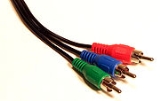
Component video is a video signal that has been split into two or more component channels. In popular use, it refers to a type of component
analog videoAnalog video is a video signal transferred by an analog signal. An analog color video signal contains luminance, brightness and chrominance of an analog television image...
(CAV) information that is transmitted or stored as three separate signals. Component video can be contrasted with
composite videoComposite video is the format of an analog television signal before it is combined with a sound signal and modulated onto an RF carrier. In contrast to component video it contains all required video information, including colors in a single line-level signal...
(
NTSCNTSC, named for the National Television System Committee, is the analog television system that is used in most of North America, most of South America , Burma, South Korea, Taiwan, Japan, the Philippines, and some Pacific island nations and territories .Most countries using the NTSC standard, as...
,
PALPAL, short for Phase Alternating Line, is an analogue television colour encoding system used in broadcast television systems in many countries. Other common analogue television systems are NTSC and SECAM. This page primarily discusses the PAL colour encoding system...
or
SECAMSECAM, also written SÉCAM , is an analog color television system first used in France....
) in which all the video information is combined into a single line-level signal that is used in
analog televisionAnalog television is the analog transmission that involves the broadcasting of encoded analog audio and analog video signal: one in which the message conveyed by the broadcast signal is a function of deliberate variations in the amplitude and/or frequency of the signal...
. Like composite, component-video cables do not carry audio and are often paired with audio cables.
When used without any other qualifications the term component video generally refers to analog
YPbPr' is a color space used in video electronics, in particular in reference to component video cables. is the analog version of the YCBCR color space; the two are numerically equivalent, but YPBPR is designed for use in analog systems whereas YCBCR is intended for digital video. cables are also...
component video with sync on luma.
Analog component video
Reproducing a video signal on a display device (for example, a
Cathode ray tubeThe cathode ray tube is a vacuum tube containing an electron gun and a fluorescent screen used to view images. It has a means to accelerate and deflect the electron beam onto the fluorescent screen to create the images. The image may represent electrical waveforms , pictures , radar targets and...
) (CRT) is a straightforward process complicated by the multitude of signal sources.
DVDA DVD is an optical disc storage media format, invented and developed by Philips, Sony, Toshiba, and Panasonic in 1995. DVDs offer higher storage capacity than Compact Discs while having the same dimensions....
,
VHSThe Video Home System is a consumer-level analog recording videocassette standard developed by Victor Company of Japan ....
, computers and video game consoles all store, process and transmit video signals using different methods, and often each will provide more than one signal option. One way of maintaining signal clarity is by separating the components of a video signal so that they do not interfere with each other. A signal separated in this way is called "component video".
S-VideoSeparate Video, more commonly known as S-Video and Y/C, is often referred to by JVC as both an S-VHS connector and as Super Video. It is an analog video transmission scheme, in which video information is encoded on two channels: luma and chroma...
, RGB and
YPbPr' is a color space used in video electronics, in particular in reference to component video cables. is the analog version of the YCBCR color space; the two are numerically equivalent, but YPBPR is designed for use in analog systems whereas YCBCR is intended for digital video. cables are also...
signals comprise two or more separate signals: hence, all are component-video signals. For most consumer-level applications, analog component video is used.
Digital component videoDigital component video is defined by ITU-R BT.601 standard and uses the Y'CbCr colorspace. Like Analog Component Video it gets its name from the fact that the video signal has been split into two or more components, that are then carried on multiple conductors between devices...
is slowly becoming popular in both computer and home-theatre applications. Component video is capable of carrying signals such as
480i480i is the shorthand name for a video mode, namely the US NTSC television system or digital television systems with the same characteristics. The i, which is sometimes uppercase, stands for interlaced, the 480 for a vertical frame resolution of 480 lines containing picture information; while NTSC...
,
480p480p is the shorthand name for a video display resolution. The p stands for progressive scan, i.e. non-interlaced. The 480 denotes a vertical resolution of 480 pixel high vertically scanning lines, usually with a horizontal resolution of 640 pixels and 4:3 aspect ratio or a horizontal resolution of...
,
576i576i is a standard-definition video mode used in PAL and SECAM countries. In digital applications it is usually referred to as "576i", in analogue contexts it is often quoted as "625 lines"...
,
576p576p is the shorthand name for a video display resolution. The p stands for progressive scan, i.e. non-interlaced, the 576 for a vertical resolution of 576 lines, usually with a horizontal resolution of 720 or 704 pixels. The frame rate can be given explicitly after the letter.-576p25:In other...
,
720p720p is the shorthand name for 1280x720, a category of High-definition television video modes having a resolution of 1080 or 720p and a progressive scan...
,
1080i1080i is the shorthand name for a high-definition television mode. The i means interlaced video; 1080i differs from 1080p, in which the p stands for progressive scan. The term 1080i assumes a widescreen aspect ratio of 16:9, implying a frame size of 1920×1080 pixels...
and even
1080p1080p is the shorthand identification for a set of HDTV high-definition video modes that are characterized by 1080 horizontal lines of resolution and progressive scan, meaning the image is not interlaced as is the case with the 1080i display standard....
(although Blu-Ray movies cannot be played at 1080p using component cables; the display would either switch to 1080i or 720p ). Many new high definition TVs support the use of component video up to their native resolution.
RGB analog component video
The various RGB (red, green, blue) analog component video standards (e.g., RGBS, RGBHV, RG&SB) use no compression and impose no real limit on color depth or resolution, but require large bandwidth to carry the signal and contain much
redundant dataInformation theory is a branch of applied mathematics and electrical engineering involving the quantification of information. Information theory was developed by Claude E. Shannon to find fundamental limits on signal processing operations such as compressing data and on reliably storing and...
since each channel typically includes the same black and white image. Most modern computers offer this signal via the
VGA portA Video Graphics Array connector is a three-row 15-pin DE-15 connector. The 15-pin VGA connector is found on many video cards, computer monitors, and some high definition television sets...
. Many televisions, especially in Europe, utilize RGB via the
SCARTSCART is a French-originated standard and associated 21-pin connector for connecting audio-visual equipment together...
connector. All arcade games, excepting early vector and black and white games, use RGB monitors.
Analog RGB is slowly falling out of favor as computers obtain better clarity using
DisplayPortDisplayPort is a digital display interface standard produced by the Video Electronics Standards Association . The specification defines a royalty-free digital interconnect for audio and video. The interface is primarily used to connect a video source to a display device such as a computer monitor...
or
Digital Visual InterfaceThe Digital Visual Interface is a video interface standard covering the transmission of video between a source device and a display device. The DVI standard has achieved widespread acceptance in the PC industry, both in desktop PCs and monitors...
(DVI) digital connections, while home theater moves towards
High-Definition Multimedia InterfaceHDMI is a compact audio/video interface for transmitting uncompressed digital data. It is a digital alternative to consumer analog standards, such as radio frequency coaxial cable, composite video, S-Video, SCART, component video, D-Terminal, or VGA...
(HDMI). Analog RGB has been largely ignored, despite its quality and suitability, as it cannot easily be made to support
digital rights managementDigital rights management is a class of access control technologies that are used by hardware manufacturers, publishers, copyright holders and individuals with the intent to limit the use of digital content and devices after sale. DRM is any technology that inhibits uses of digital content that...
. RGB was never popular in North America for consumer electronics as S-Video was considered sufficient for consumer use, although RGB was used extensively in commercial, professional and high-end installations.
RGB requires an additional signal for synchronizing the video display. Several methods are used:
- composite sync, where the horizontal and vertical signals are mixed together on a separate wire (the S in RGBS)
- separate sync, where the horizontal and vertical are each on their own wire (the H and V in RGBHV)
- sync on green, where a composite sync signal is overlaid on the green wire (SoG or RGsB).
- sync on red or sync on blue, where a composite sync signal is overlaid on either the red or blue wire
Composite sync is common in the European
SCARTSCART is a French-originated standard and associated 21-pin connector for connecting audio-visual equipment together...
connection scheme (using pin 17 [gnd] and 19 [out] or 20 [in]). Sometimes a full
composite videoComposite video is the format of an analog television signal before it is combined with a sound signal and modulated onto an RF carrier. In contrast to component video it contains all required video information, including colors in a single line-level signal...
signal may also serve as the sync signal, though often computer monitors will be unable to handle the extra video data. A full composite sync video signal requires four wires – red, green, blue, sync. If separate cables are used, the sync cable is usually colored white (or yellow, as is the standard for composite video).
Separate sync is most common with VGA, used worldwide for analog
computer monitorsA monitor or display is an electronic visual display for computers. The monitor comprises the display device, circuitry, and an enclosure...
. This is sometimes known as RGBHV, as the horizontal and vertical synchronization pulses are sent in separate channels. This mode requires five conductors. If separate cables are used, the sync lines are usually yellow (H) and white (V), or yellow (H) and black (V), or gray (H) and black (V).
Sync on GreenComponent video requires an extra synchronization signal to be sent along with the video. Component video sync signals can be sent in several different ways:...
(SoG) is less common, and while some VGA monitors support it, most do not.
Sony, commonly referred to as Sony, is a Japanese multinational conglomerate corporation headquartered in Minato, Tokyo, Japan and the world's fifth largest media conglomerate measured by revenues....
is a big proponent of SoG, and most of their monitors (and their
PlayStation 2The PlayStation 2 is a sixth-generation video game console manufactured by Sony as part of the PlayStation series. Its development was announced in March 1999 and it was first released on March 4, 2000, in Japan...
video game console) use it. Like devices that use composite video or S-video, SoG devices require additional circuitry to remove the sync signal from the green line. A monitor that is not equipped to handle SoG will display an image with an extreme green tint, if any image at all, when given a SoG input.
Sync on red and sync on blue are even rarer than sync on green, and are typically used only in certain specialized equipment.
YPbPr analog component video
Further types of component analog video signals do not use R, G, and B components but rather a colorless component, termed
luma, which provides brightness information (as in black-and-white video). This combines with one or more color-carrying components, termed
chromaChrominance is the signal used in video systems to convey the color information of the picture, separately from the accompanying luma signal . Chrominance is usually represented as two color-difference components: U = B' − Y' and V = R' − Y'...
, that give only color information. Both the
S-VideoSeparate Video, more commonly known as S-Video and Y/C, is often referred to by JVC as both an S-VHS connector and as Super Video. It is an analog video transmission scheme, in which video information is encoded on two channels: luma and chroma...
component video output (two separate signals) and the
YPbPr' is a color space used in video electronics, in particular in reference to component video cables. is the analog version of the YCBCR color space; the two are numerically equivalent, but YPBPR is designed for use in analog systems whereas YCBCR is intended for digital video. cables are also...
component video output (three separate signals) seen on DVD players are examples of this method.
Converting video into luma and chroma allows for
chroma subsamplingChroma subsampling is the practice of encoding images by implementing less resolution for chroma information than for luma information, taking advantage of the human visual system's lower acuity for color differences than for luminance....
, a method used by
JPEGIn computing, JPEG . The degree of compression can be adjusted, allowing a selectable tradeoff between storage size and image quality. JPEG typically achieves 10:1 compression with little perceptible loss in image quality....
images and
DVDA DVD is an optical disc storage media format, invented and developed by Philips, Sony, Toshiba, and Panasonic in 1995. DVDs offer higher storage capacity than Compact Discs while having the same dimensions....
players to reduce the storage requirements for images and video. The
YPbPr' is a color space used in video electronics, in particular in reference to component video cables. is the analog version of the YCBCR color space; the two are numerically equivalent, but YPBPR is designed for use in analog systems whereas YCBCR is intended for digital video. cables are also...
scheme is usually what is meant when people talk of component video today. Many consumer DVD players, high-definition displays, video projectors and other video devices use this form of color coding.
These connections are commonly and mistakenly labeled with terms like "YUV", "Y/R-Y/B-Y" and Y, B-Y, R-Y. This is inaccurate since
YUVYUV is a color space typically used as part of a color image pipeline. It encodes a color image or video taking human perception into account, allowing reduced bandwidth for chrominance components, thereby typically enabling transmission errors or compression artifacts to be more efficiently...
,
YPbPr' is a color space used in video electronics, in particular in reference to component video cables. is the analog version of the YCBCR color space; the two are numerically equivalent, but YPBPR is designed for use in analog systems whereas YCBCR is intended for digital video. cables are also...
, and Y B-Y R-Y differ in their scale factors.
When used for connecting a video source to a video display where both support 4:3 and 16:9 display formats, the PAL television standard provides for signaling pulses that will automatically switch the display from one format to the other.
Connectors used
- D-Terminal: Used mostly on Japanese electronics.
- Three BNC
The BNC connector ' is a common type of RF connector used for coaxial cable. It is used with radio, television, and other radio-frequency electronic equipment, test instruments, video signals, and was once a popular computer network connector. BNC connectors are made to match the characteristic...
(professional) or RCA connectorAn RCA connector, sometimes called a phono connector or cinch connector, is a type of electrical connector commonly used to carry audio and video signals...
s (consumerConsumer electronics are electronic equipment intended for everyday use, most often in entertainment, communications and office productivity. Radio broadcasting in the early 20th century brought the first major consumer product, the broadcast receiver...
): Typically colored red (Pr), green (Y), and blue (Pb).
- SCART
SCART is a French-originated standard and associated 21-pin connector for connecting audio-visual equipment together...
used in Europe.
- Video In Video Out
Video In Video Out, usually seen as the acronym VIVO , is a graphics port which enables some video cards to have bidirectional analog video transfer through a mini-DIN connector, usually of the 9-pin variety, and a specialised splitter cable .VIVO is found on high-end ATI and NVIDIA...
(VIVO): 9-pin Mini-DIN-connectors called "TV Out" in computer video cardsA video card, Graphics Card, or Graphics adapter is an expansion card which generates output images to a display. Most video cards offer various functions such as accelerated rendering of 3D scenes and 2D graphics, MPEG-2/MPEG-4 decoding, TV output, or the ability to connect multiple monitors...
, which usually include an adaptor for component RCAAn RCA connector, sometimes called a phono connector or cinch connector, is a type of electrical connector commonly used to carry audio and video signals...
, compositeComposite video is the format of an analog television signal before it is combined with a sound signal and modulated onto an RF carrier. In contrast to component video it contains all required video information, including colors in a single line-level signal...
RCAAn RCA connector, sometimes called a phono connector or cinch connector, is a type of electrical connector commonly used to carry audio and video signals...
and 4-pin S-VideoSeparate Video, more commonly known as S-Video and Y/C, is often referred to by JVC as both an S-VHS connector and as Super Video. It is an analog video transmission scheme, in which video information is encoded on two channels: luma and chroma...
-Mini-DIN.
International standards
Examples of international component video standards are:
- RS-170 RGB (525 lines, based on NTSC
NTSC, named for the National Television System Committee, is the analog television system that is used in most of North America, most of South America , Burma, South Korea, Taiwan, Japan, the Philippines, and some Pacific island nations and territories .Most countries using the NTSC standard, as...
timings, now EIAThe Electronic Industries Alliance was a standards and trade organization composed as an alliance of trade associations for electronics manufacturers in the United States. They developed standards to ensure the equipment of different manufacturers was compatible and interchangeable...
/TIA-343)
- RS-343 RGB (525, 625 or 875 lines)
- STANAG 3350
STANAG 3350 is a NATO analog video Standardization Agreement for military aircraft avionics.Video-capable sensors such as radars, FLIR, or video-guided missiles often provide a STANAG 3350 video output...
Analogue Video Standard (NATO military version of RS-343 RGB, now EIA-343A)
- CEA-770.3 High Definition TV Analog Component Video Interface Consumer Electronics Association
The Consumer Electronics Association is a standards and trade organization for the consumer electronics industry in the United States. The Consumer Electronics Association is the preeminent trade association promoting growth in the $173 billion U.S...
Component versus composite
In a composite signal, the
luminanceLuminance is a photometric measure of the luminous intensity per unit area of light travelling in a given direction. It describes the amount of light that passes through or is emitted from a particular area, and falls within a given solid angle. The SI unit for luminance is candela per square...
, Brightness (Y) signal and the
chrominanceChrominance is the signal used in video systems to convey the color information of the picture, separately from the accompanying luma signal . Chrominance is usually represented as two color-difference components: U = B' − Y' and V = R' − Y'...
, Color (C) signals are encoded together into one signal. When the color components are kept as separate signals, the video is called component analog video (CAV), which requires three separate signals: the luminance signal (Y) and the color difference signals (R-Y and B-Y).
Component video does not undergo the encoding process, the color quality is noticeably better than composite video.
Component video connectors are not unique in that the same connectors are used for several different standards; hence, making a component video connection often does not lead to a satisfactory video signal being transferred. Many DVD players and TVs may need to be set to indicate the type of input/output being used, and if set incorrectly the image may not be properly displayed.
Progressive scanProgressive scanning is a way of displaying, storing, or transmitting moving images in which all the lines of each frame are drawn in sequence...
, for example, is often not enabled by default, even when component video output is selected.