


Operating system

Encyclopedia
An operating system is a set of programs
that manage computer hardware
resources and provide common services for application software
. The operating system is the most important type of system software
in a computer system. A user cannot run an application program on the computer without an operating system, unless the application program is self booting.
Time-sharing operating systems schedule tasks for efficient use of the system and may also include accounting for cost allocation of processor time, mass storage, printing, and other resources.
For hardware functions such as input and output and memory allocation, the operating system acts as an intermediary between application programs and the computer hardware, although the application code is usually executed directly by the hardware and will frequently call the OS or be interrupted by it. Operating systems are found on almost any device that contains a computer—from cellular phones and video game console
s to supercomputers and web servers.
Examples of popular modern operating systems include Android, iOS, Linux
, Mac OS X
, and Microsoft Windows
.
Multi-user vs. Single-user
Multi-tasking vs. Single-tasking
Distributed
Embedded
, interrupts
, and parallel processing
. When personal computers by companies such as Apple Inc., Atari
, IBM
and Amiga
became popular in the 1980s, vendors added operating system features that had previously become widely used on mainframe and mini computers. Later, many features such as graphical user interface
were developed specifically for personal computer operating systems.
An operating system consists of many parts. One of the most important components is the kernel
, which controls low-level processes that the average user usually cannot see: it controls how memory is read and written, the order in which processes are executed, how information is received and sent by devices like the monitor, keyboard and mouse, and decides how to interpret information received from networks. The user interface
is a component that interacts with the computer user directly, allowing them to control and use programs. The user interface may be graphical with icons and a desktop
, or textual, with a command line
. Application programming interface
s provide services and code libraries that let applications developers write modular code reusing well defined programming sequences in user space libraries or in the operating system itself. Which features are considered part of the operating system is defined differently in various operating systems. For example, Microsoft Windows considers its user interface to be part of the operating system, while many versions of Linux do not.
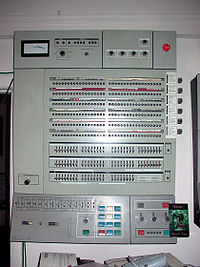 In the early 1950s, a computer could execute only one program at a time. Each user had sole use of the computer for a limited period of time and would arrive at a scheduled time with program and data on punched paper cards and/or punched tape. The program would be loaded into the machine, and the machine would be set to work until the program completed or crashed. Programs could generally be debugged via a front panel using toggle switches and panel lights. It is said that Alan Turing
was a master of this on the early Manchester Mark 1
machine, and he was already deriving the primitive conception of an operating system from the principles of the Universal Turing machine
.
Later machines came with libraries of software
, which would be linked to a user's program to assist in operations such as input and output and generating computer code
from human-readable symbolic code
. This was the genesis of the modern-day operating system. However, machines still ran a single job at a time. At Cambridge University in England the job queue was at one time a washing line from which tapes were hung with different colored clothes-pegs to indicate job-priority.
, input/output interrupt
, buffering, multitasking
, spooling
, runtime libraries
, link-loading, and programs for sorting records
in files. These features were included or not included in application software at the option of application programmers, rather than in a separate operating system used by all applications. In 1959 the SHARE Operating System
was released as an integrated utility for the IBM 704
, and later in the 709
and 7090
mainframes, although it was quickly supplanted by IBSYS/IBJOB on the 709, 7090 and 7094.
During the 1960s, IBM's OS/360 introduced the concept of a single OS spanning an entire product line, which was crucial for the success of the System/360 machines. IBM
's current mainframe operating systems are distant descendants
of this original system and applications written for OS/360 can still be run on modern machines.
OS/360 also pioneered the concept that the operating system keeps track of all of the system resources that are used, including program and data space allocation in main memory and file space in secondary storage, and file locking
during update. When the process is terminated for any reason, all of these resources are re-claimed by the operating system.
The alternative CP-67
system for the S/360-67
started a whole line of IBM operating systems focused on the concept of virtual machine
s. Other operating systems used on IBM S/360 series mainframes included systems developed by IBM: COS/360 (Compatabililty Operating System), DOS/360
(Disk Operating System), TSS/360
(Time Sharing System), TOS/360 (Tape Operating System), BOS/360 (Basic Operating System), and ACP (Airline Control Program), as well as a few non-IBM systems: MTS
(Michigan Terminal System), MUSIC
(Multi-User System for Interactive Computing), and ORVYL (Stanford Timesharing System).
Control Data Corporation
developed the SCOPE
operating system in the 1960s, for batch processing
. In cooperation with the University of Minnesota, the Kronos and later the NOS
operating systems were developed during the 1970s, which supported simultaneous batch and timesharing use. Like many commercial timesharing systems, its interface was an extension of the Dartmouth BASIC operating systems, one of the pioneering efforts in timesharing and programming languages. In the late 1970s, Control Data and the University of Illinois developed the PLATO
operating system, which used plasma panel displays and long-distance time sharing networks. Plato was remarkably innovative for its time, featuring real-time chat, and multi-user graphical games.
Burroughs Corporation introduced the B5000 in 1961 with the MCP, (Master Control Program
) operating system. The B5000 was a stack machine
designed to exclusively support high-level languages with no machine language or assembler, and indeed the MCP was the first OS to be written exclusively in a high-level language – ESPOL
, a dialect of ALGOL
. MCP also introduced many other ground-breaking innovations, such as being the first commercial implementation of virtual memory
. During development of the AS400, IBM
made an approach to Burroughs to licence MCP to run on the AS400 hardware. This proposal was declined by Burroughs management to protect its existing hardware production. MCP is still in use today in the Unisys
ClearPath/MCP line of computers.
UNIVAC, the first commercial computer manufacturer, produced a series of EXEC operating systems. Like all early main-frame systems, this was a batch-oriented system that managed magnetic drums, disks, card readers and line printers. In the 1970s, UNIVAC produced the Real-Time Basic (RTB) system to support large-scale time sharing, also patterned after the Dartmouth BC system.
General Electric and MIT developed General Electric Comprehensive Operating Supervisor (GECOS), which introduced the concept of ringed security privilege levels. After acquisition by Honeywell it was renamed to General Comprehensive Operating System
(GCOS).
Digital Equipment Corporation developed many operating systems for its various computer lines, including TOPS-10
and TOPS-20
time sharing systems for the 36-bit PDP-10 class systems. Prior to the widespread use of UNIX, TOPS-10 was a particularly popular system in universities, and in the early ARPANET
community.
In the late 1960s through the late 1970s, several hardware capabilities evolved that allowed similar or ported software to run on more than one system. Early systems had utilized microprogramming to implement features on their systems in order to permit different underlying architecture to appear to be the same as others in a series. In fact most 360s after the 360/40 (except the 360/165 and 360/168) were microprogrammed implementations. But soon other means of achieving application compatibility were proven to be more significant.
The enormous investment in software for these systems made since 1960s caused most of the original computer manufacturers to continue to develop compatible operating systems along with the hardware. The notable supported mainframe operating systems include:
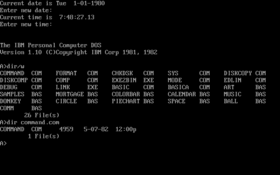
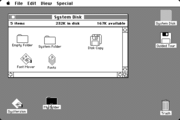 The first microcomputer
s did not have the capacity or need for the elaborate operating systems that had been developed for mainframes and minis; minimalistic operating systems were developed, often loaded from ROM
and known as Monitors. One notable early disk-based operating system was CP/M
, which was supported on many early microcomputers and was closely imitated by Microsoft
's MS-DOS
, which became wildly popular as the operating system chosen for the IBM PC
(IBM's version of it was called IBM DOS or PC DOS
). In the '80s, Apple Computer Inc. (now Apple Inc.) abandoned its popular Apple II
series of microcomputers to introduce the Apple Macintosh computer with an innovative Graphical User Interface
(GUI) to the Mac OS
.
The introduction of the Intel 80386
CPU chip with 32-bit
architecture and paging
capabilities, provided personal computers with the ability to run multitasking
operating systems like those of earlier minicomputers and mainframes. Microsoft responded to this progress by hiring Dave Cutler
, who had developed the VMS
operating system for Digital Equipment Corporation
. He would lead the development of the Windows NT
operating system, which continues to serve as the basis for Microsoft's operating systems line. Steve Jobs
, a co-founder of Apple Inc., started NeXT
Computer Inc., which developed the Unix-like
NEXTSTEP
operating system. NEXTSTEP would later be acquired by Apple Inc. and used, along with code from FreeBSD
as the core of Mac OS X.
The GNU Project
was started by activist and programmer Richard Stallman
with the goal of a complete free software
replacement to the proprietary UNIX
operating system. While the project was highly successful in duplicating the functionality of various parts of UNIX, development of the GNU Hurd
kernel proved to be unproductive. In 1991, Finnish computer science student Linus Torvalds
, with cooperation from volunteers collaborating over the Internet, released the first version of the Linux kernel
. It was soon merged with the GNU user space
components and system software
to form a complete operating system. Since then, the combination of the two major components has usually been referred to as simply "Linux" by the software industry, a naming convention that Stallman and the Free Software Foundation
remain opposed to, preferring the name GNU/Linux. The Berkeley Software Distribution, known as BSD, is the UNIX derivative distributed by the University of California, Berkeley, starting in the 1970s. Freely distributed and ported to many minicomputers, it eventually also gained a following for use on PCs, mainly as FreeBSD
, NetBSD
and OpenBSD
.
File:Unix history-simple.png|256px|thumb|Evolution of Unix
systems
default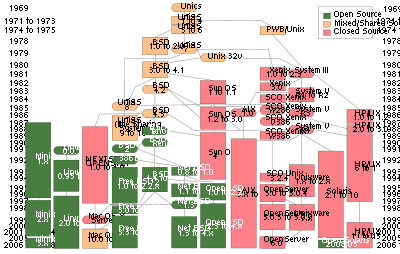
Ken Thompson
wrote B, mainly based on BCPL
, which he used to write Unix, based on his experience in the MULTICS
project. B was replaced by C
, and Unix developed into a large, complex family of inter-related operating systems which have been influential in every modern operating system (see History
).
The Unix-like
family is a diverse group of operating systems, with several major sub-categories including System V, BSD, and GNU/Linux. The name "UNIX
" is a trademark of The Open Group
which licenses it for use with any operating system that has been shown to conform to their definitions. "Unix-like" is commonly used to refer to the large set of operating systems which resemble the original Unix.
Unix-like systems run on a wide variety of machine architectures. They are used heavily for servers
in business, as well as workstation
s in academic and engineering environments. Free
Unix variants, such as GNU/Linux and BSD
, are popular in these areas.
Four operating systems are certified by the The Open Group
(holder of the Unix trademark) as Unix. HP's HP-UX
and IBM's AIX
are both descendants of the original System V Unix and are designed to run only on their respective vendor's hardware. In contrast, Sun Microsystems's
Solaris Operating System
can run on multiple types of hardware, including x86 and Sparc
servers, and PCs. Apple's Mac OS X
, a replacement for Apple's earlier (non-Unix) Mac OS, is a hybrid kernel
-based BSD variant derived from NeXTSTEP
, Mach
, and FreeBSD
.
Unix interoperability was sought by establishing the POSIX
standard. The POSIX standard can be applied to any operating system, although it was originally created for various Unix variants.
A subgroup of the Unix family is the Berkeley Software Distribution
family, which includes FreeBSD
, NetBSD
, and OpenBSD
. These operating systems are most commonly found on webservers, although they can also function as a personal computer OS. The Internet owes much of its existence to BSD, as many of the protocols now commonly used by computers to connect, send and receive data over a network were widely implemented and refined in BSD. The world wide web
was also first demonstrated on a number of computers running an OS based on BSD called NextStep
.
BSD has its roots in Unix. In 1974, University of California, Berkeley
installed its first Unix system. Over time, students and staff in the computer science department there began adding new programs to make things easier, such as text editors. When Berkely received new VAX
computers in 1978 with Unix installed, the school's undergraduates modified Unix even more in order to take advantage of the computer's hardware possibilities. The Defense Advanced Research Projects Agency
of the US Department of Defense
took interest, and decided to fund the project. Many schools, corporations, and government organizations took notice and started to use Berkeley's version of Unix instead of the official one distributed by AT&T.
Steve Jobs
, upon leaving Apple Inc. in 1985, formed NeXT Inc.
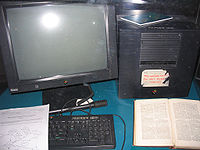
, a company that manufactured high-end computers running on a variation of BSD called NeXTSTEP
. One of these computers was used by Tim Berners-Lee
as the first webserver to create the World Wide Web.
Developers like Keith Bostic
encouraged the project to replace any non-free code that originated with Bell Labs. Once this was done, however, AT&T sued. Eventually, after two years of legal disputes, the BSD project came out ahead and spawned a number of free derivatives, such as FreeBSD
and NetBSD
.
Mac OS X is a line of open core
graphical operating systems developed, marketed, and sold by Apple Inc., the latest of which is pre-loaded on all currently shipping Macintosh
computers. Mac OS X is the successor to the original Mac OS
, which had been Apple's primary operating system since 1984. Unlike its predecessor, Mac OS X is a UNIX
operating system built on technology that had been developed at NeXT
through the second half of the 1980s and up until Apple purchased the company in early 1997.
The operating system was first released in 1999 as Mac OS X Server 1.0
, with a desktop-oriented version (Mac OS X v10.0
) following in March 2001. Since then, six more distinct "client" and "server" editions of Mac OS X have been released, the most recent being Mac OS X 10.7
, which was first made available on July 20, 2011. Releases of Mac OS X are named after big cat
s; the current version of Mac OS X is "Lion".
The server edition, Mac OS X Server
, is architecturally
identical to its desktop counterpart but usually runs on Apple's line of Macintosh server
hardware. Mac OS X Server includes work group management and administration software tools that provide simplified access to key network service
s, including a mail transfer agent
, a Samba server, an LDAP server, a domain name server
, and others. In Mac OS X v10.7 Lion
, all server aspects of Mac OS X Server have been integrated into the client version.
, Dennis Ritchie
and Douglas McIlroy
at Bell Labs
designed and developed the C programming language to build the operating system Unix. Programmers at Bell Labs went on to develop Plan 9
and Inferno
, which were engineered for modern distributed environments. Plan 9 was designed from the start to be a networked operating system, and had graphics built-in, unlike Unix, which added these features to the design later. It is currently released under the Lucent Public License
. Inferno was sold to Vita Nuova Holdings and has been released under a GPL/MIT license.
is released under an open source license, so anyone can read and modify its code. It has been modified to run on a large variety of electronics. Although estimates suggest that Linux is used on 1.82% of all personal computers, it has been widely adopted for use in servers and embedded systems (such as cell phones). Linux has superseded Unix in most places, and is used on the 10 most powerful supercomputers in the world. The Linux kernel is used in some popular distributions, such as Red Hat
, Debian
, Ubuntu
, Linux Mint
and Google
's Android.
The GNU project is a mass collaboration of programmers who seek to create a completely free and open operating system that was similar to Unix but with completely original code. It was started in 1983 by Richard Stallman
, and is responsible for many of the parts of most Linux variants. For this reason, some claim that the combined product of the Linux kernel and the GNU software collection is more correctly called GNU/Linux. Thousands of pieces of software for virtually every operating system are licensed under the GNU General Public License
. Meanwhile, the Linux kernel began as a side project of Linus Torvalds
, a university student from Finland. In 1991, Torvalds began work on it, and posted information about his project on a newsgroup for computer students and programmers. He received a wave of support and volunteers who ended up creating a full-fledged kernel. Programmers from GNU took notice, and members of both projects worked to integrate the finished GNU parts with the Linux kernel in order to create a full-fledged operating system.
Chrome is an operating system based on the Linux kernel and designed by Google
. Since Chrome OS targets computer users who spend most of their time on the Internet, it is mainly a web browser
with no ability to run applications. It relies on Internet applications (or Web apps) used in the web browser to accomplish tasks such as word processing and media viewing, as well as online storage for storing most files.
personal computer. It was developed first by the Amiga Corporation
then sold to Commodore International
, and initially introduced in 1985 with the Amiga 1000
. Early versions (1.0-3.9) run on the Motorola 68k series of 16-bit and 32-bit microprocessors, while the newer AmigaOS 4 runs only on PowerPC microprocessors.
On top of a preemptive multitasking kernel called Exec, it includes an abstraction of the Amiga's unique hardware, a disk operating system called AmigaDOS, a windowing system API called Intuition and a graphical user interface called Workbench. A command line interface called AmigaShell is also available and integrated into the system. The GUI and the CLI complement each other and share the same privileges.
The current holder of the Amiga intellectual properties is Amiga Inc. They oversaw the development of AmigaOS 4
but did not develop it themselves, contracting it instead to Hyperion Entertainment. On 20 December 2006, Amiga Inc terminated Hyperion's license to continue development of AmigaOS 4
. However, in 30 September 2009, Hyperion was granted an exclusive, perpetual, worldwide right to AmigaOS 3.1 in order to use, develop, modify, commercialize, distribute and market AmigaOS 4.x and subsequent versions of AmigaOS (including AmigaOS 5).
operating systems designed by Microsoft Corporation and primarily targeted to Intel architecture based computers, with an estimated 88.9 percent total usage share on Web connected computers. The newest version is Windows 7 for workstations and Windows Server 2008 R2
for servers. Windows 7 recently overtook Windows XP as most used OS.
Microsoft Windows originated in 1985 as an application running on top of MS-DOS
, which was the standard operating system shipped on most Intel architecture personal computers at the time. In 1995, Windows 95
was released, combining MS-DOS 7.0 with Windows on the same medium, removing the need of getting a separate MS-DOS license. Keeping much legacy, it could run real-mode MS-DOS and 16 bits Windows 3.x drivers. Windows Me
, released in 2000, was the latest version of Windows of the Windows 95 family. Later versions have all been based on the Windows NT
kernel
. Current versions of Windows run on IA-32
and x86-64
microprocessors, although Windows 8 will support ARM architecture. In the past, Windows NT supported a few non-Intel architectures.
Server editions of Windows are widely used. In recent years, Microsoft has expended significant capital in an effort to promote the use of Windows as a server operating environment. However, Windows' usage on servers is not as widespread as on personal computers, as Windows competes against Linux and BSD for server market share.
from IBM and Microsoft; Mac OS
, the non-Unix precursor to Apple's Mac OS X; BeOS
; XTS-300
. Some, most notably Haiku
, RISC OS
, MorphOS
and FreeMint continue to be developed as minority platforms for enthusiast communities and specialist applications. OpenVMS
formerly from DEC
, is still under active development by Hewlett-Packard
. Yet other operating systems are used almost exclusively in academia, for operating systems education or to do research on operating system concepts. A typical example of a system that fulfills both roles is MINIX
, while for example Singularity
is used purely for research.
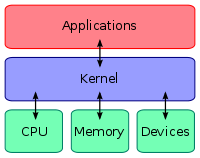
With the aid of the firmware
and device drivers, the kernel provides the most basic level of control over all of the computer's hardware devices. It manages memory access for programs in the RAM
, it determines which programs get access to which hardware resources, it sets up or resets the CPU's operating states for optimal operation at all times, and it organizes the data for long-term non-volatile storage with file systems on such media as disks, tapes, flash memory, etc.
s (50 or 60 bytes) but are unusual in modern systems with large stacks. Interrupt
-based programming is directly supported by most modern CPUs. Interrupts provide a computer with a way of automatically saving local register contexts, and running specific code in response to events. Even very basic computers support hardware interrupts, and allow the programmer to specify code which may be run when that event takes place.
When an interrupt is received, the computer's hardware automatically suspends whatever program is currently running, saves its status, and runs computer code previously associated with the interrupt; this is analogous to placing a bookmark in a book in response to a phone call. In modern operating systems, interrupts are handled by the operating system's kernel. Interrupts may come from either the computer's hardware or from the running program.
When a hardware device triggers an interrupt, the operating system's kernel decides how to deal with this event, generally by running some processing code. The amount of code being run depends on the priority of the interrupt (for example: a person usually responds to a smoke detector alarm before answering the phone). The processing of hardware interrupts is a task that is usually delegated to software called device driver, which may be either part of the operating system's kernel, part of another program, or both. Device drivers may then relay information to a running program by various means.
A program may also trigger an interrupt to the operating system. If a program wishes to access hardware for example, it may interrupt the operating system's kernel, which causes control to be passed back to the kernel. The kernel will then process the request. If a program wishes additional resources (or wishes to shed resources) such as memory, it will trigger an interrupt to get the kernel's attention.
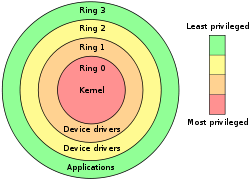 Modern CPUs support multiple modes of operation. CPUs with this capability use at least two modes: protected mode
and supervisor mode. The supervisor mode is used by the operating system's kernel for low level tasks that need unrestricted access to hardware, such as controlling how memory is written and erased, and communication with devices like graphics cards. Protected mode, in contrast, is used for almost everything else. Applications operate within protected mode, and can only use hardware by communicating with the kernel, which controls everything in supervisor mode. CPUs might have other modes similar to protected mode as well, such as the virtual modes in order to emulate older processor types, such as 16-bit processors on a 32-bit one, or 32-bit processors on a 64-bit one.
When a computer first starts up, it is automatically running in supervisor mode. The first few programs to run on the computer, being the BIOS
or EFI
, bootloader, and the operating system have unlimited access to hardware - and this is required because, by definition, initializing a protected environment can only be done outside of one. However, when the operating system passes control to another program, it can place the CPU into protected mode
.
In protected mode
, programs may have access to a more limited set of the CPU's instructions. A user program may leave protected mode
only by triggering an interrupt, causing control to be passed back to the kernel. In this way the operating system can maintain exclusive control over things like access to hardware and memory.
The term "protected mode resource" generally refers to one or more CPU registers, which contain information that the running program isn't allowed to alter. Attempts to alter these resources generally causes a switch to supervisor mode, where the operating system can deal with the illegal operation the program was attempting (for example, by killing the program).
Cooperative memory management, used by many early operating systems, assumes that all programs make voluntary use of the kernel's memory manager, and do not exceed their allocated memory. This system of memory management is almost never seen any more, since programs often contain bugs which can cause them to exceed their allocated memory. If a program fails, it may cause memory used by one or more other programs to be affected or overwritten. Malicious programs or viruses may purposefully alter another program's memory, or may affect the operation of the operating system itself. With cooperative memory management, it takes only one misbehaved program to crash the system.
Memory protection
enables the kernel to limit a process' access to the computer's memory. Various methods of memory protection exist, including memory segmentation and paging
. All methods require some level of hardware support (such as the 80286 MMU), which doesn't exist in all computers.
In both segmentation and paging, certain protected mode
registers specify to the CPU what memory address it should allow a running program to access. Attempts to access other addresses will trigger an interrupt which will cause the CPU to re-enter supervisor mode, placing the kernel in charge. This is called a segmentation violation or Seg-V for short, and since it is both difficult to assign a meaningful result to such an operation, and because it is usually a sign of a misbehaving program, the kernel will generally resort to terminating the offending program, and will report the error.
Windows 3.1-Me had some level of memory protection, but programs could easily circumvent the need to use it. A general protection fault
would be produced, indicating a segmentation violation had occurred; however, the system would often crash anyway.
If a program tries to access memory that isn't in its current range of accessible memory, but nonetheless has been allocated to it, the kernel will be interrupted in the same way as it would if the program were to exceed its allocated memory. (See section on memory management.) Under UNIX this kind of interrupt is referred to as a page fault
.
When the kernel detects a page fault it will generally adjust the virtual memory range of the program which triggered it, granting it access to the memory requested. This gives the kernel discretionary power over where a particular application's memory is stored, or even whether or not it has actually been allocated yet.
In modern operating systems, memory which is accessed less frequently can be temporarily stored on disk or other media to make that space available for use by other programs. This is called swapping
, as an area of memory can be used by multiple programs, and what that memory area contains can be swapped or exchanged on demand.
"Virtual memory" provides the programmer or the user with the perception that there is a much larger amount of RAM in the computer than is really there.
refers to the running of multiple independent computer programs on the same computer; giving the appearance that it is performing the tasks at the same time. Since most computers can do at most one or two things at one time, this is generally done via time-sharing, which means that each program uses a share of the computer's time to execute.
An operating system kernel contains a piece of software called a scheduler
which determines how much time each program will spend executing, and in which order execution control should be passed to programs. Control is passed to a process by the kernel, which allows the program access to the CPU
and memory. Later, control is returned to the kernel through some mechanism, so that another program may be allowed to use the CPU. This so-called passing of control between the kernel and applications is called a context switch
.
An early model which governed the allocation of time to programs was called cooperative multitasking. In this model, when control is passed to a program by the kernel, it may execute for as long as it wants before explicitly returning control to the kernel. This means that a malicious or malfunctioning program may not only prevent any other programs from using the CPU, but it can hang the entire system if it enters an infinite loop
.
Modern operating systems extend the concepts of application preemption to device drivers and kernel code, so that the operating system has preemptive control over internal run-times as well.
The philosophy governing preemptive multitasking is that of ensuring that all programs are given regular time on the CPU. This implies that all programs must be limited in how much time they are allowed to spend on the CPU without being interrupted. To accomplish this, modern operating system kernels make use of a timed interrupt. A protected mode
timer is set by the kernel which triggers a return to supervisor mode after the specified time has elapsed. (See above sections on Interrupts and Dual Mode Operation.)
On many single user operating systems cooperative multitasking is perfectly adequate, as home computers generally run a small number of well tested programs. Windows NT
was the first version of Microsoft Windows
which enforced preemptive multitasking, but it didn't reach the home user market until Windows XP
(since Windows NT
was targeted at professionals).
, and enables files to have names and attributes. It also allows them to be stored in a hierarchy of directories or folders arranged in a directory tree.
Early operating systems generally supported a single type of disk drive and only one kind of file system. Early file systems were limited in their capacity, speed, and in the kinds of file names and directory structures they could use. These limitations often reflected limitations in the operating systems they were designed for, making it very difficult for an operating system to support more than one file system.
While many simpler operating systems support a limited range of options for accessing storage systems, operating systems like UNIX
and GNU/Linux support a technology known as a virtual file system
or VFS. An operating system such as UNIX supports a wide array of storage devices, regardless of their design or file system
s, allowing them to be accessed through a common application programming interface
(API). This makes it unnecessary for programs to have any knowledge about the device they are accessing. A VFS allows the operating system to provide programs with access to an unlimited number of devices with an infinite variety of file systems installed on them, through the use of specific device driver
s and file system drivers.
A connected storage device
, such as a hard drive, is accessed through a device driver
. The device driver understands the specific language of the drive and is able to translate that language into a standard language used by the operating system to access all disk drives. On UNIX, this is the language of block devices.
When the kernel has an appropriate device driver in place, it can then access the contents of the disk drive in raw format, which may contain one or more file systems. A file system driver is used to translate the commands used to access each specific file system into a standard set of commands that the operating system can use to talk to all file systems. Programs can then deal with these file systems on the basis of filenames, and directories/folders, contained within a hierarchical structure. They can create, delete, open, and close files, as well as gather various information about them, including access permissions, size, free space, and creation and modification dates.
Various differences between file systems make supporting all file systems difficult. Allowed characters in file names, case sensitivity
, and the presence of various kinds of file attribute
s makes the implementation of a single interface for every file system a daunting task. Operating systems tend to recommend using (and so support natively) file systems specifically designed for them; for example, NTFS
in Windows and ext3
and ReiserFS
in GNU/Linux. However, in practice, third party drives are usually available to give support for the most widely used file systems in most general-purpose operating systems (for example, NTFS is available in GNU/Linux through NTFS-3g
, and ext2/3 and ReiserFS are available in Windows through FS-driver and rfstool).
Support for file systems is highly varied among modern operating systems, although there are several common file systems which almost all operating systems include support and drivers for. Operating systems vary on file system support and on the disk formats they may be installed on. Under Windows, each file system is usually limited in application to certain media; for example, CDs must use ISO 9660
or UDF
, and as of Windows Vista
, NTFS
is the only file system which the operating system can be installed on. It is possible to install GNU/Linux onto many types of file systems. Unlike other operating systems, GNU/Linux and UNIX allow any file system to be used regardless of the media it is stored in, whether it is a hard drive, a disc (CD,DVD...), a USB flash drive, or even contained within a file located on another file system.
is a specific type of computer software developed to allow interaction with hardware devices. Typically this constitutes an interface for communicating with the device, through the specific computer bus or communications subsystem that the hardware is connected to, providing commands to and/or receiving data from the device, and on the other end, the requisite interfaces to the operating system and software applications. It is a specialized hardware-dependent computer program which is also operating system specific that enables another program, typically an operating system or applications software package or computer program running under the operating system kernel, to interact transparently with a hardware device, and usually provides the requisite interrupt handling necessary for any necessary asynchronous time-dependent hardware interfacing needs.
The key design goal of device drivers is abstraction
. Every model of hardware (even within the same class of device) is different. Newer models also are released by manufacturers that provide more reliable or better performance and these newer models are often controlled differently. Computers and their operating systems cannot be expected to know how to control every device, both now and in the future. To solve this problem, operating systems essentially dictate how every type of device should be controlled. The function of the device driver is then to translate these operating system mandated function calls into device specific calls. In theory a new device, which is controlled in a new manner, should function correctly if a suitable driver is available. This new driver will ensure that the device appears to operate as usual from the operating system's point of view.
Under versions of Windows before Vista and versions of Linux before 2.6, all driver execution was co-operative, meaning that if a driver entered an infinite loop it would freeze the system. More recent revisions of these operating systems incorporate kernel preemption, where the kernel interrupts the driver to give it tasks, and then separates itself from the process until it receives a response from the device driver, or gives it more tasks to do.
for sharing resources such as computing
, files, printers, and scanners using either wired or wireless connections. Networks can essentially allow a computer's operating system to access the resources of a remote computer to support the same functions as it could if those resources were connected directly to the local computer. This includes everything from simple communication, to using networked file systems or even sharing another computer's graphics or sound hardware. Some network services allow the resources of a computer to be accessed transparently, such as SSH
which allows networked users direct access to a computer's command line interface.
Client/server networking allows a program on a computer, called a client, to connect via a network to another computer, called a server. Servers offer (or host) various services to other network computers and users. These services are usually provided through ports or numbered access points beyond the server's network address
. Each port number is usually associated with a maximum of one running program, which is responsible for handling requests to that port. A daemon, being a user program, can in turn access the local hardware resources of that computer by passing requests to the operating system kernel.
Many operating systems support one or more vendor-specific or open networking protocols as well, for example, SNA
on IBM
systems, DECnet
on systems from Digital Equipment Corporation
, and Microsoft-specific protocols (SMB
) on Windows. Specific protocols for specific tasks may also be supported such as NFS for file access. Protocols like ESound
, or esd can be easily extended over the network to provide sound from local applications, on a remote system's sound hardware.
The operating system must be capable of distinguishing between requests which should be allowed to be processed, and others which should not be processed. While some systems may simply distinguish between "privileged" and "non-privileged", systems commonly have a form of requester identity, such as a user name. To establish identity there may be a process of authentication. Often a username must be quoted, and each username may have a password. Other methods of authentication, such as magnetic cards or biometric data, might be used instead. In some cases, especially connections from the network, resources may be accessed with no authentication at all (such as reading files over a network share). Also covered by the concept of requester identity is authorization; the particular services and resources accessible by the requester once logged into a system are tied to either the requester's user account or to the variously configured groups of users to which the requester belongs.
In addition to the allow/disallow model of security, a system with a high level of security will also offer auditing options. These would allow tracking of requests for access to resources (such as, "who has been reading this file?"). Internal security, or security from an already running program is only possible if all possibly harmful requests must be carried out through interrupts to the operating system kernel. If programs can directly access hardware and resources, they cannot be secured.
External security involves a request from outside the computer, such as a login at a connected console or some kind of network connection. External requests are often passed through device drivers to the operating system's kernel, where they can be passed onto applications, or carried out directly. Security of operating systems has long been a concern because of highly sensitive data held on computers, both of a commercial and military nature. The United States Government Department of Defense
(DoD) created the Trusted Computer System Evaluation Criteria
(TCSEC) which is a standard that sets basic requirements for assessing the effectiveness of security. This became of vital importance to operating system makers, because the TCSEC was used to evaluate, classify and select computer systems being considered for the processing, storage and retrieval of sensitive or classified information
.
Network services include offerings such as file sharing, print services, email, web sites, and file transfer protocol
s (FTP), most of which can have compromised security. At the front line of security are hardware devices known as firewalls or intrusion detection/prevention systems. At the operating system level, there are a number of software firewalls available, as well as intrusion detection/prevention systems. Most modern operating systems include a software firewall, which is enabled by default. A software firewall can be configured to allow or deny network traffic to or from a service or application running on the operating system. Therefore, one can install and be running an insecure service, such as Telnet or FTP, and not have to be threatened by a security breach because the firewall would deny all traffic trying to connect to the service on that port.
An alternative strategy, and the only sandbox
strategy available in systems that do not meet the Popek and Goldberg virtualization requirements
, is the operating system not running user programs as native code, but instead either emulates
a processor or provides a host for a p-code
based system such as Java.
Internal security is especially relevant for multi-user systems; it allows each user of the system to have private files that the other users cannot tamper with or read. Internal security is also vital if auditing is to be of any use, since a program can potentially bypass the operating system, inclusive of bypassing auditing.
. The user interface is not actually a part of the operating system—it generally runs in a separate program usually referred to as a shell
, but is essential if human interaction is to be supported. The user interface requests services from the operating system that will acquire data from input hardware devices
, such as a keyboard
, mouse
or credit card reader
, and requests operating system services to display prompts, status messages and such on output hardware devices
, such as a video monitor or printer. The two most common forms of a user interface have historically been the command-line interface
, where computer commands are typed out line-by-line, and the graphical user interface
, where a visual environment (most commonly with windows, buttons, icons and a mouse pointer) is present.
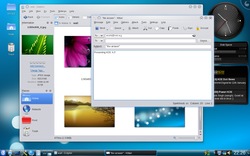 Most of the modern computer systems support graphical user interface
s (GUI), and often include them. In some computer systems, such as the original implementation of Mac OS
, the GUI is integrated into the kernel.
While technically a graphical user interface is not an operating system service, incorporating support for one into the operating system kernel can allow the GUI to be more responsive by reducing the number of context switch
es required for the GUI to perform its output functions. Other operating systems are modular
, separating the graphics subsystem from the kernel and the Operating System. In the 1980s UNIX, VMS and many others had operating systems that were built this way. GNU/Linux and Mac OS X are also built this way. Modern releases of Microsoft Windows such as Windows Vista
implement a graphics subsystem that is mostly in user-space; however the graphics drawing routines of versions between Windows NT 4.0
and Windows Server 2003
exist mostly in kernel space. Windows 9x
had very little distinction between the interface and the kernel.
Many computer operating systems allow the user to install or create any user interface they desire. The X Window System
in conjunction with GNOME
or KDE
is a commonly found setup on most Unix and Unix-like
(BSD, GNU/Linux, Solaris) systems. A number of Windows shell replacements have been released for Microsoft Windows, which offer alternatives to the included Windows shell
, but the shell itself cannot be separated from Windows.
Numerous Unix-based GUIs have existed over time, most derived from X11. Competition among the various vendors of Unix (HP, IBM, Sun) led to much fragmentation, though an effort to standardize in the 1990s to COSE and CDE
failed for various reasons, and were eventually eclipsed by the widespread adoption of GNOME and KDE. Prior to free software
-based toolkits and desktop environments, Motif was the prevalent toolkit/desktop combination (and was the basis upon which CDE was developed).
Graphical user interfaces evolve over time. For example, Windows has modified its user interface almost every time a new major version of Windows is released, and the Mac OS GUI changed dramatically with the introduction of Mac OS X in 1999.
). Such applications include some small embedded system
s, automobile engine controllers, industrial robots, spacecraft, industrial control, and some large-scale computing systems.
An early example of a large-scale real-time operating system was Transaction Processing Facility
developed by American Airlines
and IBM for the Sabre Airline Reservations System.
Embedded systems that have fixed deadlines use a real-time operating system
such as VxWorks
, PikeOS
, eCos
, QNX
, MontaVista Linux and RTLinux
. Windows CE
is a real-time operating system
that shares similar APIs to desktop Windows but shares none of desktop Windows' codebase. Symbian OS also has an RTOS kernel (EKA2) starting with version 8.0b.
Some embedded systems use operating systems such as Palm OS
, BSD, and GNU/Linux, although such operating systems do not support real-time computing.
.
In some cases, hobby development is in support of a "homebrew
" computing device, for example, a simple single-board computer
powered by a 6502 microprocessor. Or, development may be for an architecture already in widespread use. Operating system development may come from entirely new concepts, or may commence by modeling an existing operating system. In either case, the hobbyist is his/her own developer, or may interact with a small and sometimes unstructured group of individuals who have like interests.
Examples of a hobby operating system include ReactOS
and Syllable
.
.
This cost in supporting operating systems diversity can be avoided by instead writing applications against software platforms like Java, or Qt
for web browsers. These abstractions have already borne the cost of adaptation to specific operating systems and their system libraries.
Another approach is for operating system vendors to adopt standards. For example, POSIX
and OS abstraction layers provide commonalities that reduce porting costs.
Computer program
A computer program is a sequence of instructions written to perform a specified task with a computer. A computer requires programs to function, typically executing the program's instructions in a central processor. The program has an executable form that the computer can use directly to execute...
that manage computer hardware
Computer hardware
Personal computer hardware are component devices which are typically installed into or peripheral to a computer case to create a personal computer upon which system software is installed including a firmware interface such as a BIOS and an operating system which supports application software that...
resources and provide common services for application software
Application software
Application software, also known as an application or an "app", is computer software designed to help the user to perform specific tasks. Examples include enterprise software, accounting software, office suites, graphics software and media players. Many application programs deal principally with...
. The operating system is the most important type of system software
System software
System software is computer software designed to operate the computer hardware and to provide a platform for running application software.The most basic types of system software are:...
in a computer system. A user cannot run an application program on the computer without an operating system, unless the application program is self booting.
Time-sharing operating systems schedule tasks for efficient use of the system and may also include accounting for cost allocation of processor time, mass storage, printing, and other resources.
For hardware functions such as input and output and memory allocation, the operating system acts as an intermediary between application programs and the computer hardware, although the application code is usually executed directly by the hardware and will frequently call the OS or be interrupted by it. Operating systems are found on almost any device that contains a computer—from cellular phones and video game console
Video game console
A video game console is an interactive entertainment computer or customized computer system that produces a video display signal which can be used with a display device to display a video game...
s to supercomputers and web servers.
Examples of popular modern operating systems include Android, iOS, Linux
Linux
Linux is a Unix-like computer operating system assembled under the model of free and open source software development and distribution. The defining component of any Linux system is the Linux kernel, an operating system kernel first released October 5, 1991 by Linus Torvalds...
, Mac OS X
Mac OS X
Mac OS X is a series of Unix-based operating systems and graphical user interfaces developed, marketed, and sold by Apple Inc. Since 2002, has been included with all new Macintosh computer systems...
, and Microsoft Windows
Microsoft Windows
Microsoft Windows is a series of operating systems produced by Microsoft.Microsoft introduced an operating environment named Windows on November 20, 1985 as an add-on to MS-DOS in response to the growing interest in graphical user interfaces . Microsoft Windows came to dominate the world's personal...
.
Types
Real-time- A real-time operating systemReal-time operating systemA real-time operating system is an operating system intended to serve real-time application requests.A key characteristic of a RTOS is the level of its consistency concerning the amount of time it takes to accept and complete an application's task; the variability is jitter...
is a multitasking operating system that aims at executing real-time applications. Real-time operating systems often use specialized scheduling algorithms so that they can achieve a deterministic nature of behavior. The main objective of real-time operating systems is their quick and predictable response to events. They have an event-driven or time-sharing design and often aspects of both. An event-driven system switches between tasks based on their priorities or external events while time-sharing operating systems switch tasks based on clock interrupts.
Multi-user vs. Single-user
- A multi-user operating system allows multiple users to access a computer system concurrently. Time-sharing system can be classified as multi-user systems as they enable a multiple user access to a computer through the sharing of time. Single-user operating systems, as opposed to a multi-user operating system, are usable by a single user at a time. Being able to have multiple accounts on a Windows operating system does not make it a multi-user system. Rather, only the network administrator is the real user. But for a Unix-like operating system, it is possible for two users to login at a time and this capability of the OS makes it a multi-user operating system.
Multi-tasking vs. Single-tasking
- When only a single program is allowed to run at a time, the system is grouped under a single-tasking system. However, when the operating system allows the execution of multiple tasks at one time, it is classified as a multi-tasking operating system. Multi-tasking can be of two types: pre-emptive or co-operative. In pre-emptive multitasking, the operating system slices the CPU time and dedicates one slot to each of the programs. Unix-like operating systems such as Solaris and Linux support pre-emptive multitasking. Cooperative multitasking is achieved by relying on each process to give time to the other processes in a defined manner. MS Windows prior to Windows 2000 used to support cooperative multitasking.
Distributed
- A distributed operating system manages a group of independent computers and makes them appear to be a single computer. The development of networked computers that could be linked and communicate with each other gave rise to distributed computing. Distributed computations are carried out on more than one machine. When computers in a group work in cooperation, they make a distributed system.
Embedded
- EmbeddedEmbedded systemAn embedded system is a computer system designed for specific control functions within a larger system. often with real-time computing constraints. It is embedded as part of a complete device often including hardware and mechanical parts. By contrast, a general-purpose computer, such as a personal...
operating systems are designed to be used in embedded computer systems. They are designed to operate on small machines like PDAs with less autonomy. They are able to operate with a limited number of resources. They are very compact and extremely efficient by design. Windows CE and Minix 3 are some examples of embedded operating systems.
Summary
Early computers were built to perform a series of single tasks, like a calculator. Operating systems did not exist in their modern and more complex forms until the early 1960s. Some operating system features were developed in the 1950s, such as monitor programs that could automatically run different application programs in succession to speed up processing. Hardware features were added that enabled use of runtime librariesRuntime library
In computer programming, a runtime library is a special program library used by a compiler, to implement functions built into a programming language, during the execution of a computer program...
, interrupts
Programmable Interrupt Controller
In computing, a programmable interrupt controller is a device that is used to combine several sources of interrupt onto one or more CPU lines, while allowing priority levels to be assigned to its interrupt outputs. When the device has multiple interrupt outputs to assert, it will assert them in...
, and parallel processing
Parallel processing
Parallel processing is the ability to carry out multiple operations or tasks simultaneously. The term is used in the contexts of both human cognition, particularly in the ability of the brain to simultaneously process incoming stimuli, and in parallel computing by machines.-Parallel processing by...
. When personal computers by companies such as Apple Inc., Atari
Atari
Atari is a corporate and brand name owned by several entities since its inception in 1972. It is currently owned by Atari Interactive, a wholly owned subsidiary of the French publisher Atari, SA . The original Atari, Inc. was founded in 1972 by Nolan Bushnell and Ted Dabney. It was a pioneer in...
, IBM
IBM
International Business Machines Corporation or IBM is an American multinational technology and consulting corporation headquartered in Armonk, New York, United States. IBM manufactures and sells computer hardware and software, and it offers infrastructure, hosting and consulting services in areas...
and Amiga
Amiga
The Amiga is a family of personal computers that was sold by Commodore in the 1980s and 1990s. The first model was launched in 1985 as a high-end home computer and became popular for its graphical, audio and multi-tasking abilities...
became popular in the 1980s, vendors added operating system features that had previously become widely used on mainframe and mini computers. Later, many features such as graphical user interface
Graphical user interface
In computing, a graphical user interface is a type of user interface that allows users to interact with electronic devices with images rather than text commands. GUIs can be used in computers, hand-held devices such as MP3 players, portable media players or gaming devices, household appliances and...
were developed specifically for personal computer operating systems.
An operating system consists of many parts. One of the most important components is the kernel
Kernel (computing)
In computing, the kernel is the main component of most computer operating systems; it is a bridge between applications and the actual data processing done at the hardware level. The kernel's responsibilities include managing the system's resources...
, which controls low-level processes that the average user usually cannot see: it controls how memory is read and written, the order in which processes are executed, how information is received and sent by devices like the monitor, keyboard and mouse, and decides how to interpret information received from networks. The user interface
User interface
The user interface, in the industrial design field of human–machine interaction, is the space where interaction between humans and machines occurs. The goal of interaction between a human and a machine at the user interface is effective operation and control of the machine, and feedback from the...
is a component that interacts with the computer user directly, allowing them to control and use programs. The user interface may be graphical with icons and a desktop
Graphical user interface
In computing, a graphical user interface is a type of user interface that allows users to interact with electronic devices with images rather than text commands. GUIs can be used in computers, hand-held devices such as MP3 players, portable media players or gaming devices, household appliances and...
, or textual, with a command line
Command-line interface
A command-line interface is a mechanism for interacting with a computer operating system or software by typing commands to perform specific tasks...
. Application programming interface
Application programming interface
An application programming interface is a source code based specification intended to be used as an interface by software components to communicate with each other...
s provide services and code libraries that let applications developers write modular code reusing well defined programming sequences in user space libraries or in the operating system itself. Which features are considered part of the operating system is defined differently in various operating systems. For example, Microsoft Windows considers its user interface to be part of the operating system, while many versions of Linux do not.
History
In the 1940s, the earliest electronic digital systems had no operating systems. Electronic systems of this time were so primitive compared to those of today that instructions were often entered into the system one bit at a time on rows of mechanical switches or by jumper wires on plug boards. These were special-purpose systems that, for example, generated ballistics tables for the military or controlled the printing of payroll checks from data on punched paper cards. After programmable general purpose computers were invented, machine languages (consisting of strings of the binary digits 0 and 1 on punched paper tape) were introduced that speed up the programming process (Stern, 1981).Alan Turing
Alan Mathison Turing, OBE, FRS , was an English mathematician, logician, cryptanalyst, and computer scientist. He was highly influential in the development of computer science, providing a formalisation of the concepts of "algorithm" and "computation" with the Turing machine, which played a...
was a master of this on the early Manchester Mark 1
Manchester Mark 1
The Manchester Mark 1 was one of the earliest stored-program computers, developed at the Victoria University of Manchester from the Small-Scale Experimental Machine or "Baby" . It was also called the Manchester Automatic Digital Machine, or MADM...
machine, and he was already deriving the primitive conception of an operating system from the principles of the Universal Turing machine
Universal Turing machine
In computer science, a universal Turing machine is a Turing machine that can simulate an arbitrary Turing machine on arbitrary input. The universal machine essentially achieves this by reading both the description of the machine to be simulated as well as the input thereof from its own tape. Alan...
.
Later machines came with libraries of software
Computer software
Computer software, or just software, is a collection of computer programs and related data that provide the instructions for telling a computer what to do and how to do it....
, which would be linked to a user's program to assist in operations such as input and output and generating computer code
Machine code
Machine code or machine language is a system of impartible instructions executed directly by a computer's central processing unit. Each instruction performs a very specific task, typically either an operation on a unit of data Machine code or machine language is a system of impartible instructions...
from human-readable symbolic code
Assembly language
An assembly language is a low-level programming language for computers, microprocessors, microcontrollers, and other programmable devices. It implements a symbolic representation of the machine codes and other constants needed to program a given CPU architecture...
. This was the genesis of the modern-day operating system. However, machines still ran a single job at a time. At Cambridge University in England the job queue was at one time a washing line from which tapes were hung with different colored clothes-pegs to indicate job-priority.
Mainframes
Through the 1950s, many major features were pioneered in the field of operating systems, including batch processingBatch processing
Batch processing is execution of a series of programs on a computer without manual intervention.Batch jobs are set up so they can be run to completion without manual intervention, so all input data is preselected through scripts or command-line parameters...
, input/output interrupt
Interrupt
In computing, an interrupt is an asynchronous signal indicating the need for attention or a synchronous event in software indicating the need for a change in execution....
, buffering, multitasking
Computer multitasking
In computing, multitasking is a method where multiple tasks, also known as processes, share common processing resources such as a CPU. In the case of a computer with a single CPU, only one task is said to be running at any point in time, meaning that the CPU is actively executing instructions for...
, spooling
Spooling
In computer science, spool refers to the process of placing data in a temporary working area for another program to process. The most common use is in writing files on a magnetic tape or disk and entering them in the work queue for another process. Spooling is useful because devices access data at...
, runtime libraries
Runtime library
In computer programming, a runtime library is a special program library used by a compiler, to implement functions built into a programming language, during the execution of a computer program...
, link-loading, and programs for sorting records
Sorting algorithm
In computer science, a sorting algorithm is an algorithm that puts elements of a list in a certain order. The most-used orders are numerical order and lexicographical order...
in files. These features were included or not included in application software at the option of application programmers, rather than in a separate operating system used by all applications. In 1959 the SHARE Operating System
SHARE Operating System
The SHARE Operating System, also known as SOS, was created in 1959 as an improvement on the General Motors GM-NAA I/O operating system, the first operating system, by the SHARE user group...
was released as an integrated utility for the IBM 704
IBM 704
The IBM 704, the first mass-produced computer with floating point arithmetic hardware, was introduced by IBM in 1954. The 704 was significantly improved over the IBM 701 in terms of architecture as well as implementations which were not compatible with its predecessor.Changes from the 701 included...
, and later in the 709
IBM 709
The IBM 709 was an early computer system introduced by IBM in August, 1958. It was an improved version of the IBM 704 and the second member of the IBM 700/7000 series of scientific computers....
and 7090
IBM 7090
The IBM 7090 was a second-generation transistorized version of the earlier IBM 709 vacuum tube mainframe computers and was designed for "large-scale scientific and technological applications". The 7090 was the third member of the IBM 700/7000 series scientific computers. The first 7090 installation...
mainframes, although it was quickly supplanted by IBSYS/IBJOB on the 709, 7090 and 7094.
During the 1960s, IBM's OS/360 introduced the concept of a single OS spanning an entire product line, which was crucial for the success of the System/360 machines. IBM
IBM
International Business Machines Corporation or IBM is an American multinational technology and consulting corporation headquartered in Armonk, New York, United States. IBM manufactures and sells computer hardware and software, and it offers infrastructure, hosting and consulting services in areas...
's current mainframe operating systems are distant descendants
History of IBM mainframe operating systems
The history of operating systems running on IBM mainframes is a notable chapter of history of mainframe operating systems, because of IBM's long-standing position as the world's largest hardware supplier of mainframe computers....
of this original system and applications written for OS/360 can still be run on modern machines.
OS/360 also pioneered the concept that the operating system keeps track of all of the system resources that are used, including program and data space allocation in main memory and file space in secondary storage, and file locking
File locking
File locking is a mechanism that restricts access to a computer file by allowing only one user or process access at any specific time. Systems implement locking to prevent the classic interceding update scenario ....
during update. When the process is terminated for any reason, all of these resources are re-claimed by the operating system.
The alternative CP-67
CP-67
CP-67 was the control program portion of CP/CMS, a virtual machine operating system developed for the IBM System/360-67 by IBM's Cambridge Scientific Center. It was a reimplementation of their earlier research system CP-40, which ran on a one-off customized S/360-40...
system for the S/360-67
IBM System/360 Model 67
The IBM System/360 Model 67 was an important IBM mainframe model in the late 1960s. Unlike the rest of the S/360 series, it included features to facilitate time-sharing applications, notably a DAT box to support virtual memory and 32-bit addressing...
started a whole line of IBM operating systems focused on the concept of virtual machine
Virtual machine
A virtual machine is a "completely isolated guest operating system installation within a normal host operating system". Modern virtual machines are implemented with either software emulation or hardware virtualization or both together.-VM Definitions:A virtual machine is a software...
s. Other operating systems used on IBM S/360 series mainframes included systems developed by IBM: COS/360 (Compatabililty Operating System), DOS/360
DOS/360
Disk Operating System/360, also DOS/360, or simply DOS, was an operating system for IBM mainframes. It was announced by IBM on the last day of 1964, and it was first delivered in June 1966....
(Disk Operating System), TSS/360
TSS/360
The IBM Time Sharing System TSS/360 was an early time-sharing operating system designed exclusively for a special model of the System/360 line of mainframes, the Model 67. Made available on a trial basis to a limited set of customers in 1967, it was never officially released as a supported product...
(Time Sharing System), TOS/360 (Tape Operating System), BOS/360 (Basic Operating System), and ACP (Airline Control Program), as well as a few non-IBM systems: MTS
Michigan Terminal System
The Michigan Terminal System is one of the first time-sharing computer operating systems. Initially developed in 1967 at the University of Michigan for use on IBM S/360-67, S/370 and compatible mainframe computers, it was developed and used by a consortium of eight universities in the United...
(Michigan Terminal System), MUSIC
MUSIC/SP
MUSIC/SP was developed at McGill University in the 1970s from an early IBM time-sharing system called RAX...
(Multi-User System for Interactive Computing), and ORVYL (Stanford Timesharing System).
Control Data Corporation
Control Data Corporation
Control Data Corporation was a supercomputer firm. For most of the 1960s, it built the fastest computers in the world by far, only losing that crown in the 1970s after Seymour Cray left the company to found Cray Research, Inc....
developed the SCOPE
SCOPE (software)
SCOPE, an acronym for Supervisory Control Of Program Execution, was the name used by the Control Data Corporation for a number of operating system projects in the 1960s.-Variants:* SCOPE for the CDC 3000 series....
operating system in the 1960s, for batch processing
Batch processing
Batch processing is execution of a series of programs on a computer without manual intervention.Batch jobs are set up so they can be run to completion without manual intervention, so all input data is preselected through scripts or command-line parameters...
. In cooperation with the University of Minnesota, the Kronos and later the NOS
NOS (software)
NOS was an operating system with time-sharing capabilities, written by Control Data Corporation in the 1970s....
operating systems were developed during the 1970s, which supported simultaneous batch and timesharing use. Like many commercial timesharing systems, its interface was an extension of the Dartmouth BASIC operating systems, one of the pioneering efforts in timesharing and programming languages. In the late 1970s, Control Data and the University of Illinois developed the PLATO
PLATO
PLATO was the first generalized computer assisted instruction system, and, by the late 1970s, comprised several thousand terminals worldwide on nearly a dozen different networked mainframe computers...
operating system, which used plasma panel displays and long-distance time sharing networks. Plato was remarkably innovative for its time, featuring real-time chat, and multi-user graphical games.
Burroughs Corporation introduced the B5000 in 1961 with the MCP, (Master Control Program
MCP (Burroughs Large Systems)
The MCP is the proprietary operating system of the Burroughs large systems including the Unisys Clearpath/MCP systems....
) operating system. The B5000 was a stack machine
Stack machine
A stack machine may be* A real or emulated computer that evaluates each sub-expression of a program statement via a pushdown data stack and uses a reverse Polish notation instruction set....
designed to exclusively support high-level languages with no machine language or assembler, and indeed the MCP was the first OS to be written exclusively in a high-level language – ESPOL
ESPOL
ESPOL was a superset of ALGOL 60 that provided capabilities of what would later be known as Mohols, machine oriented high order languages, such as interrupting a processor on a multiprocessor system...
, a dialect of ALGOL
ALGOL
ALGOL is a family of imperative computer programming languages originally developed in the mid 1950s which greatly influenced many other languages and became the de facto way algorithms were described in textbooks and academic works for almost the next 30 years...
. MCP also introduced many other ground-breaking innovations, such as being the first commercial implementation of virtual memory
Virtual memory
In computing, virtual memory is a memory management technique developed for multitasking kernels. This technique virtualizes a computer architecture's various forms of computer data storage , allowing a program to be designed as though there is only one kind of memory, "virtual" memory, which...
. During development of the AS400, IBM
IBM
International Business Machines Corporation or IBM is an American multinational technology and consulting corporation headquartered in Armonk, New York, United States. IBM manufactures and sells computer hardware and software, and it offers infrastructure, hosting and consulting services in areas...
made an approach to Burroughs to licence MCP to run on the AS400 hardware. This proposal was declined by Burroughs management to protect its existing hardware production. MCP is still in use today in the Unisys
Unisys
Unisys Corporation , headquartered in Blue Bell, Pennsylvania, United States, and incorporated in Delaware, is a long established business whose core products now involves computing and networking.-History:...
ClearPath/MCP line of computers.
UNIVAC, the first commercial computer manufacturer, produced a series of EXEC operating systems. Like all early main-frame systems, this was a batch-oriented system that managed magnetic drums, disks, card readers and line printers. In the 1970s, UNIVAC produced the Real-Time Basic (RTB) system to support large-scale time sharing, also patterned after the Dartmouth BC system.
General Electric and MIT developed General Electric Comprehensive Operating Supervisor (GECOS), which introduced the concept of ringed security privilege levels. After acquisition by Honeywell it was renamed to General Comprehensive Operating System
General Comprehensive Operating System
General Comprehensive Operating System is a family of operating systems oriented toward mainframe computers.The original version of GCOS was developed by General Electric from 1962; originally called GECOS...
(GCOS).
Digital Equipment Corporation developed many operating systems for its various computer lines, including TOPS-10
TOPS-10
The TOPS-10 System was a computer operating system from Digital Equipment Corporation for the PDP-10 mainframe computer launched in 1967...
and TOPS-20
TOPS-20
The TOPS-20 operating system by Digital Equipment Corporation was the second proprietary OS for the PDP-10 mainframe computer. TOPS-20 began in 1969 as the TENEX operating system of Bolt, Beranek and Newman...
time sharing systems for the 36-bit PDP-10 class systems. Prior to the widespread use of UNIX, TOPS-10 was a particularly popular system in universities, and in the early ARPANET
ARPANET
The Advanced Research Projects Agency Network , was the world's first operational packet switching network and the core network of a set that came to compose the global Internet...
community.
In the late 1960s through the late 1970s, several hardware capabilities evolved that allowed similar or ported software to run on more than one system. Early systems had utilized microprogramming to implement features on their systems in order to permit different underlying architecture to appear to be the same as others in a series. In fact most 360s after the 360/40 (except the 360/165 and 360/168) were microprogrammed implementations. But soon other means of achieving application compatibility were proven to be more significant.
The enormous investment in software for these systems made since 1960s caused most of the original computer manufacturers to continue to develop compatible operating systems along with the hardware. The notable supported mainframe operating systems include:
- Burroughs MCPMCP (Burroughs Large Systems)The MCP is the proprietary operating system of the Burroughs large systems including the Unisys Clearpath/MCP systems....
– B5000, 1961 to UnisysUnisysUnisys Corporation , headquartered in Blue Bell, Pennsylvania, United States, and incorporated in Delaware, is a long established business whose core products now involves computing and networking.-History:...
Clearpath/MCP, present. - IBM OS/360 – IBM System/360, 1966 to IBM z/OSZ/OSz/OS is a 64-bit operating system for mainframe computers, produced by IBM. It derives from and is the successor to OS/390, which in turn followed a string of MVS versions.Starting with earliest:*OS/VS2 Release 2 through Release 3.8...
, present. - IBM CP-67CP-67CP-67 was the control program portion of CP/CMS, a virtual machine operating system developed for the IBM System/360-67 by IBM's Cambridge Scientific Center. It was a reimplementation of their earlier research system CP-40, which ran on a one-off customized S/360-40...
– IBM System/360, 1967 to IBM z/VMZ/VMz/VM is the current version in IBM's VM family of virtual machine operating systems. z/VM was first released in October 2000 and remains in active use and development . It is directly based on technology and concepts dating back to the 1960s, with IBM's CP/CMS on the IBM System/360-67...
, present. - UNIVAC EXEC 8EXEC 8EXEC 8 was UNIVAC's operating system developed for the UNIVAC 1108 in 1964. It combined the best features of the earlier operating systems: EXEC I and EXEC II . EXEC 8 was one of the first commercially successful multiprocessing operating systems...
– UNIVAC 1108, 1967, to OS 2200Unisys OS 2200 operating systemOS 2200 is the operating system currently used for the Unisys ClearPath Dorado family of mainframe systems. OS 2200 is a lineal descendant of Exec 8 for the UNIVAC 1108. The name Exec 8 was shorthand for “Executive System for the UNIVAC 1108.” The UNIVAC 1108 computer was announced in 1964 and...
UnisysUnisysUnisys Corporation , headquartered in Blue Bell, Pennsylvania, United States, and incorporated in Delaware, is a long established business whose core products now involves computing and networking.-History:...
Clearpath Dorado, present.
Microcomputers
Microcomputer
A microcomputer is a computer with a microprocessor as its central processing unit. They are physically small compared to mainframe and minicomputers...
s did not have the capacity or need for the elaborate operating systems that had been developed for mainframes and minis; minimalistic operating systems were developed, often loaded from ROM
Read-only memory
Read-only memory is a class of storage medium used in computers and other electronic devices. Data stored in ROM cannot be modified, or can be modified only slowly or with difficulty, so it is mainly used to distribute firmware .In its strictest sense, ROM refers only...
and known as Monitors. One notable early disk-based operating system was CP/M
CP/M
CP/M was a mass-market operating system created for Intel 8080/85 based microcomputers by Gary Kildall of Digital Research, Inc...
, which was supported on many early microcomputers and was closely imitated by Microsoft
Microsoft
Microsoft Corporation is an American public multinational corporation headquartered in Redmond, Washington, USA that develops, manufactures, licenses, and supports a wide range of products and services predominantly related to computing through its various product divisions...
's MS-DOS
MS-DOS
MS-DOS is an operating system for x86-based personal computers. It was the most commonly used member of the DOS family of operating systems, and was the main operating system for IBM PC compatible personal computers during the 1980s to the mid 1990s, until it was gradually superseded by operating...
, which became wildly popular as the operating system chosen for the IBM PC
IBM PC
The IBM Personal Computer, commonly known as the IBM PC, is the original version and progenitor of the IBM PC compatible hardware platform. It is IBM model number 5150, and was introduced on August 12, 1981...
(IBM's version of it was called IBM DOS or PC DOS
PC-DOS
IBM PC DOS is a DOS system for the IBM Personal Computer and compatibles, manufactured and sold by IBM from the 1980s to the 2000s....
). In the '80s, Apple Computer Inc. (now Apple Inc.) abandoned its popular Apple II
Apple II
The Apple II is an 8-bit home computer, one of the first highly successful mass-produced microcomputer products, designed primarily by Steve Wozniak, manufactured by Apple Computer and introduced in 1977...
series of microcomputers to introduce the Apple Macintosh computer with an innovative Graphical User Interface
Graphical user interface
In computing, a graphical user interface is a type of user interface that allows users to interact with electronic devices with images rather than text commands. GUIs can be used in computers, hand-held devices such as MP3 players, portable media players or gaming devices, household appliances and...
(GUI) to the Mac OS
Mac OS
Mac OS is a series of graphical user interface-based operating systems developed by Apple Inc. for their Macintosh line of computer systems. The Macintosh user experience is credited with popularizing the graphical user interface...
.
The introduction of the Intel 80386
Intel 80386
The Intel 80386, also known as the i386, or just 386, was a 32-bit microprocessor introduced by Intel in 1985. The first versions had 275,000 transistors and were used as the central processing unit of many workstations and high-end personal computers of the time...
CPU chip with 32-bit
32-bit
The range of integer values that can be stored in 32 bits is 0 through 4,294,967,295. Hence, a processor with 32-bit memory addresses can directly access 4 GB of byte-addressable memory....
architecture and paging
Paging
In computer operating systems, paging is one of the memory-management schemes by which a computer can store and retrieve data from secondary storage for use in main memory. In the paging memory-management scheme, the operating system retrieves data from secondary storage in same-size blocks called...
capabilities, provided personal computers with the ability to run multitasking
Computer multitasking
In computing, multitasking is a method where multiple tasks, also known as processes, share common processing resources such as a CPU. In the case of a computer with a single CPU, only one task is said to be running at any point in time, meaning that the CPU is actively executing instructions for...
operating systems like those of earlier minicomputers and mainframes. Microsoft responded to this progress by hiring Dave Cutler
Dave Cutler
David Neil Cutler, Sr. is an American software engineer, designer and developer of several operating systems including RSX-11M, VMS and VAXELN at Digital Equipment Corporation and Windows at Microsoft.- Personal history :...
, who had developed the VMS
OpenVMS
OpenVMS , previously known as VAX-11/VMS, VAX/VMS or VMS, is a computer server operating system that runs on VAX, Alpha and Itanium-based families of computers. Contrary to what its name suggests, OpenVMS is not open source software; however, the source listings are available for purchase...
operating system for Digital Equipment Corporation
Digital Equipment Corporation
Digital Equipment Corporation was a major American company in the computer industry and a leading vendor of computer systems, software and peripherals from the 1960s to the 1990s...
. He would lead the development of the Windows NT
Windows NT
Windows NT is a family of operating systems produced by Microsoft, the first version of which was released in July 1993. It was a powerful high-level-language-based, processor-independent, multiprocessing, multiuser operating system with features comparable to Unix. It was intended to complement...
operating system, which continues to serve as the basis for Microsoft's operating systems line. Steve Jobs
Steve Jobs
Steven Paul Jobs was an American businessman and inventor widely recognized as a charismatic pioneer of the personal computer revolution. He was co-founder, chairman, and chief executive officer of Apple Inc...
, a co-founder of Apple Inc., started NeXT
NeXT
Next, Inc. was an American computer company headquartered in Redwood City, California, that developed and manufactured a series of computer workstations intended for the higher education and business markets...
Computer Inc., which developed the Unix-like
Unix-like
A Unix-like operating system is one that behaves in a manner similar to a Unix system, while not necessarily conforming to or being certified to any version of the Single UNIX Specification....
NEXTSTEP
NEXTSTEP
NeXTSTEP was the object-oriented, multitasking operating system developed by NeXT Computer to run on its range of proprietary workstation computers, such as the NeXTcube...
operating system. NEXTSTEP would later be acquired by Apple Inc. and used, along with code from FreeBSD
FreeBSD
FreeBSD is a free Unix-like operating system descended from AT&T UNIX via BSD UNIX. Although for legal reasons FreeBSD cannot be called “UNIX”, as the direct descendant of BSD UNIX , FreeBSD’s internals and system APIs are UNIX-compliant...
as the core of Mac OS X.
The GNU Project
GNU Project
The GNU Project is a free software, mass collaboration project, announced on September 27, 1983, by Richard Stallman at MIT. It initiated GNU operating system development in January, 1984...
was started by activist and programmer Richard Stallman
Richard Stallman
Richard Matthew Stallman , often shortened to rms,"'Richard Stallman' is just my mundane name; you can call me 'rms'"|last= Stallman|first= Richard|date= N.D.|work=Richard Stallman's homepage...
with the goal of a complete free software
Free software
Free software, software libre or libre software is software that can be used, studied, and modified without restriction, and which can be copied and redistributed in modified or unmodified form either without restriction, or with restrictions that only ensure that further recipients can also do...
replacement to the proprietary UNIX
Unix
Unix is a multitasking, multi-user computer operating system originally developed in 1969 by a group of AT&T employees at Bell Labs, including Ken Thompson, Dennis Ritchie, Brian Kernighan, Douglas McIlroy, and Joe Ossanna...
operating system. While the project was highly successful in duplicating the functionality of various parts of UNIX, development of the GNU Hurd
GNU Hurd
GNU Hurd is a free software Unix-like replacement for the Unix kernel, released under the GNU General Public License. It has been under development since 1990 by the GNU Project of the Free Software Foundation...
kernel proved to be unproductive. In 1991, Finnish computer science student Linus Torvalds
Linus Torvalds
Linus Benedict Torvalds is a Finnish software engineer and hacker, best known for having initiated the development of the open source Linux kernel. He later became the chief architect of the Linux kernel, and now acts as the project's coordinator...
, with cooperation from volunteers collaborating over the Internet, released the first version of the Linux kernel
Linux kernel
The Linux kernel is an operating system kernel used by the Linux family of Unix-like operating systems. It is one of the most prominent examples of free and open source software....
. It was soon merged with the GNU user space
User space
A conventional computer operating system usually segregates virtual memory into kernel space and user space. Kernel space is strictly reserved for running the kernel, kernel extensions, and most device drivers...
components and system software
System software
System software is computer software designed to operate the computer hardware and to provide a platform for running application software.The most basic types of system software are:...
to form a complete operating system. Since then, the combination of the two major components has usually been referred to as simply "Linux" by the software industry, a naming convention that Stallman and the Free Software Foundation
Free Software Foundation
The Free Software Foundation is a non-profit corporation founded by Richard Stallman on 4 October 1985 to support the free software movement, a copyleft-based movement which aims to promote the universal freedom to create, distribute and modify computer software...
remain opposed to, preferring the name GNU/Linux. The Berkeley Software Distribution, known as BSD, is the UNIX derivative distributed by the University of California, Berkeley, starting in the 1970s. Freely distributed and ported to many minicomputers, it eventually also gained a following for use on PCs, mainly as FreeBSD
FreeBSD
FreeBSD is a free Unix-like operating system descended from AT&T UNIX via BSD UNIX. Although for legal reasons FreeBSD cannot be called “UNIX”, as the direct descendant of BSD UNIX , FreeBSD’s internals and system APIs are UNIX-compliant...
, NetBSD
NetBSD
NetBSD is a freely available open source version of the Berkeley Software Distribution Unix operating system. It was the second open source BSD descendant to be formally released, after 386BSD, and continues to be actively developed. The NetBSD project is primarily focused on high quality design,...
and OpenBSD
OpenBSD
OpenBSD is a Unix-like computer operating system descended from Berkeley Software Distribution , a Unix derivative developed at the University of California, Berkeley. It was forked from NetBSD by project leader Theo de Raadt in late 1995...
.
Unix and Unix-like operating systems
File:Unix history-simple.png|256px|thumb|Evolution of Unix
Unix
Unix is a multitasking, multi-user computer operating system originally developed in 1969 by a group of AT&T employees at Bell Labs, including Ken Thompson, Dennis Ritchie, Brian Kernighan, Douglas McIlroy, and Joe Ossanna...
systems
default
Ken Thompson
Ken Thompson
Kenneth Lane Thompson , commonly referred to as ken in hacker circles, is an American pioneer of computer science...
wrote B, mainly based on BCPL
BCPL
BCPL is a procedural, imperative, and structured computer programming language designed by Martin Richards of the University of Cambridge in 1966.- Design :...
, which he used to write Unix, based on his experience in the MULTICS
Multics
Multics was an influential early time-sharing operating system. The project was started in 1964 in Cambridge, Massachusetts...
project. B was replaced by C
C (programming language)
C is a general-purpose computer programming language developed between 1969 and 1973 by Dennis Ritchie at the Bell Telephone Laboratories for use with the Unix operating system....
, and Unix developed into a large, complex family of inter-related operating systems which have been influential in every modern operating system (see History
History of operating systems
The history of computer operating systems recapitulates to a degree the recent history of computer hardware.Operating systems provide a set of functions needed and used by most application programs on a computer, and the linkages needed to control and synchronize computer hardware...
).
The Unix-like
Unix-like
A Unix-like operating system is one that behaves in a manner similar to a Unix system, while not necessarily conforming to or being certified to any version of the Single UNIX Specification....
family is a diverse group of operating systems, with several major sub-categories including System V, BSD, and GNU/Linux. The name "UNIX
Unix
Unix is a multitasking, multi-user computer operating system originally developed in 1969 by a group of AT&T employees at Bell Labs, including Ken Thompson, Dennis Ritchie, Brian Kernighan, Douglas McIlroy, and Joe Ossanna...
" is a trademark of The Open Group
The Open Group
The Open Group is a vendor and technology-neutral industry consortium, currently with over three hundred member organizations. It was formed in 1996 when X/Open merged with the Open Software Foundation...
which licenses it for use with any operating system that has been shown to conform to their definitions. "Unix-like" is commonly used to refer to the large set of operating systems which resemble the original Unix.
Unix-like systems run on a wide variety of machine architectures. They are used heavily for servers
Server (computing)
In the context of client-server architecture, a server is a computer program running to serve the requests of other programs, the "clients". Thus, the "server" performs some computational task on behalf of "clients"...
in business, as well as workstation
Workstation
A workstation is a high-end microcomputer designed for technical or scientific applications. Intended primarily to be used by one person at a time, they are commonly connected to a local area network and run multi-user operating systems...
s in academic and engineering environments. Free
Free software
Free software, software libre or libre software is software that can be used, studied, and modified without restriction, and which can be copied and redistributed in modified or unmodified form either without restriction, or with restrictions that only ensure that further recipients can also do...
Unix variants, such as GNU/Linux and BSD
Berkeley Software Distribution
Berkeley Software Distribution is a Unix operating system derivative developed and distributed by the Computer Systems Research Group of the University of California, Berkeley, from 1977 to 1995...
, are popular in these areas.
Four operating systems are certified by the The Open Group
The Open Group
The Open Group is a vendor and technology-neutral industry consortium, currently with over three hundred member organizations. It was formed in 1996 when X/Open merged with the Open Software Foundation...
(holder of the Unix trademark) as Unix. HP's HP-UX
HP-UX
HP-UX is Hewlett-Packard's proprietary implementation of the Unix operating system, based on UNIX System V and first released in 1984...
and IBM's AIX
AIX operating system
AIX AIX AIX (Advanced Interactive eXecutive, pronounced "a i ex" is a series of proprietary Unix operating systems developed and sold by IBM for several of its computer platforms...
are both descendants of the original System V Unix and are designed to run only on their respective vendor's hardware. In contrast, Sun Microsystems's
Sun Microsystems
Sun Microsystems, Inc. was a company that sold :computers, computer components, :computer software, and :information technology services. Sun was founded on February 24, 1982...
Solaris Operating System
Solaris Operating System
Solaris is a Unix operating system originally developed by Sun Microsystems. It superseded their earlier SunOS in 1993. Oracle Solaris, as it is now known, has been owned by Oracle Corporation since Oracle's acquisition of Sun in January 2010....
can run on multiple types of hardware, including x86 and Sparc
SPARC
SPARC is a RISC instruction set architecture developed by Sun Microsystems and introduced in mid-1987....
servers, and PCs. Apple's Mac OS X
Mac OS X
Mac OS X is a series of Unix-based operating systems and graphical user interfaces developed, marketed, and sold by Apple Inc. Since 2002, has been included with all new Macintosh computer systems...
, a replacement for Apple's earlier (non-Unix) Mac OS, is a hybrid kernel
Hybrid kernel
A hybrid kernel is a kernel architecture based on combining aspects of microkernel and monolithic kernel architectures used in computer operating systems. The category is controversial due to the similarity to monolithic kernel; the term has been dismissed by Linus Torvalds as simple marketing...
-based BSD variant derived from NeXTSTEP
NEXTSTEP
NeXTSTEP was the object-oriented, multitasking operating system developed by NeXT Computer to run on its range of proprietary workstation computers, such as the NeXTcube...
, Mach
Mach (kernel)
Mach is an operating system kernel developed at Carnegie Mellon University to support operating system research, primarily distributed and parallel computation. Although Mach is often mentioned as one of the earliest examples of a microkernel, not all versions of Mach are microkernels...
, and FreeBSD
FreeBSD
FreeBSD is a free Unix-like operating system descended from AT&T UNIX via BSD UNIX. Although for legal reasons FreeBSD cannot be called “UNIX”, as the direct descendant of BSD UNIX , FreeBSD’s internals and system APIs are UNIX-compliant...
.
Unix interoperability was sought by establishing the POSIX
POSIX
POSIX , an acronym for "Portable Operating System Interface", is a family of standards specified by the IEEE for maintaining compatibility between operating systems...
standard. The POSIX standard can be applied to any operating system, although it was originally created for various Unix variants.
BSD and its descendants
A subgroup of the Unix family is the Berkeley Software Distribution
Berkeley Software Distribution
Berkeley Software Distribution is a Unix operating system derivative developed and distributed by the Computer Systems Research Group of the University of California, Berkeley, from 1977 to 1995...
family, which includes FreeBSD
FreeBSD
FreeBSD is a free Unix-like operating system descended from AT&T UNIX via BSD UNIX. Although for legal reasons FreeBSD cannot be called “UNIX”, as the direct descendant of BSD UNIX , FreeBSD’s internals and system APIs are UNIX-compliant...
, NetBSD
NetBSD
NetBSD is a freely available open source version of the Berkeley Software Distribution Unix operating system. It was the second open source BSD descendant to be formally released, after 386BSD, and continues to be actively developed. The NetBSD project is primarily focused on high quality design,...
, and OpenBSD
OpenBSD
OpenBSD is a Unix-like computer operating system descended from Berkeley Software Distribution , a Unix derivative developed at the University of California, Berkeley. It was forked from NetBSD by project leader Theo de Raadt in late 1995...
. These operating systems are most commonly found on webservers, although they can also function as a personal computer OS. The Internet owes much of its existence to BSD, as many of the protocols now commonly used by computers to connect, send and receive data over a network were widely implemented and refined in BSD. The world wide web
World Wide Web
The World Wide Web is a system of interlinked hypertext documents accessed via the Internet...
was also first demonstrated on a number of computers running an OS based on BSD called NextStep
NEXTSTEP
NeXTSTEP was the object-oriented, multitasking operating system developed by NeXT Computer to run on its range of proprietary workstation computers, such as the NeXTcube...
.
BSD has its roots in Unix. In 1974, University of California, Berkeley
University of California, Berkeley
The University of California, Berkeley , is a teaching and research university established in 1868 and located in Berkeley, California, USA...
installed its first Unix system. Over time, students and staff in the computer science department there began adding new programs to make things easier, such as text editors. When Berkely received new VAX
VAX
VAX was an instruction set architecture developed by Digital Equipment Corporation in the mid-1970s. A 32-bit complex instruction set computer ISA, it was designed to extend or replace DEC's various Programmed Data Processor ISAs...
computers in 1978 with Unix installed, the school's undergraduates modified Unix even more in order to take advantage of the computer's hardware possibilities. The Defense Advanced Research Projects Agency
Defense Advanced Research Projects Agency
The Defense Advanced Research Projects Agency is an agency of the United States Department of Defense responsible for the development of new technology for use by the military...
of the US Department of Defense
United States Department of Defense
The United States Department of Defense is the U.S...
took interest, and decided to fund the project. Many schools, corporations, and government organizations took notice and started to use Berkeley's version of Unix instead of the official one distributed by AT&T.
Steve Jobs
Steve Jobs
Steven Paul Jobs was an American businessman and inventor widely recognized as a charismatic pioneer of the personal computer revolution. He was co-founder, chairman, and chief executive officer of Apple Inc...
, upon leaving Apple Inc. in 1985, formed NeXT Inc.
NeXT
Next, Inc. was an American computer company headquartered in Redwood City, California, that developed and manufactured a series of computer workstations intended for the higher education and business markets...
, a company that manufactured high-end computers running on a variation of BSD called NeXTSTEP
NEXTSTEP
NeXTSTEP was the object-oriented, multitasking operating system developed by NeXT Computer to run on its range of proprietary workstation computers, such as the NeXTcube...
. One of these computers was used by Tim Berners-Lee
Tim Berners-Lee
Sir Timothy John "Tim" Berners-Lee, , also known as "TimBL", is a British computer scientist, MIT professor and the inventor of the World Wide Web...
as the first webserver to create the World Wide Web.
Developers like Keith Bostic
Keith Bostic
Keith Bostic is a computer programmer from the United States.In 1986, Bostic joined the Computer Systems Research Group at the University of California, Berkeley. He was one of the principal architects of the Berkeley 4.4BSD and 4.4BSD-Lite releases...
encouraged the project to replace any non-free code that originated with Bell Labs. Once this was done, however, AT&T sued. Eventually, after two years of legal disputes, the BSD project came out ahead and spawned a number of free derivatives, such as FreeBSD
FreeBSD
FreeBSD is a free Unix-like operating system descended from AT&T UNIX via BSD UNIX. Although for legal reasons FreeBSD cannot be called “UNIX”, as the direct descendant of BSD UNIX , FreeBSD’s internals and system APIs are UNIX-compliant...
and NetBSD
NetBSD
NetBSD is a freely available open source version of the Berkeley Software Distribution Unix operating system. It was the second open source BSD descendant to be formally released, after 386BSD, and continues to be actively developed. The NetBSD project is primarily focused on high quality design,...
.
Mac OS X
Mac OS X is a line of open core
Open core
Open core is a business model where an open source product is also made available commercially with non-open-source additions...
graphical operating systems developed, marketed, and sold by Apple Inc., the latest of which is pre-loaded on all currently shipping Macintosh
Macintosh
The Macintosh , or Mac, is a series of several lines of personal computers designed, developed, and marketed by Apple Inc. The first Macintosh was introduced by Apple's then-chairman Steve Jobs on January 24, 1984; it was the first commercially successful personal computer to feature a mouse and a...
computers. Mac OS X is the successor to the original Mac OS
Mac OS
Mac OS is a series of graphical user interface-based operating systems developed by Apple Inc. for their Macintosh line of computer systems. The Macintosh user experience is credited with popularizing the graphical user interface...
, which had been Apple's primary operating system since 1984. Unlike its predecessor, Mac OS X is a UNIX
Unix
Unix is a multitasking, multi-user computer operating system originally developed in 1969 by a group of AT&T employees at Bell Labs, including Ken Thompson, Dennis Ritchie, Brian Kernighan, Douglas McIlroy, and Joe Ossanna...
operating system built on technology that had been developed at NeXT
NeXT
Next, Inc. was an American computer company headquartered in Redwood City, California, that developed and manufactured a series of computer workstations intended for the higher education and business markets...
through the second half of the 1980s and up until Apple purchased the company in early 1997.
The operating system was first released in 1999 as Mac OS X Server 1.0
Mac OS X Server 1.0
Mac OS X Server 1.0, released on March 16, 1999, is the first operating system released into the retail market by Apple Computer based on their acquisition of NeXT. It followed the Rhapsody series of developer releases of what was to be known as Mac OS X...
, with a desktop-oriented version (Mac OS X v10.0
Mac OS X v10.0
Mac OS X version 10.0, code named "Cheetah", is the first major release of Mac OS X, Apple’s desktop and server operating system. Mac OS X v10.0 was released on March 24, 2001 for a price of US$129...
) following in March 2001. Since then, six more distinct "client" and "server" editions of Mac OS X have been released, the most recent being Mac OS X 10.7
Mac OS X Lion
Mac OS X Lion is the eighth and current major release of Mac OS X, Apple's desktop and server operating system for Macintosh computers....
, which was first made available on July 20, 2011. Releases of Mac OS X are named after big cat
Big cat
The term big cat – which is not a biological classification – is used informally to distinguish the larger felid species from smaller ones. One definition of "big cat" includes the four members of the genus Panthera: the tiger, lion, jaguar, and leopard. Members of this genus are the only cats able...
s; the current version of Mac OS X is "Lion".
The server edition, Mac OS X Server
Mac OS X Server
Mac OS X Server is a Unix server operating system from Apple Inc. The server edition of Mac OS X is architecturally identical to its desktop counterpart, except that it includes work group management and administration software tools...
, is architecturally
Software architecture
The software architecture of a system is the set of structures needed to reason about the system, which comprise software elements, relations among them, and properties of both...
identical to its desktop counterpart but usually runs on Apple's line of Macintosh server
Server (computing)
In the context of client-server architecture, a server is a computer program running to serve the requests of other programs, the "clients". Thus, the "server" performs some computational task on behalf of "clients"...
hardware. Mac OS X Server includes work group management and administration software tools that provide simplified access to key network service
Network service
Network services are the foundation of a networked computing environment. Generally network services are installed on one or more servers to provide shared resources to client computers.- Network services in LAN :...
s, including a mail transfer agent
Mail transfer agent
Within Internet message handling services , a message transfer agent or mail transfer agent or mail relay is software that transfers electronic mail messages from one computer to another using a client–server application architecture...
, a Samba server, an LDAP server, a domain name server
Domain name system
The Domain Name System is a hierarchical distributed naming system for computers, services, or any resource connected to the Internet or a private network. It associates various information with domain names assigned to each of the participating entities...
, and others. In Mac OS X v10.7 Lion
Mac OS X Lion
Mac OS X Lion is the eighth and current major release of Mac OS X, Apple's desktop and server operating system for Macintosh computers....
, all server aspects of Mac OS X Server have been integrated into the client version.
Plan 9
Ken ThompsonKen Thompson
Kenneth Lane Thompson , commonly referred to as ken in hacker circles, is an American pioneer of computer science...
, Dennis Ritchie
Dennis Ritchie
Dennis MacAlistair Ritchie , was an American computer scientist who "helped shape the digital era." He created the C programming language and, with long-time colleague Ken Thompson, the UNIX operating system...
and Douglas McIlroy
Douglas McIlroy
Malcolm Douglas McIlroy is a mathematician, engineer, and programmer. As of 2007 he is an Adjunct Professor of Computer Science at Dartmouth College. Dr...
at Bell Labs
Bell Labs
Bell Laboratories is the research and development subsidiary of the French-owned Alcatel-Lucent and previously of the American Telephone & Telegraph Company , half-owned through its Western Electric manufacturing subsidiary.Bell Laboratories operates its...
designed and developed the C programming language to build the operating system Unix. Programmers at Bell Labs went on to develop Plan 9
Plan 9 from Bell Labs
Plan 9 from Bell Labs is a distributed operating system. It was developed primarily for research purposes as the successor to Unix by the Computing Sciences Research Center at Bell Labs between the mid-1980s and 2002...
and Inferno
Inferno (operating system)
Inferno is a distributed operating system started at Bell Labs, but is now developed and maintained by Vita Nuova Holdings as free software. Inferno was based on the experience gained with Plan 9 from Bell Labs, and the further research of Bell Labs into operating systems, languages, on-the-fly...
, which were engineered for modern distributed environments. Plan 9 was designed from the start to be a networked operating system, and had graphics built-in, unlike Unix, which added these features to the design later. It is currently released under the Lucent Public License
Lucent Public License
The Lucent Public License is an open-source license created by Lucent Technologies. It has been released in two versions: Version 1.0 and 1.02....
. Inferno was sold to Vita Nuova Holdings and has been released under a GPL/MIT license.
Linux and GNU
Linux (or GNU/Linux) is a Unix-like operating system that was developed without any actual Unix code, unlike BSD and its variants. Linux can be used on a wide range of devices from supercomputers to wristwatches. The Linux kernelLinux kernel
The Linux kernel is an operating system kernel used by the Linux family of Unix-like operating systems. It is one of the most prominent examples of free and open source software....
is released under an open source license, so anyone can read and modify its code. It has been modified to run on a large variety of electronics. Although estimates suggest that Linux is used on 1.82% of all personal computers, it has been widely adopted for use in servers and embedded systems (such as cell phones). Linux has superseded Unix in most places, and is used on the 10 most powerful supercomputers in the world. The Linux kernel is used in some popular distributions, such as Red Hat
Red Hat
Red Hat, Inc. is an S&P 500 company in the free and open source software sector, and a major Linux distribution vendor. Founded in 1993, Red Hat has its corporate headquarters in Raleigh, North Carolina with satellite offices worldwide....
, Debian
Debian
Debian is a computer operating system composed of software packages released as free and open source software primarily under the GNU General Public License along with other free software licenses. Debian GNU/Linux, which includes the GNU OS tools and Linux kernel, is a popular and influential...
, Ubuntu
Ubuntu (operating system)
Ubuntu is a computer operating system based on the Debian Linux distribution and distributed as free and open source software. It is named after the Southern African philosophy of Ubuntu...
, Linux Mint
Linux Mint
Linux Mint is a Linux-based computer operating system best known for its usability and ease of installation, particularly for users with no previous GNU/Linux experience...
and Google
Google
Google Inc. is an American multinational public corporation invested in Internet search, cloud computing, and advertising technologies. Google hosts and develops a number of Internet-based services and products, and generates profit primarily from advertising through its AdWords program...
's Android.
The GNU project is a mass collaboration of programmers who seek to create a completely free and open operating system that was similar to Unix but with completely original code. It was started in 1983 by Richard Stallman
Richard Stallman
Richard Matthew Stallman , often shortened to rms,"'Richard Stallman' is just my mundane name; you can call me 'rms'"|last= Stallman|first= Richard|date= N.D.|work=Richard Stallman's homepage...
, and is responsible for many of the parts of most Linux variants. For this reason, some claim that the combined product of the Linux kernel and the GNU software collection is more correctly called GNU/Linux. Thousands of pieces of software for virtually every operating system are licensed under the GNU General Public License
GNU General Public License
The GNU General Public License is the most widely used free software license, originally written by Richard Stallman for the GNU Project....
. Meanwhile, the Linux kernel began as a side project of Linus Torvalds
Linus Torvalds
Linus Benedict Torvalds is a Finnish software engineer and hacker, best known for having initiated the development of the open source Linux kernel. He later became the chief architect of the Linux kernel, and now acts as the project's coordinator...
, a university student from Finland. In 1991, Torvalds began work on it, and posted information about his project on a newsgroup for computer students and programmers. He received a wave of support and volunteers who ended up creating a full-fledged kernel. Programmers from GNU took notice, and members of both projects worked to integrate the finished GNU parts with the Linux kernel in order to create a full-fledged operating system.
Google Chrome OS
Chrome is an operating system based on the Linux kernel and designed by Google
Google
Google Inc. is an American multinational public corporation invested in Internet search, cloud computing, and advertising technologies. Google hosts and develops a number of Internet-based services and products, and generates profit primarily from advertising through its AdWords program...
. Since Chrome OS targets computer users who spend most of their time on the Internet, it is mainly a web browser
Web browser
A web browser is a software application for retrieving, presenting, and traversing information resources on the World Wide Web. An information resource is identified by a Uniform Resource Identifier and may be a web page, image, video, or other piece of content...
with no ability to run applications. It relies on Internet applications (or Web apps) used in the web browser to accomplish tasks such as word processing and media viewing, as well as online storage for storing most files.
AmigaOS
AmigaOS is the default native operating system of the AmigaAmiga
The Amiga is a family of personal computers that was sold by Commodore in the 1980s and 1990s. The first model was launched in 1985 as a high-end home computer and became popular for its graphical, audio and multi-tasking abilities...
personal computer. It was developed first by the Amiga Corporation
Amiga Corporation
Amiga Corporation was a United States computer company formed in the early 1980s as Hi-Toro. It is most famous for having developed the Amiga computer, code named Lorraine.-History:...
then sold to Commodore International
Commodore International
Commodore is the commonly used name for Commodore Business Machines , the U.S.-based home computer manufacturer and electronics manufacturer headquartered in West Chester, Pennsylvania, which also housed Commodore's corporate parent company, Commodore International Limited...
, and initially introduced in 1985 with the Amiga 1000
Amiga 1000
The A1000, or Commodore Amiga 1000, was Commodore's initial Amiga personal computer, introduced on July 23, 1985 at the Lincoln Center in New York City....
. Early versions (1.0-3.9) run on the Motorola 68k series of 16-bit and 32-bit microprocessors, while the newer AmigaOS 4 runs only on PowerPC microprocessors.
On top of a preemptive multitasking kernel called Exec, it includes an abstraction of the Amiga's unique hardware, a disk operating system called AmigaDOS, a windowing system API called Intuition and a graphical user interface called Workbench. A command line interface called AmigaShell is also available and integrated into the system. The GUI and the CLI complement each other and share the same privileges.
The current holder of the Amiga intellectual properties is Amiga Inc. They oversaw the development of AmigaOS 4
AmigaOS 4
AmigaOS 4, , is a line of Amiga operating systems which runs on PowerPC microprocessors. It is mainly based on AmigaOS 3.1 source code, and partially on version 3.9 developed by Haage & Partner...
but did not develop it themselves, contracting it instead to Hyperion Entertainment. On 20 December 2006, Amiga Inc terminated Hyperion's license to continue development of AmigaOS 4
AmigaOS 4
AmigaOS 4, , is a line of Amiga operating systems which runs on PowerPC microprocessors. It is mainly based on AmigaOS 3.1 source code, and partially on version 3.9 developed by Haage & Partner...
. However, in 30 September 2009, Hyperion was granted an exclusive, perpetual, worldwide right to AmigaOS 3.1 in order to use, develop, modify, commercialize, distribute and market AmigaOS 4.x and subsequent versions of AmigaOS (including AmigaOS 5).
Microsoft Windows
Microsoft Windows is a family of proprietaryProprietary software
Proprietary software is computer software licensed under exclusive legal right of the copyright holder. The licensee is given the right to use the software under certain conditions, while restricted from other uses, such as modification, further distribution, or reverse engineering.Complementary...
operating systems designed by Microsoft Corporation and primarily targeted to Intel architecture based computers, with an estimated 88.9 percent total usage share on Web connected computers. The newest version is Windows 7 for workstations and Windows Server 2008 R2
Windows Server 2008 R2
Windows Server 2008 R2 is a server operating system produced by Microsoft. It was released to manufacturing on July 22, 2009 and launched on October 22, 2009. According to the Windows Server Team blog, the retail availability was September 14, 2009. It is built on Windows NT 6.1, the same core...
for servers. Windows 7 recently overtook Windows XP as most used OS.
Microsoft Windows originated in 1985 as an application running on top of MS-DOS
MS-DOS
MS-DOS is an operating system for x86-based personal computers. It was the most commonly used member of the DOS family of operating systems, and was the main operating system for IBM PC compatible personal computers during the 1980s to the mid 1990s, until it was gradually superseded by operating...
, which was the standard operating system shipped on most Intel architecture personal computers at the time. In 1995, Windows 95
Windows 95
Windows 95 is a consumer-oriented graphical user interface-based operating system. It was released on August 24, 1995 by Microsoft, and was a significant progression from the company's previous Windows products...
was released, combining MS-DOS 7.0 with Windows on the same medium, removing the need of getting a separate MS-DOS license. Keeping much legacy, it could run real-mode MS-DOS and 16 bits Windows 3.x drivers. Windows Me
Windows Me
Windows Millennium Edition, or Windows Me , is a graphical operating system released on September 14, 2000 by Microsoft, and was the last operating system released in the Windows 9x series. Support for Windows Me ended on July 11, 2006....
, released in 2000, was the latest version of Windows of the Windows 95 family. Later versions have all been based on the Windows NT
Windows NT
Windows NT is a family of operating systems produced by Microsoft, the first version of which was released in July 1993. It was a powerful high-level-language-based, processor-independent, multiprocessing, multiuser operating system with features comparable to Unix. It was intended to complement...
kernel
Kernel (computing)
In computing, the kernel is the main component of most computer operating systems; it is a bridge between applications and the actual data processing done at the hardware level. The kernel's responsibilities include managing the system's resources...
. Current versions of Windows run on IA-32
IA-32
IA-32 , also known as x86-32, i386 or x86, is the CISC instruction-set architecture of Intel's most commercially successful microprocessors, and was first implemented in the Intel 80386 as a 32-bit extension of x86 architecture...
and x86-64
X86-64
x86-64 is an extension of the x86 instruction set. It supports vastly larger virtual and physical address spaces than are possible on x86, thereby allowing programmers to conveniently work with much larger data sets. x86-64 also provides 64-bit general purpose registers and numerous other...
microprocessors, although Windows 8 will support ARM architecture. In the past, Windows NT supported a few non-Intel architectures.
Server editions of Windows are widely used. In recent years, Microsoft has expended significant capital in an effort to promote the use of Windows as a server operating environment. However, Windows' usage on servers is not as widespread as on personal computers, as Windows competes against Linux and BSD for server market share.
Other
Older operating systems which are still used in niche markets include OS/2OS/2
OS/2 is a computer operating system, initially created by Microsoft and IBM, then later developed by IBM exclusively. The name stands for "Operating System/2," because it was introduced as part of the same generation change release as IBM's "Personal System/2 " line of second-generation personal...
from IBM and Microsoft; Mac OS
Mac OS
Mac OS is a series of graphical user interface-based operating systems developed by Apple Inc. for their Macintosh line of computer systems. The Macintosh user experience is credited with popularizing the graphical user interface...
, the non-Unix precursor to Apple's Mac OS X; BeOS
BeOS
BeOS is an operating system for personal computers which began development by Be Inc. in 1991. It was first written to run on BeBox hardware. BeOS was optimized for digital media work and was written to take advantage of modern hardware facilities such as symmetric multiprocessing by utilizing...
; XTS-300
XTS-400
The XTS-400 is a multi-level secure computer operating system. It is multi-user and multitasking. It works in networked environments and supports Gigabit Ethernet and both IPv4 and IPv6....
. Some, most notably Haiku
Haiku (operating system)
Haiku is a free and open source operating system compatible with BeOS. Its development began in 2001, and the operating system became self-hosting in 2008, with the first alpha release in September 2009, the second in May 2010 and the third in June 2011....
, RISC OS
RISC OS
RISC OS is a computer operating system originally developed by Acorn Computers Ltd in Cambridge, England for their range of desktop computers, based on their own ARM architecture. First released in 1987, under the name Arthur, the subsequent iteration was renamed as in 1988...
, MorphOS
MorphOS
MorphOS is an Amiga-compatible computer operating system. It is a mixed proprietary and open source OS produced for the Pegasos PowerPC processor based computer, PowerUP accelerator equipped Amiga computers, and a series of Freescale development boards that use the Genesi firmware, including the...
and FreeMint continue to be developed as minority platforms for enthusiast communities and specialist applications. OpenVMS
OpenVMS
OpenVMS , previously known as VAX-11/VMS, VAX/VMS or VMS, is a computer server operating system that runs on VAX, Alpha and Itanium-based families of computers. Contrary to what its name suggests, OpenVMS is not open source software; however, the source listings are available for purchase...
formerly from DEC
Digital Equipment Corporation
Digital Equipment Corporation was a major American company in the computer industry and a leading vendor of computer systems, software and peripherals from the 1960s to the 1990s...
, is still under active development by Hewlett-Packard
Hewlett-Packard
Hewlett-Packard Company or HP is an American multinational information technology corporation headquartered in Palo Alto, California, USA that provides products, technologies, softwares, solutions and services to consumers, small- and medium-sized businesses and large enterprises, including...
. Yet other operating systems are used almost exclusively in academia, for operating systems education or to do research on operating system concepts. A typical example of a system that fulfills both roles is MINIX
Minix
MINIX is a Unix-like computer operating system based on a microkernel architecture created by Andrew S. Tanenbaum for educational purposes; MINIX also inspired the creation of the Linux kernel....
, while for example Singularity
Singularity (operating system)
Singularity is an experimental operating system being built by Microsoft Research since 2003. It is intended as a highly-dependable OS in which the kernel, device drivers, and applications are all written in managed code.- Workings :...
is used purely for research.
Components
The components of an operating system all exist in order to make the different parts of a computer work together. All software—from financial databases to film editors—needs to go through the operating system in order to use any of the hardware, whether it be as simple as a mouse or keyboard or complex as an Internet connection.Kernel
With the aid of the firmware
Firmware
In electronic systems and computing, firmware is a term often used to denote the fixed, usually rather small, programs and/or data structures that internally control various electronic devices...
and device drivers, the kernel provides the most basic level of control over all of the computer's hardware devices. It manages memory access for programs in the RAM
Ram
-Animals:*Ram, an uncastrated male sheep*Ram cichlid, a species of freshwater fish endemic to Colombia and Venezuela-Military:*Battering ram*Ramming, a military tactic in which one vehicle runs into another...
, it determines which programs get access to which hardware resources, it sets up or resets the CPU's operating states for optimal operation at all times, and it organizes the data for long-term non-volatile storage with file systems on such media as disks, tapes, flash memory, etc.
Program execution
The operating system provides an interface between an application program and the computer hardware, so that an application program can interact with the hardware only by obeying rules and procedures programmed into the operating system. The operating system is also a set of services which simplify development and execution of application programs. Executing an application program involves the creation of a process by the operating system kernel which assigns memory space and other resources, establishes a priority for the process in multi-tasking systems, loads program binary code into memory, and initiates execution of the application program which then interacts with the user and with hardware devices.Interrupts
Interrupts are central to operating systems, as they provide an efficient way for the operating system to interact with and react to its environment. The alternative — having the operating system "watch" the various sources of input for events (polling) that require action — can be found in older systems with very small stackCall stack
In computer science, a call stack is a stack data structure that stores information about the active subroutines of a computer program. This kind of stack is also known as an execution stack, control stack, run-time stack, or machine stack, and is often shortened to just "the stack"...
s (50 or 60 bytes) but are unusual in modern systems with large stacks. Interrupt
Interrupt
In computing, an interrupt is an asynchronous signal indicating the need for attention or a synchronous event in software indicating the need for a change in execution....
-based programming is directly supported by most modern CPUs. Interrupts provide a computer with a way of automatically saving local register contexts, and running specific code in response to events. Even very basic computers support hardware interrupts, and allow the programmer to specify code which may be run when that event takes place.
When an interrupt is received, the computer's hardware automatically suspends whatever program is currently running, saves its status, and runs computer code previously associated with the interrupt; this is analogous to placing a bookmark in a book in response to a phone call. In modern operating systems, interrupts are handled by the operating system's kernel. Interrupts may come from either the computer's hardware or from the running program.
When a hardware device triggers an interrupt, the operating system's kernel decides how to deal with this event, generally by running some processing code. The amount of code being run depends on the priority of the interrupt (for example: a person usually responds to a smoke detector alarm before answering the phone). The processing of hardware interrupts is a task that is usually delegated to software called device driver, which may be either part of the operating system's kernel, part of another program, or both. Device drivers may then relay information to a running program by various means.
A program may also trigger an interrupt to the operating system. If a program wishes to access hardware for example, it may interrupt the operating system's kernel, which causes control to be passed back to the kernel. The kernel will then process the request. If a program wishes additional resources (or wishes to shed resources) such as memory, it will trigger an interrupt to get the kernel's attention.
Modes
Protected mode
In computing, protected mode, also called protected virtual address mode, is an operational mode of x86-compatible central processing units...
and supervisor mode. The supervisor mode is used by the operating system's kernel for low level tasks that need unrestricted access to hardware, such as controlling how memory is written and erased, and communication with devices like graphics cards. Protected mode, in contrast, is used for almost everything else. Applications operate within protected mode, and can only use hardware by communicating with the kernel, which controls everything in supervisor mode. CPUs might have other modes similar to protected mode as well, such as the virtual modes in order to emulate older processor types, such as 16-bit processors on a 32-bit one, or 32-bit processors on a 64-bit one.
When a computer first starts up, it is automatically running in supervisor mode. The first few programs to run on the computer, being the BIOS
BIOS
In IBM PC compatible computers, the basic input/output system , also known as the System BIOS or ROM BIOS , is a de facto standard defining a firmware interface....
or EFI
Extensible Firmware Interface
The Unified Extensible Firmware Interface is a specification that defines a software interface between an operating system and platform firmware...
, bootloader, and the operating system have unlimited access to hardware - and this is required because, by definition, initializing a protected environment can only be done outside of one. However, when the operating system passes control to another program, it can place the CPU into protected mode
Protected mode
In computing, protected mode, also called protected virtual address mode, is an operational mode of x86-compatible central processing units...
.
In protected mode
Protected mode
In computing, protected mode, also called protected virtual address mode, is an operational mode of x86-compatible central processing units...
, programs may have access to a more limited set of the CPU's instructions. A user program may leave protected mode
Protected mode
In computing, protected mode, also called protected virtual address mode, is an operational mode of x86-compatible central processing units...
only by triggering an interrupt, causing control to be passed back to the kernel. In this way the operating system can maintain exclusive control over things like access to hardware and memory.
The term "protected mode resource" generally refers to one or more CPU registers, which contain information that the running program isn't allowed to alter. Attempts to alter these resources generally causes a switch to supervisor mode, where the operating system can deal with the illegal operation the program was attempting (for example, by killing the program).
Memory management
Among other things, a multiprogramming operating system kernel must be responsible for managing all system memory which is currently in use by programs. This ensures that a program does not interfere with memory already in use by another program. Since programs time share, each program must have independent access to memory.Cooperative memory management, used by many early operating systems, assumes that all programs make voluntary use of the kernel's memory manager, and do not exceed their allocated memory. This system of memory management is almost never seen any more, since programs often contain bugs which can cause them to exceed their allocated memory. If a program fails, it may cause memory used by one or more other programs to be affected or overwritten. Malicious programs or viruses may purposefully alter another program's memory, or may affect the operation of the operating system itself. With cooperative memory management, it takes only one misbehaved program to crash the system.
Memory protection
Memory protection
Memory protection is a way to control memory access rights on a computer, and is a part of most modern operating systems. The main purpose of memory protection is to prevent a process from accessing memory that has not been allocated to it. This prevents a bug within a process from affecting...
enables the kernel to limit a process' access to the computer's memory. Various methods of memory protection exist, including memory segmentation and paging
Paging
In computer operating systems, paging is one of the memory-management schemes by which a computer can store and retrieve data from secondary storage for use in main memory. In the paging memory-management scheme, the operating system retrieves data from secondary storage in same-size blocks called...
. All methods require some level of hardware support (such as the 80286 MMU), which doesn't exist in all computers.
In both segmentation and paging, certain protected mode
Protected mode
In computing, protected mode, also called protected virtual address mode, is an operational mode of x86-compatible central processing units...
registers specify to the CPU what memory address it should allow a running program to access. Attempts to access other addresses will trigger an interrupt which will cause the CPU to re-enter supervisor mode, placing the kernel in charge. This is called a segmentation violation or Seg-V for short, and since it is both difficult to assign a meaningful result to such an operation, and because it is usually a sign of a misbehaving program, the kernel will generally resort to terminating the offending program, and will report the error.
Windows 3.1-Me had some level of memory protection, but programs could easily circumvent the need to use it. A general protection fault
General protection fault
A general protection fault in the Intel x86 and AMD x86-64 architectures, and other unrelated architectures, is a fault that can encompass several cases in which protection mechanisms within the processor architecture are violated by any of the programs that are running, either the kernel or a...
would be produced, indicating a segmentation violation had occurred; however, the system would often crash anyway.
Virtual memory
The use of virtual memory addressing (such as paging or segmentation) means that the kernel can choose what memory each program may use at any given time, allowing the operating system to use the same memory locations for multiple tasks.If a program tries to access memory that isn't in its current range of accessible memory, but nonetheless has been allocated to it, the kernel will be interrupted in the same way as it would if the program were to exceed its allocated memory. (See section on memory management.) Under UNIX this kind of interrupt is referred to as a page fault
Page fault
A page fault is a trap to the software raised by the hardware when a program accesses a page that is mapped in the virtual address space, but not loaded in physical memory. In the typical case the operating system tries to handle the page fault by making the required page accessible at a location...
.
When the kernel detects a page fault it will generally adjust the virtual memory range of the program which triggered it, granting it access to the memory requested. This gives the kernel discretionary power over where a particular application's memory is stored, or even whether or not it has actually been allocated yet.
In modern operating systems, memory which is accessed less frequently can be temporarily stored on disk or other media to make that space available for use by other programs. This is called swapping
Paging
In computer operating systems, paging is one of the memory-management schemes by which a computer can store and retrieve data from secondary storage for use in main memory. In the paging memory-management scheme, the operating system retrieves data from secondary storage in same-size blocks called...
, as an area of memory can be used by multiple programs, and what that memory area contains can be swapped or exchanged on demand.
"Virtual memory" provides the programmer or the user with the perception that there is a much larger amount of RAM in the computer than is really there.
Multitasking
MultitaskingComputer multitasking
In computing, multitasking is a method where multiple tasks, also known as processes, share common processing resources such as a CPU. In the case of a computer with a single CPU, only one task is said to be running at any point in time, meaning that the CPU is actively executing instructions for...
refers to the running of multiple independent computer programs on the same computer; giving the appearance that it is performing the tasks at the same time. Since most computers can do at most one or two things at one time, this is generally done via time-sharing, which means that each program uses a share of the computer's time to execute.
An operating system kernel contains a piece of software called a scheduler
Scheduling (computing)
In computer science, a scheduling is the method by which threads, processes or data flows are given access to system resources . This is usually done to load balance a system effectively or achieve a target quality of service...
which determines how much time each program will spend executing, and in which order execution control should be passed to programs. Control is passed to a process by the kernel, which allows the program access to the CPU
Central processing unit
The central processing unit is the portion of a computer system that carries out the instructions of a computer program, to perform the basic arithmetical, logical, and input/output operations of the system. The CPU plays a role somewhat analogous to the brain in the computer. The term has been in...
and memory. Later, control is returned to the kernel through some mechanism, so that another program may be allowed to use the CPU. This so-called passing of control between the kernel and applications is called a context switch
Context switch
A context switch is the computing process of storing and restoring the state of a CPU so that execution can be resumed from the same point at a later time. This enables multiple processes to share a single CPU. The context switch is an essential feature of a multitasking operating system...
.
An early model which governed the allocation of time to programs was called cooperative multitasking. In this model, when control is passed to a program by the kernel, it may execute for as long as it wants before explicitly returning control to the kernel. This means that a malicious or malfunctioning program may not only prevent any other programs from using the CPU, but it can hang the entire system if it enters an infinite loop
Infinite loop
An infinite loop is a sequence of instructions in a computer program which loops endlessly, either due to the loop having no terminating condition, having one that can never be met, or one that causes the loop to start over...
.
Modern operating systems extend the concepts of application preemption to device drivers and kernel code, so that the operating system has preemptive control over internal run-times as well.
The philosophy governing preemptive multitasking is that of ensuring that all programs are given regular time on the CPU. This implies that all programs must be limited in how much time they are allowed to spend on the CPU without being interrupted. To accomplish this, modern operating system kernels make use of a timed interrupt. A protected mode
Protected mode
In computing, protected mode, also called protected virtual address mode, is an operational mode of x86-compatible central processing units...
timer is set by the kernel which triggers a return to supervisor mode after the specified time has elapsed. (See above sections on Interrupts and Dual Mode Operation.)
On many single user operating systems cooperative multitasking is perfectly adequate, as home computers generally run a small number of well tested programs. Windows NT
Windows NT
Windows NT is a family of operating systems produced by Microsoft, the first version of which was released in July 1993. It was a powerful high-level-language-based, processor-independent, multiprocessing, multiuser operating system with features comparable to Unix. It was intended to complement...
was the first version of Microsoft Windows
Microsoft Windows
Microsoft Windows is a series of operating systems produced by Microsoft.Microsoft introduced an operating environment named Windows on November 20, 1985 as an add-on to MS-DOS in response to the growing interest in graphical user interfaces . Microsoft Windows came to dominate the world's personal...
which enforced preemptive multitasking, but it didn't reach the home user market until Windows XP
Windows XP
Windows XP is an operating system produced by Microsoft for use on personal computers, including home and business desktops, laptops and media centers. First released to computer manufacturers on August 24, 2001, it is the second most popular version of Windows, based on installed user base...
(since Windows NT
Windows NT
Windows NT is a family of operating systems produced by Microsoft, the first version of which was released in July 1993. It was a powerful high-level-language-based, processor-independent, multiprocessing, multiuser operating system with features comparable to Unix. It was intended to complement...
was targeted at professionals).
Disk access and file systems
Access to data stored on disks is a central feature of all operating systems. Computers store data on disks using files, which are structured in specific ways in order to allow for faster access, higher reliability, and to make better use out of the drive's available space. The specific way in which files are stored on a disk is called a file systemFile system
A file system is a means to organize data expected to be retained after a program terminates by providing procedures to store, retrieve and update data, as well as manage the available space on the device which contain it. A file system organizes data in an efficient manner and is tuned to the...
, and enables files to have names and attributes. It also allows them to be stored in a hierarchy of directories or folders arranged in a directory tree.
Early operating systems generally supported a single type of disk drive and only one kind of file system. Early file systems were limited in their capacity, speed, and in the kinds of file names and directory structures they could use. These limitations often reflected limitations in the operating systems they were designed for, making it very difficult for an operating system to support more than one file system.
While many simpler operating systems support a limited range of options for accessing storage systems, operating systems like UNIX
Unix
Unix is a multitasking, multi-user computer operating system originally developed in 1969 by a group of AT&T employees at Bell Labs, including Ken Thompson, Dennis Ritchie, Brian Kernighan, Douglas McIlroy, and Joe Ossanna...
and GNU/Linux support a technology known as a virtual file system
Virtual file system
A virtual file system or virtual filesystem switch is an abstraction layer on top of a more concrete file system. The purpose of a VFS is to allow client applications to access different types of concrete file systems in a uniform way...
or VFS. An operating system such as UNIX supports a wide array of storage devices, regardless of their design or file system
File system
A file system is a means to organize data expected to be retained after a program terminates by providing procedures to store, retrieve and update data, as well as manage the available space on the device which contain it. A file system organizes data in an efficient manner and is tuned to the...
s, allowing them to be accessed through a common application programming interface
Application programming interface
An application programming interface is a source code based specification intended to be used as an interface by software components to communicate with each other...
(API). This makes it unnecessary for programs to have any knowledge about the device they are accessing. A VFS allows the operating system to provide programs with access to an unlimited number of devices with an infinite variety of file systems installed on them, through the use of specific device driver
Device driver
In computing, a device driver or software driver is a computer program allowing higher-level computer programs to interact with a hardware device....
s and file system drivers.
A connected storage device
Data storage device
thumb|200px|right|A reel-to-reel tape recorder .The magnetic tape is a data storage medium. The recorder is data storage equipment using a portable medium to store the data....
, such as a hard drive, is accessed through a device driver
Device driver
In computing, a device driver or software driver is a computer program allowing higher-level computer programs to interact with a hardware device....
. The device driver understands the specific language of the drive and is able to translate that language into a standard language used by the operating system to access all disk drives. On UNIX, this is the language of block devices.
When the kernel has an appropriate device driver in place, it can then access the contents of the disk drive in raw format, which may contain one or more file systems. A file system driver is used to translate the commands used to access each specific file system into a standard set of commands that the operating system can use to talk to all file systems. Programs can then deal with these file systems on the basis of filenames, and directories/folders, contained within a hierarchical structure. They can create, delete, open, and close files, as well as gather various information about them, including access permissions, size, free space, and creation and modification dates.
Various differences between file systems make supporting all file systems difficult. Allowed characters in file names, case sensitivity
Case sensitivity
Text sometimes exhibits case sensitivity; that is, words can differ in meaning based on differing use of uppercase and lowercase letters. Words with capital letters do not always have the same meaning when written with lowercase letters....
, and the presence of various kinds of file attribute
File attribute
A file attribute is metadata that describes or is associated with a computer file. For example, an operating system often keeps track of the date a file was created and last modified, as well as the file's size and extension . File permissions are also kept track of...
s makes the implementation of a single interface for every file system a daunting task. Operating systems tend to recommend using (and so support natively) file systems specifically designed for them; for example, NTFS
NTFS
NTFS is the standard file system of Windows NT, including its later versions Windows 2000, Windows XP, Windows Server 2003, Windows Server 2008, Windows Vista, and Windows 7....
in Windows and ext3
Ext3
The ext3 or third extended filesystem is a journaled file system that is commonly used by the Linux kernel. It is the default file system for many popular Linux distributions, including Debian...
and ReiserFS
ReiserFS
ReiserFS is a general-purpose, journaled computer file system designed and implemented by a team at Namesys led by Hans Reiser. ReiserFS is currently supported on Linux . Introduced in version 2.4.1 of the Linux kernel, it was the first journaling file system to be included in the standard kernel...
in GNU/Linux. However, in practice, third party drives are usually available to give support for the most widely used file systems in most general-purpose operating systems (for example, NTFS is available in GNU/Linux through NTFS-3g
NTFS-3G
NTFS-3G is an open source cross-platform implementation of the Microsoft Windows NTFS file system with read-write support. NTFS-3G often uses the FUSE file system interface, so it can run unmodified on many different operating systems. It is runnable on Linux, FreeBSD, NetBSD, OpenSolaris, BeOS,...
, and ext2/3 and ReiserFS are available in Windows through FS-driver and rfstool).
Support for file systems is highly varied among modern operating systems, although there are several common file systems which almost all operating systems include support and drivers for. Operating systems vary on file system support and on the disk formats they may be installed on. Under Windows, each file system is usually limited in application to certain media; for example, CDs must use ISO 9660
ISO 9660
ISO 9660, also referred to as CDFS by some hardware and software providers, is a file system standard published by the International Organization for Standardization for optical disc media....
or UDF
Universal Disk Format
Universal Disk Format is an implementation of the specification known as ISO/IEC 13346 and ECMA-167 and is an open vendor-neutral file system for computer data storage for a broad range of media. In practice, it has been most widely used for DVDs and newer optical disc formats, supplanting ISO 9660...
, and as of Windows Vista
Windows Vista
Windows Vista is an operating system released in several variations developed by Microsoft for use on personal computers, including home and business desktops, laptops, tablet PCs, and media center PCs...
, NTFS
NTFS
NTFS is the standard file system of Windows NT, including its later versions Windows 2000, Windows XP, Windows Server 2003, Windows Server 2008, Windows Vista, and Windows 7....
is the only file system which the operating system can be installed on. It is possible to install GNU/Linux onto many types of file systems. Unlike other operating systems, GNU/Linux and UNIX allow any file system to be used regardless of the media it is stored in, whether it is a hard drive, a disc (CD,DVD...), a USB flash drive, or even contained within a file located on another file system.
Device drivers
A device driverDevice driver
In computing, a device driver or software driver is a computer program allowing higher-level computer programs to interact with a hardware device....
is a specific type of computer software developed to allow interaction with hardware devices. Typically this constitutes an interface for communicating with the device, through the specific computer bus or communications subsystem that the hardware is connected to, providing commands to and/or receiving data from the device, and on the other end, the requisite interfaces to the operating system and software applications. It is a specialized hardware-dependent computer program which is also operating system specific that enables another program, typically an operating system or applications software package or computer program running under the operating system kernel, to interact transparently with a hardware device, and usually provides the requisite interrupt handling necessary for any necessary asynchronous time-dependent hardware interfacing needs.
The key design goal of device drivers is abstraction
Abstraction
Abstraction is a process by which higher concepts are derived from the usage and classification of literal concepts, first principles, or other methods....
. Every model of hardware (even within the same class of device) is different. Newer models also are released by manufacturers that provide more reliable or better performance and these newer models are often controlled differently. Computers and their operating systems cannot be expected to know how to control every device, both now and in the future. To solve this problem, operating systems essentially dictate how every type of device should be controlled. The function of the device driver is then to translate these operating system mandated function calls into device specific calls. In theory a new device, which is controlled in a new manner, should function correctly if a suitable driver is available. This new driver will ensure that the device appears to operate as usual from the operating system's point of view.
Under versions of Windows before Vista and versions of Linux before 2.6, all driver execution was co-operative, meaning that if a driver entered an infinite loop it would freeze the system. More recent revisions of these operating systems incorporate kernel preemption, where the kernel interrupts the driver to give it tasks, and then separates itself from the process until it receives a response from the device driver, or gives it more tasks to do.
Networking
Currently most operating systems support a variety of networking protocols, hardware, and applications for using them. This means that computers running dissimilar operating systems can participate in a common networkComputer network
A computer network, often simply referred to as a network, is a collection of hardware components and computers interconnected by communication channels that allow sharing of resources and information....
for sharing resources such as computing
Remote procedure call
In computer science, a remote procedure call is an inter-process communication that allows a computer program to cause a subroutine or procedure to execute in another address space without the programmer explicitly coding the details for this remote interaction...
, files, printers, and scanners using either wired or wireless connections. Networks can essentially allow a computer's operating system to access the resources of a remote computer to support the same functions as it could if those resources were connected directly to the local computer. This includes everything from simple communication, to using networked file systems or even sharing another computer's graphics or sound hardware. Some network services allow the resources of a computer to be accessed transparently, such as SSH
Secure Shell
Secure Shell is a network protocol for secure data communication, remote shell services or command execution and other secure network services between two networked computers that it connects via a secure channel over an insecure network: a server and a client...
which allows networked users direct access to a computer's command line interface.
Client/server networking allows a program on a computer, called a client, to connect via a network to another computer, called a server. Servers offer (or host) various services to other network computers and users. These services are usually provided through ports or numbered access points beyond the server's network address
Network address
Network address may refer to:*Base address*Classful address*IP address*IPX address*Logical address*Network layer address,*X.25/X.21 address*MAC address-See also:*Autonomous system *Host address*Link layer*Subnet mask...
. Each port number is usually associated with a maximum of one running program, which is responsible for handling requests to that port. A daemon, being a user program, can in turn access the local hardware resources of that computer by passing requests to the operating system kernel.
Many operating systems support one or more vendor-specific or open networking protocols as well, for example, SNA
Systems Network Architecture
Systems Network Architecture is IBM's proprietary networking architecture created in 1974. It is a complete protocol stack for interconnecting computers and their resources. SNA describes the protocol and is, in itself, not actually a program...
on IBM
IBM
International Business Machines Corporation or IBM is an American multinational technology and consulting corporation headquartered in Armonk, New York, United States. IBM manufactures and sells computer hardware and software, and it offers infrastructure, hosting and consulting services in areas...
systems, DECnet
DECnet
DECnet is a suite of network protocols created by Digital Equipment Corporation, originally released in 1975 in order to connect two PDP-11 minicomputers. It evolved into one of the first peer-to-peer network architectures, thus transforming DEC into a networking powerhouse in the 1980s...
on systems from Digital Equipment Corporation
Digital Equipment Corporation
Digital Equipment Corporation was a major American company in the computer industry and a leading vendor of computer systems, software and peripherals from the 1960s to the 1990s...
, and Microsoft-specific protocols (SMB
Server Message Block
In computer networking, Server Message Block , also known as Common Internet File System operates as an application-layer network protocol mainly used to provide shared access to files, printers, serial ports, and miscellaneous communications between nodes on a network. It also provides an...
) on Windows. Specific protocols for specific tasks may also be supported such as NFS for file access. Protocols like ESound
ESound
Esound is a small sound daemon for both Linux and UNIX. ESD was created to provide a consistent and simple interface to the audio device, so applications do not need to have different driver support written per architecture. It was also designed to enhance capabilities of audio devices such as...
, or esd can be easily extended over the network to provide sound from local applications, on a remote system's sound hardware.
Security
A computer being secure depends on a number of technologies working properly. A modern operating system provides access to a number of resources, which are available to software running on the system, and to external devices like networks via the kernel.The operating system must be capable of distinguishing between requests which should be allowed to be processed, and others which should not be processed. While some systems may simply distinguish between "privileged" and "non-privileged", systems commonly have a form of requester identity, such as a user name. To establish identity there may be a process of authentication. Often a username must be quoted, and each username may have a password. Other methods of authentication, such as magnetic cards or biometric data, might be used instead. In some cases, especially connections from the network, resources may be accessed with no authentication at all (such as reading files over a network share). Also covered by the concept of requester identity is authorization; the particular services and resources accessible by the requester once logged into a system are tied to either the requester's user account or to the variously configured groups of users to which the requester belongs.
In addition to the allow/disallow model of security, a system with a high level of security will also offer auditing options. These would allow tracking of requests for access to resources (such as, "who has been reading this file?"). Internal security, or security from an already running program is only possible if all possibly harmful requests must be carried out through interrupts to the operating system kernel. If programs can directly access hardware and resources, they cannot be secured.
External security involves a request from outside the computer, such as a login at a connected console or some kind of network connection. External requests are often passed through device drivers to the operating system's kernel, where they can be passed onto applications, or carried out directly. Security of operating systems has long been a concern because of highly sensitive data held on computers, both of a commercial and military nature. The United States Government Department of Defense
United States Department of Defense
The United States Department of Defense is the U.S...
(DoD) created the Trusted Computer System Evaluation Criteria
Trusted Computer System Evaluation Criteria
Trusted Computer System Evaluation Criteria is a United States Government Department of Defense standard that sets basic requirements for assessing the effectiveness of computer security controls built into a computer system...
(TCSEC) which is a standard that sets basic requirements for assessing the effectiveness of security. This became of vital importance to operating system makers, because the TCSEC was used to evaluate, classify and select computer systems being considered for the processing, storage and retrieval of sensitive or classified information
Classified information
Classified information is sensitive information to which access is restricted by law or regulation to particular groups of persons. A formal security clearance is required to handle classified documents or access classified data. The clearance process requires a satisfactory background investigation...
.
Network services include offerings such as file sharing, print services, email, web sites, and file transfer protocol
File Transfer Protocol
File Transfer Protocol is a standard network protocol used to transfer files from one host to another host over a TCP-based network, such as the Internet. FTP is built on a client-server architecture and utilizes separate control and data connections between the client and server...
s (FTP), most of which can have compromised security. At the front line of security are hardware devices known as firewalls or intrusion detection/prevention systems. At the operating system level, there are a number of software firewalls available, as well as intrusion detection/prevention systems. Most modern operating systems include a software firewall, which is enabled by default. A software firewall can be configured to allow or deny network traffic to or from a service or application running on the operating system. Therefore, one can install and be running an insecure service, such as Telnet or FTP, and not have to be threatened by a security breach because the firewall would deny all traffic trying to connect to the service on that port.
An alternative strategy, and the only sandbox
Sandbox (computer security)
In computer security, a sandbox is a security mechanism for separating running programs. It is often used to execute untested code, or untrusted programs from unverified third-parties, suppliers, untrusted users and untrusted websites....
strategy available in systems that do not meet the Popek and Goldberg virtualization requirements
Popek and Goldberg virtualization requirements
The Popek and Goldberg virtualization requirements are a set of conditions sufficient for a computer architecture to support system virtualization efficiently. They were introduced by Gerald J. Popek and Robert P. Goldberg in their 1974 article "Formal Requirements for Virtualizable Third...
, is the operating system not running user programs as native code, but instead either emulates
Emulator
In computing, an emulator is hardware or software or both that duplicates the functions of a first computer system in a different second computer system, so that the behavior of the second system closely resembles the behavior of the first system...
a processor or provides a host for a p-code
P-Code machine
In computer programming, a p-code machine, or portable code machine is a virtual machine designed to execute p-code...
based system such as Java.
Internal security is especially relevant for multi-user systems; it allows each user of the system to have private files that the other users cannot tamper with or read. Internal security is also vital if auditing is to be of any use, since a program can potentially bypass the operating system, inclusive of bypassing auditing.
User interface
Every computer that is to be operated by an individual requires a user interfaceUser interface
The user interface, in the industrial design field of human–machine interaction, is the space where interaction between humans and machines occurs. The goal of interaction between a human and a machine at the user interface is effective operation and control of the machine, and feedback from the...
. The user interface is not actually a part of the operating system—it generally runs in a separate program usually referred to as a shell
Shell (computing)
A shell is a piece of software that provides an interface for users of an operating system which provides access to the services of a kernel. However, the term is also applied very loosely to applications and may include any software that is "built around" a particular component, such as web...
, but is essential if human interaction is to be supported. The user interface requests services from the operating system that will acquire data from input hardware devices
Input device
In computing, an input device is any peripheral used to provide data and control signals to an information processing system such as a computer or other information appliance...
, such as a keyboard
Keyboard (computing)
In computing, a keyboard is a typewriter-style keyboard, which uses an arrangement of buttons or keys, to act as mechanical levers or electronic switches...
, mouse
Mouse (computing)
In computing, a mouse is a pointing device that functions by detecting two-dimensional motion relative to its supporting surface. Physically, a mouse consists of an object held under one of the user's hands, with one or more buttons...
or credit card reader
Credit card
A credit card is a small plastic card issued to users as a system of payment. It allows its holder to buy goods and services based on the holder's promise to pay for these goods and services...
, and requests operating system services to display prompts, status messages and such on output hardware devices
Output device
An output device is any piece of computer hardware equipment used to communicate the results of data processing carried out by an information processing system to the outside world....
, such as a video monitor or printer. The two most common forms of a user interface have historically been the command-line interface
Command-line interface
A command-line interface is a mechanism for interacting with a computer operating system or software by typing commands to perform specific tasks...
, where computer commands are typed out line-by-line, and the graphical user interface
Graphical user interface
In computing, a graphical user interface is a type of user interface that allows users to interact with electronic devices with images rather than text commands. GUIs can be used in computers, hand-held devices such as MP3 players, portable media players or gaming devices, household appliances and...
, where a visual environment (most commonly with windows, buttons, icons and a mouse pointer) is present.
Graphical user interfaces
Graphical user interface
In computing, a graphical user interface is a type of user interface that allows users to interact with electronic devices with images rather than text commands. GUIs can be used in computers, hand-held devices such as MP3 players, portable media players or gaming devices, household appliances and...
s (GUI), and often include them. In some computer systems, such as the original implementation of Mac OS
Mac OS
Mac OS is a series of graphical user interface-based operating systems developed by Apple Inc. for their Macintosh line of computer systems. The Macintosh user experience is credited with popularizing the graphical user interface...
, the GUI is integrated into the kernel.
While technically a graphical user interface is not an operating system service, incorporating support for one into the operating system kernel can allow the GUI to be more responsive by reducing the number of context switch
Context switch
A context switch is the computing process of storing and restoring the state of a CPU so that execution can be resumed from the same point at a later time. This enables multiple processes to share a single CPU. The context switch is an essential feature of a multitasking operating system...
es required for the GUI to perform its output functions. Other operating systems are modular
Modularity (programming)
Modular programming is a software design technique that increases the extent to which software is composed of separate, interchangeable components called modules by breaking down program functions into modules, each of which accomplishes one function and contains everything necessary to accomplish...
, separating the graphics subsystem from the kernel and the Operating System. In the 1980s UNIX, VMS and many others had operating systems that were built this way. GNU/Linux and Mac OS X are also built this way. Modern releases of Microsoft Windows such as Windows Vista
Windows Vista
Windows Vista is an operating system released in several variations developed by Microsoft for use on personal computers, including home and business desktops, laptops, tablet PCs, and media center PCs...
implement a graphics subsystem that is mostly in user-space; however the graphics drawing routines of versions between Windows NT 4.0
Windows NT 4.0
Windows NT 4.0 is a preemptive, graphical and business-oriented operating system designed to work with either uniprocessor or symmetric multi-processor computers. It was the next release of Microsoft's Windows NT line of operating systems and was released to manufacturing on 31 July 1996...
and Windows Server 2003
Windows Server 2003
Windows Server 2003 is a server operating system produced by Microsoft, introduced on 24 April 2003. An updated version, Windows Server 2003 R2, was released to manufacturing on 6 December 2005...
exist mostly in kernel space. Windows 9x
Windows 9x
Windows 9x is a generic term referring to a series of Microsoft Windows computer operating systems produced since 1995, which were based on the original and later modified Windows 95 kernel...
had very little distinction between the interface and the kernel.
Many computer operating systems allow the user to install or create any user interface they desire. The X Window System
X Window System
The X window system is a computer software system and network protocol that provides a basis for graphical user interfaces and rich input device capability for networked computers...
in conjunction with GNOME
GNOME
GNOME is a desktop environment and graphical user interface that runs on top of a computer operating system. It is composed entirely of free and open source software...
or KDE
KDE
KDE is an international free software community producing an integrated set of cross-platform applications designed to run on Linux, FreeBSD, Microsoft Windows, Solaris and Mac OS X systems...
is a commonly found setup on most Unix and Unix-like
Unix-like
A Unix-like operating system is one that behaves in a manner similar to a Unix system, while not necessarily conforming to or being certified to any version of the Single UNIX Specification....
(BSD, GNU/Linux, Solaris) systems. A number of Windows shell replacements have been released for Microsoft Windows, which offer alternatives to the included Windows shell
Windows Shell
The Windows shell is the main graphical user interface in Microsoft Windows, and since Windows 95 hosted by Windows Explorer. The Windows shell includes well-known Windows components such as the Taskbar and the Start menu...
, but the shell itself cannot be separated from Windows.
Numerous Unix-based GUIs have existed over time, most derived from X11. Competition among the various vendors of Unix (HP, IBM, Sun) led to much fragmentation, though an effort to standardize in the 1990s to COSE and CDE
Common Desktop Environment
The Common Desktop Environment is a desktop environment for Unix and OpenVMS, based on the Motif widget toolkit.- Corporate history :...
failed for various reasons, and were eventually eclipsed by the widespread adoption of GNOME and KDE. Prior to free software
Free software
Free software, software libre or libre software is software that can be used, studied, and modified without restriction, and which can be copied and redistributed in modified or unmodified form either without restriction, or with restrictions that only ensure that further recipients can also do...
-based toolkits and desktop environments, Motif was the prevalent toolkit/desktop combination (and was the basis upon which CDE was developed).
Graphical user interfaces evolve over time. For example, Windows has modified its user interface almost every time a new major version of Windows is released, and the Mac OS GUI changed dramatically with the introduction of Mac OS X in 1999.
Real-time operating systems
A real-time operating system (RTOS) is a multitasking operating system intended for applications with fixed deadlines (real-time computingReal-time computing
In computer science, real-time computing , or reactive computing, is the study of hardware and software systems that are subject to a "real-time constraint"— e.g. operational deadlines from event to system response. Real-time programs must guarantee response within strict time constraints...
). Such applications include some small embedded system
Embedded system
An embedded system is a computer system designed for specific control functions within a larger system. often with real-time computing constraints. It is embedded as part of a complete device often including hardware and mechanical parts. By contrast, a general-purpose computer, such as a personal...
s, automobile engine controllers, industrial robots, spacecraft, industrial control, and some large-scale computing systems.
An early example of a large-scale real-time operating system was Transaction Processing Facility
Transaction Processing Facility
TPF is an IBM real-time operating system for mainframes descended from the IBM System/360 family, including zSeries and System z9. The name is an initialism for Transaction Processing Facility....
developed by American Airlines
American Airlines
American Airlines, Inc. is the world's fourth-largest airline in passenger miles transported and operating revenues. American Airlines is a subsidiary of the AMR Corporation and is headquartered in Fort Worth, Texas adjacent to its largest hub at Dallas/Fort Worth International Airport...
and IBM for the Sabre Airline Reservations System.
Embedded systems that have fixed deadlines use a real-time operating system
Real-time operating system
A real-time operating system is an operating system intended to serve real-time application requests.A key characteristic of a RTOS is the level of its consistency concerning the amount of time it takes to accept and complete an application's task; the variability is jitter...
such as VxWorks
VxWorks
VxWorks is a real-time operating system developed as proprietary software by Wind River Systems of Alameda, California, USA. First released in 1987, VxWorks is designed for use in embedded systems.- History :...
, PikeOS
PikeOS
PikeOS is a microkernel-based real-time operating system made by SYSGO AG. It is targeted at safety and security critical embedded systems. It provides a partitioned environment for multiple operating systems with different design goals, safety requirements, or security requirements to coexist in a...
, eCos
ECos
eCos is an open source, royalty-free, real-time operating system intended for embedded systems and applications which need only one process with multiple threads. It is designed to be customizable to precise application requirements of run-time performance and hardware needs...
, QNX
QNX
QNX is a commercial Unix-like real-time operating system, aimed primarily at the embedded systems market. The product was originally developed by Canadian company, QNX Software Systems, which was later acquired by Canadian BlackBerry-producer Research In Motion.-Description:As a microkernel-based...
, MontaVista Linux and RTLinux
RTLinux
RTLinux or RTCore is a hard realtime RTOS microkernel that runs the entire Linux operating system as a fully preemptive process.It was developed by Victor Yodaiken , Michael Barabanov , Cort Dougan and others at the New Mexico Institute of Mining and Technology and then as a commercial product at...
. Windows CE
Windows CE
Microsoft Windows CE is an operating system developed by Microsoft for embedded systems. Windows CE is a distinct operating system and kernel, rather than a trimmed-down version of desktop Windows...
is a real-time operating system
Real-time operating system
A real-time operating system is an operating system intended to serve real-time application requests.A key characteristic of a RTOS is the level of its consistency concerning the amount of time it takes to accept and complete an application's task; the variability is jitter...
that shares similar APIs to desktop Windows but shares none of desktop Windows' codebase. Symbian OS also has an RTOS kernel (EKA2) starting with version 8.0b.
Some embedded systems use operating systems such as Palm OS
Palm OS
Palm OS is a mobile operating system initially developed by Palm, Inc., for personal digital assistants in 1996. Palm OS is designed for ease of use with a touchscreen-based graphical user interface. It is provided with a suite of basic applications for personal information management...
, BSD, and GNU/Linux, although such operating systems do not support real-time computing.
Operating system development as a hobby
Operating system development is one of the most complicated activities in which a computing hobbyist may engage. A hobby operating system may be classified as one whose code has not been directly derived from an existing operating system, and has few users and active developersSoftware development
Software development is the development of a software product...
.
In some cases, hobby development is in support of a "homebrew
Homebrew
Homebrew may refer to:* Homebrewing of alcoholic beverages and other drinks* Homebrew * Homebrew - A package manager for Mac OS X* Homebrew ** Wii homebrew...
" computing device, for example, a simple single-board computer
Single-board computer
A single-board computer is a complete computer built on a single circuit board, with microprocessor, memory, input/output and other features required of a functional computer. Unlike a typical personal computer, an SBC may not include slots into which accessory cards may be plugged...
powered by a 6502 microprocessor. Or, development may be for an architecture already in widespread use. Operating system development may come from entirely new concepts, or may commence by modeling an existing operating system. In either case, the hobbyist is his/her own developer, or may interact with a small and sometimes unstructured group of individuals who have like interests.
Examples of a hobby operating system include ReactOS
ReactOS
ReactOS is an open source computer operating system intended to be binary compatible with application software and device drivers made for Microsoft Windows NT versions 5.x and up...
and Syllable
Syllable (operating system)
Syllable Desktop is a free and open source operating system for Pentium and compatible processors. Its purpose is to create an easy-to-use desktop operating system for the home and small office user...
.
Diversity of operating systems and portability
Application software is generally written for use on a specific operating system, and sometimes even for specific hardware. When porting the application to run on another OS, the functionality required by that application may be implemented differently by that OS (the names of functions, meaning of arguments, etc.) requiring the application to be adapted, changed, or otherwise maintainedSoftware maintenance
Software Maintenance in software engineering is the modification of a software product after delivery to correct faults, to improve performance or other attributes....
.
This cost in supporting operating systems diversity can be avoided by instead writing applications against software platforms like Java, or Qt
Qt (toolkit)
Qt is a cross-platform application framework that is widely used for developing application software with a graphical user interface , and also used for developing non-GUI programs such as command-line tools and consoles for servers...
for web browsers. These abstractions have already borne the cost of adaptation to specific operating systems and their system libraries.
Another approach is for operating system vendors to adopt standards. For example, POSIX
POSIX
POSIX , an acronym for "Portable Operating System Interface", is a family of standards specified by the IEEE for maintaining compatibility between operating systems...
and OS abstraction layers provide commonalities that reduce porting costs.
See also
- Comparison of operating systemsComparison of operating systemsThese tables compare general and technical information for a number of widely used and currently available operating systems.Because of the large number and variety of available Linux distributions, they are all grouped under a single entry; see comparison of Linux distributions for a detailed...
- Usage share of operating systems
- Computer systems architecture
- Disk operating systemDisk operating systemDisk Operating System and disk operating system , most often abbreviated as DOS, refers to an operating system software used in most computers that provides the abstraction and management of secondary storage devices and the information on them...
- Electronic medical recordElectronic medical recordAn electronic medical record is a computerized medical record created in an organization that delivers care, such as a hospital or physician's office...
- Handheld computers
- History of IBM mainframe operating systemsHistory of IBM mainframe operating systemsThe history of operating systems running on IBM mainframes is a notable chapter of history of mainframe operating systems, because of IBM's long-standing position as the world's largest hardware supplier of mainframe computers....
- Interruptible operating systemInterruptible operating systemInterruptible operating systems are the operating systems with ability to handle multiple interrupts concurrently, or in other words, which allow interrupts to be interrupted....
- List of operating systems
- MicrocontrollerMicrocontrollerA microcontroller is a small computer on a single integrated circuit containing a processor core, memory, and programmable input/output peripherals. Program memory in the form of NOR flash or OTP ROM is also often included on chip, as well as a typically small amount of RAM...
- Network operating systemNetwork operating systemA networking operating system , also referred to as the Dialoguer, is the software that runs on a server and enables the server to manage data, users, groups, security, applications, and other networking functions...
- Operating System ProjectsOperating System ProjectsOSP, an Environment for Operating System Projects, is a teaching operating system designed to provide an environment for an introductory course in operating systems...
- Operating systems
- Object-oriented operating systemObject-oriented operating systemAn object-oriented operating system is an operating system which internally uses object-oriented methodologies.An object-oriented operating system is in contrast to an object-oriented user interface or programming framework, which can be placed above a non-object-oriented operating system like DOS,...
- PCjacking
- System callSystem callIn computing, a system call is how a program requests a service from an operating system's kernel. This may include hardware related services , creating and executing new processes, and communicating with integral kernel services...
- System imageSystem imageA system image in computing is a copy of the entire state of a computer system stored in some non-volatile form such as a file. A system is said to be capable of using system images if it can be shut down and later restored to exactly the same state...
- Timeline of operating systems
- Trusted operating systemTrusted operating systemTrusted Operating System generally refers to an operating system that provides sufficient support for multilevel security and evidence of correctness to meet a particular set of government requirements....
- HypervisorHypervisorIn computing, a hypervisor, also called virtual machine manager , is one of many hardware virtualization techniques that allow multiple operating systems, termed guests, to run concurrently on a host computer. It is so named because it is conceptually one level higher than a supervisory program...
External links
- Multics History and the history of operating systems
- How Stuff Works - Operating Systems
- Help finding your Operating System type and version