
|
|
|
|
Arson
|
| |
|
| |
Arson is the crime of deliberately and maliciously setting fire to structures or wildland areas. It may be distinguished from other causes such as spontaneous combustion and natural wildfires caused by lightning for example. The study of the causes is the subject of fire investigation. Fires set to the property of another or to one's own property may be for an improper purpose, such as to collect insurance compensation.
n (or fire-raising, as it is known in Scotland) is defined as "the malicious burning of the dwelling of another" " in common law.
The prosecutor must prove each element of the crime beyond a reasonable doubt.
Arson was punished at common law as a felony in the eighteenth century.

Discussion
Ask a question about 'Arson'
Start a new discussion about 'Arson'
Answer questions from other users
|
Recent Posts

Encyclopedia
Arson is the crime of deliberately and maliciously setting fire to structures or wildland areas. It may be distinguished from other causes such as spontaneous combustion and natural wildfires caused by lightning for example. The study of the causes is the subject of fire investigation. Fires set to the property of another or to one's own property may be for an improper purpose, such as to collect insurance compensation.
Legal definitions
Common law
Arson (or fire-raising, as it is known in Scotland) is defined as "the malicious burning of the dwelling of another" " in common law.
The prosecutor must prove each element of the crime beyond a reasonable doubt.
Arson was punished at common law as a felony in the eighteenth century. The destruction of an unoccupied building was not considered as arson, "[s]ince arson protected habitation, the burning of an unoccupied house did not constitute arson." Furthermore, "[t]he burning of one's own dwelling to collect insurance did not constitute common law arson. It was generally assumed in early England that one had the legal right to destroy his own property in any manner he chose."
United States
In the U.S., the common law elements of arson are often varied in different jurisdictions. For example, the element of "dwelling" is no longer required in most states, and arson occurs by the burning of any real property without consent or with unlawful intent.
Arson is prosecuted with attention to degree of severity in the alleged offense. First degree arson generally occurs when persons are harmed or killed in the course of the fire, while second degree arson occurs when significant destruction of property occurs. Arson may also be prosecuted as a misdemeanor,
"criminal mischief", or "destruction of property."
Burglary also occurs, if the arson involved a "breaking and entering". A criminal may be sentenced to death penalty if arson occurred as a method of homicide, as was the recent case in Texas of Cameron Willingham.
England and Scotland
In English law, arson was a common law offence which was recently defined again and codified by the Criminal Damage Act 1971.
In Scots Law, the term "fire raising" has always been used instead of "arson", but their meanings are the same.
Motives
Arsonists often file fraudulent insurance claims after committing arson. Financial gain is a common motive for arsonists.
Some arson is committed to conceal or disguise other crimes. Some may be committed by 'enforcers' of protection rackets as consequences of failing to pay extortionists.
Arson in Southeast Asian wilderness may result from political conflicts, from private companies wanting to purchase cheap land, and to generate future work opportunities. Revenge may also be a key factor, as indigenous and migrant farmers use arson as a tool during land conflicts.
Victims’ property is often damaged or destroyed, compromising physical safety and sometimes causing personal injury. Domestic violence sometimes results in arson. Firefighters are occasionally found to have committed arson, with motives including revenge, pyroterrorism or pyromania.
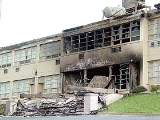
Anger and frustration are behind the arsons perpetrated by juvenile vandals. Vandalism through fire often occurs in vacant or abandoned buildings - for instance schools. Cities usually encourage owners to secure vacant buildings. Fire departments aggressively attack fires in abandoned buildings out of concern for the transient or homeless people that may be dwelling inside.
Notable historical instances of arson
Political ideology motivates some acts of arson. For example, some members of the Earth Liberation Front are believed to have set fires to structures in order to spread a message of environmental protection. And in virtually every human conflict/war throughout history, acts of arson have been committed or attributed to each side of the conflict, such as in the American Civil War, Kristallnacht pogroms in Nazi Germany in 1938 when a thousand Jewish synagogues were burnt or most recently, Serbian protests of Kosovo's Independence, at the Serbia-Kosovo border on February 19 2008 and at the American Embassy in Belgrade on February 21 2008.
It was rumored that Roman emperor Nero purposefully ordered the Great Fire of Rome, which erupted on the night of July 18 CE64. In reality, the fire started from the shops selling flammable goods at the south-eastern end of the Circus Maximus and reportedly lasted for nine days.
Political power motivates others, such as the notorious Reichstag fire of February 1933, when the main parliament building in Germany was burnt to the ground. Marinus van der Lubbe was executed for the crime. Historians continue to debate whether members of the Nazi Party were involved, but the fire likely contributed to a Nazi-led coalition winning a majority in the German parliament in March 1933.
See also
|
| |
|
|