


Royal Train

Encyclopedia
A royal train is a set of carriages dedicated for the use of the monarch
or other members of that particular royal family. Most monarchies with a railway system employ a set of royal carriages.
have operated a number of royal trains for members of the Monarchy of Australia on their royal visits to Australia
.
 In Japan
, trains for the Emperor
, the Empress
, or the Empress Dowager are called , literally meaning "trains that they use", albeit with extremely polite word for "use". Trains for the other members of the Imperial Family
are called , meaning "trains to ride" in slightly more common language. However, both Omeshi Ressha and Gojōyō Ressha refer to a non-scheduled service solely operated for the Imperial Family. Dedicated Imperial carriages were owned by Japanese National Railways
(JNR), and these came under the control of the East Japan Railway Company
(JR East) following privatisation. The dedicated locomotive-hauled set was retired in the 2000s and replaced by the specially-built E655 series
EMU, which can also be used as a VIP charter trainset.
In the modern period, imperial trains are used less and less, as the current Emperor Akihito
generally travels by air, or regular scheduled trains with a reserved carriage. Imperial trains are still operated occasionally, but they mainly function as a cordial reception for state guests, rather than transportation of the Imperial Family.
 The Dutch State Railways
uses a single Royal carriage to transport the Queen and her family. It was ordered by the Dutch Royal Family
in 1991, and construction was finished in 1993. It replaced a previous two-carriage Royal Train built in 1930, which is currently on display in the Dutch Railway Museum
. When the Queen travels by train, a single locomotive travels ahead to explore the tracks. The train itself is composed of two ordinary locomotives of the Dutch State Railways
(head and tail of the train), the royal carriage itself, and two ordinary first class passenger carriages for staff, press
and other guests.
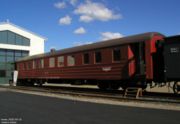 The Norwegian Royal Train is a set of train carriages used by the Norwegian royal family
and maintained by Norges Statsbaner (Norwegian State Railways). The current set was introduced in 1994 in connection with the Lillehammer Olympics
and replaced a set from 1962, that had consisted of B3 carriages named A1. The set contains a main sleeping compartment with dressing room and adjoining bathroom, two guest compartments, guest bathroom, kitchen, guard compartments and a combined dining and conference room.
The set is pulled by ordinary railway locomotives and most often ordinary passenger carriages for press and other guests are added.
toured South Africa
in a special train known as The White Train.
The three month long British Royal Family
tour of South Africa in 1947 saw the ordering of eight ivory-painted air-conditioned saloons from Britain
, three of which were built to Blue Train
sleeping car standards, while the remaining five were special saloons for use by the Royal family and Field Marshal
Jan Smuts
, the South African Prime Minister
.
After the tour the Blue Train type saloons were painted in the Blue Train's livery for service on the Blue Train, while the remaining special saloons became part of the White Train used exclusively by the Governor-General
of South Africa and later the President
of the Republic of South Africa
.
was the first British monarch to travel by train, on 13 June 1842, when she travelled on the Great Western Railway
(GWR), which ran the line between London
and Windsor
(for the Castle
). Pretty soon, other major British
railway companies had their own carriage(s) dedicated for use by the Royal Family or other dignitaries.
In 1948, upon the formation of British Rail
ways, the individual regions continued to maintain their own Royal Train carriages. A single "Royal Train" was only formed in 1977 as a response to the demands of the Silver Jubilee. This train has been maintained since privatisation of the UK's railways by EWS, although the Royal Family has travelled on ordinary service trains more frequently in recent years to minimise costs.
Monarchy
A monarchy is a form of government in which the office of head of state is usually held until death or abdication and is often hereditary and includes a royal house. In some cases, the monarch is elected...
or other members of that particular royal family. Most monarchies with a railway system employ a set of royal carriages.
Australia
The various government railway operators of AustraliaAustralia
Australia , officially the Commonwealth of Australia, is a country in the Southern Hemisphere comprising the mainland of the Australian continent, the island of Tasmania, and numerous smaller islands in the Indian and Pacific Oceans. It is the world's sixth-largest country by total area...
have operated a number of royal trains for members of the Monarchy of Australia on their royal visits to Australia
Royal visits to Australia
Since 1867, there have been over fifty visits by a member of the Royal Family to Australia, though only six of those came before 1954. Elizabeth II is the only reigning monarch of Australia to have set foot on Australian soil; she first did so on 3 February 1954...
.
Canada
Royal trains have been employed to transport members of the country's royal family on numerous tours prior to the 1960s, after which the Canadian Royal Flight was predominantly used.- 1860 - Grand Trunk RailwayGrand Trunk RailwayThe Grand Trunk Railway was a railway system which operated in the Canadian provinces of Quebec and Ontario, as well as the American states of Connecticut, Maine, Michigan, Massachusetts, New Hampshire, and Vermont. The railway was operated from headquarters in Montreal, Quebec; however, corporate...
: Prince of WalesPrince of WalesPrince of Wales is a title traditionally granted to the heir apparent to the reigning monarch of the United Kingdom of Great Britain and Northern Ireland and the 15 other independent Commonwealth realms...
(later as Edward VII of the United KingdomEdward VII of the United KingdomEdward VII was King of the United Kingdom and the British Dominions and Emperor of India from 22 January 1901 until his death in 1910...
) - 1901 - Canadian Pacific RailwayCanadian Pacific RailwayThe Canadian Pacific Railway , formerly also known as CP Rail between 1968 and 1996, is a historic Canadian Class I railway founded in 1881 and now operated by Canadian Pacific Railway Limited, which began operations as legal owner in a corporate restructuring in 2001...
: Duke of YorkDuke of YorkThe Duke of York is a title of nobility in the British peerage. Since the 15th century, it has, when granted, usually been given to the second son of the British monarch. The title has been created a remarkable eleven times, eight as "Duke of York" and three as the double-barreled "Duke of York and...
(later as George V of the United KingdomGeorge V of the United KingdomGeorge V was King of the United Kingdom and the British Dominions, and Emperor of India, from 6 May 1910 through the First World War until his death in 1936....
) - 1906 - Canadian Pacific RailwayCanadian Pacific RailwayThe Canadian Pacific Railway , formerly also known as CP Rail between 1968 and 1996, is a historic Canadian Class I railway founded in 1881 and now operated by Canadian Pacific Railway Limited, which began operations as legal owner in a corporate restructuring in 2001...
: Duke of ConnaughtDuke of Connaught and StrathearnThe title Duke of Connaught and Strathearn was granted by Queen Victoria of the United Kingdom of Great Britain and Ireland to her third son, Prince Arthur....
(Prince Arthur, Duke of Connaught and StrathearnPrince Arthur, Duke of Connaught and StrathearnPrince Arthur, Duke of Connaught and Strathearn was a member of the shared British and Saxe-Coburg and Gotha royal family who served as the Governor General of Canada, the 10th since Canadian Confederation.Born the seventh child and third son of Queen Victoria and Prince Albert of Saxe-Coburg and...
) - 1939 - Canadian Pacific RailwayCanadian Pacific RailwayThe Canadian Pacific Railway , formerly also known as CP Rail between 1968 and 1996, is a historic Canadian Class I railway founded in 1881 and now operated by Canadian Pacific Railway Limited, which began operations as legal owner in a corporate restructuring in 2001...
and Canadian National RailwayCanadian National RailwayThe Canadian National Railway Company is a Canadian Class I railway headquartered in Montreal, Quebec. CN's slogan is "North America's Railroad"....
: King George VIGeorge VI of the United KingdomGeorge VI was King of the United Kingdom and the Dominions of the British Commonwealth from 11 December 1936 until his death...
and Queen ElizabethElizabeth Bowes-LyonElizabeth Angela Marguerite Bowes-Lyon was the queen consort of King George VI from 1936 until her husband's death in 1952, after which she was known as Queen Elizabeth The Queen Mother, to avoid confusion with her daughter, Queen Elizabeth II...
Japan
Japan
Japan is an island nation in East Asia. Located in the Pacific Ocean, it lies to the east of the Sea of Japan, China, North Korea, South Korea and Russia, stretching from the Sea of Okhotsk in the north to the East China Sea and Taiwan in the south...
, trains for the Emperor
Emperor of Japan
The Emperor of Japan is, according to the 1947 Constitution of Japan, "the symbol of the state and of the unity of the people." He is a ceremonial figurehead under a form of constitutional monarchy and is head of the Japanese Imperial Family with functions as head of state. He is also the highest...
, the Empress
Japanese empresses
In Japan, empress may refer to either or .- Empresses regnant :There were eight female imperial reigns in Japan's early history between 593 and 770, and two more in the early modern period...
, or the Empress Dowager are called , literally meaning "trains that they use", albeit with extremely polite word for "use". Trains for the other members of the Imperial Family
Imperial House of Japan
The , also referred to as the Imperial Family or the Yamato Dynasty, comprises those members of the extended family of the reigning Emperor of Japan who undertake official and public duties. Under the present Constitution of Japan, the emperor is the symbol of the state and unity of the people...
are called , meaning "trains to ride" in slightly more common language. However, both Omeshi Ressha and Gojōyō Ressha refer to a non-scheduled service solely operated for the Imperial Family. Dedicated Imperial carriages were owned by Japanese National Railways
Japanese National Railways
, abbreviated or "JNR", was the national railway network of Japan from 1949 to 1987.-History:The term Kokuyū Tetsudō "state-owned railway" originally referred to a network of railway lines operated by nationalized companies under the control of the Railway Institute following the nationalization...
(JNR), and these came under the control of the East Japan Railway Company
East Japan Railway Company
is the largest passenger railway company in the world and one of the seven Japan Railways Group companies. The company name is officially abbreviated as JR East in English, and as in Japanese. The company's headquarters are in Yoyogi, Shibuya, Tokyo....
(JR East) following privatisation. The dedicated locomotive-hauled set was retired in the 2000s and replaced by the specially-built E655 series
E655 series
The is an AC/DC dual-voltage electric multiple unit train operated by East Japan Railway Company in Japan. The single 5-car trainset is used as a luxury charter train called , and also as the Imperial train by inserting a dedicated Imperial carriage....
EMU, which can also be used as a VIP charter trainset.
In the modern period, imperial trains are used less and less, as the current Emperor Akihito
Akihito
is the current , the 125th emperor of his line according to Japan's traditional order of succession. He acceded to the throne in 1989.-Name:In Japan, the emperor is never referred to by his given name, but rather is referred to as "His Imperial Majesty the Emperor" which may be shortened to . In...
generally travels by air, or regular scheduled trains with a reserved carriage. Imperial trains are still operated occasionally, but they mainly function as a cordial reception for state guests, rather than transportation of the Imperial Family.
Morocco
The Moroccan Royal train was produced by Budd Company in the US and delivered in the early 1980s. The Royal train consists of two self-propelled cars. After King Hassan II died, the Royal train stopped being used by the new king, Mohammed VI.The Netherlands
Nederlandse Spoorwegen
Nederlandse Spoorwegen , or NS, is the principal passenger railway operator in the Netherlands.Its trains operate over the tracks of the Dutch national railinfrastructure, operated by ProRail, which was split off from NS in 2003...
uses a single Royal carriage to transport the Queen and her family. It was ordered by the Dutch Royal Family
Monarchy of the Netherlands
The Netherlands has been an independent monarchy since 16 March 1815, and has been governed by members of the House of Orange-Nassau since.-Constitutional role and position of the monarch:...
in 1991, and construction was finished in 1993. It replaced a previous two-carriage Royal Train built in 1930, which is currently on display in the Dutch Railway Museum
Nederlands Spoorwegmuseum
The Nederlands Spoorwegmuseum is the Dutch national railway museum. It was established in 1927; since 1954 it has been housed in the "Maliebaan station", a former station in Utrecht.- History :...
. When the Queen travels by train, a single locomotive travels ahead to explore the tracks. The train itself is composed of two ordinary locomotives of the Dutch State Railways
Nederlandse Spoorwegen
Nederlandse Spoorwegen , or NS, is the principal passenger railway operator in the Netherlands.Its trains operate over the tracks of the Dutch national railinfrastructure, operated by ProRail, which was split off from NS in 2003...
(head and tail of the train), the royal carriage itself, and two ordinary first class passenger carriages for staff, press
News media
The news media are those elements of the mass media that focus on delivering news to the general public or a target public.These include print media , broadcast news , and more recently the Internet .-Etymology:A medium is a carrier of something...
and other guests.
Norway
Harald V of Norway
Harald V is the king of Norway. He succeeded to the throne of Norway upon the death of his father Olav V on 17 January 1991...
and maintained by Norges Statsbaner (Norwegian State Railways). The current set was introduced in 1994 in connection with the Lillehammer Olympics
1994 Winter Olympics
The 1994 Winter Olympics, officially known as the XVII Olympic Winter Games, was a winter multi-sport event celebrated from 12 to 27 February 1994 in and around Lillehammer, Norway. Lillehammer failed to win the bid for the 1992 event. Lillehammer was awarded the games in 1988, after having beat...
and replaced a set from 1962, that had consisted of B3 carriages named A1. The set contains a main sleeping compartment with dressing room and adjoining bathroom, two guest compartments, guest bathroom, kitchen, guard compartments and a combined dining and conference room.
The set is pulled by ordinary railway locomotives and most often ordinary passenger carriages for press and other guests are added.
South Africa
From 5 February to 10 April 1934, Prince George, Duke of KentPrince George, Duke of Kent
Prince George, Duke of Kent was a member of the British Royal Family, the fourth son of George V and Mary of Teck, and younger brother of Edward VIII and George VI...
toured South Africa
South Africa
The Republic of South Africa is a country in southern Africa. Located at the southern tip of Africa, it is divided into nine provinces, with of coastline on the Atlantic and Indian oceans...
in a special train known as The White Train.
The three month long British Royal Family
British Royal Family
The British Royal Family is the group of close relatives of the monarch of the United Kingdom. The term is also commonly applied to the same group of people as the relations of the monarch in her or his role as sovereign of any of the other Commonwealth realms, thus sometimes at variance with...
tour of South Africa in 1947 saw the ordering of eight ivory-painted air-conditioned saloons from Britain
United Kingdom
The United Kingdom of Great Britain and Northern IrelandIn the United Kingdom and Dependencies, other languages have been officially recognised as legitimate autochthonous languages under the European Charter for Regional or Minority Languages...
, three of which were built to Blue Train
Blue Train (South Africa)
The Blue Train travels an approximately journey in South Africa between Pretoria and Cape Town. It is one of the most luxurious train journeys in the world...
sleeping car standards, while the remaining five were special saloons for use by the Royal family and Field Marshal
Field Marshal
Field Marshal is a military rank. Traditionally, it is the highest military rank in an army.-Etymology:The origin of the rank of field marshal dates to the early Middle Ages, originally meaning the keeper of the king's horses , from the time of the early Frankish kings.-Usage and hierarchical...
Jan Smuts
Jan Smuts
Jan Christiaan Smuts, OM, CH, ED, KC, FRS, PC was a prominent South African and British Commonwealth statesman, military leader and philosopher. In addition to holding various cabinet posts, he served as Prime Minister of the Union of South Africa from 1919 until 1924 and from 1939 until 1948...
, the South African Prime Minister
Prime minister
A prime minister is the most senior minister of cabinet in the executive branch of government in a parliamentary system. In many systems, the prime minister selects and may dismiss other members of the cabinet, and allocates posts to members within the government. In most systems, the prime...
.
After the tour the Blue Train type saloons were painted in the Blue Train's livery for service on the Blue Train, while the remaining special saloons became part of the White Train used exclusively by the Governor-General
Governor-General
A Governor-General, is a vice-regal person of a monarch in an independent realm or a major colonial circonscription. Depending on the political arrangement of the territory, a Governor General can be a governor of high rank, or a principal governor ranking above "ordinary" governors.- Current uses...
of South Africa and later the President
President
A president is a leader of an organization, company, trade union, university, or country.Etymologically, a president is one who presides, who sits in leadership...
of the Republic of South Africa
South Africa
The Republic of South Africa is a country in southern Africa. Located at the southern tip of Africa, it is divided into nine provinces, with of coastline on the Atlantic and Indian oceans...
.
United Kingdom
Queen VictoriaVictoria of the United Kingdom
Victoria was the monarch of the United Kingdom of Great Britain and Ireland from 20 June 1837 until her death. From 1 May 1876, she used the additional title of Empress of India....
was the first British monarch to travel by train, on 13 June 1842, when she travelled on the Great Western Railway
Great Western Railway
The Great Western Railway was a British railway company that linked London with the south-west and west of England and most of Wales. It was founded in 1833, received its enabling Act of Parliament in 1835 and ran its first trains in 1838...
(GWR), which ran the line between London
London
London is the capital city of :England and the :United Kingdom, the largest metropolitan area in the United Kingdom, and the largest urban zone in the European Union by most measures. Located on the River Thames, London has been a major settlement for two millennia, its history going back to its...
and Windsor
Windsor, Berkshire
Windsor is an affluent suburban town and unparished area in the Royal Borough of Windsor and Maidenhead in Berkshire, England. It is widely known as the site of Windsor Castle, one of the official residences of the British Royal Family....
(for the Castle
Windsor Castle
Windsor Castle is a medieval castle and royal residence in Windsor in the English county of Berkshire, notable for its long association with the British royal family and its architecture. The original castle was built after the Norman invasion by William the Conqueror. Since the time of Henry I it...
). Pretty soon, other major British
British people
The British are citizens of the United Kingdom, of the Isle of Man, any of the Channel Islands, or of any of the British overseas territories, and their descendants...
railway companies had their own carriage(s) dedicated for use by the Royal Family or other dignitaries.
In 1948, upon the formation of British Rail
British Rail
British Railways , which from 1965 traded as British Rail, was the operator of most of the rail transport in Great Britain between 1948 and 1997. It was formed from the nationalisation of the "Big Four" British railway companies and lasted until the gradual privatisation of British Rail, in stages...
ways, the individual regions continued to maintain their own Royal Train carriages. A single "Royal Train" was only formed in 1977 as a response to the demands of the Silver Jubilee. This train has been maintained since privatisation of the UK's railways by EWS, although the Royal Family has travelled on ordinary service trains more frequently in recent years to minimise costs.
See also
- Royal yachtRoyal YachtA royal yacht is a ship used by a monarch or a royal family. If the monarch is an emperor the proper term is imperial yacht. Most of them are financed by the government of the country of which the monarch is head...
- Official state carOfficial state carAn official state car is a car used by a government to transport its head of state in an official capacity, which may also be used occasionally to transport other members of the government or visiting dignitaries from other countries. On a state visit, the official state car might be transported...
- Air transports of heads of state and government
- North Korean presidential trainsNorth Korean presidential trainsNorth Korean leader Kim Jong Il is known to use his high-security private trains as his preferred method of domestic and international travel, as was his father and predecessor Kim Il Sung....