

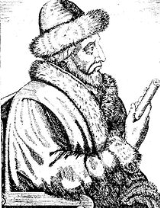
Vasili III of Russia

Encyclopedia
Vasili III Ivanovich (25 March 1479 – 3 December 1533, Moscow) was the Grand Prince of Moscow
from 1505 to 1533. He was the son of Ivan III Vasiliyevich and Sophia Paleologue
and was christened with the name Gavriil (Гавриил). He had three brothers; Yuri
, born in 1480, Simeon, born in 1487 and Andrei, born in 1490, as well as five sisters: Elena (born and died in 1474), Feodosiya (born and died in 1475), another Elena (born 1476), another Feodosiya (born 1485) and Eudoxia (born 1492).
ed the last surviving autonomous provinces: Pskov
in 1510, appanage
of Volokolamsk
in 1513, principalities of Ryazan
in 1521 and Novgorod-Seversky in 1522.
Vasili also took advantage of the difficult position of Sigismund of Poland
to capture Smolensk, the great eastern fortress of Lithuania
(siege started 1512, ended in 1514), chiefly through the aid of the rebel Lithuanian, Prince Mikhail Hlinski, who provided him with artillery and engineers. The loss of Smolensk was an important injury inflicted by Russia on Lithuania in the course of the Russo-Lithuanian Wars and only the exigencies of Sigismund compelled him to acquiesce in its surrender (1522).
Equally successful were Vasili's actions against the Crimean Khanate
. Although in 1519 he was obliged to buy off the khan of the Crimea, Mehmed I Giray
, under the very walls of Moscow, towards the end of his reign he established Russian influence on the Volga. In 1531-32 he placed the pretender Cangali khan on the throne of Kazan
.
 In his internal policy, Vasili III enjoyed the support of the Church
in his struggle with the feudal opposition
. In 1521, metropolitan Varlaam
was banished for refusing to participate in Vasili's fight against an appanage prince Vasili Ivanovich Shemyachich
. Rurikid
princes Vasili Shuisky
and Ivan Vorotynsky
were also sent into exile
. The diplomat
and statesman
, Ivan Bersen-Beklemishev
, was executed in 1525 for criticizing Vasili's policies. Maximus the Greek
(publicist
), Vassian Patrikeyev
(statesman) and others were sentence
d for the same reason in 1525 and 1531. During the reign of Vasili III, the gentry
's landownership increased; authorities were actively trying to limit immunities and privilege
s of boyars and nobility
.
for over 20 years with no heir to his throne being produced. Conscious of her husband's disappointment, Solomonia tried to remedy this by consulting sorcerers and going on pilgrimages. When this proved unsuccessful, Vasili consulted the boyars, announcing that he did not trust his two brothers to handle Russia's affairs. The boyars suggested that he take a new wife, and despite much opposition from the clergy, he divorced his barren wife and married Princess Elena Glinskaya
, the daughter of a Serbian princess and niece of his friend Michael Glinski
. Not many of the boyars approved of his choice, as Elena was of Catholic upringing. Vasili was so smitten that he defied Russian social norms and trimmed his beard to appear younger. After three days of matrimonial festivity, the couple consummated their marriage, only to discover that Elena appeared to be just as sterile as Solomonia. The Russian populace began suspect this to be a sign of God's disapproval of the marriage. However, to the great joy of Vasili and the populace, the new tsaritsa gave birth to a son, who succeeded him as Ivan IV
. Three years later, a second son, Yuri
was born. According to a story, Solomonia Saburova also bore a son in the convent
where she had been confined, just several months after the controversial divorce.
. He was transported to the village of Kolp, where he was visited by two German doctors who were unable to stop the infection with conventional remedies. Believing that his time was short, Vasili requested to be returned to Moscow, where he was kept in the Saint Joseph Cathedral along the way. By 25 November 1533, Vasili reached Moscow and asked to be made a monk
before dying. Taking on the name Varlaam, Vasili died at midnight, 4 December 1533.
Grand Duchy of Moscow
The Grand Duchy of Moscow or Grand Principality of Moscow, also known in English simply as Muscovy , was a late medieval Rus' principality centered on Moscow, and the predecessor state of the early modern Tsardom of Russia....
from 1505 to 1533. He was the son of Ivan III Vasiliyevich and Sophia Paleologue
Sophia Paleologue
Zoe Palaiologina , later changed her name to Sophia Palaiologina , Grand Duchess of Moscow, was a niece of the last Byzantine emperor Constantine XI and second wife of Ivan III of Russia. She was also the grandmother of Ivan the Terrible.- Biography :...
and was christened with the name Gavriil (Гавриил). He had three brothers; Yuri
Yury (Vasily III brother)
Yury Ivanovich was second surviving son of Ivan the Great by Sophia of Byzantium. Since 1519, his appanages included Dmitrovskoe knjazevstvo.When his elder brother Vasily III ascended to the throne, Yury was 24 years old...
, born in 1480, Simeon, born in 1487 and Andrei, born in 1490, as well as five sisters: Elena (born and died in 1474), Feodosiya (born and died in 1475), another Elena (born 1476), another Feodosiya (born 1485) and Eudoxia (born 1492).
Foreign affairs
Vasili III continued the policies of his father Ivan III and spent most of his reign consolidating Ivan's gains. Vasili annexAnnexation
Annexation is the de jure incorporation of some territory into another geo-political entity . Usually, it is implied that the territory and population being annexed is the smaller, more peripheral, and weaker of the two merging entities, barring physical size...
ed the last surviving autonomous provinces: Pskov
Pskov
Pskov is an ancient city and the administrative center of Pskov Oblast, Russia, located in the northwest of Russia about east from the Estonian border, on the Velikaya River. Population: -Early history:...
in 1510, appanage
Appanage
An apanage or appanage or is the grant of an estate, titles, offices, or other things of value to the younger male children of a sovereign, who would otherwise have no inheritance under the system of primogeniture...
of Volokolamsk
Volokolamsk
Volokolamsk is a town and the administrative center of Volokolamsky District of Moscow Oblast, Russia, located on the Gorodenka River, not far from its confluence with the Lama River, northwest of Moscow. Population: -History:...
in 1513, principalities of Ryazan
Ryazan Principality
The Grand Duchy of Ryazan existed from 1078 when it was separated from the Chernigov Principality as the provincial Murom Principality.-Prior to the invasion of Batu Khan:...
in 1521 and Novgorod-Seversky in 1522.
Vasili also took advantage of the difficult position of Sigismund of Poland
Sigismund I the Old
Sigismund I of Poland , of the Jagiellon dynasty, reigned as King of Poland and also as the Grand Duke of Lithuania from 1506 until 1548...
to capture Smolensk, the great eastern fortress of Lithuania
Lithuania
Lithuania , officially the Republic of Lithuania is a country in Northern Europe, the biggest of the three Baltic states. It is situated along the southeastern shore of the Baltic Sea, whereby to the west lie Sweden and Denmark...
(siege started 1512, ended in 1514), chiefly through the aid of the rebel Lithuanian, Prince Mikhail Hlinski, who provided him with artillery and engineers. The loss of Smolensk was an important injury inflicted by Russia on Lithuania in the course of the Russo-Lithuanian Wars and only the exigencies of Sigismund compelled him to acquiesce in its surrender (1522).
Equally successful were Vasili's actions against the Crimean Khanate
Crimean Khanate
Crimean Khanate, or Khanate of Crimea , was a state ruled by Crimean Tatars from 1441 to 1783. Its native name was . Its khans were the patrilineal descendants of Toqa Temür, the thirteenth son of Jochi and grandson of Genghis Khan...
. Although in 1519 he was obliged to buy off the khan of the Crimea, Mehmed I Giray
Mehmed I Giray
Mehmed I Giray known as Great — a khan of the Crimean Khanate in 1515 –1523.Son of Meñli I Giray, inherited power after his father's death. In 1520 signed a temporary alliance with king of Poland and Grand Duke of Lithuania, Zygmunt I Stary, against Muscovy. In 1521 he took Kazan, where he...
, under the very walls of Moscow, towards the end of his reign he established Russian influence on the Volga. In 1531-32 he placed the pretender Cangali khan on the throne of Kazan
Khanate of Kazan
The Khanate of Kazan was a medieval Tatar state which occupied the territory of former Volga Bulgaria between 1438 and 1552. Its khans were the patrilineal descendants of Toqa Temür, the thirteenth son of Jochi and grandson of Genghis Khan. The khanate covered contemporary Tatarstan, Mari El,...
.
Domestic affairs
Russian Orthodox Church
The Russian Orthodox Church or, alternatively, the Moscow Patriarchate The ROC is often said to be the largest of the Eastern Orthodox churches in the world; including all the autocephalous churches under its umbrella, its adherents number over 150 million worldwide—about half of the 300 million...
in his struggle with the feudal opposition
Opposition (politics)
In politics, the opposition comprises one or more political parties or other organized groups that are opposed to the government , party or group in political control of a city, region, state or country...
. In 1521, metropolitan Varlaam
Varlaam
Varlaam is a variant of Barlaam. It may refer to:Places:*Greece:**Varlaam, Greece, a village in the southern Ioannina in Epirus*Romania:** Varlaam, a village in Gura Teghii Commune, Buzău County...
was banished for refusing to participate in Vasili's fight against an appanage prince Vasili Ivanovich Shemyachich
Vasili Ivanovich Shemyachich
Vasili Ivanovich Shemyachich Russian prince, who was knyaz of Novgorod-Seversky and lord of Putyvl .Vasili Ivanovich Shemyachich was a grandson of the famous knyaz of Galich, Dmitry Yurievich Shemyaka...
. Rurikid
Rurik Dynasty
The Rurik dynasty or Rurikids was a dynasty founded by the Varangian prince Rurik, who established himself in Novgorod around the year 862 AD...
princes Vasili Shuisky
Shuisky
The Princes Shuisky were a Rurikid family of boyars descending from Grand Duke Dmitry Konstantinovich of Vladimir-Suzdal and Prince Andrey Yaroslavich, brother to Alexander Nevsky. Their name is derived from the town of Shuya, of which they gained ownership in 1403. The family briefly reached the...
and Ivan Vorotynsky
Vorotynsky
Vorotynsky was one of the most eminent Rurikid princely houses of Muscovite Russia. Their lands lay principally in the Upper Oka region and comprised the towns of Peremyshl and Vorotynsk as well as parts of Novosil and Odoyev....
were also sent into exile
Exile
Exile means to be away from one's home , while either being explicitly refused permission to return and/or being threatened with imprisonment or death upon return...
. The diplomat
Diplomat
A diplomat is a person appointed by a state to conduct diplomacy with another state or international organization. The main functions of diplomats revolve around the representation and protection of the interests and nationals of the sending state, as well as the promotion of information and...
and statesman
Statesman
A statesman is usually a politician or other notable public figure who has had a long and respected career in politics or government at the national and international level. As a term of respect, it is usually left to supporters or commentators to use the term...
, Ivan Bersen-Beklemishev
Ivan Bersen-Beklemishev
Ivan Nikitich Beklemishev, nicknamed Bersen was one of the most prominent Russian diplomats and statesmen during the reigns of Ivan III and Vasili III....
, was executed in 1525 for criticizing Vasili's policies. Maximus the Greek
Maximus the Greek
Maximus the Greek, also known as Maximos the Greek or Maksim Grek , was a Greek monk, publicist, writer, scholar, humanist, and translator active in Russia...
(publicist
Publicist
A publicist is a person whose job is to generate and manage publicity for a public figure, especially a celebrity, a business, or for a work such as a book, film or album...
), Vassian Patrikeyev
Vassian Patrikeyev
Vassian Patrikeyev, also known as Vassian Kosoy was a Russian ecclesiastic and political figure and writer...
(statesman) and others were sentence
Sentence (law)
In law, a sentence forms the final explicit act of a judge-ruled process, and also the symbolic principal act connected to his function. The sentence can generally involve a decree of imprisonment, a fine and/or other punishments against a defendant convicted of a crime...
d for the same reason in 1525 and 1531. During the reign of Vasili III, the gentry
Gentry
Gentry denotes "well-born and well-bred people" of high social class, especially in the past....
's landownership increased; authorities were actively trying to limit immunities and privilege
Privilege
A privilege is a special entitlement to immunity granted by the state or another authority to a restricted group, either by birth or on a conditional basis. It can be revoked in certain circumstances. In modern democratic states, a privilege is conditional and granted only after birth...
s of boyars and nobility
Nobility
Nobility is a social class which possesses more acknowledged privileges or eminence than members of most other classes in a society, membership therein typically being hereditary. The privileges associated with nobility may constitute substantial advantages over or relative to non-nobles, or may be...
.
Family life
By 1526 when he was 47 years old, Vasili had been married to Solomonia SaburovaSolomonia Saburova
Saint Solomonia Yuryevna Saburova was the first wife of Grand Prince Vasili III of Muscovy. She was canonized by the Russian Orthodox Church as Saint Sofia of Suzdal....
for over 20 years with no heir to his throne being produced. Conscious of her husband's disappointment, Solomonia tried to remedy this by consulting sorcerers and going on pilgrimages. When this proved unsuccessful, Vasili consulted the boyars, announcing that he did not trust his two brothers to handle Russia's affairs. The boyars suggested that he take a new wife, and despite much opposition from the clergy, he divorced his barren wife and married Princess Elena Glinskaya
Elena Glinskaya
Elena Vasilyevna Glinskaya April 1538, Moscow) was the second wife of Grand Prince Vasili III and regent of Russia for 5 years .- Background :...
, the daughter of a Serbian princess and niece of his friend Michael Glinski
Michael Glinski
Michael Glinski was a noble from the Grand Duchy of Lithuania of distant Tatar extraction who was also a tutor of his nephew, Ivan the Terrible. As a young man, Glinski served in the court of Emperor Maximilian I and earned distinction for his military service. Around 1498 he returned to Lithuania...
. Not many of the boyars approved of his choice, as Elena was of Catholic upringing. Vasili was so smitten that he defied Russian social norms and trimmed his beard to appear younger. After three days of matrimonial festivity, the couple consummated their marriage, only to discover that Elena appeared to be just as sterile as Solomonia. The Russian populace began suspect this to be a sign of God's disapproval of the marriage. However, to the great joy of Vasili and the populace, the new tsaritsa gave birth to a son, who succeeded him as Ivan IV
Ivan IV of Russia
Ivan IV Vasilyevich , known in English as Ivan the Terrible , was Grand Prince of Moscow from 1533 until his death. His long reign saw the conquest of the Khanates of Kazan, Astrakhan, and Siberia, transforming Russia into a multiethnic and multiconfessional state spanning almost one billion acres,...
. Three years later, a second son, Yuri
Yuri Vasilevich (son of Vasili IIl)
Yuri Vasilievich of the House of Rurik, was Prince of Uglich, and the second son of Vasily III of Russia and Elena Glinskaya, as well as being the younger brother of Ivan the Terrible...
was born. According to a story, Solomonia Saburova also bore a son in the convent
Kudeyar
Kudeyar is a Russian legendary folk hero whose story is told in Nikolay Kostomarov's 1875 novel of the same name.According to this legend, Kudeyar was the elder brother of Ivan the Terrible. His mother purportedly was Solomonida Saburova, whom Vasily III divorced on account of her barrenness and...
where she had been confined, just several months after the controversial divorce.
Death
Whilst out hunting on horseback near Volokolamsk, Vasili felt a great pain in his right hip, the result of an abscessAbscess
An abscess is a collection of pus that has accumulated in a cavity formed by the tissue in which the pus resides due to an infectious process or other foreign materials...
. He was transported to the village of Kolp, where he was visited by two German doctors who were unable to stop the infection with conventional remedies. Believing that his time was short, Vasili requested to be returned to Moscow, where he was kept in the Saint Joseph Cathedral along the way. By 25 November 1533, Vasili reached Moscow and asked to be made a monk
Monk
A monk is a person who practices religious asceticism, living either alone or with any number of monks, while always maintaining some degree of physical separation from those not sharing the same purpose...
before dying. Taking on the name Varlaam, Vasili died at midnight, 4 December 1533.