


Vithoba

Encyclopedia
Vithoba also known as Vitthala and Panduranga , is a Hindu
god, worshipped predominantly in the Indian states of Maharashtra
, Karnataka
, Goa
and Andhra Pradesh
. He is generally considered a manifestation of the Hindu god Vishnu
or his Avatar
(incarnation) Krishna
. Vithoba is often depicted as a dark young boy, standing arms-akimbo
on a brick, sometimes accompanied by his main consort Rakhumai (Rukmini
).
Vithoba is the focus of the monotheistic, non-Brahmanical Varkari
sect of Maharashtra and the Haridasa
sect of Karnataka. Vithoba's main temple
stands at Pandharpur
in Maharashtra, close to the Karnataka border. Vithoba legends revolve around his devotee Pundalik
, who is credited with bringing the deity to Pandharpur, and around Vithoba's role as a saviour to the poet-saints of the Varkari faith. The Varkari poet-saints are known for their unique genre of devotional lyric, the abhanga, dedicated to Vithoba and composed in Marathi. Other devotional literature dedicated to Vithoba includes the Kannada hymns of the Haridasa, and Marathi versions of the generic Hindu arati songs, associated with rituals of offering light to the deity.The most important festivals of Vithoba are held on the eleventh (ekadashi) day of Hindu lunar months: Shayani Ekadashi
in the month of Ashadha, and Prabodhini Ekadashi
in the month of Kartik
.
The historiography of Vithoba and his cult
is an area of continuing debate, even regarding his name. Various indologists have proposed a prehistory for Vithoba worship where he was previously: a hero stone
, a pastoral deity, a manifestation of Shiva, a Jain saint, or even all of these at various times for various devotees. Though the origins of both his cult and his main temple are likewise debated, there is clear evidence that they already existed by the 13th century.
, orientalist
, supported this explanation. The prescribed iconography of Vithoba stipulates that he be shown standing arms-akimbo upon a brick, which is associated with the legend of the devotee Pundalik.
However, the Varkari poet-saint Tukaram
proposed a different etymology—that Vitthala is composed of the words vittha (ignorance) and la (one who accepts), thus meaning 'one who accepts innocent people who are devoid of knowledge'. Historian Ramakrishna Gopal Bhandarkar
offers yet another possibility—that Vitthu is a Kannada corruption of the name Vishnu adopted in Marathi. The suffixes -la and -ba (meaning 'father' in Marathi) were appended for reverence, producing the names Vitthala and Vithoba. This corruption of Vishnu to Vitthu could have been due to the tendency of Marathi and Kannada people to pronounce the Sanskrit (/ʃn/) as (/ʈʈʰ/), attested since the 8th century.
According to research scholar M. S. Mate of the Deccan College
, Pundalik—who is assumed to be a historical figure—was instrumental in persuading the Hoysala king Vishnuvardhana
alias Bittidev to build the Pandharpur temple dedicated to Vishnu. The deity was subsequently named as Vitthala, a derivative of Bittidev, by the builder-king. Other variants of the name include (King Vitthala), and (Mother Vitthala). The people of Gujarat add the suffix -nath (Lord) to Vitthala, which yields the name Vitthal-nath.
Panduranga, also spelt as Pandurang and Pandaranga, is another popular epithet for Vithoba, which means 'the white god' in Sanskrit. The Jain author-saint Hemachandra (1089–1172 AD) notes it is also used as an epithet for the god Rudra
-Shiva. Even though Vithoba is depicted with dark complexion, he is called a "white god". Bhandarkar explains this paradox, proposing that Panduranga may be an epithet for the form of Shiva worshipped in Pandharpur, and whose temple still stands. Later, with the increasing popularity of Vithoba's cult, this was also transferred to Vithoba. Another theory suggests that Vithoba may initially have been a Shaiva
god (related to Shiva), only later identified with Vishnu, thus explaining the usage of Panduranga for Vithoba. Crooke, however, proposed that Panduranga is a Sanskritised form of Pandaraga (belonging to Pandarga), referring to the old name of Pandharpur. Another name, Pandharinath, also refers to Vithoba as the lord of Pandhari (yet another variant for Pandharpur). Finally, Vithoba is also addressed by generic Vaishnava
names like Hari
and Narayana
, which are typical of the cult of the god Vishnu.
charya of the 8th century, indicates that Vithoba worship might have already existed at an early date.
According to Richard Maxwell Eaton, author of A Social History of the Deccan, Vithoba was first worshipped as a pastoral god as early as the 6th century. Vithoba's arms-akimbo iconography is similar to Bir Kuar
, the cattle-god of the Ahirs
of Bihar
, who is now also associated with Krishna. Vithoba was probably later assimilated into the Shaiva pantheon and identified with the god Shiva, like most other pastoral gods. This is backed by the facts that the temple at Pandharpur is surrounded by Shaiva temples (most notably of the devotee Pundalik himself), and that Vithoba is crowned with the Linga, symbol of Shiva. However, since the 13th century, the poet-saints like Namdev
, Eknath
and Tukaram identified Vithoba with Vishnu.
Christian Lee Novetzke of the University of Washington
suggests that Vithoba's worship migrated from Karnataka to the formerly Shaiva city of Pandharpur some time before 1000 CE; but under the possible influence of a Krishna-worshipping Mahanubhava
sect, the town was transformed into a Vaishnava center of pilgrimage. This proposal is consistent with contemporary remnants of Shaiva worship in the town.
The religious historian R.C. Dhere, winner of the Sahitya Akademi Award
for his book Sri Vitthal: Ek Mahasamanvaya, opines that Vithoba worship may be even older—"Vedic
or pre-Vedic", hence pre-dating the worship of Krishna. According to this theory, Vithoba is an amalgam of various local heroes, who gave their lives to save their cattle. He was first worshipped by the Dhangar
, the cattle-owning caste
of Maharashtra. The rise of the Yadava dynasty, which had cowherd ancestry, could have led to the glorification of Vithoba as Krishna, who is often depicted as a cowherd. This Vaishnavization of Vithoba also led to conversion of the Shaiva Pundarika shrine to the Vaishnava shrine of the devotee Pundalik, who—according to legend—brought Vithoba to Pandharpur. There may have been an attempt to assimilate Vithoba into Buddhism
; today, both are viewed as a form of Vishnu in Hinduism.
Despite assimilation in Vaishnavism as Krishna-Vishnu, Vithoba does not inherit the erotic overtones of Krishna, such as his dalliance with the gopi
s (milkmaids). Vithoba is associated more with "compassion, an infinite love and tenderness for his bhaktas (devotees) that can be compared to the love of the mother for her children .. pining for the presence of his devotees the way a cow pines for her far-away calf."
G. A. Deleury, author of The cult of Vithoba, proposes that the image of Vithoba is a viragal (hero stone
), which was later identified with Vishnu in his form as Krishna, and that Pundalik transformed the Puranic, ritualistic puja worship into more idealised bhakti
worship—"interiorized adoration prescinding caste distinction and institutional priesthood .." Indologist Dr. Tilak suggests that Vithoba emerged as "an alternative to the existing pantheon" of brahminical deities (related to classical, ritualistic Hinduism). The emergence of Vithoba was concurrent with the rise of a "new type of lay devotee", the Varkari. While Vishnu and Shiva were bound in rigid ritualistic worship and Brahmin
(priestly) control, Vithoba, "the God of the subaltern, became increasingly human." Vithoba is often praised as the protector of the poor and needy. Stevenson (1843) suggests that Vithoba could have been a Jain saint, as the Vithoba images were similar to Jain images.
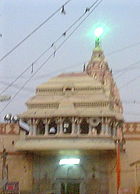 Scholastic investigation of Vithoba's history often begins with consideration of the dating of the chief temple at Pandharpur, which is believed to be the earliest Vithoba temple. The oldest part of the temple dates to the Yadava period of the 12th and 13th centuries. Most of the temple is believed to have been built in the 17th century, though addition to the temple has never ceased. The date the temple was first established is unclear to Bhandarkar, but he insists there is clear evidence to suggest it existed by the 13th century. According to S. G. Tulpule, the temple stood as early as 1189. In fact, a monument dated 1189 records establishment of a small Vithoba shrine at the present location of the temple; thus, Tulpule concludes, the worship of Vithoba predates 1189.
A stone inscription dated 1237, found on an overhead beam of the present Vithoba temple, mentions that the Hoysala king Someshvara
donated a village for the expense of the bhoga (food offering) for "Vitthala". An inscription on a copper plate, dated 1249, records the Yadava king Krishna granting to one of his generals the village Paundrikakshetra (kshetra of Pundarik), on the river Bhimarathi, in the presence of the god Vishnu. Another stone inscription in Pandharpur narrates a sacrifice at Pandurangapura due to which "people and Vitthal along with the gods were gratified". Thus from the 13th century, the city is known as the city of Panduranga. Inside the temple, a stone inscription records gifts to the temple between 1272–77 from various donors, notably the Yadava king Ramachandra's minister Hemadri.
Ranade believes that an inscription, found in Alandi
and referring to Vitthala and Rakhumai, is the oldest related to Vithoba, and dates it to 1209. However, the name Pandaranga is found on a Rashtrakuta
copper plate inscription, dated 516. Citing this, Pande infers that Vithoba's cult was well established by the 6th century.
(image) of Vithoba at Pandharpur, and various textual references to it, have inspired theories relating to Vithoba worship. Sand concludes, from a version of Pundalik's legend in the Skanda Purana
(see Legend below), that two distinct murtis must have existed at Pandharpur—one each of tirtha and kshetra
type. The earlier one was a tirtha murti, an image purposely sited near a holy body of water (tirtha), in this case facing west, on the Bhima
riverbed, near the Pundalik shrine. The later murti, according to Sand, was a kshetra murti, located at a place of holy power (kshetra), in this case facing east, on the hill where the current temple has stood since about 1189. Thus, Sand proposes that the worship of Vithoba may predate the temple itself.
Deleury suggests that although the temple may have been built in the 13th century, given the Hemadpanthi
style architecture, the statue of Vithoba is of an earlier style so may have been carved for an earlier, smaller shrine that existed in Pandharpur. The workmanship of the image is earlier than the style of the Yadava (1175–1318), the Anhivad Chalukya
(943–1210) and even the Ajmer Chohans
(685–1193) eras. Although no other existing Vishnu temple has iconography like Pandharpur's Vithoba, Deleury finds similarities between the Pandharpur image and the third-century, arms-akimbo Vishnu images at Udaygiri Caves
, Madhya Pradesh
but declares that they are from different schools of sculpture.
Vishnu himself, not an Avatar
(manifestation) of Vishnu like Krishna, despite legends and consorts linking Vithoba to Krishna. However, even the Mahanubhava
s, who rose in the 13th century as a Krishna-worshipping sect, not only dismissed the notion that Vithoba is Krishna but also frequently vilified Vithoba.
In some traditions though, Vithoba is also worshipped as a form of Shiva. The Dhangars still consider Vithoba to be a brother of the god Viroba, and view Vithoba as a Shaiva god rather than a Vaishnava one. Underhill proposes that the shrine of Pandharpur is a combined form of Vishnu-Shiva established by the Bhagavata
sect that worships Vishnu-Shiva—the Lord, which is what bhagavata means. However, for the chief priests of the Pandharpur temple—Brahmins of the Badva family —" is neither nor . is " (IAST original). Despite this, some priests of the temple point to marks on the Vithoba image's chest as proof of Vithoba being Vishnu, in his form as Krishna.
Vithoba's image replaces the traditional representation of Buddha, when depicted as the ninth avatar of Vishnu, in some temple sculptures and Hindu astrological almanacs in Maharashtra. In the 17th century, Maratha
artists sculpted an image of Pandharpur's Vithoba in the Buddha's place on a panel showing Vishnu's avatars. This can be found in the Shivner caves of Junnar
. Stevenson goes so far as to call devotees of Vithoba (Vithal-bhaktas) Buddhist Vaishnavas (Bauddho-Vaishnavas), since they consider Vithoba to be the ninth—namely Buddha—avatar of Vishnu. Some of the poet-saints praised Vithoba as a form of Buddha. B. R. Ambedkar
, an Indian political leader and Buddhist convert, suggested that the image of Vithoba at Pandharpur was in reality the image of the Buddha.
with a dark complexion". He wears high, conical headgear or a crown, interpreted as Shiva's symbol—the Linga. Thus, according to Zelliot, Vithoba represents Shiva as well as Vishnu. The first Varkari poet-saint, Dnyaneshwar
(13th century), states that Vithoba (Vishnu) carries Shiva, who according to Vaishnavism is Vishnu's first and foremost devotee, on his own head.
Vithoba is shown standing arms-akimbo on the brick thrown by the devotee Pundalik. He wears a necklace of tulsi
-beads, embedded with the legendary kaustubha
gem, and makara-kundala (fish-shaped earrings) that the poet-saint Tukaram relates to the iconography of Vishnu. Pandharpur's Vithoba holds a shankha
(conch) in his left hand and a chakra
(discus) or lotus flower in his right, all of which are symbols traditionally associated with Vishnu. Some images depict Vithoba's right hand making a gesture that has been traditionally misunderstood as a blessing; no gesture of blessing is present in the Pandharpur image. Though usually depicted two-armed, four-armed representations of the deity also exist.
The Pandharpur image, when not clothed by its attendant priest to receive devotees, provides Vithoba with the detailed features distinctive of a male body, visible in full relief. However, close inspection of the stonework reveals the outline of a loincloth
, supported by a kambarband (waist belt), traced by thin, light carvings. Other images and pictures depict Vithoba clothed, usually with pitambara - a yellow dhoti
and various gold ornaments—the manner in which he is attired by the priests in the daily rites.
The Pandharpur image also bears, on the left breast, the mark known as the srivatsa
lanchhana—said to be a curl of white hair, usually found on the breast of Vishnu and Krishna images. The image is also dignified with a ring-shaped mark called shriniketana on the right breast, mekhala (a three-stringed waist-belt), a long stick (kathi) embedded in the ground between the legs, and double ring and pearl bracelets on the elbows.
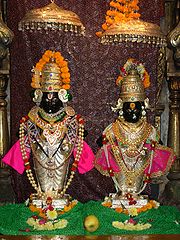 Vithoba is usually depicted with his main consort, Rakhumai, on his left side. Rakhumai (or Rakhamai) literally means 'mother Rukmini'. Rukmini is traditionally viewed as the wife of Krishna. Hindus generally consider Krishna to be a form of Vishnu, hence his consort as a form of Lakshmi
. Rakhumai is depicted in the arms-akimbo posture, standing on a brick. She has an independent cella
in the Pandharpur temple complex. According to Ghurye, Rukmini—a princess of the Vidarbha
region of in Maharashtra—was elevated to the status of the main consort instead of Radha
, because of her affiliation with the region. According to Dhangar tradition, Rukhumai is worshipped by the community as Padmavati or Padubai, a protector of the community and cattle in particular. Dhangar folklore explains the reason behind separate shrines for Vithoba and Padubai as the outcome of Vithoba invoking a curse on his consort, and his non-attachment to samsara
(the householder's life). Apart from Rakhumai, two other consorts Satyabhama
and Rahi (derived from Radha) are worshipped too. All three consorts are regarded as Krishna's in Hindu mythology.
, Tamil Nadu
, Kerala
and Gujarat, but not in the same numbers. Vithoba is worshipped and revered by most Marathis, but he is not popular as a kuldevta
(family deity). The main temple of Vithoba, which includes a distinct, additional shrine for his consort Rakhumai, is located at Pandharpur. In this context, Pandharpur is affectionately called "Bhu-Vaikuntha" (the place of residence of Vishnu on earth) by devotees. Devotees from across Maharashtra, Karnataka and Telangana
region of Andhra Pradesh, visit Vithoba's central temple at Pandharpur, since the times of Dnyaneshwar (13th century).
Two distinct traditions revolve around the worship of Vithoba in Maharashtra: ritual worship inside the temple by the Brahmin
priests of the Badva family; and spiritual worship by the Varkaris. The ritual worship includes five daily rites. First, at about 3 am, is an arati to awaken the god, called . Next comes the , a puja that includes a bath with five (pancha) sweet substances called panchamrita
. The image is then dressed to receive morning devotions. The third rite is another puja involving re-dressing and lunch at noon. This is known as . Afternoon devotions are followed by a fourth rite for dinner at sunset—the . The final rite is , an arati for putting the god to sleep. In addition to the rites at the main temple in Pandharpur, Haridasa traditions dedicated to Vitthala flourish in Karnataka.
Panth (Pilgrim Path) or Varkari Sampradaya
(Pilgrim Tradition) is one of the most important Vaishnava sects in India. It is a monotheistic, bhakti sect, focused on the worship of Vithoba and based on traditional Bhagavata dharma
. The sect is a "Shaiva-Vaishnava synthesis" and "nominal Vaishnavism, containing a free mix of other religions". It is believed to have originated in Karnataka and migrated to Maharashtra. This last theory is based on a reference to Vithoba as "Kannada" (belonging to Karnataka) in the work of the first of the poet-saints, Dnyaneshwar
. However, this word can also be interpreted as "difficult to understand". Varkaris and scholars who believe Pundalik to have been a historical figure also consider him to be founder of the cult of Vithoba. This is evidenced by the liturgical call—Pundalikavarada Hari Vitthala!—which means "O Hari Vitthala (Vithoba), who has given a boon to Pundalik!" However, according to Zelliot, the sect was founded by Dnyaneshwar (also spelled Jnaneshwar), who was a Brahmin poet and philosopher and flourished during the period 1275–1296. Varkaris also give him credit with the saying—Dnyanadev rachila paya—which means "Dnyaneshwar laid the foundation stone".
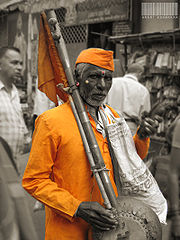 Namdev
(c. 1270–1350), a Shudra
tailor, wrote short Marathi devotional poems
in praise of Vithoba called abhangas (literally 'unbroken'), and used the call-and-response kirtan
(literally 'repeating') form of singing to praise the glory of his Lord. Public performance of this musical devotion led to the spread of the Vithoba faith, which accepted women, Shudras and outcaste "untouchables
", something forbidden in classical brahminical Hinduism. In the times of Muslim rulers, the faith faced stagnation. However, after the decline of the Vijayanagara empire
, when wars erupted in the Deccan region, the Muslim rulers had to accept the faiths of Maharashtra in order to gather the support of its people. In this period, Eknath
(c. 1533–99) revived the Varkari tradition. With the foundation of the Maratha empire
under Shivaji, Tukaram
(c. 1568–1650), a Shudra grocer, further propagated the Vithoba-centric tradition throughout the Maharashtra region.
All these poet-saints, and others like Janabai
, the maidservant of Namdev, wrote poetry dedicated to Vithoba. This Marathi poetry advocates pure devotion, referring to Vithoba mostly as a father, or in the case of the female saint Janabai's poetry, as a mother (Vithabai). Not only women, like Janabai, but also a wide variety of people from different castes and backgrounds wrote abhangas in praise of Vithoba: Visoba Khechara
(who was an orthodox Shaiva and teacher of Namdev), Sena the barber
, Narhari the goldsmith, Savata the gardener
, Gora the potter
, Kanhopatra
the dancing girl, Chokhamela
the "untouchable" Mahar
, and even the Muslim
Sheikh Muhammad (1560–1650). Anyone born Shaiva or Vaishnava who considers Vithoba his maya-baap (mother-father) and Pandharpur his maher (maternal house of a bride) is accepted as a Varkari by the sect irrespective of the barriers of caste
. Varkaris often practice Vithoba japa
(meditative repetition of a divine name), and observe a fast on the ekadashi of each month.
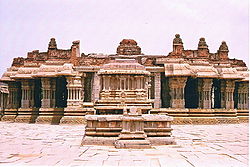 Haridasa
means servant (dasa
) of Vishnu (Hari). According to Haridasa tradition, their sampradaya, also known as Haridasa-kuta, was founded by Achalananda Vitthala (c. 888). It is a distinct branch within Vaishnavism, centered on Vitthala (the Haridasa–Kannada name for Vithoba).
Where Varkari are normally associated with Maharashtra, Haridasa are normally associated with Karnataka. The scholar Sharma considers Vithoba worship first emerged in Karnataka, only later moving to Maharashtra. He argues this on the basis of the reference by Dnyaneshwar, mentioned in section "Varkari sect" above. Lutgendorf credits the movement to Vyasatirtha
(1478–1539), the royal guru
(rajguru) to king Krishnadevaraya
of the Vijayanagara empire. Vitthala enjoyed royal patronage in this era. Krishnadevaraya is also credited with building Vitthala's temple at the then capital city Vijayanagara
(modern Hampi
).
Haridasas consider the temple of Pandharpur to be sacred, as well that of Hampi, and worship Vitthala along with forms of Krishna. Haridasa literature generally deals with praise dedicated to Vitthala and Krishna. Haridasa poets like Vijaya Vitthala
, Gopala Vitthala
, Jagannatha Vitthala, Venugopala Vitthala and Mohana Vitthala assumed pen-names ending with "Vitthala", as an act of devotion. The Haridasa poet Purandara Dasa
or Purandara Vitthala (1484–1564), "father of Carnatic music
", often ended his Kannada language compositions with a salutation to Vitthala.
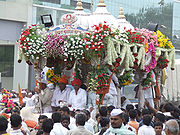 The festivals associated with Vithoba primarily correspond to the bi-annual yatra
s (pilgrimages) of the Varkaris. The pilgrims travel to the Pandharpur temple from Alandi and Dehu
, towns closely associated with poet-saints Dnyaneshwar and Tukaram respectively. Along the way, they sing abhangas (devotional songs) dedicated to Vithoba and repeat his name, carrying the palkhis (palanquins) of the poet-saints. Varkaris do not engage in ritual worship but only practice darshan
(visual adoration) of the deity. The ritual worship by the priests is restricted to five days each around the Ashadha (June–July) and Kartik (October–November) Ekadashi
s, when a large number of Varkaris participate in the yatras. In smaller numbers, the Varkaris also visit the temple on two other Ekadashis—in the Hindu months of Magha
and Chaitra
.
More than 800,000 Varkaris travel to Pandharpur for the yatra on Shayani Ekadashi, the 11th day of the waxing moon
in the lunar month of Ashadha. Both Shayani Ekadashi and Prabodhini Ekadashi
(in the waxing half of Kartik), are associated with the mythology of Vishnu. Hindus believe that Vishnu falls asleep in Ksheersagar (a cosmic ocean of milk), while lying on the back of Shesha-nāga
(the cosmic serpent). His sleep begins on Shayani Ekadashi (literally the 'sleeping 11th') and he finally awakens from his slumber, four months later, on Prabodhini Ekadashi. The celebrations in Ashadha and Kartik continue until the full-moon in those months, concluding with torchlight processions. Inscriptions dating to the 11th century mention the Ekadashi pilgrimages to Pandharpur. On Shayani Ekadashi and Prabodini Ekadashi, the chief minister or a minister of Maharashtra state performs ritual components of worship on behalf of the Government of Maharashtra
. This form of worship is known as sarkari-mahapuja.
Apart from the four Ekadashis, a fair is held on Dussera night at Pandharpur, when devotees dance on a large slab (ranga-shila) before Vithoba, accompanied with torchlight processions. Other observances at the Pandharpur temple include: Ranga-Panchami
, when gulal (red powder) is sprinkled on the god's feet; and Krishna Janmashtami, Krishna's birthday, when devotees dance and sing in front of Vithoba for nine days. Other sacred days include Wednesdays, Saturdays and all other Ekadashis, all of which are considered holy in Vaishnavism.
The Varkari texts are: Bhaktalilamrita and Bhaktavijaya
by Mahipati
, Pundalika-Mahatmya by Bahinabai
, and a long abhanga by Namdev
. All these texts describe the legend of Pundalik. The Brahmin texts include: two versions of Panduranga-Mahatmya from the Skanda Purana
(consisting of 900 verses); Panduranga-Mahatmya from the Padma Purana
(consisting of 1,200 verses); Bhima-Mahatmya, also from the Padma Purana; and a third devotional work, yet again called Panduranga-Mahatmya, which is found in the Vishnu Purana
. The "third tradition" is found in two works: Panduranga-Mahatmya by the Brahmin Sridhara (consisting of 750 verses), and another work of the same name written by Prahlada Maharaj (consisting of 181 verses).
In addition to the above, there are many abhangas, the short Marathi
devotional poems of the Varkaris, and many stutis (songs of praise) and stotras (hymns), some of them originating from the Haridasa tradition. The best known of these is "Pandurangastaka" or "Pandurangastrotra", attributed to Adi Shankara
charya, although this attribution is questioned. A text called "Tirthavali-Gatha", attributed to Namdev or Dnyaneshwar but possibly a collection of writings of many poet-saints, also centers on the propagation of Varkari faith and Vithoba worship. Other devotional works include aratis like "Yuge atthavisa vitevari ubha" by Namdev and "Yei O Vitthala maje mauli re". These aratis sing of Vithoba, who wears yellow garments (a characteristic of Vishnu) and is served by Garuda
(mount
of Vishnu) and Hanuman
(the monkey god, devotee of Rama
—an avatar of Vishnu). Finally, the Telugu
poet Tenali Ramakrishna
(16th century) refers to Vithoba, as Panduranga, in his poem Panduranga-Mahatmyamu: "(O Parvati
), accepting the services of Pundarika and Kshetrapala (Kala-bhairava
), becoming the wish fulfilling tree by assuming a subtle body for the sake of devotees, fulfilling their wishes, the deity Panduranga resides in that temple."
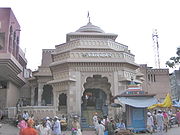 There are many Vithoba temples in Maharashtra, and some in Karnataka, Tamil Nadu and Andhra Pradesh. However, the main centre of worship is Vithoba's temple in Pandharpur. The temple's date of establishment is disputed, though it is clear that it was standing at the time of Dnyaneshwar in the 13th century. Along with Vithoba and his consorts—Rukmini, Satyabhama and Radha—other Vaishnava deities are worshipped. These include: Venkateshwara
, a form of Vishnu; Mahalakshmi, a form of Vishnu's consort Lakshmi
; Garuda and Hanuman (see previous section). Shaiva deities are also worshipped, such as: Ganesha
, the elephant-headed god of wisdom and beginnings; Khandoba
, a form of Shiva; and Annapurna
, a form of Shiva's consort Parvati
. The samadhi
s (memorials) of saints like Namdev, Chokhamela
and Janabai
, and of devotees such as Pundalik and Kanhopatra
, are in and around the temple. Other significant temples in Maharashtra are located: at Dehu, the birthplace of Tukaram, which attracts visitors at all ekadashi
s of the year; at Kole (Satara district
), in memory of Ghadge Bova, which has a fair on the fifth day of the bright fortnight (waxing moon) in Magha
month; at Kolhapur and Rajapur, which host fairs on Shayani Ekadashi and Prabodini Ekadashi; Madhe - a refuge of the Pandharpur image when it was moved to protect from Muslim invaders and finally at the Birla Mandir in Shahad
.
Several temples are found in Goa, the well-known ones being the temples at Sanquelim, Sanguem
and Gokarna Math. Similarly temple festivals celebrated in Vitthala temples in Margao
, Ponda attract a lot a pilgrims. Vitthal is also worshipped as Vitthalnath at the Nathdwara
in Gujarat.
Vithoba was introduced to South India during the Vijayanagara and Maratha rule. In South India he is generally known as Vitthala. The Hampi temple (mentioned above) is a World Heritage site
and the most important of Vitthala's temples outside Maharashtra. Constructed in the 15th century, the temple is believed to have housed the central image from Pandharpur, which the Vijayanagara king Krishnadevaraya took "to enhance his own status" or to save the image from plunder by Muslim
invaders. It was later returned to Pandharpur by Bhanudas (1448–1513), great-grandfather of poet-saint Eknath. Today, the temple stands without a central image, though between 1516 to 1565, most important transactions, which would have been carried out previously in the presence of the original state deity Virupaksha
(a form of Shiva), were issued in presence of the central image of Vitthala. Three of Madhvacharya
's eight mathas (monasteries)
in Karnataka—Shirur
, Pejavara
and Puttige
—have Vitthala as their presiding deity. A Vitthaleshwara temple stands at Mulbagal
, Karnataka. In Tamil Nadu, Vitthala shrines are found in Srirangam
, Vittalapuram in Tirunelveli district
, and Thennangur
, Govindapuram near Kumbakonam
and sculptures are also found in Kanchi.
and Padma Purana
. It is also documented in Marathi texts: Panduranga-Mahatmya by a Brahmin called Sridhara; another work of the same name written by Prahlada Maharaj; and also in the abhangas of various poet-saints.
There are three versions of the Pundalik legend, two of which are attested as textual variants of the Skanda Purana (1.34–67). According to the first, the ascetic Pundarika (Pundalik) is described as a devotee of god Vishnu and dedicated to the service of his parents. The god Gopala
-Krishna, a form of Vishnu, comes from Govardhana
as a cowherd, accompanied by his grazing cows, to meet Pundarika. Krishna is described as in digambar form, wearing makara-kundala, the srivatsa mark (described above), a head-dress of peacock feathers, resting his hands on his hips and keeping his cow-stick between his thighs. Pundarika asks Krishna to remain in this form on the banks of the river Bhima. He believes that Krishna's presence will make the site a tirtha and a kshetra
. The location is identified with modern-day Pandharpur, which is situated on the banks of the Bhima. The description of Krishna resembles the characteristics of the Pandharpur image of Vithoba.
The second version of the legend depicts Vithoba appearing before Pundalik as the five-year-old Bala Krishna
(infant Krishna). This version is found in manuscripts of both Puranas, Prahlada Maharaj, and the poet-saints, notably Tukaram. The remaining version of the Pundalik legend appears in Sridhara and as a variant in the Padma Purana. Pundalik, a Brahmin madly in love with his wife, neglected his aged parents as a result. Later, on meeting sage Kukkuta, Pundalik underwent a transformation and devoted his life to the service of his aged parents. Meanwhile, Radha, the milkmaid-lover of Krishna, came to Dwarka
, the kingdom of Krishna, and sat on his lap. Radha did not honour Rukmini, the chief queen of Krishna, nor did Krishna hold Radha accountable for the offence. Offended, Rukmini left Krishna and went to the forest of Dandivana near Pandharpur. Saddened by Rukmini's departure, Krishna searched for his queen and finally found her resting in Dandivana, near Pundalik's house. After some coaxing, Rukmini was pacified. Then Krishna visited Pundalik and found him serving his parents. Pundalik threw a brick outside for Krishna to rest on. Krishna stood on the brick and waited for Pundalik. After completing his services, Pundalik asked that his Lord, in Vithoba form, remain on the brick with Rukmini, in Rakhumai form, and bless His devotees forever.
Other legends describe Vithoba coming to the rescue of his devotees in the form of a commoner, an outcast Mahar
"untouchable" or a Brahmin beggar. Mahipati
, in his work Pandurangastrotra, narrates how Vithoba helped female saints like Janabai in their daily chores, such as sweeping the house and pounding the rice. He narrates how Vithoba came to the aid of Sena the barber. The king of Bidar
had ordered Sena to be arrested for not coming to the palace despite royal orders. As Sena was engrossed in his prayers to Vithoba, Vithoba went to the palace in the form of Sena to serve the king, and Sena was saved. Another tale deals with a saint, Damaji, the keeper of the royal grain store, who distributed grain to the people in famine. Vithoba came as an outcast with a bag of gold to pay for the grain. Yet another story narrates how Vithoba resurrected the child of Gora Kumbara (potter), who had been trampled into the clay by Gora while singing the name of Vithoba.
Outside the Varkari sect, the founder of the Hindu sect Pushtimarg
- Vallabhacharya (1479–1531) is believed to have visited Pandharpur at least twice and was ordered to marry by Vithoba (Vitthalnath).
Hinduism
Hinduism is the predominant and indigenous religious tradition of the Indian Subcontinent. Hinduism is known to its followers as , amongst many other expressions...
god, worshipped predominantly in the Indian states of Maharashtra
Maharashtra
Maharashtra is a state located in India. It is the second most populous after Uttar Pradesh and third largest state by area in India...
, Karnataka
Karnataka
Karnataka , the land of the Kannadigas, is a state in South West India. It was created on 1 November 1956, with the passing of the States Reorganisation Act and this day is annually celebrated as Karnataka Rajyotsava...
, Goa
Goa
Goa , a former Portuguese colony, is India's smallest state by area and the fourth smallest by population. Located in South West India in the region known as the Konkan, it is bounded by the state of Maharashtra to the north, and by Karnataka to the east and south, while the Arabian Sea forms its...
and Andhra Pradesh
Andhra Pradesh
Andhra Pradesh , is one of the 28 states of India, situated on the southeastern coast of India. It is India's fourth largest state by area and fifth largest by population. Its capital and largest city by population is Hyderabad.The total GDP of Andhra Pradesh is $100 billion and is ranked third...
. He is generally considered a manifestation of the Hindu god Vishnu
Vishnu
Vishnu is the Supreme god in the Vaishnavite tradition of Hinduism. Smarta followers of Adi Shankara, among others, venerate Vishnu as one of the five primary forms of God....
or his Avatar
Avatar
In Hinduism, an avatar is a deliberate descent of a deity to earth, or a descent of the Supreme Being and is mostly translated into English as "incarnation," but more accurately as "appearance" or "manifestation"....
(incarnation) Krishna
Krishna
Krishna is a central figure of Hinduism and is traditionally attributed the authorship of the Bhagavad Gita. He is the supreme Being and considered in some monotheistic traditions as an Avatar of Vishnu...
. Vithoba is often depicted as a dark young boy, standing arms-akimbo
Akimbo
Akimbo is a human body position in which the hands are on the hips and the elbows are bowed outward, or bent or bowed in a more general sense .-Origins:The term was recorded first in the English language around 1400 in The Tale of Beryn: "The hoost .....
on a brick, sometimes accompanied by his main consort Rakhumai (Rukmini
Rukmini
In Hinduism, Rukmini is the principal wife and queen of Krishna at his city of Dwarka. Krishna heroically kidnaps her from an un-wanted marriage at her request . Of Krishna's 16,108 queens, Rukmini is the first and most prominent...
).
Vithoba is the focus of the monotheistic, non-Brahmanical Varkari
Varkari
Varkari is a Vaishnava religious movement within the bhakti spiritual tradition of Hinduism, geographically associated with the Indian states of Maharashtra and northern Karnataka. Varkaris worship Vithoba , the presiding deity of Pandharpur, regarded as a form of Krishna, an Avatar of Vishnu...
sect of Maharashtra and the Haridasa
Haridasa
The Haridasa devotional movement is considered as one of the turning points in the cultural history of India. Over a span of nearly six centuries, several saints and mystics helped shape the culture, philosophy and art of South India and Karnataka in particular by exerting considerable spiritual...
sect of Karnataka. Vithoba's main temple
Vithoba temple, Pandharpur
Vithoba temple, Pandharpur is the main centre of worship for the Hindu deity Vithoba, believed to be a local form of god Krishna or Vishnu and his consort Rakhumai. It is the most visited temple in Maharastra. The Warkaris start marching from their homes to the temple of Pandharpur in groups called...
stands at Pandharpur
Pandharpur
Pandharpur is an important pilgrimage city on the Bhimā river in Solāpur district, Maharashtra, India. The Vithoba temple attracts about half a million Hindu pilgrims during the major yātrā in the month of Ashadh ....
in Maharashtra, close to the Karnataka border. Vithoba legends revolve around his devotee Pundalik
Pundalik
Pundalik or Pundarik is a central figure in the legends of the Hindu god Vithoba, generally considered a Vaishnava deity identified with deities Vishnu and Krishna. He is credited to have brought Vithoba to Pandharpur, where Vithoba's central shrine stands today...
, who is credited with bringing the deity to Pandharpur, and around Vithoba's role as a saviour to the poet-saints of the Varkari faith. The Varkari poet-saints are known for their unique genre of devotional lyric, the abhanga, dedicated to Vithoba and composed in Marathi. Other devotional literature dedicated to Vithoba includes the Kannada hymns of the Haridasa, and Marathi versions of the generic Hindu arati songs, associated with rituals of offering light to the deity.The most important festivals of Vithoba are held on the eleventh (ekadashi) day of Hindu lunar months: Shayani Ekadashi
Shayani Ekadashi
Shayani Ekadashi or Maha-ekadashi or Prathama-ekadashi or Padma Ekadashi is the eleventh lunar day of the bright fortnight of the Hindu month of Ashadha . Thus it is also known as Ashadhi Ekadashi or Ashadhi...
in the month of Ashadha, and Prabodhini Ekadashi
Prabodhini Ekadashi
Prabodhini Ekadashi is the 11th lunar day in the bright fortnight of the Hindu month of Kartik. It marks the end of the four-month period of Chaturmas, when god Vishnu is believed to sleep...
in the month of Kartik
Kartika (month)
Kartika , is a month of Hindu and Bengali calendars, named after the Hindu god, Kartikeya....
.
The historiography of Vithoba and his cult
Cult (religious practice)
In traditional usage, the cult of a religion, quite apart from its sacred writings , its theology or myths, or the personal faith of its believers, is the totality of external religious practice and observance, the neglect of which is the definition of impiety. Cult in this primary sense is...
is an area of continuing debate, even regarding his name. Various indologists have proposed a prehistory for Vithoba worship where he was previously: a hero stone
Hero stone
Hero stone is a memorial commemorating the honorable death of a hero in battle of Tamil People. A hero stone can display a variety of adornments, including bas relief panels, statues, and figures of carved stone...
, a pastoral deity, a manifestation of Shiva, a Jain saint, or even all of these at various times for various devotees. Though the origins of both his cult and his main temple are likewise debated, there is clear evidence that they already existed by the 13th century.
Etymology and other names
Vithoba is known by many names, including: Vitthala, Panduranga, Pandharinath, Hari and Narayan. There are several theories about the origins and meanings of these names. Varkari tradition suggests that the name Vitthala (also spelled as Vitthal, Viththal, Vittala and Vithal) is composed of two Sanskrit-Marathi words: , which means 'brick'; and thal, which may have originated from the Sanskrit sthala, meaning 'standing'. Thus, Vitthala would mean 'one standing on a brick'. William CrookeWilliam Crooke
William Crooke was an English orientalist and "the central figure in Anglo-Indian folklore" according to Richard Mercer Dorson. He was a member of a family that had been settled in Ireland for many years, with his father being a doctor in Macroom. County Cork...
, orientalist
Oriental studies
Oriental studies is the academic field of study that embraces Near Eastern and Far Eastern societies and cultures, languages, peoples, history and archaeology; in recent years the subject has often been turned into the newer terms of Asian studies and Middle Eastern studies...
, supported this explanation. The prescribed iconography of Vithoba stipulates that he be shown standing arms-akimbo upon a brick, which is associated with the legend of the devotee Pundalik.
However, the Varkari poet-saint Tukaram
Tukaram
Sant Tukaram was a prominent Varkari Sant and spiritual poet during a Bhakti movement in India.Sant Tukaram was born and lived most of his life in Dehu, a town close to Pune in Mahārāshtra, India. He was born to a couple with the family name "More", the descendent of the Mourya Clan with first...
proposed a different etymology—that Vitthala is composed of the words vittha (ignorance) and la (one who accepts), thus meaning 'one who accepts innocent people who are devoid of knowledge'. Historian Ramakrishna Gopal Bhandarkar
Ramakrishna Gopal Bhandarkar
Ramakrishna Gopal Bhandarkar was an Indian scholar, orientalist, and social reformer.-Early life:Bhandarkar was born in Malvan in Ratnagiri district of Maharashtra. After his early schooling in Ratnagiri, he studied at Elphinstone College in Bombay...
offers yet another possibility—that Vitthu is a Kannada corruption of the name Vishnu adopted in Marathi. The suffixes -la and -ba (meaning 'father' in Marathi) were appended for reverence, producing the names Vitthala and Vithoba. This corruption of Vishnu to Vitthu could have been due to the tendency of Marathi and Kannada people to pronounce the Sanskrit (/ʃn/) as (/ʈʈʰ/), attested since the 8th century.
According to research scholar M. S. Mate of the Deccan College
Deccan College (Pune)
Deccan College Post-Graduate and Research Institute is a post-graduate institute of Archeology and Linguistics in Pune, India.Established October 6, 1821, Deccan College is one of the oldest institutions of modern learning in India...
, Pundalik—who is assumed to be a historical figure—was instrumental in persuading the Hoysala king Vishnuvardhana
Vishnuvardhana
Vishnuvardhana was an emperor of the Hoysala Empire in present day Indian state of Karnataka. Vishnuvardhana took the first step in consolidating the Hoysala Empire in South India through a series of battles against his overlords, the Western Chalukya empire...
alias Bittidev to build the Pandharpur temple dedicated to Vishnu. The deity was subsequently named as Vitthala, a derivative of Bittidev, by the builder-king. Other variants of the name include (King Vitthala), and (Mother Vitthala). The people of Gujarat add the suffix -nath (Lord) to Vitthala, which yields the name Vitthal-nath.
Panduranga, also spelt as Pandurang and Pandaranga, is another popular epithet for Vithoba, which means 'the white god' in Sanskrit. The Jain author-saint Hemachandra (1089–1172 AD) notes it is also used as an epithet for the god Rudra
Rudra
' is a Rigvedic God, associated with wind or storm, and the hunt. The name has been translated as "The Roarer", or "The Howler"....
-Shiva. Even though Vithoba is depicted with dark complexion, he is called a "white god". Bhandarkar explains this paradox, proposing that Panduranga may be an epithet for the form of Shiva worshipped in Pandharpur, and whose temple still stands. Later, with the increasing popularity of Vithoba's cult, this was also transferred to Vithoba. Another theory suggests that Vithoba may initially have been a Shaiva
Shaivism
Shaivism is one of the four major sects of Hinduism, the others being Vaishnavism, Shaktism and Smartism. Followers of Shaivism, called "Shaivas," and also "Saivas" or "Saivites," revere Shiva as the Supreme Being. Shaivas believe that Shiva is All and in all, the creator, preserver, destroyer,...
god (related to Shiva), only later identified with Vishnu, thus explaining the usage of Panduranga for Vithoba. Crooke, however, proposed that Panduranga is a Sanskritised form of Pandaraga (belonging to Pandarga), referring to the old name of Pandharpur. Another name, Pandharinath, also refers to Vithoba as the lord of Pandhari (yet another variant for Pandharpur). Finally, Vithoba is also addressed by generic Vaishnava
Vaishnavism
Vaishnavism is a tradition of Hinduism, distinguished from other schools by its worship of Vishnu, or his associated Avatars such as Rama and Krishna, as the original and supreme God....
names like Hari
Hari
Hari is an Avatar, another name of and , and appears as the 650th name in the Vishnu sahasranama of Mahabharata. In Sanskrit "hari" sometimes refers to a colour, green, yellow, or fawn-coloured/khaki. It is the colour of the Sun and of Soma...
and Narayana
Narayana
Narayana or Narayan or Naraina is an important Sanskrit name for Vishnu, and in many contemporary vernaculars a common Indian name. Narayana is also identified as the original man, Purusha. The Puranas present divergent views on Narayana...
, which are typical of the cult of the god Vishnu.
Origins and development
Reconstruction of the historical development of Vithoba worship has been much debated. In particular, several alternative theories have been proposed regarding the earliest stages, as well as the point at which he came to be recognised as a distinct deity. The Panduranga-shataka-stotra, a hymn attributed to Adi ShankaraAdi Shankara
Adi Shankara Adi Shankara Adi Shankara (IAST: pronounced , (Sanskrit: , ) (788 CE - 820 CE), also known as ' and ' was an Indian philosopher from Kalady of present day Kerala who consolidated the doctrine of advaita vedānta...
charya of the 8th century, indicates that Vithoba worship might have already existed at an early date.
According to Richard Maxwell Eaton, author of A Social History of the Deccan, Vithoba was first worshipped as a pastoral god as early as the 6th century. Vithoba's arms-akimbo iconography is similar to Bir Kuar
Bir Kuar
Bir Kuar or Birkuar , also known as Birnath, is a Hindu cattle-god worshipped by the herder-class of Ahirs of western Bihar in India. He is considered to be a form of god Krishna. He is worshipped in form of wooden posts that depict him standing arms-akimbo...
, the cattle-god of the Ahirs
Ahirs
Ahir is an Indian caste. The term can be used synonymously with Yadav, as the latter term refers to Ahirs who have identified as Yadavs. The major divisions of Ahirs are: Yaduvanshi, Nandvanshi, and Gwalvanshi.-Etymology:...
of Bihar
Bihar
Bihar is a state in eastern India. It is the 12th largest state in terms of geographical size at and 3rd largest by population. Almost 58% of Biharis are below the age of 25, which is the highest proportion in India....
, who is now also associated with Krishna. Vithoba was probably later assimilated into the Shaiva pantheon and identified with the god Shiva, like most other pastoral gods. This is backed by the facts that the temple at Pandharpur is surrounded by Shaiva temples (most notably of the devotee Pundalik himself), and that Vithoba is crowned with the Linga, symbol of Shiva. However, since the 13th century, the poet-saints like Namdev
Namdev
Sant Namdeo or Bhagat Namdeo was born on October 29, 1270 in the state of Maharashtra village of Narasi-Bamani, in Hingoli district . His father, a calico printer/tailor, was named Damshet and his mother's name was Gonabai...
, Eknath
Eknath
Eknath was a prominent Marathi scholar and religious poet. He is called a "sant" in the Marathi tradition as are most other religious poets...
and Tukaram identified Vithoba with Vishnu.
Christian Lee Novetzke of the University of Washington
University of Washington
University of Washington is a public research university, founded in 1861 in Seattle, Washington, United States. The UW is the largest university in the Northwest and the oldest public university on the West Coast. The university has three campuses, with its largest campus in the University...
suggests that Vithoba's worship migrated from Karnataka to the formerly Shaiva city of Pandharpur some time before 1000 CE; but under the possible influence of a Krishna-worshipping Mahanubhava
Mahanubhava
Mahanubhav- Hindu sects in maharashtra mainly in amaravati district started by Chakradhar Swami in 1267. Chakradhar Swami propagated a religious movement as well as social movement, in which all were accepted irrespective of their castes and the traditional ritualistic religion was...
sect, the town was transformed into a Vaishnava center of pilgrimage. This proposal is consistent with contemporary remnants of Shaiva worship in the town.
The religious historian R.C. Dhere, winner of the Sahitya Akademi Award
Sahitya Akademi Award
Sahitya Akademi Award is a literary honor in India which Sahitya Akademi, India's National Academy of Letters, annually confers on writers of outstanding works in one of the following twenty-four major Indian languagesAssamese, Bengali, Bodo, Dogri, English, Gujarati, Hindi, Kannada, Kashmiri,...
for his book Sri Vitthal: Ek Mahasamanvaya, opines that Vithoba worship may be even older—"Vedic
Vedic period
The Vedic period was a period in history during which the Vedas, the oldest scriptures of Hinduism, were composed. The time span of the period is uncertain. Philological and linguistic evidence indicates that the Rigveda, the oldest of the Vedas, was composed roughly between 1700–1100 BCE, also...
or pre-Vedic", hence pre-dating the worship of Krishna. According to this theory, Vithoba is an amalgam of various local heroes, who gave their lives to save their cattle. He was first worshipped by the Dhangar
Dhangar
The Dhangar caste is primarily located in the Indian state of Maharashtra...
, the cattle-owning caste
Caste
Caste is an elaborate and complex social system that combines elements of endogamy, occupation, culture, social class, tribal affiliation and political power. It should not be confused with race or social class, e.g. members of different castes in one society may belong to the same race, as in India...
of Maharashtra. The rise of the Yadava dynasty, which had cowherd ancestry, could have led to the glorification of Vithoba as Krishna, who is often depicted as a cowherd. This Vaishnavization of Vithoba also led to conversion of the Shaiva Pundarika shrine to the Vaishnava shrine of the devotee Pundalik, who—according to legend—brought Vithoba to Pandharpur. There may have been an attempt to assimilate Vithoba into Buddhism
Buddhism
Buddhism is a religion and philosophy encompassing a variety of traditions, beliefs and practices, largely based on teachings attributed to Siddhartha Gautama, commonly known as the Buddha . The Buddha lived and taught in the northeastern Indian subcontinent some time between the 6th and 4th...
; today, both are viewed as a form of Vishnu in Hinduism.
Despite assimilation in Vaishnavism as Krishna-Vishnu, Vithoba does not inherit the erotic overtones of Krishna, such as his dalliance with the gopi
Gopi
Gopi is a word of Sanskrit origin meaning 'cow-herd girl'. In Hinduism specifically the name gopi is used more commonly to refer to the group of cow herding girls famous within Vaishnava Theology for their unconditional devotion to Krishna as described in the stories of Bhagavata Purana and...
s (milkmaids). Vithoba is associated more with "compassion, an infinite love and tenderness for his bhaktas (devotees) that can be compared to the love of the mother for her children .. pining for the presence of his devotees the way a cow pines for her far-away calf."
G. A. Deleury, author of The cult of Vithoba, proposes that the image of Vithoba is a viragal (hero stone
Hero stone
Hero stone is a memorial commemorating the honorable death of a hero in battle of Tamil People. A hero stone can display a variety of adornments, including bas relief panels, statues, and figures of carved stone...
), which was later identified with Vishnu in his form as Krishna, and that Pundalik transformed the Puranic, ritualistic puja worship into more idealised bhakti
Bhakti
In Hinduism Bhakti is religious devotion in the form of active involvement of a devotee in worship of the divine.Within monotheistic Hinduism, it is the love felt by the worshipper towards the personal God, a concept expressed in Hindu theology as Svayam Bhagavan.Bhakti can be used of either...
worship—"interiorized adoration prescinding caste distinction and institutional priesthood .." Indologist Dr. Tilak suggests that Vithoba emerged as "an alternative to the existing pantheon" of brahminical deities (related to classical, ritualistic Hinduism). The emergence of Vithoba was concurrent with the rise of a "new type of lay devotee", the Varkari. While Vishnu and Shiva were bound in rigid ritualistic worship and Brahmin
Brahmin
Brahmin Brahman, Brahma and Brahmin.Brahman, Brahmin and Brahma have different meanings. Brahman refers to the Supreme Self...
(priestly) control, Vithoba, "the God of the subaltern, became increasingly human." Vithoba is often praised as the protector of the poor and needy. Stevenson (1843) suggests that Vithoba could have been a Jain saint, as the Vithoba images were similar to Jain images.
Pandharpur temple and inscriptions
A stone inscription dated 1237, found on an overhead beam of the present Vithoba temple, mentions that the Hoysala king Someshvara
Vira Someshwara
Vira Someshwara was a king of the Hoysala Empire. The preoccupation of Vira Narasimha II in the affairs of Tamil country resulted in neglect of northern territories and Vira Someshwara had to face Seuna incursion south of the Tungabhadra river....
donated a village for the expense of the bhoga (food offering) for "Vitthala". An inscription on a copper plate, dated 1249, records the Yadava king Krishna granting to one of his generals the village Paundrikakshetra (kshetra of Pundarik), on the river Bhimarathi, in the presence of the god Vishnu. Another stone inscription in Pandharpur narrates a sacrifice at Pandurangapura due to which "people and Vitthal along with the gods were gratified". Thus from the 13th century, the city is known as the city of Panduranga. Inside the temple, a stone inscription records gifts to the temple between 1272–77 from various donors, notably the Yadava king Ramachandra's minister Hemadri.
Ranade believes that an inscription, found in Alandi
Alandi
Alandi is a city and a municipal council in Pune district in the state of Maharashtra, India.-Geography:Alandi is located on the banks of the Indrayani River, east of Pune, India. It has an average elevation of .-Demographics:...
and referring to Vitthala and Rakhumai, is the oldest related to Vithoba, and dates it to 1209. However, the name Pandaranga is found on a Rashtrakuta
Rashtrakuta
The Rashtrakuta Empire was a royal dynasty ruling large parts of the Indian Subcontinent between the sixth and the 10th centuries. During this period they ruled as several closely related, but individual clans. Rastrakutas in inscriptions represented as descendants of Satyaki, a Yadava well known...
copper plate inscription, dated 516. Citing this, Pande infers that Vithoba's cult was well established by the 6th century.
Central image
The physical characteristics of the central murtiMurti
In Hinduism, a murti , or murthi, or vigraha or pratima typically refers to an image which expresses a Divine Spirit . Meaning literally "embodiment", a murti is a representation of a divinity, made usually of stone, wood, or metal, which serves as a means through which a divinity may be worshiped...
(image) of Vithoba at Pandharpur, and various textual references to it, have inspired theories relating to Vithoba worship. Sand concludes, from a version of Pundalik's legend in the Skanda Purana
Skanda Purana
The Skanda Purana is the largest Mahapurana, a genre of eighteen Hindu religious texts. The text is devoted mainly to the lilas of Kartikeya , a son of Shiva and Parvati. It also contains a number of legends about Shiva, and the holy places associated with him...
(see Legend below), that two distinct murtis must have existed at Pandharpur—one each of tirtha and kshetra
Tirtha and Kshetra
In Hinduism, Tirtha and Kshetra are two terms denoting sites of pilgrimage.-Tirtha:A tīrtha , which literally means "a ford, a shallow part of a body of water that may be easily crossed" has come to connote places of pilgrimage associated with sacred water.-Kshetra:A Kṣētra denotes a holy precinct...
type. The earlier one was a tirtha murti, an image purposely sited near a holy body of water (tirtha), in this case facing west, on the Bhima
Bhima River
The Bhima River originates in Bhimashankar hills near Karjat on the western side of Western Ghats, known as Sahyadri, in Maharashtra state in India. Bhima flows southeast for 861 km through Maharashtra, Karnataka, Andhra Pradesh states...
riverbed, near the Pundalik shrine. The later murti, according to Sand, was a kshetra murti, located at a place of holy power (kshetra), in this case facing east, on the hill where the current temple has stood since about 1189. Thus, Sand proposes that the worship of Vithoba may predate the temple itself.
Deleury suggests that although the temple may have been built in the 13th century, given the Hemadpanthi
Hemadpanthi
Hemadpanthi Sculpture is an architectural form or a style, which is named after its introducer and founder, the prime minister named Hemadpant in the court of Seuna Yadavas of Devagiri. The period of discovery was during the 13th Century in Maharashtra. Main ingredients in the construction include...
style architecture, the statue of Vithoba is of an earlier style so may have been carved for an earlier, smaller shrine that existed in Pandharpur. The workmanship of the image is earlier than the style of the Yadava (1175–1318), the Anhivad Chalukya
Chalukya dynasty
The Chalukya dynasty was an Indian royal dynasty that ruled large parts of southern and central India between the 6th and the 12th centuries. During this period, they ruled as three related yet individual dynasties. The earliest dynasty, known as the "Badami Chalukyas", ruled from Vatapi from the...
(943–1210) and even the Ajmer Chohans
Chauhan
Chauhan, Chouhan or Chohan , , - is a clan who ruled parts of northern India in the Middle Ages. The clan is most famous for Rajput King Maharaja Prithviraj Chauhan...
(685–1193) eras. Although no other existing Vishnu temple has iconography like Pandharpur's Vithoba, Deleury finds similarities between the Pandharpur image and the third-century, arms-akimbo Vishnu images at Udaygiri Caves
Udaygiri Caves
Udayagiri caves are archaeological caves near Vidisha, carved when the city was a provincial capital of the Gupta Empire . The site is near present Vidisha in Vidisha district, in the state of Madhya Pradesh, India, and under the protection of the Archaeological Survey of India and is of utmost...
, Madhya Pradesh
Madhya Pradesh
Madhya Pradesh , often called the Heart of India, is a state in central India. Its capital is Bhopal and Indore is the largest city....
but declares that they are from different schools of sculpture.
Pundalik
The devotee Pundalik, thrower of the brick (see Legend below), is a major character in the legends of Vithoba. He is commonly perceived to be a historical figure, connected with the establishment and propagation of the Vithoba-centric Varkari sect. Ramakrishna Gopal Bhandarkar considers Pundalik to be the founder of the Varkari sect and the one who promulgated the sect in Maratha country. Stevenson (1843) goes further, suggesting he might have been a Jain or a Buddhist, since Varkari tradition is a combination of Jain and Buddhist morals, and Vithoba is viewed as Vishnu in his form as Buddha. Frazer, Edwards and P.R. Bhandarkar (1922) all suggest that Pundalik tried to unify Shiva and Vishnu, and that this sect originated in Karnataka. Ranade (1933) thinks that Pundalik, a Kannada saint, was not only the founder of the Varkari sect but also the first great devotee or first high priest of the Pandharpur temple. Upadhyaya supports the priest theory but declines the Kannada origin theory. According to M. S. Mate, Pundalik was instrumental in coaxing the Hoysala king Vishnuvardhana to build the Pandharpur temple to Vishnu, placing him in the early 12th century. Other scholars like Raeside (1965), Dhanpalvar (1972), and Vaudeville (1974) have questioned the historicity of Pundalik altogether, and dismissed him as a mythical figure.Identifications
Primarily, there are three Hindu deities associated with Vithoba: Vishnu, Krishna and Shiva. Gautama Buddha is also associated with Vithoba, consistent with Hindu deification of the Buddha as the ninth incarnation of Vishnu. However, Varkari consider Vithoba to be the svarup (original)Vishnu himself, not an Avatar
Avatar
In Hinduism, an avatar is a deliberate descent of a deity to earth, or a descent of the Supreme Being and is mostly translated into English as "incarnation," but more accurately as "appearance" or "manifestation"....
(manifestation) of Vishnu like Krishna, despite legends and consorts linking Vithoba to Krishna. However, even the Mahanubhava
Mahanubhava
Mahanubhav- Hindu sects in maharashtra mainly in amaravati district started by Chakradhar Swami in 1267. Chakradhar Swami propagated a religious movement as well as social movement, in which all were accepted irrespective of their castes and the traditional ritualistic religion was...
s, who rose in the 13th century as a Krishna-worshipping sect, not only dismissed the notion that Vithoba is Krishna but also frequently vilified Vithoba.
In some traditions though, Vithoba is also worshipped as a form of Shiva. The Dhangars still consider Vithoba to be a brother of the god Viroba, and view Vithoba as a Shaiva god rather than a Vaishnava one. Underhill proposes that the shrine of Pandharpur is a combined form of Vishnu-Shiva established by the Bhagavata
Bhagavata
Bhagavata signifies in the context of Hinduism. In this context bhakti has the primary meaning of 'adoration', while Bhagavat means 'the Adorable One', and Bhagavata is a worshiper of the Adorable One...
sect that worships Vishnu-Shiva—the Lord, which is what bhagavata means. However, for the chief priests of the Pandharpur temple—Brahmins of the Badva family —" is neither nor . is " (IAST original). Despite this, some priests of the temple point to marks on the Vithoba image's chest as proof of Vithoba being Vishnu, in his form as Krishna.
Vithoba's image replaces the traditional representation of Buddha, when depicted as the ninth avatar of Vishnu, in some temple sculptures and Hindu astrological almanacs in Maharashtra. In the 17th century, Maratha
Maratha
The Maratha are an Indian caste, predominantly in the state of Maharashtra. The term Marāthā has three related usages: within the Marathi speaking region it describes the dominant Maratha caste; outside Maharashtra it can refer to the entire regional population of Marathi-speaking people;...
artists sculpted an image of Pandharpur's Vithoba in the Buddha's place on a panel showing Vishnu's avatars. This can be found in the Shivner caves of Junnar
Junnar
Junnar is a city with thousands of years of history in the Pune district of the Indian state of Maharashtra. It is a taluka headquarter. Situated at the base of the Sahyadri mountains, it is around 100 km east of Mumbai and 94 km north of Pune...
. Stevenson goes so far as to call devotees of Vithoba (Vithal-bhaktas) Buddhist Vaishnavas (Bauddho-Vaishnavas), since they consider Vithoba to be the ninth—namely Buddha—avatar of Vishnu. Some of the poet-saints praised Vithoba as a form of Buddha. B. R. Ambedkar
B. R. Ambedkar
Bhimrao Ramji Ambedkar , popularly also known as Babasaheb, was an Indian jurist, political leader, philosopher, thinker, anthropologist, historian, orator, prolific writer, economist, scholar, editor, a revolutionary and one of the founding fathers of independent India. He was also the Chairman...
, an Indian political leader and Buddhist convert, suggested that the image of Vithoba at Pandharpur was in reality the image of the Buddha.
Iconography
All Vithoba images are generally modelled on his central image in Pandharpur. The Pandharpur image is a black basalt sculpture that is 3 in 9 in (1.14 m) tall. Vithoba is depicted as dark young boy. The poet-saints have called him "Para-brahmanPara Brahman
Para Brahman or Param Brahman - is a term often used by Vedantic philosophers as to the "attainment of the ultimate goal". Adi Shankara has said that there is only one Supreme Para-Brahman and all the other deities are the forms and expansions of this Para-Brahman...
with a dark complexion". He wears high, conical headgear or a crown, interpreted as Shiva's symbol—the Linga. Thus, according to Zelliot, Vithoba represents Shiva as well as Vishnu. The first Varkari poet-saint, Dnyaneshwar
Dnyaneshwar
Dnyāneshwar , also known as Jñanadeva , was born into a Deshastha Brahmin Kulkarni family.He was a 13th century Maharashtrian Hindu saint , poet, philosopher and yogi of the Nath tradition whose works Bhavartha deepika teeka ,...
(13th century), states that Vithoba (Vishnu) carries Shiva, who according to Vaishnavism is Vishnu's first and foremost devotee, on his own head.
Vithoba is shown standing arms-akimbo on the brick thrown by the devotee Pundalik. He wears a necklace of tulsi
Tulsi
Ocimum tenuiflorum Ocimum tenuiflorum Ocimum tenuiflorum (also tulsi, tulasī, or Holy Basil is an aromatic plant in the family Lamiaceae which is native throughout the Old World tropics and widespread as a cultivated plant and an escaped weed. It is an erect, much branched subshrub 30–60 cm...
-beads, embedded with the legendary kaustubha
Kaustubha
Kaustubh is a divine jewel - the most valuable stone "Mani" is in the possession of lord Vishnu who lives in the Ksheer Sagar - "the ocean of milk".-In History :...
gem, and makara-kundala (fish-shaped earrings) that the poet-saint Tukaram relates to the iconography of Vishnu. Pandharpur's Vithoba holds a shankha
Shankha
Shankha bhasam , also spelled and pronounced as Shankh and Sankha, is a conch shell of ritual and religious importance in Hinduism and Buddhism. It is the shell of a large predatory sea snail,Turbinella pyrum found in the Indian Ocean....
(conch) in his left hand and a chakra
Chakra
Chakra is a concept originating in Hindu texts, featured in tantric and yogic traditions of Hinduism and Buddhism. Its name derives from the Sanskrit word for "wheel" or "turning" .Chakra is a concept referring to wheel-like vortices...
(discus) or lotus flower in his right, all of which are symbols traditionally associated with Vishnu. Some images depict Vithoba's right hand making a gesture that has been traditionally misunderstood as a blessing; no gesture of blessing is present in the Pandharpur image. Though usually depicted two-armed, four-armed representations of the deity also exist.
The Pandharpur image, when not clothed by its attendant priest to receive devotees, provides Vithoba with the detailed features distinctive of a male body, visible in full relief. However, close inspection of the stonework reveals the outline of a loincloth
Loincloth
A loincloth is a one-piece male garment, sometimes kept in place by a belt, which covers the genitals and, at least partially, the buttocks.-History and types:Loincloths are being and have been worn:*in societies where no other clothing is needed or wanted...
, supported by a kambarband (waist belt), traced by thin, light carvings. Other images and pictures depict Vithoba clothed, usually with pitambara - a yellow dhoti
Dhoti
The dhoti or pancha is the traditional men's garment in the in India, Bangladesh and Sri Lanka. A similar garment is worn in some rural areas of Punjab province in Pakistan, but the use is fast declining...
and various gold ornaments—the manner in which he is attired by the priests in the daily rites.
The Pandharpur image also bears, on the left breast, the mark known as the srivatsa
Srivatsa
The Śrīvatsa, Shrivatsa, or Sri Vatsa is a figure of South Asian symbology. Shrivatsa was married to Rudrani. Chandra et al.. state that it denotes "...the auspicious mark represented by a curled noose emblematical of love...".Shrivatsa is an ancient auspicious symbol in India...
lanchhana—said to be a curl of white hair, usually found on the breast of Vishnu and Krishna images. The image is also dignified with a ring-shaped mark called shriniketana on the right breast, mekhala (a three-stringed waist-belt), a long stick (kathi) embedded in the ground between the legs, and double ring and pearl bracelets on the elbows.
Consorts
Lakshmi
Lakshmi or Lakumi is the Hindu goddess of wealth, prosperity , light, wisdom, fortune, fertility, generosity and courage; and the embodiment of beauty, grace and charm. Representations of Lakshmi are also found in Jain monuments...
. Rakhumai is depicted in the arms-akimbo posture, standing on a brick. She has an independent cella
Cella
A cella or naos , is the inner chamber of a temple in classical architecture, or a shop facing the street in domestic Roman architecture...
in the Pandharpur temple complex. According to Ghurye, Rukmini—a princess of the Vidarbha
Vidarbha
Vidarbha is the eastern region of Maharashtra state made up of Nagpur Division and Amravati Division. Its former name is Berar . It occupies 31.6% of total area and holds 21.3% of total population of Maharashtra...
region of in Maharashtra—was elevated to the status of the main consort instead of Radha
Radha
Radha , also called Radhika, Radharani and Radhikarani, is the childhood friend and lover of Krishna in the Bhagavata Purana, and the Gita Govinda of the Vaisnava traditions of Hinduism...
, because of her affiliation with the region. According to Dhangar tradition, Rukhumai is worshipped by the community as Padmavati or Padubai, a protector of the community and cattle in particular. Dhangar folklore explains the reason behind separate shrines for Vithoba and Padubai as the outcome of Vithoba invoking a curse on his consort, and his non-attachment to samsara
Samsara
thumb|right|200px|Traditional Tibetan painting or [[Thanka]] showing the [[wheel of life]] and realms of saṃsāraSaṅsāra or Saṃsāra , , literally meaning "continuous flow", is the cycle of birth, life, death, rebirth or reincarnation within Hinduism, Buddhism, Bön, Jainism, Sikhism, and other...
(the householder's life). Apart from Rakhumai, two other consorts Satyabhama
Satyabhama
Satyabhama is the third wife of Lord Krishna, known for her strong will and tantrums.She is believed to be a partial avatar of Bhudevi.-Marriage:...
and Rahi (derived from Radha) are worshipped too. All three consorts are regarded as Krishna's in Hindu mythology.
Worship
Vithoba is a popular deity in Maharashtra and Karnataka; devotees also exist in Andhra PradeshAndhra Pradesh
Andhra Pradesh , is one of the 28 states of India, situated on the southeastern coast of India. It is India's fourth largest state by area and fifth largest by population. Its capital and largest city by population is Hyderabad.The total GDP of Andhra Pradesh is $100 billion and is ranked third...
, Tamil Nadu
Tamil Nadu
Tamil Nadu is one of the 28 states of India. Its capital and largest city is Chennai. Tamil Nadu lies in the southernmost part of the Indian Peninsula and is bordered by the union territory of Pondicherry, and the states of Kerala, Karnataka, and Andhra Pradesh...
, Kerala
Kerala
or Keralam is an Indian state located on the Malabar coast of south-west India. It was created on 1 November 1956 by the States Reorganisation Act by combining various Malayalam speaking regions....
and Gujarat, but not in the same numbers. Vithoba is worshipped and revered by most Marathis, but he is not popular as a kuldevta
Kuldevta
Kuladevata or Kuladevi, also known as Kuladev and Kŭladaiwat, stands for "family deity, that is either a god or a goddess" within Hinduism, as distinct from personal ishta-devata and village deities...
(family deity). The main temple of Vithoba, which includes a distinct, additional shrine for his consort Rakhumai, is located at Pandharpur. In this context, Pandharpur is affectionately called "Bhu-Vaikuntha" (the place of residence of Vishnu on earth) by devotees. Devotees from across Maharashtra, Karnataka and Telangana
Telangana
Telangana is a region in the present state of Andhra Pradesh, India and formerly was part of Hyderabad state which was ruled by Nizam. It is bordered with the states of Maharashtra on the north and north-west, Karnataka on the west, Chattisgarh on the north-east and Orissa to the east...
region of Andhra Pradesh, visit Vithoba's central temple at Pandharpur, since the times of Dnyaneshwar (13th century).
Two distinct traditions revolve around the worship of Vithoba in Maharashtra: ritual worship inside the temple by the Brahmin
Brahmin
Brahmin Brahman, Brahma and Brahmin.Brahman, Brahmin and Brahma have different meanings. Brahman refers to the Supreme Self...
priests of the Badva family; and spiritual worship by the Varkaris. The ritual worship includes five daily rites. First, at about 3 am, is an arati to awaken the god, called . Next comes the , a puja that includes a bath with five (pancha) sweet substances called panchamrita
Panchamrita
Panchamrita is a mixture of five foods used in Hindu worship and puja, usually honey, sugar, milk, yoghurt, and ghee.-Etymology:Pañcāmṛta is a Sanskrit compound of two words:, 'five'....
. The image is then dressed to receive morning devotions. The third rite is another puja involving re-dressing and lunch at noon. This is known as . Afternoon devotions are followed by a fourth rite for dinner at sunset—the . The final rite is , an arati for putting the god to sleep. In addition to the rites at the main temple in Pandharpur, Haridasa traditions dedicated to Vitthala flourish in Karnataka.
Varkari sect
The VarkariVarkari
Varkari is a Vaishnava religious movement within the bhakti spiritual tradition of Hinduism, geographically associated with the Indian states of Maharashtra and northern Karnataka. Varkaris worship Vithoba , the presiding deity of Pandharpur, regarded as a form of Krishna, an Avatar of Vishnu...
Panth (Pilgrim Path) or Varkari Sampradaya
Sampradaya
In Hinduism, a sampradaya can be translated as ‘tradition’ or a ‘religious system’, although the word commands much more respect and power in the Indian context than its translations in English does...
(Pilgrim Tradition) is one of the most important Vaishnava sects in India. It is a monotheistic, bhakti sect, focused on the worship of Vithoba and based on traditional Bhagavata dharma
Dharma
Dharma means Law or Natural Law and is a concept of central importance in Indian philosophy and religion. In the context of Hinduism, it refers to one's personal obligations, calling and duties, and a Hindu's dharma is affected by the person's age, caste, class, occupation, and gender...
. The sect is a "Shaiva-Vaishnava synthesis" and "nominal Vaishnavism, containing a free mix of other religions". It is believed to have originated in Karnataka and migrated to Maharashtra. This last theory is based on a reference to Vithoba as "Kannada" (belonging to Karnataka) in the work of the first of the poet-saints, Dnyaneshwar
Dnyaneshwar
Dnyāneshwar , also known as Jñanadeva , was born into a Deshastha Brahmin Kulkarni family.He was a 13th century Maharashtrian Hindu saint , poet, philosopher and yogi of the Nath tradition whose works Bhavartha deepika teeka ,...
. However, this word can also be interpreted as "difficult to understand". Varkaris and scholars who believe Pundalik to have been a historical figure also consider him to be founder of the cult of Vithoba. This is evidenced by the liturgical call—Pundalikavarada Hari Vitthala!—which means "O Hari Vitthala (Vithoba), who has given a boon to Pundalik!" However, according to Zelliot, the sect was founded by Dnyaneshwar (also spelled Jnaneshwar), who was a Brahmin poet and philosopher and flourished during the period 1275–1296. Varkaris also give him credit with the saying—Dnyanadev rachila paya—which means "Dnyaneshwar laid the foundation stone".
Namdev
Sant Namdeo or Bhagat Namdeo was born on October 29, 1270 in the state of Maharashtra village of Narasi-Bamani, in Hingoli district . His father, a calico printer/tailor, was named Damshet and his mother's name was Gonabai...
(c. 1270–1350), a Shudra
Shudra
Shudra is the fourth Varna, as prescribed in the Purusha Sukta of the Rig veda, which constitutes society into four varnas or Chaturvarna. The other three varnas are Brahmans - priests, Kshatriya - those with governing functions, Vaishya - agriculturalists, cattle rearers and traders...
tailor, wrote short Marathi devotional poems
Marathi literature
Marathi literature is the body of literature of Marathi, a Sanskrit-derived language spoken mainly in the Indian state of Maharashtra and written in the Devanagari script.-Early Marathi Literature :...
in praise of Vithoba called abhangas (literally 'unbroken'), and used the call-and-response kirtan
Kirtan
Kirtan or Kirtana is call-and-response chanting or "responsory" performed in India's devotional traditions. A person performing kirtan is known as a kirtankar. Kirtan practice involves chanting hymns or mantras to the accompaniment of instruments such as the harmonium, tablas, the two-headed...
(literally 'repeating') form of singing to praise the glory of his Lord. Public performance of this musical devotion led to the spread of the Vithoba faith, which accepted women, Shudras and outcaste "untouchables
Dalit
Dalit is a designation for a group of people traditionally regarded as Untouchable. Dalits are a mixed population, consisting of numerous castes from all over South Asia; they speak a variety of languages and practice a multitude of religions...
", something forbidden in classical brahminical Hinduism. In the times of Muslim rulers, the faith faced stagnation. However, after the decline of the Vijayanagara empire
Vijayanagara Empire
The Vijayanagara Empire , referred as the Kingdom of Bisnaga by the Portuguese, was an empire based in South Indian in the Deccan Plateau region. It was established in 1336 by Harihara I and his brother Bukka Raya I of the Yadava lineage. The empire rose to prominence as a culmination of attempts...
, when wars erupted in the Deccan region, the Muslim rulers had to accept the faiths of Maharashtra in order to gather the support of its people. In this period, Eknath
Eknath
Eknath was a prominent Marathi scholar and religious poet. He is called a "sant" in the Marathi tradition as are most other religious poets...
(c. 1533–99) revived the Varkari tradition. With the foundation of the Maratha empire
Maratha Empire
The Maratha Empire or the Maratha Confederacy was an Indian imperial power that existed from 1674 to 1818. At its peak, the empire covered much of South Asia, encompassing a territory of over 2.8 million km²....
under Shivaji, Tukaram
Tukaram
Sant Tukaram was a prominent Varkari Sant and spiritual poet during a Bhakti movement in India.Sant Tukaram was born and lived most of his life in Dehu, a town close to Pune in Mahārāshtra, India. He was born to a couple with the family name "More", the descendent of the Mourya Clan with first...
(c. 1568–1650), a Shudra grocer, further propagated the Vithoba-centric tradition throughout the Maharashtra region.
All these poet-saints, and others like Janabai
Janabai
Janābāi was a Marāthi religious poetess in the Hindu tradition in India, who was born likely in the seventh or the eighth decade of the 13th century. According to folklore, she died in 1350....
, the maidservant of Namdev, wrote poetry dedicated to Vithoba. This Marathi poetry advocates pure devotion, referring to Vithoba mostly as a father, or in the case of the female saint Janabai's poetry, as a mother (Vithabai). Not only women, like Janabai, but also a wide variety of people from different castes and backgrounds wrote abhangas in praise of Vithoba: Visoba Khechara
Visoba Khechara
Visoba Khechara , spelled also as Visoba Khechar or Visoba Khecar, was the yogi-guru of the Varkari poet-saint Namdev of Maharashtra, India. Visoba was a disciple of the Varkari poet-saint Dnyaneshwar . He had linkages with the Varkari tradition as well as the Nath tradition of Maharashtra...
(who was an orthodox Shaiva and teacher of Namdev), Sena the barber
Sena Nhavi
A Marathi Vaishnava Saint who was a devotee of Lord VittalA Marathi Vaishnava Saint who was a devotee of Lord VittalA Marathi Vaishnava Saint who was a devotee of Lord Vittal:As a barber, I shall give a dressing...
, Narhari the goldsmith, Savata the gardener
Savata Mali
Shri Sant Savata Mali - Hindu bhakti Saint born into the Mali community from 13th century, he was contemprary of Sant Namdeo. He was a great devotee of Lord Vitthal , while working on his field he sang the glory of vithalla. Lord vitthal came to meet him in village Aran since he never able to go...
, Gora the potter
Gora Kumbhar
Sant Gora Kumbhar was one of the notable Kumhar/prajapati saints in history. He was a Maharashtra based saint.Sant Gora Kumbhar and other saints also wrote and sung hundreds of Abhangs. The central ideology of this sect was chanting of Namas-kirtana daily. This sampardaya attached least importance...
, Kanhopatra
Kanhopatra
Kanhopatra or Kanhupatra was a 15th century Marathi saint-poetess, venerated by the Varkari sect of Hinduism.Little is known about Kanhopatra. According to most traditional accounts, Kanhopatra was a courtesan and dancing-girl...
the dancing girl, Chokhamela
Chokhamela
Chokhamela was a saint in Maharashtra, India in the 14th century. He belonged to the Mahar caste considered "untouchable" in India in that era. He was born at Mehuna raja, a village in Deulgaon Raja Taluka of Buldhana district. He lived at Mangalvedhe in Maharashtra. He wrote many Abhangas...
the "untouchable" Mahar
Mahar
Mahar is an important social group within the Indian state of Maharashtra and surrounding states. A grouping of related endogamous castes, the Mahar are the largest scheduled caste group in Maharashtra, in which they comprise ten percent of the population .On...
, and even the Muslim
Muslim
A Muslim, also spelled Moslem, is an adherent of Islam, a monotheistic, Abrahamic religion based on the Quran, which Muslims consider the verbatim word of God as revealed to prophet Muhammad. "Muslim" is the Arabic term for "submitter" .Muslims believe that God is one and incomparable...
Sheikh Muhammad (1560–1650). Anyone born Shaiva or Vaishnava who considers Vithoba his maya-baap (mother-father) and Pandharpur his maher (maternal house of a bride) is accepted as a Varkari by the sect irrespective of the barriers of caste
Caste
Caste is an elaborate and complex social system that combines elements of endogamy, occupation, culture, social class, tribal affiliation and political power. It should not be confused with race or social class, e.g. members of different castes in one society may belong to the same race, as in India...
. Varkaris often practice Vithoba japa
Japa
Japa is a spiritual discipline involving the meditative repetition of a mantra or name of a divine power. The mantra or name may be spoken softly, enough for the practitioner to hear it, or it may be spoken purely within the recitor's mind...
(meditative repetition of a divine name), and observe a fast on the ekadashi of each month.
Haridasa sect
Haridasa
The Haridasa devotional movement is considered as one of the turning points in the cultural history of India. Over a span of nearly six centuries, several saints and mystics helped shape the culture, philosophy and art of South India and Karnataka in particular by exerting considerable spiritual...
means servant (dasa
Dasa
Dasa is a term used with the primary meaning 'enemy', especially relating to tribes identified as the enemies of the Indo-Aryan tribes in the Rigveda....
) of Vishnu (Hari). According to Haridasa tradition, their sampradaya, also known as Haridasa-kuta, was founded by Achalananda Vitthala (c. 888). It is a distinct branch within Vaishnavism, centered on Vitthala (the Haridasa–Kannada name for Vithoba).
Where Varkari are normally associated with Maharashtra, Haridasa are normally associated with Karnataka. The scholar Sharma considers Vithoba worship first emerged in Karnataka, only later moving to Maharashtra. He argues this on the basis of the reference by Dnyaneshwar, mentioned in section "Varkari sect" above. Lutgendorf credits the movement to Vyasatirtha
Vyasatirtha
Vyasatirtha , also called Vyasaraja or Vyasaraya or Vyasraja swamin, was acclaimed as one of the three spiritual lights or munitrayam of dvaita Vedanta, i.e., Sri Madhvacharya, Sri Jayatirtha and Sri Vyasatirtha. He was a scholar of very high order with a judicious defence of the Dvaita Vedanta...
(1478–1539), the royal guru
Guru
A guru is one who is regarded as having great knowledge, wisdom, and authority in a certain area, and who uses it to guide others . Other forms of manifestation of this principle can include parents, school teachers, non-human objects and even one's own intellectual discipline, if the...
(rajguru) to king Krishnadevaraya
Krishnadevaraya
Śrī Kriṣhṇa Devarāya , , , and also known as Krishna Devarayulu in some inscriptions was the famed Emperor of the Vijayanagara Empire who reigned from 1509–1529 CE.He is the third ruler of the Tuluva Dynasty. Presiding over the empire at its zenith, he is regarded as an icon by many Indians...
of the Vijayanagara empire. Vitthala enjoyed royal patronage in this era. Krishnadevaraya is also credited with building Vitthala's temple at the then capital city Vijayanagara
Vijayanagara
Vijayanagara is in Bellary District, northern Karnataka. It is the name of the now-ruined capital city "which was regarded as the second Rome" that surrounds modern-day Hampi, of the historic Vijayanagara empire which extended over the southern part of India....
(modern Hampi
Hampi
Hampi is a village in northern Karnataka state, India. It is located within the ruins of Vijayanagara, the former capital of the Vijayanagara Empire. Predating the city of Vijayanagara, it continues to be an important religious centre, housing the Virupaksha Temple, as well as several other...
).
Haridasas consider the temple of Pandharpur to be sacred, as well that of Hampi, and worship Vitthala along with forms of Krishna. Haridasa literature generally deals with praise dedicated to Vitthala and Krishna. Haridasa poets like Vijaya Vitthala
Vijaya Dasa
Vijaya Dasa or Sri Vijaya Dasa was a prominent saint from the Haridasa tradition of Karnataka, India in the 18th century. Sri VijayaDasaru is an amsha of Sri Brighu Muni; the very same muni, who was the nimmita for the eternal kshetra Tirumala ! Sri Krishna himself in BG 10.25 says "maharsinam...
, Gopala Vitthala
Gopala Dasa
Sri Gopala Dasa was a prominent 18th century saint, under the Haridasa tradition. Along with other contemporary Haridasas such as Vijaya Dasa, Jagannatha Dasa and Venugopala Dasa, Gopala Dasa propagated the Dvaita philosophy of Sri Madhvacharya throughout South India through Devaranamas or "Songs...
, Jagannatha Vitthala, Venugopala Vitthala and Mohana Vitthala assumed pen-names ending with "Vitthala", as an act of devotion. The Haridasa poet Purandara Dasa
Purandara Dasa
Purandara Dāsa is one of the most prominent composers of Carnatic music and is widely regarded as the "father of Carnatic Music". Purandara Dasa addressed social issues in addition to worship in his compositions, a practice emulated by his younger contemporary, Kanaka Dasa...
or Purandara Vitthala (1484–1564), "father of Carnatic music
Carnatic music
Carnatic music is a system of music commonly associated with the southern part of the Indian subcontinent, with its area roughly confined to four modern states of India: Andhra Pradesh, Karnataka, Kerala, and Tamil Nadu...
", often ended his Kannada language compositions with a salutation to Vitthala.
Festivals
Yatra
' , in Hinduism and other Indian religions, generally means pilgrimage to holy places such as confluences of sacred rivers, places associated with Hindu epics such as the Mahabharata and Ramayana, and other sacred pilgrimage sites. Tīrtha-yātrā refers to a pilgrimage to a holy site, and is...
s (pilgrimages) of the Varkaris. The pilgrims travel to the Pandharpur temple from Alandi and Dehu
Dehu
-Demographics: India census, Dehu had a population of 5340. Males constitute 52% of the population and females 48%. Dehu has an average literacy rate of 77%, higher than the national average of 59.5%: male literacy is 83% and, female literacy is 72%. In Dehu, 11% of the population is under 6 years...
, towns closely associated with poet-saints Dnyaneshwar and Tukaram respectively. Along the way, they sing abhangas (devotional songs) dedicated to Vithoba and repeat his name, carrying the palkhis (palanquins) of the poet-saints. Varkaris do not engage in ritual worship but only practice darshan
Darshan
or Darshan is a Sanskrit term meaning "sight" , vision, apparition, or glimpse. It is most commonly used for "visions of the divine" in Hindu worship, e.g. of a deity , or a very holy person or artifact...
(visual adoration) of the deity. The ritual worship by the priests is restricted to five days each around the Ashadha (June–July) and Kartik (October–November) Ekadashi
Ekadashi
Ekadashi , also spelled as Ekadasi, is the eleventh lunar day of the shukla or krishna paksha of every lunar month in the Hindu calendar . In Hinduism and Jainism it is considered a spiritually beneficial day...
s, when a large number of Varkaris participate in the yatras. In smaller numbers, the Varkaris also visit the temple on two other Ekadashis—in the Hindu months of Magha
Maagha
Maagha is a month of the Hindu calendar. In India's national civil calendar, Maagh is the eleventh month of the year, beginning in January and ending in February....
and Chaitra
Chaitra
Chaitra is a month of the Hindu calendar....
.
More than 800,000 Varkaris travel to Pandharpur for the yatra on Shayani Ekadashi, the 11th day of the waxing moon
Lunar phase
A lunar phase or phase of the moon is the appearance of the illuminated portion of the Moon as seen by an observer, usually on Earth. The lunar phases change cyclically as the Moon orbits the Earth, according to the changing relative positions of the Earth, Moon, and Sun...
in the lunar month of Ashadha. Both Shayani Ekadashi and Prabodhini Ekadashi
Prabodhini Ekadashi
Prabodhini Ekadashi is the 11th lunar day in the bright fortnight of the Hindu month of Kartik. It marks the end of the four-month period of Chaturmas, when god Vishnu is believed to sleep...
(in the waxing half of Kartik), are associated with the mythology of Vishnu. Hindus believe that Vishnu falls asleep in Ksheersagar (a cosmic ocean of milk), while lying on the back of Shesha-nāga
Shesha
In Hindu tradition, Shesha or Sheshanaag is the king of all nagas, one of the primal beings of creation, and according to the Bhagavata Purana, an Avatar of the Supreme God known as Sankarshan. In the Puranas, Shesha is said to hold all the planets of the Universe on his hoods and to constantly...
(the cosmic serpent). His sleep begins on Shayani Ekadashi (literally the 'sleeping 11th') and he finally awakens from his slumber, four months later, on Prabodhini Ekadashi. The celebrations in Ashadha and Kartik continue until the full-moon in those months, concluding with torchlight processions. Inscriptions dating to the 11th century mention the Ekadashi pilgrimages to Pandharpur. On Shayani Ekadashi and Prabodini Ekadashi, the chief minister or a minister of Maharashtra state performs ritual components of worship on behalf of the Government of Maharashtra
Government of Maharashtra
Government of Maharashtra is the government for the state of Maharashtra in Western India.It is an elected government with 288 MLAs elected to the legislative assembly for a 5 year term.-Ministers:...
. This form of worship is known as sarkari-mahapuja.
Apart from the four Ekadashis, a fair is held on Dussera night at Pandharpur, when devotees dance on a large slab (ranga-shila) before Vithoba, accompanied with torchlight processions. Other observances at the Pandharpur temple include: Ranga-Panchami
Holi
Holi , is a religious spring festival celebrated by Hindus. Holi is also known as festival of Colours. It is primarily observed in India, Nepal, Pakistan, and countries with large Indic diaspora populations following Hinduism, such as Suriname, Malaysia, Guyana, South Africa, Trinidad, United...
, when gulal (red powder) is sprinkled on the god's feet; and Krishna Janmashtami, Krishna's birthday, when devotees dance and sing in front of Vithoba for nine days. Other sacred days include Wednesdays, Saturdays and all other Ekadashis, all of which are considered holy in Vaishnavism.
Devotional works
Devotional works dedicated to Vithoba can be categorised into the Varkari tradition, the Brahmin tradition and what Raeside calls a "third tradition", that includes both Varkari and Brahmin elements. The Varkari texts are written in Marathi, the Brahmin texts in Sanskrit, and the "third tradition" are Marathi texts written by Brahmins.The Varkari texts are: Bhaktalilamrita and Bhaktavijaya
Bhaktavijaya
Bhaktavijaya is a Marathi text by Mahipati, which extols the deeds of the saint-poets of the Varkari sect of Hinduism....
by Mahipati
Mahipati
Mahipati was an author who wrote in Marāthi biographies of the prominent Hindu saints who had lived between the 13th and the 17th centuries in Mahārāshtra, India....
, Pundalika-Mahatmya by Bahinabai
Bahinabai
Bahinabai or Bahina or Bahini is a Varkari female-saint from Maharashtra, India. She is considered as a disciple of another Varkari poet-saint Tukaram. Born in a brahmin family, Bahinabai was married to a widower at a tender age and spent most of her childhood wandering around Maharashtra along...
, and a long abhanga by Namdev
Namdev
Sant Namdeo or Bhagat Namdeo was born on October 29, 1270 in the state of Maharashtra village of Narasi-Bamani, in Hingoli district . His father, a calico printer/tailor, was named Damshet and his mother's name was Gonabai...
. All these texts describe the legend of Pundalik. The Brahmin texts include: two versions of Panduranga-Mahatmya from the Skanda Purana
Skanda Purana
The Skanda Purana is the largest Mahapurana, a genre of eighteen Hindu religious texts. The text is devoted mainly to the lilas of Kartikeya , a son of Shiva and Parvati. It also contains a number of legends about Shiva, and the holy places associated with him...
(consisting of 900 verses); Panduranga-Mahatmya from the Padma Purana
Padma Purana
Padma Purana , one of the major eighteen Puranas, a Hindu religious text, is divided into five parts.In the first part of the text, sage Pulastya explains to Bhishma about religion and the essence of the religion. The second part describes in detail Prithvi...
(consisting of 1,200 verses); Bhima-Mahatmya, also from the Padma Purana; and a third devotional work, yet again called Panduranga-Mahatmya, which is found in the Vishnu Purana
Vishnu Purana
The Vishnu Purana is a religious Hindu text and one of the eighteen Mahapuranas. It is considered one of the most important Puranas and has been given the name Puranaratna...
. The "third tradition" is found in two works: Panduranga-Mahatmya by the Brahmin Sridhara (consisting of 750 verses), and another work of the same name written by Prahlada Maharaj (consisting of 181 verses).
In addition to the above, there are many abhangas, the short Marathi
Marathi literature
Marathi literature is the body of literature of Marathi, a Sanskrit-derived language spoken mainly in the Indian state of Maharashtra and written in the Devanagari script.-Early Marathi Literature :...
devotional poems of the Varkaris, and many stutis (songs of praise) and stotras (hymns), some of them originating from the Haridasa tradition. The best known of these is "Pandurangastaka" or "Pandurangastrotra", attributed to Adi Shankara
Adi Shankara
Adi Shankara Adi Shankara Adi Shankara (IAST: pronounced , (Sanskrit: , ) (788 CE - 820 CE), also known as ' and ' was an Indian philosopher from Kalady of present day Kerala who consolidated the doctrine of advaita vedānta...
charya, although this attribution is questioned. A text called "Tirthavali-Gatha", attributed to Namdev or Dnyaneshwar but possibly a collection of writings of many poet-saints, also centers on the propagation of Varkari faith and Vithoba worship. Other devotional works include aratis like "Yuge atthavisa vitevari ubha" by Namdev and "Yei O Vitthala maje mauli re". These aratis sing of Vithoba, who wears yellow garments (a characteristic of Vishnu) and is served by Garuda
Garuda
The Garuda is a large mythical bird or bird-like creature that appears in both Hindu and Buddhist mythology.From an Indian perspective, Garuda is the Hindu name for the constellation Aquila and...
(mount
Vahana
Vāhana denotes the being, typically an animal or mythical entity, a particular deva is said to use as a vehicle. In this capacity, the vāhana is often called the deity's mount. Upon the partnership between the deva and his vāhana is woven much iconography and mythology...
of Vishnu) and Hanuman
Hanuman
Hanuman , is a Hindu deity, who is an ardent devotee of Rama, a central character in the Indian epic Ramayana and one of the dearest devotees of lord Rama. A general among the vanaras, an ape-like race of forest-dwellers, Hanuman is an incarnation of the divine and a disciple of Lord Rama in the...
(the monkey god, devotee of Rama
Rama
Rama or full name Ramachandra is considered to be the seventh avatar of Vishnu in Hinduism, and a king of Ayodhya in ancient Indian...
—an avatar of Vishnu). Finally, the Telugu
Telugu language
Telugu is a Central Dravidian language primarily spoken in the state of Andhra Pradesh, India, where it is an official language. It is also spoken in the neighbouring states of Chattisgarh, Karnataka, Maharashtra, Orissa and Tamil Nadu...
poet Tenali Ramakrishna
Tenali Ramakrishna
Garlapati Tenali Ramakrishna , popularly known as Tenali Rama and Vikata Kavi, was a court-poet of the Vijayanagara Empire in the 16th century. He was one of the Ashtadiggajas who belonged to the court of Krishnadevaraya in Vijayanagar....
(16th century) refers to Vithoba, as Panduranga, in his poem Panduranga-Mahatmyamu: "(O Parvati
Parvati
Parvati is a Hindu goddess. Parvati is Shakti, the wife of Shiva and the gentle aspect of Mahadevi, the Great Goddess...
), accepting the services of Pundarika and Kshetrapala (Kala-bhairava
Bhairava
Bhairava , sometimes known as Bhairo or Bhairon or Bhairadya or Bheruji , Kaala Bhairavar or Vairavar , is the fierce manifestation of Lord Shiva associated with annihilation...
), becoming the wish fulfilling tree by assuming a subtle body for the sake of devotees, fulfilling their wishes, the deity Panduranga resides in that temple."
Temples
Venkateshwara
Venkateswara also known as Srinivasa, Balaji, Venkata and Venkatachalapati , is a form of the Hindu god Vishnu. Venkateswara means the Lord who destroys the sins of the people...
, a form of Vishnu; Mahalakshmi, a form of Vishnu's consort Lakshmi
Lakshmi
Lakshmi or Lakumi is the Hindu goddess of wealth, prosperity , light, wisdom, fortune, fertility, generosity and courage; and the embodiment of beauty, grace and charm. Representations of Lakshmi are also found in Jain monuments...
; Garuda and Hanuman (see previous section). Shaiva deities are also worshipped, such as: Ganesha
Ganesha
Ganesha , also spelled Ganesa or Ganesh, also known as Ganapati , Vinayaka , and Pillaiyar , is one of the deities best-known and most widely worshipped in the Hindu pantheon. His image is found throughout India and Nepal. Hindu sects worship him regardless of affiliations...
, the elephant-headed god of wisdom and beginnings; Khandoba
Khandoba
Khandoba, also known as Khanderao, Khanderaya, Malhari Martand and Mallu Khan is a regional Hindu deity, worshipped as Mārtanda Bhairava, a form of Shiva, mainly in the Deccan plateau of India, especially in the states of Maharashtra and Karnataka. He is the most popular family deity in Maharashtra...
, a form of Shiva; and Annapurna
Annapurna
Annapurna is a section of the Himalayas in north-central Nepal that includes Annapurna I, thirteen additional peaks over and 16 more over ....
, a form of Shiva's consort Parvati
Parvati
Parvati is a Hindu goddess. Parvati is Shakti, the wife of Shiva and the gentle aspect of Mahadevi, the Great Goddess...
. The samadhi
Samadhi
Samadhi in Hinduism, Buddhism,Jainism, Sikhism and yogic schools is a higher level of concentrated meditation, or dhyāna. In the yoga tradition, it is the eighth and final limb identified in the Yoga Sūtras of Patañjali....
s (memorials) of saints like Namdev, Chokhamela
Chokhamela
Chokhamela was a saint in Maharashtra, India in the 14th century. He belonged to the Mahar caste considered "untouchable" in India in that era. He was born at Mehuna raja, a village in Deulgaon Raja Taluka of Buldhana district. He lived at Mangalvedhe in Maharashtra. He wrote many Abhangas...
and Janabai
Janabai
Janābāi was a Marāthi religious poetess in the Hindu tradition in India, who was born likely in the seventh or the eighth decade of the 13th century. According to folklore, she died in 1350....
, and of devotees such as Pundalik and Kanhopatra
Kanhopatra
Kanhopatra or Kanhupatra was a 15th century Marathi saint-poetess, venerated by the Varkari sect of Hinduism.Little is known about Kanhopatra. According to most traditional accounts, Kanhopatra was a courtesan and dancing-girl...
, are in and around the temple. Other significant temples in Maharashtra are located: at Dehu, the birthplace of Tukaram, which attracts visitors at all ekadashi
Ekadashi
Ekadashi , also spelled as Ekadasi, is the eleventh lunar day of the shukla or krishna paksha of every lunar month in the Hindu calendar . In Hinduism and Jainism it is considered a spiritually beneficial day...
s of the year; at Kole (Satara district
Satara district
Satara District is a district of Maharashtra state in western India with an area of 10,480 km² and a population of 2,808,994 of which 14.17% were urban . Satara is the capital of the district and other major towns include Wai, Karad, Koregaon, Koyananagar, Rahimatpur, Phaltan, Mahabaleshwar...
), in memory of Ghadge Bova, which has a fair on the fifth day of the bright fortnight (waxing moon) in Magha
Maagha
Maagha is a month of the Hindu calendar. In India's national civil calendar, Maagh is the eleventh month of the year, beginning in January and ending in February....
month; at Kolhapur and Rajapur, which host fairs on Shayani Ekadashi and Prabodini Ekadashi; Madhe - a refuge of the Pandharpur image when it was moved to protect from Muslim invaders and finally at the Birla Mandir in Shahad
Shahad
Shahad is a town in Thāne district in Maharashtra state in India. It is located 60 km from Mumbai.The term "Shahad" is derived from Urdu word "Shah Had" "Shah" related to Mughals and "Had" means Border, it means Border of Shah's. Kalyan was developed under Mughal empire...
.
Several temples are found in Goa, the well-known ones being the temples at Sanquelim, Sanguem
Sanguem
Sanguem is a city and a municipal council in South Goa district in the Indian state of Goa.Notable landmarks include the Sagameshwar Temple, Bhagwan Mahaveer Sanctuary and Mollem National Park and the Salaulim Dam.-Geography:...
and Gokarna Math. Similarly temple festivals celebrated in Vitthala temples in Margao
Margao
Margao and commercial capital of the Indian state of Goa. It is the administrative headquarters of South Goa district and of the Salcete taluka.- Etymology :...
, Ponda attract a lot a pilgrims. Vitthal is also worshipped as Vitthalnath at the Nathdwara
Nathdwara
Nathdwara is a town in Rajasthan state of western India. It is located in the Aravalli hills, on the banks of the Banas River in Rajsamand District, 48 kilometers north-east of Udaipur. This town is famous for its temple of Krishna which houses the idol of Shrinathji, a 14th century, 7-year old...
in Gujarat.
Vithoba was introduced to South India during the Vijayanagara and Maratha rule. In South India he is generally known as Vitthala. The Hampi temple (mentioned above) is a World Heritage site
World Heritage Site
A UNESCO World Heritage Site is a place that is listed by the UNESCO as of special cultural or physical significance...
and the most important of Vitthala's temples outside Maharashtra. Constructed in the 15th century, the temple is believed to have housed the central image from Pandharpur, which the Vijayanagara king Krishnadevaraya took "to enhance his own status" or to save the image from plunder by Muslim
Muslim
A Muslim, also spelled Moslem, is an adherent of Islam, a monotheistic, Abrahamic religion based on the Quran, which Muslims consider the verbatim word of God as revealed to prophet Muhammad. "Muslim" is the Arabic term for "submitter" .Muslims believe that God is one and incomparable...
invaders. It was later returned to Pandharpur by Bhanudas (1448–1513), great-grandfather of poet-saint Eknath. Today, the temple stands without a central image, though between 1516 to 1565, most important transactions, which would have been carried out previously in the presence of the original state deity Virupaksha
Virupaksha Temple
Virupaksha Temple is located in Hampi 350 km from Bangalore, in the state of Karnataka in southern India. It is part of the Group of Monuments at Hampi, designated a UNESCO World Heritage Site...
(a form of Shiva), were issued in presence of the central image of Vitthala. Three of Madhvacharya
Madhvacharya
Madhvācārya was the chief proponent of Tattvavāda "Philosophy of Reality", popularly known as the Dvaita school of Hindu philosophy. It is one of the three most influential Vedānta philosophies. Madhvācārya was one of the important philosophers during the Bhakti movement. He was a pioneer in...
's eight mathas (monasteries)
Ashta Mathas of Udupi
The Tulu Ashta Mathas of Udupi are a group of eight mathas or monasteries established by Sri Madhvacharya the preceptor of the Dvaita school of Hindu thought. For each of the eight mathas, Sri Madhvacharya also appointed one of his direct disciples to be the first Swamiji...
in Karnataka—Shirur
Shiroor
Shirur or Shiroor is a village in Udupi district in the Indian state of Karnataka. The national highway number 17 connecting Panvel to Eranakulam passes through this village...
, Pejavara
Pejavara
Pejavara is a village located in the Mangalore taluk of Dakshina Kannada, formerly known as South Canara or South Kanara, district of Karnataka, India. It houses one of the eight ashta mathas established by Madhvacharya, the Dvaita philosopher. It also houses a branch of the Krishnapura matha,...
and Puttige
Puttige
There are three places named as Puttige in Karnataka. One of them is in the Udupi district and the other happens to be near Mudabidri and third one in Puttur taluk of Dakshina Kannada district....
—have Vitthala as their presiding deity. A Vitthaleshwara temple stands at Mulbagal
Mulbagal
Mulbagal is a town and Taluk headquarters of Mulbagal Taluk in the Kolar district in the state of Karnataka, India. It lies just off the National Highway 4.-Etymology:...
, Karnataka. In Tamil Nadu, Vitthala shrines are found in Srirangam
Srirangam
Srirangam , Old name is Vellithirumutha gramam and Tamil name is Thiruvarangam , is an island and a part of the city of Tiruchirapalli , in South India....
, Vittalapuram in Tirunelveli district
Tirunelveli District
Tirunelveli District is a district of Tamil Nadu state in southern India. The city of Tirunelveli is the district headquarters. A unique feature of this district is that it encompasses all five geographical traditions of Tamil Literature; kurinji , mullai , marudham , neithal and palai...
, and Thennangur
Thennangur
Thennangur is a village located in Tiruvanamalai district of Tamil Nadu. The village is the site of a uniquely designed Hindu temple and is regarded as the birthplace of the Hindu goddess Meenakshi.-Location:...
, Govindapuram near Kumbakonam
Kumbakonam
Kumbakonam , also spelt as Coombaconum in the records of British India , is a town and a special grade municipality in the Thanjavur district in the southeast Indian state of Tamil Nadu. Located 40 kilometres from Thanjavur and 272 kilometres from Chennai, it is the headquarters of the Kumbakonam...
and sculptures are also found in Kanchi.
Legend
Legends regarding Vithoba usually focus on his devotee Pundalik or on Vithoba's role as a savior to the poet-saints of the Varkari faith. As discussed in the devotional works section above, the Pundalik legend appears in the Sanskrit scriptures Skanda PuranaSkanda Purana
The Skanda Purana is the largest Mahapurana, a genre of eighteen Hindu religious texts. The text is devoted mainly to the lilas of Kartikeya , a son of Shiva and Parvati. It also contains a number of legends about Shiva, and the holy places associated with him...
and Padma Purana
Padma Purana
Padma Purana , one of the major eighteen Puranas, a Hindu religious text, is divided into five parts.In the first part of the text, sage Pulastya explains to Bhishma about religion and the essence of the religion. The second part describes in detail Prithvi...
. It is also documented in Marathi texts: Panduranga-Mahatmya by a Brahmin called Sridhara; another work of the same name written by Prahlada Maharaj; and also in the abhangas of various poet-saints.
There are three versions of the Pundalik legend, two of which are attested as textual variants of the Skanda Purana (1.34–67). According to the first, the ascetic Pundarika (Pundalik) is described as a devotee of god Vishnu and dedicated to the service of his parents. The god Gopala
Gopal (Krishna)
Gopala is the infant/child form of Lord Krishna, the Cowherd Boy who enchanted the Cowherd Maidens with the divine sound of his flute, attracting even Madana . Historically one of the earliest forms of worship in Krishnaism or Vaishnava dharma...
-Krishna, a form of Vishnu, comes from Govardhana
Govardhan hill
Govardhan is a hill located near the town of Vrindavan, in the Mathura district of Uttar Pradesh, India. It considered as sacred by a number of traditions within Hinduism....
as a cowherd, accompanied by his grazing cows, to meet Pundarika. Krishna is described as in digambar form, wearing makara-kundala, the srivatsa mark (described above), a head-dress of peacock feathers, resting his hands on his hips and keeping his cow-stick between his thighs. Pundarika asks Krishna to remain in this form on the banks of the river Bhima. He believes that Krishna's presence will make the site a tirtha and a kshetra
Tirtha and Kshetra
In Hinduism, Tirtha and Kshetra are two terms denoting sites of pilgrimage.-Tirtha:A tīrtha , which literally means "a ford, a shallow part of a body of water that may be easily crossed" has come to connote places of pilgrimage associated with sacred water.-Kshetra:A Kṣētra denotes a holy precinct...
. The location is identified with modern-day Pandharpur, which is situated on the banks of the Bhima. The description of Krishna resembles the characteristics of the Pandharpur image of Vithoba.
The second version of the legend depicts Vithoba appearing before Pundalik as the five-year-old Bala Krishna
Bala Krishna
Bala Krishna sometimes translated to "Divine Child Krishna", is historically one of the early forms of worship in Krishnaism and an element of the history of Krishna worship in antiquity...
(infant Krishna). This version is found in manuscripts of both Puranas, Prahlada Maharaj, and the poet-saints, notably Tukaram. The remaining version of the Pundalik legend appears in Sridhara and as a variant in the Padma Purana. Pundalik, a Brahmin madly in love with his wife, neglected his aged parents as a result. Later, on meeting sage Kukkuta, Pundalik underwent a transformation and devoted his life to the service of his aged parents. Meanwhile, Radha, the milkmaid-lover of Krishna, came to Dwarka
Dwarka
Dwarka also spelled Dvarka, Dwaraka, and Dvaraka, is a city and a municipality of Jamnagar district in the Gujarat state in India. Dwarka , also known as Dwarawati in Sanskrit literature is rated as one of the seven most ancient cities in the country...
, the kingdom of Krishna, and sat on his lap. Radha did not honour Rukmini, the chief queen of Krishna, nor did Krishna hold Radha accountable for the offence. Offended, Rukmini left Krishna and went to the forest of Dandivana near Pandharpur. Saddened by Rukmini's departure, Krishna searched for his queen and finally found her resting in Dandivana, near Pundalik's house. After some coaxing, Rukmini was pacified. Then Krishna visited Pundalik and found him serving his parents. Pundalik threw a brick outside for Krishna to rest on. Krishna stood on the brick and waited for Pundalik. After completing his services, Pundalik asked that his Lord, in Vithoba form, remain on the brick with Rukmini, in Rakhumai form, and bless His devotees forever.
Other legends describe Vithoba coming to the rescue of his devotees in the form of a commoner, an outcast Mahar
Mahar
Mahar is an important social group within the Indian state of Maharashtra and surrounding states. A grouping of related endogamous castes, the Mahar are the largest scheduled caste group in Maharashtra, in which they comprise ten percent of the population .On...
"untouchable" or a Brahmin beggar. Mahipati
Mahipati
Mahipati was an author who wrote in Marāthi biographies of the prominent Hindu saints who had lived between the 13th and the 17th centuries in Mahārāshtra, India....
, in his work Pandurangastrotra, narrates how Vithoba helped female saints like Janabai in their daily chores, such as sweeping the house and pounding the rice. He narrates how Vithoba came to the aid of Sena the barber. The king of Bidar
Bidar
Bidar is a city in the Indian state of Karnataka. Located on the Deccan Plateau in the north-eastern part of Karnataka. It is the headquarters of the Bidar District....
had ordered Sena to be arrested for not coming to the palace despite royal orders. As Sena was engrossed in his prayers to Vithoba, Vithoba went to the palace in the form of Sena to serve the king, and Sena was saved. Another tale deals with a saint, Damaji, the keeper of the royal grain store, who distributed grain to the people in famine. Vithoba came as an outcast with a bag of gold to pay for the grain. Yet another story narrates how Vithoba resurrected the child of Gora Kumbara (potter), who had been trampled into the clay by Gora while singing the name of Vithoba.
Outside the Varkari sect, the founder of the Hindu sect Pushtimarg
Pushtimarg
Pushtimarg is a sect of the Hindu religion, founded by Shrimad Vallabhacharya around 1500 AD.Shri Vallabhacharya is one of the five main Acharyas of the Hindu Religion...
- Vallabhacharya (1479–1531) is believed to have visited Pandharpur at least twice and was ordered to marry by Vithoba (Vitthalnath).