
All Topics  
Shivaji

 
Shivaji

   Email Print
   Bookmark   Link


Shivaji


Shivaji Bhosle (Born:February 19, 1630, Died: April 3, 1680), commonly known as Chhatrapati Shivaji Maharaj laid the foundations of the Maratha Empire
Maratha Empire

The Maratha Empire or the Maratha Confederacy was a Hindu state located in present-day India. It existed from 1674 to 1818. At its peak, the empire's territories covered much of South Asia....
. Shivaji was younger of the two sons of Shahaji Bhosle
Shahaji

Shahaji Raje Bhosale was the eldest son of Maloji Raje Bhosale of Verul . He brought the house of Bhonsle into prominence. The princely states of Kolhapur, Satara and Thanjavur are Bhosale legacies....
 and Jijabai
Jijabai

Jijabai was the mother of Shivaji, founder of the Maratha Empire. She was a daughter of Lakhuji Jadhav, a prominent grandee of Sindkhed in the present-day Buldhana district of Maharashtra State....
. His father, Shahaji was a Maratha general who served at various times the Bijapur Sultanate, Deccan sultanates
Deccan sultanates

The Deccan sultanates were five Muslim-ruled late medieval kingdoms?-Bijapur Sultanate, Golconda Sultanate, Ahmednagar Sultanate, Bidar Sultanate, and Berar Sultanate of south-central India....
 and the Mughals. Shivaji with his ideology of Hindavi Swaraj (freedom for Hindustan) decided to directly challenge Bijapur Sultanate rule and eventually the Mughal empire, to establish the Mara?ha Samrajya or the Maratha kingdom.


Discussion
Ask a question about 'Shivaji'
Start a new discussion about 'Shivaji'
Answer questions from other users
Full Discussion Forum


Encyclopedia


Shivaji Bhosle (Born:February 19, 1630, Died: April 3, 1680), commonly known as Chhatrapati Shivaji Maharaj laid the foundations of the Maratha Empire
Maratha Empire

The Maratha Empire or the Maratha Confederacy was a Hindu state located in present-day India. It existed from 1674 to 1818. At its peak, the empire's territories covered much of South Asia....
. Shivaji was younger of the two sons of Shahaji Bhosle
Shahaji

Shahaji Raje Bhosale was the eldest son of Maloji Raje Bhosale of Verul . He brought the house of Bhonsle into prominence. The princely states of Kolhapur, Satara and Thanjavur are Bhosale legacies....
 and Jijabai
Jijabai

Jijabai was the mother of Shivaji, founder of the Maratha Empire. She was a daughter of Lakhuji Jadhav, a prominent grandee of Sindkhed in the present-day Buldhana district of Maharashtra State....
. His father, Shahaji was a Maratha general who served at various times the Bijapur Sultanate, Deccan sultanates
Deccan sultanates

The Deccan sultanates were five Muslim-ruled late medieval kingdoms?-Bijapur Sultanate, Golconda Sultanate, Ahmednagar Sultanate, Bidar Sultanate, and Berar Sultanate of south-central India....
 and the Mughals. Shivaji with his ideology of Hindavi Swaraj (freedom for Hindustan) decided to directly challenge Bijapur Sultanate rule and eventually the Mughal empire, to establish the Mara?ha Samrajya or the Maratha kingdom. Shivaji succeeded in establishing control of major portion of the present state of Maharastra in western India, during his lifetime. At its peak the Maratha Empire rule spread across most of the present day India.

Shivaji’s ideology of Hindavi Swaraj and subsequent expansion of the Maratha Empire, was partly responsible for re-establisment of Hindu rule and its re-emergent assertiveness throughout the mainland of present day India after being ruled by various Muslim dynasties. The ideology of Hindavi swaraj was in part the inspiration that propelled the succeeding generation of Marathas to establish independent kingdom in India prior to their eventual defeat by the British Empire. This ideology was neither directed against Islam nor aimed toward propagation of Hinduism.

Shivaji established and set up a competent civil rule with the help of well regulated and disciplined military and well structured administrative organizations. The then prevalent practices of treating women as war booty, destruction of religious monuments, slavery and forceful religious conversions were firmly opposed under his administration. Shivaji himself was a religious, devout and tolerant Hindu who worshipped with deep faith. He was also responsible for inclusion of Sanskrit vocabulary into everyday language.

Shivaji changed rules of military engagement prevalent in that era. He pioneered Ganimi Kava, rapid commando actions, which leveraged various factors like demographics, speed, surprise and focused attack. In comparison to his enemies, Shivaji had smaller army and thereby was obliged to make major innovative reforms in military organization, logistics, stratergies and tactics to help overcome this great imbalance.

A large portion of his kingdom was a coastline and he secured it with a potent navy under his commander Angre. He was very successful in keeping foreign naval ships, particularly Portugese and British, under check. For his foresight of establishing of one of the first large scale naval presence he is referred to as the "Father of Indian Navy". Building and securing seaside and land based forts played an important role in Shivaji’s military history. He conquered, constructed and renovated many strategically located forts to defend and secure his kingdom.

Early life

Shivaji Jijamata

Birth

Shivaji was the youngest son of Shahaji and Jijabai Bhosle. Shivaji's birth date was a matter of controversy but recently a consensus has been reached and is deemed to be 19 February 1630. He was born on Shivneri Fort
Shivneri Fort

Shivneri Fort is a historic military fortification located near Junnar which is around 105 km from Pune, a city in the Indian state of Maharashtra....
, Junnar
Junnar

Junnar is a city with thousands of years of history in the Pune district of the Indian States and territories of India of Maharashtra. It is a taluka headquarter....
, 60 kilometres north of Pune
Pune

Pune ,Pune is the administrative capital of Pune district and the 7th Metro city of India.Pune is known to have existed as a town since 937 AD....
 and was named Shiva after Shivai, Goddess of the fort, whom his mother Jijabai
Jijabai

Jijabai was the mother of Shivaji, founder of the Maratha Empire. She was a daughter of Lakhuji Jadhav, a prominent grandee of Sindkhed in the present-day Buldhana district of Maharashtra State....
 during her pregnancy. Shivaji was fifth son born to Jijabai, 3 of whom had died as infants and only Sambhaji survived. While Shivaji was accompanied mostly by his mother, Sambhaji lived with his father Shahaji at Banglore (present day Bengaluru). During the period of Shivaji's birth, the power in Maharastra was shared by three Sultanates - Bijapur, Ahmednagar, and Golconda. Most of the then Marathas forces had pledged their loyalties to one of these Sultanates and were engaged in a continuous game of mutual alliances and aggressions.

Shahaji Bhosle - Shivaji's father - was the eldest son of Maloji Bhosale of Verul (present day Ellora, Maharastra). Maloji Bhosale's was deeply insulted by Lakhuji Jadhavrao, a sardar in Nizamshahi, due his refusal to allow his daughter Jijabai's (Shivaji's mother) marriage to his son - Shahaji. This lead Maloji's to aggressive conquests to obtain a higher station and an important role under Nizamshahi, something that eventually lead him to achieving the title of Mansabdar (military commander and a imperial adminstrator). Leveraging this new found fame and power he was able to convince Jadhavrao to give his daughter in marriage to his son Shahaji.

Shahaji continuing the lead of his father played an important role in various Deccan wars. He began service with the young Nizam of Ahmednagar and together with Malik Amber, Nizam's minister, he won back most of the district for the Nizam from the Moghuls who had gained it during their attack of 1600. Thereafter Lakhuji Jadhav, Shahaji's father in law attacked Shahaji and surrounded him at the Mahuli fort along with Jijabai who was 4 month pregnant. After seeing no relief coming from Nizam, Shahaji decided to give up the fort and planned his escape.

He sent Jijabai off to the safety of Shivneri fort which was under his control. It was here at Shivneri that Shivaji was born. In the meanwhile entire Jadhavrao family including Lakhuji and his three sons were murdered in Nizam's court while they had come there to join his forces. Unsettled by this incident Shahaji Raje decided to part himself from Nizamshahi and raise the banner of independence and establish an independent kingdom.

After this episode Ahmednagar fell to the Moghul emperor Shah Jahan, and shortly thereafter Shahji as Nizam's General responded by attacking the Mughal garrison and regained control of this region again. In response the Mughals sent a much larger force in 1635 to recover the area back and forced Shahaji to retreat into Mahuli. Adilshah of Bijapur agreed to pay tribute to the Moghuls in return for the authority to rule this region in the year of 1636. Thereafter Shahaji was inducted by Adilshah of Bijapur and was offered a distant jagir
Jagir

In Pakistan and India, a Jagir was a small territory granted by the ruler to an army chieftain in fairly short terms usually of three years but not extending beyond his lifetime, in recognition of his military service....
 - land holdings, at present-day Bangalore
Bangalore

Bangalore , officially Bengaluru , is the capital of the Indian States and territories of India of Karnataka. Located on the Deccan Plateau in the south-eastern part of Karnataka, Bangalore is India's List of most populous cities in India and List of most populous metropolitan areas in India....
, but he was allowed to keep his old land tenures and holdings in Pune.

Foundation of empire

Shivaji
Shahaji
Shahaji

Shahaji Raje Bhosale was the eldest son of Maloji Raje Bhosale of Verul . He brought the house of Bhonsle into prominence. The princely states of Kolhapur, Satara and Thanjavur are Bhosale legacies....
 appointed young Shivaji, under the care of his mother Jijabai to manage the Pune holdings. A small council of ministers was appointed to assist and train Shivaji in administration. This council included Shamrao Nilkanth as Peshwa
Peshwa

The Peshwa were Brahmin Prime Ministers to the Maratha Chattrapatis , who began commanding Maratha armies and later became the hereditary rulers of the Maratha empire of central India from 1749 to 1818....
 (Prime Minister), Balkrishna Pant as Muzumdar, Raghunath Ballal as Sabnis, Sonopant as Dabir and Dadoji Konddeo
Dadoji Konddeo

Dadoji Konddeo was a 16th century martial arts expert from India, particularly known for his loyalty towards his master Shahaji, the father of Maratha empire founder Shivaji....
 as teacher. Apart from these ministers, military commanders Kanhoji Jedhe
Kanhoji Jedhe

Kanhoji Jedhe, was a trusted follower of Shahaji.Shahaji had sent Kanhoji along with the young Shivaji to Pune. He was elder to Shivaji, founder of the Maratha Empire in 1674, by almost 20 years....
 and Baji Pasalkar were appointed to train Shivaji in martial arts. In 1644, Shahaji had Lal Mahal
Lal Mahal

The Lal Mahal of Pune is one of the most famous monuments located in Pune,India. In the year 1643 AD, Shivaji's Father Sahaji Bhonsle, famously known as Dadaji, established Lal Mahal for his wife Jijabai and son....
 built in Pune
Pune

Pune ,Pune is the administrative capital of Pune district and the 7th Metro city of India.Pune is known to have existed as a town since 937 AD....
 for his wife and his son Shivaji. A royal seal in Sanskrit
Sanskrit

Sanskrit is a historical Indo-Aryan language, one of the liturgical languages of Hinduism and Buddhism, and one of the 22 official languages of India....
 which read, This is the royal seal of Shivaji, son of Shahaji. This royal seal is for the welfare of people. This seal (the rule of the seal) will grow like the new moon grows, was handed to Shivaji. Thus Shivaji started his career as an independent young prince of a small kingdom on a mission. Shivaji used the title of Raja (king) only after Shahaji's death. His mother made an indelible impression on him with her teachings, with her love for the homeland and its people. Shivaji learned much from his father's failed attempts at political independence: his exceptional military capabilities and achievements, his knowledge of Sanskrit
Sanskrit

Sanskrit is a historical Indo-Aryan language, one of the liturgical languages of Hinduism and Buddhism, and one of the 22 official languages of India....
, Hindu ethos
Ethos

Ethos is a Ancient Greek word originally meaning "accustomed place" , "custom, habit", that can be translated into English language in different ways....
, patronage
Patronage

Patronage is the support, encouragement, privilege and often financial aid that an organization or individual bestows to another. In the history of art, arts patronage refers to the support that kings or popes have provided to musicians, painters, and sculptors....
 of the arts, his war strategies and peacetime diplomacy. He was inspired and informed by his family's vision of independence and freedom.

Furthermore, his mother, having lost her father and three brothers to a treacherous plot hatched by the regional king Nizamshah, was opposed to those who she considered alien rulers, due to their derision and callousness toward the local population. Jijabai thus instilled in Shivaji a natural love for self-determination and an aversion to external political domination.

Her piety and commitment to indigenous culture and her recounting of tales from the great Indian epics of Mahabharata and Ramayana molded Shivaji's character and helped him to be peerless (as confirmed by even otherwise inimical chroniclers, Khafi Khan) especially in his tolerant attitude towards other religion
Religion

A religion is an organized approach to human spirituality which usually encompasses a set of myth, symbols, beliefs and practices, often with a supernatural or transcendence quality, that give meaning to the practitioner's experiences of life through reference to a higher power or truth....
s as well as in his fair and kind treatment of women and non-combatants.

Shahaji
Shahaji

Shahaji Raje Bhosale was the eldest son of Maloji Raje Bhosale of Verul . He brought the house of Bhonsle into prominence. The princely states of Kolhapur, Satara and Thanjavur are Bhosale legacies....
's vision, Jijabai
Jijabai

Jijabai was the mother of Shivaji, founder of the Maratha Empire. She was a daughter of Lakhuji Jadhav, a prominent grandee of Sindkhed in the present-day Buldhana district of Maharashtra State....
's and Dadoji Konddeo
Dadoji Konddeo

Dadoji Konddeo was a 16th century martial arts expert from India, particularly known for his loyalty towards his master Shahaji, the father of Maratha empire founder Shivaji....
's teachings and motivation, and the able training by military commanders such as Gomaji Naik
Gomaji Naik

Gomaji Naik Pansambal was a renowned warrior and military adviser in the army of Shivaji, founder of the Maratha Empire in 17th century India. He is one of his Gurus....
 Pansambal and Baji Pasalkar were the main influences which groomed Shivaji into a brave and fearless military leader as well as a responsible administrator. Shivaji along with his mavla friends took a blood oath to fight against the Mughal empire at Rohideshwara temple. And young Shivaji, energetic and enthusiastic as he was, wasted no time in setting off on a path of freedom and glory.

Confrontation with the Regional Sultanates

At the age of 17 Shivaji carried out his first military action by attacking and capturing Torna Fort
Torna Fort

Torna Fort or Prachandagad is a large fort located in Pune district in the state of Maharashtra, India. It is historically significant as one of the first forts to be captured by Shivaji in 1643, forming the nucleus of the Maratha empire....
 of the Bijapur kingdom, in 1645.By 1647 he had captured Kondana and Rajgad
Rajgad

Rajgad , literally meaning King of forts, is one of the most impressive forts of Maharashtra state in India. Situated in the Pune district, the fort is approximately 4250 feet above sea level....
 forts and had complete control of the Pune
Pune

Pune ,Pune is the administrative capital of Pune district and the 7th Metro city of India.Pune is known to have existed as a town since 937 AD....
 region.

By 1654 Shivaji had captured forts in the Western Ghats
Western Ghats

The Western Ghats also known as the Sahyadri mountains, is a mountain range along the western side of India. It runs north to south along the western edge of the Deccan Plateau, and separates the plateau from a narrow coastal plain along the Arabian Sea....
 and along the Konkan
Konkan

The Konkan , also called the Konkan Coast or Karavali, is a rugged section of the western coastline of India from Raigad to Mangalore. The sapta-Konkan is a slightly larger region described in the Skanda-purana....
 coast. In a bid to sabotage this move of the Marathas under Shivaji's able leadership, Adilshah had his father - Shahaji
Shahaji

Shahaji Raje Bhosale was the eldest son of Maloji Raje Bhosale of Verul . He brought the house of Bhonsle into prominence. The princely states of Kolhapur, Satara and Thanjavur are Bhosale legacies....
 arrested by deceitful means, and he sent one army against Sambhaji, Shivaji's elder brother at Bangalore
Bangalore

Bangalore , officially Bengaluru , is the capital of the Indian States and territories of India of Karnataka. Located on the Deccan Plateau in the south-eastern part of Karnataka, Bangalore is India's List of most populous cities in India and List of most populous metropolitan areas in India....
 (led by Farradkhan) and another against Shivaji at Purandhar
Purandhar

Purandhar is a taluka or tehsil of the Pune district of Maharashtra, India.The taluka got its name because of the mighty Maratha fort of the same name located in this area....
 (led by Fattekhan). However both Bhosle brothers defeated the invading armies securing the release of their father. Thereafter,Afzal Khan
Afzul Khan

Afzal Khan was a Bijapur Sultanate general. Prominent in his own time, he is best known today for his death; he was killed as part of the Battle of Pratapgad by the Maratha king Shivaji outside Pratapgad in 1658....
, a seasoned commander and an accomplished warrior, was then sent to destroy Shivaji, in an effort to put down what was seen by Bijapur
Bijapur

Various places in India.*Bijapur, Karnataka*Bijapur Sultanate*Bijapur District*Bijapur, Chhattisgarh - an assembly constituency under Bastar . This are is in Bijapur district, Chhattisgarh, Chhattisgarh...
 as a regional revolt.

Battle of Pratapgarh/ Pratapgad
Pratapgad

Pratapgad is a large fort located in Satara district, in the state of Maharashtra in India. Significant as the site of the Battle of Pratapgad, the fort is now a popular tourist destination....
 

Afzal Khan
Afzul Khan

Afzal Khan was a Bijapur Sultanate general. Prominent in his own time, he is best known today for his death; he was killed as part of the Battle of Pratapgad by the Maratha king Shivaji outside Pratapgad in 1658....
, after leaving Bijapur
Bijapur

Various places in India.*Bijapur, Karnataka*Bijapur Sultanate*Bijapur District*Bijapur, Chhattisgarh - an assembly constituency under Bastar . This are is in Bijapur district, Chhattisgarh, Chhattisgarh...
 to confront Shivaji, first desecrated the temples of goddess Bhavani
Bhavani

Bhavani is a ferocious aspect of theHindu goddess Parvati . Bhavani means "giver of life", the power of nature or the source of creative energy....
 in Tuljapur
Tuljapur

Tuljapur is a city and a municipal council in Osmanabad district in the Indian States and territories of India of Maharashtra. It is the administrative seat of Tuljapur taluka....
 and Pandharpur
Pandharpur

Pandharpur is an important pilgrimage city on the Bhima river in Solapur, Maharashtra, India. The Vithoba temple attracts about half a million Hindu pilgrims during the major yAtrA in the month of Ashadh ....
. The intent was to get a roiled, disturbed, and shaken Shivaji out in the open to face him in a pitched battle. Instead, Shivaji sent a letter saying he was not eager to face Afzal Khan
Afzul Khan

Afzal Khan was a Bijapur Sultanate general. Prominent in his own time, he is best known today for his death; he was killed as part of the Battle of Pratapgad by the Maratha king Shivaji outside Pratapgad in 1658....
 and sought some type of understanding. Shivaji upon carefully weighing his options, strategically decided to confront and surprise Afzal Khan
Afzul Khan

Afzal Khan was a Bijapur Sultanate general. Prominent in his own time, he is best known today for his death; he was killed as part of the Battle of Pratapgad by the Maratha king Shivaji outside Pratapgad in 1658....
 under the guise of diplomatic negotiations. A meeting was arranged between Afzal Khan
Afzul Khan

Afzal Khan was a Bijapur Sultanate general. Prominent in his own time, he is best known today for his death; he was killed as part of the Battle of Pratapgad by the Maratha king Shivaji outside Pratapgad in 1658....
 and Shivaji at the foothills of Fort Pratapgad. Shivaji got word that Afzal Khan planned to slay him during the meeting.

Shivaji, armed himself with a weapon called wagh nakh (tiger claw), and chilkhat (armour) prior to the meeting. Afzul Khan|Afzal Khan]] attempted to stab Shivaji in the back with a dagger as they embraced at the onset of their meeting. Shivaji was unharmed due to the armour he wore under his clothes, and he counter attacked Afzal Khan with a wagh nakh and bich'hwa
Bich'hwa

A bich'hwa is a doubly-curved double-bladed dagger with a loop hilt of Indian origin. They were fashioned in the style of horn daggers, which retained the shape of the domestic buffalo horns from which they were made....
, spilling his blood and entrails on the ground. Thereupon Afzal Khan's
Afzul Khan

Afzal Khan was a Bijapur Sultanate general. Prominent in his own time, he is best known today for his death; he was killed as part of the Battle of Pratapgad by the Maratha king Shivaji outside Pratapgad in 1658....
 deputy, Krishnaji Bhaskar Kulkarni and his bodyguard Sayyed Banda attacked Shivaji with swords but Jiva Mahala, Shivaji's personal bodyguard fatally struck them down with a 'dandpatta' (medieval weapon). Afzal Khan
Afzul Khan

Afzal Khan was a Bijapur Sultanate general. Prominent in his own time, he is best known today for his death; he was killed as part of the Battle of Pratapgad by the Maratha king Shivaji outside Pratapgad in 1658....
 managed to stumble out of the tent to get help but was immediately slain by Shivaji's associate Sambhaji Kavji, before he could alert his commanders or raise an alarm.

In the ensuing battle of Pratapgarh
Battle of Pratapgarh

The Battle of Pratapgad was a land battle fought on November 10, 1659 at the fort of Pratapgad near the town of Satara, Maharashtra, India between the Maratha Shivaji and Afzal Khan of the Adilshahi....
 in the dense forests, which was fought on November 30, 1659, Shivaji's armies attacked Bijapur's (Afzal Khan's) forces and engaged them in swift flanking maneuvers.

Immediately after slaying Afzal Khan, Shivaji galloped up the slope towards the fortress with his lieutenants and ordered cannons to be fired. This was a signal to his infantry, which had been strategically placed under the cover of the densely covered valley, to immediately attack Afzal Khan's forces.

Maratha
Maratha

The Marathas are Indo Aryans speaking castes of Hindu warriors and peasants hailing mostly from the present-day state of Maharashtra, who created the expansive Maratha Empire, covering a major part of Indian subcontinent, in the late 17th and 18th centuries....
 troops commanded by Shivaji's captain Kanhoji Jedhe
Kanhoji Jedhe

Kanhoji Jedhe, was a trusted follower of Shahaji.Shahaji had sent Kanhoji along with the young Shivaji to Pune. He was elder to Shivaji, founder of the Maratha Empire in 1674, by almost 20 years....
, swept down on Afzal Khan's 1,500 musketeers; resulting in a complete rout of the musketeers at the foothills of the fort. Then in a rapid march, a section of Adilshahi forces commanded by Musekhan was attacked. Musekhan, Afzal Khan's leiutenant, was wounded and subsequently fled the field.

Meanwhile, Moropant
Moropant

Moreshwar Ramji Paradkar was a Marathi poet who specialized in Pant-Sahitya.'Moropant' had a preference for Pruthvi vrutta and Arya, which is also a vrutta ....
 led the Maratha infantry toward the left flank of the main portion of Adilshahi troops. The suddenness of this attack on Afzal Khan's artillery at close quarters made them ineffective in providing artillery cover for the main portion of their troops. And as a result of this the rest of their troops rapidly succumbed to an all out Maratha attack. Simultaneously Shivaji's Sardar (captain), Ragho Atre's cavalry units swooped down and attacked the large but unprepared Adilshahi cavalry before they were able to be fully geared up for battle and succeeded in completely routing them in short order.

The Maratha cavalry under Netaji Palkar
Netaji Palkar

Netaji Palkar was the second Sarnaubat in the army of Shivaji, the founder of the Maratha empire in western India....
 pursued the retreating Adilshahi forces, who were attempting to join up with the part of their reserve forces stationed in the nearby village of Wai. They were engaged in battle before they could regroup and were defeated prior to reaching Wai.

This great and complete victory made Shivaji a hero of Maratha folklore and a legendary figure among his people. The large quantities of captured weapons, horses, armour and other materials helped to strengthen the nascent and emerging Maratha army.

Subsequently, the Sultan of Bijapur sent an elite Pashtun army comprised mainly of Afghani mercenaries to subdue and defeat Shivaji before he could substantially expand his army. In the resulting war of Panhalgadh, Bijapur
Bijapur

Various places in India.*Bijapur, Karnataka*Bijapur Sultanate*Bijapur District*Bijapur, Chhattisgarh - an assembly constituency under Bastar . This are is in Bijapur district, Chhattisgarh, Chhattisgarh...
's Pashtun army was decimated by the Maratha
Maratha

The Marathas are Indo Aryans speaking castes of Hindu warriors and peasants hailing mostly from the present-day state of Maharashtra, who created the expansive Maratha Empire, covering a major part of Indian subcontinent, in the late 17th and 18th centuries....
 troops. The intense and bloody battle ended in the unconditional surrender of Bijapuri forces to Shivaji.

The Mughal Emperor Aurangzeb
Aurangzeb

Aurangzeb Aurangzeb ruled India for 48 years, bringing a larger area under Mughal rule than ever before . He is generally regarded as the last Great Mughal ruler....
, now identified Shivaji as a major threat to the mighty Mughal Empire.

Battle of Kolhapur

To counter the loss at Pratapgad and to defeat the newly emerging Maratha power, another army, this time numbering over 10,000, was sent against Shivaji, commanded by Bijapur's renowned Abyssinian general Rustemjaman. With cavalry of 5000 Marathas, Shivaji attacked them near Kolhapur
Kolhapur

Kolhapur is a city situated in the south west corner of Maharashtra, India. The population of Kolhapur is around 419,000. The main language is Marathi....
 on December 28, 1659. In a swift movement, Shivaji led a full frontal attack at the center of the enemy forces while other two portions of his cavalry attacked the flanks. This battle lasted for several hours and at the end Bijapuri forces were soundly defeated and Rustemjaman ignominiously fled the battlefield.

This victory alarmed the mighty Mughal empire who now derisively called Shivaji "Mountain Rat" . Aurangzeb the Mughal emperor was now actively preparing to bring the full might and resources of the Mughal Empire to bear down on the potential Maratha threat.

Battle of Pavan Khind


In 1660, Adil Shah
Adil Shah

Adil Shah Afshar or Ali Qoli was Shah of Persia from 1747 until 1748. Subsequent to the assassination of Nadir Shah in Fathabad , his nephew declared himself Adil Shah , and shah of Persia....
, once again sent Siddi Johar an accomplished general to put down Shivaji. He ordered his large army north to Kolhapur, Maharashtra to confront and defeat Shivaji once and for all.

At that time Shivaji was camped at the Panhala fort
Panhala fort

Panhala fort is located in Panhala, 20 kilometres northwest of Kolhapur in Maharashtra, India. It is one of the largest forts in the Deccan, with a perimeter of 14 kilometres and 110 lookout posts....
 with a small part of his army, near present day Kolhapur
Kolhapur

Kolhapur is a city situated in the south west corner of Maharashtra, India. The population of Kolhapur is around 419,000. The main language is Marathi....
, on the borders of his dominion. Siddi Johar's army camped near Panhala
Panhala

Panhala is a scenic hill station 18 km northwest of Kolhapur, in Kolhapur district in the Indian States and territories of India of Maharashtra....
, cutting off supply routes to the fort. Shivaji, decided to escape to a nearby fort Vishalgad
Vishalgad

Vishalgad was one of the important forts of Shivaji and Maratha Empire. The name ?Vishalgad? meaninggrand fort in Marathi, was given by Shivaji after annexing it for the Maratha Empire in 1659....
, where he could regroup his soldiers to fight a decisive battle.

Shivaji sent misleading messages to Siddi Johar indicating that he was willing to negotiate and was looking for accommodation, understanding and mercy. With this news Adilshahi soldiers relaxed , and Shivaji escaped under the cover of a very stormy night. Johar's soldiers captured a small group of the Marathas apparently including Shivaji, only to realize he was a look-alike dressed like Shivaji, sent out to create a diversion and facilitate the real king's escape. Siddi Johar's soldiers realized that the imposter was Shivaji's barber and that Shivaji and his army were headed to Vishalgad.

Sensing that enemy cavalry was fast closing in on them Shivaji sought to avoid defeat and capture. Baji Prabhu Deshpande
Baji Prabhu Deshpande

Baji Prabhu Deshpande was one of the lieutenants of Shivaji, founder of the Maratha empire. The legend of Baji Prabhu is intricately linked with the final battle during Shivaji's escape from Panhala fort, where he played a key role in the final battle....
, a brave Sardar along with 300 soldiers, volunteered to fight to the death to hold back the enemy at Ghod Khind to give Shivaji and the rest of the army a chance to reach the safety of Vishaal Gad.

In the ensuing battle of Pavan Khind
Battle of Pavan Khind

Battle of P?vankhind was a rear guard battle that took place on July 13, 1660 at a mountain pass in the vicinity of fort Vishalgad, near the city of Kolhapur, Maharashtra, India between the Maratha sardar Bajiprabhu and Siddi Masud of Adilshah....
, Baji Prabhu Deshpande
Baji Prabhu Deshpande

Baji Prabhu Deshpande was one of the lieutenants of Shivaji, founder of the Maratha empire. The legend of Baji Prabhu is intricately linked with the final battle during Shivaji's escape from Panhala fort, where he played a key role in the final battle....
 fought relentlessly. He was almost fatally wounded but he held on and continued to attack until he heard the sound of cannon
Cannon

A cannon is any tubular piece of artillery, that uses gunpowder or other usually explosive-based propellants to launch a projectile over a distance....
 fire from Vishaal Gaad, signalling Shivaji had reached safety of the fort. The result was the death of 300 Marathas and 1286 of Adilshah's troops in this fierce battle.

Thereafter a truce was made between Shivaji and Adilshahi through Shahaji, acknowledging and formally recognizing the independence of Shivaji's Kingdom. Also, as the terms of peace, Panhala Fort
Panhala fort

Panhala fort is located in Panhala, 20 kilometres northwest of Kolhapur in Maharashtra, India. It is one of the largest forts in the Deccan, with a perimeter of 14 kilometres and 110 lookout posts....
 was awarded to Siddi Johar.

Ghod Khind (khind = " a narrow mountain pass") was renamed Pavan Khind (Sacred Pass) in honor of Bajiprabhu Deshpande and the soldiers who selflessly fought and died to save their king and country. A small memorial stands even today in the pass in recognition of the heroism of Bajiprabhu and his courageous men.

This remained the situation until the death of Shahaji. Henceforth the Marathas became a formal and recognized power in the Deccan.

Clash with the Mughals


Shaista Khan

In January, 1660, Aurangzeb
Aurangzeb

Aurangzeb Aurangzeb ruled India for 48 years, bringing a larger area under Mughal rule than ever before . He is generally regarded as the last Great Mughal ruler....
 sent his maternal uncle Shaista Khan
Shaista Khan

Mirza Abu Talib, better known by his title Shaista Khan , was a Subahdar and general in the army of the Mughal Empire. He served as the Mughal Empire governor of Bengal from 1664 to 1688....
, with a large army to defeat Shivaji. He was an experienced commander who had defeated Shahaji
Shahaji

Shahaji Raje Bhosale was the eldest son of Maloji Raje Bhosale of Verul . He brought the house of Bhonsle into prominence. The princely states of Kolhapur, Satara and Thanjavur are Bhosale legacies....
 in the same region in 1636. Within three years Shivaji had lost most of his conquests to a relentless attack by Shaista Khan and his army numbering over 100,000.

Shaista Khan, seized Pune
Pune

Pune ,Pune is the administrative capital of Pune district and the 7th Metro city of India.Pune is known to have existed as a town since 937 AD....
 and the nearby fort of Chakan
Chakan

Chakan may mean:*...
. Although he held Pune for almost a year, he had little further success. He had set up his residence at Lal Mahal
Lal Mahal

The Lal Mahal of Pune is one of the most famous monuments located in Pune,India. In the year 1643 AD, Shivaji's Father Sahaji Bhonsle, famously known as Dadaji, established Lal Mahal for his wife Jijabai and son....
, Shivaji's palace, in the city of Pune
Pune

Pune ,Pune is the administrative capital of Pune district and the 7th Metro city of India.Pune is known to have existed as a town since 937 AD....
.

Shaista Khan kept the security in Pune very tight. Shivaji planned a daring attack on Shaista Khan amidst tight security. In April 1663, a wedding party had obtained special permission for a procession; Shivaji planned an attack using the wedding party as cover. The Marathas disguised themselves as the bridegroom's procession and entered Pune. Shivaji, having spent much of his youth in Pune, knew his way around the city and his own palace of Lal Mahal.

After overpowering and slaying the palace guards, the Marathas broke into the mansion by breaking through a wall. Shivaji confronted Shaista Khan and severed three of Shaista Khan's fingers with his sword as he fled through an open window. Shaista Khan narrowly escaped death; lost his son, many of his guards and soldiers in the raid.

Within twenty-four hours of this daring attack, Amir-ul-Umra, Shaista Khan left Pune and headed North towards Agra. An angered Aurangzeb transferred him to distant Bengal as a punishment for bringing embarrassment to the Mughals with his very personal and ignoble defeat in Pune.

Surat and Mirza Raja Jai Singh

In 1664 Shivaji invaded Surat
Surat

Surat is a seaport city in the Indian Indian state of Gujarat and administrative headquarters of the Surat District. As of 2007, Surat and its metropolitan area had a population about the same size as Singapore, approximately 4 million....
, an important and wealthy Mughal trading city, and looted it to replenish his now depleted treasury and also as a revenge for the capture and looting of Maratha territory by Shaista Khan.

Aurangzeb was enraged and sent Mirza Raja Jai Singh I
Jai Singh I

Mirza Raja Jai Singh was ruler of the kingdom of Amber, India . His father was Maha Singh the Raja of Garha, and his mother was Damayanti, a princess of Mewar....
, with an army numbering well over 100,000 to defeat Shivaji. The Mughal forces proved to be unstoppable in the early battles and Shivaji decided to come to terms with Aurangzeb. In the treaty of Purander, signed between Shivaji and Jai Singh, Shivaji agreed to give up all of his 23 forts and 400,000 rupees to the Mughals. He also agreed to let his son Sambhaji become a Mughal Sardar
Sardar

Sardar is a title of Persian language origin, used for military or political leaders.The word's cognate in Persian, Sard?r, means commander....
 and serve the Mughal court of Aurangzeb

Trip To Agra and Escape

In 1666, Aurangzeb summoned Shivaji to agra, along with his six year old son Sambhaji, on the occasion of his fiftieth birthday. Aurangzeb's plan was to send Shivaji to Khandahar, modern day Afghanistan to consolidate the Mughal empire's north-western frontier. However in the court, on May 12, 1666, Aurangzeb made Shivaji stand behind mansabdars (military commanders) of his court. Shivaji took offense to this seeming insult and stormed out of court and was promptly placed under house arrest, under the watch of Fulad Khan, Kotwal of Agra.

From his spies, Shivaji learned that Aurangzeb planned to shift him to Raja Vitthaldas's Haveli and then to possibly kill him or send him to fight in the Afghan frontier. As a result Shivaji planned his escape. The entire plan of escape displayed Shivaji's excellent ability to carefully analyze, plan and to flawless execute toward a successful outcome. He feigned almost fatal sickness and requested to send most of his contingent back to Deccan. Thereafter, on his request, he was allowed to send daily shipments of sweets and gifts to saints, fakirs, and temples in Agra as offerings for getting well.

After several days and weeks of sending out boxes containing sweets, Shivaji hid himself in one of the boxes and managed to escape.Sambhaji
Sambhaji

Sambhaji Raje Bhonsle was the eldest son of the Maratha Empire founder Shivaji, and succeeded him as the Chhatrapati or the High Protector of the Maratha Empire....
, his six year old son had been smuggled out a couple of days earlier. Shivaji and his son fled to the Deccan disguised as sadhu
Sadhu

In Hinduism, sadhu is a common term for an ascetic or practitioner of yoga who has achieved the first three Hindu Puru?artha: Kama , artha , and even dharma ....
s (holy men). Some accounts claim that after the escape, rumours of Sambhaji's death were intentionally spread by Shivaji himself in order to deceive the Mughals and to protect Sambhaji.

Dr. Ajit Joshi in a book Agryahun Sutka, concluded that Shivaji likely disguised himself as a Brahmin priest after performance of religious rites at the haveli grounds and escaped by mingling in within the departing priestly entourage.

Preparing for War

In the years 1667-69, Shivaji adopted a low profile and began to aggressively build up his army. His army now contained about 40,000 cavalry, backed by 60,000 infantry, a strong navy and a potent artillery. The Mughals had the impression that he was now a spent force and would not cause them any more trouble. But Shivaji was on a war footing and aimed to directly take on the combined might of the Moghul empire. Shivaji was more than prepared to squarely face the great dangers inherent in waging a war against a the powerful Mughal empire - he was fighting for independence and as such feared no earthly power, he had taken a solemn oath to achieve freedom or die trying. In January 1670 Shivaji launched a major, multi-pronged assault on Mughal garrisons in Maharashtra. Within six months he had regained most of his old territory and more. From 1670 to 1674 Shivaji expanded his kingdom to include major portions of Maharashtra and far in to the south including parts of modern-day Karnataka
Karnataka

Karnataka is a States and territories of India in the southern part of India. It was Unification of Karnataka on November 1, 1956, with the passing of the States Reorganisation Act....
 and Tamil Nadu
Tamil Nadu

Tamil Nadu is one of the 28 States and territories of India of India. Its capital and largest city is Chennai . Tamil Nadu lies in the southern most part of the Indian Peninsula and is bordered by Puducherry , Kerala, Karnataka and Andhra Pradesh....


Battle of Sinhagad

Kondana fort, on the outskirts of Pune
Pune

Pune ,Pune is the administrative capital of Pune district and the 7th Metro city of India.Pune is known to have existed as a town since 937 AD....
, was still under Mughal control. Uday Bhan Rathod, the fort keeper, led an army of about 1500 Rajputs and Mughals for the protection of the fort. On February 4, 1670 Shivaji deputed one of his most senior and trusted generals, Tanaji Malusare
Tanaji Malusare

Tanaji Malusare , also known as Sinha , was a renowned warrior and military leader in the army of Shivaji, founder of the Maratha Empire in 17th century India....
, to head a mission to capture Kondana.

Tanaji Malusare
Tanaji Malusare

Tanaji Malusare , also known as Sinha , was a renowned warrior and military leader in the army of Shivaji, founder of the Maratha Empire in 17th century India....
 surveyed the fort and its defenses for some days. The fort was extremely well guarded. One very sheer cliff caught Tanaji's eye. This side was least guarded as one could not possibly imagine climbing the fort from this steep side. Tanaji decided to scale this cliff to enter the fort. He used a monitor lizard
Monitor lizard

Monitor lizards or biawak are members of the family Varanidae, a group of carnivorous lizard which includes the heaviest living lizard, the Komodo dragon, with the crocodile monitor being the longest in the world....
(known as ghorpad in Marathi
Marathi language

Marathi is an Indo-Aryan languages spoken by the Marathi people of western India. It is the official language of the state of Maharashtra. There are 90 million fluent speakers worldwide....
 named "Yeshwanti" with a rope tied around its body for climbing this cliff on a moonless night. Perhaps this was the first time in the history of wars where a lizard was used to climb a fort.

As the advance party reached the top, they threw ropes for others to climb. Meanwhile Tanaji's brother Suryaji moved close to the gates of the fort, namely Kalyan Darwaja, with another 300 Mavalas. The gates were soon opened and once inside, all his soldiers joined Tanaji in the surprise attack.

Tanaji and Uday Bhan came face to face and a fierce fight ensued. Uday Bhan broke Tanaji`s Dhal [Defence shield] with a single blow, Tanaji was not deterred and proceeded to tie a piece of cloth around his left hand for protection and to stanch the bleeding, and he continued to fight. Tanaji was killed by Uday Bhan in a fierce battle. Seeing their leader mortally wounded, the Maratha soldiers started to back-up and retreat, Suryaji and Shelar Mama stepped up and assumed leadership. Shelar Mama an Old Sardar in his 70s faced and challenged Uday Bhan and killed him. Suryaji, then stepped in front and center to rally the troops and lead them back on the offensive. The Marathas now re-commenced their ferocious attack on the Mughal defenders and captured the fort.

When Shivaji reached the fort after the victory, he was deeply bereaved by the loss of his good friend Tanaji. He sadly commented "Gadh ala puhn sinha gela" (The fort was conquered but the lion was lost). Thereafter Kondana fort was renamed Sinhagad (Lion Fort) to honor Tanaji Malusare's bravery and sacrifice.

Coronation

Shivaji was formally crowned
Coronation

A coronation is a ceremony marking the investiture of a monarch with regal power, specifically involving the placement of a coronation crown upon his or her head, and the presentation of other items of regalia....
 Chhatrapati
Chhatrapati

Chhatrapati is an honorific or an imperial title for an Indian ruler. It most notably refers to Chhatrapati Shivaji, founder of the Maratha Empire....
 (Chief, or King of Kshatriyas), on June 6, 1674 at Raigad
Raigad

Raigad is a hill fortress situated in the modern day Raigad district of Maharashtra, India. The Maratha king Shivaji made the fort his capital in 1674 when he was crowned King of a Maratha Kingdom which later developed into the Maratha Empire eventually covering majority of modern day India....
 fort, and given the title Kshatriya Kulavantas Sinhasanadheeshwar Chhatrapati Shivaji Maharaj. Pandit Gaga Bhatt, a renowned Brahmin
Brahmin

Brahmin is the class of educators, law makers, scholars and preachers of Dharma in Hinduism. It is said to occupy the highest position among the varna in Hinduism of Hinduism....
 from Varanasi
Varanasi

Varanasi , also commonly known as Benares or Banaras and Kashi , is a city situated on the left bank of the River Ganges River in the Indian state of Uttar Pradesh, regarded as holy by Hinduism, Buddhists and Jains, and is one of the List of oldest continuously inhabited cities....
, officially presided over the ceremony declaring that Shivaji's lineage was bonafide and recognized Kshatriya.

He was bestowed with the Zaanva, (in Hindi the Janeu the sacred thread), with the Vedas
Vedas

The Vedas are a large body of texts originating in History of India. They form the oldest layer of Sanskrit literature and the oldest Hindu scripture of Hinduism....
 and was bathed in an abisheka. Shivaji had insisted on an Indrabhishek
Indrabhishek

Indrabhishek was a ceremony performed by Indian kings and mentioned in the Aiteraya Brahmanas....
 ritual, which had fallen into disuse since the 9th century.

Shivaji then was conferred with the title of "shakkarta". He started his own calendar. A few days later a second ceremony was carried out, this time according to the Bengal
Bengal

Bengal , is a historical and geographical region in the northeast of South Asia. Today it is mainly divided between the independent sovereign nation of the Bangladesh and the state of West Bengal in India, although some regions of the previous kingdoms of Bengal are now part of the neighboring Indian states of Bihar, Assam, Tripura and Oris...
 school of Tantricism
Tantra

Tantra , or tantram is a religious philosophy according to which Shakti is usually the main deity worshipped, and the universe is regarded as the divine play of shakti and shiva....
 and presided over by Nischal Puri.

Rule

Shivaji was an able and competent administrator and established a government that included such modern concepts as cabinet (Ashtapradhan mandal), foreign affairs
Foreign Affairs

Foreign Affairs is an United States journal on international relations published by the Council on Foreign Relations six times annually. The CFR is a private-sector group established in New York City in 1921, with the mission of promoting understanding of foreign policy and America?s role in the world....
 (Dabir) and internal intelligence
Intelligence

Intelligence is an umbrella term used to describe a property of the mind that encompasses many related abilities, such as the capacities to reason, to plan, to problem solving, to think abstraction, to comprehend ideas, to use language, and to Learning....
. Shivaji established an effective civil and military administration. He also built a powerful navy and erected new forts like Sindhudurg
Sindhudurg

Sindhudurg is a fortress which occupies an islet in the Arabian Sea, just off the coast of Maharashtra in western India. The fortress lies on the shore of Malvan town of Sindhudurg District in the Konkan region of Maharashtra, south of Mumbai....
 and strengthened old ones like Vijayadurg
Vijayadurg

Vijaydurga, which literally means "Victory Fort", is a fort built by Shivaji in the Sindhudurga district in Maharashtra, India. The main purpose of building this fort was to defend the shoreline on the Arabian Sea....
 on the west coast. The Maratha
Maratha

The Marathas are Indo Aryans speaking castes of Hindu warriors and peasants hailing mostly from the present-day state of Maharashtra, who created the expansive Maratha Empire, covering a major part of Indian subcontinent, in the late 17th and 18th centuries....
 navy
Navy

A navy is the branch of a nation's military forces principally designated for naval warfare and amphibious warfare; namely, lake- or ocean-borne combat operations and related functions....
 held its own against the British
Kingdom of Great Britain

The Kingdom of Great Britain, also known as the United Kingdom of Great Britain, was a country in North-West Europe, in existence from 1707 to 1801....
, Portuguese
Portugal

Portugal , officially the Portuguese Republic , is a country on the Iberian Peninsula. Located in southwestern Europe, Portugal is the westernmost country of mainland Europe and is bordered by the Atlantic Ocean to the west and south and by Spain to the north and east....
 and Dutch
Netherlands

The Netherlands is a country that is part of the Kingdom of the Netherlands. It is a parliamentary democratic constitutional monarchy. The Netherlands is located in North-West Europe, and bordered by the North Sea to the north and west, Belgium to the south, and Germany to the east....
 till Maratha internal conflict brought their downfall in 1756.

Shivaji is well known for his benevolent attitude towards his subjects. He believed that there was a close bond between the state and the citizens. He encouraged all accomplished and competent individuals to participate in the ongoing political/military struggle. He is remembered as a just and welfare-minded king. He brought revolutionary changes in military organisation, fort architecture, society and politics.

He laid the foundations of the modern Marathi identity and infused it with strong martial and moral traditions.

Shivaji successfully lead and marshalled his forces to cope and overcome several major enemy invasions of his territories. He was also unceasing and inexorable in expanding his kingdoms boundaries. His success was driven by his fierce and urgent determination to establish a free and independent homeland, and in this goal he was supported by the high level of loyalty, respect and commitment he received from his soldiers, followers and citizens.

He was an innovator and an able commander, he successfully used effective tactics including hit-and-run, strategic expansion of territories and forts, formation of highly mobile light cavalry and infantry units, adaptation of strategic battle plans and formations, whereby he succeeded in out-maneuvering, time and time again, his vastly bigger and determined enemies.

Toward the end of his reign he had built up the Maratha forces to be over one hundred thousand strong, and was able to effectively keep the Mughal forces in check and on the defensive while expanding his kingdom southward to Gingee, Tamil Nadu.

Shivaji's kingdom served as a Hindu bulwark against Islamic powers within India. His brilliant strategic and tactical maneuvering on battlefields and his acute management and administrative skills helped him to lay the foundations of the future Maratha empire in India.

Character

During his long military career and his many campaigns his strong religious and warrior code of ethics, exemplary character and deep seated and uncompromising spiritual values directed him to offer protection to houses of worship, non-combatants, women and children. He always showed respect, defended and protected places of worship of all denominations and religions.

Shivaji was once offered as a war booty an extremely beautiful young lady, by an uninformed Maratha captain. She was the daughter-in-law of a defeated Muslim Amir (local ruler) of Kalyan, Maharashtra. Shivaji was reported to have told the lady that her beauty was mesmerizing and that if his mother was as beautiful as her, he would have been handsome as well. He told her to go back to her family in peace, unmolested and under his protection. His behaviour, was noted by those around him, to be always of the highest moral caliber. He clearly and unambiguously embodied the virtues and ideals of a true nobleman.

He boldly risked his life, his treasure and his personal well being and that of his family, to openly challenge his immensely larger enemies to defend and achieve freedom and independence for his country. And in that lay the foundations of the greatness of Chhattrapati Shivaji Maharaj, which was based not as much on his successes on or off the battlefields, or on the strength of his arms, or his brilliant strategies or his noble birth but was truly based on his selfless and courageously fierce actions he undertook against any and all enemies, on behalf of his beloved Vatan (sacred homeland/nation). He defied overwhelming odds stacked against him by the mighty Mughal empire and the sultanates, he overcame and succeeded in face of unprecedented level of succeedingly difficult challenges and trials.

He did not spend any resources on projects designed for self-aggrandizement or vanity, instead he was propeled by his sense of Dharma (sacred duty) to his people and country which lead him to directly challenge the dangerous, powerful and oppressive rule of the Sultans and the Mughals. His legacy is heroism, selflessness, freedom, independence, brotherhood and unwavering courage, and as such he is a great role model for the ages.

Shivaji did not believe in being treated as a royalty, in fact he mingled freely with his subjects to spend time with them to better understand their thoughts, issues and challenges. It is reported that he enjoyed simple meals of crushed onion and ‘bhakris’ - a type of Indian peasant bread with his foot soldiers (mavlas). This reflected his 'down to earth' character.

Shivaji struck a deep chord with his followers and the citizenary. And the high level of admiration and respect he earned from his followers and subjects sets him apart from most other Indian kings or chieftains in the recorded Indian history. Even today he is venerated in India and especially in the state of Maharashtra with awe and admiration and is viewed as a hero of epic proportions.

Revolution in military organisation

Shivaji's genius is most evident in his military organisation which lasted till the demise of the Maratha empire. He was one of the pioneers of commando
Commando

In military science, the term commando denotes an individual soldier, a military unit, and a raid . Contemporarily, commando identifies ?lite light infantry and special forces units specialised in parachuting, rappelling, and amphibious warfare to conduct and effect attacks....
 actions, "Ganimi Kava" a term used for such a warefare, (though the term "commando" is modern). Shivaji was responsible for a lot of changes in military organization. These include -
  • A standing army belonging to the state called paga;
  • All war horses belonged to the state; responsibility for their upkeep rested on the Soveriegn.
  • Creation of part time soldiers from peasants who worked for eight months in the field and supported four months in war.
  • Highly mobile and light infantry and cavalry were his innovations and they excelled in commando tactics;
  • The introduction of an centralized intelligence department, a potent navy, and regular chain-of-command;
  • Introduction of field craft viz. Guerrilla warfare, commando actions, swift flanking attacks;
  • Innovation of weapons and firepower, innovative use of traditional weapons like tiger claw or 'Baghnakh'. 'Vita' was a weapon invented by Shivaji;
  • Militarisation of almost the entire society, including all classes, with the entire peasant population of settlements and villages near forts actively involved in their defence


Father of Indian Navy

Shivaji realized the importance of having a secure coastline and protecting the western Konkan coastline from the attacks of Siddi’s fleet he had realized the tactical advantage of having a strong navy and decided to purse this idea. Shivaji was concerned about the growing dominance of British India naval forces over Indian waters and start building his navy forces to tackle this issue. For this very reason he is also referred to as the “Father of Indian Navy”.

Forts

Pratapgarh
Shivaji constructed a chain of 300 or more forts running over a thousand kilometres across the rugged Western Ghats
Western Ghats

The Western Ghats also known as the Sahyadri mountains, is a mountain range along the western side of India. It runs north to south along the western edge of the Deccan Plateau, and separates the plateau from a narrow coastal plain along the Arabian Sea....
.Each were placed under three officers of equal status lest a single traitor should deliver it to the enemy. The officers (Sabnis, Havladar, Sar-i-naubat) acted jointly and provided mutual checks and balance.

Promotion of Sanskrit

The house of Shivaji was one of the Indian royal families who were well acquainted with Sanskrit
Sanskrit

Sanskrit is a historical Indo-Aryan language, one of the liturgical languages of Hinduism and Buddhism, and one of the 22 official languages of India....
 and promoted it. The root can be traced from Shahaji who supported Jayram Pindye and many like him. Shivaji's seal was prepared by him.

Shivaji continued this trait and developed it further. He named his forts as Sindhdurg, Prachandgarh, Suvarndurg etc. He named Ashta Pradhan (council of ministers) as per Sanskrit nomenclature viz. Nyayadhish, Senapati etc. He got Rajya Vyavahar Kosh (a political treatise) prepared. His Rajpurohit
Rajpurohit

Rajpurohit is a subgroup of Hindu Brahmins with its roots in Rishikul in India. There are more than 100 sub-castes of Rajpurohit. Some of them are Sevad, Siya/Siha, Jagarwal, Udesh, Manana, Mutha, Sodha, Rajguru/Rajgur/Rajgar, Raigur/Raigar, Paliwal, Gundecha, Santhua, Panchlod, Sidhap, Udesh/Audichya, Dudawat, Trambkoti, Balvasa/Balocha,...
 Keshav Pandit
Keshav Pandit

Keshav Swami Purohit , also known as Keshav Pandit or Keshav Bhat Pandit, was Chhatrapati Shivaji?s Rajpurohit and a Sanskrit scholar and poet of his times....
 was himself a Sanskrit
Sanskrit

Sanskrit is a historical Indo-Aryan language, one of the liturgical languages of Hinduism and Buddhism, and one of the 22 official languages of India....
 scholar and poet.

After his death Sambhaji, who was himself a Sanskrit
Sanskrit

Sanskrit is a historical Indo-Aryan language, one of the liturgical languages of Hinduism and Buddhism, and one of the 22 official languages of India....
 scholar (his verse - Budhbhushanam), continued it. His grandson Shahu spent his entire childhood in Mughal captivity, which affected his taste. But even he showered gifts on learned Brahmins. Serfoji II
Serfoji II

Serfoji II was the last ruler of the Maratha principality of Tanjore to exercise absolute sovereignty over his dominions. His Kinship, however, have managed to thrive as titular Maharajahs of Thanjavur to the present day....
 from the Thanjavur
Thanjavur

Thanjavur , also known by its anglicised name Tanjore, is a municipality and the headquarters of the Thanjavur district in the Indian States and territories of India of Tamil Nadu....
 branch of the Bhosle continued the tradition by printing the first book in Marathi Devnagari.

Sambhaji issued one danapatra (donation plaque) which is in Sanskrit composed by himself in which he writes about his father as:

  1. Yavanarambha gritat mlechakshaydiksha: It means - Shivaji had taken a sacred oath and was on mission to defeat invaders
  2. Dillindraman pradhvanspatu: One who has defeated the Mughal Emperor of Delhi
  3. Vijayapuradhishwar prathtarmanya bhujchachayay: One whose help was sought by Adilshahi King of Vijaypur


Religion

Shivaji made available to Ramdas a fort named Parali Fort to establish his permanent monastery there. The fort was subsequently renamed as "Sajjangad"(Fort of Decent/Holy ones).

Chhatrapati Shivaji was a devout Hindu and he respected all religions within the region. Shivaji had great respect for Warkari saints like Tukaram
Tukaram

Tukaram was a prominent Marathi Sant and religious poet in the Hindu tradition in India.He was born and lived most of his life in Dehu, a town close to Pune city in Maharashtra, India....
 and Sufi Muslim
Muslim

:A Muslim , , is an adherent of the religion of Islam. The feminine form is Muslimah . Literally, the word means "one who submits "....
 pir Shaikh Yacub Baba Avaliya of Konkan
Konkan

The Konkan , also called the Konkan Coast or Karavali, is a rugged section of the western coastline of India from Raigad to Mangalore. The sapta-Konkan is a slightly larger region described in the Skanda-purana....
 .

He also visited Mouni Maharaj temple
Temple

A temple is a structure reserved for religious or spiritual activities, such as prayer and sacrifice, or analogous rites. A ??templum?? constituted a sacred precinct as defined by a priest, or augur....
 and Samadhi at Patgaon (Bhudargad Taluka near to Gargoti) in Kolhapur
Kolhapur

Kolhapur is a city situated in the south west corner of Maharashtra, India. The population of Kolhapur is around 419,000. The main language is Marathi....
 district. Shahaji
Shahaji

Shahaji Raje Bhosale was the eldest son of Maloji Raje Bhosale of Verul . He brought the house of Bhonsle into prominence. The princely states of Kolhapur, Satara and Thanjavur are Bhosale legacies....
 had donated a huge piece of land to Shaha-Sharif Durgah of Ahmednagar. (The names "Shahaji", the father of Shivaji, and "Sarfoji", the uncle of Shivaji, are derived in deference to this Shah Sharifji.)

Shivaji allowed his subjects freedom of religion and opposed forced conversion. The first thing Shivaji did after a conquest was to promulgate protection of mosques and Muslim tombs. One-third of his army was Muslim, as were many of his commanders: one of his most trusted general in all his campaigns was Haider Ali Kohari
Haider Ali Kohari

Maulana Haider Ali Kohari was the trusted military general and secretary of the great Maratha king Shivaji. He was one of the most trusted lieutenants of Shivaji and was involved in almost all the early campaigns of the great Maratha leader....
; Darya Sarang was chief of armoury; Ibrahim Khan and Daulat Khan were prominent in the navy; and Siddi Ibrahim was chief of artillery.

Shivaji had respect for the Sufi tradition of Islam
Islam

Islam is a Monotheism, Abrahamic religion originating with the teachings of the Prophets of Islam Muhammad, a 7th century Arab religious and political figure....
. Shivaji used to pray at the mausoleum of the great Sufi Muslim
Muslim

:A Muslim , , is an adherent of the religion of Islam. The feminine form is Muslimah . Literally, the word means "one who submits "....
 saint Baba Sharifuddin. He also visited the abode of another great Sufi saint, Shaikh Yacub of the Konkan
Konkan

The Konkan , also called the Konkan Coast or Karavali, is a rugged section of the western coastline of India from Raigad to Mangalore. The sapta-Konkan is a slightly larger region described in the Skanda-purana....
, and sought his blessings. He called Hazrat Baba of Ratnagiri
Ratnagiri

Ratnagiri The Sahyadri mountains border Ratnagiri on its west. Heavy rainfall results in highly eroded landscape in the coastal region, but fertile alluvial valleys in the region produce abundant rice, coconuts, cashew nuts, and fruits, delicious "Hapus" mangoes being one of the main fruits....
 bahut thorwale bhau, meaning "great elder brother".

His Mavala army's war cry was 'Haar Haar Mahadev' (Hail Lord Shiva).

He commanded the respect and fealty of the muslims under his command by his fair treatment of his friends as well as enemies.

Kafi Khan, the Mughal historian and Bernier
François Bernier

Fran?ois Bernier was a French people physician and traveler, born at Jou?-Etiau /Anjou. For 12 years he was the personal physician of the Mughal Empire emperor Aurangzeb....
, a French
France

France , officially the French Republic , is a country whose Metropolitan France is located in Western Europe and that also comprises various Overseas departments and territories of France....
 traveler, spoke highly of his religious policy. He also brought back converts like Netaji Palkar
Netaji Palkar

Netaji Palkar was the second Sarnaubat in the army of Shivaji, the founder of the Maratha empire in western India....
 & Bajaji in to Hinduism
Hinduism

'Hinduism' is the predominant religion of the Indian subcontinent. Hinduism is often referred to as , a Sanskrit phrase meaning "the eternal dharma", by its practitioners....
. He prohibited slavery
Slavery

Slavery is a form of forced labor where a person is compelled to Labor for another . Slaves are held against their will from the time of their capture, purchase, or birth, and are deprived of the right to leave, to refuse to work, or to receive Remuneration in return for their labor....
 in his kingdom.

Shivaji applied a humane and liberal policy to the women of his state. There are many instances in folklore, which describes Shivaji's respect for women, irrespective of their religion, nationality, or creed.

Shivaji's sentiments of inclusivity and tolerance of other religions can be seen in an admonishing letter to Aurangzeb
Aurangzeb

Aurangzeb Aurangzeb ruled India for 48 years, bringing a larger area under Mughal rule than ever before . He is generally regarded as the last Great Mughal ruler....
, in which he wrote:

"Verily, Islam
Islam

Islam is a Monotheism, Abrahamic religion originating with the teachings of the Prophets of Islam Muhammad, a 7th century Arab religious and political figure....
 and Hinduism
Hinduism

'Hinduism' is the predominant religion of the Indian subcontinent. Hinduism is often referred to as , a Sanskrit phrase meaning "the eternal dharma", by its practitioners....
 are terms of contrast. They are used by the true Divine Painter for blending the colours and filling in the outlines. If it is a mosque, the call to prayer is chanted in remembrance of him. If it is a temple, the bells are rung in yearning for him alone."


Southern expedition

Towards the end of 1676, Shivaji defeated and captured the forts at Vellore
Vellore Fort

Vellore Fort is a large 16th-century fort situated in Vellore city near Chennai, in the States and territories of India of Tamil Nadu, India....
 and Gingee
Gingee Fort

Gingee Fort also known as Chinji or Jinji in Tamil Nadu, India is one of the few surving forts in Tamil Nadu — which is much more popular for its temples than forts....
 near Bijapur, Karnataka, modern-day Tamilnadu. These victories proved quite crucial during future wars. Jinjee served as Maratha
Maratha

The Marathas are Indo Aryans speaking castes of Hindu warriors and peasants hailing mostly from the present-day state of Maharashtra, who created the expansive Maratha Empire, covering a major part of Indian subcontinent, in the late 17th and 18th centuries....
 capital for 9 years during 27 years of war.

Death and succession

It is said that he died due to contracting a disease Bloody Flux, Intestinal anthrax. The funeral ceremony was arranged in Raigad in presence of his son Rajaram
Rajaram

Rajaram may refer to:* Rajaram Chhatrapati, 17th century leader of the Maratha Empire in India* Rajaram College in Kolhapur, named after the Maratha King...
, and wife Soyarabai
Soyarabai

Soyarabai was the second wife of Shivaji, founder of Maratha empire in western India. She was born in the Rajput family of the Mohite's of Talbid....
. After Shivaji's death, his elder son Sambhaji
Sambhaji

Sambhaji Raje Bhonsle was the eldest son of the Maratha Empire founder Shivaji, and succeeded him as the Chhatrapati or the High Protector of the Maratha Empire....
 and Soyarabai , fought for control of the kingdom. After a brief struggle Sambhaji was crowned king.

Raigad
A few months after Shivaji's death, Aurangzeb's son, Prince Akbar, rebelled against his father and was sheltered by Sambhaji. Thereafter, in 1681, Aurangzeb, his army, entourage and the royal court moved in mass to the Deccan to wage an all out war for the complete destruction of Maratha power. This was the beginning of the twenty seven year war, initially the Marathas were overwhelmed by the might and the great power of the Mughal empire. Under the overpowering and unrelenting Mughal assault the endangered Maratha capital was forced to be moved and evacuated from Raigad to Jinjee in the south and for a time it seemed that Aurangzeb's objective of stamping out the Maratha threat, once and for all, would be achieved. However, in the following months and years the tide of the war began to change.

The indomitable Marathas adapted very well to the huge but slow moving Mughal menace and fought Aurangzeb to a stalemate. And towards the end of the second decade the Marathas gathered more strength and began to turn the tide of the war. The Mughal forces were dealt several serious body blows by able Maratha generals like Santaji Ghorpade
Santaji Ghorpade

Santaji Mhaloji Ghorpade, popularly known as ?Santaji? or ?Santaji Ghorpade?, was one of the greatest warrior and the chief General of the Maratha Empire during Chhatrapati Rajaram?s regime....
 and Dhanaji Jadhav
Dhanaji Jadhav

Dhanaji Shambhusinha Jadhav , popularly known as Dhanaji Jadhav, was one of the great warriors of the Maratha Empire. His name became inseparable from the name of Santaji Ghorpade with whom he made terrifying campaigns against Mughal Empire army continuously from 1689 to 1696....
. They effectively employed lightning fast and highly mobile attacks, tactics initially developed and effectively used by Shivaji.

Eventually a broken, defeated Aurangzeb retreated in sickness from the Deccan in 1705. The final Mughal withdrawal came two years later. He had spent most of his remaining resources and manpower trying to defeat the Marathas and ended up significantly weakening the once mighty Mughal Empire. Aurangzeb's heirs never again challenged the Marathas and within eighty years of Shivaji's death, they were themselves finally overtaken and utterly dominated by the Peshwa's Maratha Sardars, namely Scindia and Holkar.

Sir Jadunath Sarkar
Jadunath Sarkar

Sir Jadunath Sarkar was a noted Indian Bengali people historian....
, a noted Indian historian and scholar, estimated that about 500,000 Mughal soldiers and 200,000 Marathas died during this decades long epic struggle for dominance of the Indian sub-continent.

Legacy

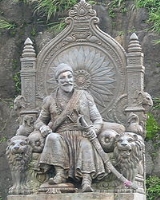
Shivajistatue
Because of his struggle against an imperial power, Shivaji became an icon of freedom fighters in the Indian independence struggle that followed two centuries later.He is remembered as a just and wise king and his rule is called one of the six golden ages in Indian history.

School texts in Maharashtra describe Shivaji's rule as heroic, exemplary and inspiring and he is considered the founder of the modern Marathi nation; his policies were instrumental in forging a distinct Maharashtrian
Maharashtrian

Maharashtrian can refer to:*An ethno-linguistic group of people from Maharashtra, India, speaking Marathi language, see Marathi people...
 identity.

A sectarian political party, the Shiv Sena
Shiv Sena

Shiv Sena , is a far-right political party in India founded on June 19, 1966 by Balasaheb Thackeray, son of Prabodhankar Thackeray , who resigned from the active leadership and gave the position to his son Uddhav....
, claims to draw inspiration from Shivaji.

The World Heritage site
World Heritage Site

A UNESCO World Heritage Site is a site that is on the list maintained by the international World Heritage Programme administered by the UNESCO World Heritage Committee, composed of 21 Sovereign state which are elected by their General Assembly for a four-year term....
 of Victoria Terminus and Sahar International Airport in Mumbai
Mumbai

Mumbai— formerly Bombay, is the capital of the Indian state of Maharashtra. The city proper has approximately 14 million people and, along with the neighbouring suburbs of Navi Mumbai and Thane, Mumbai forms the World's largest urban agglomerations according to the United Nations World Urbanization Prospects report with around 19...
 were renamed Chatrapati Shivaji Terminus and Chatrapati Shivaji International Airport
Chatrapati Shivaji International Airport

Chhatrapati Shivaji International Airport , formerly Sahar Airport, is situated in the city of Mumbai in Maharashtra, India.The airport, with its two terminals spread over an operational area of , is India's largest and most important aviation airline hub and it primarily serves the Mumbai....
 respectively in Shivaji's honour, as have many public buildings and spaces in recent years. The Interstate Bus Terminal of New Delhi
New Delhi

New Delhi is the capital city of India. With a total area of 42.7 km2, New Delhi is situated within the metropolis of Delhi and serves as the seat of the Government of India and the Government of the National Capital Territory of Delhi ....
 has also been named after Shivaji.

The School of Naval Engineering of the Indian Navy
Indian Navy

The Indian Navy is the navy of the Indian Armed Forces. It currently has approximately 55,000 personnel on active duty, including 5,000 members of the naval aviation branch and 2,000 MARCOS , making it the world's fifth largest navy....
 is named as INS Shivaji.

Literature and Movies

Main Article: List of movies on Shivaji

Shivaji is a source of inspiration for a number of artists, directors, actors, writers, shahir (ballad composer), poets and orators. In Marathi, Bhalaji Pendharkar directed on the movie, 'Raja Shivaji' in which the main role was played by the famous Marathi actor Chandrakant Mandare
Chandrakant Mandare

Chandrakant Mandare He donated his art gallery , to Government of Maharashtra....
. Apart form this movie, 'Maratha tituka melawawa','Gad ala pan sinh gela' and many more movies specially in Marathi were made on his and his associates' life.

Sriman yogi is a novel written on Shivaji's life by Ranjit Desai
Ranjit Desai

Ranjit Desai is a well known Marathi writer. He is mainly famous for writing historical books. He was born in Kowad, province Chandgad in Kolhapur district of Maharashtra....
. Raja Shivachhatrapati is a biography authored by Babasaheb Purandare on his life which was later brought out as Jaanata Raja (????? ????), a musical tale of Shivaji's life. Kusumagraj
Kusumagraj

Vishnu Vaman Shirwadkar , popularly known by his pen name, Kusumagraj , was an eminent Marathi poet, writer and humanist in India. He was born in and spent most of his life in the city of Nasik in Maharashtra, India....
 has composed a famous poem on Shivaji's general Prataprao Gujar' Vedat Marathe vir daudale sat'. performed Lata Mangeshkar
Lata Mangeshkar

Lata Mangeshkar is a singer from India. She is one of the best-known playback singers in the Bollywood. Mangeshkar's career started in 1942 and has spanned over six and a half decades....
 and Hridayanath Mangeshkar
Hridayanath Mangeshkar

Hridaynath Mangeshkar is a composer/singer from India known for his eclectic compositions and a well respected body of work....
.

Marathi playwright Vasant Kanetkar
Vasant Kanetkar

Vasant Shankar Kanetkar or Vasant Kanetkar was an Indian playwright who wrote in the Marathi language. He was born in the small town of Rahimatpur in what is now Satara District, Maharashtra....
 wrote 'Raigadala Jevha Jaag Yete' (When Raigad awakes), a play based on the complex relationship between Shivaji and Sambhaji. Shahir like Tulsidas and Agandas had written heroic ballads on him. Kavi Bhushan has composed in Hindi
Hindi

Standard Hindi, also known as High Hindi, Nagari Hindi or Literary Hindi is a Standard language register of Hindi. It is one of the 22 official languages of India, and is used, along with English language, for administration of the central government....
, a famous work 'Shivraj Bhushan'.

Star Pravah- the Marathi channel of Star India Network now has a multi-crore TV serial Raja ShivChhatrapati on the life of Shivaji. The serial was launched in November 2008 and is expected to run for more than 100 one-hour episodes. The serial is excellent in terms of technology, visuals, grand scale sets, realistic locales and mesmerising performances by the actors.

Mee Shivaji Raje Bhosle Boltoy is a yet-to-be launched Marathi film which tries to convey how Shivaji would have responded to the problems faced by the 'Marathi manoos' today. Mahesh Manjrekar plays Shivaji in the film.

Associates

Some of Shivaji's close associates were also his primary army chieftains, and have entered folklore along with him. These include:
  • Antaji Konde-Deshmukh
  • Baji Jedhe
  • Baji Pasalkar
  • Baji Prabhu Deshpande
    Baji Prabhu Deshpande

    Baji Prabhu Deshpande was one of the lieutenants of Shivaji, founder of the Maratha empire. The legend of Baji Prabhu is intricately linked with the final battle during Shivaji's escape from Panhala fort, where he played a key role in the final battle....
  • Balaji Avji Chitre
  • Bapuji Mudgal Deshpande
  • Chimanaji Deshpande
  • Dhanajirao Jadhavrao
  • Firangoji Narsala
    Firangoji Narsala

    Firangoji Narsala was a renowned Maratha warrior and military leader in the army of Shivaji, a Maharaja of Maharashtra, in 17th century India. He is famous for his defence of Sangram Durg, a fort, against a Mughal era army led by Shayeste in 1660 ....
  • Fullaji Prabhu Deshpande
  • Gangadhar Pant
  • Gomaji Naik
    Gomaji Naik

    Gomaji Naik Pansambal was a renowned warrior and military adviser in the army of Shivaji, founder of the Maratha Empire in 17th century India. He is one of his Gurus....
  • Haider Ali Kohari
    Haider Ali Kohari

    Maulana Haider Ali Kohari was the trusted military general and secretary of the great Maratha king Shivaji. He was one of the most trusted lieutenants of Shivaji and was involved in almost all the early campaigns of the great Maratha leader....
  • Hambirrao Mohite
  • Hiroji Farjad
  • Jiva Mahala
  • Kanhoji Jedhe Deshmukh
  • Keso Narayan Deshpande
  • Kondaji Farjand
  • Lay Patil Koli
  • Murarbaji Deshpande
  • Nanaji Deshpande
  • Neelkanthrao Surnaik
  • Netaji Palkar
    Netaji Palkar

    Netaji Palkar was the second Sarnaubat in the army of Shivaji, the founder of the Maratha empire in western India....
  • Prataprao Gujar
    Prataprao Gujar

    Prataprao Bargujar was the third royal Sarnaubat of Shivaji's army, which was probably the most successful army in 17th century India. He was given the pseudonym of Prataprao by Shivaji in acknowledgement of his bravery in the war against Mirza raje Jaisingh....
  • Rango Narayan Orpe
    Rango Narayan Orpe

    Rangnath Narayan Orpe, historically mentioned as ?Rango Narayan?, was a warrior and administrative officer on Fort Vishalgad in the regimes of Shivaji, founder of the Maratha Empire and his son Sambhaji in the 17th century in India....
    Sarpotdar
    Sarpotdar

    Sarpotdar is a historical family name which is not very common in India. It is derived from the Persian language word "pota" which means "treasure"....
  • Sambhaji Kavji
  • Santaji Ghorpade
    Santaji Ghorpade

    Santaji Mhaloji Ghorpade, popularly known as ?Santaji? or ?Santaji Ghorpade?, was one of the greatest warrior and the chief General of the Maratha Empire during Chhatrapati Rajaram?s regime....
  • Suryaji Kakade
  • Tanaji Malusare
    Tanaji Malusare

    Tanaji Malusare , also known as Sinha , was a renowned warrior and military leader in the army of Shivaji, founder of the Maratha Empire in 17th century India....
  • Yesaji Kank


Under Shivaji, many men of talent and enterprise rose into prominence. They carried forward his mission and ensured the defeat of the Mughals in the War of 27 years
War of 27 years

War of 27 years was a series of battles fought between Marathas and Mughals from 1681 to 1707 in the Indian subcontinent. It was the longest fought war in the history of the Indian subcontinent....
. These include Ramchandrapant amtya, Santaji Ghorpade
Santaji Ghorpade

Santaji Mhaloji Ghorpade, popularly known as ?Santaji? or ?Santaji Ghorpade?, was one of the greatest warrior and the chief General of the Maratha Empire during Chhatrapati Rajaram?s regime....
, Dhanaji Jadhav
Dhanaji Jadhav

Dhanaji Shambhusinha Jadhav , popularly known as Dhanaji Jadhav, was one of the great warriors of the Maratha Empire. His name became inseparable from the name of Santaji Ghorpade with whom he made terrifying campaigns against Mughal Empire army continuously from 1689 to 1696....
, Parsoji Bhosle, Harji raje Mahadik and Kanhoji Angre
Kanhoji Angre

Kanhoji Angre or Conajee Angria or Sarkhel Angre was the first notable chief of the Maratha Navy in 18th century India. He fought successfully all his life against the Royal Navy, Netherlands and Portugal naval interests in the Indian Ocean during the eighteenth century, and hence was alleged by them to be a pirate....
.

Accounts of contemporary foreign travellers

Many foreign travellers who visited India
India

India, officially the Republic of India , is a country in South Asia. It is the List of countries and outlying territories by total area country by geographical area, the List of countries by population country, and the most populous liberal democracy in the world....
 during Shivaji's time wrote about him.
  • The Abbe Carre was a French traveller who visited India around 1670; his account was published as Voyage des Indes Orienteles mele de plusiers histories curieuses at Paris in 1699. Some quotes: "Hardly had he won a battle or taken to town in one end of the kingdom than he was at the other extremity causing havoc everywhere and surprising important places. To this quickness of movement he added, like Julius Caesar
    Julius Caesar

    'Gaius Julius Caesar' , July 13, 100 BC ? March 15, 44 BC,) was a Roman Republic military and political leader. He played a critical role in the transformation of the Roman Republic into the Roman Empire....
    , a clemency and bounty that won him the hearts of those his arms had worsted." "In his courage and rapidity he does not ill resemble that great king of Sweden, Gustavus Adolphus."
  • The French traveller Francois Bernier
    François Bernier

    Fran?ois Bernier was a French people physician and traveler, born at Jou?-Etiau /Anjou. For 12 years he was the personal physician of the Mughal Empire emperor Aurangzeb....
     wrote in his Travels in Mughal India. "I forgot to mention that during pillage of Sourate, Seva-ji, the Holy Seva-ji! Respected the habitation of the reverend father Ambrose, the Capuchin missionary. 'The Frankish Padres are good men', he said 'and shall not be attacked.' He spared also the house of a deceased Delale or Gentile broker, of the Dutch, because assured that he had been very charitable while alive."


Further reading

  • Shivchatrapati- Ek Magowa by Dr Jysingrao Bhausaheb Pawar.
  • Apte, B.K. (editor), Chhatrapati Shivaji: Coronation Tercentenary Commemoration Volume, Bombay: University of Bombay (1974-75)
  • Duff, Grant, History of Marhattas, Oxford University Press
    Oxford University Press

    Oxford University Press is a publisher and a department of the University of Oxford in England. It is the largest university press in the world, being larger than all the American university presses combined with Cambridge University Press....
    , London
    London

    London is the capital of both England and the United Kingdom, and the most populous municipality in the European Union. An important settlement for two millennia, History of London goes back to its founding by the Roman Empire....
     Link - http://books.google.com/books?id=FKQ9AAAAMAAJ&printsec=frontcover&dq=subject:%22Maratha+(Indic+people)%22#PRA1-PR21,M1.
  • V.D.Katamble, Shivaji the Great, Pune
    Pune

    Pune ,Pune is the administrative capital of Pune district and the 7th Metro city of India.Pune is known to have existed as a town since 937 AD....
     : Balwant Printers - English Translation of popular Marathi book "Shrimanyogi".
  • Kasar, D.B., Rigveda to Raigarh - Making of Shivaji the Great, Mumbai: Manudevi Prakashan (2005)
  • Vishwas Patil - Sambhaji
    Sambhaji

    Sambhaji Raje Bhonsle was the eldest son of the Maratha Empire founder Shivaji, and succeeded him as the Chhatrapati or the High Protector of the Maratha Empire....
    , Mehta Publishing House, Pune (2006) ISBN 81-7766-651-7
  • Purandare B. M. (author), Raja Shivachhatrapati, he is the most popular and most enigmatic historian of Maratha times, especially that of Shivaji. He is revered throughout Maharashtra as "Shivashahir".
  • Sriman Yogi
  • Joshi, Ajit, Agryahun Sutka, Marathi, Pune: Shivapratap Prakashan (1997)
  • More, Vasantrao, James Laine: A research scholar or a barbarian?, Marathi, Shivsangram Prakashan (2004), Kolhapur
  • Laine, James, Shivaji: Hindu king in Islamic India, London
    London

    London is the capital of both England and the United Kingdom, and the most populous municipality in the European Union. An important settlement for two millennia, History of London goes back to its founding by the Roman Empire....
    : Oxford University Press
    Oxford University Press

    Oxford University Press is a publisher and a department of the University of Oxford in England. It is the largest university press in the world, being larger than all the American university presses combined with Cambridge University Press....
     2003.
  • Parulekar, Shyamrao, Yashogatha Vijaya durg, Vijay Durg (1982)
  • Jyotirao Phule, Chatrapati Shivaji Raje Bhosle Yanche Powade, Marathi, (1869)
  • Sarkar, Jadunath
    Jadunath Sarkar

    Sir Jadunath Sarkar was a noted Indian Bengali people historian....
    , Shivaji and his times, Calcutta
  • Zakaria, Rafique, Communal Rage in Secular India, Popular Prakashan, Mumbai (2003)
  • Work of D. G. Godse
  • Rajendra Ghorpade
  • Mahesh Tendulkar, Runzunjar Senapati Santaji Ghorpade - a book on Santaji Ghorpade
    Santaji Ghorpade

    Santaji Mhaloji Ghorpade, popularly known as ?Santaji? or ?Santaji Ghorpade?, was one of the greatest warrior and the chief General of the Maratha Empire during Chhatrapati Rajaram?s regime....
    .
  • Vishwas Patil, Panipat
    Panipat

    Panipat is an ancient and historic city in Panipat District, Haryana States and territories of India, India. It is 90 km from Delhi on List of National Highways in India-1 and comes under the National Capital Territory of Delhi....
     - a book on the battle of Panipat.
  • Ranjit Desai
    Ranjit Desai

    Ranjit Desai is a well known Marathi writer. He is mainly famous for writing historical books. He was born in Kowad, province Chandgad in Kolhapur district of Maharashtra....
    , Swami
    Swami

    Swami is primarily a Hindu honorific title, for either males or females. It is derived from Sanskrit and means "He who knows and is master of himself", "owner of oneself", or "free from the senses"....
     - a book on Madhavrao Peshwa
    Madhavrao Peshwa

    Shrimant Thorle Madhavrao Peshwa , , was a Peshwa ruler of the Maratha Empire....


See also

  • Chhatrapati
    Chhatrapati

    Chhatrapati is an honorific or an imperial title for an Indian ruler. It most notably refers to Chhatrapati Shivaji, founder of the Maratha Empire....
  • Marathas
  • Maratha Empire
    Maratha Empire

    The Maratha Empire or the Maratha Confederacy was a Hindu state located in present-day India. It existed from 1674 to 1818. At its peak, the empire's territories covered much of South Asia....
  • Bhosle family ancestry
    Bhonsle

    The Bhosle or Bhosale were a prominent Maratha clan who served as rulers of several states in India .The most prominent member of the clan was Shivaji, the founder of the Maratha empire....
  • Marathi people
    Marathi people

    The Marathi people or Maharashtrians are an Indo-Aryans ethnic group, that inhabit the Maharashtra region and state of western India. Their language Marathi is part of the southern group of Indo-Aryan languages....
  • List of people known as The Great
    List of people known as The Great

    This is a list of people whose names in English language are commonly appended with the phrase "the Great", or who were called that or an equivalent phrase in their own language....
  • Maratha clan system
    Maratha clan system

    The Marathas is a collective term referring to an Indo-Aryans group of Hindu, Marathi-speaking castes of Kshatriya, warriors, commoner and peasants, hailing mostly from the Indian state of Maharashtra....
  • Marathawada


External links