

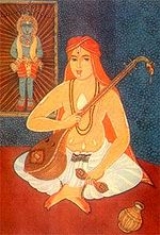
Haridasa

Encyclopedia
The Haridasa devotional movement is considered as one of the turning points in the cultural history of India
. Over a span of nearly six centuries, several saints and mystics helped shape the culture, philosophy and art of South India
and Karnataka
in particular by exerting considerable spiritual influence over the masses and kingdoms that ruled South India.
This movement was ushered in by the Haridasas ' onMouseout='HidePop("61153")' href="/topics/Hari">Hari
') and took shape in the 13th century - 14th century CE, period, prior to and during the early rule of the Vijayanagara
empire. The main objective of this movement was to propagate the Dvaita
philosophy of Madhvacharya
(Madhva Siddhanta) to the masses through a literary medium known as Dasa Sahitya (literature of the servants of the Lord).
Prominent Hindu
philosophers, poets and scholars like Sripadaraya
, Vyasathirtha, Vadirajatirtha
, Purandara Dasa
and Kanaka Dasa
played an important role during this time. Though the movement found its roots in the Kannada country and later spread to other parts of South India, it was a net result of earlier devotional movements like the Veerashaiva movement (of Vachana literature in Kannada) of northern Karnataka led by Basavanna in the 12th century and the Alvar
saints of Tamil Nadu
during the 10th century. Later, Vallabhacharya in Gujarat and Guru Chaitanya were influenced by the teachings of Madhvacharya. Their devotees started the worldwide ISKCON movement.
The Haridasas were saints, some of who were wandering bards, and considered themselves as slaves of the supreme Lord - Hari
. While the movement was mainly heralded by the Brahmins, it was a devotional one whose ideals and thoughts pervaded and received noteworthy contributions from all sections of society. The Haridasa movement can be considered as a part of a larger Bhakti
movement whose devotional inspiration to the masses lasted over a millennium making significant contribution to Kannada devotional literature.
region, largely due to the Vedanta
propounded in the 13th century by Madhvacharya
of Udupi (1238 - 1317 CE).
The Haridasas' who propagated the philosophy (Vedanta) of Madhvacharya belonged to two groups; the Dasakuta, who conveyed the philosophy of Madhvacharya in simple and lucid Kannada to the masses and the Vyasakuta, who were required to be proficient in the Vedas
, Upanishad
s and other Darshanas. During this period, this movement became a strong spiritual
force which helped a resurgence of a strong Hindu
sentiment in Southern India, when Northern India was already under Muslim
rule. The Haridasas' found state patronage in the Vijayanagara Empire
which ruled over entire Southern India
at its peak. Vyasatirtha was intimately associated with the empire and was considered the family guru by King Krishnadevaraya
.
Haridasas' belonged to the Vaishnava school of Hinduism
and worshipped Vitthala, a manifestation of Vishnu
and all forms of Krishna
. The Vittalanatha temple at Pandharapura on the bank of the river Bhima
in present day Maharashtra
, the Vittala Swami temples at Hampi
in Karnataka
and the Srinivasa temple on Tirumala hills in Andhra Pradesh
are considered the holiest of places in the Haridasa context.
, but there were some exceptions like Jayatirtha
who came from Mangalvedhe near Pandharapura in modern Maharashtra
and Sri Naraharitirtha
(a disciple of Madhvacharya) who was a native of either Andhra Pradesh
or Orissa
. Naraharitirtha (1281), a minister in the court of Kalinga was inducted into the Madhvacharya order. He composed many early devotional hymns in praise of Vishnu in Kannada language, some of which are available today. While the Srikurmam inscription indicates that Naraharitirtha may have been the originator of this devotional movement, the songs of the Haridasas' give credit to Sripadaraya
as the real founder of the movement in the 15th century.
Famous haridasas from the Madhvacharya order during the Vijayanagar empire period were:
, the sacred centre of Vijayanagara
, the regal capital of Vijayanagara empire.
The Haridasa movement gained further impetus in the 17th century and 18th century in and around Raichur District
and some of the great saints from this era were Guru Raghavendra, Vijaya Dasa
, Gopala Dasa, Jagannatha Dasa, Prasanna Venkata Dasa, Pranesha Dasa, Venugopala Dasa, Mahipathi Dasa, Mohana Dasa, Helevanakatte Giriamma and Harapanhalli Bhimavva.
The history of the Haridasa movement from the 13th century to the present day is the history of spreading Hari bhakti
(devotion to Hari-God) to the common man and in that purpose has contributed immensely to Kannada literature
and to the development of Kannada language. Both the Haridasa and Veerashaiva movements pervade the length and breadth of Karnataka and exert ennobling influences upon the neighboring provinces of Andhra Pradesh
, Tamil Nadu
and Maharashtra
.
by spawning a whole corpus of devotional literature in the form of verses, hymns and musical compositions, rendering the spread of the Dvaita
philosophy (Vedanta) postulated by Madhvacharya. The literature that originated from this devotional movement is called Dasa Sahitya (or dasara padagalu - literature of the dasas). These various compositions are generally called as Devaranamas (literally meaning names of the Lord) and are sung in the praise of the Lord Hari
. All these compositions have the concept of Hari Bhakti
(devotion to God) at their core and they usually revolve around references to Hindu
mythology and the Dvaita philosophy. Some Haridasas like Purandara Dasa and Kanaka Dasa also composed several Devaranamas using the day-to-day happenings, morals and virtues as the central theme. These compositions were in the Kannada language since the main objective of this movement was to take the devotional philosophy to the common man. In doing so, the common people were also educated in the importance of consciousness (jnana), devotion (bhakti), ethics and Hindu religion. Their hymns (padas) set to various musical tones (ragas) aroused the frevor among the masses. As advocates of religious reform, the Haridasas' propounded the virtues of detachment (vairagya). Similes and metaphors were used to great effect in achieving this and they are found in abundance in songs and hymns. In addition to devotional songs, Kanaka Dasa authored five literary classical writings in the kavya
style. Jagannathadasa, Vijaya Dasa
and Gopaladasa etc., are more well known among a galaxy of composers who made rich contributions to Kannada literature.
The compositions can be broadly classified under one of the following three types:
tradition as a distinct art form from the Hindustani style thereby heralding a renaissance in the world of Indian classical music
. Purandara Dasa
, one of the foremost of Haridasas' is known as the "Father of carnatic music" (Karnataka Sangeeta Pitamaha) for his invaluable contributions to this art form. He was a prolific composer, historians propose the number of his compositions were as many as 75,000 - 475,000 songs in Kannada language, though only few hundreds are available today. He composed several Keertane which later served as the foundation for the Kriti
form, elaborated and perfected by the Trinity of Carnatic music
. He codified and consolidated the teaching of Carnatic music by evolving several steps like sarali, jantai, thattu varisai, alankara and geetham and laid down a framework for imparting formal training in this art form. The structure and lessons he formulated four centuries ago remain the foundation for all students of carnatic music. Apart from Purandara Dasa, several later Haridasas' composed songs adhering to the same musical and philosophical traditions. Their compositions usually fell in one of the following categories: Padagalu (or Devaranama- devotional hymns), Kriti, Ugabhoga, Suladi, Vruttanama, Dandaka, Tripadi (three line poetry), Pattadi, Sangathya and Ragale
(lyrical verses in blank verse). These forms of composition are still prevalent in South India
and especially in Karnataka
.
Though these compositions usually adhere to the carnatic style of music, some of these compositions have also been sung in the Hindustani style by musicians such as Bhimsen Joshi
and Gangubai Hangal
.
India
India , officially the Republic of India , is a country in South Asia. It is the seventh-largest country by geographical area, the second-most populous country with over 1.2 billion people, and the most populous democracy in the world...
. Over a span of nearly six centuries, several saints and mystics helped shape the culture, philosophy and art of South India
South India
South India is the area encompassing India's states of Andhra Pradesh, Karnataka, Kerala and Tamil Nadu as well as the union territories of Lakshadweep and Pondicherry, occupying 19.31% of India's area...
and Karnataka
Karnataka
Karnataka , the land of the Kannadigas, is a state in South West India. It was created on 1 November 1956, with the passing of the States Reorganisation Act and this day is annually celebrated as Karnataka Rajyotsava...
in particular by exerting considerable spiritual influence over the masses and kingdoms that ruled South India.
This movement was ushered in by the Haridasas ' onMouseout='HidePop("61153")' href="/topics/Hari">Hari
Hari
Hari is an Avatar, another name of and , and appears as the 650th name in the Vishnu sahasranama of Mahabharata. In Sanskrit "hari" sometimes refers to a colour, green, yellow, or fawn-coloured/khaki. It is the colour of the Sun and of Soma...
') and took shape in the 13th century - 14th century CE, period, prior to and during the early rule of the Vijayanagara
Vijayanagara
Vijayanagara is in Bellary District, northern Karnataka. It is the name of the now-ruined capital city "which was regarded as the second Rome" that surrounds modern-day Hampi, of the historic Vijayanagara empire which extended over the southern part of India....
empire. The main objective of this movement was to propagate the Dvaita
Dvaita
Dvaita is a school of Vedanta founded by Shri Madhvacharya....
philosophy of Madhvacharya
Madhvacharya
Madhvācārya was the chief proponent of Tattvavāda "Philosophy of Reality", popularly known as the Dvaita school of Hindu philosophy. It is one of the three most influential Vedānta philosophies. Madhvācārya was one of the important philosophers during the Bhakti movement. He was a pioneer in...
(Madhva Siddhanta) to the masses through a literary medium known as Dasa Sahitya (literature of the servants of the Lord).
Prominent Hindu
Hindu
Hindu refers to an identity associated with the philosophical, religious and cultural systems that are indigenous to the Indian subcontinent. As used in the Constitution of India, the word "Hindu" is also attributed to all persons professing any Indian religion...
philosophers, poets and scholars like Sripadaraya
Sripadaraya
Sripadaraya, a haridasa, is also known as Sripadaraja or Lakshminarayana Tirtha .Sripadaraya was born in Abburu in Chennapattana taluk of Karnataka state. It is believed that he was the incarnation of dhruva...
, Vyasathirtha, Vadirajatirtha
Vadirajatirtha
Sri Vadirajatirtha , traditionally 1480 - 1600, a Haridasa, is said to have been a Shivalli Tulu Brahmin and native of the village of Hoovinakere, near Kumbhashi in Kundapura taluk, Udupi District in Karnataka state...
, Purandara Dasa
Purandara Dasa
Purandara Dāsa is one of the most prominent composers of Carnatic music and is widely regarded as the "father of Carnatic Music". Purandara Dasa addressed social issues in addition to worship in his compositions, a practice emulated by his younger contemporary, Kanaka Dasa...
and Kanaka Dasa
Kanaka Dasa
Kanaka Dasa was a great poet, philosopher, musician and composer from Karnataka. He is known for his Kirtanes and Ugabhoga compositions in the Kannada language for Carnatic music...
played an important role during this time. Though the movement found its roots in the Kannada country and later spread to other parts of South India, it was a net result of earlier devotional movements like the Veerashaiva movement (of Vachana literature in Kannada) of northern Karnataka led by Basavanna in the 12th century and the Alvar
Alvar
An alvar is a biological environment based on a limestone plain with thin or no soil and, as a result, sparse vegetation. It is also known as a pavement barren although this term is also used for similar landforms based on sandstone. In the United Kingdom the exposed landform is called a limestone...
saints of Tamil Nadu
Tamil Nadu
Tamil Nadu is one of the 28 states of India. Its capital and largest city is Chennai. Tamil Nadu lies in the southernmost part of the Indian Peninsula and is bordered by the union territory of Pondicherry, and the states of Kerala, Karnataka, and Andhra Pradesh...
during the 10th century. Later, Vallabhacharya in Gujarat and Guru Chaitanya were influenced by the teachings of Madhvacharya. Their devotees started the worldwide ISKCON movement.
The Haridasas were saints, some of who were wandering bards, and considered themselves as slaves of the supreme Lord - Hari
Hari
Hari is an Avatar, another name of and , and appears as the 650th name in the Vishnu sahasranama of Mahabharata. In Sanskrit "hari" sometimes refers to a colour, green, yellow, or fawn-coloured/khaki. It is the colour of the Sun and of Soma...
. While the movement was mainly heralded by the Brahmins, it was a devotional one whose ideals and thoughts pervaded and received noteworthy contributions from all sections of society. The Haridasa movement can be considered as a part of a larger Bhakti
Bhakti
In Hinduism Bhakti is religious devotion in the form of active involvement of a devotee in worship of the divine.Within monotheistic Hinduism, it is the love felt by the worshipper towards the personal God, a concept expressed in Hindu theology as Svayam Bhagavan.Bhakti can be used of either...
movement whose devotional inspiration to the masses lasted over a millennium making significant contribution to Kannada devotional literature.
Origin
The origin of the Haridasa movement is not clearly known, with some legends indicating that there were holy men and kings who espoused this form of devotion as early as the 9th century. However it is well known that the great Vaishnava religious devotionalism called Dasa Kuta found its organizational base and started to produce large congregation of devotees in the KarnatakaKarnataka
Karnataka , the land of the Kannadigas, is a state in South West India. It was created on 1 November 1956, with the passing of the States Reorganisation Act and this day is annually celebrated as Karnataka Rajyotsava...
region, largely due to the Vedanta
Vedanta
Vedānta was originally a word used in Hindu philosophy as a synonym for that part of the Veda texts known also as the Upanishads. The name is a morphophonological form of Veda-anta = "Veda-end" = "the appendix to the Vedic hymns." It is also speculated that "Vedānta" means "the purpose or goal...
propounded in the 13th century by Madhvacharya
Madhvacharya
Madhvācārya was the chief proponent of Tattvavāda "Philosophy of Reality", popularly known as the Dvaita school of Hindu philosophy. It is one of the three most influential Vedānta philosophies. Madhvācārya was one of the important philosophers during the Bhakti movement. He was a pioneer in...
of Udupi (1238 - 1317 CE).
The Haridasas' who propagated the philosophy (Vedanta) of Madhvacharya belonged to two groups; the Dasakuta, who conveyed the philosophy of Madhvacharya in simple and lucid Kannada to the masses and the Vyasakuta, who were required to be proficient in the Vedas
Vedas
The Vedas are a large body of texts originating in ancient India. Composed in Vedic Sanskrit, the texts constitute the oldest layer of Sanskrit literature and the oldest scriptures of Hinduism....
, Upanishad
Upanishad
The Upanishads are philosophical texts considered to be an early source of Hindu religion. More than 200 are known, of which the first dozen or so, the oldest and most important, are variously referred to as the principal, main or old Upanishads...
s and other Darshanas. During this period, this movement became a strong spiritual
Spirituality
Spirituality can refer to an ultimate or an alleged immaterial reality; an inner path enabling a person to discover the essence of his/her being; or the “deepest values and meanings by which people live.” Spiritual practices, including meditation, prayer and contemplation, are intended to develop...
force which helped a resurgence of a strong Hindu
Hindu
Hindu refers to an identity associated with the philosophical, religious and cultural systems that are indigenous to the Indian subcontinent. As used in the Constitution of India, the word "Hindu" is also attributed to all persons professing any Indian religion...
sentiment in Southern India, when Northern India was already under Muslim
Muslim
A Muslim, also spelled Moslem, is an adherent of Islam, a monotheistic, Abrahamic religion based on the Quran, which Muslims consider the verbatim word of God as revealed to prophet Muhammad. "Muslim" is the Arabic term for "submitter" .Muslims believe that God is one and incomparable...
rule. The Haridasas' found state patronage in the Vijayanagara Empire
Vijayanagara Empire
The Vijayanagara Empire , referred as the Kingdom of Bisnaga by the Portuguese, was an empire based in South Indian in the Deccan Plateau region. It was established in 1336 by Harihara I and his brother Bukka Raya I of the Yadava lineage. The empire rose to prominence as a culmination of attempts...
which ruled over entire Southern India
South India
South India is the area encompassing India's states of Andhra Pradesh, Karnataka, Kerala and Tamil Nadu as well as the union territories of Lakshadweep and Pondicherry, occupying 19.31% of India's area...
at its peak. Vyasatirtha was intimately associated with the empire and was considered the family guru by King Krishnadevaraya
Krishnadevaraya
Śrī Kriṣhṇa Devarāya , , , and also known as Krishna Devarayulu in some inscriptions was the famed Emperor of the Vijayanagara Empire who reigned from 1509–1529 CE.He is the third ruler of the Tuluva Dynasty. Presiding over the empire at its zenith, he is regarded as an icon by many Indians...
.
Haridasas' belonged to the Vaishnava school of Hinduism
Hinduism
Hinduism is the predominant and indigenous religious tradition of the Indian Subcontinent. Hinduism is known to its followers as , amongst many other expressions...
and worshipped Vitthala, a manifestation of Vishnu
Vishnu
Vishnu is the Supreme god in the Vaishnavite tradition of Hinduism. Smarta followers of Adi Shankara, among others, venerate Vishnu as one of the five primary forms of God....
and all forms of Krishna
Krishna
Krishna is a central figure of Hinduism and is traditionally attributed the authorship of the Bhagavad Gita. He is the supreme Being and considered in some monotheistic traditions as an Avatar of Vishnu...
. The Vittalanatha temple at Pandharapura on the bank of the river Bhima
Bhima
In the Mahābhārata, Bhima is one of the central characters of Mahabharata and the second of the Pandava brothers...
in present day Maharashtra
Maharashtra
Maharashtra is a state located in India. It is the second most populous after Uttar Pradesh and third largest state by area in India...
, the Vittala Swami temples at Hampi
Hampi
Hampi is a village in northern Karnataka state, India. It is located within the ruins of Vijayanagara, the former capital of the Vijayanagara Empire. Predating the city of Vijayanagara, it continues to be an important religious centre, housing the Virupaksha Temple, as well as several other...
in Karnataka
Karnataka
Karnataka , the land of the Kannadigas, is a state in South West India. It was created on 1 November 1956, with the passing of the States Reorganisation Act and this day is annually celebrated as Karnataka Rajyotsava...
and the Srinivasa temple on Tirumala hills in Andhra Pradesh
Andhra Pradesh
Andhra Pradesh , is one of the 28 states of India, situated on the southeastern coast of India. It is India's fourth largest state by area and fifth largest by population. Its capital and largest city by population is Hyderabad.The total GDP of Andhra Pradesh is $100 billion and is ranked third...
are considered the holiest of places in the Haridasa context.
Preachers
The Haridasas' generally hailed from places in present day KarnatakaKarnataka
Karnataka , the land of the Kannadigas, is a state in South West India. It was created on 1 November 1956, with the passing of the States Reorganisation Act and this day is annually celebrated as Karnataka Rajyotsava...
, but there were some exceptions like Jayatirtha
Jayatirtha
Seer Jayateertharu was the sixth pontiff of Sri Madhvacharya Peetha. He is one of the most important seers in the Dvaita philosophy on account of his elucidations of Sri Ananda Teertha's masterpieces...
who came from Mangalvedhe near Pandharapura in modern Maharashtra
Maharashtra
Maharashtra is a state located in India. It is the second most populous after Uttar Pradesh and third largest state by area in India...
and Sri Naraharitirtha
Naraharitirtha
Sri Naraharitirtha CE. was a disciple of 13th Century Indian saint Madhvacharya and is considered by some as the founder of the Haridasa movement in India. He was not only a great saint but also a royal pontiff as evidenced by some inscriptions...
(a disciple of Madhvacharya) who was a native of either Andhra Pradesh
Andhra Pradesh
Andhra Pradesh , is one of the 28 states of India, situated on the southeastern coast of India. It is India's fourth largest state by area and fifth largest by population. Its capital and largest city by population is Hyderabad.The total GDP of Andhra Pradesh is $100 billion and is ranked third...
or Orissa
Orissa
Orissa , officially Odisha since Nov 2011, is a state of India, located on the east coast of India, by the Bay of Bengal. It is the modern name of the ancient nation of Kalinga, which was invaded by the Maurya Emperor Ashoka in 261 BC. The modern state of Orissa was established on 1 April...
. Naraharitirtha (1281), a minister in the court of Kalinga was inducted into the Madhvacharya order. He composed many early devotional hymns in praise of Vishnu in Kannada language, some of which are available today. While the Srikurmam inscription indicates that Naraharitirtha may have been the originator of this devotional movement, the songs of the Haridasas' give credit to Sripadaraya
Sripadaraya
Sripadaraya, a haridasa, is also known as Sripadaraja or Lakshminarayana Tirtha .Sripadaraya was born in Abburu in Chennapattana taluk of Karnataka state. It is believed that he was the incarnation of dhruva...
as the real founder of the movement in the 15th century.
Famous haridasas from the Madhvacharya order during the Vijayanagar empire period were:
- Madhavatirtha - around A.D. 1215–1350
- Akshobhyatirtha
- Vijayindratirtha
- Raghottamatirtha
- Naraharitirtha
- Jayatirtha
- Sripadaraya (1404 - 1502 CE.)
- Vyasatirtha (1447 - 1539 CE.)
- Purandara Dasa (1480 - 1564 CE.)
- Kanaka Dasa (1508 - 1606 CE.) (non-brahmin saint)
- Vadirajatirtha (1480 - 1600 CE.) (lived for 120 years).
Growth and Patronage
Sripadaraya, Vyasatirtha and Vadirajatirtha are called "three great saints" (yathi trayaru) in Haridasa movement where as the epithet "great trinity of Vaishnava composers" from Karnataka goes to Sripadaraya, Purandaradasa and Kanakadasa, though it is difficult to separate literature, music, devotion from their composite writings. The center of their activity in the 15th century and 16th century was HampiHampi
Hampi is a village in northern Karnataka state, India. It is located within the ruins of Vijayanagara, the former capital of the Vijayanagara Empire. Predating the city of Vijayanagara, it continues to be an important religious centre, housing the Virupaksha Temple, as well as several other...
, the sacred centre of Vijayanagara
Vijayanagara
Vijayanagara is in Bellary District, northern Karnataka. It is the name of the now-ruined capital city "which was regarded as the second Rome" that surrounds modern-day Hampi, of the historic Vijayanagara empire which extended over the southern part of India....
, the regal capital of Vijayanagara empire.
The Haridasa movement gained further impetus in the 17th century and 18th century in and around Raichur District
Raichur district
Raichur District is an administrative district in the Indian state of Karnataka. It is located in the northeast part of the state and is bounded by Yadgir district in the north, Bijapur and Bagalkot district in the northwest, Koppal district in the west, Bellary district in the south, Anantapur...
and some of the great saints from this era were Guru Raghavendra, Vijaya Dasa
Vijaya Dasa
Vijaya Dasa or Sri Vijaya Dasa was a prominent saint from the Haridasa tradition of Karnataka, India in the 18th century. Sri VijayaDasaru is an amsha of Sri Brighu Muni; the very same muni, who was the nimmita for the eternal kshetra Tirumala ! Sri Krishna himself in BG 10.25 says "maharsinam...
, Gopala Dasa, Jagannatha Dasa, Prasanna Venkata Dasa, Pranesha Dasa, Venugopala Dasa, Mahipathi Dasa, Mohana Dasa, Helevanakatte Giriamma and Harapanhalli Bhimavva.
The history of the Haridasa movement from the 13th century to the present day is the history of spreading Hari bhakti
Bhakti
In Hinduism Bhakti is religious devotion in the form of active involvement of a devotee in worship of the divine.Within monotheistic Hinduism, it is the love felt by the worshipper towards the personal God, a concept expressed in Hindu theology as Svayam Bhagavan.Bhakti can be used of either...
(devotion to Hari-God) to the common man and in that purpose has contributed immensely to Kannada literature
Kannada literature
Kannada literature is the corpus of written forms of the Kannada language, a member of the Dravidian family spoken mainly in the Indian state of Karnataka and written in the Kannada script....
and to the development of Kannada language. Both the Haridasa and Veerashaiva movements pervade the length and breadth of Karnataka and exert ennobling influences upon the neighboring provinces of Andhra Pradesh
Andhra Pradesh
Andhra Pradesh , is one of the 28 states of India, situated on the southeastern coast of India. It is India's fourth largest state by area and fifth largest by population. Its capital and largest city by population is Hyderabad.The total GDP of Andhra Pradesh is $100 billion and is ranked third...
, Tamil Nadu
Tamil Nadu
Tamil Nadu is one of the 28 states of India. Its capital and largest city is Chennai. Tamil Nadu lies in the southernmost part of the Indian Peninsula and is bordered by the union territory of Pondicherry, and the states of Kerala, Karnataka, and Andhra Pradesh...
and Maharashtra
Maharashtra
Maharashtra is a state located in India. It is the second most populous after Uttar Pradesh and third largest state by area in India...
.
Contribution to Kannada Literature
Haridasa movement has made a significant contribution towards Kannada literatureKannada literature
Kannada literature is the corpus of written forms of the Kannada language, a member of the Dravidian family spoken mainly in the Indian state of Karnataka and written in the Kannada script....
by spawning a whole corpus of devotional literature in the form of verses, hymns and musical compositions, rendering the spread of the Dvaita
Dvaita
Dvaita is a school of Vedanta founded by Shri Madhvacharya....
philosophy (Vedanta) postulated by Madhvacharya. The literature that originated from this devotional movement is called Dasa Sahitya (or dasara padagalu - literature of the dasas). These various compositions are generally called as Devaranamas (literally meaning names of the Lord) and are sung in the praise of the Lord Hari
Hari
Hari is an Avatar, another name of and , and appears as the 650th name in the Vishnu sahasranama of Mahabharata. In Sanskrit "hari" sometimes refers to a colour, green, yellow, or fawn-coloured/khaki. It is the colour of the Sun and of Soma...
. All these compositions have the concept of Hari Bhakti
Bhakti
In Hinduism Bhakti is religious devotion in the form of active involvement of a devotee in worship of the divine.Within monotheistic Hinduism, it is the love felt by the worshipper towards the personal God, a concept expressed in Hindu theology as Svayam Bhagavan.Bhakti can be used of either...
(devotion to God) at their core and they usually revolve around references to Hindu
Hindu
Hindu refers to an identity associated with the philosophical, religious and cultural systems that are indigenous to the Indian subcontinent. As used in the Constitution of India, the word "Hindu" is also attributed to all persons professing any Indian religion...
mythology and the Dvaita philosophy. Some Haridasas like Purandara Dasa and Kanaka Dasa also composed several Devaranamas using the day-to-day happenings, morals and virtues as the central theme. These compositions were in the Kannada language since the main objective of this movement was to take the devotional philosophy to the common man. In doing so, the common people were also educated in the importance of consciousness (jnana), devotion (bhakti), ethics and Hindu religion. Their hymns (padas) set to various musical tones (ragas) aroused the frevor among the masses. As advocates of religious reform, the Haridasas' propounded the virtues of detachment (vairagya). Similes and metaphors were used to great effect in achieving this and they are found in abundance in songs and hymns. In addition to devotional songs, Kanaka Dasa authored five literary classical writings in the kavya
Kavya
Kavya refers to the Sanskrit literary style used by Indian court poets flourishing from the first half of the seventh century AD. This literary style is characterised by abundant usage of figures of speech, metaphors, similes, and hyperbole to create its emotional effects...
style. Jagannathadasa, Vijaya Dasa
Vijaya Dasa
Vijaya Dasa or Sri Vijaya Dasa was a prominent saint from the Haridasa tradition of Karnataka, India in the 18th century. Sri VijayaDasaru is an amsha of Sri Brighu Muni; the very same muni, who was the nimmita for the eternal kshetra Tirumala ! Sri Krishna himself in BG 10.25 says "maharsinam...
and Gopaladasa etc., are more well known among a galaxy of composers who made rich contributions to Kannada literature.
The compositions can be broadly classified under one of the following three types:
- Kavya or poetic compositions
- Tatva or philosophic compositions
- General compositions.
nom-de-plume (Ankita Nama)
Each Haridasa had a unique ankita nama with which they 'signed' all their compositions. The nom-de-plumes of some of the most well known Haridasas is listed below:- Naraharitirtha: Narahari Raghupathi
- Sripadaraya: Ranga Vitthala
- Vyasatirtha: Sri Krishna
- Vadirajatirtha: Hayavadana
- Raghavendra: Dheera Venu Gopala
- Purandara Dasa: Purandara Vittala
- Kanaka Dasa: Adi Keshava
- Vijaya DasaVijaya DasaVijaya Dasa or Sri Vijaya Dasa was a prominent saint from the Haridasa tradition of Karnataka, India in the 18th century. Sri VijayaDasaru is an amsha of Sri Brighu Muni; the very same muni, who was the nimmita for the eternal kshetra Tirumala ! Sri Krishna himself in BG 10.25 says "maharsinam...
(1682-1755): Vijaya Vittala - Gopaladasa (1722-1762): Gopala Vittala
- Helevanakatte Giriyamma (18th century): Helevanakatte Ranga
- Jagannathadasa (1727 to 1809): Jagannatha Vittala
- Mahipathidasa (1611-1681): Mahipathi
- Prasanna Venkatadasa (1680 to 1752): Prasanna Venkata
- Venugopaladasa (18th century): Venugopala Vittala
- Mohanadasa (18th century): Mohana Vittala
- Nekkara Krishnadasa (18th century): Varaha Thimmappa
- Tande Venkatesha Vittala Dasaru (1907-1982): Tande Venkatesha Vittala
- Gurugovindadasaru
Contribution to Carnatic music
The Haridasa movement developed the Carnatic musicCarnatic music
Carnatic music is a system of music commonly associated with the southern part of the Indian subcontinent, with its area roughly confined to four modern states of India: Andhra Pradesh, Karnataka, Kerala, and Tamil Nadu...
tradition as a distinct art form from the Hindustani style thereby heralding a renaissance in the world of Indian classical music
Classical music
Classical music is the art music produced in, or rooted in, the traditions of Western liturgical and secular music, encompassing a broad period from roughly the 11th century to present times...
. Purandara Dasa
Purandara Dasa
Purandara Dāsa is one of the most prominent composers of Carnatic music and is widely regarded as the "father of Carnatic Music". Purandara Dasa addressed social issues in addition to worship in his compositions, a practice emulated by his younger contemporary, Kanaka Dasa...
, one of the foremost of Haridasas' is known as the "Father of carnatic music" (Karnataka Sangeeta Pitamaha) for his invaluable contributions to this art form. He was a prolific composer, historians propose the number of his compositions were as many as 75,000 - 475,000 songs in Kannada language, though only few hundreds are available today. He composed several Keertane which later served as the foundation for the Kriti
Kriti
-Structure:Kritis typically contain three parts#Pallavi. This is the equivalent of a refrain in Western music.#Anupallavi. The second verse, which is sometimes optional....
form, elaborated and perfected by the Trinity of Carnatic music
Trinity of Carnatic music
The outstanding group of composer-musicians of Carnatic music which included Tyāgarāja, Muthuswami Dikshitar and Syama Sastri, are commonly referred to as the Trinity of Carnatic music....
. He codified and consolidated the teaching of Carnatic music by evolving several steps like sarali, jantai, thattu varisai, alankara and geetham and laid down a framework for imparting formal training in this art form. The structure and lessons he formulated four centuries ago remain the foundation for all students of carnatic music. Apart from Purandara Dasa, several later Haridasas' composed songs adhering to the same musical and philosophical traditions. Their compositions usually fell in one of the following categories: Padagalu (or Devaranama- devotional hymns), Kriti, Ugabhoga, Suladi, Vruttanama, Dandaka, Tripadi (three line poetry), Pattadi, Sangathya and Ragale
Ragale
Ragale is a type of meter in Kannada prosody that is used in Kannada poetry.This meter can usually have as many padas of syllables divided into two groups of various fixed number of matra in each line...
(lyrical verses in blank verse). These forms of composition are still prevalent in South India
South India
South India is the area encompassing India's states of Andhra Pradesh, Karnataka, Kerala and Tamil Nadu as well as the union territories of Lakshadweep and Pondicherry, occupying 19.31% of India's area...
and especially in Karnataka
Karnataka
Karnataka , the land of the Kannadigas, is a state in South West India. It was created on 1 November 1956, with the passing of the States Reorganisation Act and this day is annually celebrated as Karnataka Rajyotsava...
.
Though these compositions usually adhere to the carnatic style of music, some of these compositions have also been sung in the Hindustani style by musicians such as Bhimsen Joshi
Bhimsen Joshi
Pandit Bhimsen Gururaj Joshi ; February 4, 1922 - January 24, 2011) was an Indian vocalist in the Hindustani classical tradition. A member of the Kirana Gharana , he is renowned for the khayal form of singing, as well as for his popular renditions of devotional music...
and Gangubai Hangal
Gangubai Hangal
Gangubai Hangal was an Indian singer of the khyal genre of Hindustani classical music, who was known for her deep and powerful voice. Hangal belonged to the Kirana gharana.-Early life:...
.