

Chalukya dynasty

Encyclopedia
The Chalukya dynasty ( tʃaːɭukjə) was an India
n royal dynasty that ruled large parts of southern
and central India between the 6th and the 12th centuries. During this period, they ruled as three related yet individual dynasties. The earliest dynasty, known as the "Badami Chalukyas", ruled from Vatapi (modern Badami
) from the middle of the 6th century. The Badami Chalukyas began to assert their independence at the decline of the Kadamba kingdom of Banavasi
and rapidly rose to prominence during the reign of Pulakesi II. After the death of Pulakesi II, the Eastern Chalukyas
became an independent kingdom in the eastern Deccan. They ruled from Vengi
until about the 11th century. In the western Deccan, the rise of the Rashtrakutas in the middle of the 8th century eclipsed the Chalukyas of Badami before being revived by their descendants, the Western Chalukyas
, in the late 10th century. These Western Chalukyas ruled from Kalyani (modern Basavakalyan
) until the end of the 12th century.
The rule of the Chalukyas marks an important milestone in the history of South India
and a golden age in the history of Karnataka
. The political atmosphere in South India shifted from smaller kingdoms to large empires with the ascendancy of Badami Chalukyas. For the first time, a South Indian kingdom took control and consolidated the entire region between the Kaveri and the Narmada
rivers. The rise of this empire saw the birth of efficient administration, overseas trade and commerce and the development of new style of architecture called "Chalukyan architecture". Kannada literature
, which had enjoyed royal support in the 9th century Rashtrakuta court found eager patronage from the Western Chalukyas in the Jain and Veerashaiva traditions. The 11th century saw the birth of Telugu literature
under the patronage of the Eastern .
 While opinions vary regarding the early origins of the Chalukyas, the consensus is that the founders of the empire at Badami were native to the Karnataka
region. According to one theory, the Chalukya were descendants of the "Seleukia" tribe of Iraq
and that their conflict with the Pallava
of Kanchi was, but a continuation of the conflict between ancient Seleukia and "Parthians", the proposed ancestors of Pallavas. However, this theory has been rejected as it seeks to build lineages based simply on similar sounding clan names.
Another theory, that they were descendants of a 2nd century chieftain called Kandachaliki Remmanaka, a feudatory of the Andhra Ikshvaku
(from an Ikshvaku inscription of 2nd century) was put forward. But this has failed to explain the difference in lineage. The Kandachaliki feudatory call themselves Vashisthiputras of the Hiranyakagotra. The Chalukyas, however, address themselves as Harithiputras of Manavyasagotra in their inscriptions, which is the same lineage as their early overlords, the Kadambas of Banavasi. This makes them descendants of the Kadambas. The Chalukyas took control of the territory formerly ruled by the Kadambas
.
A later record of Eastern Chalukyas mentions the northern origin theory and claims one ruler of Ayodhya came south, defeated the Pallavas and married a Pallava princess. She had a child called Vijayaditya who is claimed to be the Pulakesi I's father. However, there are Badami Chalukya inscriptions that confirm Jayasimha was Pulakesi I's grandfather and Ranaranga, his father. It was a popular practice in the 11th century to link South Indian royal family lineage to a Northern kingdom. The Badami Chalukya records themselves are silent with regards to the Ayodhya origin.
While the northern origin theory has been dismissed by many historians, it is suggested that a southern migration is a distinct possibility which needs examination. The complete absence of any inscriptional reference of their family connections to Ayodhya, and their subsequent Kannadiga identity may have been due to their earlier migration into present day Karnataka region where they achieved success as chieftains and kings. Hence, the place of origin of their ancestors may have been of no significance to the kings of the empire who may have considered themselves natives of the Kannada speaking region. There is controversy even regarding the caste to which the Badami Chalukyas belonged. The writing of 12th century Kashmiri
poet Bilhana
suggests the Chalukya family belonged to the Shudra
caste while other sources claim they were Kshatriya
s.
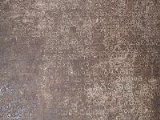
The Badami Chalukya inscriptions are in Kannada and Sanskrit
. Their inscriptions call them Karnatas and their names use indigenous Kannada titles such as Priyagallam and Noduttagelvom. The names of some Chalukya princes end with the pure Kannada term arasa (meaning "king" or "chief"). The Rashtrakuta
inscriptions call the Chalukyas of Badami Karnatabala ("Power of Karnata"). It has been proposed that the word "Chalukya" originated from Salki or Chalki which is a Kannada word for an agricultural implement.
hold the view that Chalukyas were one of the ruling clan of Gurjaras (or Gujjars). Bhandarkar put the point that Gujarat was known as Lata prior to it came to known as Gurjaratra at the time of chalukyas.If the chalukyas had not been Gurjars, it is inconceivable how that province could have named Gurjaratra (country ruled or protected by Gurjars) when it was up-till their advent known as Lata.However scholars such as D. P. Dikshit argues that Chalukyas ruled over that part of country formerly known as Lata and taken as Gurjaratra or Gujarat didn't imply the Chalukyas didn't make any change in the nomenclature because of their close association with the region.
Dr.V. A. Smith
and A. M. T. Jackson also endorsed the view that Chalukyas were branch of famous Gurjaras(or Gujjars).
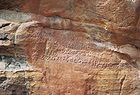
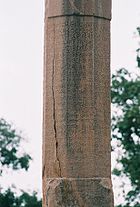
cave inscriptions of Mangalesa (578), Kappe Arabhatta
record of c. 700, Peddavaduguru inscription of Pulakesi II, the Kanchi Kailasanatha Temple inscription and Pattadakal
Virupaksha Temple inscription of Vikramaditya II (all in Kannada language) provide more evidence of the Chalukya language. The Badami cliff inscription of Pulakesi I (543), the Mahakuta Pillar
inscription of Mangalesa
(595) and the Aihole
inscription of Pulakesi II (634) are examples of important Sanskrit inscriptions written in old Kannada script
.
The reign of the Chalukyas saw the arrival of Kannada as the predominant language of inscriptions along with Sanskrit, in areas of the Indian peninsula outside what is known as Tamilaham
(Tamil country). Several coins of the Badami Chalukyas with Kannada legends have been found. All this indicates that Kannada language flourished during this period.
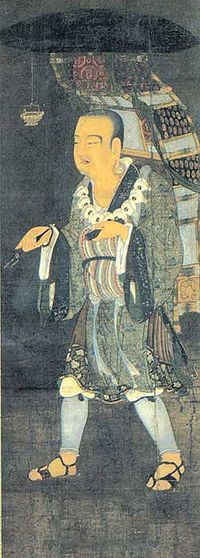 Travelogues of contemporary foreign travellers have provided useful information about the Chalukyan empire. The Chinese traveller Hsüan-tsang (Xuanzang) had visited the court of Pulakesi II. At the time of this visit, as mentioned in the Aihole
record, Pulakesi II had divided his empire into three Maharashtrakas or great provinces comprising 99,000 villages each. This empire possibly covered present day Karnataka
, Maharashtra
and coastal Konkan
. Hsüan-tsang, impressed with the governance of the empire observed that the benefits of king's efficient administration was felt far and wide. Later, Persian emperor Khosrau II exchanged ambassadors with Pulakesi II.
Some scholar connect the Chalukyas with the Solanki
s of Gujarat. According to a myth mentioned in latter manuscripts of Prithviraj Raso
, Solanki
s were born out of fire-pit (Agnikund) at Mount Abu. However it has been reported that the story of Agnikula
is mot mentioned at all in the original version of the Prithviraj Raso
preserved in the Fort Library at Bikaner.
According to the Nilagunda inscription of King Vikramaditya VI (11th century or later), the Chalukyas originally hailed from Ayodhya where fifty-nine kings ruled, and later, sixteen more of this family ruled from South India where they had migrated. This is repeated by his court poet Bilhana, who claims that the first member of the family, "Chalukya", was so named as he was born in the "hollow of the hands" of God Brahma
.
In these circumstances, says prof. R. Sathianathaier, it is best to take the Chalukyas as allied to the Gurjaras.
or "Later Chalukyas") and the "Chalukyas of Vengi" (also called Eastern Chalukyas
).
and their immediate successors in northern India, major changes began to happen in the area south of the Vindyas – the Deccan and Tamilaham
. The age of small kingdoms had given way to large empires in this region. The Chalukya dynasty was established by Pulakesi I in 543. Pulakesi I took Vatapi (modern Badami
in Bagalkot
district, Karnataka
) under his control and made it his capital. Pulakesi I and his descendants are referred to as "Chalukyas of Badami". They ruled over an empire that comprised the entire state of Karnataka and most of Andhra Pradesh
in the Deccan.
Pulakesi II, whose precoronation name was Ereya, commanded control over the entire Deccan and is perhaps the most well-known emperor of the Badami dynasty. He is considered one of the notable kings in Indian history. His queens were princess from the Alupa Dynasty
of South Canara
and the Western Ganga Dynasty of Talakad
, clans with whom the Chalukyas maintained close family and marital relationships. Pulakesi II extended the Chalukya Empire up to the northern extents of the Pallava
kingdom and halted the southward march of Harsha
by defeating him on the banks of the river Narmada
. He then defeated the Vishnukundins in the southeastern Deccan. Pallava Narasimhavarman however reversed this victory in 642 by attacking and occupying Badami temporarily. It is presumed Pulakesi II, "the great hero", died fighting.
The Badami Chalukya dynasty went in to a brief decline following the death of Pulakesi II due to internal feuds when Badami was occupied by the Pallavas for a period of thirteen years. It recovered during the reign of Vikramaditya I, who succeeded in pushing the Pallavas out of Badami and restoring order to the empire. Vikramaditya I took the title "Rajamalla" (lit "Sovereign of the Mallas" or Pallavas). The thirty-seven year rule of Vijayaditya
was a prosperous one and is known for prolific temple building activity.
The empire was its peak again during the rule of the illustrious Vikramaditya II who is known not only for his repeated invasions of the territory of Tondaimandalam and his subsequent victories over Pallava Nandivarman II, but also for his benevolence towards the people and the monuments of Kanchipuram, the Pallava capital. He thus avenged the earlier humiliation of the Chalukyas by the Pallavas and engraved a Kannada inscription on the victory pillar at the Kailasanatha Temple. He later overran the other traditional kingdoms of Tamil country, the Pandyas, the Cholas and the Chera
s in addition to subduing a Kalabhra ruler. The last Chalukya king, Kirtivarman II, was overthrown by the Rashtrakuta
King Dantidurga
in 753. At their peak, the Chalukyas ruled a vast empire stretching from the Kaveri in the south to the Narmada
in the north.
Tailapa II
, a Rashtrakuta feudatory ruling from Tardavadi – 1000 (Bijapur district) overthrew Karka II, re-established the Chalukya rule in the western Deccan and recovered most of the Chalukya empire. The Western Chalukyas ruled for over 200 years and were in constant conflict with the Cholas, and with their cousins, the Eastern Chalukyas
of Vengi. Vikramaditya VI is widely considered the most notable ruler of the dynasty. Starting from the very beginning of his reign, which lasted fifty years, he abolished the original Saka era and established the Vikrama Era. Most subsequent Chalukya inscriptions are dated in this new era. Vikramaditya VI was an ambitious and skilled military leader. Under his leadership the Western Chalukyas were able to end the Chola influence over Vengi (coastal Andhra) and become the dominant power in the Deccan. The Western Chalukya period was an important age in the development of Kannada literature
and Sanskrit literature
. They went into their final dissolution towards the end of the 12th century with the rise of the Hoysala Empire
, the Pandyas, the Kakatiya and the Seuna Yadavas of Devagiri.
in 616, defeating the remnants of the Vishnukundina
kingdom. He appointed his brother Kubja Vishnuvardhana
as Viceroy in 621. Thus the Eastern Chalukyas were originally of Kannada stock. After the death of Pulakesi II, the Vengi Viceroyalty developed into an independent kingdom and included the region between Nellore
and Vishakapatnam.
After the decline of the Badami Chalukya empire in the mid-8th century, territorial disputes flared up between the Rashtrakutas, the new rulers of the western deccan, and the Eastern Chalukyas. For much of the next two centuries, the Eastern Chalukyas had to accept subordination towards the Rashtrakutas. Apart from a rare military success, such as the one by Vijayaditya II, it was only during the rule of Bhima I (892) that these Chalukyas were able to celebrate a measure of independence. After the death of Bhima I, the Andhra region once again saw succession disputes and interference in Vengi affairs by the Rashtrakutas.
The fortunes of the Eastern Chalukyas took a turn around 1000. Danarnava, their king, was killed in battle in 973 by the Telugu Choda King Bhima who then imposed his rule over the region for twenty-seven years. During this time, Danarnava's two sons took refuge in the Chola kingdom. Choda Bhima 's invasion of Tondaimandalam, a Chola territory, and his subsequent death on the battlefield opened up a new era in Chola–Chalukya relations. Saktivarman I, the elder son of Danarnava was crowned as the ruler of Vengi in 1000, though under the control of king Rajaraja Chola I. This new relationship between the Cholas and the coastal Andhra kingdom was unacceptable to the Western Chalukyas, who had by then replaced the Rashtrakutas as the main power in the western Deccan. The Western Chalukyas sought to brook the growing Chola influence in the Vengi region but were unsuccessful.
Initially, the Eastern Chalukyas had encouraged Kannada language and literature, though, after a period of time, local factors took over and they gave importance to Telugu language
. Telugu literature owes its growth to the Eastern Chalukyas.
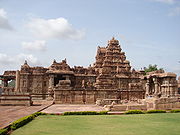
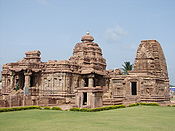
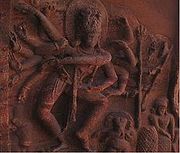
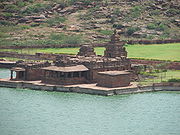
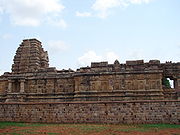 The Badami Chalukya era was an important period in the development of South Indian architecture. Their style of architecture is called "Chalukyan architecture" or "Karnata Dravida architecture". Nearly a hundred monuments built by them, rock cut (cave) and structural, are found in the Malaprabha river basin in modern Bagalkot district
of northern Karnataka. The building material they used was a reddish-golden Sandstone
found locally. Though they ruled a vast empire, the Chalukyan workshops concentrated most of their temple building activity in a relatively small area within the Chalukyan heartland – Aihole
, Badami, Pattadakal
and Mahakuta
in modern Karnataka state.
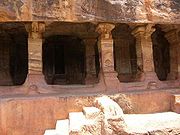
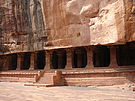
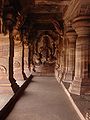
Their temple building activity can be categorised into three phases. The early phase began in the last quarter of the 6th century and resulted in many cave temples, prominent among which are three elementary cave temples at Aihole (one Vedic, one Jain and one Buddhist which is incomplete), followed by four developed cave temples at Badami (of which cave 3, a Vaishnava temple, is dated accurately to 578 CE). These cave temples at Badami are similar, in that, each has a plain exterior but an exceptionally well finished interior consisting of a pillared verandah
, a columned hall (mantapa) and a cella (shrine, cut deep into rock) which contains the deity of worship. In Badami, three caves temples are Vedic and one in Jain. The Vedic temples contain large well sculpted images of Harihara
, Mahishasuramardhini
, Varaha
, Narasimha
, Trivikrama, Vishnu
seated on Anantha (the snake) and Nataraja
(dancing Shiva
).
The second phase of temple building was at Aihole (where some seventy structures exist and has been called "one of the cradles of Indian temple architecture") and Badami. Though the exact dating of these temples has been debated, there is consensus that the beginnings of these constructions are from c. 600. These are the Lad Khan Temple (dated by some to c. 450 but more accurately to 620) with its interesting perforated stone windows and sculptures of river goddesses; the Meguti Jain Temple (634) which shows progress in structural design; the Durga Temple with its northern Indian style tower (8th century) and experiments to adapt a Buddhist Chaitya design to a brahminical one; the Huccimalli Gudi Temple with a new inclusion, a vestibule
, connecting the sanctum to the hall. Other dravida style temples from this period are the Naganatha Temple at Nagaral; the Banantigudi Temple, the Mahakutesvara Temple and the Mallikarjuna Temple at Mahakuta; and the Lower Sivalaya Temple, the Malegitti Sivalaya Temple (upper) and the Jambulingesvara Temple at Badami.
The structural temples at Pattadakal, built in the 8th century and now a UNESCO
World Heritage Site
, marks the culmination and mature phase of Badami Chalukyan architecture. The Bhutanatha group of temples at Badami are also from this period. There are ten temples at Pattadakal, six in southern dravida style and four in the northern nagara style. Well known among these are the Sangamesvara Temple (725), the Virupaksha Temple (740–745) and the Mallikarjuna Temple (740–745) in the southern style. The Papanatha temple (680) and Galaganatha Temple (740) are early attempts in the nagara – dravida fusion style. Inscriptional evidence suggests that the Virupaksha and the Mallikarjuna Temples were commissioned by the two queens of King Vikramaditya II after his military success over the Pallavas of Kanchipuram. Some well known names of Chalukyan architects are Revadi Ovajja, Narasobba and Anivarita Gunda
.
The reign of Western Chalukyas was an important period in the development of Deccan architecture. Their architecture served as a conceptual link between the Badami Chalukya architecture of the 8th century and the Hoysala architecture
popularised in the 13th century. The centre of their cultural and temple-building activity lay in the Tungabhadra region of modern Karnataka state, encompassing the present-day Dharwad district
; it included areas of present-day Haveri
and Gadag
districts. Here, large medieval workshops built numerous monuments. These monuments, regional variants of pre-existing dravida
temples, defined the Karnata dravida tradition.
The most notable of the many buildings dating from this period are the Mahadeva Temple
at Itagi in the Koppal district
, the Kasivisvesvara Temple at Lakkundi
in the Gadag district
, the Mallikarjuna Temple at Kuruvatti and the Kallesvara Temple at Bagali, both in the Davangere district. Other notable constructions are the Dodda Basappa Temple at Dambal
(Gadag district), the Siddhesvara Temple
at Haveri
(Haveri district
), and the Amrtesvara Temple at Annigeri (Dharwad district
). The Eastern Chalukyas built some fine temples at Alampur, in modern eastern Andhra Pradesh.
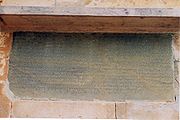 The Aihole inscription of Pulakesi II (634) written by his court poet Ravikirti in Sanskrit language and Kannada script is considered as an excellent piece of poetry. A few verses of a poetess named Vijayanaka who describes herself as the "dark Sarasvati" have been preserved. It is possible that she may have been a queen of prince Chandraditya (a son of Pulakesi II). Famous writers in Sanskrit from the Western Chalukya period are Vijnaneshwara
who achieved fame by writing Mitakshara
, a book on Hindu law, and King Somesvara III, a noted scholar, who compiled an encyclopedia
of all arts and sciences called Manasollasa.
From the period of the Badami Chalukyas, references are made to the existence of Kannada literature, though not much has survived. Inscriptions however refer to Kannada as the "natural language". The Kappe Arabhatta
record of c. 700 in tripadi
(three line) metre is the earliest available work in Kannada poetics. Karnateshwara Katha, which was quoted later by Jayakirti, is believed to be a eulogy of Pulakesi II and to have belonged to this period. Other probable Kannada writers, whose works are not extant now but titles of which are known from independent references are Syamakundacharya (650), who is said to have authored the Prabhrita, and Srivaradhadeva (also called Tumubuluracharya, 650 or earlier), the possible author of the Chudamani ("Crest Jewel"), a lengthy commentary on logic
.
The rule of the Western and Eastern Chalukyas, however, is a major event in the history of Kannada and Telugu literatures respectively. By the 9th–10th centuries, Kannada language had already seen some of its most notable writers. The "three gems" of Kannada literature
, Adikavi Pampa
, Sri Ponna
and Ranna
belonged to this period. In the 11th century, Telugu literature
was born under the patronage of the Eastern Chalukyas with Nannaya Bhatta as its first writer.
 The army was well organised and this was the reason for Pulakesi II's success beyond the Vindyas. It consisted of an infantry, a cavalry, an elephant corps and a powerful navy. The Chinese traveller Hiuen-Tsiang wrote that the Chalukyan army had hundreds of elephants which were intoxicated with liquor prior to battle. It was with their navy that they conquered Revatidvipa (Goa
), and Puri
on east coast of India. Rashtrakuta inscriptions use the term Karnatabala when referring to the powerful Chalukya armies.
Land governance
The government, at higher levels, was closely modelled after the Magadha
n and Satavahana
administrative machinery. The empire was divided into Maharashtrakas (provinces), then into smaller Rashtrakas (Mandala), Vishaya (district), Bhoga (group of 10 villages) which is similar to the Dasagrama unit used by the Kadambas
. At the lower levels of administration, the Kadamba style prevailed fully. The Sanjan plates of Vikramaditya I even mentions a land unit called Dasagrama. In addition to imperial provinces, there were autonomous regions ruled by feudatories such as the Alupas, the Gangas, the Banas
and the Sendrakas. Local assemblies and guilds looked after local issues. Groups of mahajan
as (learned brahmin
s) looked after agraharas (called ghatika or "place of higher learning") such as at Badami which was served by 2000 mahajans and Aihole which was served by 500 mahajanas. Taxes were levied and were called the herjunka – tax on loads, the kirukula – tax on retail goods in transit, the bilkode – sales tax, the pannaya – betel tax, siddaya – land tax and the vaddaravula – tax levied to support royalty.
Coinage
 The Badami Chalukyas minted coins that were of a different standard compared to the coins of the northern kingdoms. The coins had Nagari
and Kannada legends. The coins of Mangalesa had the symbol of a temple on the obverse and a 'sceptre between lamps' or a temple on the reverse. Pulakesi II's coins had a caparisoned lion facing right on the obverse and a temple on the reverse. The coins weighed 4 grams and were called, in old-Kannada, hun (or honnu) and had fractions such as fana (or fanam) and the quarter fana (the modern day Kannada equivalent being hana – which literally means "money"). A gold coin called gadyana is mentioned in a record at the Vijayeshwara Temple at Pattadakal
, which later came to be known as varaha (their royal emblem).
Religion
 Both Shaivism
and Vaishnavism
flourished during the Badami Chalukya period, though it seems the former was more popular. Famous temples were built in places such as Pattadakal, Aihole and Mahakuta, and priests (archakas) were imported from northern India. Vedic sacrifices, religious vows (vrata) and the giving of gifts (dana) was important. The Badami kings were initially followers of Vedic
Hindusim and dedicated temples to popular Hindu deities in Aihole. Sculptures of deities testify to the popularity of Hindu Gods such as Vishnu
, Shiva
, Kartikeya, Ganapathi, Shakti
, Surya
and Sapta Matrikas
("seven mothers"). The Badami kings also performed the Ashwamedha ("horse sacrifice"). The worship of Lajja Gauri
, a fertility goddess
is known. Jainism
too was a prominent religion during this period. Few of the chalukya kings were jains. The kings of the dynasty were however secular and actively encouraged Jainism
. One of the Badami Cave temples is dedicated to the Jain faith. Jain temples were also erected in the Aihole complex, the temple at Maguti being one such example. Ravikirti, the court poet of Pulakesi II was a Jain. Queen Vinayavati consecrated a temple for the Trimurti
("Hindu trinity") at Badami. Sculptures of the Trimurti, Harihara
(half Vishnu, half Shiva) and Ardhanarishwara (half Shiva, half woman) provide ample evidence of their tolerance. Buddhism was on a decline, having made its ingress into Southeast Asia. This is confirmed by the writings of Hiuen-Tsiang. Badami, Aihole, Kurtukoti and Puligere (modern Lakshmeshwar
in the Gadag district
) were primary places of learning.
Society
 The Hindu caste system was present and prostitution was recognised by the government. Some kings had concubines (ganikas) who were given much respect, and Sati
was perhaps absent since widows like Vinayavathi and Vijayanka are mentioned in records. Devadasi
s were however present in temples. Sage Bharata
's Natyashastra, the precursor to Bharatanatyam
, the classical dance of South India, was popular and is seen in many sculptures and is mentioned in inscriptions. Some women from the royal family enjoyed political power in administration. Queen Vijayanka was a noted Sanskrit poetess, Kumkumadevi, the younger sister of Vijayaditya (and queen of Alupa King Chitravahana) made several grants and had a Jain basadi
called Anesajjebasadi constructed at Puligere, and the queens of Vikramaditya II, Lokamahadevi and Trailokyamahadevi made grants and possibly consecrated the Lokesvara Temple (now called Virupaksha temple) and the Mallikarjuna temple respectively at Pattadakal.
maintain these influences even today. This influence helped to enrich literature in these languages. The Hindu legal system owes much to the Sanskrit work Mitakshara by Vijnaneshwara in the court of Western Chalukya King Vikramaditya VI. Perhaps the greatest work in legal literature, Mitakshara is a commentary on Yajnavalkya and is a treatise on law based on earlier writings and has found acceptance in most parts of India. Englishman Henry Thomas Colebrooke
later translated into English the section on inheritance, giving it currency in the British Indian court system. It was during the Western Chalukya rule that the Bhakti
movement gained momentum in South India, in the form of Ramanujacharya and Basavanna, later spreading into northern India.
A celebration called Chalukya utsava, a three-day festival of music and dance, organised by the Government of Karnataka
, is held every year at Pattadakal, Badami and Aihole. The event is a celebration of the achievements of the Chalukyas in the realm of art, craft, music and dance. The program, which starts at Pattadakal and ends in Aihole, is inaugurated by the Chief Minister of Karnataka. Singers, dancers, poets and other artists from all over the country take part in this event. In the 2006 celebration, 400 art troupes took part in the festivities. Colorful cut outs of the Varaha
the Chalukya emblem, Satyasraya Pulakesi (Pulakesi II), famous sculptural masterpieces such as Durga
, Mahishasuramardhini
(Durga killing demon Mahishasura
) were present everywhere. The program at Pattadakal is named Anivaritacharigund vedike after the famous architect of the Virupaksha temple, Gundan Anivaritachari
. At Badami it is called Chalukya Vijayambika Vedike and at Aihole, Ravikirti Vedike after the famous poet and minister (Ravikirti) in the court of Pulakesi II. Immadi Pulakeshi, a Kannada movie of the 1960s starring Dr. Rajkumar
celebrates the life and times of the great king.
India
India , officially the Republic of India , is a country in South Asia. It is the seventh-largest country by geographical area, the second-most populous country with over 1.2 billion people, and the most populous democracy in the world...
n royal dynasty that ruled large parts of southern
South India
South India is the area encompassing India's states of Andhra Pradesh, Karnataka, Kerala and Tamil Nadu as well as the union territories of Lakshadweep and Pondicherry, occupying 19.31% of India's area...
and central India between the 6th and the 12th centuries. During this period, they ruled as three related yet individual dynasties. The earliest dynasty, known as the "Badami Chalukyas", ruled from Vatapi (modern Badami
Badami
Badami , formerly known as Vatapi, is a town and headquarters of a taluk by the same name, in the Bagalkot district of Karnataka, India. It was the regal capital of the Badami Chalukyas from 540 to 757 AD. It is famous for rock cut and other structural temples...
) from the middle of the 6th century. The Badami Chalukyas began to assert their independence at the decline of the Kadamba kingdom of Banavasi
Banavasi
Banavasi is an ancient temple town in Uttara Kannada District bordering Shivamogga district in the South Indian state of Karnataka .-History:Banavasi is one of the oldest towns in the Karnataka state...
and rapidly rose to prominence during the reign of Pulakesi II. After the death of Pulakesi II, the Eastern Chalukyas
Eastern Chalukyas
Eastern Chalukyas were a South Indian dynasty whose kingdom was located in the present day Andhra Pradesh. Their capital was Vengi and their dynasty lasted for around 500 years from the 7th century until c. 1130 C.E. when the Vengi kingdom merged with the Chola empire...
became an independent kingdom in the eastern Deccan. They ruled from Vengi
Vengi
The Vengi kingdom extended from the Godavari River in the north to Mount Mahendragiri in the southeast and to just south of the banks of River Krishna in the south of India. This area was part of Kalinga until that kingdom was conquered by Emperor Ashoka of the Mauryan Empire in the mid 3rd century...
until about the 11th century. In the western Deccan, the rise of the Rashtrakutas in the middle of the 8th century eclipsed the Chalukyas of Badami before being revived by their descendants, the Western Chalukyas
Western Chalukyas
The Western Chalukya Empire ruled most of the western Deccan, South India, between the 10th and 12th centuries. This dynasty is sometimes called the Kalyani Chalukya after its regal capital at Kalyani, today's Basavakalyan in Karnataka and alternatively the Later Chalukya from its theoretical...
, in the late 10th century. These Western Chalukyas ruled from Kalyani (modern Basavakalyan
Basavakalyan
Basavakalyan is a town in Bidar District of the state of Karnataka, India, and was historically known as Kalyan.-History:Basavakalyan's history dates back to 3000 years with its name being mentioned in Guru Charitra....
) until the end of the 12th century.
The rule of the Chalukyas marks an important milestone in the history of South India
South India
South India is the area encompassing India's states of Andhra Pradesh, Karnataka, Kerala and Tamil Nadu as well as the union territories of Lakshadweep and Pondicherry, occupying 19.31% of India's area...
and a golden age in the history of Karnataka
Karnataka
Karnataka , the land of the Kannadigas, is a state in South West India. It was created on 1 November 1956, with the passing of the States Reorganisation Act and this day is annually celebrated as Karnataka Rajyotsava...
. The political atmosphere in South India shifted from smaller kingdoms to large empires with the ascendancy of Badami Chalukyas. For the first time, a South Indian kingdom took control and consolidated the entire region between the Kaveri and the Narmada
Narmada River
The Narmada , also called Rewa is a river in central India and the fifth largest river in the Indian subcontinent. It is the third largest river that completely flows within India after Ganges and Godavari...
rivers. The rise of this empire saw the birth of efficient administration, overseas trade and commerce and the development of new style of architecture called "Chalukyan architecture". Kannada literature
Kannada literature
Kannada literature is the corpus of written forms of the Kannada language, a member of the Dravidian family spoken mainly in the Indian state of Karnataka and written in the Kannada script....
, which had enjoyed royal support in the 9th century Rashtrakuta court found eager patronage from the Western Chalukyas in the Jain and Veerashaiva traditions. The 11th century saw the birth of Telugu literature
Telugu literature
The Telugu literature or Telugu Sahityam is one of the most precious possessions of the literary products of India. Telugu literature is rich reserve of poems, stories, dramas and puranas. It flowered in the early 16th century under the Vijayanagar empire, of which Telugu was one of the court...
under the patronage of the Eastern .
Natives of Karnataka
Karnataka
Karnataka , the land of the Kannadigas, is a state in South West India. It was created on 1 November 1956, with the passing of the States Reorganisation Act and this day is annually celebrated as Karnataka Rajyotsava...
region. According to one theory, the Chalukya were descendants of the "Seleukia" tribe of Iraq
Iraq
Iraq ; officially the Republic of Iraq is a country in Western Asia spanning most of the northwestern end of the Zagros mountain range, the eastern part of the Syrian Desert and the northern part of the Arabian Desert....
and that their conflict with the Pallava
Pallava
The Pallava dynasty was a Tamil dynasty which ruled the northern Tamil Nadu region and the southern Andhra Pradesh region with their capital at Kanchipuram...
of Kanchi was, but a continuation of the conflict between ancient Seleukia and "Parthians", the proposed ancestors of Pallavas. However, this theory has been rejected as it seeks to build lineages based simply on similar sounding clan names.
Another theory, that they were descendants of a 2nd century chieftain called Kandachaliki Remmanaka, a feudatory of the Andhra Ikshvaku
Andhra Ikshvaku
The Andhra Ikshvakus were one of the earliest recorded ruling dynasties of Andhra Pradesh and are said to have been the first Kshatriya rulers in the Andhra region. They ruled the eastern Andhra country along the Krishna river during the later half of the 2nd century CE. . Their capital was...
(from an Ikshvaku inscription of 2nd century) was put forward. But this has failed to explain the difference in lineage. The Kandachaliki feudatory call themselves Vashisthiputras of the Hiranyakagotra. The Chalukyas, however, address themselves as Harithiputras of Manavyasagotra in their inscriptions, which is the same lineage as their early overlords, the Kadambas of Banavasi. This makes them descendants of the Kadambas. The Chalukyas took control of the territory formerly ruled by the Kadambas
Kadambas
The Kadamba Dynasty was an ancient royal family of Karnataka that ruled from Banavasi in present day Uttara Kannada district. The dynasty later continued to rule as a feudatory of larger Kannada empires, the Chalukya and the Rashtrakuta empires for over five hundred years during which time they...
.
A later record of Eastern Chalukyas mentions the northern origin theory and claims one ruler of Ayodhya came south, defeated the Pallavas and married a Pallava princess. She had a child called Vijayaditya who is claimed to be the Pulakesi I's father. However, there are Badami Chalukya inscriptions that confirm Jayasimha was Pulakesi I's grandfather and Ranaranga, his father. It was a popular practice in the 11th century to link South Indian royal family lineage to a Northern kingdom. The Badami Chalukya records themselves are silent with regards to the Ayodhya origin.
While the northern origin theory has been dismissed by many historians, it is suggested that a southern migration is a distinct possibility which needs examination. The complete absence of any inscriptional reference of their family connections to Ayodhya, and their subsequent Kannadiga identity may have been due to their earlier migration into present day Karnataka region where they achieved success as chieftains and kings. Hence, the place of origin of their ancestors may have been of no significance to the kings of the empire who may have considered themselves natives of the Kannada speaking region. There is controversy even regarding the caste to which the Badami Chalukyas belonged. The writing of 12th century Kashmiri
Kashmiri people
The Kashmiri people are a Dardic linguistic group living in Kashmir Valley in Indian state of Jammu and Kashmir and parts of the Pakistani territory of Azad Kashmir who speak the Kashmiri language...
poet Bilhana
Bilhana
Bilhana Kavi was an 11th-century Kashmiri poet. He is known for his love poem, the Caurapâñcâśikâ.According to legend, the Brahman Bilhana fell in love with the daughter of King Madanabhirama, Princess Yaminipurnatilaka, and had a secretive love affair. They were discovered, and Bilhana was thrown...
suggests the Chalukya family belonged to the Shudra
Shudra
Shudra is the fourth Varna, as prescribed in the Purusha Sukta of the Rig veda, which constitutes society into four varnas or Chaturvarna. The other three varnas are Brahmans - priests, Kshatriya - those with governing functions, Vaishya - agriculturalists, cattle rearers and traders...
caste while other sources claim they were Kshatriya
Kshatriya
*For the Bollywood film of the same name see Kshatriya Kshatriya or Kashtriya, meaning warrior, is one of the four varnas in Hinduism...
s.
The Badami Chalukya inscriptions are in Kannada and Sanskrit
Sanskrit
Sanskrit , is a historical Indo-Aryan language and the primary liturgical language of Hinduism, Jainism and Buddhism.Buddhism: besides Pali, see Buddhist Hybrid Sanskrit Today, it is listed as one of the 22 scheduled languages of India and is an official language of the state of Uttarakhand...
. Their inscriptions call them Karnatas and their names use indigenous Kannada titles such as Priyagallam and Noduttagelvom. The names of some Chalukya princes end with the pure Kannada term arasa (meaning "king" or "chief"). The Rashtrakuta
Rashtrakuta
The Rashtrakuta Empire was a royal dynasty ruling large parts of the Indian Subcontinent between the sixth and the 10th centuries. During this period they ruled as several closely related, but individual clans. Rastrakutas in inscriptions represented as descendants of Satyaki, a Yadava well known...
inscriptions call the Chalukyas of Badami Karnatabala ("Power of Karnata"). It has been proposed that the word "Chalukya" originated from Salki or Chalki which is a Kannada word for an agricultural implement.
Gurjaras and Chalukyas
Historians such as D R Bhandarkar, HoernleAugustus Hoernle
Dr. Augustus Rudolf Hoernle was an English Orientalist. He was born in India, the son of an Anglican priest. He attended school in Switzerland, later moving to London and studying Sanskrit under Goldstucker. He returned to India in 1865, teaching first at the Benares Hindu University and later at...
hold the view that Chalukyas were one of the ruling clan of Gurjaras (or Gujjars). Bhandarkar put the point that Gujarat was known as Lata prior to it came to known as Gurjaratra at the time of chalukyas.If the chalukyas had not been Gurjars, it is inconceivable how that province could have named Gurjaratra (country ruled or protected by Gurjars) when it was up-till their advent known as Lata.However scholars such as D. P. Dikshit argues that Chalukyas ruled over that part of country formerly known as Lata and taken as Gurjaratra or Gujarat didn't imply the Chalukyas didn't make any change in the nomenclature because of their close association with the region.
Dr.V. A. Smith
Vincent Arthur Smith
Vincent Arthur Smith was born in 1843 in Dublin which was then part of the United Kingdom of Great Britain and Ireland. He was an Indologist, historian and art historian who worked in the Indian Civil Service and retired early to devote himself to his writing.His Oxford History of India, covering...
and A. M. T. Jackson also endorsed the view that Chalukyas were branch of famous Gurjaras(or Gujjars).
Historical sources
Inscriptions are the main source of information about the Badami Chalukya history. Among them, the BadamiBadami
Badami , formerly known as Vatapi, is a town and headquarters of a taluk by the same name, in the Bagalkot district of Karnataka, India. It was the regal capital of the Badami Chalukyas from 540 to 757 AD. It is famous for rock cut and other structural temples...
cave inscriptions of Mangalesa (578), Kappe Arabhatta
Kappe Arabhatta
Kappe Arabhatta was a Chalukya warrior of the 8th century who is known from a Kannada verse inscription, dated to c. 700 CE, and carved on a cliff overlooking the northeast end of the artificial lake in Badami, Karnataka, India. The inscription consists of five stanzas written out in ten lines in...
record of c. 700, Peddavaduguru inscription of Pulakesi II, the Kanchi Kailasanatha Temple inscription and Pattadakal
Pattadakal
Pattadakal is a village in Karnataka. It lies on the banks of the Malaprabha River in Bagalkot district. It is 22 km from Badami and about 10 km from Aihole...
Virupaksha Temple inscription of Vikramaditya II (all in Kannada language) provide more evidence of the Chalukya language. The Badami cliff inscription of Pulakesi I (543), the Mahakuta Pillar
Mahakuta Pillar
Mahakuta Pillar in the town of Mahakuta in present day Bagalkot district of India's Karnataka state is the source of an important Badami Chalukya inscription called Mahakuta pillar inscription ascribed to king Mangalesa, second son of Pulakesi I. It is made of fine grained sandstone...
inscription of Mangalesa
Mangalesa
Mangalesa succeeded Kirtivarman I to the Chalukya throne. He ruled as regent as the heir to the throne Pulakesi II was considered too young to rule.-Capable warrior:An energetic and ambitious ruler, Mangalesa won several laurels in war...
(595) and the Aihole
Aihole
Aihole is a temple complex in the Bagalkot district of Karnataka, India. It is a very popular tourist spot in north Karnataka. It lies to the east of Pattadakal, along the Malaprabha River, while Badami is to the west of both....
inscription of Pulakesi II (634) are examples of important Sanskrit inscriptions written in old Kannada script
Kannada script
The Kannada script is an alphasyllabary of the Brahmic family, used primarily to write the Kannada language, one of the Dravidian languages of southern India and also Sanskrit in the past. The Telugu script is derived from Old Kannada, and resembles Kannada script...
.
The reign of the Chalukyas saw the arrival of Kannada as the predominant language of inscriptions along with Sanskrit, in areas of the Indian peninsula outside what is known as Tamilaham
Ancient Tamil country
The Sangam period is the classical period in the history of Tamil Nadu, Kerala and other parts of South India, spanning about the 3rd century BCE to the 3rd century CE...
(Tamil country). Several coins of the Badami Chalukyas with Kannada legends have been found. All this indicates that Kannada language flourished during this period.
Aihole
Aihole is a temple complex in the Bagalkot district of Karnataka, India. It is a very popular tourist spot in north Karnataka. It lies to the east of Pattadakal, along the Malaprabha River, while Badami is to the west of both....
record, Pulakesi II had divided his empire into three Maharashtrakas or great provinces comprising 99,000 villages each. This empire possibly covered present day Karnataka
Karnataka
Karnataka , the land of the Kannadigas, is a state in South West India. It was created on 1 November 1956, with the passing of the States Reorganisation Act and this day is annually celebrated as Karnataka Rajyotsava...
, Maharashtra
Maharashtra
Maharashtra is a state located in India. It is the second most populous after Uttar Pradesh and third largest state by area in India...
and coastal Konkan
Konkan
The Konkan also called the Konkan Coast or Karavali is a rugged section of the western coastline of India from Raigad to Mangalore...
. Hsüan-tsang, impressed with the governance of the empire observed that the benefits of king's efficient administration was felt far and wide. Later, Persian emperor Khosrau II exchanged ambassadors with Pulakesi II.
Legends
Court poets of the Western Chalukya dynasty of Kalyani narrate:- "Once when Brahma, the creator, was engaged in the performance of the sandhya (twilight) rituals, Indra approaced and beseeched him to create a hero who could put to an end the increasing evil on earth. On being thus requested, Brahma looked steadily into the Chuluka-jala (the water of oblation in his palm) and out sprang thence a great warrior, the progenitor of the Chalukyas". The Chalukyas claimed to have been nursed by the Sapta Matrikas ("seven divine mothers") and were worshippers of many gods including Siva, Vishnu, Chamundi, Surya, Kubera, Parvati, Vinayaka and Kartikeya.
Some scholar connect the Chalukyas with the Solanki
Solanki
The Solanki was a royal Hindu Indian dynasty that ruled parts of western and central India between the 10th to 13th centuries. A number of scholars including V. A. Smith assign them Gurjar origin....
s of Gujarat. According to a myth mentioned in latter manuscripts of Prithviraj Raso
Prithviraj Raso
The Prithviraj Raso or Prithvirajaraso is an epic poem composed by court poet, Chand Bardai, on the life of Prithviraj III, a Chauhan king who ruled Ajmer and Delhi between 1165 and 1192.Chand Bardai claimed to be contemporary of Prithviraj Chauhan.The historicity of Prithviraj Raso was proved...
, Solanki
Solanki
The Solanki was a royal Hindu Indian dynasty that ruled parts of western and central India between the 10th to 13th centuries. A number of scholars including V. A. Smith assign them Gurjar origin....
s were born out of fire-pit (Agnikund) at Mount Abu. However it has been reported that the story of Agnikula
Agnivansha
In Indian mythology and culture, the Agnivanshi are people descended from Agni, the Vedic god of fire. The Agnivanshi lineage or Agnivansha is one of the three lineages into which the Kshatriya caste of Hindus is divided, the other two races being the Suryavanshi and the Chandravanshi .-The...
is mot mentioned at all in the original version of the Prithviraj Raso
Prithviraj Raso
The Prithviraj Raso or Prithvirajaraso is an epic poem composed by court poet, Chand Bardai, on the life of Prithviraj III, a Chauhan king who ruled Ajmer and Delhi between 1165 and 1192.Chand Bardai claimed to be contemporary of Prithviraj Chauhan.The historicity of Prithviraj Raso was proved...
preserved in the Fort Library at Bikaner.
According to the Nilagunda inscription of King Vikramaditya VI (11th century or later), the Chalukyas originally hailed from Ayodhya where fifty-nine kings ruled, and later, sixteen more of this family ruled from South India where they had migrated. This is repeated by his court poet Bilhana, who claims that the first member of the family, "Chalukya", was so named as he was born in the "hollow of the hands" of God Brahma
Brahma
Brahma is the Hindu god of creation and one of the Trimurti, the others being Vishnu and Shiva. According to the Brahma Purana, he is the father of Mānu, and from Mānu all human beings are descended. In the Ramayana and the...
.
In these circumstances, says prof. R. Sathianathaier, it is best to take the Chalukyas as allied to the Gurjaras.
Periods in Chalukya history
The Chalukyas ruled over the Deccan plateau in India for over 600 years. During this period, they ruled as three closely related, but individual dynasties. These are the "Chalukyas of Badami" (also called "Early Chalukyas"), who ruled between the 6th and the 8th century, and the two sibling dynasties, the "Chalukyas of Kalyani" (also called Western ChalukyasWestern Chalukyas
The Western Chalukya Empire ruled most of the western Deccan, South India, between the 10th and 12th centuries. This dynasty is sometimes called the Kalyani Chalukya after its regal capital at Kalyani, today's Basavakalyan in Karnataka and alternatively the Later Chalukya from its theoretical...
or "Later Chalukyas") and the "Chalukyas of Vengi" (also called Eastern Chalukyas
Eastern Chalukyas
Eastern Chalukyas were a South Indian dynasty whose kingdom was located in the present day Andhra Pradesh. Their capital was Vengi and their dynasty lasted for around 500 years from the 7th century until c. 1130 C.E. when the Vengi kingdom merged with the Chola empire...
).
Chalukyas of Badami
In the 6th century, with the decline of the Gupta dynastyGupta Empire
The Gupta Empire was an ancient Indian empire which existed approximately from 320 to 550 CE and covered much of the Indian Subcontinent. Founded by Maharaja Sri-Gupta, the dynasty was the model of a classical civilization. The peace and prosperity created under leadership of Guptas enabled the...
and their immediate successors in northern India, major changes began to happen in the area south of the Vindyas – the Deccan and Tamilaham
Ancient Tamil country
The Sangam period is the classical period in the history of Tamil Nadu, Kerala and other parts of South India, spanning about the 3rd century BCE to the 3rd century CE...
. The age of small kingdoms had given way to large empires in this region. The Chalukya dynasty was established by Pulakesi I in 543. Pulakesi I took Vatapi (modern Badami
Badami
Badami , formerly known as Vatapi, is a town and headquarters of a taluk by the same name, in the Bagalkot district of Karnataka, India. It was the regal capital of the Badami Chalukyas from 540 to 757 AD. It is famous for rock cut and other structural temples...
in Bagalkot
Bagalkot
Bagalkot or Bagalkote is a town in the Indian state of Karnataka. Bagalkot is the district headquarters of the Bagalkot district. It is one of the major towns in North Karnataka.-History:...
district, Karnataka
Karnataka
Karnataka , the land of the Kannadigas, is a state in South West India. It was created on 1 November 1956, with the passing of the States Reorganisation Act and this day is annually celebrated as Karnataka Rajyotsava...
) under his control and made it his capital. Pulakesi I and his descendants are referred to as "Chalukyas of Badami". They ruled over an empire that comprised the entire state of Karnataka and most of Andhra Pradesh
Andhra Pradesh
Andhra Pradesh , is one of the 28 states of India, situated on the southeastern coast of India. It is India's fourth largest state by area and fifth largest by population. Its capital and largest city by population is Hyderabad.The total GDP of Andhra Pradesh is $100 billion and is ranked third...
in the Deccan.
Pulakesi II, whose precoronation name was Ereya, commanded control over the entire Deccan and is perhaps the most well-known emperor of the Badami dynasty. He is considered one of the notable kings in Indian history. His queens were princess from the Alupa Dynasty
Alupas
The Alupas kings were a minor dynasty who ruled parts of coastal Karnataka. Later with the dominance of Kadambas in Banavasi, they became feudatory to them. With the changing political scenario, soon they became the feudatories to Chalukyas, Hoysalas and Vijayanagara Rayas...
of South Canara
South Canara
South Canara was a district under the British empire, located at . It was bifurcated in 1859 from Canara district. It was the undivided Dakshina Kannada district...
and the Western Ganga Dynasty of Talakad
Talakad
Talakad is a desert-like town on the left bank of the Kaveri river at a spot where the river makes a sharp bend. It is 45 km from Mysore and 133 km from Bangalore in Karnataka, India. A historic site, Talakad once had over 30 temples that today are buried in sand. Now it is a scenic...
, clans with whom the Chalukyas maintained close family and marital relationships. Pulakesi II extended the Chalukya Empire up to the northern extents of the Pallava
Pallava
The Pallava dynasty was a Tamil dynasty which ruled the northern Tamil Nadu region and the southern Andhra Pradesh region with their capital at Kanchipuram...
kingdom and halted the southward march of Harsha
Harsha
Harsha or Harsha Vardhana or Harshvardhan was an Indian emperor who ruled northern India from 606 to 647 AD. He was the son of Prabhakara Vardhana and younger brother of Rajya Vardhana, a king of Thanesar, Haryana...
by defeating him on the banks of the river Narmada
Narmada River
The Narmada , also called Rewa is a river in central India and the fifth largest river in the Indian subcontinent. It is the third largest river that completely flows within India after Ganges and Godavari...
. He then defeated the Vishnukundins in the southeastern Deccan. Pallava Narasimhavarman however reversed this victory in 642 by attacking and occupying Badami temporarily. It is presumed Pulakesi II, "the great hero", died fighting.
The Badami Chalukya dynasty went in to a brief decline following the death of Pulakesi II due to internal feuds when Badami was occupied by the Pallavas for a period of thirteen years. It recovered during the reign of Vikramaditya I, who succeeded in pushing the Pallavas out of Badami and restoring order to the empire. Vikramaditya I took the title "Rajamalla" (lit "Sovereign of the Mallas" or Pallavas). The thirty-seven year rule of Vijayaditya
Vijayaditya
Vijayaditya followed his father, Vikramaditya I on to the Chalukya throne. His long reign was marked by general peace and prosperity. Vijayaditya also built a number of temples....
was a prosperous one and is known for prolific temple building activity.
The empire was its peak again during the rule of the illustrious Vikramaditya II who is known not only for his repeated invasions of the territory of Tondaimandalam and his subsequent victories over Pallava Nandivarman II, but also for his benevolence towards the people and the monuments of Kanchipuram, the Pallava capital. He thus avenged the earlier humiliation of the Chalukyas by the Pallavas and engraved a Kannada inscription on the victory pillar at the Kailasanatha Temple. He later overran the other traditional kingdoms of Tamil country, the Pandyas, the Cholas and the Chera
Chera
-Dynasties:Chera dynasty refers to three related dynasties of Southern India:* Early Chera dynasty, the ancient Sangam Tamil dynasty which ruled from Vanchi Muthur, India...
s in addition to subduing a Kalabhra ruler. The last Chalukya king, Kirtivarman II, was overthrown by the Rashtrakuta
Rashtrakuta
The Rashtrakuta Empire was a royal dynasty ruling large parts of the Indian Subcontinent between the sixth and the 10th centuries. During this period they ruled as several closely related, but individual clans. Rastrakutas in inscriptions represented as descendants of Satyaki, a Yadava well known...
King Dantidurga
Dantidurga
Dantidurga , also known as Dantivarman or Dantidurga II was the founder of the Rashtrakuta Empire of Manyakheta. His capital was based in Gulbarga region of Karnataka...
in 753. At their peak, the Chalukyas ruled a vast empire stretching from the Kaveri in the south to the Narmada
Narmada River
The Narmada , also called Rewa is a river in central India and the fifth largest river in the Indian subcontinent. It is the third largest river that completely flows within India after Ganges and Godavari...
in the north.
Chalukyas of Kalyani
The Chalukyas revived their fortunes in 973 after over 200 years of dormancy when much of the Deccan was under the Rashtrakutas. The genealogy of the kings of this empire is still debated. One theory, based on contemporary literary and inscriptional evidence plus the finding that the Western Chalukyas employed titles and names commonly used by the early Chalukyas, suggests that the Western Chalukya kings belonged to the same family line as the illustrious Badami Chalukya dynasty of the 6th century while other Western Chalukya inscriptional evidence indicates they were a distinct line unrelated to the Early Chalukyas.Tailapa II
Tailapa II
Tailapa II had titles Nurmadi Taliapa and Satyashraya Kulatilaka. He re-established the Western Chalukya dynasty after a period of 220 years during which time they had been in eclipse. The revived Chalukya kingdom rose to its height of power under Vikramaditya VI. The revived dynasty came to be...
, a Rashtrakuta feudatory ruling from Tardavadi – 1000 (Bijapur district) overthrew Karka II, re-established the Chalukya rule in the western Deccan and recovered most of the Chalukya empire. The Western Chalukyas ruled for over 200 years and were in constant conflict with the Cholas, and with their cousins, the Eastern Chalukyas
Eastern Chalukyas
Eastern Chalukyas were a South Indian dynasty whose kingdom was located in the present day Andhra Pradesh. Their capital was Vengi and their dynasty lasted for around 500 years from the 7th century until c. 1130 C.E. when the Vengi kingdom merged with the Chola empire...
of Vengi. Vikramaditya VI is widely considered the most notable ruler of the dynasty. Starting from the very beginning of his reign, which lasted fifty years, he abolished the original Saka era and established the Vikrama Era. Most subsequent Chalukya inscriptions are dated in this new era. Vikramaditya VI was an ambitious and skilled military leader. Under his leadership the Western Chalukyas were able to end the Chola influence over Vengi (coastal Andhra) and become the dominant power in the Deccan. The Western Chalukya period was an important age in the development of Kannada literature
Kannada literature
Kannada literature is the corpus of written forms of the Kannada language, a member of the Dravidian family spoken mainly in the Indian state of Karnataka and written in the Kannada script....
and Sanskrit literature
Sanskrit literature
Literature in Sanskrit begins with the Vedas, and continues with the Sanskrit Epics of Iron Age India; the golden age of Classical Sanskrit literature dates to late Antiquity . Literary production saw a late bloom in the 11th century before declining after 1100 AD...
. They went into their final dissolution towards the end of the 12th century with the rise of the Hoysala Empire
Hoysala Empire
The Hoysala Empire was a prominent South Indian Kannadiga empire that ruled most of the modern day state of Karnataka between the 10th and the 14th centuries. The capital of the Hoysalas was initially located at Belur but was later moved to Halebidu....
, the Pandyas, the Kakatiya and the Seuna Yadavas of Devagiri.
Chalukyas of Vengi
Pulakesi II conquered the eastern Deccan, corresponding to the coastal districts of modern Andhra PradeshAndhra Pradesh
Andhra Pradesh , is one of the 28 states of India, situated on the southeastern coast of India. It is India's fourth largest state by area and fifth largest by population. Its capital and largest city by population is Hyderabad.The total GDP of Andhra Pradesh is $100 billion and is ranked third...
in 616, defeating the remnants of the Vishnukundina
Vishnukundina
The Vishnukundina Empire was an Indian imperial power controlling the Deccan, Orissa and parts of South India during the 5th and 6th centuries, carving land out from the Vakataka Empire. It played an important role in the history of the Deccan during the 5th and 6th centuries CE...
kingdom. He appointed his brother Kubja Vishnuvardhana
Kubja Vishnuvardhana
Kubja Vishnuvardhana was the brother of Chalukya Pulakesi II. Vishnuvardhana ruled the Vengi territories in the eastern Andhra Pradesh as the viceroy under Pulakesi II from around 615 CE. Eventually Vishnuvardhana declared his independence and started the Eastern Chalukya dynasty Kubja...
as Viceroy in 621. Thus the Eastern Chalukyas were originally of Kannada stock. After the death of Pulakesi II, the Vengi Viceroyalty developed into an independent kingdom and included the region between Nellore
Nellore
Nellore , is a city and headquarters of Potti Sri Ramulu Nellore District, formerly Nellore district.And in the state of Andhra Pradesh. Ancient name of Nellore was "Vikrama Simhapuri"....
and Vishakapatnam.
After the decline of the Badami Chalukya empire in the mid-8th century, territorial disputes flared up between the Rashtrakutas, the new rulers of the western deccan, and the Eastern Chalukyas. For much of the next two centuries, the Eastern Chalukyas had to accept subordination towards the Rashtrakutas. Apart from a rare military success, such as the one by Vijayaditya II, it was only during the rule of Bhima I (892) that these Chalukyas were able to celebrate a measure of independence. After the death of Bhima I, the Andhra region once again saw succession disputes and interference in Vengi affairs by the Rashtrakutas.
The fortunes of the Eastern Chalukyas took a turn around 1000. Danarnava, their king, was killed in battle in 973 by the Telugu Choda King Bhima who then imposed his rule over the region for twenty-seven years. During this time, Danarnava's two sons took refuge in the Chola kingdom. Choda Bhima 's invasion of Tondaimandalam, a Chola territory, and his subsequent death on the battlefield opened up a new era in Chola–Chalukya relations. Saktivarman I, the elder son of Danarnava was crowned as the ruler of Vengi in 1000, though under the control of king Rajaraja Chola I. This new relationship between the Cholas and the coastal Andhra kingdom was unacceptable to the Western Chalukyas, who had by then replaced the Rashtrakutas as the main power in the western Deccan. The Western Chalukyas sought to brook the growing Chola influence in the Vengi region but were unsuccessful.
Initially, the Eastern Chalukyas had encouraged Kannada language and literature, though, after a period of time, local factors took over and they gave importance to Telugu language
Telugu language
Telugu is a Central Dravidian language primarily spoken in the state of Andhra Pradesh, India, where it is an official language. It is also spoken in the neighbouring states of Chattisgarh, Karnataka, Maharashtra, Orissa and Tamil Nadu...
. Telugu literature owes its growth to the Eastern Chalukyas.
Architecture
Bagalkot district
Bāgalkot district is an administrative district in the Indian state of Karnataka. The district headquarters is located in the town of Bagalkot. The district is located in northern Karnataka and borders Belgaum, Gadag, Koppal, Raichur and Bijapur...
of northern Karnataka. The building material they used was a reddish-golden Sandstone
Sandstone
Sandstone is a sedimentary rock composed mainly of sand-sized minerals or rock grains.Most sandstone is composed of quartz and/or feldspar because these are the most common minerals in the Earth's crust. Like sand, sandstone may be any colour, but the most common colours are tan, brown, yellow,...
found locally. Though they ruled a vast empire, the Chalukyan workshops concentrated most of their temple building activity in a relatively small area within the Chalukyan heartland – Aihole
Aihole
Aihole is a temple complex in the Bagalkot district of Karnataka, India. It is a very popular tourist spot in north Karnataka. It lies to the east of Pattadakal, along the Malaprabha River, while Badami is to the west of both....
, Badami, Pattadakal
Pattadakal
Pattadakal is a village in Karnataka. It lies on the banks of the Malaprabha River in Bagalkot district. It is 22 km from Badami and about 10 km from Aihole...
and Mahakuta
Mahakuta group of temples
The Mahakuta group of temples is located in Mahakuta, a town in the Bagalkot district of Karnataka state, India. It is an important place of worship for Hindus and the location of a well-known Shaiva monastery. The temples are dated to the 6th or 7th century and were constructed by the early kings...
in modern Karnataka state.
Their temple building activity can be categorised into three phases. The early phase began in the last quarter of the 6th century and resulted in many cave temples, prominent among which are three elementary cave temples at Aihole (one Vedic, one Jain and one Buddhist which is incomplete), followed by four developed cave temples at Badami (of which cave 3, a Vaishnava temple, is dated accurately to 578 CE). These cave temples at Badami are similar, in that, each has a plain exterior but an exceptionally well finished interior consisting of a pillared verandah
Verandah
A veranda or verandah is a roofed opened gallery or porch. It is also described as an open pillared gallery, generally roofed, built around a central structure...
, a columned hall (mantapa) and a cella (shrine, cut deep into rock) which contains the deity of worship. In Badami, three caves temples are Vedic and one in Jain. The Vedic temples contain large well sculpted images of Harihara
Harihara
Harihara is the name of a combined deity form of both Vishnu and Shiva from the Hindu tradition. Also known as Shankaranarayana , Harihara is thus worshipped by both Vaishnavites and Shaivities as a form of the Supreme God, as well as being a figure of worship for other Hindu traditions in general...
, Mahishasuramardhini
Durga
For the 1985 Hindi Film of Rajesh Khanna see DurgaaIn Hinduism, Durga ; ; meaning "the inaccessible" or "the invincible"; , durga) or Maa Durga "one who can redeem in situations of utmost distress" is a form of Devi, the supremely radiant goddess, depicted as having eighteen arms, riding a lion...
, Varaha
Varaha
Varaha is the third Avatar of the Hindu Godhead Vishnu, in the form of a Boar. He appeared in order to defeat Hiranyaksha, a demon who had taken the Earth and carried it to the bottom of what is described as the cosmic ocean in the story. The battle between Varaha and Hiranyaksha is believed to...
, Narasimha
Narasimha
Narasimha or Nrusimha , also spelt as Narasingh and Narasingha, whose name literally translates from Sanskrit as "Man-lion", is an avatar of Vishnu described in the Puranas, Upanishads and other ancient religious texts of Hinduism...
, Trivikrama, Vishnu
Vishnu
Vishnu is the Supreme god in the Vaishnavite tradition of Hinduism. Smarta followers of Adi Shankara, among others, venerate Vishnu as one of the five primary forms of God....
seated on Anantha (the snake) and Nataraja
Nataraja
Nataraja or Nataraj , The Lord of Dance; Tamil: கூத்தன் ;Telugu:నటరాజ is a depiction of the Hindu god Shiva as the cosmic dancer Koothan who performs his divine dance to destroy a weary universe and make preparations for god Brahma to start the process of creation...
(dancing Shiva
Shiva
Shiva is a major Hindu deity, and is the destroyer god or transformer among the Trimurti, the Hindu Trinity of the primary aspects of the divine. God Shiva is a yogi who has notice of everything that happens in the world and is the main aspect of life. Yet one with great power lives a life of a...
).
The second phase of temple building was at Aihole (where some seventy structures exist and has been called "one of the cradles of Indian temple architecture") and Badami. Though the exact dating of these temples has been debated, there is consensus that the beginnings of these constructions are from c. 600. These are the Lad Khan Temple (dated by some to c. 450 but more accurately to 620) with its interesting perforated stone windows and sculptures of river goddesses; the Meguti Jain Temple (634) which shows progress in structural design; the Durga Temple with its northern Indian style tower (8th century) and experiments to adapt a Buddhist Chaitya design to a brahminical one; the Huccimalli Gudi Temple with a new inclusion, a vestibule
Vestibule (architecture)
A vestibule is a lobby, entrance hall, or passage between the entrance and the interior of a building.The same term can apply to structures in modern or ancient roman architecture. In modern architecture vestibule typically refers to a small room or hall between an entrance and the interior of...
, connecting the sanctum to the hall. Other dravida style temples from this period are the Naganatha Temple at Nagaral; the Banantigudi Temple, the Mahakutesvara Temple and the Mallikarjuna Temple at Mahakuta; and the Lower Sivalaya Temple, the Malegitti Sivalaya Temple (upper) and the Jambulingesvara Temple at Badami.
The structural temples at Pattadakal, built in the 8th century and now a UNESCO
UNESCO
The United Nations Educational, Scientific and Cultural Organization is a specialized agency of the United Nations...
World Heritage Site
World Heritage Site
A UNESCO World Heritage Site is a place that is listed by the UNESCO as of special cultural or physical significance...
, marks the culmination and mature phase of Badami Chalukyan architecture. The Bhutanatha group of temples at Badami are also from this period. There are ten temples at Pattadakal, six in southern dravida style and four in the northern nagara style. Well known among these are the Sangamesvara Temple (725), the Virupaksha Temple (740–745) and the Mallikarjuna Temple (740–745) in the southern style. The Papanatha temple (680) and Galaganatha Temple (740) are early attempts in the nagara – dravida fusion style. Inscriptional evidence suggests that the Virupaksha and the Mallikarjuna Temples were commissioned by the two queens of King Vikramaditya II after his military success over the Pallavas of Kanchipuram. Some well known names of Chalukyan architects are Revadi Ovajja, Narasobba and Anivarita Gunda
Gundan Anivaritachari
Sri Gundan Anivaritachari was the chief architect of the Virupaksha temple, the most famous and center piece at world heritage temple complex at Pattadakal...
.
The reign of Western Chalukyas was an important period in the development of Deccan architecture. Their architecture served as a conceptual link between the Badami Chalukya architecture of the 8th century and the Hoysala architecture
Hoysala architecture
Hoysala architecture is the building style developed under the rule of the Hoysala Empire between the 11th and 14th centuries, in the region known today as Karnataka, a state of India. Hoysala influence was at its peak in the 13th century, when it dominated the Southern Deccan Plateau region...
popularised in the 13th century. The centre of their cultural and temple-building activity lay in the Tungabhadra region of modern Karnataka state, encompassing the present-day Dharwad district
Dharwad District
Dharwad District is an administrative district of the state of Karnataka in southern India. Dharwad is the cultural headquarters of North Karnataka....
; it included areas of present-day Haveri
Haveri District
Haveri is a district in the state of Karnataka, India with the potential to become a tourist hub. As of 2001, it had a population of 1,439,116 of which 20.78% were urban residents.-Tourism:Examples of tourist attractions in the district:...
and Gadag
Gadag District
Gadag District had a population of 971,952 of which 35.21% was urban as of 2001. Population increased 13.14% in the decade 1991-2001. The District is bounded on the north by Bagalkot District, on the east by Koppal District, on the southeast by Bellary District, on the southwest by Haveri...
districts. Here, large medieval workshops built numerous monuments. These monuments, regional variants of pre-existing dravida
Dravidian architecture
Dravidian architecture was a style of architecture that emerged thousands of years ago in Southern part of the Indian subcontinent or South India. They consist primarily of pyramid shaped temples called Koils which are dependent on intricate carved stone in order to create a step design consisting...
temples, defined the Karnata dravida tradition.
The most notable of the many buildings dating from this period are the Mahadeva Temple
Mahadeva Temple (Itagi)
Itagi is in Yalburga Taluk, Koppal District, in North Karnataka, Karnataka, India. It is about 7 km from Kuknur. It is near to Lakkundi about 20 km.Itagi is famous for the Chalukya style Mahadeva Temple...
at Itagi in the Koppal district
Koppal district
Koppal district is an administrative district in the state of Karnataka in India. In the past Koppal was referred to as 'Kopana Nagara'. Hampi, a World heritage center, covers some areas of Koppal District. It is situated approximately 38 km away...
, the Kasivisvesvara Temple at Lakkundi
Lakkundi
Lakkundi in Gadag District of Karnataka is a tiny village on the way to Hampi from Hubli. Lakkundi 11 km from Gadag in the east...
in the Gadag district
Gadag District
Gadag District had a population of 971,952 of which 35.21% was urban as of 2001. Population increased 13.14% in the decade 1991-2001. The District is bounded on the north by Bagalkot District, on the east by Koppal District, on the southeast by Bellary District, on the southwest by Haveri...
, the Mallikarjuna Temple at Kuruvatti and the Kallesvara Temple at Bagali, both in the Davangere district. Other notable constructions are the Dodda Basappa Temple at Dambal
Dambal
Dambal is a village in the Gadag district of the state of Karnataka, India. It was an ancient center of Buddhism and remained so as late as the 12th century.Dambal is at an elevation of 590 metres and its population is 21,096.-History:...
(Gadag district), the Siddhesvara Temple
Siddhesvara Temple
The Siddhesvara Temple is located in the town of Haveri in Haveri district, Karnataka state, India. It is considered an ornate example of 12th century Western Chalukyan art and is well-known for the many loose sculptures of Hindu deities that exist in it, and is the finest testimonial for...
at Haveri
Haveri
Haveriis a town in Karnataka. It is the administrative headquarters of Haveri District. The name Haveri is derived from the Kannada words havu and keri, which means place of snakes. Haveri is famous for its cardamom garlands. It is said that Haveri had around 1000 maths in ancient days. One of...
(Haveri district
Haveri District
Haveri is a district in the state of Karnataka, India with the potential to become a tourist hub. As of 2001, it had a population of 1,439,116 of which 20.78% were urban residents.-Tourism:Examples of tourist attractions in the district:...
), and the Amrtesvara Temple at Annigeri (Dharwad district
Dharwad District
Dharwad District is an administrative district of the state of Karnataka in southern India. Dharwad is the cultural headquarters of North Karnataka....
). The Eastern Chalukyas built some fine temples at Alampur, in modern eastern Andhra Pradesh.
Literature
Vijnaneshwara
Vijnaneshwara was a prominent jurist of twelfth century India. His treatise, the Mitakshara, dealt with inheritance, and is one of the most influential legal treatises in Hindu law....
who achieved fame by writing Mitakshara
Mitakshara
The ' is a on the Yajnavalkya Smriti best known for its theory of "inheritance by birth." It was written by Vijñāneśvara, a scholar in the Western Chalukya court in the late eleventh and early twelfth century. Along with the Dāyabhāga, it was considered one of the main authorities on Hindu Law...
, a book on Hindu law, and King Somesvara III, a noted scholar, who compiled an encyclopedia
Encyclopedia
An encyclopedia is a type of reference work, a compendium holding a summary of information from either all branches of knowledge or a particular branch of knowledge....
of all arts and sciences called Manasollasa.
From the period of the Badami Chalukyas, references are made to the existence of Kannada literature, though not much has survived. Inscriptions however refer to Kannada as the "natural language". The Kappe Arabhatta
Kappe Arabhatta
Kappe Arabhatta was a Chalukya warrior of the 8th century who is known from a Kannada verse inscription, dated to c. 700 CE, and carved on a cliff overlooking the northeast end of the artificial lake in Badami, Karnataka, India. The inscription consists of five stanzas written out in ten lines in...
record of c. 700 in tripadi
Tripadi
Tripadi is a metre in the Kannada language dating back to c. 700 CE.-Definition:...
(three line) metre is the earliest available work in Kannada poetics. Karnateshwara Katha, which was quoted later by Jayakirti, is believed to be a eulogy of Pulakesi II and to have belonged to this period. Other probable Kannada writers, whose works are not extant now but titles of which are known from independent references are Syamakundacharya (650), who is said to have authored the Prabhrita, and Srivaradhadeva (also called Tumubuluracharya, 650 or earlier), the possible author of the Chudamani ("Crest Jewel"), a lengthy commentary on logic
Logic
In philosophy, Logic is the formal systematic study of the principles of valid inference and correct reasoning. Logic is used in most intellectual activities, but is studied primarily in the disciplines of philosophy, mathematics, semantics, and computer science...
.
The rule of the Western and Eastern Chalukyas, however, is a major event in the history of Kannada and Telugu literatures respectively. By the 9th–10th centuries, Kannada language had already seen some of its most notable writers. The "three gems" of Kannada literature
Kannada literature
Kannada literature is the corpus of written forms of the Kannada language, a member of the Dravidian family spoken mainly in the Indian state of Karnataka and written in the Kannada script....
, Adikavi Pampa
Adikavi Pampa
Pampa , called by the honorific Ādikavi is one of the greatest Kannada poets of all time.He is very famous even today for his philosophical beliefs...
, Sri Ponna
Sri Ponna
Sri Ponna was a Kannada poet in the court of Rashtrakuta Dynasty king Krishna III . The emperor honoured Ponna with the title "emperor among poets" for his domination of the Kannada literary circles of the time, and the title "imperial poet of two languages" for his command over Sanskrit as well...
and Ranna
Ranna
Ranna was one of the earliest poets of Kannada language.Ranna, Adikavi Pampa and Sri Ponna together are called "three gems of Kannada literature".-Early days:Ranna was born on 949 C.E. in Muduvolalu Bagalkot district, Karnataka....
belonged to this period. In the 11th century, Telugu literature
Telugu literature
The Telugu literature or Telugu Sahityam is one of the most precious possessions of the literary products of India. Telugu literature is rich reserve of poems, stories, dramas and puranas. It flowered in the early 16th century under the Vijayanagar empire, of which Telugu was one of the court...
was born under the patronage of the Eastern Chalukyas with Nannaya Bhatta as its first writer.
Badami Chalukya country
ArmyGoa
Goa , a former Portuguese colony, is India's smallest state by area and the fourth smallest by population. Located in South West India in the region known as the Konkan, it is bounded by the state of Maharashtra to the north, and by Karnataka to the east and south, while the Arabian Sea forms its...
), and Puri
Puri
Puri is district headquarter, a city situated about south of state capital Bhubaneswar, on the eastern coast of the Bay of Bengal in the Indian state of Orissa. It is also known as Jagannath Puri after the Jagannath Temple . It is a holy city of the Hindus as a part of the Char Dham pilgrimages...
on east coast of India. Rashtrakuta inscriptions use the term Karnatabala when referring to the powerful Chalukya armies.
Land governance
The government, at higher levels, was closely modelled after the Magadha
Magadha
Magadha formed one of the sixteen Mahājanapadas or kingdoms in ancient India. The core of the kingdom was the area of Bihar south of the Ganga; its first capital was Rajagriha then Pataliputra...
n and Satavahana
Satavahana
The Sātavāhana Empire or Andhra Empire, was a royal Indian dynasty based from Dharanikota and Amaravati in Andhra Pradesh as well as Junnar and Prathisthan in Maharashtra. The territory of the empire covered much of India from 230 BCE onward...
administrative machinery. The empire was divided into Maharashtrakas (provinces), then into smaller Rashtrakas (Mandala), Vishaya (district), Bhoga (group of 10 villages) which is similar to the Dasagrama unit used by the Kadambas
Kadambas
The Kadamba Dynasty was an ancient royal family of Karnataka that ruled from Banavasi in present day Uttara Kannada district. The dynasty later continued to rule as a feudatory of larger Kannada empires, the Chalukya and the Rashtrakuta empires for over five hundred years during which time they...
. At the lower levels of administration, the Kadamba style prevailed fully. The Sanjan plates of Vikramaditya I even mentions a land unit called Dasagrama. In addition to imperial provinces, there were autonomous regions ruled by feudatories such as the Alupas, the Gangas, the Banas
Bana Kingdom
The Banas were a dynasty of South India, who claimed descent from the asura Mahabali. The dynasty takes its name from Bana, the son of Mahabali. The Banas faced opposition from several neighbouring dynasties and served some major dynasties such as the Cholas and Pandyas as feudatories, sometimes...
and the Sendrakas. Local assemblies and guilds looked after local issues. Groups of mahajan
Mahajan
Mahajan is an Indian surname or title, found among several castes and communities.The word "Mahajan" is an amalgam of two Sanskrit words: Maha meaning great, and Jan meaning people or individuals...
as (learned brahmin
Brahmin
Brahmin Brahman, Brahma and Brahmin.Brahman, Brahmin and Brahma have different meanings. Brahman refers to the Supreme Self...
s) looked after agraharas (called ghatika or "place of higher learning") such as at Badami which was served by 2000 mahajans and Aihole which was served by 500 mahajanas. Taxes were levied and were called the herjunka – tax on loads, the kirukula – tax on retail goods in transit, the bilkode – sales tax, the pannaya – betel tax, siddaya – land tax and the vaddaravula – tax levied to support royalty.
Coinage
Devanagari
Devanagari |deva]]" and "nāgarī" ), also called Nagari , is an abugida alphabet of India and Nepal...
and Kannada legends. The coins of Mangalesa had the symbol of a temple on the obverse and a 'sceptre between lamps' or a temple on the reverse. Pulakesi II's coins had a caparisoned lion facing right on the obverse and a temple on the reverse. The coins weighed 4 grams and were called, in old-Kannada, hun (or honnu) and had fractions such as fana (or fanam) and the quarter fana (the modern day Kannada equivalent being hana – which literally means "money"). A gold coin called gadyana is mentioned in a record at the Vijayeshwara Temple at Pattadakal
Pattadakal
Pattadakal is a village in Karnataka. It lies on the banks of the Malaprabha River in Bagalkot district. It is 22 km from Badami and about 10 km from Aihole...
, which later came to be known as varaha (their royal emblem).
Religion
Shaivism
Shaivism is one of the four major sects of Hinduism, the others being Vaishnavism, Shaktism and Smartism. Followers of Shaivism, called "Shaivas," and also "Saivas" or "Saivites," revere Shiva as the Supreme Being. Shaivas believe that Shiva is All and in all, the creator, preserver, destroyer,...
and Vaishnavism
Vaishnavism
Vaishnavism is a tradition of Hinduism, distinguished from other schools by its worship of Vishnu, or his associated Avatars such as Rama and Krishna, as the original and supreme God....
flourished during the Badami Chalukya period, though it seems the former was more popular. Famous temples were built in places such as Pattadakal, Aihole and Mahakuta, and priests (archakas) were imported from northern India. Vedic sacrifices, religious vows (vrata) and the giving of gifts (dana) was important. The Badami kings were initially followers of Vedic
Srauta
' traditions are conservative ritualistic traditions of the historical Vedic religion in Hinduism, based on the body of Śruti literature...
Hindusim and dedicated temples to popular Hindu deities in Aihole. Sculptures of deities testify to the popularity of Hindu Gods such as Vishnu
Vishnu
Vishnu is the Supreme god in the Vaishnavite tradition of Hinduism. Smarta followers of Adi Shankara, among others, venerate Vishnu as one of the five primary forms of God....
, Shiva
Shiva
Shiva is a major Hindu deity, and is the destroyer god or transformer among the Trimurti, the Hindu Trinity of the primary aspects of the divine. God Shiva is a yogi who has notice of everything that happens in the world and is the main aspect of life. Yet one with great power lives a life of a...
, Kartikeya, Ganapathi, Shakti
Shakti
Shakti from Sanskrit shak - "to be able," meaning sacred force or empowerment, is the primordial cosmic energy and represents the dynamic forces that are thought to move through the entire universe in Hinduism. Shakti is the concept, or personification, of divine feminine creative power, sometimes...
, Surya
Surya
Surya Suraya or Phra Athit is the chief solar deity in Hinduism, one of the Adityas, son of Kasyapa and one of his wives, Aditi; of Indra; or of Dyaus Pitar . The term Surya also refers to the Sun, in general. Surya has hair and arms of gold...
and Sapta Matrikas
Matrikas
Matrikas , also called Matara and Matris , are a group of Hindu goddesses who are always depicted together. Since they are usually depicted as a heptad, they are called Saptamatrikas : Brahmani, Vaishnavi, Maheshvari, Indrani, Kaumari, Varahi and Chamunda or Narasimhi...
("seven mothers"). The Badami kings also performed the Ashwamedha ("horse sacrifice"). The worship of Lajja Gauri
Lajja Gauri
Lajja Gauri is a goddess associated with abundance and fertility, and she has been euphemistically described as Lajja .-History:...
, a fertility goddess
Fertility goddess
A fertility deity is a god or goddess in mythology associated with fertility, pregnancy, and birth. In some cases these deities are directly associated with sex, and in others they simply embody related attributes...
is known. Jainism
Jainism
Jainism is an Indian religion that prescribes a path of non-violence towards all living beings. Its philosophy and practice emphasize the necessity of self-effort to move the soul towards divine consciousness and liberation. Any soul that has conquered its own inner enemies and achieved the state...
too was a prominent religion during this period. Few of the chalukya kings were jains. The kings of the dynasty were however secular and actively encouraged Jainism
Jainism
Jainism is an Indian religion that prescribes a path of non-violence towards all living beings. Its philosophy and practice emphasize the necessity of self-effort to move the soul towards divine consciousness and liberation. Any soul that has conquered its own inner enemies and achieved the state...
. One of the Badami Cave temples is dedicated to the Jain faith. Jain temples were also erected in the Aihole complex, the temple at Maguti being one such example. Ravikirti, the court poet of Pulakesi II was a Jain. Queen Vinayavati consecrated a temple for the Trimurti
Trimurti
The Trimurti is a concept in Hinduism "in which the cosmic functions of creation, maintenance, and destruction are personified by the forms of Brahmā the creator, Vishnu the maintainer or preserver, and Śhiva the destroyer or transformer," These three deities have been called "the Hindu triad" or...
("Hindu trinity") at Badami. Sculptures of the Trimurti, Harihara
Harihara
Harihara is the name of a combined deity form of both Vishnu and Shiva from the Hindu tradition. Also known as Shankaranarayana , Harihara is thus worshipped by both Vaishnavites and Shaivities as a form of the Supreme God, as well as being a figure of worship for other Hindu traditions in general...
(half Vishnu, half Shiva) and Ardhanarishwara (half Shiva, half woman) provide ample evidence of their tolerance. Buddhism was on a decline, having made its ingress into Southeast Asia. This is confirmed by the writings of Hiuen-Tsiang. Badami, Aihole, Kurtukoti and Puligere (modern Lakshmeshwar
Lakshmeshwar
Lakshmeshwara is a town in Shirahatti taluk, Gadag district, North Karnataka, in the Indian state of Karnataka. It is about 50 km from Gadag and 55 km from Hubli. Lakshmeshwara is an agricultural trading town....
in the Gadag district
Gadag District
Gadag District had a population of 971,952 of which 35.21% was urban as of 2001. Population increased 13.14% in the decade 1991-2001. The District is bounded on the north by Bagalkot District, on the east by Koppal District, on the southeast by Bellary District, on the southwest by Haveri...
) were primary places of learning.
Society
Sati (practice)
For other uses, see Sati .Satī was a religious funeral practice among some Indian communities in which a recently widowed woman either voluntarily or by use of force and coercion would have immolated herself on her husband’s funeral pyre...
was perhaps absent since widows like Vinayavathi and Vijayanka are mentioned in records. Devadasi
Devadasi
In Hinduism, the devadasi tradition is a religious tradition in which girls are "married" and dedicated to a deity or to a temple and includes performance aspects such as those that take place in the temple as well as in the courtly and mujuvani [telegu] or home context. Dance and music were...
s were however present in temples. Sage Bharata
Bharata Muni
Bharata was an ancient Indian musicologist who authored the Natya Shastra, a theoretical treatise on ancient Indian dramaturgy and histrionics, dated to between roughly 400 BC and 200 BC. Indian dance and music find their root in the Natyashastra...
's Natyashastra, the precursor to Bharatanatyam
Bharatanatyam
Bharata Natyam or Chadhir Attam, is a classical dance form from the South Indian state of Tamil Nadu, practiced predominantly in modern times by women. The dance is usually accompanied by classical Carnatic music...
, the classical dance of South India, was popular and is seen in many sculptures and is mentioned in inscriptions. Some women from the royal family enjoyed political power in administration. Queen Vijayanka was a noted Sanskrit poetess, Kumkumadevi, the younger sister of Vijayaditya (and queen of Alupa King Chitravahana) made several grants and had a Jain basadi
Basadi
Basadi is a Jain shrine or temple.The word is generally used in South India, including Maharashtra. Its historical use in North is preserved in the names of the Vimala Vasahi and Luna Vasahi temples of Mount Abu...
called Anesajjebasadi constructed at Puligere, and the queens of Vikramaditya II, Lokamahadevi and Trailokyamahadevi made grants and possibly consecrated the Lokesvara Temple (now called Virupaksha temple) and the Mallikarjuna temple respectively at Pattadakal.
In popular culture
The Chalukya era may be seen as the beginning in the fusion of cultures of northern and southern India, making way for the transmission of ideas between the two regions. This is seen clearly in the field of architecture. The Chalukyas spawned the Vesara style of architecture which includes elements of the northern nagara and southern dravida styles. During this period, the expanding Sanskritic culture mingled with local Dravidian vernaculars which were already popular. Dravidian languagesDravidian languages
The Dravidian language family includes approximately 85 genetically related languages, spoken by about 217 million people. They are mainly spoken in southern India and parts of eastern and central India as well as in northeastern Sri Lanka, Pakistan, Nepal, Bangladesh, Afghanistan, Iran, and...
maintain these influences even today. This influence helped to enrich literature in these languages. The Hindu legal system owes much to the Sanskrit work Mitakshara by Vijnaneshwara in the court of Western Chalukya King Vikramaditya VI. Perhaps the greatest work in legal literature, Mitakshara is a commentary on Yajnavalkya and is a treatise on law based on earlier writings and has found acceptance in most parts of India. Englishman Henry Thomas Colebrooke
Henry Thomas Colebrooke
Henry Thomas Colebrooke was an English orientalist.-Biography:Henry Thomas Colebrooke, third son of Sir George Colebrooke, 2nd Baronet, was born in London. He was educated at home; and when only fifteen he had made considerable attainments in classics and mathematics...
later translated into English the section on inheritance, giving it currency in the British Indian court system. It was during the Western Chalukya rule that the Bhakti
Bhakti
In Hinduism Bhakti is religious devotion in the form of active involvement of a devotee in worship of the divine.Within monotheistic Hinduism, it is the love felt by the worshipper towards the personal God, a concept expressed in Hindu theology as Svayam Bhagavan.Bhakti can be used of either...
movement gained momentum in South India, in the form of Ramanujacharya and Basavanna, later spreading into northern India.
A celebration called Chalukya utsava, a three-day festival of music and dance, organised by the Government of Karnataka
Government of Karnataka
The Government of Karnataka is a democratically elected body with the Governor as the constitutional head. The Governor who is appointed for a period of five years appoints the Chief Minister and his council of ministers...
, is held every year at Pattadakal, Badami and Aihole. The event is a celebration of the achievements of the Chalukyas in the realm of art, craft, music and dance. The program, which starts at Pattadakal and ends in Aihole, is inaugurated by the Chief Minister of Karnataka. Singers, dancers, poets and other artists from all over the country take part in this event. In the 2006 celebration, 400 art troupes took part in the festivities. Colorful cut outs of the Varaha
Varaha
Varaha is the third Avatar of the Hindu Godhead Vishnu, in the form of a Boar. He appeared in order to defeat Hiranyaksha, a demon who had taken the Earth and carried it to the bottom of what is described as the cosmic ocean in the story. The battle between Varaha and Hiranyaksha is believed to...
the Chalukya emblem, Satyasraya Pulakesi (Pulakesi II), famous sculptural masterpieces such as Durga
Durga
For the 1985 Hindi Film of Rajesh Khanna see DurgaaIn Hinduism, Durga ; ; meaning "the inaccessible" or "the invincible"; , durga) or Maa Durga "one who can redeem in situations of utmost distress" is a form of Devi, the supremely radiant goddess, depicted as having eighteen arms, riding a lion...
, Mahishasuramardhini
Durga
For the 1985 Hindi Film of Rajesh Khanna see DurgaaIn Hinduism, Durga ; ; meaning "the inaccessible" or "the invincible"; , durga) or Maa Durga "one who can redeem in situations of utmost distress" is a form of Devi, the supremely radiant goddess, depicted as having eighteen arms, riding a lion...
(Durga killing demon Mahishasura
Mahishasura
In Hindu mythology, Mahishasura was an asura.Mahishasura's father Rambha was king of the asuras, and he once fell in love with a water buffalo ; Mahishasura was born out of this union...
) were present everywhere. The program at Pattadakal is named Anivaritacharigund vedike after the famous architect of the Virupaksha temple, Gundan Anivaritachari
Gundan Anivaritachari
Sri Gundan Anivaritachari was the chief architect of the Virupaksha temple, the most famous and center piece at world heritage temple complex at Pattadakal...
. At Badami it is called Chalukya Vijayambika Vedike and at Aihole, Ravikirti Vedike after the famous poet and minister (Ravikirti) in the court of Pulakesi II. Immadi Pulakeshi, a Kannada movie of the 1960s starring Dr. Rajkumar
Rajkumar
Rajkumar , born as Singanalluru Puttaswamayya Muthuraju was a popular actor and singer in the Kannada film industry...
celebrates the life and times of the great king.
See also
- Eastern ChalukyasEastern ChalukyasEastern Chalukyas were a South Indian dynasty whose kingdom was located in the present day Andhra Pradesh. Their capital was Vengi and their dynasty lasted for around 500 years from the 7th century until c. 1130 C.E. when the Vengi kingdom merged with the Chola empire...
- Western ChalukyasWestern ChalukyasThe Western Chalukya Empire ruled most of the western Deccan, South India, between the 10th and 12th centuries. This dynasty is sometimes called the Kalyani Chalukya after its regal capital at Kalyani, today's Basavakalyan in Karnataka and alternatively the Later Chalukya from its theoretical...
- Chalukya CholasChalukya CholasThe Later Chola dynasty ruled the Chola Empire from 1070 C.E. until the demise of the empire in the second half of the 13th century. This dynasty was the product of decades of alliances based on marriages between the Cholas and the Eastern Chalukyas based in Vengi and produced some of the greatest...
- Hoysala EmpireHoysala EmpireThe Hoysala Empire was a prominent South Indian Kannadiga empire that ruled most of the modern day state of Karnataka between the 10th and the 14th centuries. The capital of the Hoysalas was initially located at Belur but was later moved to Halebidu....
- Chola dynastyChola DynastyThe Chola dynasty was a Tamil dynasty which was one of the longest-ruling in some parts of southern India. The earliest datable references to this Tamil dynasty are in inscriptions from the 3rd century BC left by Asoka, of Maurya Empire; the dynasty continued to govern over varying territory until...
- KamboiKamboiKamboi is an ancient village/town located in chanasma taluka, in Patan district, in the modern Indian State of Gujarat. This place is at a distance of 10 km west of Chanasma on the Harij-Mehsana road. It has post office Postcode number of 384230....
- Kamboja
External links
2006|accessdate=2006-11-10 |format= |work= }} 2006|accessdate=2006-11-12 |work= }}- Chalukyas of Kalyana (973–1198 CE) by Dr. Jyotsna Kamat