

Loincloth

Encyclopedia

Belt (clothing)
A belt is a flexible band or strap, typically made of leather or heavy cloth, and worn around the waist. A belt supports trousers or other articles of clothing.-History:...
, which covers the genitals and, at least partially, the buttocks
Buttocks
The buttocks are two rounded portions of the anatomy, located on the posterior of the pelvic region of apes and humans, and many other bipeds or quadrupeds, and comprise a layer of fat superimposed on the gluteus maximus and gluteus medius muscles. Physiologically, the buttocks enable weight to...
.
History and types
Loincloths are being and have been worn:- in societies where no other clothing is needed or wanted
- as an undergarmentUndergarmentUndergarments or underwear are clothes worn under other clothes, often next to the skin. They keep outer garments from being soiled by bodily secretions and discharges, shape the body, and provide support for parts of it. In cold weather, long underwear is sometimes worn to provide additional...
or swimsuitSwimsuitA swimsuit, bathing suit, or swimming costume is an item of clothing designed to be worn by men, women or children while they are engaging in a water-based activity or water sports, such as swimming, water polo, diving, surfing, water skiing, or during activities in the sun, such as sun bathing.A... - for symbolical purposes, e.g. in asceticismAsceticismAsceticism describes a lifestyle characterized by abstinence from various sorts of worldly pleasures often with the aim of pursuing religious and spiritual goals...
to express soberness- Mahatma GandhiMahatma GandhiMohandas Karamchand Gandhi , pronounced . 2 October 1869 – 30 January 1948) was the pre-eminent political and ideological leader of India during the Indian independence movement...
wore a dhotiDhotiThe dhoti or pancha is the traditional men's garment in the in India, Bangladesh and Sri Lanka. A similar garment is worn in some rural areas of Punjab province in Pakistan, but the use is fast declining...
, a HinduHinduismHinduism is the predominant and indigenous religious tradition of the Indian Subcontinent. Hinduism is known to its followers as , amongst many other expressions...
loincloth, as a way of identifying with the poorest Indians, even though he knew it could be taken as a sign of primitiveness.
- Mahatma Gandhi
The loincloth or breechcloth
Breechcloth
A breechcloth, or breechclout, is a form of loincloth consisting in a strip of material – usually a narrow rectangle – passed between the thighs and held up in front and behind by a belt or string. Often, the flaps hang down in front and back.- Native Americans :In most Native American...
is the most basic form of male dress, often worn as an only garment. Men have worn a loincloth or breechcloth as a fundamental piece of clothing which covers their genitals---not the buttocks---in most societies throughout human history which disapproved of genital nakedness. The loincloth is in essence a piece of material, bark-bast, leather or cloth, passed between the legs covering the genitals. Despite this simpleness of function the loincloth takes many forms.
A particular style of loincloth (more typical of tropic regions) consists of a single long strip of bark-cloth or woven cloth. This was used by the inhtabitants of the Austronesian
Austronesian languages
The Austronesian languages are a language family widely dispersed throughout the islands of Southeast Asia and the Pacific, with a few members spoken on continental Asia that are spoken by about 386 million people. It is on par with Indo-European, Niger-Congo, Afroasiatic and Uralic as one of the...
speaking area of Southeast Asia and Oceania
Oceania
Oceania is a region centered on the islands of the tropical Pacific Ocean. Conceptions of what constitutes Oceania range from the coral atolls and volcanic islands of the South Pacific to the entire insular region between Asia and the Americas, including Australasia and the Malay Archipelago...
, where it was known as chawat [cawat], sirat, bah, bahag, maro or malo. The cawat/maro style loincloth is an important cultural marker of the region.
Various cultures in tropical Africa wore or still wear loincloths, often as (nearly) the only traditional garment for every day use. The loincloth of Southern African Bushmen
Bushmen
The indigenous people of Southern Africa, whose territory spans most areas of South Africa, Zimbabwe, Lesotho, Mozambique, Swaziland, Botswana, Namibia, and Angola, are variously referred to as Bushmen, San, Sho, Barwa, Kung, or Khwe...
, called xai, is a piece of skin roughly T-shaped with long ties at the corners of the arms. The free end is pulled in back and tucked under the ties.
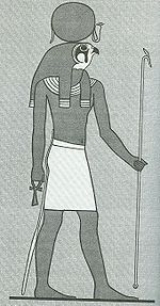
The ancient Egyptians, both men and women, wore loincloths as underwear, the men beneath their kilt-like schenti. These loincloths consisted of fine linen cloths in a triangular shape with ties at the two corners. The base of the triangle was placed at the small of the back and the ties tied in front, then the point or apex was drawn between the legs and tucked under the string, exactly the opposite of the Bushman fashion.
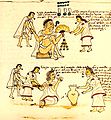
A similar style of loincloth was also characteristic of ancient Meso-America. The male inhabitants of the area of modern Mexico wore a wound loincloth of woven fabric. One end of the loincloth was held up, the remainder passed between the thighs, wound about the waist, and secured in back by tucking. (Local names: Nahuatl maxtlatl, Mayan ex.)
In Pre-Columbian South America, ancient Inca men wore a strip of cloth between their legs held up by strings or tape as a belt. The cloth was secured to the tapes at the back and the front portion hung in front as an apron, always well ornamented. The same garment, mostly in plain cotton
Cotton
Cotton is a soft, fluffy staple fiber that grows in a boll, or protective capsule, around the seeds of cotton plants of the genus Gossypium. The fiber is almost pure cellulose. The botanical purpose of cotton fiber is to aid in seed dispersal....
but whose aprons are now, like t-shirts, sometimes decorated with logos, is known in Japan as etchu fundoshi.
Some of the culturally diverse Amazonian Indians still wear some ancestral type of loincloth.
In most of (sub-)tropical continental Asia, types of loincloth such as the Indian lungi
Lungi
The Lungi , also known as a sarong , is a traditional garment worn around the waist in India, Pakistan, Bangladesh, Sri Lanka, Burma, Brunei, Indonesia, Malaysia, Singapore, the Horn of Africa and the southern Arabian Peninsula...
, often unisex or with a close female counterpart, remain in use as traditional dress, especially among the rural peasant communities, while city dwellers tend to adopt western style costumes. An elaborate, decorated form is also worn as the only garment in certain martial arts
Martial arts
Martial arts are extensive systems of codified practices and traditions of combat, practiced for a variety of reasons, including self-defense, competition, physical health and fitness, as well as mental and spiritual development....
, such as Kerala
Kerala
or Keralam is an Indian state located on the Malabar coast of south-west India. It was created on 1 November 1956 by the States Reorganisation Act by combining various Malayalam speaking regions....
's Kalarippayattu
Kalarippayattu
Kalaripayattu is a southern Indian martial art originating in Tamil Nadu but also practiced in contiguous parts of Kerala and Karnataka.Kalari payat includes strikes, kicks, grappling, preset forms, weaponry and healing methods...
; like the aptly named boxer shorts
Boxer shorts
Boxer shorts are a type of undergarment worn by men. The term has been used in English since 1944 for all-around-elastic shorts, so named after the shorts worn by boxers, for whom unhindered leg movement is very important.Reasons for a preference for boxers can be attributed to their variety of...
, it must allow the fighters free, even acrobatic movement.
Japanese men traditionally wear (formerly always) a loincloth known as a fundoshi
Fundoshi
is the traditional Japanese undergarment for adult males, made from a length of cotton. Before World War II, the fundoshi was the main form of underwear for Japanese adult males...
. The fundoshi is a 35 cm (14 inch) wide piece of fabric (cotton or silk
Silk
Silk is a natural protein fiber, some forms of which can be woven into textiles. The best-known type of silk is obtained from the cocoons of the larvae of the mulberry silkworm Bombyx mori reared in captivity...
) passed between the thighs and secured to cover the genitals. There are a hundred ways of tying the fundoshi, and in the modern age, men are coming to enjoy using patterned cloth for their fundoshis.
Men of Indo-European culture, Greeks, Romans and Scandinavians, wore the loincloth more or less habitually. (Women wore a fuller version, with ties before and behind, "bikinis" called a "perizoma", as depicted on the mosaics at Piazza Armerina.) An ancient version of the loincloth, the breechcloth
Breechcloth
A breechcloth, or breechclout, is a form of loincloth consisting in a strip of material – usually a narrow rectangle – passed between the thighs and held up in front and behind by a belt or string. Often, the flaps hang down in front and back.- Native Americans :In most Native American...
, was found in the Alps on a ca. 2000 BCE archaeological find named Ötzi the Iceman
Ötzi the Iceman
Ötzi the Iceman , Similaun Man, and Man from Hauslabjoch are modern names for a well-preserved natural mummy of a man who lived about 5,300 years ago. The mummy was found in September 1991 in the Ötztal Alps, near Hauslabjoch on the border between Austria and Italy. The nickname comes from the...
.
After the fall of the Roman empire, the loincloth disappeared in Europe. Trousers
Trousers
Trousers are an item of clothing worn on the lower part of the body from the waist to the ankles, covering both legs separately...
of one kind or another, which had been considered a Celtic oddity in the Ancient Mediterranean cultures, were prescribed for men.
Connotations
When Westerners once again came into contact with loincloths elsewhere, they viewed it as an exotic and indecent garment, possibly because the wearer's buttocks were partially exposed. The connection of loincloth-wearing with "backwardness" became even more pronounced in the 19th century heyday of colonialismColonialism
Colonialism is the establishment, maintenance, acquisition and expansion of colonies in one territory by people from another territory. It is a process whereby the metropole claims sovereignty over the colony and the social structure, government, and economics of the colony are changed by...
and industrialisation
Industrialisation
Industrialization is the process of social and economic change that transforms a human group from an agrarian society into an industrial one...
. Often the only garment black male slaves in the tropical colonies were permitted to wear was a scanty breechcloth, while even working class in the West wore at least a shirt and trousers.
During the Second World War, Allied prisoners of war in the harsh Japanese camps often had nothing but a breechcloth to wear.
At present the loincloth is nearly extinct as normal male wear in the industrialized world, except in certain contexts in Japan. However, in some cases it is worn as part of tribal - or national dress, either for the benefit of tourists, by tradition or as a statement. It is occasionally worn in jest by naturists on the village square and near the port of the naturist village Ile du Levant
Île du Levant
Île du Levant , sometimes referred to as Le Levant, is a Mediterranean French island off the coast of the Riviera, near Toulon. It is one of the three that constitute the Îles d'Hyères of France. The island is 8 km long, 2 km wide, and located in the Gulf of Lion...
, where by law some cloth must be worn.