

Vijayanagara

Encyclopedia
Vijayanagara is in Bellary District, northern Karnataka
. It is the name of the now-ruined capital city "which was regarded as the second Rome" that surrounds modern-day Hampi
, of the historic Vijayanagara empire
which extended over the southern part of India
.
. The city was built around the original religious centre of the Virupaksha temple at Hampi
. Other holy places lie within its environs, including the site of what is said to be Kishkindha
where a Hanuman
temple, the cave home of Anjana
, Kesari and Shabari, a holy pond named the Pampasarovar are located. It also contains the cave home of Sugriva
, the monkey king of the Ramayana
.
The city at its greatest extent was considerably larger than the area described here; an account is given at the article on the Vijayanagara metropolitan area. The central areas of the city, which include what are now called the Royal Centre and the Sacred Centre, extend over an area of at least 40 km². It includes the modern village of Hampi
. Another village, Kamalapura
, lies just outside the old walled city, but is also surrounded by ruins and monuments. The nearest town and railway is in Hosapete, about 13 km (8.1 mi) away by road. Hosapete also lies within the original extents of the old city, though most of the items of interest are within walking distance of Hampi and Kamalapura.
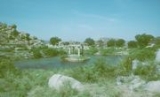
The natural setting for the city is a hilly landscape, dotted with numerous granite boulders. The Tungabhadra river runs through it, and provides protection from the north. Beyond the hills, on the south bank on which the city was built, a plain extended further the south. Large walls and fortifications of hewn granite defended the centre of the city.
The ruined city is a UNESCO
World Heritage Site
, known in that context as the Ruins of Hampi. In recent years there have been concerns regarding damage to the site at Hampi from heavy vehicular traffic and the construction of road bridges in the vicinity. Hampi is now listed as a "threatened" World Heritage Site.
It is widely believed that Vijaynagar was the largest city in India and the second largest city in the world at the end of 15th century with 500,000 inhabitants.
, also called the Sangama brothers. The empire consolidated under Harihara I and began to expand and prosper under Bukka Raya. Some time after its original establishment the capital was established at the more defensible and secure location of Vijayanagara on the south side of the river.
Contemporary descriptions depict a very large and highly-developed metropolitan area: recent commentators say,
The city flourished between the 14th century and 16th century, during the height of the power of the Vijayanagar empire. During this time, the empire was often in conflict with the Muslim
kingdoms which had become established in the northern Deccan, and which are often collectively termed the Deccan sultanates
. In 1565, the empire's armies suffered a massive and catastrophic defeat at the hands of an alliance of the sultanates, and the capital was taken. The victorious Muslim
armies then proceeded to raze, depopulate, and destroy the city and its Hindu temples and icons over a period of several months. Despite the empire continuing to exist thereafter during a slow decline, the original capital was not reoccupied or rebuilt. It has not been occupied since.
The buildings in the city are mostly built in the original native traditions of southern India, associated with the Hindu
religion. Some of them show a certain amount of Islamic influence due the interaction with the Islamic kingdoms.

. Also known as the Pampapati temple, it predated the empire, and was extended between the 13th and 17th centuries. It has two courts with entrance gopurams. The main entrance with a 50 meter gopuram faces east into a ceremonial and colonnaded street, that exends for about 1 km (0.621372736649807 mi) to a monolithic statue of Nandi
.
The temple is still in use now. It is dedicated to Virupaksha, an aspect of Shiva
and his consort Pampa, a local deity.
, entrances, and gopurams exist on the hill, some of which were never completed.

after military campaigns in Orissa
. The temple is contained in twin enclosures. Parts of the temple and its compound have collapsed, and while some restoration has been carried out, it is generally in poor condition. There is now no image in the inner sanctuary.
, the fierce aspect of Vishnu
, 6.7 m high. Originally the idol bore a smaller image of Lakshmi
on one knee; this had fallen off, probably due to vandalism. The Lakshmi statue is now in the museum at Kamalapuram.
 Narasimha is depicted seated on the coils of Shesha
. Shesha is shown here in a form with seven heads, the heads arching over Narasimha to form a canopy. The statue has recently been restored. The granite strap binding between his knees is a recent addition to stabilise it.
The donation of this work is ascribed to either Krishnadeva Raya, or to a wealthy merchant during his reign.
, where Rama
is said to have met him and Hanuman
on his travels. The cave is marked by coloured markings, and the attentions of pilgrims.
. This temple marks the spot where Rama
crowned Sugriva
. The temple is still in use, and the garbha griha contains statues of Rama, Lakshmana
and Sita
all carved out a single boulder.

worshipped in the Maratha country. It is believed to date from the 16th century.
In the front of the temple is the famous stone chariot or ratha. This is itself a miniature temple, carved out of a single rock, to resemble the temple chariots or rathas in which temple idols are traditionally taken out in procession.
One of the notable features of the Vittala Temple is the musical pillars. Each of the pillars that support the roof of the main temple is supported by a pillar representing a musical instrument, and is constructed as 7 minor pillars arranged around a main pillar. These 7 pillars, when struck, emanate the 7 notes from the representative instrument, varying in sound quality based on whether it represents a wind, string or percussion instrument.
The temple is the venue of the annual Purandaradasa festival.
, and extends southeast, almost to the village of Kamalapura
m. It is separated from the Sacred Centre by a small valley, now consisting of agricultural fields, and which carries irrigation canals or streams that join the river opposite Anegondi. A granite platform overlooks the Royal Centre. The Royal Centre contains the ruins of palaces, administrative buildings, and some temples directly associated with royalty. Little remains of the palaces except the foundations, as they were largely timber structures, for comfort. The temples and some of the other stone structures survive however, as do many of the surrounding city walls.
An aqueduct runs through much of the Royal Enclosure and into the Great Tank
where water was brought for special events. The west end of the tank is overlooked by a platform shrine. The aqueduct also runs into the large stepped tank
, lined in green diorite, with a geometric design that has not required restoration.

occur on the inner courtyard walls, and on the temple itself. There is a well-relief of baby Krishna on the walls.
The temple may have been exclusively for royal use. It is believed to be constructed at the site of Vaali's killing in the hands of Rama. It may have been a private shrine for royalty. It is unusual in that it has four black basalt columns in the mantapa (columned hall). The inner sanctuary of the temple is now empty.
This is also known as the Hazara Rama temple (temple of a thousand Ramas), due to the recurrence of images of Rama on the walls. Sometimes it is called the Hajara Rama temple (the Rama temple in the courtyard).
An inscription referring to this temple states that Krishnadevaraya
donated Nagalapura and other villages for worship and offerings to the Gods for the merit of his parents Narsa Nayaka and Nagaji Devi.
At times the base of the temple is flooded and may be inaccessible. When it is accessible, masses of small insect bat
s may be found in the temple.

designed for bathing. Such sunken wells were created to provide relief from daytime heat. It would have been covered when the city was occupied.

A number of modern populated towns and villages lie within the extents of the original city. These include;
All of these are in Bellary district, except Anegondi which is in Koppal district
.
Karnataka
Karnataka , the land of the Kannadigas, is a state in South West India. It was created on 1 November 1956, with the passing of the States Reorganisation Act and this day is annually celebrated as Karnataka Rajyotsava...
. It is the name of the now-ruined capital city "which was regarded as the second Rome" that surrounds modern-day Hampi
Hampi
Hampi is a village in northern Karnataka state, India. It is located within the ruins of Vijayanagara, the former capital of the Vijayanagara Empire. Predating the city of Vijayanagara, it continues to be an important religious centre, housing the Virupaksha Temple, as well as several other...
, of the historic Vijayanagara empire
Vijayanagara Empire
The Vijayanagara Empire , referred as the Kingdom of Bisnaga by the Portuguese, was an empire based in South Indian in the Deccan Plateau region. It was established in 1336 by Harihara I and his brother Bukka Raya I of the Yadava lineage. The empire rose to prominence as a culmination of attempts...
which extended over the southern part of India
India
India , officially the Republic of India , is a country in South Asia. It is the seventh-largest country by geographical area, the second-most populous country with over 1.2 billion people, and the most populous democracy in the world...
.
Location
Most of the city lies on the south bank of the Tungabhadra RiverTungabhadra River
The Tungabhadra River is a sacred river in southern India that flows through the state of Karnataka to Andhra Pradesh, where it serves as the chief tributary of the Krishna River...
. The city was built around the original religious centre of the Virupaksha temple at Hampi
Hampi
Hampi is a village in northern Karnataka state, India. It is located within the ruins of Vijayanagara, the former capital of the Vijayanagara Empire. Predating the city of Vijayanagara, it continues to be an important religious centre, housing the Virupaksha Temple, as well as several other...
. Other holy places lie within its environs, including the site of what is said to be Kishkindha
Kishkindha
Kishkindha is mythical the monkey kingdom of the Vanara King Sugriva, the younger brother of Vali, in the Indian mythology of Ramayana times...
where a Hanuman
Hanuman
Hanuman , is a Hindu deity, who is an ardent devotee of Rama, a central character in the Indian epic Ramayana and one of the dearest devotees of lord Rama. A general among the vanaras, an ape-like race of forest-dwellers, Hanuman is an incarnation of the divine and a disciple of Lord Rama in the...
temple, the cave home of Anjana
Anjana
' was the mother of Hanuman and Maruti Anjana and Kesari named him after their first son Hanuman he is said to be born when Hanuman was 16 years old and it is said hey has taken an avatar on earth and believed to be still alive . one of the heroes of the Indian epic, the Ramayana...
, Kesari and Shabari, a holy pond named the Pampasarovar are located. It also contains the cave home of Sugriva
Sugriva
In the Hindu epic Ramayana, Sugriva , also spelled Sugreeva or Sugreev, was the younger brother of Bali, whom he succeeded as ruler of the vanara or monkey kingdom Kishkindha. Ruma was his wife. He was the son of Surya, the Hindu deity of the sun...
, the monkey king of the Ramayana
Ramayana
The Ramayana is an ancient Sanskrit epic. It is ascribed to the Hindu sage Valmiki and forms an important part of the Hindu canon , considered to be itihāsa. The Ramayana is one of the two great epics of India and Nepal, the other being the Mahabharata...
.
The city at its greatest extent was considerably larger than the area described here; an account is given at the article on the Vijayanagara metropolitan area. The central areas of the city, which include what are now called the Royal Centre and the Sacred Centre, extend over an area of at least 40 km². It includes the modern village of Hampi
Hampi
Hampi is a village in northern Karnataka state, India. It is located within the ruins of Vijayanagara, the former capital of the Vijayanagara Empire. Predating the city of Vijayanagara, it continues to be an important religious centre, housing the Virupaksha Temple, as well as several other...
. Another village, Kamalapura
Kamalapura
Kamalapura is a panchayat town in Gulbarga district in Karnataka 10miles from Basavakalyan " The Birth place of Indian Democracy where the 12th century Philosopher Basaveshwara created the model Parliament called " Anubhava Mantap" with the view that " Parliament should reflect the society". He...
, lies just outside the old walled city, but is also surrounded by ruins and monuments. The nearest town and railway is in Hosapete, about 13 km (8.1 mi) away by road. Hosapete also lies within the original extents of the old city, though most of the items of interest are within walking distance of Hampi and Kamalapura.
The natural setting for the city is a hilly landscape, dotted with numerous granite boulders. The Tungabhadra river runs through it, and provides protection from the north. Beyond the hills, on the south bank on which the city was built, a plain extended further the south. Large walls and fortifications of hewn granite defended the centre of the city.
The City
The name translates as 'City of Victory', from vijaya (victory) and nagara (city). As the prosperous capital of the largest and most powerful kingdom of its time in all of India, Vijayanagara attracted people from all around the world. Pandit Nehru, in his book, "The Discovery of India" writes:- After Timur's sack of Delhi, North India remained weak and divided up. South India was better off, and the largest and most powerful of the southern kingdoms was Vijayanagar. This state and city attracted many of the Hindu refugees from the north. From contemporary accounts, it appears that the city was rich and very beautiful--The city is such that eye has not seen nor ear heard of any place resembling it upon earth", says Abdur-Razzak from Central Asia. There were arcades and magnificent galleries for the bazaars, and rising above them all was the palace of the king surrounded by "many rivulets and streams flowing through channels of cut stone, polished and even." The whole city was full of gardens, and because of them, as an Italian visitor in 1420, Nicolo Conti, writes, the circumference of the city was sixty miles. A later visitor was Paes, a Portuguese who came in 1522 after having visited the Italian cities of the Renaissance. The city of Vijayanagar, he says, is as "large as Rome and very beautiful to the sight"; it is full of charm and wonder with its innumerable lakes and waterways and fruit gardens. It is "the best-provided city in the world" and "everything abounds." The chambers of the palace were a mass of ivory, with roses and lotuses carved in ivory at the top--"it is so rich and beautiful that you would hardly find anywhere, another such."
The ruined city is a UNESCO
UNESCO
The United Nations Educational, Scientific and Cultural Organization is a specialized agency of the United Nations...
World Heritage Site
World Heritage Site
A UNESCO World Heritage Site is a place that is listed by the UNESCO as of special cultural or physical significance...
, known in that context as the Ruins of Hampi. In recent years there have been concerns regarding damage to the site at Hampi from heavy vehicular traffic and the construction of road bridges in the vicinity. Hampi is now listed as a "threatened" World Heritage Site.
It is widely believed that Vijaynagar was the largest city in India and the second largest city in the world at the end of 15th century with 500,000 inhabitants.
History
The Vijayanagara empire was founded by(Harihara) and BukkaBukka
Bukka was an emperor of the Vijayanagara Empire from the Sangama Dynasty. Bukka patronised Telugu poet Nachana Soma....
, also called the Sangama brothers. The empire consolidated under Harihara I and began to expand and prosper under Bukka Raya. Some time after its original establishment the capital was established at the more defensible and secure location of Vijayanagara on the south side of the river.
Contemporary descriptions depict a very large and highly-developed metropolitan area: recent commentators say,
- "The massive walls, which can still be traced, enclosed an area of more than sixty square miles, much of which was occupied by fields and gardens watered by canals from the river. The population cannot be estimated with precision, but it was certainly very large when judged by the standards of the fifteenth century. The great majority of the houses were naturally small and undistinguished, but among them were scattered palaces, temples, public buildings, wide streets of shops shaded by trees, busy markets, and all the equipment of a great and wealthy city. The principal buildings were constructed in the regular Hindu style, covered with ornamental carving, and the fragments which have survived suffice to give point to the enthusiastic admiration of the men who saw the city in the days of its magnificence."
The city flourished between the 14th century and 16th century, during the height of the power of the Vijayanagar empire. During this time, the empire was often in conflict with the Muslim
Muslim
A Muslim, also spelled Moslem, is an adherent of Islam, a monotheistic, Abrahamic religion based on the Quran, which Muslims consider the verbatim word of God as revealed to prophet Muhammad. "Muslim" is the Arabic term for "submitter" .Muslims believe that God is one and incomparable...
kingdoms which had become established in the northern Deccan, and which are often collectively termed the Deccan sultanates
Deccan sultanates
The Deccan sultanates were five Muslim-ruled late medieval kingdoms—Bijapur, Golkonda, Ahmadnagar, Bidar, and Berar—of south-central India. The Deccan sultanates were located on the Deccan Plateau, between the Krishna River and the Vindhya Range. These kingdoms became independent during the breakup...
. In 1565, the empire's armies suffered a massive and catastrophic defeat at the hands of an alliance of the sultanates, and the capital was taken. The victorious Muslim
Muslim
A Muslim, also spelled Moslem, is an adherent of Islam, a monotheistic, Abrahamic religion based on the Quran, which Muslims consider the verbatim word of God as revealed to prophet Muhammad. "Muslim" is the Arabic term for "submitter" .Muslims believe that God is one and incomparable...
armies then proceeded to raze, depopulate, and destroy the city and its Hindu temples and icons over a period of several months. Despite the empire continuing to exist thereafter during a slow decline, the original capital was not reoccupied or rebuilt. It has not been occupied since.
The buildings in the city are mostly built in the original native traditions of southern India, associated with the Hindu
Hindu
Hindu refers to an identity associated with the philosophical, religious and cultural systems that are indigenous to the Indian subcontinent. As used in the Constitution of India, the word "Hindu" is also attributed to all persons professing any Indian religion...
religion. Some of them show a certain amount of Islamic influence due the interaction with the Islamic kingdoms.
The Sacred Center
This title has been given by historians to the areas extending from Hampi village to Matanga Hill to its east. It is sometimes extended further northeast to the Vitthala Temple. It consists of a hilly region immediately to the south of the Tungabhadra.Virupaksha Temple
This surviving temple and temple complex is the core of the village of HampiHampi
Hampi is a village in northern Karnataka state, India. It is located within the ruins of Vijayanagara, the former capital of the Vijayanagara Empire. Predating the city of Vijayanagara, it continues to be an important religious centre, housing the Virupaksha Temple, as well as several other...
. Also known as the Pampapati temple, it predated the empire, and was extended between the 13th and 17th centuries. It has two courts with entrance gopurams. The main entrance with a 50 meter gopuram faces east into a ceremonial and colonnaded street, that exends for about 1 km (0.621372736649807 mi) to a monolithic statue of Nandi
Nandi bull
Nandi or Nandin , is now universally supposed to be the name for the bull which serves as the mount of Shiva and as the gate keeper of Shiva and Parvati in Hindu mythology. Temples venerating Shiva and Parvati display stone images of a seated Nandi, generally facing the main shrine...
.
The temple is still in use now. It is dedicated to Virupaksha, an aspect of Shiva
Shiva
Shiva is a major Hindu deity, and is the destroyer god or transformer among the Trimurti, the Hindu Trinity of the primary aspects of the divine. God Shiva is a yogi who has notice of everything that happens in the world and is the main aspect of life. Yet one with great power lives a life of a...
and his consort Pampa, a local deity.
Hemakuta Hill
The hill is situated to the south of Hampi village. It bears several small temples that predate the construction of Vijayanagara as the capital of the empire, some being as early as the 10th century. The hill was fortified when the main city was constructed, and a number of more recent temples, tanksIrrigation tank
For etymology, see Storage tank#Etymology.In India, an irrigation tank or tank is an artificial reservoir of any size. . It can also have a natural or man-made spring included as part of a structure...
, entrances, and gopurams exist on the hill, some of which were never completed.
Krishna Temple
This is a ruined temple, south of Hampi and Hemakuta hill. It was built by the emperor KrishnadevarayaKrishnadevaraya
Śrī Kriṣhṇa Devarāya , , , and also known as Krishna Devarayulu in some inscriptions was the famed Emperor of the Vijayanagara Empire who reigned from 1509–1529 CE.He is the third ruler of the Tuluva Dynasty. Presiding over the empire at its zenith, he is regarded as an icon by many Indians...
after military campaigns in Orissa
Orissa
Orissa , officially Odisha since Nov 2011, is a state of India, located on the east coast of India, by the Bay of Bengal. It is the modern name of the ancient nation of Kalinga, which was invaded by the Maurya Emperor Ashoka in 261 BC. The modern state of Orissa was established on 1 April...
. The temple is contained in twin enclosures. Parts of the temple and its compound have collapsed, and while some restoration has been carried out, it is generally in poor condition. There is now no image in the inner sanctuary.
Lakshmi Narasimha
Also to the south of Hampi is this massive rock cut idol of NarasimhaNarasimha
Narasimha or Nrusimha , also spelt as Narasingh and Narasingha, whose name literally translates from Sanskrit as "Man-lion", is an avatar of Vishnu described in the Puranas, Upanishads and other ancient religious texts of Hinduism...
, the fierce aspect of Vishnu
Vishnu
Vishnu is the Supreme god in the Vaishnavite tradition of Hinduism. Smarta followers of Adi Shankara, among others, venerate Vishnu as one of the five primary forms of God....
, 6.7 m high. Originally the idol bore a smaller image of Lakshmi
Lakshmi
Lakshmi or Lakumi is the Hindu goddess of wealth, prosperity , light, wisdom, fortune, fertility, generosity and courage; and the embodiment of beauty, grace and charm. Representations of Lakshmi are also found in Jain monuments...
on one knee; this had fallen off, probably due to vandalism. The Lakshmi statue is now in the museum at Kamalapuram.
Shesha
In Hindu tradition, Shesha or Sheshanaag is the king of all nagas, one of the primal beings of creation, and according to the Bhagavata Purana, an Avatar of the Supreme God known as Sankarshan. In the Puranas, Shesha is said to hold all the planets of the Universe on his hoods and to constantly...
. Shesha is shown here in a form with seven heads, the heads arching over Narasimha to form a canopy. The statue has recently been restored. The granite strap binding between his knees is a recent addition to stabilise it.
The donation of this work is ascribed to either Krishnadeva Raya, or to a wealthy merchant during his reign.
Sugriva's cave
This is a natural cave, said to be the original home of the monkey king SugrivaSugriva
In the Hindu epic Ramayana, Sugriva , also spelled Sugreeva or Sugreev, was the younger brother of Bali, whom he succeeded as ruler of the vanara or monkey kingdom Kishkindha. Ruma was his wife. He was the son of Surya, the Hindu deity of the sun...
, where Rama
Rama
Rama or full name Ramachandra is considered to be the seventh avatar of Vishnu in Hinduism, and a king of Ayodhya in ancient Indian...
is said to have met him and Hanuman
Hanuman
Hanuman , is a Hindu deity, who is an ardent devotee of Rama, a central character in the Indian epic Ramayana and one of the dearest devotees of lord Rama. A general among the vanaras, an ape-like race of forest-dwellers, Hanuman is an incarnation of the divine and a disciple of Lord Rama in the...
on his travels. The cave is marked by coloured markings, and the attentions of pilgrims.
Kodandarama Temple
This is situated to the east of Hampi, near the end of the colonnaded street that leads out from the Virupaksha temple. It is in the sacred centre of the city, and by a narrow point of the Tungabhadra riverTungabhadra River
The Tungabhadra River is a sacred river in southern India that flows through the state of Karnataka to Andhra Pradesh, where it serves as the chief tributary of the Krishna River...
. This temple marks the spot where Rama
Rama
Rama or full name Ramachandra is considered to be the seventh avatar of Vishnu in Hinduism, and a king of Ayodhya in ancient Indian...
crowned Sugriva
Sugriva
In the Hindu epic Ramayana, Sugriva , also spelled Sugreeva or Sugreev, was the younger brother of Bali, whom he succeeded as ruler of the vanara or monkey kingdom Kishkindha. Ruma was his wife. He was the son of Surya, the Hindu deity of the sun...
. The temple is still in use, and the garbha griha contains statues of Rama, Lakshmana
Lakshmana
Lakshmana was the brother and close companion of Rama, and himself a hero in the famous epic Ramayana...
and Sita
SITA
SITA is a multinational information technology company specialising in providing IT and telecommunication services to the air transport industry...
all carved out a single boulder.
Vittala Temple
Situated northeast of Hampi, opposite the village of Anegondi, this is one of the principal monuments of the city. It is dedicated to Vittala, an aspect of VishnuVishnu
Vishnu is the Supreme god in the Vaishnavite tradition of Hinduism. Smarta followers of Adi Shankara, among others, venerate Vishnu as one of the five primary forms of God....
worshipped in the Maratha country. It is believed to date from the 16th century.
In the front of the temple is the famous stone chariot or ratha. This is itself a miniature temple, carved out of a single rock, to resemble the temple chariots or rathas in which temple idols are traditionally taken out in procession.
One of the notable features of the Vittala Temple is the musical pillars. Each of the pillars that support the roof of the main temple is supported by a pillar representing a musical instrument, and is constructed as 7 minor pillars arranged around a main pillar. These 7 pillars, when struck, emanate the 7 notes from the representative instrument, varying in sound quality based on whether it represents a wind, string or percussion instrument.
The temple is the venue of the annual Purandaradasa festival.
The King's Balance
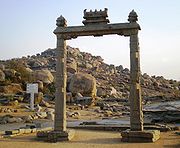
This structure, the Tulapurushandana, stands to the southwest of the Vittala temple. consists of two carved granite pillars, spanned by a carved horizontal granite transom. This was used on ceremonial days, when scales were hung from the transom, and the Raya (the emperor) was ceremonially weighed against gold or jewels. The treasure was then distributed, to Brahmins or others in the city.The Royal Centre
This extensive area consists of a small plateau, which starts about 2 km (1.2 mi) to the southeast of HampiHampi
Hampi is a village in northern Karnataka state, India. It is located within the ruins of Vijayanagara, the former capital of the Vijayanagara Empire. Predating the city of Vijayanagara, it continues to be an important religious centre, housing the Virupaksha Temple, as well as several other...
, and extends southeast, almost to the village of Kamalapura
Kamalapura
Kamalapura is a panchayat town in Gulbarga district in Karnataka 10miles from Basavakalyan " The Birth place of Indian Democracy where the 12th century Philosopher Basaveshwara created the model Parliament called " Anubhava Mantap" with the view that " Parliament should reflect the society". He...
m. It is separated from the Sacred Centre by a small valley, now consisting of agricultural fields, and which carries irrigation canals or streams that join the river opposite Anegondi. A granite platform overlooks the Royal Centre. The Royal Centre contains the ruins of palaces, administrative buildings, and some temples directly associated with royalty. Little remains of the palaces except the foundations, as they were largely timber structures, for comfort. The temples and some of the other stone structures survive however, as do many of the surrounding city walls.
An aqueduct runs through much of the Royal Enclosure and into the Great Tank
Irrigation tank
For etymology, see Storage tank#Etymology.In India, an irrigation tank or tank is an artificial reservoir of any size. . It can also have a natural or man-made spring included as part of a structure...
where water was brought for special events. The west end of the tank is overlooked by a platform shrine. The aqueduct also runs into the large stepped tank
Irrigation tank
For etymology, see Storage tank#Etymology.In India, an irrigation tank or tank is an artificial reservoir of any size. . It can also have a natural or man-made spring included as part of a structure...
, lined in green diorite, with a geometric design that has not required restoration.
Ramachandra Temple
The temple stands in a rectangular courtyard, with entrances facing to the east. Reliefs showing daily life and festival scenes occur on the outer walls of the courtyard. Scenes from the RamayanaRamayana
The Ramayana is an ancient Sanskrit epic. It is ascribed to the Hindu sage Valmiki and forms an important part of the Hindu canon , considered to be itihāsa. The Ramayana is one of the two great epics of India and Nepal, the other being the Mahabharata...
occur on the inner courtyard walls, and on the temple itself. There is a well-relief of baby Krishna on the walls.
The temple may have been exclusively for royal use. It is believed to be constructed at the site of Vaali's killing in the hands of Rama. It may have been a private shrine for royalty. It is unusual in that it has four black basalt columns in the mantapa (columned hall). The inner sanctuary of the temple is now empty.
This is also known as the Hazara Rama temple (temple of a thousand Ramas), due to the recurrence of images of Rama on the walls. Sometimes it is called the Hajara Rama temple (the Rama temple in the courtyard).
Underground Shiva Temple
The temple has a Garbagriha with an antarala and Aradhamantapa and a Mahamantatapa. The mahamantapa has pillared corridors that fuse with the pillared Mukhamantapa, making a larger pillared frontal Mantapa which also encloses a Dwajasthamba. The pillars of this temple are plain.An inscription referring to this temple states that Krishnadevaraya
Krishnadevaraya
Śrī Kriṣhṇa Devarāya , , , and also known as Krishna Devarayulu in some inscriptions was the famed Emperor of the Vijayanagara Empire who reigned from 1509–1529 CE.He is the third ruler of the Tuluva Dynasty. Presiding over the empire at its zenith, he is regarded as an icon by many Indians...
donated Nagalapura and other villages for worship and offerings to the Gods for the merit of his parents Narsa Nayaka and Nagaji Devi.
At times the base of the temple is flooded and may be inaccessible. When it is accessible, masses of small insect bat
Bat
Bats are mammals of the order Chiroptera "hand" and pteron "wing") whose forelimbs form webbed wings, making them the only mammals naturally capable of true and sustained flight. By contrast, other mammals said to fly, such as flying squirrels, gliding possums, and colugos, glide rather than fly,...
s may be found in the temple.
Lotus Mahal
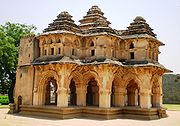
A palace for the queen that has, among other things, pipes with running water. A construction of the later Vijayanagara period, this structure shows Islamic influence in its arched gateways and vaulted ceilings; its construction entirely in stone is a clear deviation from conventional Vijayanagara palace and house construction that used wooden structures on stone platforms.Pushkarani
Also called the Stepped Bath, or the Queen's bath, this is a stepped wellStepwell
Stepwells, also called bawdi or baoli , or vaav are wells or ponds in which the water can be reached by descending a set of steps. They may be covered and protected, and are often of architectural significance...
designed for bathing. Such sunken wells were created to provide relief from daytime heat. It would have been covered when the city was occupied.
Elephant stables
A set of large stables, to house the ceremonial elephants of the royal household. The area in front of them was a parade ground for the elephants, and for troops. This is another structure that shows Islamic influence in its domes and arched gateways. The guards' barracks are located right next to the elephant stables.Other areas
Other monuments and places of interest can be found outside of the above two major centers.A number of modern populated towns and villages lie within the extents of the original city. These include;
- AnegondiAnegondiAnegondi , which literally means elephant pit in Kannada, is a small village in Koppal district of Karnataka state, located on the north banks of the Tungabhadra River on the opposite bank of the Vittala Temple....
, probably the earliest settlement in the area, on the north side of the Tungabhadra riverTungabhadra RiverThe Tungabhadra River is a sacred river in southern India that flows through the state of Karnataka to Andhra Pradesh, where it serves as the chief tributary of the Krishna River...
. - HampiHampiHampi is a village in northern Karnataka state, India. It is located within the ruins of Vijayanagara, the former capital of the Vijayanagara Empire. Predating the city of Vijayanagara, it continues to be an important religious centre, housing the Virupaksha Temple, as well as several other...
, the village lies in the middle of the ruins. - HospetHospetHospet , is a city in Bellary District in northern Karnataka, India. It is on the Tungabhadra River, 12 km from the World Heritage site consisting of the ruins of the medieval city of Vijayanagara, former capital of the Vijayanagara Empire....
, a town and railhead, to the southwest. - KamalapuraKamalapuraKamalapura is a panchayat town in Gulbarga district in Karnataka 10miles from Basavakalyan " The Birth place of Indian Democracy where the 12th century Philosopher Basaveshwara created the model Parliament called " Anubhava Mantap" with the view that " Parliament should reflect the society". He...
, a small temple town to the southeast of the Royal Centre, also houses an archaeological museum.
All of these are in Bellary district, except Anegondi which is in Koppal district
Koppal district
Koppal district is an administrative district in the state of Karnataka in India. In the past Koppal was referred to as 'Kopana Nagara'. Hampi, a World heritage center, covers some areas of Koppal District. It is situated approximately 38 km away...
.
See also
- Vijayanagara Architecture
- Vijayanagara EmpireVijayanagara EmpireThe Vijayanagara Empire , referred as the Kingdom of Bisnaga by the Portuguese, was an empire based in South Indian in the Deccan Plateau region. It was established in 1336 by Harihara I and his brother Bukka Raya I of the Yadava lineage. The empire rose to prominence as a culmination of attempts...