

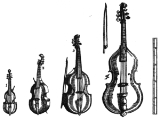
Viol

Encyclopedia
The viol is any one of a family of bowed
, fret
ted and stringed musical instrument
s developed in the mid-late 15th century and used primarily in the Renaissance
and Baroque
periods. The family is related to and descends primarily from the Renaissance vihuela
, a plucked instrument that preceded the guitar
. An influence in the playing posture has been credited to the example of Moorish rabab players.
Viols are different in several respects from instruments of the violin family
.
 Vihuelists
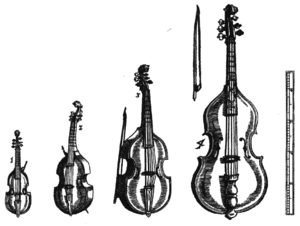
began playing their flat-bridged instruments with a bow in the second half of the 15th century. Within two or three decades, this led to the evolution of an entirely new and dedicated bowed string instrument that retained many of the features of the original plucked vihuela: a flat back, sharp waist-cuts, frets, thin ribs (initially), and an identical tuning—hence its original name, vihuela de arco; arco is Spanish
for "bow".
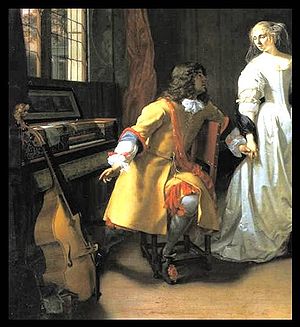
strings of lower tension than on the members of the violin family, let alone the steel strings mostly used there today. Gut strings produce a sonority far different from steel, the former generally described as softer and sweeter. Around 1660, gut or silk core strings overspun with copper
wire first became available; these were then used for the lowest-pitched bass strings on viols, and on many other string instruments as well. Viols are fretted in a manner similar to early guitars or lute
s, by means of movable wrapped-around and tied-on gut frets. A low seventh string was supposedly added in France
to the bass viol by Monsieur de Sainte-Colombe
(c. 1640–1690), whose students included the French gamba virtuoso
and composer Marin Marais
. Also, the painting Saint Cecilia with an Angel (1618) by Domenichino
(1581–1641) shows what may be a seven-string viol.
Unlike members of the violin family
, which are tuned in fifths
, viols are usually tuned in fourths with a major third in the middle, mirroring the tuning employed on the vihuela de mano and lute
during the 16th century and similar to that of the modern six-string guitar
.
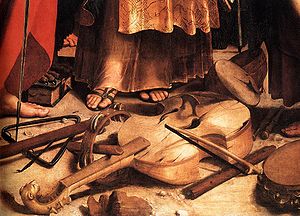 Viols were first constructed much like the vihuela de mano, with all surfaces, top, back, and sides made from flat slabs or pieces of joined wood, bent or curved as required. However, some viols, both early and later, had carved tops, similar to those more commonly associated with instruments of the violin family. The ribs or sides of early viols were usually quite shallow, reflecting more the construction of their plucked vihuela counterparts. Rib depth increased during the course of the 16th century, finally coming to resemble the greater depth of the classic 17th-century pattern. The flat backs of most viols have a sharply angled break or canted bend in their surface close to where the neck meets the body. This serves to taper the back (and overall body depth) at its upper end to meet the back of the neck joint flush with its heel. Traditional construction uses animal glue, and internal joints are often reinforced with strips of either linen
or vellum
soaked in hot animal glue—a practice also employed in early plucked vihuela construction. The peg boxes of viols (which hold the tuning pegs) were typically decorated either with elaborate carved heads of animals or people or with the now familiar spiral scroll
finial.
The earliest vihuelas and viols, both plucked and bowed, all had sharp cuts to their waists, similar to the profile of a modern violin. This is a key and new feature—first appearing in the mid-15th century—and from then on, it was employed on many different types of string instruments. This feature is also key in seeing and understanding the connection between the plucked and bowed versions of early vihuelas. If one were to go searching for very early viols with smooth-curved figure-eight bodies, like those found on the only slightly later plucked vihuelas and the modern guitar, they would be out of luck. By the mid-16th century, however, "guitar-shaped" viols were fairly common, and a few of them survive.
The earliest viols had flat, glued-down bridges just like their plucked counterpart vihuelas. Soon after, however, viols adopted the wider and high-arched bridge that facilitated the bowing of single strings. The earliest of viols would also have had the ends of their fretboards flat on the deck, level with or resting upon the top or sound board. Once the end of their fretboards were elevated above the top of the instrument's face, the entire top could vibrate freely. Early viols did not have sound post
s, either (again reflecting their plucked vihuela siblings). This reduced damping
again meant that their tops could vibrate more freely, contributing to the characteristic "humming" sound of viols; yet the absence of a sound post also resulted in a quieter and softer voice overall.
It is commonly believed that C-holes (a type and shape of pierced sound port visible on the top face or belly of string instruments) are a definitive feature of viols, a feature used to distinguish viols from instruments in the violin family, which typically had F-shaped holes. This generality, however, renders an incomplete picture. The earliest viols had either large, open, round, sound holes (or even round pierced rosette
s like those found on lutes and vihuelas), or they had some kind of C-holes. Viols sometimes had as many as four small C-holes—one placed in each corner of the bouts—but more commonly, they had two. The two C-holes might be placed in the upper bouts, centrally, or in the lower bouts. In the formative years, C-holes were most often placed facing each other or turned inwards. In addition to round or C-holes, however, and as early as the first quarter of the 16th century, some viols adopted S-shaped holes, again facing inward. By the mid-16th century, S-holes morphed into the classic F-shaped holes, which were then used by viols and members of the violin family alike. By the mid- to late 16th century, the viol's C-holes facing direction was reversed, becoming outward facing. That configuration then became a standard feature of what we today call the “classic” 17th-century pattern. Yet another style of sound holes found on some viols was a pair of flame-shaped Arabesques placed left and right. The lute and vihuelalike round or oval ports or rosettes became a standard feature of German and Austrian viols and was retained to the very end. That feature or “genetic marker” was exclusively unique to viols and reminded one always of the viol's more ancient plucked vihuela roots, the "luteness" of viols.
Historians, makers, and players generally distinguish between Renaissance
and Baroque
viols. The latter are more heavily constructed and are fitted with a bass bar
and sound post, like modern stringed instruments.
is held underhand (palm up), similar to a German double bass
bow grip, but away from the frog towards the balance point. The stick's curvature is generally convex as were violin bows of the period, rather than concave like a modern violin bow. The "frog" (which holds the bowhair and adjusts its tension) is also different from that of modern bows: whereas a violin bow frog has a "slide" (often made of mother of pearl
), which pinches the hair and holds it flat and stationary across the frog, viol bows have an open frog that allows more movement of the hair. This facilitates a traditional playing technique where the performer uses one or two fingers of the bow hand to press the hair away from the bow stick. This dynamically increases bow hair tension to control articulation
and inflection.
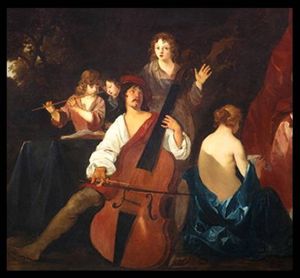
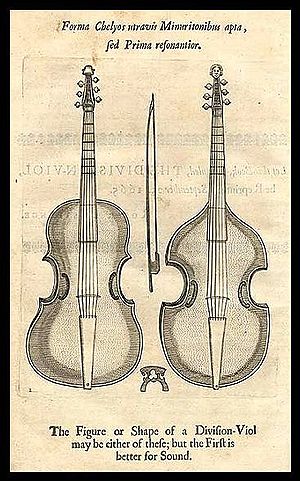
). The treble is about the size of a violin
, but with a deeper body; the standard bass is a bit smaller than a cello
. The English made smaller basses known as division viol
s, and the still-smaller Lyra viol
. German
consort basses were larger than the French instruments designed for continuo. Two closely related instruments include the baryton
and the viola d'amore
, although the latter is played under the chin, viola-fashion.
, with a major third
in the middle (like the standard Renaissance lute
tuning). For bass viols, the notes would be (from the lowest) D-G-C-E-A-D, with an additional low A for seven-string bass viols. For the tenor viol, the tuning is G-C-F-A-D-G (though the Renaissance tenor viol is usually tuned A-D-G-B-E-A). The treble viol is one octave
higher than the bass.
Alternate tunings (called scordatura) were often employed, particularly in the solo lyra viol
style of playing, which also made use of many techniques such as chords
and pizzicato
, not generally used in consort playing. An unusual style of pizzicato was known as a thump. Lyra viol music was also commonly written in tablature
. There is a vast repertoire of this music, some by well-known composers and much by anonymous ones.
Much viol music predates the adoption of equal temperament
tuning by musicians. The movable nature of the tied-on frets permits the viol player to make adjustments to the tempering of the instrument, and some players and consorts adopt meantone temperament
s, which are arguably more suited to Renaissance music. Several fretting schemes involve frets that are spaced unevenly to produce "better-sounding" chords in a limited number of keys
. In some of these schemes, the two strands of gut that form the fret are separated so that the player can finger a slightly sharper or flatter version of a note (for example G sharp vs. A flat) to suit different circumstances.
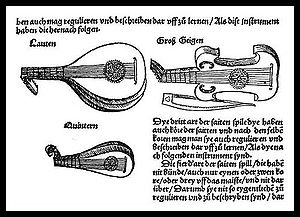 Descriptions and illustrations of viols are found in numerous early 16th-century musical treatises, including those authored by:
Both Agricola's and Gerle's works were published in various editions.
There were then several important treatise
s concerning or devoted to the viol. The first was by Silvestro Ganassi dal Fontego
: Regola Rubertina & Lettione Seconda (1542/3). Diego Ortiz
published Trattado de Glosas (Rome
, 1553), an important book of music for the viol with both examples of ornamentation and pieces called Recercadas. In England, Christopher Simpson
wrote the most important treatise, with the second edition being published in 1667 in parallel text (English
and Latin
). This has divisions
at the back that are very worthwhile repertoire. A little later, in England, Thomas Mace wrote Musick's Monument, which deals more with the lute but has an important section on the viol. After this, the French treatises by Machy (1685), Rousseau (1687), Danoville
(1687), and Loulie (1700) show further developments in playing technique.
, which would contain one or more instruments of each size. Gamba ensembles, called consorts
, were common in the 16th and 17th centuries, when they performed vocal music (consort songs or verse anthem
s) as well as that written specifically for instruments. Only the treble, tenor, and bass sizes were regular members of the viol consort, which consisted of three, four, five, or six instruments. Music for consorts was very popular in England
in Elizabethan
times, with composers such as William Byrd
and John Dowland
, and, during the reign of King Charles I, John Jenkins
and William Lawes
. The last music for viol consorts before their modern revival was probably written in the early 1680s by Henry Purcell
.
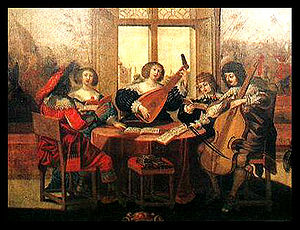 Perhaps even more common than the pure consort of viols was the mixed or broken consort
(also called Morley consort). Broken consorts combined a mixture of different instruments—a small band, essentially—usually comprising a gathering of social amateurs and typically including such instruments as a bass viol, a lute
or orpharion
(a wire-strung lute, metal-fretted, flat-backed, and festoon-shaped), a cittern
, a treble viol (or violin
, as time progressed), sometimes an early keyboard instrument (virginal, spinet
, or harpsichord
), and whatever other instruments or players (or singers) might be available at the moment. The single most common and ubiquitous pairing of all was always and everywhere the lute and bass viol: for centuries, the inseparable duo.
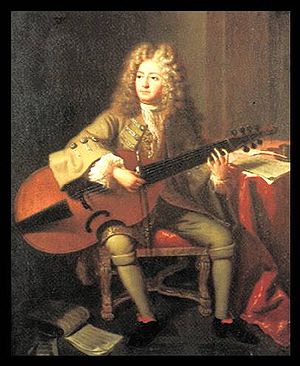
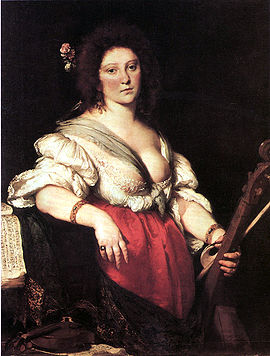 The bass viola da gamba continued to be used into the 18th century as a solo
instrument (and to complement the harpsichord
in basso continuo). It was a favorite instrument of Louis XIV
and acquired associations of both courtliness and "Frenchness" (in contrast to the Italianate violin). Composers such as Marin Marais
, Johann Sebastian Bach
, Antoine Forqueray
, and Carl Friedrich Abel wrote virtuoso music for it. However, viols fell out of use as concert halls grew larger and the louder and more penetrating tone of the violin family became more popular. In the 20th century, the viola da gamba and its repertoire were revived by early music
enthusiasts, an early proponent being Arnold Dolmetsch
.
The treble viol in d and the even smaller pardessus de viole in g (often with only five strings) were also popular instruments in the 18th century, specially in France. Composers like Jean-Baptise Barrière, Georg Phillipp Telemann and Marin Marais
wrote solo- and ensemble pieces for treble or pardessus. It was also common to play music for violins or flutes or unspecified top parts on small viols.
Historic viols survive in relatively great number, though very few remain in original condition. They can often be found in collections of historic musical instruments at museums and universities. Here are some of the extant historic viols at The Metropolitan Museum of Art:
wrote that the viol repertoire "...belongs to an age that demanded musicianship more often than virtuosity."
There are now many societies for people with an interest in the viol. The first was The Viola da Gamba Society, which was established in the United Kingdom in 1948 and has a worldwide membership. Since then, similar societies have been organized in several other nations.
A living museum of historical musical instruments was created at the University of Vienna
as a center for the revival of the instrument. More than 100 instruments, including approximately 50 historical viola da gambas in playable condition, are the property of this new concept of museum: the Orpheon Foundation Museum of Historical Instruments. All the instruments of this museum are played by the Orpheon Baroque Orchestra, the Orpheon consort, or by musicians who receive an instrument for a permanent loan. The instruments can be seen during temporary exhibitions http://www.orpheon.org/Seiten/exhibition/exhibit.htm. They are studied and copied by violin makers, contributing to the extension of the general knowledge we have on the viola da gamba, its forms, and the different techniques used for its manufacture.
The 1991 feature film
Tous les matins du monde
(All the Mornings of the World) by Alain Corneau
, based on the lives of Monsieur de Sainte-Colombe
and Marin Marais
, prominently featured these composers' music for the viola da gamba and brought viol music to new audiences. The film's bestselling soundtrack
features performances by Jordi Savall
, one of the best-known modern viola da gamba players.
Among the foremost modern players of the viol are Alison Crum
, Vittorio Ghielmi
, Wieland Kuijken
, Paolo Pandolfo
, and Hille Perl
. Many fine modern viol consorts (ensembles) are also recording and performing, among them the groups Fretwork
, the Rose Consort of Viols
and Phantasm
. The Baltimore Consort specializes in Renaissance song (mostly English) with broken consort (including viols).
has been most active in this regard, commissioning George Benjamin
, Michael Nyman
, Elvis Costello
, Sir John Tavener, Orlando Gough
, John Woolrich
, Tan Dun
, Alexander Goehr
, Fabrice Fitch, Andrew Keeling
, Thea Musgrave
, Sally Beamish
, Peter Sculthorpe
, Gavin Bryars
, Barrington Pheloung
, Simon Bainbridge
, Duncan Druce
, Poul Ruders
, Ivan Moody
, and Barry Guy
; many of these compositions may be heard on their 1997 CD Sit Fast. The Yukimi Kambe Viol Consort has commissioned and recorded many works by David Loeb, and the New York Consort of Viols has commissioned Bülent Arel
, David Loeb, Daniel Pinkham
, Tison Street
, Frank Russo, Seymour Barab
, William Presser, and Will Ayton, many of these compositions appearing on their 1993 CD Illicita Cosa. Jay Elfenbein has also written works for the Yukimi Kambe Viol Consort, Les Voix Humaines, and Elliot Z. Levine, among others. Other composers for viols include Moondog
, Kevin Volans
, Roy Whelden, Toyohiko Satoh
, Roman Turovsky, Giorgio Pacchioni
, Michael Starke
, and Jan Goorissen.
brace-mounted design, have met with varying degrees of ergonomic and musical success.
In the early 21st century, the Ruby Gamba, a solid-body seven-string electric viola da gamba, was developed by Ruby Instruments of Arnhem
, the Netherlands
. It has 21 tied nylon (adjustable) frets in keeping with the adjustable (tied gut) frets on traditional viols and has an effective playing range of more than six octaves.
Electric viols have been adopted by such contemporary gambists as Gilles Zimmermann, Loren Ludwig, Jay Elfenbein, Paolo Pandolfo
, Tina Chancey
, Victor Penniman, and Tony Overwater.
, the alto member of the modern violin
family and a standard member of both the symphony orchestra and string quartet. In the 15th century, the Italian word "viola" was a generic term used to refer to any bowed instrument, or fiddle. It is important to note that the word "viola" existed in Italy before the vihuela, or first viol, was brought from Spain. In Italy, "viola" was first applied to a braccio precursor to the modern violin, as described by Tinctoris (De inventione et usu musice, c. 1481–3), and then was later used to describe the first Italian viols as well. The names viola (Italy) and vihuela (Spain) were essentially synonymous and interchangeable. According to viol historian Ian Woodfield, there is little evidence that the vihuela de arco was introduced to Italy before the 1490s. The use of the term "viola" was never used exclusively for viols in the 15th or 16th centuries. In 16th century Italy, both "violas,"—the early viols and violins—developed somewhat simultaneously. While the violins such as those of Amati achieved their classic form before the first half of the century, the viol's form would be standardized later in the century by instrument makers in England.
Viola da gamba, viola cum arculo, and vihuela de arco are some (true) alternate names for viols. Both "vihuela" and "viola" were originally used in a fairly generic way, having included even early violins (viola da braccio) under their umbrella. It is common enough (and justifiable) today for modern players of the viola da gamba to call their instruments violas and likewise to call themselves violists. That the "alto violin" eventually became known simply as the "viola" is not without historical context, yet the ambiguity of the name tends to cause some confusion. The violin, or violino, was originally the soprano viola da braccio, or violino da braccio. Due to the popularity of the soprano violin, the entire consort eventually took on the name "violin family." Depending on the context, the unmodified "viola da braccio" most regularly denoted either an instrument from the violin family, or specifically the viola. When Monteverdi called simply for "viole da braccio" in "Orfeo," the composer was requesting violas as well as treble and bass instruments. "Viola da braccio" was finally shortened to "viola" once viols became less common. Some other names for viols include viole or violle (French). In Elizabethan English, the word "gambo" (for gamba) appears in many permutations; e.g., "viola de gambo," "gambo violl," "viol de gambo," or "viole de gambo," used by such notables as Tobias Hume
, John Dowland
, and William Shakespeare
in Twelfth Night.
"Viola da Gamba" also appears as a name appended to a spoof
letter-to-the-editor in the first issue of National Lampoon magazine (April 1970).
Viol da Gamba and Gamba also appear as string family stops on the pipe organ
.
Bow (music)
In music, a bow is moved across some part of a musical instrument, causing vibration which the instrument emits as sound. The vast majority of bows are used with string instruments, although some bows are used with musical saws and other bowed idiophones....
, fret
Fret
A fret is a raised portion on the neck of a stringed instrument, that extends generally across the full width of the neck. On most modern western instruments, frets are metal strips inserted into the fingerboard...
ted and stringed musical instrument
Musical instrument
A musical instrument is a device created or adapted for the purpose of making musical sounds. In principle, any object that produces sound can serve as a musical instrument—it is through purpose that the object becomes a musical instrument. The history of musical instruments dates back to the...
s developed in the mid-late 15th century and used primarily in the Renaissance
Renaissance music
Renaissance music is European music written during the Renaissance. Defining the beginning of the musical era is difficult, given that its defining characteristics were adopted only gradually; musicologists have placed its beginnings from as early as 1300 to as late as the 1470s.Literally meaning...
and Baroque
Baroque music
Baroque music describes a style of Western Classical music approximately extending from 1600 to 1760. This era follows the Renaissance and was followed in turn by the Classical era...
periods. The family is related to and descends primarily from the Renaissance vihuela
Vihuela
Vihuela is a name given to two different guitar-like string instruments: one from 15th and 16th century Spain, usually with 12 paired strings, and the other, the Mexican vihuela, from 19th century Mexico with five strings and typically played in Mariachi bands.-History:The vihuela, as it was known...
, a plucked instrument that preceded the guitar
Guitar
The guitar is a plucked string instrument, usually played with fingers or a pick. The guitar consists of a body with a rigid neck to which the strings, generally six in number, are attached. Guitars are traditionally constructed of various woods and strung with animal gut or, more recently, with...
. An influence in the playing posture has been credited to the example of Moorish rabab players.
Viols are different in several respects from instruments of the violin family
Violin family
The violin family of musical instruments was developed in Italy in the sixteenth century. The standard modern violin family consists of the violin, viola, cello, and double bass....
.
History
Vihuela
Vihuela is a name given to two different guitar-like string instruments: one from 15th and 16th century Spain, usually with 12 paired strings, and the other, the Mexican vihuela, from 19th century Mexico with five strings and typically played in Mariachi bands.-History:The vihuela, as it was known...
began playing their flat-bridged instruments with a bow in the second half of the 15th century. Within two or three decades, this led to the evolution of an entirely new and dedicated bowed string instrument that retained many of the features of the original plucked vihuela: a flat back, sharp waist-cuts, frets, thin ribs (initially), and an identical tuning—hence its original name, vihuela de arco; arco is Spanish
Spanish language
Spanish , also known as Castilian , is a Romance language in the Ibero-Romance group that evolved from several languages and dialects in central-northern Iberia around the 9th century and gradually spread with the expansion of the Kingdom of Castile into central and southern Iberia during the...
for "bow".
Construction
Viols most commonly had six strings, although many 16th-century instruments had five or even four strings. Viols were (and are) strung with gutCatgut
Catgut is a type of cord that is prepared from the natural fibre found in the walls of animal intestines. Usually sheep or goat intestines are used, but it is occasionally made from the intestines of cattle, hogs, horses, mules, or donkeys.-Etymology:...
strings of lower tension than on the members of the violin family, let alone the steel strings mostly used there today. Gut strings produce a sonority far different from steel, the former generally described as softer and sweeter. Around 1660, gut or silk core strings overspun with copper
Copper
Copper is a chemical element with the symbol Cu and atomic number 29. It is a ductile metal with very high thermal and electrical conductivity. Pure copper is soft and malleable; an exposed surface has a reddish-orange tarnish...
wire first became available; these were then used for the lowest-pitched bass strings on viols, and on many other string instruments as well. Viols are fretted in a manner similar to early guitars or lute
Lute
Lute can refer generally to any plucked string instrument with a neck and a deep round back, or more specifically to an instrument from the family of European lutes....
s, by means of movable wrapped-around and tied-on gut frets. A low seventh string was supposedly added in France
France
The French Republic , The French Republic , The French Republic , (commonly known as France , is a unitary semi-presidential republic in Western Europe with several overseas territories and islands located on other continents and in the Indian, Pacific, and Atlantic oceans. Metropolitan France...
to the bass viol by Monsieur de Sainte-Colombe
Monsieur de Sainte-Colombe
Monsieur de Sainte-Colombe was a French composer and violist.It is speculated by various scholars that Monsieur de Sainte-Colombe was of Lyonnais or Burgundian petty nobility; and also the selfsame 'Jean de Sainte-Colombe' noted as the father of 'Monsieur de Saint Colombe le fils.This assumption...
(c. 1640–1690), whose students included the French gamba virtuoso
Virtuoso
A virtuoso is an individual who possesses outstanding technical ability in the fine arts, at singing or playing a musical instrument. The plural form is either virtuosi or the Anglicisation, virtuosos, and the feminine form sometimes used is virtuosa...
and composer Marin Marais
Marin Marais
Marin Marais was a French composer and viol player. He studied composition with Jean-Baptiste Lully, often conducting his operas, and with master of the bass viol Monsieur de Sainte-Colombe for 6 months. He was hired as a musician in 1676 to the royal court of Versailles...
. Also, the painting Saint Cecilia with an Angel (1618) by Domenichino
Domenico Zampieri
Domenico Zampieri was an Italian Baroque painter of the Bolognese School, or Carracci School, of painters.-Life:...
(1581–1641) shows what may be a seven-string viol.
Unlike members of the violin family
Violin family
The violin family of musical instruments was developed in Italy in the sixteenth century. The standard modern violin family consists of the violin, viola, cello, and double bass....
, which are tuned in fifths
Perfect fifth
In classical music from Western culture, a fifth is a musical interval encompassing five staff positions , and the perfect fifth is a fifth spanning seven semitones, or in meantone, four diatonic semitones and three chromatic semitones...
, viols are usually tuned in fourths with a major third in the middle, mirroring the tuning employed on the vihuela de mano and lute
Lute
Lute can refer generally to any plucked string instrument with a neck and a deep round back, or more specifically to an instrument from the family of European lutes....
during the 16th century and similar to that of the modern six-string guitar
Guitar
The guitar is a plucked string instrument, usually played with fingers or a pick. The guitar consists of a body with a rigid neck to which the strings, generally six in number, are attached. Guitars are traditionally constructed of various woods and strung with animal gut or, more recently, with...
.
Linen
Linen is a textile made from the fibers of the flax plant, Linum usitatissimum. Linen is labor-intensive to manufacture, but when it is made into garments, it is valued for its exceptional coolness and freshness in hot weather....
or vellum
Vellum
Vellum is mammal skin prepared for writing or printing on, to produce single pages, scrolls, codices or books. It is generally smooth and durable, although there are great variations depending on preparation, the quality of the skin and the type of animal used...
soaked in hot animal glue—a practice also employed in early plucked vihuela construction. The peg boxes of viols (which hold the tuning pegs) were typically decorated either with elaborate carved heads of animals or people or with the now familiar spiral scroll
Scroll (music)
A scroll is the decoratively carved end of the neck of certain stringed instruments, mainly members of the violin family. The scroll is typically carved in the shape of a volute according to a canonical pattern, although some violins are adorned with carved heads, human and animal. The quality of...
finial.
The earliest vihuelas and viols, both plucked and bowed, all had sharp cuts to their waists, similar to the profile of a modern violin. This is a key and new feature—first appearing in the mid-15th century—and from then on, it was employed on many different types of string instruments. This feature is also key in seeing and understanding the connection between the plucked and bowed versions of early vihuelas. If one were to go searching for very early viols with smooth-curved figure-eight bodies, like those found on the only slightly later plucked vihuelas and the modern guitar, they would be out of luck. By the mid-16th century, however, "guitar-shaped" viols were fairly common, and a few of them survive.
The earliest viols had flat, glued-down bridges just like their plucked counterpart vihuelas. Soon after, however, viols adopted the wider and high-arched bridge that facilitated the bowing of single strings. The earliest of viols would also have had the ends of their fretboards flat on the deck, level with or resting upon the top or sound board. Once the end of their fretboards were elevated above the top of the instrument's face, the entire top could vibrate freely. Early viols did not have sound post
Sound post
In a string instrument, the sound post is a small dowel inside the instrument under the treble end of the bridge, spanning the space between the top and back plates and held in place by friction...
s, either (again reflecting their plucked vihuela siblings). This reduced damping
Damping
In physics, damping is any effect that tends to reduce the amplitude of oscillations in an oscillatory system, particularly the harmonic oscillator.In mechanics, friction is one such damping effect...
again meant that their tops could vibrate more freely, contributing to the characteristic "humming" sound of viols; yet the absence of a sound post also resulted in a quieter and softer voice overall.
It is commonly believed that C-holes (a type and shape of pierced sound port visible on the top face or belly of string instruments) are a definitive feature of viols, a feature used to distinguish viols from instruments in the violin family, which typically had F-shaped holes. This generality, however, renders an incomplete picture. The earliest viols had either large, open, round, sound holes (or even round pierced rosette
Rosette (design)
A rosette is a round, stylized flower design, used extensively in sculptural objects from antiquity. Appearing in Mesopotamia and used to decorate the funeral stele in Ancient Greece...
s like those found on lutes and vihuelas), or they had some kind of C-holes. Viols sometimes had as many as four small C-holes—one placed in each corner of the bouts—but more commonly, they had two. The two C-holes might be placed in the upper bouts, centrally, or in the lower bouts. In the formative years, C-holes were most often placed facing each other or turned inwards. In addition to round or C-holes, however, and as early as the first quarter of the 16th century, some viols adopted S-shaped holes, again facing inward. By the mid-16th century, S-holes morphed into the classic F-shaped holes, which were then used by viols and members of the violin family alike. By the mid- to late 16th century, the viol's C-holes facing direction was reversed, becoming outward facing. That configuration then became a standard feature of what we today call the “classic” 17th-century pattern. Yet another style of sound holes found on some viols was a pair of flame-shaped Arabesques placed left and right. The lute and vihuelalike round or oval ports or rosettes became a standard feature of German and Austrian viols and was retained to the very end. That feature or “genetic marker” was exclusively unique to viols and reminded one always of the viol's more ancient plucked vihuela roots, the "luteness" of viols.
Historians, makers, and players generally distinguish between Renaissance
Renaissance music
Renaissance music is European music written during the Renaissance. Defining the beginning of the musical era is difficult, given that its defining characteristics were adopted only gradually; musicologists have placed its beginnings from as early as 1300 to as late as the 1470s.Literally meaning...
and Baroque
Baroque music
Baroque music describes a style of Western Classical music approximately extending from 1600 to 1760. This era follows the Renaissance and was followed in turn by the Classical era...
viols. The latter are more heavily constructed and are fitted with a bass bar
Bass bar
In a string instrument, the bass bar is a brace running from the foot of the neck to a position under the bridge, which bears much of the tension of the strings. Bass bars are used:* In all members of the violin family;* In some archtop guitars;...
and sound post, like modern stringed instruments.
Viol bows
The bowBow (music)
In music, a bow is moved across some part of a musical instrument, causing vibration which the instrument emits as sound. The vast majority of bows are used with string instruments, although some bows are used with musical saws and other bowed idiophones....
is held underhand (palm up), similar to a German double bass
Double bass
The double bass, also called the string bass, upright bass, standup bass or contrabass, is the largest and lowest-pitched bowed string instrument in the modern symphony orchestra, with strings usually tuned to E1, A1, D2 and G2...
bow grip, but away from the frog towards the balance point. The stick's curvature is generally convex as were violin bows of the period, rather than concave like a modern violin bow. The "frog" (which holds the bowhair and adjusts its tension) is also different from that of modern bows: whereas a violin bow frog has a "slide" (often made of mother of pearl
Nacre
Nacre , also known as mother of pearl, is an organic-inorganic composite material produced by some mollusks as an inner shell layer; it is also what makes up pearls. It is very strong, resilient, and iridescent....
), which pinches the hair and holds it flat and stationary across the frog, viol bows have an open frog that allows more movement of the hair. This facilitates a traditional playing technique where the performer uses one or two fingers of the bow hand to press the hair away from the bow stick. This dynamically increases bow hair tension to control articulation
Articulation (music)
In music, articulation refers to the musical direction performance technique which affects the transition or continuity on a single note or between multiple notes or sounds.- Types of articulations :...
and inflection.
Versions
Gamba (as the name is often abbreviated for convenience) comes in six sizes: "pardessus de viole" (which is relatively rare and did not exist before the 18th century), treble, alto, tenor, bass, and contrabass (also known as a violoneViolone
The term violone can refer to several distinct large, bowed musical instruments which belong to either the viol or violin family. The violone is sometimes a fretted instrument, and may have six, five, four, or even only three strings. The violone is also not always a contrabass instrument...
). The treble is about the size of a violin
Violin
The violin is a string instrument, usually with four strings tuned in perfect fifths. It is the smallest, highest-pitched member of the violin family of string instruments, which includes the viola and cello....
, but with a deeper body; the standard bass is a bit smaller than a cello
Cello
The cello is a bowed string instrument with four strings tuned in perfect fifths. It is a member of the violin family of musical instruments, which also includes the violin, viola, and double bass. Old forms of the instrument in the Baroque era are baryton and viol .A person who plays a cello is...
. The English made smaller basses known as division viol
Division viol
The division viol is an English type of bass viol, which was originally popular in the mid-17th century, but is currently experiencing a renaissance of its own due to the movement for historically informed performance...
s, and the still-smaller Lyra viol
Lyra viol
The lyra viol is a small bass viol, used primarily in England in the seventeenth century.While the instrument itself differs little physically from the standard consort viol, there is a large and important repertoire which was developed specifically for the lyra viol...
. German
Germany
Germany , officially the Federal Republic of Germany , is a federal parliamentary republic in Europe. The country consists of 16 states while the capital and largest city is Berlin. Germany covers an area of 357,021 km2 and has a largely temperate seasonal climate...
consort basses were larger than the French instruments designed for continuo. Two closely related instruments include the baryton
Baryton
The baryton is a bowed string instrument in the viol family, in regular use in Europe up until the end of the 18th century. In London a performance at Marylebone Gardens was announced in 1744, when Mr Ferrand was to perform on "the Pariton, an instrument never played on in publick before." It most...
and the viola d'amore
Viola d'amore
The viola d'amore is a 7- or 6-stringed musical instrument with sympathetic strings used chiefly in the baroque period. It is played under the chin in the same manner as the violin.- Structure and sound :...
, although the latter is played under the chin, viola-fashion.
Tuning
The standard tuning of the viol is in fourthsPerfect fourth
In classical music from Western culture, a fourth is a musical interval encompassing four staff positions , and the perfect fourth is a fourth spanning five semitones. For example, the ascending interval from C to the next F is a perfect fourth, as the note F lies five semitones above C, and there...
, with a major third
Major third
In classical music from Western culture, a third is a musical interval encompassing three staff positions , and the major third is one of two commonly occurring thirds. It is qualified as major because it is the largest of the two: the major third spans four semitones, the minor third three...
in the middle (like the standard Renaissance lute
Lute
Lute can refer generally to any plucked string instrument with a neck and a deep round back, or more specifically to an instrument from the family of European lutes....
tuning). For bass viols, the notes would be (from the lowest) D-G-C-E-A-D, with an additional low A for seven-string bass viols. For the tenor viol, the tuning is G-C-F-A-D-G (though the Renaissance tenor viol is usually tuned A-D-G-B-E-A). The treble viol is one octave
Octave
In music, an octave is the interval between one musical pitch and another with half or double its frequency. The octave relationship is a natural phenomenon that has been referred to as the "basic miracle of music", the use of which is "common in most musical systems"...
higher than the bass.
Alternate tunings (called scordatura) were often employed, particularly in the solo lyra viol
Lyra viol
The lyra viol is a small bass viol, used primarily in England in the seventeenth century.While the instrument itself differs little physically from the standard consort viol, there is a large and important repertoire which was developed specifically for the lyra viol...
style of playing, which also made use of many techniques such as chords
Chord (music)
A chord in music is any harmonic set of two–three or more notes that is heard as if sounding simultaneously. These need not actually be played together: arpeggios and broken chords may for many practical and theoretical purposes be understood as chords...
and pizzicato
Pizzicato
Pizzicato is a playing technique that involves plucking the strings of a string instrument. The exact technique varies somewhat depending on the type of stringed instrument....
, not generally used in consort playing. An unusual style of pizzicato was known as a thump. Lyra viol music was also commonly written in tablature
Tablature
Tablature is a form of musical notation indicating instrument fingering rather than musical pitches....
. There is a vast repertoire of this music, some by well-known composers and much by anonymous ones.
Much viol music predates the adoption of equal temperament
Equal temperament
An equal temperament is a musical temperament, or a system of tuning, in which every pair of adjacent notes has an identical frequency ratio. As pitch is perceived roughly as the logarithm of frequency, this means that the perceived "distance" from every note to its nearest neighbor is the same for...
tuning by musicians. The movable nature of the tied-on frets permits the viol player to make adjustments to the tempering of the instrument, and some players and consorts adopt meantone temperament
Meantone temperament
Meantone temperament is a musical temperament, which is a system of musical tuning. In general, a meantone is constructed the same way as Pythagorean tuning, as a stack of perfect fifths, but in meantone, each fifth is narrow compared to the ratio 27/12:1 in 12 equal temperament, the opposite of...
s, which are arguably more suited to Renaissance music. Several fretting schemes involve frets that are spaced unevenly to produce "better-sounding" chords in a limited number of keys
Key (music)
In music theory, the term key is used in many different and sometimes contradictory ways. A common use is to speak of music as being "in" a specific key, such as in the key of C major or in the key of F-sharp. Sometimes the terms "major" or "minor" are appended, as in the key of A minor or in the...
. In some of these schemes, the two strands of gut that form the fret are separated so that the player can finger a slightly sharper or flatter version of a note (for example G sharp vs. A flat) to suit different circumstances.
Treatises
- Sebastian VirdungSebastian VirdungSebastian Virdung was a German composer and theorist on musical instruments. He is grouped among the composers known as the Colorists. He studied in Heidelberg as a scholar of Johannes von Soest at the chapel of the ducal court. After being ordained, he became chaplain at the court in Heidelberg....
: Musica getutsch, 1511 - Hans Judenkunig: Ain schone kunstliche Vunderwaisung, 1523
- Martin AgricolaMartin AgricolaMartin Agricola was a German composer of Renaissance music and a music theorist.He was born in Schwiebus in Lower Silesia. His German name was Sohr or Sore....
: Musica instrumentalis deutsch, 1528 - Hans GerleHans GerleHans Gerle was a German lutenist and arranger of the Renaissance.Little concrete information is available regarding Gerle's life. His father was probably Conrad Gerle , one of the city's better-known lute makers...
: Musica Teusch (or Teutsch), 1532
Both Agricola's and Gerle's works were published in various editions.
There were then several important treatise
Treatise
A treatise is a formal and systematic written discourse on some subject, generally longer and treating it in greater depth than an essay, and more concerned with investigating or exposing the principles of the subject.-Noteworthy treatises:...
s concerning or devoted to the viol. The first was by Silvestro Ganassi dal Fontego
Silvestro Ganassi dal Fontego
Silvestro di Ganassi dal Fontego was a Venetian musician and author of two important treatises on instrumental technique....
: Regola Rubertina & Lettione Seconda (1542/3). Diego Ortiz
Diego Ortiz
Diego Ortiz was a Spanish composer and musicologist, in service to the Spanish viceroy in Naples and later to Philip II of Spain. Ortiz published influential treatises on both instrumental and vocal performance....
published Trattado de Glosas (Rome
Rome
Rome is the capital of Italy and the country's largest and most populated city and comune, with over 2.7 million residents in . The city is located in the central-western portion of the Italian Peninsula, on the Tiber River within the Lazio region of Italy.Rome's history spans two and a half...
, 1553), an important book of music for the viol with both examples of ornamentation and pieces called Recercadas. In England, Christopher Simpson
Christopher Simpson
Christopher Simpson was an English musician and composer, particularly associated with music for the viola da gamba.-Life:Simpson was born between 1602 and 1606, probably at Egton, Yorkshire...
wrote the most important treatise, with the second edition being published in 1667 in parallel text (English
English language
English is a West Germanic language that arose in the Anglo-Saxon kingdoms of England and spread into what was to become south-east Scotland under the influence of the Anglian medieval kingdom of Northumbria...
and Latin
Latin
Latin is an Italic language originally spoken in Latium and Ancient Rome. It, along with most European languages, is a descendant of the ancient Proto-Indo-European language. Although it is considered a dead language, a number of scholars and members of the Christian clergy speak it fluently, and...
). This has divisions
Variation (music)
In music, variation is a formal technique where material is repeated in an altered form. The changes may involve harmony, melody, counterpoint, rhythm, timbre, orchestration or any combination of these.-Variation form:...
at the back that are very worthwhile repertoire. A little later, in England, Thomas Mace wrote Musick's Monument, which deals more with the lute but has an important section on the viol. After this, the French treatises by Machy (1685), Rousseau (1687), Danoville
Le Sieur Danoville
Le Sieur Danoville was a French gambist and instrumental teacher.He described himself as a disciple of Monsieur de Sainte-Colombe. In Paris in 1687, he published the book L'Art de toucher le dessus et le basse de violle about playing on viola da gamba. This concise work of 47 pages was written...
(1687), and Loulie (1700) show further developments in playing technique.
Popularity
Viols were second in popularity only to the lute (although this is disputed), and like lutes, were very often played by amateurs. Affluent homes might have a so-called chest of violsChest of viols
Chest of viols is a term which was used primarily in the 16th and 17th centuries in England for either a consort of viols, or the specialized cabinet made to contain a small consort of viols, usually containing two treble, two tenor, and two bass viols, or alternately two treble, three tenor, and...
, which would contain one or more instruments of each size. Gamba ensembles, called consorts
Consort of instruments
A consort of instruments was a phrase used in England during the sixteenth and seventeenth centuries to indicate an instrumental ensemble. These could be of the same or a variety of instruments. Consort music enjoyed considerable popularity at court and in households of the wealthy in the...
, were common in the 16th and 17th centuries, when they performed vocal music (consort songs or verse anthem
Verse anthem
In religious music, the verse anthem is a species of choral music, or song, distinct from the motet or 'full' anthem . In the 'verse' anthem the music alternates between sections for a solo voice or voices and the full choir. The organ provided accompaniment in liturgical settings, but viols took...
s) as well as that written specifically for instruments. Only the treble, tenor, and bass sizes were regular members of the viol consort, which consisted of three, four, five, or six instruments. Music for consorts was very popular in England
England
England is a country that is part of the United Kingdom. It shares land borders with Scotland to the north and Wales to the west; the Irish Sea is to the north west, the Celtic Sea to the south west, with the North Sea to the east and the English Channel to the south separating it from continental...
in Elizabethan
Elizabeth I of England
Elizabeth I was queen regnant of England and Ireland from 17 November 1558 until her death. Sometimes called The Virgin Queen, Gloriana, or Good Queen Bess, Elizabeth was the fifth and last monarch of the Tudor dynasty...
times, with composers such as William Byrd
William Byrd
William Byrd was an English composer of the Renaissance. He wrote in many of the forms current in England at the time, including various types of sacred and secular polyphony, keyboard and consort music.-Provenance:Knowledge of Byrd's biography expanded in the late 20th century, thanks largely...
and John Dowland
John Dowland
John Dowland was an English Renaissance composer, singer, and lutenist. He is best known today for his melancholy songs such as "Come, heavy sleep" , "Come again", "Flow my tears", "I saw my Lady weepe" and "In darkness let me dwell", but his instrumental music has undergone a major revival, and has...
, and, during the reign of King Charles I, John Jenkins
John Jenkins (composer)
John Jenkins , English composer, was born in Maidstone, Kent, and died at Kimberley, Norfolk.Little is known of his early life. The son of Henry Jenkins, a carpenter who occasionally made musical instruments, he may have been the "Jack Jenkins" employed in the household of Anne, Countess of Warwick...
and William Lawes
William Lawes
William Lawes was an English composer and musician.-Life and career:Lawes was born in Salisbury, Wiltshire and was baptised on 1 May 1602...
. The last music for viol consorts before their modern revival was probably written in the early 1680s by Henry Purcell
Henry Purcell
Henry Purcell – 21 November 1695), was an English organist and Baroque composer of secular and sacred music. Although Purcell incorporated Italian and French stylistic elements into his compositions, his legacy was a uniquely English form of Baroque music...
.
Broken consort
A broken consort in English early Baroque musical terminology refers to ensembles featuring instruments from more than one family, for example a group featuring both string and wind instruments...
(also called Morley consort). Broken consorts combined a mixture of different instruments—a small band, essentially—usually comprising a gathering of social amateurs and typically including such instruments as a bass viol, a lute
Lute
Lute can refer generally to any plucked string instrument with a neck and a deep round back, or more specifically to an instrument from the family of European lutes....
or orpharion
Orpharion
The orpharion or opherion is a plucked instrument from the Renaissance. It is part of the cittern family. Its construction is similar to the larger bandora. The metal strings are tuned like a lute and are plucked with the fingers. Therefore, the orpharion can be used instead of a lute...
(a wire-strung lute, metal-fretted, flat-backed, and festoon-shaped), a cittern
Cittern
The cittern or cither is a stringed instrument dating from the Renaissance. Modern scholars debate its exact history, but it is generally accepted that it is descended from the Medieval Citole, or Cytole. It looks much like the modern-day flat-back mandolin and the modern Irish bouzouki and cittern...
, a treble viol (or violin
Violin
The violin is a string instrument, usually with four strings tuned in perfect fifths. It is the smallest, highest-pitched member of the violin family of string instruments, which includes the viola and cello....
, as time progressed), sometimes an early keyboard instrument (virginal, spinet
Spinet
A spinet is a smaller type of harpsichord or other keyboard instrument, such as a piano or organ.-Spinets as harpsichords:While the term spinet is used to designate a harpsichord, typically what is meant is the bentside spinet, described in this section...
, or harpsichord
Harpsichord
A harpsichord is a musical instrument played by means of a keyboard. It produces sound by plucking a string when a key is pressed.In the narrow sense, "harpsichord" designates only the large wing-shaped instruments in which the strings are perpendicular to the keyboard...
), and whatever other instruments or players (or singers) might be available at the moment. The single most common and ubiquitous pairing of all was always and everywhere the lute and bass viol: for centuries, the inseparable duo.
Solo (music)
In music, a solo is a piece or a section of a piece played or sung by a single performer...
instrument (and to complement the harpsichord
Harpsichord
A harpsichord is a musical instrument played by means of a keyboard. It produces sound by plucking a string when a key is pressed.In the narrow sense, "harpsichord" designates only the large wing-shaped instruments in which the strings are perpendicular to the keyboard...
in basso continuo). It was a favorite instrument of Louis XIV
Louis XIV of France
Louis XIV , known as Louis the Great or the Sun King , was a Bourbon monarch who ruled as King of France and Navarre. His reign, from 1643 to his death in 1715, began at the age of four and lasted seventy-two years, three months, and eighteen days...
and acquired associations of both courtliness and "Frenchness" (in contrast to the Italianate violin). Composers such as Marin Marais
Marin Marais
Marin Marais was a French composer and viol player. He studied composition with Jean-Baptiste Lully, often conducting his operas, and with master of the bass viol Monsieur de Sainte-Colombe for 6 months. He was hired as a musician in 1676 to the royal court of Versailles...
, Johann Sebastian Bach
Johann Sebastian Bach
Johann Sebastian Bach was a German composer, organist, harpsichordist, violist, and violinist whose sacred and secular works for choir, orchestra, and solo instruments drew together the strands of the Baroque period and brought it to its ultimate maturity...
, Antoine Forqueray
Antoine Forqueray
Antoine Forqueray was a French composer and virtuoso of the viola da gamba.Forqueray, born in Paris, was the first in a line of composers who included his brother Michel and his sons Jean-Baptiste and Nicolas Gilles...
, and Carl Friedrich Abel wrote virtuoso music for it. However, viols fell out of use as concert halls grew larger and the louder and more penetrating tone of the violin family became more popular. In the 20th century, the viola da gamba and its repertoire were revived by early music
Early music
Early music is generally understood as comprising all music from the earliest times up to the Renaissance. However, today this term has come to include "any music for which a historically appropriate style of performance must be reconstructed on the basis of surviving scores, treatises,...
enthusiasts, an early proponent being Arnold Dolmetsch
Arnold Dolmetsch
Arnold Dolmetsch , was a French-born musician and instrument maker who spent much of his working life in England and established an instrument-making workshop in Haslemere, Surrey...
.
The treble viol in d and the even smaller pardessus de viole in g (often with only five strings) were also popular instruments in the 18th century, specially in France. Composers like Jean-Baptise Barrière, Georg Phillipp Telemann and Marin Marais
Marin Marais
Marin Marais was a French composer and viol player. He studied composition with Jean-Baptiste Lully, often conducting his operas, and with master of the bass viol Monsieur de Sainte-Colombe for 6 months. He was hired as a musician in 1676 to the royal court of Versailles...
wrote solo- and ensemble pieces for treble or pardessus. It was also common to play music for violins or flutes or unspecified top parts on small viols.
Historic viols survive in relatively great number, though very few remain in original condition. They can often be found in collections of historic musical instruments at museums and universities. Here are some of the extant historic viols at The Metropolitan Museum of Art:
- Division Viol by Barak Norman, London, 1692
- Bass Viol, labeled Richard Meares, London, ca. 1680
- Bass Viol by John Rose, ca. 1600, London
- English viol, unsigned, 17th century in spectacularly original condition
- Division Viol, School of Tielke, Hamburg, ca. 1720
- Bass Viol by Matthias Humel, 18th century, Nuremberg
- Bass Viol, Germany, 18th century
- Bass Viol by Nicolas Bertrand, Paris, 1720
The viol today
Today, the viol is attracting ever more interest, particularly among amateur players. This may be due to the increased availability of reasonably priced instruments from companies using more automated production techniques, coupled with the greater accessibility of music editions. The viol is also regarded as a suitable instrument for adult learners; Percy ScholesPercy Scholes
Percy Alfred Scholes was an English musician, journalist and prolific writer, whose best-known achievement was his compilation of the first edition of The Oxford Companion to Music...
wrote that the viol repertoire "...belongs to an age that demanded musicianship more often than virtuosity."
There are now many societies for people with an interest in the viol. The first was The Viola da Gamba Society, which was established in the United Kingdom in 1948 and has a worldwide membership. Since then, similar societies have been organized in several other nations.
A living museum of historical musical instruments was created at the University of Vienna
University of Vienna
The University of Vienna is a public university located in Vienna, Austria. It was founded by Duke Rudolph IV in 1365 and is the oldest university in the German-speaking world...
as a center for the revival of the instrument. More than 100 instruments, including approximately 50 historical viola da gambas in playable condition, are the property of this new concept of museum: the Orpheon Foundation Museum of Historical Instruments. All the instruments of this museum are played by the Orpheon Baroque Orchestra, the Orpheon consort, or by musicians who receive an instrument for a permanent loan. The instruments can be seen during temporary exhibitions http://www.orpheon.org/Seiten/exhibition/exhibit.htm. They are studied and copied by violin makers, contributing to the extension of the general knowledge we have on the viola da gamba, its forms, and the different techniques used for its manufacture.
The 1991 feature film
Feature film
In the film industry, a feature film is a film production made for initial distribution in theaters and being the main attraction of the screening, rather than a short film screened before it; a full length movie...
Tous les matins du monde
Tous les matins du monde (film)
Tous les matins du monde is a 1991 French film based on the book of the same name....
(All the Mornings of the World) by Alain Corneau
Alain Corneau
Alain Corneau was a French film director and writer.Corneau was born in Meung-sur-Loire, Loiret. Originally a musician, he worked with Costa-Gavras as an assistant, which was also his first opportunity to work with the actor Yves Montand, with whom he would collaborate three times later in his...
, based on the lives of Monsieur de Sainte-Colombe
Monsieur de Sainte-Colombe
Monsieur de Sainte-Colombe was a French composer and violist.It is speculated by various scholars that Monsieur de Sainte-Colombe was of Lyonnais or Burgundian petty nobility; and also the selfsame 'Jean de Sainte-Colombe' noted as the father of 'Monsieur de Saint Colombe le fils.This assumption...
and Marin Marais
Marin Marais
Marin Marais was a French composer and viol player. He studied composition with Jean-Baptiste Lully, often conducting his operas, and with master of the bass viol Monsieur de Sainte-Colombe for 6 months. He was hired as a musician in 1676 to the royal court of Versailles...
, prominently featured these composers' music for the viola da gamba and brought viol music to new audiences. The film's bestselling soundtrack
Soundtrack
A soundtrack can be recorded music accompanying and synchronized to the images of a motion picture, book, television program or video game; a commercially released soundtrack album of music as featured in the soundtrack of a film or TV show; or the physical area of a film that contains the...
features performances by Jordi Savall
Jordi Savall
Jordi Savall i Bernadet is a Catalan viol player, conductor and composer. He has been one of the major figures in the field of Western early music since the 1970s, largely responsible for bringing the viol back to life on the stage...
, one of the best-known modern viola da gamba players.
Among the foremost modern players of the viol are Alison Crum
Alison Crum
Alison Crum , is an English viol player. She got her first viol while studying music at Reading University, and went on to study at the Royal Conservatory of Brussels with Wieland Kuijken and, later, with Jordi Savall at the Schola Cantorum Basiliensis...
, Vittorio Ghielmi
Vittorio Ghielmi
Gamba player, conductor, composer. Born in Milano, Italy, still very young he attracts notice for the intensity and versatility of his musical interpretation and for his new approach to the viol and to the sound of ancient music repertoire...
, Wieland Kuijken
Wieland Kuijken
Wieland Kuijken is a Belgian musician and player of the viola da gamba and baroque cello.Kuijken started his career in music in 1952 with the Brussels Alariusensemble of which he formed part until 1972...
, Paolo Pandolfo
Paolo Pandolfo
Paolo Pandolfo is an Italian virtuoso player, composer, and teacher of music for the viola da gamba.He began his studies as a double bass and guitar player, becoming a skilled performer of jazz and popular music. In the mid-late 1970s he studied viola da gamba at the Rome Conservatory...
, and Hille Perl
Hille Perl
Hille Perl is a German virtuoso performer of the viola da gamba and lirone. She is considered to be one of the world's finest viola da gamba players, specializing in solo and ensemble music of the 17th and 18th centuries...
. Many fine modern viol consorts (ensembles) are also recording and performing, among them the groups Fretwork
Fretwork (music group)
Fretwork is a consort of viols based in England, United Kingdom. Formed in 1986, the group consisted of six players, while it is currently five viols...
, the Rose Consort of Viols
Rose Consort of Viols
The Rose Consort of Viols is an English ensemble of viol players that perform mainly early consort music, including works by Gibbons, Dowland and Purcell....
and Phantasm
Phantasm (music group)
Phantasm is a viol consort based in England. It was founded in 1994 by Laurence Dreyfus.They have recorded on the Channel Classics Records, GMN, Simax, and Avie Records labels.-Members:*Laurence Dreyfus, treble viol and director...
. The Baltimore Consort specializes in Renaissance song (mostly English) with broken consort (including viols).
New compositions for viol
A number of contemporary composers have written for viol, and a number of soloists and ensembles have commissioned new music for viol. FretworkFretwork (music group)
Fretwork is a consort of viols based in England, United Kingdom. Formed in 1986, the group consisted of six players, while it is currently five viols...
has been most active in this regard, commissioning George Benjamin
George Benjamin
George Benjamin may refer to:* George Benjamin , Canadian political figure* George Benjamin , English composer...
, Michael Nyman
Michael Nyman
Michael Laurence Nyman, CBE is an English composer of minimalist music, pianist, librettist and musicologist, known for the many film scores he wrote during his lengthy collaboration with the filmmaker Peter Greenaway, and his multi-platinum soundtrack album to Jane Campion's The Piano...
, Elvis Costello
Elvis Costello
Elvis Costello , born Declan Patrick MacManus, is an English singer-songwriter. He came to prominence as an early participant in London's pub rock scene in the mid-1970s and later became associated with the punk/New Wave genre. Steeped in word play, the vocabulary of Costello's lyrics is broader...
, Sir John Tavener, Orlando Gough
Orlando Gough
Orlando Gough is a British composer, educated at Oxford, and noted for projects written for ballet, contemporary dance and theatre. Collaborators have included Siobhan Davies, Alain Platel, Shobana Jeyasingh and Ashley Page of The Royal Ballet. He is artistic director of The Shout, which he...
, John Woolrich
John Woolrich
John Woolrich is a British composer. He was BBC Radio 3 'Composer of the Week' in March 2008, involving the broadcast of over 4 hours of his music in one week.-External links:**...
, Tan Dun
Tan Dun
Tan Dun is a Chinese contemporary classical composer, most widely known for his scores for the movies Crouching Tiger, Hidden Dragon and Hero.-Early life in China:...
, Alexander Goehr
Alexander Goehr
Alexander Goehr is an English composer and academic.Goehr was born in Berlin in 1932, the son of the conductor and Schoenberg pupil Walter Goehr. In his early twenties he emerged as a central figure in the Manchester School of post-war British composers. In 1955–56 he joined Oliver Messiaen's...
, Fabrice Fitch, Andrew Keeling
Andrew Keeling
Andrew Keeling is a classical composer. Since the late 1980s he has written music for the likes of Opus 20 , Het Trio , The Hilliard Ensemble , The Apollo Saxophone Quartet , the BBC Philharmonic Orchestra , Evelyn Glennie , The...
, Thea Musgrave
Thea Musgrave
Thea Musgrave CBE is a Scottish composer of opera and classical music.-Biography:Born in Barnton, Edinburgh, Thea Musgrave studied at the University of Edinburgh and in Paris as a pupil of Nadia Boulanger...
, Sally Beamish
Sally Beamish
Sally Beamish is a British composer of chamber, vocal, choral and orchestral music. She has also worked in the field of music theatre, film and television, as well as composing for children and for her local community....
, Peter Sculthorpe
Peter Sculthorpe
Peter Joshua Sculthorpe AO OBE is an Australian composer. Much of his music has resulted from an interest in the music of Australia's neighbours as well as from the impulse to bring together aspects of native Australian music with that of the heritage of the West...
, Gavin Bryars
Gavin Bryars
Richard Gavin Bryars is an English composer and double bassist. He has been active in, or has produced works in, a variety of styles of music, including jazz, free improvisation, minimalism, historicism, experimental music, avant-garde and neoclassicism.-Early life and career:Born in Goole, East...
, Barrington Pheloung
Barrington Pheloung
Barrington Somers Pheloung is an Australian composer, now living in England. He is one of the most prolific television and film composers in the UK, known for his wide range of compositional genres....
, Simon Bainbridge
Simon Bainbridge
Simon Bainbridge is a British composer, and a professor and former head of composition at the Royal Academy of Music, London, and visiting professor at the University of Louisville, Kentucky in the United States.-Biography:...
, Duncan Druce
Duncan Druce
Duncan Druce is a British composer, string player and musicologist. He is particularly noted for the breadth of musical disciplines in which he specialises and the uniformly high standards of his work in all of these areas....
, Poul Ruders
Poul Ruders
Poul Ruders is a Danish composer.Ruders trained as an organist, and studied orchestration with Karl Aage Rasmussen. Ruders's first compositions date from the mid-1960s...
, Ivan Moody
Ivan Moody
Ivan Moody, British composer, was born in London in 1964, and studied composition with Brian Dennis at London University, William Brooks at York University and privately with John Tavener. He also studied Orthodox theology at the University of Joensuu, Finland...
, and Barry Guy
Barry Guy
Barry John Guy is a British composer and double bass player. His range of interests encompasses early music, contemporary composition, jazz and improvisation, and he has worked with a wide variety of orchestras in the UK and Europe...
; many of these compositions may be heard on their 1997 CD Sit Fast. The Yukimi Kambe Viol Consort has commissioned and recorded many works by David Loeb, and the New York Consort of Viols has commissioned Bülent Arel
Bülent Arel
Bülent Arel was a Turkish-born composer of contemporary classical music and electronic music.He was born in Istanbul, and studied composition at the Ankara Conservatory and sound engineering in Paris...
, David Loeb, Daniel Pinkham
Daniel Pinkham
Daniel Rogers Pinkham, Jr. was an American composer, organist, and harpsichordist. Pinkham was one of America's most active composers during his lifetime...
, Tison Street
Tison Street
Tison C. Street is an American composer of contemporary classical music and violinist.He studied violin with Einar Hansen from 1951 to 1959. He later studied composition at Harvard University with Leon Kirchner and David Del Tredici, receiving B.A. and M.A...
, Frank Russo, Seymour Barab
Seymour Barab
Seymour Barab is an American composer, organist, pianist,. He is known for his fairy tale operas for young audiences, such as Chanticleer and Little Red Riding Hood. He is a long time member of the Philip Glass Ensemble.-References:**-External links:*...
, William Presser, and Will Ayton, many of these compositions appearing on their 1993 CD Illicita Cosa. Jay Elfenbein has also written works for the Yukimi Kambe Viol Consort, Les Voix Humaines, and Elliot Z. Levine, among others. Other composers for viols include Moondog
Moondog
Moondog, born Louis Thomas Hardin , was a blind American composer, musician, poet and inventor of several musical instruments. Moving to New York as a young man, Moondog made a deliberate decision to make his home on the streets there, where he spent approximately twenty of the thirty years he...
, Kevin Volans
Kevin Volans
Kevin Volans is a composer associated with the post-minimalist movement in contemporary composition. He was born in Pietermaritzburg, South Africa on July 6, 1949, and even though he has spent most of his life outside his native country, is the best known South African composer active today.In...
, Roy Whelden, Toyohiko Satoh
Toyohiko Satoh
- is a Japanese lutenist and composer.At Rikkyo University in Tokyo, Satoh studied music history with Tatsuo Minagawa and guitar with Kazuhito Ohosawa. He gave his first guitar recital in the Tokyo Bunka Kaikan concert hall in 1965...
, Roman Turovsky, Giorgio Pacchioni
Giorgio Pacchioni
Giorgio Pacchioni is an Italian performer, professor, and composer.- Life :He has held the chair of recorder at the Conservatorio G.B. Martini in Bologna from 1977 to 2006, when he retired and moved to Ubatuba...
, Michael Starke
Michael Starke (composer)
Michael Starke is an American neo-baroque composer who has gained a following worldwide for his chamber works that showcase the recorder....
, and Jan Goorissen.
Electric viols
Since the late 1980s, numerous instrument makers, including Eric Jensen, Francois Danger, Jan Goorissen, and Jonathan Wilson, have experimented with the design and construction of electric viols. Their range of approaches, from Danger's minimally electrified acoustic/electric Altra line to Eric Jensen's solid-bodySolid body
A solid-body instrument is a string instrument such as a guitar, bass or violin built without its normal sound box and relying on an electric pickup system to directly receive the vibrations of the strings....
brace-mounted design, have met with varying degrees of ergonomic and musical success.
In the early 21st century, the Ruby Gamba, a solid-body seven-string electric viola da gamba, was developed by Ruby Instruments of Arnhem
Arnhem
Arnhem is a city and municipality, situated in the eastern part of the Netherlands. It is the capital of the province of Gelderland and located near the river Nederrijn as well as near the St. Jansbeek, which was the source of the city's development. Arnhem has 146,095 residents as one of the...
, the Netherlands
Netherlands
The Netherlands is a constituent country of the Kingdom of the Netherlands, located mainly in North-West Europe and with several islands in the Caribbean. Mainland Netherlands borders the North Sea to the north and west, Belgium to the south, and Germany to the east, and shares maritime borders...
. It has 21 tied nylon (adjustable) frets in keeping with the adjustable (tied gut) frets on traditional viols and has an effective playing range of more than six octaves.
Electric viols have been adopted by such contemporary gambists as Gilles Zimmermann, Loren Ludwig, Jay Elfenbein, Paolo Pandolfo
Paolo Pandolfo
Paolo Pandolfo is an Italian virtuoso player, composer, and teacher of music for the viola da gamba.He began his studies as a double bass and guitar player, becoming a skilled performer of jazz and popular music. In the mid-late 1970s he studied viola da gamba at the Rome Conservatory...
, Tina Chancey
Tina Chancey
Tina Chancey is a multi-instrumentalist specializing in early bowed strings from the rebec and vielle to the kamenj, viol and lyra viol. She has received grants from the National Endowment for the Arts to support solo performances on the pardessus de viole at the Kennedy Center and Weill Recital...
, Victor Penniman, and Tony Overwater.
Similar names
The viola da gamba is occasionally confused with the violaViola
The viola is a bowed string instrument. It is the middle voice of the violin family, between the violin and the cello.- Form :The viola is similar in material and construction to the violin. A full-size viola's body is between and longer than the body of a full-size violin , with an average...
, the alto member of the modern violin
Violin
The violin is a string instrument, usually with four strings tuned in perfect fifths. It is the smallest, highest-pitched member of the violin family of string instruments, which includes the viola and cello....
family and a standard member of both the symphony orchestra and string quartet. In the 15th century, the Italian word "viola" was a generic term used to refer to any bowed instrument, or fiddle. It is important to note that the word "viola" existed in Italy before the vihuela, or first viol, was brought from Spain. In Italy, "viola" was first applied to a braccio precursor to the modern violin, as described by Tinctoris (De inventione et usu musice, c. 1481–3), and then was later used to describe the first Italian viols as well. The names viola (Italy) and vihuela (Spain) were essentially synonymous and interchangeable. According to viol historian Ian Woodfield, there is little evidence that the vihuela de arco was introduced to Italy before the 1490s. The use of the term "viola" was never used exclusively for viols in the 15th or 16th centuries. In 16th century Italy, both "violas,"—the early viols and violins—developed somewhat simultaneously. While the violins such as those of Amati achieved their classic form before the first half of the century, the viol's form would be standardized later in the century by instrument makers in England.
Viola da gamba, viola cum arculo, and vihuela de arco are some (true) alternate names for viols. Both "vihuela" and "viola" were originally used in a fairly generic way, having included even early violins (viola da braccio) under their umbrella. It is common enough (and justifiable) today for modern players of the viola da gamba to call their instruments violas and likewise to call themselves violists. That the "alto violin" eventually became known simply as the "viola" is not without historical context, yet the ambiguity of the name tends to cause some confusion. The violin, or violino, was originally the soprano viola da braccio, or violino da braccio. Due to the popularity of the soprano violin, the entire consort eventually took on the name "violin family." Depending on the context, the unmodified "viola da braccio" most regularly denoted either an instrument from the violin family, or specifically the viola. When Monteverdi called simply for "viole da braccio" in "Orfeo," the composer was requesting violas as well as treble and bass instruments. "Viola da braccio" was finally shortened to "viola" once viols became less common. Some other names for viols include viole or violle (French). In Elizabethan English, the word "gambo" (for gamba) appears in many permutations; e.g., "viola de gambo," "gambo violl," "viol de gambo," or "viole de gambo," used by such notables as Tobias Hume
Tobias Hume
Tobias Hume was a Scottish composer, viol player and soldier.Little is known of his life. Some have suggested that he was born in 1569 because he was admitted to the London Charterhouse in 1629, a pre-requisite to which was being at least 60 years old, though there is no certainty over this...
, John Dowland
John Dowland
John Dowland was an English Renaissance composer, singer, and lutenist. He is best known today for his melancholy songs such as "Come, heavy sleep" , "Come again", "Flow my tears", "I saw my Lady weepe" and "In darkness let me dwell", but his instrumental music has undergone a major revival, and has...
, and William Shakespeare
William Shakespeare
William Shakespeare was an English poet and playwright, widely regarded as the greatest writer in the English language and the world's pre-eminent dramatist. He is often called England's national poet and the "Bard of Avon"...
in Twelfth Night.
"Viola da Gamba" also appears as a name appended to a spoof
Parody
A parody , in current usage, is an imitative work created to mock, comment on, or trivialise an original work, its subject, author, style, or some other target, by means of humorous, satiric or ironic imitation...
letter-to-the-editor in the first issue of National Lampoon magazine (April 1970).
Viol da Gamba and Gamba also appear as string family stops on the pipe organ
Pipe organ
The pipe organ is a musical instrument that produces sound by driving pressurized air through pipes selected via a keyboard. Because each organ pipe produces a single pitch, the pipes are provided in sets called ranks, each of which has a common timbre and volume throughout the keyboard compass...
.