
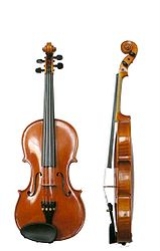
The
violin family of
musical instrumentA musical instrument is a device created or adapted for the purpose of making musical sounds. In principle, any object that produces sound can serve as a musical instrument—it is through purpose that the object becomes a musical instrument. The history of musical instruments dates back to the...
s was developed in
ItalyItaly , officially the Italian Republic languages]] under the European Charter for Regional or Minority Languages. In each of these, Italy's official name is as follows:;;;;;;;;), is a unitary parliamentary republic in South-Central Europe. To the north it borders France, Switzerland, Austria and...
in the sixteenth century. The standard modern violin family consists of the
violinThe violin is a string instrument, usually with four strings tuned in perfect fifths. It is the smallest, highest-pitched member of the violin family of string instruments, which includes the viola and cello....
,
violaThe viola is a bowed string instrument. It is the middle voice of the violin family, between the violin and the cello.- Form :The viola is similar in material and construction to the violin. A full-size viola's body is between and longer than the body of a full-size violin , with an average...
,
celloThe cello is a bowed string instrument with four strings tuned in perfect fifths. It is a member of the violin family of musical instruments, which also includes the violin, viola, and double bass. Old forms of the instrument in the Baroque era are baryton and viol .A person who plays a cello is...
, and
double bassThe double bass, also called the string bass, upright bass, standup bass or contrabass, is the largest and lowest-pitched bowed string instrument in the modern symphony orchestra, with strings usually tuned to E1, A1, D2 and G2...
.
Instrument names in the violin family are all derived from the root
viola, which is a derivative of the
Medieval LatinMedieval Latin was the form of Latin used in the Middle Ages, primarily as a medium of scholarly exchange and as the liturgical language of the medieval Roman Catholic Church, but also as a language of science, literature, law, and administration. Despite the clerical origin of many of its authors,...
word
vitula (meaning "stringed instrument"). A
violin is a "little viola", a
violone is a "big viola" or a
bass violinBass violin is the generic modern term used to denote various 16th- and 17th-century forms of bass instruments of the violin family. They were the direct ancestor of the modern cello. Bass violins were usually somewhat larger than the modern cello, but tuned the same or sometimes just one step...
, and a
violoncello (often abbreviated
cello) is a "small violone" (or, literally, a "small big viola"). (The
violoneThe term violone can refer to several distinct large, bowed musical instruments which belong to either the viol or violin family. The violone is sometimes a fretted instrument, and may have six, five, four, or even only three strings. The violone is also not always a contrabass instrument...
is not part of the modern violin family; its place is taken by the modern double bass, an instrument with a mix of violin and
violThe viol is any one of a family of bowed, fretted and stringed musical instruments developed in the mid-late 15th century and used primarily in the Renaissance and Baroque periods. The family is related to and descends primarily from the Renaissance vihuela, a plucked instrument that preceded the...
characteristics.)
The instruments of the violin family may be descended in part from the
lira da braccioThe lira da braccio was a European bowed string instrument of the Renaissance. It was used by Italian poet-musicians in court in the 15th and 16th centuries to accompany their improvised recitations of lyric and narrative poetry. It is most closely related to the medieval fiddle, or vielle, and...
and the medieval Byzantine lira.
 |
 |
 |
 |
ViolinThe violin is a string instrument, usually with four strings tuned in perfect fifths. It is the smallest, highest-pitched member of the violin family of string instruments, which includes the viola and cello.... |
ViolaThe viola is a bowed string instrument. It is the middle voice of the violin family, between the violin and the cello.- Form :The viola is similar in material and construction to the violin. A full-size viola's body is between and longer than the body of a full-size violin , with an average... |
Cello (violoncello)The cello is a bowed string instrument with four strings tuned in perfect fifths. It is a member of the violin family of musical instruments, which also includes the violin, viola, and double bass. Old forms of the instrument in the Baroque era are baryton and viol .A person who plays a cello is... |
Double bass (contrabass)The double bass, also called the string bass, upright bass, standup bass or contrabass, is the largest and lowest-pitched bowed string instrument in the modern symphony orchestra, with strings usually tuned to E1, A1, D2 and G2...
|
Characteristics
The playing ranges of the instruments in the violin family overlap each other, but the tone quality and physical size of each distinguishes them from one another. Both the violin and the viola are played under the jaw, the viola being the larger of the two instruments, with a playing range reaching a
perfect fifthIn classical music from Western culture, a fifth is a musical interval encompassing five staff positions , and the perfect fifth is a fifth spanning seven semitones, or in meantone, four diatonic semitones and three chromatic semitones...
below the violin's. The cello is played sitting down with the instrument between the knees, and its playing range reaches an
octaveIn music, an octave is the interval between one musical pitch and another with half or double its frequency. The octave relationship is a natural phenomenon that has been referred to as the "basic miracle of music", the use of which is "common in most musical systems"...
below the viola's. The double bass is played standing or sitting on a stool, with a range that typically reaches a
minor sixth-Subminor sixth:In music, a subminor sixth or septimal sixth is an interval that is noticeably narrower than a minor sixth but noticeably wider than a diminished sixth.The sub-minor sixth is an interval of a 14:9 ratio or alternately 11:7....
, an octave, or a
ninthIn music, a ninth is a compound interval consisting of an octave plus a second.Like the second, the interval of a ninth is classified as a dissonance in common practice tonality. Since a ninth is a larger than a second, its sonority level is considered less dense.-Major ninth:A major ninth is a...
below the cello's.
While the
celloThe cello is a bowed string instrument with four strings tuned in perfect fifths. It is a member of the violin family of musical instruments, which also includes the violin, viola, and double bass. Old forms of the instrument in the Baroque era are baryton and viol .A person who plays a cello is...
(which developed from the
bass violinBass violin is the generic modern term used to denote various 16th- and 17th-century forms of bass instruments of the violin family. They were the direct ancestor of the modern cello. Bass violins were usually somewhat larger than the modern cello, but tuned the same or sometimes just one step...
), the
violaThe viola is a bowed string instrument. It is the middle voice of the violin family, between the violin and the cello.- Form :The viola is similar in material and construction to the violin. A full-size viola's body is between and longer than the body of a full-size violin , with an average...
and the
violinThe violin is a string instrument, usually with four strings tuned in perfect fifths. It is the smallest, highest-pitched member of the violin family of string instruments, which includes the viola and cello....
are indisputable members of the ancestral violin, or
viola da braccio family, the
double bassThe double bass, also called the string bass, upright bass, standup bass or contrabass, is the largest and lowest-pitched bowed string instrument in the modern symphony orchestra, with strings usually tuned to E1, A1, D2 and G2...
's origins are sometimes called into question. The double bass is occasionally taken to be part of the
violThe viol is any one of a family of bowed, fretted and stringed musical instruments developed in the mid-late 15th century and used primarily in the Renaissance and Baroque periods. The family is related to and descends primarily from the Renaissance vihuela, a plucked instrument that preceded the...
family, due to its sloping shoulders, its tuning, the practice of some basses being made with more than four strings, and its sometimes flat back. Others point out that correlation does not imply causality, and say that these external similarities are either arbitrary, or that they arise from causes other than a relationship to the viol family. They point to the internal construction of the double bass, which includes a
sound postIn a string instrument, the sound post is a small dowel inside the instrument under the treble end of the bridge, spanning the space between the top and back plates and held in place by friction...
and a
bass barIn a string instrument, the bass bar is a brace running from the foot of the neck to a position under the bridge, which bears much of the tension of the strings. Bass bars are used:* In all members of the violin family;* In some archtop guitars;...
like other violin family instruments, as a more weighty piece of evidence than the external features. Its origins aside, it has historically been used as the lowest member of the violin family.
All
string instrumentA string instrument is a musical instrument that produces sound by means of vibrating strings. In the Hornbostel-Sachs scheme of musical instrument classification, used in organology, they are called chordophones...
s share similar form, parts, construction, and function, and the
violThe viol is any one of a family of bowed, fretted and stringed musical instruments developed in the mid-late 15th century and used primarily in the Renaissance and Baroque periods. The family is related to and descends primarily from the Renaissance vihuela, a plucked instrument that preceded the...
s bear a particularly close resemblance to the violin family. However, instruments in the violin family are set apart from viols by similarities in shape, in tuning practice, and in history. Violin family instruments have four
stringsA string is the vibrating element that produces sound in string instruments, such as the guitar, harp, piano, and members of the violin family. Strings are lengths of a flexible material kept under tension so that they may vibrate freely, but controllably. Strings may be "plain"...
each, are
tunedIn music, there are two common meanings for tuning:* Tuning practice, the act of tuning an instrument or voice.* Tuning systems, the various systems of pitches used to tune an instrument, and their theoretical bases.-Tuning practice:...
in fifths (except the double bass, which is tuned in fourths), are not
fretA fret is a raised portion on the neck of a stringed instrument, that extends generally across the full width of the neck. On most modern western instruments, frets are metal strips inserted into the fingerboard...
ted, and have four rounded bouts, and always have a sound post and a bass bar inside. In contrast, the viol family instruments usually have five to six strings with a fretted fingerboard, are tuned in fourths and thirds, often have sloping shoulders, and do not necessarily have a sound post or bass bar.
Uses
The instruments of the violin family are the most used
bowedIn music, a bow is moved across some part of a musical instrument, causing vibration which the instrument emits as sound. The vast majority of bows are used with string instruments, although some bows are used with musical saws and other bowed idiophones....
string instruments in the world today. Although all share a place in classical music, they are also used to a lesser degree in
jazzJazz is a musical style that originated at the beginning of the 20th century in African American communities in the Southern United States. It was born out of a mix of African and European music traditions. From its early development until the present, jazz has incorporated music from 19th and 20th...
,
electronic musicElectronic music is music that employs electronic musical instruments and electronic music technology in its production. In general a distinction can be made between sound produced using electromechanical means and that produced using electronic technology. Examples of electromechanical sound...
,
rockRock music is a genre of popular music that developed during and after the 1960s, particularly in the United Kingdom and the United States. It has its roots in 1940s and 1950s rock and roll, itself heavily influenced by rhythm and blues and country music...
, and other types of
popular musicPopular music belongs to any of a number of musical genres "having wide appeal" and is typically distributed to large audiences through the music industry. It stands in contrast to both art music and traditional music, which are typically disseminated academically or orally to smaller, local...
, where they are often amplified, or simply created to be used as
electric instrumentsAn electric violin is a violin equipped with an electronic output of its sound. The term most properly refers to an instrument purposely made to be electrified with built-in pickups, usually with a solid body...
. The violin is also used extensively in
fiddle music-Classical music:Since the Baroque era the violin has been one of the most important of all instruments in classical music, for several reasons. The tone of the violin stands out above other instruments, making it appropriate for playing a melody line. In the hands of a good player, the violin...
,
country musicCountry music is a popular American musical style that began in the rural Southern United States in the 1920s. It takes its roots from Western cowboy and folk music...
, and
folk musicFolk music is an English term encompassing both traditional folk music and contemporary folk music. The term originated in the 19th century. Traditional folk music has been defined in several ways: as music transmitted by mouth, as music of the lower classes, and as music with unknown composers....
. The double bass plays an indispensable part in both classical and jazz music forms.
One of the most popular and standardized groupings in classical
chamber musicChamber music is a form of classical music, written for a small group of instruments which traditionally could be accommodated in a palace chamber. Most broadly, it includes any art music that is performed by a small number of performers with one performer to a part...
, the
string quartetA string quartet is a musical ensemble of four string players – usually two violin players, a violist and a cellist – or a piece written to be performed by such a group...
, is composed entirely of instruments from the violin family: two violins, one viola and one cello. This similarity in the manner of sound production allows string quartets to blend their tone colour and
timbreIn music, timbre is the quality of a musical note or sound or tone that distinguishes different types of sound production, such as voices and musical instruments, such as string instruments, wind instruments, and percussion instruments. The physical characteristics of sound that determine the...
more easily than less homogeneous groups. This is particularly notable in comparison to the standard
wind quintetA wind quintet, also sometimes known as a woodwind quintet, is a group of five wind players . The term also applies to a composition for such a group....
, which, although composed entirely of wind instruments, includes four fundamentally different ways of producing musical
pitchPitch is an auditory perceptual property that allows the ordering of sounds on a frequency-related scale.Pitches are compared as "higher" and "lower" in the sense associated with musical melodies,...
.
Octobass
The
octobassThe octobass is an extremely large bowed string instrument constructed about 1850 in Paris by the French luthier Jean Baptiste Vuillaume...
, a larger version of the double bass, is a rarely used member of this family constructed in the 19th century. It is extremely unwieldy to play and thus has not found much acceptance; nevertheless, it can be found in some Romantic-era scores and is called for occasionally in modern works. The octobass is played standing and its range typically reaches an
octaveIn music, an octave is the interval between one musical pitch and another with half or double its frequency. The octave relationship is a natural phenomenon that has been referred to as the "basic miracle of music", the use of which is "common in most musical systems"...
below the double bass.
See also
- Violin octet
The violin octet is a family of stringed instruments developed in the 20th century primarily under the direction of the American luthier Carleen Hutchins. Each instrument is based directly on the traditional violin and shares its acoustical properties, with the goal of a richer and more homogeneous...
, an experiment in part to create an even more homogeneous blend of instruments related to the violin.
- String instrument
A string instrument is a musical instrument that produces sound by means of vibrating strings. In the Hornbostel-Sachs scheme of musical instrument classification, used in organology, they are called chordophones...
- String orchestra
A string orchestra is an orchestra composed solely or primarily of instruments from the string family. These instruments are the violin, the viola, the cello, the double bass , the piano, the harp, and sometimes percussion...
- List of string instruments
- Viol
The viol is any one of a family of bowed, fretted and stringed musical instruments developed in the mid-late 15th century and used primarily in the Renaissance and Baroque periods. The family is related to and descends primarily from the Renaissance vihuela, a plucked instrument that preceded the...
External links