

Sound post

Encyclopedia
In a string instrument
, the sound post is a small dowel
inside the instrument under the treble end of the bridge, spanning the space between the top and back plates and held in place by friction. It serves as a structural support for an archtop instrument, transfers sound from the top plate to the back plate and alters the tone of the instrument by changing the vibrational modes of the plates.
The sound post is sometimes referred to as the âme, a French
word meaning "soul". The bow has also been referred to as the soul of these instruments. The Italians use the same term, anima, for this.
Sound posts are used:
Soundpost adjustment is as much art as science, depending on the ears, experience, structural sense, and sensitive touch of the luthier. The rough guidelines in the following section outline the effects of various moves, but the interaction of all the factors involved keeps it from being a simple process. Moving the sound post has very complex consequences on the sound. In the end, it is the ear of the person doing the adjusting that determines the desired location of the post.
String instrument
A string instrument is a musical instrument that produces sound by means of vibrating strings. In the Hornbostel-Sachs scheme of musical instrument classification, used in organology, they are called chordophones...
, the sound post is a small dowel
Dowel
A dowel is a solid cylindrical rod, usually made of wood, plastic or metal. In its original manufactured form, dowel is called dowel rod.Dowel rod is employed in numerous, diverse applications. It is used to form axles in toys, as detents on gymnastics grips, as knitting needles, as structural...
inside the instrument under the treble end of the bridge, spanning the space between the top and back plates and held in place by friction. It serves as a structural support for an archtop instrument, transfers sound from the top plate to the back plate and alters the tone of the instrument by changing the vibrational modes of the plates.
The sound post is sometimes referred to as the âme, a French
French language
French is a Romance language spoken as a first language in France, the Romandy region in Switzerland, Wallonia and Brussels in Belgium, Monaco, the regions of Quebec and Acadia in Canada, and by various communities elsewhere. Second-language speakers of French are distributed throughout many parts...
word meaning "soul". The bow has also been referred to as the soul of these instruments. The Italians use the same term, anima, for this.
Sound posts are used:
- In all members of the violinViolinThe violin is a string instrument, usually with four strings tuned in perfect fifths. It is the smallest, highest-pitched member of the violin family of string instruments, which includes the viola and cello....
family; - In some members of the violViolThe viol is any one of a family of bowed, fretted and stringed musical instruments developed in the mid-late 15th century and used primarily in the Renaissance and Baroque periods. The family is related to and descends primarily from the Renaissance vihuela, a plucked instrument that preceded the...
family; - In some archtop guitarArchtop guitarAn archtop guitar is a steel-stringed acoustic or semi-acoustic guitar with a full body and a distinctive arched top, whose sound is particularly popular with blues and jazz players.Typically, an archtop guitar has:* 6 strings...
s; - In other string instruments.
Sound post adjustment
The position of the sound post inside a violin is critical, and moving it by very small amounts (as little as 0.5mm or 0.25mm, or less) can make a big difference in the sound quality and loudness of an instrument. Specialized tools for standing up or moving a sound post are commercially available. Often the pointed end of an S-shaped setter is sharpened with a file and left rough, to grip the post a bit better.Soundpost adjustment is as much art as science, depending on the ears, experience, structural sense, and sensitive touch of the luthier. The rough guidelines in the following section outline the effects of various moves, but the interaction of all the factors involved keeps it from being a simple process. Moving the sound post has very complex consequences on the sound. In the end, it is the ear of the person doing the adjusting that determines the desired location of the post.
Effect of position on the instrument
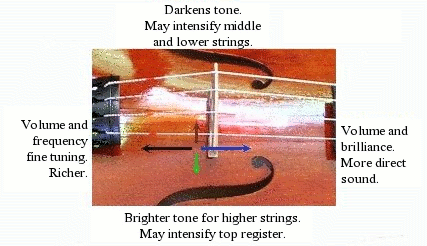
Moving the sound post towards the fingerboard tends to increase brilliance and loudness. Moving the sound post towards the tail piece decreases the loudness and adds a richness or hollowness to the tonal quality of the instrument. Moving it towards the outside of the instrument increases brightness and moving in towards the middle of the instrument increases the lower frequencies. There is very little room to move the post from side to side without fitting a new post (or shortening the existing one) since tension (how firmly the post is wedged between top and back) plays an important role in tone adjustment. Perfect wood-to-wood fit at both ends of the post is critical to getting the desired sound.External links
- How to Set a Sound Post (contains introduction to and theory of the sound post)
- Musical Instrument Makers Forum
- Violin Discussion Forum Section on building and maintaining violins
- Joseph Curtin on setups and sound post considerations