


Spinet

Encyclopedia
A spinet is a smaller type of harpsichord
or other keyboard instrument, such as a piano
or organ
.
The bentside spinet shares most of its characteristics with the full-size instrument, including action
, soundboard, and case construction. What primarily distinguishes the spinet is the angle of its strings: whereas in a full-size harpsichord, the strings are at a 90 degree angle to the keyboard (that is, they are parallel to the player's gaze); and in a virginals
they are parallel to the keyboard, in a spinet the strings are at an angle of about 30 degrees to the keyboard, going toward the right.
The case of a bentside spinet is approximately triangular. The side on the right is usually bent concavely (hence the name of the instrument), curving away from the player toward the right rear corner. The longest side is adjacent to and parallel with the bass strings, going from the right rear corner to a location on the player's left. The front side of the spinet contains the keyboard. Typically, there are very short sides at the right rear and on the left, connecting the bentside to the long side and the long side to the front. (Note that the spinet in the illustration has no such piece on its left corner.)
The other major aspect of spinet design is that the strings are arranged in pairs. The gap between the two strings of a pair is about four millimetres, and the wider gap between pairs is about ten. The jacks (which pluck the strings (see harpsichord
)) are arranged in pairs as well, placed in the wider gap. They face in opposite directions, plucking the adjacent string on either side of the wider gap. The fact that half of the gaps are four millimetres instead of ten makes it possible to crowd more strings together into a smaller case.
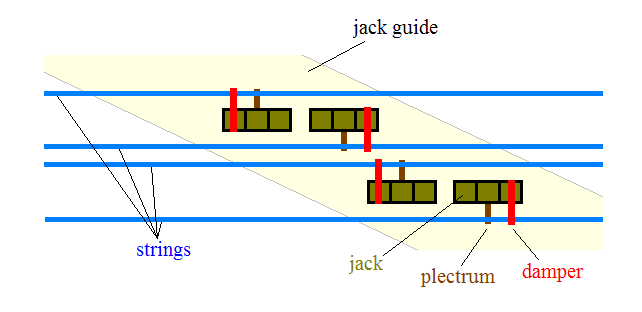 The disadvantage of the paired design is that it generally limits the spinet to a single choir of strings, at eight-foot pitch. In a full-size harpsichord, the registers that guide the jacks can be shifted slightly to one side, permitting the player to control whether or not that particular set of strings is sounded. This is impossible in a spinet, due to the alternating orientation of the jacks. For an exception to this point, see "spinettone", below.
The angling of the strings also had consequences for tone quality: generally, it was not possible to make the plucking points as close to the nut as in a regular harpsichord. Thus spinets normally had a slightly different tone quality, with fewer higher harmonic
s. Spinets also had smaller soundboards than regular harpsichords, and normally had a weaker sound. For these reasons, the spinet was normally only a domestic instrument, purchased to save money and conserve domestic space.
wrote in 1967, "the earliest [bentside] spinet known to me was made by Hieronymus de Zentis in 1631. It is quite possible that Zentis was the inventor of the type so widely copied in other countries." He further notes that the spinet in France was sometimes called the épinette à l'italienne, supporting an Italian origin.
The spinet was later developed into the spinettone
("big spinet") by Bartolomeo Cristofori
(1655–1731), the inventor of the piano
. The spinettone incorporated multiple choirs of strings, with a disposition
of 1 x 8', 1 x 4', and used the same ingenious mechanism for changing stops that Cristofori had earlier used for his oval spinet
. The spinettone was a local success among the musicians of the Medici
court (Montanari 2002), and Cristofori eventually built a total of four of them.
Spinets are occasionally made today, sometimes from kits, and serve the same purpose they always have, of saving money and space.
; its strings were parallel to the keyboard. Typically, the pentagonal spinet was more compact than other types of virginals, as the pentagon shape arose from lopping off the corners of the original rectangular virginal design.
 More generally, the word spinet was not always very sharply defined in former times, particularly in its French and Italian cognate forms épinette and spinetta. Thus, for example, when Bartolomeo Cristofori
invented a new kind of virginals in 1688, he called it the "spinetta ovale", "oval spinet
".
Spinet derives from the Italian
spinetta, which in 17th century Italian was a word used generally for all quilled instruments, especially what in Elizabethan/Jacobean English
were called virginals
. The specific Italian word for a virginal is spinetta a tabola. Likewise, the French derivation from spinetta, épinette, is specifically what the virginal is called in French, although the word is also used for any other small quilled instrument, whether a small harpsichord or a clavichord
.
A dumb spinet is a manichord or "clavichord
or clarichord
," according to the 1913 edition of Webster's Dictionary
.
The defining characteristic of the spinet was its drop action (sometimes called indirect blow action). In this device, the keys did not engage the action directly; rather they pulled upward on rods called "stickers," which in turn pulled upward on levers located below the level of the keyboard, which in turn engaged the action
. The stickers were sufficiently long that the hammer heads (the highest part of the action) ended up at roughly the same vertical level as the keyboard.
Thanks to the drop action, spinet pianos could be made very small; the top of a spinet rose only a few inches above the level of the keyboard itself. However, according to piano author Larry Fine
, the cost in quality was considerable. The stickers were "often noisy and troublesome." Moreover, to make room for them, the keys had to be made shorter, resulting in "very poor leverage" and thus a poor sense of touch and control for the player. Lastly, the very short strings of the spinet resulted in a narrow range of harmonics and thus in poor tone quality.
The spinet was also the bane of piano technicians. Concerning the difficulty of servicing them, Fine writes "Spinets ... are very difficult to service because even the smallest repair requiring removal of the action becomes a major ordeal. Each of the connecting stickers has to be disconnected and tied up to the action and all the keys have to be removed from the piano before the action can be lifted out."
. (According to Loesser, the price could be less than $300, "about twenty-five percent lower than ... a small upright of 1924.") Loesser notes that the spinet was not entirely new, as very small pianos had been manufactured at various times in the 19th century.
The discontinuation of spinet manufacture around the turn of the 21st century is perhaps attributable to the rise of the electronic piano
, which competed very effectively with spinets in price. Unlike better-quality pianos, the spinet could not compete with electronic instruments by offering superior touch or tone quality.
Harpsichord
A harpsichord is a musical instrument played by means of a keyboard. It produces sound by plucking a string when a key is pressed.In the narrow sense, "harpsichord" designates only the large wing-shaped instruments in which the strings are perpendicular to the keyboard...
or other keyboard instrument, such as a piano
Piano
The piano is a musical instrument played by means of a keyboard. It is one of the most popular instruments in the world. Widely used in classical and jazz music for solo performances, ensemble use, chamber music and accompaniment, the piano is also very popular as an aid to composing and rehearsal...
or organ
Organ (music)
The organ , is a keyboard instrument of one or more divisions, each played with its own keyboard operated either with the hands or with the feet. The organ is a relatively old musical instrument in the Western musical tradition, dating from the time of Ctesibius of Alexandria who is credited with...
.
Spinets as harpsichords
While the term spinet is used to designate a harpsichord, typically what is meant is the bentside spinet, described in this section. For other uses, see below.The bentside spinet shares most of its characteristics with the full-size instrument, including action
Action (music)
The term action, used in connection with stringed instruments, has two meanings, depending on whether the instrument is played with a keyboard or plucked by hand.-In keyboard instruments:...
, soundboard, and case construction. What primarily distinguishes the spinet is the angle of its strings: whereas in a full-size harpsichord, the strings are at a 90 degree angle to the keyboard (that is, they are parallel to the player's gaze); and in a virginals
Virginals
The virginals or virginal is a keyboard instrument of the harpsichord family...
they are parallel to the keyboard, in a spinet the strings are at an angle of about 30 degrees to the keyboard, going toward the right.
The case of a bentside spinet is approximately triangular. The side on the right is usually bent concavely (hence the name of the instrument), curving away from the player toward the right rear corner. The longest side is adjacent to and parallel with the bass strings, going from the right rear corner to a location on the player's left. The front side of the spinet contains the keyboard. Typically, there are very short sides at the right rear and on the left, connecting the bentside to the long side and the long side to the front. (Note that the spinet in the illustration has no such piece on its left corner.)
The other major aspect of spinet design is that the strings are arranged in pairs. The gap between the two strings of a pair is about four millimetres, and the wider gap between pairs is about ten. The jacks (which pluck the strings (see harpsichord
Harpsichord
A harpsichord is a musical instrument played by means of a keyboard. It produces sound by plucking a string when a key is pressed.In the narrow sense, "harpsichord" designates only the large wing-shaped instruments in which the strings are perpendicular to the keyboard...
)) are arranged in pairs as well, placed in the wider gap. They face in opposite directions, plucking the adjacent string on either side of the wider gap. The fact that half of the gaps are four millimetres instead of ten makes it possible to crowd more strings together into a smaller case.
The angling of the strings also had consequences for tone quality: generally, it was not possible to make the plucking points as close to the nut as in a regular harpsichord. Thus spinets normally had a slightly different tone quality, with fewer higher harmonic
Harmonic
A harmonic of a wave is a component frequency of the signal that is an integer multiple of the fundamental frequency, i.e. if the fundamental frequency is f, the harmonics have frequencies 2f, 3f, 4f, . . . etc. The harmonics have the property that they are all periodic at the fundamental...
s. Spinets also had smaller soundboards than regular harpsichords, and normally had a weaker sound. For these reasons, the spinet was normally only a domestic instrument, purchased to save money and conserve domestic space.
History
Harpsichord historian Frank HubbardFrank Hubbard
Frank Twombly Hubbard was an American harpsichord maker, a pioneer in the revival of historical methods of harpsichord building.-Student days:...
wrote in 1967, "the earliest [bentside] spinet known to me was made by Hieronymus de Zentis in 1631. It is quite possible that Zentis was the inventor of the type so widely copied in other countries." He further notes that the spinet in France was sometimes called the épinette à l'italienne, supporting an Italian origin.
The spinet was later developed into the spinettone
Spinettone
The spinettone was a kind of harpsichord invented in the late 17th century by Bartolomeo Cristofori, who was later the inventor of the piano...
("big spinet") by Bartolomeo Cristofori
Bartolomeo Cristofori
Bartolomeo Cristofori di Francesco was an Italian maker of musical instruments, generally regarded as the inventor of the piano.-Life:...
(1655–1731), the inventor of the piano
Piano
The piano is a musical instrument played by means of a keyboard. It is one of the most popular instruments in the world. Widely used in classical and jazz music for solo performances, ensemble use, chamber music and accompaniment, the piano is also very popular as an aid to composing and rehearsal...
. The spinettone incorporated multiple choirs of strings, with a disposition
Disposition (harpsichord)
The disposition of a harpsichord is the set of choirs of strings it contains. This article describes various dispositions and gives the standard notation for describing them....
of 1 x 8', 1 x 4', and used the same ingenious mechanism for changing stops that Cristofori had earlier used for his oval spinet
Oval spinet
The oval spinet is a type of harpsichord invented in the late 17th century by Bartolomeo Cristofori, the Italian instrument maker who later achieved fame for inventing the piano. The oval spinet was unusual for its shape, the arrangement of its strings, and for its mechanism for changing...
. The spinettone was a local success among the musicians of the Medici
Medici
The House of Medici or Famiglia de' Medici was a political dynasty, banking family and later royal house that first began to gather prominence under Cosimo de' Medici in the Republic of Florence during the late 14th century. The family originated in the Mugello region of the Tuscan countryside,...
court (Montanari 2002), and Cristofori eventually built a total of four of them.
Spinets are occasionally made today, sometimes from kits, and serve the same purpose they always have, of saving money and space.
Other uses of "spinet" for harpsichords
The pentagonal spinet was not a spinet in the sense given above, but rather a virginalsVirginals
The virginals or virginal is a keyboard instrument of the harpsichord family...
; its strings were parallel to the keyboard. Typically, the pentagonal spinet was more compact than other types of virginals, as the pentagon shape arose from lopping off the corners of the original rectangular virginal design.
Bartolomeo Cristofori
Bartolomeo Cristofori di Francesco was an Italian maker of musical instruments, generally regarded as the inventor of the piano.-Life:...
invented a new kind of virginals in 1688, he called it the "spinetta ovale", "oval spinet
Oval spinet
The oval spinet is a type of harpsichord invented in the late 17th century by Bartolomeo Cristofori, the Italian instrument maker who later achieved fame for inventing the piano. The oval spinet was unusual for its shape, the arrangement of its strings, and for its mechanism for changing...
".
Nomenclature
In earlier times when English spelling was less standardized, "spinet" was sometimes spelled "spinnet" or "spinnit". "Spinet" is standard today.Spinet derives from the Italian
Italian language
Italian is a Romance language spoken mainly in Europe: Italy, Switzerland, San Marino, Vatican City, by minorities in Malta, Monaco, Croatia, Slovenia, France, Libya, Eritrea, and Somalia, and by immigrant communities in the Americas and Australia...
spinetta, which in 17th century Italian was a word used generally for all quilled instruments, especially what in Elizabethan/Jacobean English
English language
English is a West Germanic language that arose in the Anglo-Saxon kingdoms of England and spread into what was to become south-east Scotland under the influence of the Anglian medieval kingdom of Northumbria...
were called virginals
Virginals
The virginals or virginal is a keyboard instrument of the harpsichord family...
. The specific Italian word for a virginal is spinetta a tabola. Likewise, the French derivation from spinetta, épinette, is specifically what the virginal is called in French, although the word is also used for any other small quilled instrument, whether a small harpsichord or a clavichord
Clavichord
The clavichord is a European stringed keyboard instrument known from the late Medieval, through the Renaissance, Baroque and Classical eras. Historically, it was widely used as a practice instrument and as an aid to composition, not being loud enough for larger performances. The clavichord produces...
.
A dumb spinet is a manichord or "clavichord
Clavichord
The clavichord is a European stringed keyboard instrument known from the late Medieval, through the Renaissance, Baroque and Classical eras. Historically, it was widely used as a practice instrument and as an aid to composition, not being loud enough for larger performances. The clavichord produces...
or clarichord
Clarichord
The clarichord, rest, clavicord or clarion is a rare charge in heraldry of uncertain origin and meaning. In Canadian heraldry, it is the cadency mark of a ninth daughter....
," according to the 1913 edition of Webster's Dictionary
Webster's Dictionary
Webster's Dictionary refers to the line of dictionaries first developed by Noah Webster in the early 19th century, and also to numerous unrelated dictionaries that added Webster's name just to share his prestige. The term is a genericized trademark in the U.S.A...
.
Spinets as pianos
The spinet piano, manufactured from the 1930s until recent times, was a culmination of a trend among manufacturers to make pianos smaller and cheaper. It served the purpose of making pianos available for a low price, for owners who had little space for a piano. Many spinet pianos still exist today, left over from their period of manufacture.The defining characteristic of the spinet was its drop action (sometimes called indirect blow action). In this device, the keys did not engage the action directly; rather they pulled upward on rods called "stickers," which in turn pulled upward on levers located below the level of the keyboard, which in turn engaged the action
Action (piano)
The piano action mechanism, or the key action mechanism, or simply the action of a piano or other musical keyboards, is the mechanical assembly which translates the depression of the keys into rapid motion of a hammer, which creates sound by striking the strings. Action can be referred to a pianos...
. The stickers were sufficiently long that the hammer heads (the highest part of the action) ended up at roughly the same vertical level as the keyboard.
Thanks to the drop action, spinet pianos could be made very small; the top of a spinet rose only a few inches above the level of the keyboard itself. However, according to piano author Larry Fine
Larry Fine (pianos)
Larry Fine is an American piano technician, consultant, and author. He is best known as the author of The Piano Book.The Piano Book, in its fourth edition, describes how pianos work, discusses and reviews many brands of pianos, tracks changes in the piano industry worldwide, describes the retail...
, the cost in quality was considerable. The stickers were "often noisy and troublesome." Moreover, to make room for them, the keys had to be made shorter, resulting in "very poor leverage" and thus a poor sense of touch and control for the player. Lastly, the very short strings of the spinet resulted in a narrow range of harmonics and thus in poor tone quality.
The spinet was also the bane of piano technicians. Concerning the difficulty of servicing them, Fine writes "Spinets ... are very difficult to service because even the smallest repair requiring removal of the action becomes a major ordeal. Each of the connecting stickers has to be disconnected and tied up to the action and all the keys have to be removed from the piano before the action can be lifted out."
History
According to piano historian Arthur Loesser (reference below), the first spinet piano was offered to the public in May 1935, by an American manufacturer Loesser does not identify. The instrument was initially a success, being the only kind of piano that many people could afford in the depths of the Great DepressionGreat Depression
The Great Depression was a severe worldwide economic depression in the decade preceding World War II. The timing of the Great Depression varied across nations, but in most countries it started in about 1929 and lasted until the late 1930s or early 1940s...
. (According to Loesser, the price could be less than $300, "about twenty-five percent lower than ... a small upright of 1924.") Loesser notes that the spinet was not entirely new, as very small pianos had been manufactured at various times in the 19th century.
The discontinuation of spinet manufacture around the turn of the 21st century is perhaps attributable to the rise of the electronic piano
Electronic piano
An electronic piano is a keyboard instrument designed to simulate the timbre of a piano using analog circuitry....
, which competed very effectively with spinets in price. Unlike better-quality pianos, the spinet could not compete with electronic instruments by offering superior touch or tone quality.
Harpsichord spinet
- Hubbard, Frank (1967) Three Centuries of Harpsichord Making. Cambridge, MA: Harvard University Press; ISBN 0-674-88845-6.
- Kottick, Edward (2003) A history of the harpsichord. Bloomington: Indiana University Press. ISBN 0253341663, 9780253341662.
- Montanari, Giuliana (2002) "The oval spinets and Grind Prince Ferdinando de' Medici's collection of quilled instruments," in La spinetta del 1690/The 1690 Oval Spinet, edited by Gabriele Rossi-Rognoni, (Sillabe for the Galleria dell’Accademia, Florence). Offers some information on the spinettone.
- The New Grove Dictionary of Music and Musicians (pay site on-line, and in many libraries) offers detailed coverage of the harpsichord spinet; see under "Spinet".
Piano spinet
- Fine, Larry (2001) The Piano Book (4th ed. Jamaica Plain, Massachusetts: Brookside Press, 2001; ISBN 1-929145-01-2)
- Loesser, Arthur [1954] (1991). Men, Women, and Pianos: A Social History. New York: Dover Publications. Originally New York: Simon and Schuster, 1954.