


Vihuela

Encyclopedia
Vihuela is a name given to two different guitar
-like string instrument
s: one from 15th and 16th century Spain
, usually with 12 paired strings, and the other, the Mexican vihuela
, from 19th century Mexico
with five strings and typically played in Mariachi
bands.
and Portugal
. The two names are functionally synonymous and interchangeable. In its most developed form, the vihuela was a guitar-like instrument with six double-strings (paired courses) made of gut
. Vihuelas were tuned almost like a modern guitar, with the exception of the third string, which was tuned a semitone lower. Six-course vihuela tuning was identical to six-course Renaissance lute
tuning—4ths and mid-3rd (44344). Many consider the vihuela to have been the instrument that decisively influenced the development of the modern guitar.
Plucked vihuela, being essentially flat-backed lutes, evolved in the mid-15th century, in the Kingdom of Aragón
(located in north-eastern Iberia (Spain), filling the gap that elsewhere in Europe was taken up by the lute; for the Spanish the lute was too close to the oud
. In Spain and Italy the vihuela was in common use by the late 15th through to the late 16th centuries. In the second half of the 15th century some vihuela players began using a bow, leading to the development of the viol
.
There were several different types of vihuela (or different playing methods at least):
Tunings for 6 course vihuela de mano (44344):
The vihuela faded away, along with the complex polyphonic music that was its repertoire, in the late 16th century, along with the other primary instrument of the Spanish Renaissance, the cross-strung harp
. The vihuela's descendants that are still played are the violas campaniças of Portugal
. Much of the vihuela's place, role, and function was taken up by the subsequent Baroque guitar
(also sometimes referred to as vihuela or bigüela). Today, the vihuela is in use primarily for the performance of early music
, using modern replicas of historical instruments. Juan Carlos Rivera, Juan Carlos de Mulder y Eligio Luis Quinteiro http://cayrasco.com are some of the leading performers of this historic instrument. Today, instruments like the tiple
are descendants of vihuelas brought to America in the 16th century.
Vihuela (and viola) were built in different sizes, large and small, a family of instruments. Duet music was published for vihuelas tuned one step, a minor third, a fourth, or a fifth apart, as well as unison tuned.
The physical appearance, "the look", of vihuela was varied and diverse—there was little standardization and no mass production. Overall and in general, vihuela looked very similar to modern guitars. The first generation of vihuela, from the mid-15th century on, had sharp cuts to its waist, similar to that of a violin. A second generation of vihuela, beginning sometime around c.1490, took on the now familiar smooth-curved figure-eight shaped body contours. The sharp waist-cut models continued to be built into the early-to-mid-16th century, side by side with the later pattern. Many early vihuela had extremely long necks, while others had the shorter variety. Top decoration, the number, shape, and placement, of sound holes, ports, pierced rosettes, etc., also varied greatly. More than a few styles of peg-boxes were used as well.
Vihuela were chromatically fretted in a manner similar to lutes, by means of movable, wrapped-around and tied-on gut frets. Vihuela, however, usually had ten frets, whereas lutes had only seven. Unlike modern guitars, which often use steel and bronze strings, vihuela were gut strung, and usually in paired courses. Gut strings produce a sonority far different from metal, generally described as softer and sweeter. A six course vihuela could be strung in either of two ways: with 12 strings in 6 pairs, or 11 strings in total if a single unpaired chanterelle is used on the first (or highest pitched) course. Unpaired chanterelles were common on all lute
s, vihuela, and (other) early guitars (both Renaissance guitars and Baroque guitar
s).
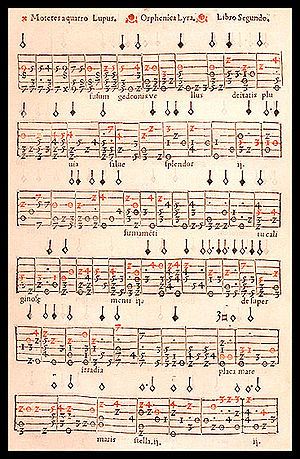 The first person to publish a collection of music for the vihuela was the Spanish composer Luis de Milán
, with his volume titled Libro de música de vihuela de mano intitulado El maestro of 1536. The notational device used throughout this and other vihuela music books is a numeric tablature
(otherwise called "lute tablature"), which is also the model from which modern "guitar tab" was fashioned. The music is easily performed on a modern guitar using either standard guitar tuning (44434), sometimes called "new lute tuning", or by retuning slightly to Classic lute and vihuela tuning (44344). The tablature system used in all these texts is the "Italian" tablature, wherein the stopped frets are indicated by numbers and the lowest line of the staff represents the highest-pitch course (or string), as if the performer were looking "through" the neck of the instrument; Milán's book also uses numbers to indicate the stopping of the courses but exceptionally it is the top line of the staff that represents the highest-pitch course, as in "French" tablature.
The printed books of music for the Vihuela which have survived are, in chronological order:
Guitar
The guitar is a plucked string instrument, usually played with fingers or a pick. The guitar consists of a body with a rigid neck to which the strings, generally six in number, are attached. Guitars are traditionally constructed of various woods and strung with animal gut or, more recently, with...
-like string instrument
String instrument
A string instrument is a musical instrument that produces sound by means of vibrating strings. In the Hornbostel-Sachs scheme of musical instrument classification, used in organology, they are called chordophones...
s: one from 15th and 16th century Spain
Spain
Spain , officially the Kingdom of Spain languages]] under the European Charter for Regional or Minority Languages. In each of these, Spain's official name is as follows:;;;;;;), is a country and member state of the European Union located in southwestern Europe on the Iberian Peninsula...
, usually with 12 paired strings, and the other, the Mexican vihuela
Mexican vihuela
Vihuela is the name of two different guitar-like string instruments: the historical vihuela of 16th century Spain, usually with 12 paired strings, and the Mexican vihuela from 19th century Mexico with five strings and typically played in mariachi groups.-Mexican vihuela:While the Mexican vihuela...
, from 19th century Mexico
Mexico
The United Mexican States , commonly known as Mexico , is a federal constitutional republic in North America. It is bordered on the north by the United States; on the south and west by the Pacific Ocean; on the southeast by Guatemala, Belize, and the Caribbean Sea; and on the east by the Gulf of...
with five strings and typically played in Mariachi
Mariachi
Mariachi is a genre of music that originated in the State of Jalisco, in Mexico. It is an integration of stringed instruments highly influenced by the cultural impacts of the historical development of Western Mexico. Throughout the history of mariachi, musicians have experimented with brass, wind,...
bands.
History
The vihuela, as it was known in Spain, was called the viola da mano in ItalyItaly
Italy , officially the Italian Republic languages]] under the European Charter for Regional or Minority Languages. In each of these, Italy's official name is as follows:;;;;;;;;), is a unitary parliamentary republic in South-Central Europe. To the north it borders France, Switzerland, Austria and...
and Portugal
Portugal
Portugal , officially the Portuguese Republic is a country situated in southwestern Europe on the Iberian Peninsula. Portugal is the westernmost country of Europe, and is bordered by the Atlantic Ocean to the West and South and by Spain to the North and East. The Atlantic archipelagos of the...
. The two names are functionally synonymous and interchangeable. In its most developed form, the vihuela was a guitar-like instrument with six double-strings (paired courses) made of gut
Catgut
Catgut is a type of cord that is prepared from the natural fibre found in the walls of animal intestines. Usually sheep or goat intestines are used, but it is occasionally made from the intestines of cattle, hogs, horses, mules, or donkeys.-Etymology:...
. Vihuelas were tuned almost like a modern guitar, with the exception of the third string, which was tuned a semitone lower. Six-course vihuela tuning was identical to six-course Renaissance lute
Lute
Lute can refer generally to any plucked string instrument with a neck and a deep round back, or more specifically to an instrument from the family of European lutes....
tuning—4ths and mid-3rd (44344). Many consider the vihuela to have been the instrument that decisively influenced the development of the modern guitar.
Plucked vihuela, being essentially flat-backed lutes, evolved in the mid-15th century, in the Kingdom of Aragón
Kingdom of Aragon
The Kingdom of Aragon was a medieval and early modern kingdom in the Iberian Peninsula, corresponding to the modern-day autonomous community of Aragon, in Spain...
(located in north-eastern Iberia (Spain), filling the gap that elsewhere in Europe was taken up by the lute; for the Spanish the lute was too close to the oud
Oud
The oud is a pear-shaped stringed instrument commonly used in North African and Middle Eastern music. The modern oud and the European lute both descend from a common ancestor via diverging paths...
. In Spain and Italy the vihuela was in common use by the late 15th through to the late 16th centuries. In the second half of the 15th century some vihuela players began using a bow, leading to the development of the viol
Viol
The viol is any one of a family of bowed, fretted and stringed musical instruments developed in the mid-late 15th century and used primarily in the Renaissance and Baroque periods. The family is related to and descends primarily from the Renaissance vihuela, a plucked instrument that preceded the...
.
There were several different types of vihuela (or different playing methods at least):
- Vihuela de mano — 6 or 5 courseCourse (music)A course is a pair or more of adjacent strings tuned to unison or an octave and usually played together as if a single string. It may also refer to a single string normally played on its own on an instrument with other multi-string courses, for example the bass string on a nine string baroque...
s played with the fingers - Vihuela de penola — played with a plectrum
- Vihuela de arco — played with a bow (ancestor of the viola da gambaViolThe viol is any one of a family of bowed, fretted and stringed musical instruments developed in the mid-late 15th century and used primarily in the Renaissance and Baroque periods. The family is related to and descends primarily from the Renaissance vihuela, a plucked instrument that preceded the...
)
Tunings for 6 course vihuela de mano (44344):
- G C F A D G
- C F Bb D G C
The vihuela faded away, along with the complex polyphonic music that was its repertoire, in the late 16th century, along with the other primary instrument of the Spanish Renaissance, the cross-strung harp
Cross-strung harp
The cross-strung harp is a multi-course harp that has two rows of strings which intersect without touching. While accidentals are played on the pedal harp via the pedals and on the lever harp with levers, the cross-strung harp features two rows so that each of the twelve semitones of the chromatic...
. The vihuela's descendants that are still played are the violas campaniças of Portugal
Portugal
Portugal , officially the Portuguese Republic is a country situated in southwestern Europe on the Iberian Peninsula. Portugal is the westernmost country of Europe, and is bordered by the Atlantic Ocean to the West and South and by Spain to the North and East. The Atlantic archipelagos of the...
. Much of the vihuela's place, role, and function was taken up by the subsequent Baroque guitar
Baroque guitar
The Baroque guitar is a guitar from the baroque era , an ancestor of the modern classical guitar. The term is also used for modern instruments made in the same style....
(also sometimes referred to as vihuela or bigüela). Today, the vihuela is in use primarily for the performance of early music
Early music
Early music is generally understood as comprising all music from the earliest times up to the Renaissance. However, today this term has come to include "any music for which a historically appropriate style of performance must be reconstructed on the basis of surviving scores, treatises,...
, using modern replicas of historical instruments. Juan Carlos Rivera, Juan Carlos de Mulder y Eligio Luis Quinteiro http://cayrasco.com are some of the leading performers of this historic instrument. Today, instruments like the tiple
Tiple
Tiple is the Spanish word for treble or soprano, is often applied to specific instruments, generally to refer to a small chordophone of the guitar family. A tiple player is called a tiplista.-Colombian tiple:...
are descendants of vihuelas brought to America in the 16th century.
Construction
Vihuela bodies were lightly constructed from thin flat slabs or pieces of wood, bent or curved as required. This construction method distinguished them from some earlier types of string instruments whose bodies (if not the entire instrument including neck) were carved out from a solid single block of wood. The back and sides of common lutes were also made of pieces however, being multiple curved or bent staves joined and glued together to form a bowl. Made from Cypress with a Spruce or Cedar top.Vihuela (and viola) were built in different sizes, large and small, a family of instruments. Duet music was published for vihuelas tuned one step, a minor third, a fourth, or a fifth apart, as well as unison tuned.
The physical appearance, "the look", of vihuela was varied and diverse—there was little standardization and no mass production. Overall and in general, vihuela looked very similar to modern guitars. The first generation of vihuela, from the mid-15th century on, had sharp cuts to its waist, similar to that of a violin. A second generation of vihuela, beginning sometime around c.1490, took on the now familiar smooth-curved figure-eight shaped body contours. The sharp waist-cut models continued to be built into the early-to-mid-16th century, side by side with the later pattern. Many early vihuela had extremely long necks, while others had the shorter variety. Top decoration, the number, shape, and placement, of sound holes, ports, pierced rosettes, etc., also varied greatly. More than a few styles of peg-boxes were used as well.
Vihuela were chromatically fretted in a manner similar to lutes, by means of movable, wrapped-around and tied-on gut frets. Vihuela, however, usually had ten frets, whereas lutes had only seven. Unlike modern guitars, which often use steel and bronze strings, vihuela were gut strung, and usually in paired courses. Gut strings produce a sonority far different from metal, generally described as softer and sweeter. A six course vihuela could be strung in either of two ways: with 12 strings in 6 pairs, or 11 strings in total if a single unpaired chanterelle is used on the first (or highest pitched) course. Unpaired chanterelles were common on all lute
Lute
Lute can refer generally to any plucked string instrument with a neck and a deep round back, or more specifically to an instrument from the family of European lutes....
s, vihuela, and (other) early guitars (both Renaissance guitars and Baroque guitar
Baroque guitar
The Baroque guitar is a guitar from the baroque era , an ancestor of the modern classical guitar. The term is also used for modern instruments made in the same style....
s).
Repertoire
Luis de Milán
Luis de Milán was a Spanish Renaissance composer, vihuelist , and writer on music...
, with his volume titled Libro de música de vihuela de mano intitulado El maestro of 1536. The notational device used throughout this and other vihuela music books is a numeric tablature
Tablature
Tablature is a form of musical notation indicating instrument fingering rather than musical pitches....
(otherwise called "lute tablature"), which is also the model from which modern "guitar tab" was fashioned. The music is easily performed on a modern guitar using either standard guitar tuning (44434), sometimes called "new lute tuning", or by retuning slightly to Classic lute and vihuela tuning (44344). The tablature system used in all these texts is the "Italian" tablature, wherein the stopped frets are indicated by numbers and the lowest line of the staff represents the highest-pitch course (or string), as if the performer were looking "through" the neck of the instrument; Milán's book also uses numbers to indicate the stopping of the courses but exceptionally it is the top line of the staff that represents the highest-pitch course, as in "French" tablature.
The printed books of music for the Vihuela which have survived are, in chronological order:
- El Maestro by Luis de MilánLuis de MilánLuis de Milán was a Spanish Renaissance composer, vihuelist , and writer on music...
(1536) - Los seys libros del Delphin by Luis de NarváezLuis de NarváezLuis de Narváez was a Spanish composer and vihuelist. Highly regarded during his lifetime, Narváez is known today for Los seys libros del delphín, a collection of polyphonic music for the vihuela which includes the earliest known variation sets...
(1538) - Tres Libros de Música by Alonso MudarraAlonso MudarraAlonso Mudarra was a Spanish composer and vihuelist of the Renaissance. He was an innovative composer of instrumental music as well as songs, and was the composer of the earliest surviving music for the guitar....
(1546) - Silva de sirenas by Enríquez de ValderrábanoEnríquez de ValderrábanoEnríquez de Valderrábano was a Spanish vihuelist and composer. There is little biographical data on this composer of early music, but there is some from the prologue to his book of music, Libro de música de vihuela intitulado Silva de Sirenas, published in Valladolid, Spain in 1547...
(1547) - Libro de música de Vihuela by Diego PisadorDiego PisadorDiego Pisador was a Spanish vihuelist and composer of the Renaissance.-Life:Little is known of the details of Pisador's life, not even the exact dates of his birth and death. It is known that he was born in Salamanca around the years 1509 or 10. He was the oldest son of Alonso Pisador and Isabel...
(1552) - Orphénica Lyra by Miguel de FuenllanaMiguel de FuenllanaMiguel de Fuenllana was a Spanish vihuelist and composer of the Renaissance.-Biography:Little is known of his life. It is assumed from his name that his roots lie in the municipality of Fuenllana, in the province of Ciudad Real, although he was born in Navalcarnero, Madrid...
(1554) - El Parnasso by Estevan Daça (1576).
Surviving instruments
There are only three definite surviving vihuela:- the well-known example in the Musée Jacquemart-Andrée, the 'Guadalupe' vihuela;
- the recently re-discovered 'Chambure' instrument in the Cité de la Musique (both of the above in Paris)
- an instrument in the Iglesia de la Compañia de Jesús de Quito, in Quito, Ecuador.
Other possible surviving instruments
- the Portuguese 'Dias' vihuela in the Royal College of Music (London)
- a relic of Saint Mariana de Jesús (1618–1645), kept in the Iglesia de la Compañia de Jesús de Quito.
Discography
- Delphin (with Vihuela sound samples)
- http://www.rmguitar.info/vihuela.htm - many free mp3 downloads
External links
- Sociedad de la Vihuela
- Lex Eisenhardt, vihuelist
- lutesandguitars.co.uk Stephen Barber & Sandi Harris, lutemakers and researchers
- vihuelademano.com Alexander Batov, vihuela maker and researcher
- Capilla Cayrasco & Camerata Cayrasco, director Eligio Luis Quinteiro http://www.cayrasco.com
- Goldberg magazine: Los dos rinacimintos de la vihuela The 20th-century resuscitation of the vihuela.
- Several photos of Spanish vihuelas can be found among the instrument photos at Wayne Cripps's lute pages.
- liuteriadinsieme.it Liuteria d'insieme: lutemakers and researchers