


Vienna Awards

Encyclopedia
The Vienna Awards are two arbitral awards by which arbiters of Nazi Germany
and Fascist Italy
sought to enforce peacefully the claims of Hungary
on territory it had lost in 1920 when it signed the Treaty of Trianon
. The First Vienna Award
occurred in 1938 and the Second
in 1940.
The awards sanctioned Hungary's annexation of territories in present-day Slovakia
, Ukraine
and Romania
which Hungary had sought to regain in the period between the two World Wars.
They are also known by various such names, such as the Vienna Arbitration Awards, Vienna Arbitral Awards, Viennese Arbitrals, Viennese Arbitrages, which are all variation of the same and express no different value judgement on its content. There is, however, also the substantially different name Vienna Diktats, expressing the point of view of the countries which stood to lose territory as a result.
The awards were overturned following the defeat of Germany in 1945, and Hungary lost again all of the territory it had gained.
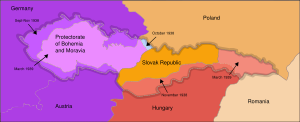 By this award, Germany and Italy compelled Czechoslovakia
to cede southern Slovakia
and southern Subcarpathia
(now in Ukraine) to Hungary
on 2 November 1938.
 By this award, Germany and Italy compelled Romania
to cede half of Transylvania
(an area henceforth known as Northern Transylvania
) to Hungary
on 30 August 1940. This decision was taken not so much to do justice as to win Hungary for German war aims. In reversing a major element of the Treaty of Trianon
, it, like Trianon, granted a multiethnic area to another country, caused massive migration of populations from both sides, and sundered old socioeconomic units.
In addition to the Second Vienna Award, on 7 September 1940 the Cadrilater or "Quadrilateral" (southern Dobrudja) was given by Romania
to Bulgaria
under the Treaty of Craiova
. It had been part of Romania since 1913, after Bulgaria's defeat in the Second Balkan War
.
Nazi Germany
Nazi Germany , also known as the Third Reich , but officially called German Reich from 1933 to 1943 and Greater German Reich from 26 June 1943 onward, is the name commonly used to refer to the state of Germany from 1933 to 1945, when it was a totalitarian dictatorship ruled by...
and Fascist Italy
Kingdom of Italy (1861–1946)
The Kingdom of Italy was a state forged in 1861 by the unification of Italy under the influence of the Kingdom of Sardinia, which was its legal predecessor state...
sought to enforce peacefully the claims of Hungary
Hungary
Hungary , officially the Republic of Hungary , is a landlocked country in Central Europe. It is situated in the Carpathian Basin and is bordered by Slovakia to the north, Ukraine and Romania to the east, Serbia and Croatia to the south, Slovenia to the southwest and Austria to the west. The...
on territory it had lost in 1920 when it signed the Treaty of Trianon
Treaty of Trianon
The Treaty of Trianon was the peace agreement signed in 1920, at the end of World War I, between the Allies of World War I and Hungary . The treaty greatly redefined and reduced Hungary's borders. From its borders before World War I, it lost 72% of its territory, which was reduced from to...
. The First Vienna Award
First Vienna Award
The First Vienna Award was the result of the First Vienna Arbitration, which took place at Vienna's Belvedere Palace on November 2, 1938. The Arbitration and Award were direct consequences of the Munich Agreement...
occurred in 1938 and the Second
Second Vienna Award
The Second Vienna Award was the second of two Vienna Awards arbitrated by the Nazi Germany and Fascist Italy. Rendered on August 30, 1940, it re-assigned the territory of Northern Transylvania from Romania to Hungary.-Prelude and historical background :After the World War I, the multi-ethnic...
in 1940.
The awards sanctioned Hungary's annexation of territories in present-day Slovakia
Slovakia
The Slovak Republic is a landlocked state in Central Europe. It has a population of over five million and an area of about . Slovakia is bordered by the Czech Republic and Austria to the west, Poland to the north, Ukraine to the east and Hungary to the south...
, Ukraine
Ukraine
Ukraine is a country in Eastern Europe. It has an area of 603,628 km², making it the second largest contiguous country on the European continent, after Russia...
and Romania
Romania
Romania is a country located at the crossroads of Central and Southeastern Europe, on the Lower Danube, within and outside the Carpathian arch, bordering on the Black Sea...
which Hungary had sought to regain in the period between the two World Wars.
They are also known by various such names, such as the Vienna Arbitration Awards, Vienna Arbitral Awards, Viennese Arbitrals, Viennese Arbitrages, which are all variation of the same and express no different value judgement on its content. There is, however, also the substantially different name Vienna Diktats, expressing the point of view of the countries which stood to lose territory as a result.
The awards were overturned following the defeat of Germany in 1945, and Hungary lost again all of the territory it had gained.
First Vienna Award
Czechoslovakia
Czechoslovakia or Czecho-Slovakia was a sovereign state in Central Europe which existed from October 1918, when it declared its independence from the Austro-Hungarian Empire, until 1992...
to cede southern Slovakia
Slovakia
The Slovak Republic is a landlocked state in Central Europe. It has a population of over five million and an area of about . Slovakia is bordered by the Czech Republic and Austria to the west, Poland to the north, Ukraine to the east and Hungary to the south...
and southern Subcarpathia
Carpathian Ruthenia
Carpathian Ruthenia is a region in Eastern Europe, mostly located in western Ukraine's Zakarpattia Oblast , with smaller parts in easternmost Slovakia , Poland's Lemkovyna and Romanian Maramureş.It is...
(now in Ukraine) to Hungary
Hungary
Hungary , officially the Republic of Hungary , is a landlocked country in Central Europe. It is situated in the Carpathian Basin and is bordered by Slovakia to the north, Ukraine and Romania to the east, Serbia and Croatia to the south, Slovenia to the southwest and Austria to the west. The...
on 2 November 1938.
Second Vienna Award
Romania
Romania is a country located at the crossroads of Central and Southeastern Europe, on the Lower Danube, within and outside the Carpathian arch, bordering on the Black Sea...
to cede half of Transylvania
Transylvania
Transylvania is a historical region in the central part of Romania. Bounded on the east and south by the Carpathian mountain range, historical Transylvania extended in the west to the Apuseni Mountains; however, the term sometimes encompasses not only Transylvania proper, but also the historical...
(an area henceforth known as Northern Transylvania
Northern Transylvania
Northern Transylvania is a region of Transylvania, situated within the territory of Romania. The population is largely composed of both ethnic Romanians and Hungarians, and the region has been part of Romania since 1918 . During World War II, as a consequence of the territorial agreement known as...
) to Hungary
Hungary
Hungary , officially the Republic of Hungary , is a landlocked country in Central Europe. It is situated in the Carpathian Basin and is bordered by Slovakia to the north, Ukraine and Romania to the east, Serbia and Croatia to the south, Slovenia to the southwest and Austria to the west. The...
on 30 August 1940. This decision was taken not so much to do justice as to win Hungary for German war aims. In reversing a major element of the Treaty of Trianon
Treaty of Trianon
The Treaty of Trianon was the peace agreement signed in 1920, at the end of World War I, between the Allies of World War I and Hungary . The treaty greatly redefined and reduced Hungary's borders. From its borders before World War I, it lost 72% of its territory, which was reduced from to...
, it, like Trianon, granted a multiethnic area to another country, caused massive migration of populations from both sides, and sundered old socioeconomic units.
In addition to the Second Vienna Award, on 7 September 1940 the Cadrilater or "Quadrilateral" (southern Dobrudja) was given by Romania
Romania
Romania is a country located at the crossroads of Central and Southeastern Europe, on the Lower Danube, within and outside the Carpathian arch, bordering on the Black Sea...
to Bulgaria
Bulgaria
Bulgaria , officially the Republic of Bulgaria , is a parliamentary democracy within a unitary constitutional republic in Southeast Europe. The country borders Romania to the north, Serbia and Macedonia to the west, Greece and Turkey to the south, as well as the Black Sea to the east...
under the Treaty of Craiova
Treaty of Craiova
The Treaty of Craiova was signed on 7 September 1940 between the Kingdom of Bulgaria and the Kingdom of Romania. Under the terms of this treaty, Romania returned the southern part of Dobruja to Bulgaria and agreed to participate in organizing a population exchange...
. It had been part of Romania since 1913, after Bulgaria's defeat in the Second Balkan War
Second Balkan War
The Second Balkan War was a conflict which broke out when Bulgaria, dissatisfied with its share of the spoils of the First Balkan War, attacked its former allies, Serbia and Greece, on 29 June 1913. Bulgaria had a prewar agreement about the division of region of Macedonia...
.