

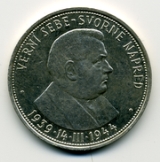
Jozef Tiso

Encyclopedia
Jozef Tiso was a Slovak Roman Catholic priest, politician
of the Slovak People's Party
, and Nazi collaborator. Between 1939 and 1945, Tiso was the head of the Slovak State, a satellite state
of Nazi Germany
. After the end of World War II
, Tiso was convicted and hanged for his activities in support of Nazism
.
(present-day Bytča, Slovakia) to Slovak parents in Austria-Hungary
. The Bishop of Nitra
(Nyitra), Imre Bende, offered Tiso a chance to study for the priesthood, and, in 1911, Tiso graduated from the prestigious Pázmáneum in Vienna
. His early ministry was spent as an assistant priest in three parishes in today's Slovakia. After brief frontline service as a field curate in World War I, he was appointed as the Spiritual Director of the Nitra seminary by Bende's successor, Vilmos Batthyány. Tiso was also active at this time as a school teacher and journalist. His articles for the local paper would later be controversial because of their strong support for the Hungarian war cause.
With the collapse of Austria-Hungary and the creation of Czechoslovakia in 1918, Tiso suddenly embraced politics as a career, at the same time declaring himself in public as a Slovak. Within a few weeks, he had joined the Slovak People's Party
. From 1921 to 1923, he served as the secretary to the new Slovak bishop of Nitra, Karol Kmeťko. During the same period, political agitation earned Tiso two convictions for incitement, one of which resulted in a short incarceration. Displeased, Kmeťko dropped him as secretary in 1923, but retained him as a Professor of Theology. In 1924, Tiso left Nitra to become parish priest and then dean
of Bánovce nad Bebravou. His dedication to this parish would become legendary, and he would remain its very active priest even during his presidency.
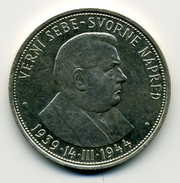
(otherwise known as the Ľudáks), which had been founded by Father Andrej Hlinka
in 1913, while Austria-Hungary
still ruled Slovakia. The party's interwar platform demanded the autonomy of Slovakia within a Czechoslovak framework. After 1925, the Ľudáks were the largest party in Slovakia. They were one of two explicitly Slovak parties in Slovakia, the others either representing national minorities or structuring themselves as Czechoslovak. Although Tiso seemed destined in the late 1920s to soon succeed Hlinka, he spent the 1930s instead competing for Hlinka's mantle with party radicals, most notably Karol Sidor
. When Hlinka died in 1938, Tiso emerged only as de facto leader of the party. He, however, quickly consolidated his control of the party, becoming its undisputed chairman in fall 1939.
Tiso first ran for parliament in 1920. Although the electoral results from his district were bright spots in what was otherwise a disappointing election for the Ľudáks, the party did not reward him with a legislative seat. Tiso, however, easily claimed one in the 1925 election, which also resulted in a breakthrough victory for the party. Until 1938, he was a fixture in the Czechoslovak parliament in Prague
. From 1927 to 1929, in a failed attempt to integrate the Ľudáks into the Czechoslovak polity, he also served as the Czechoslovak Minister of Health and Physical Education.
Adolf Hitler
's Germany
annexed the Sudetenland
(the German part of Czechoslovakia) and the Czechoslovak president Edvard Beneš
fled the country in October 1938. During the chaos which resulted, the Slovaks (who had lacked any form of autonomy within Czechoslovakia) declared their autonomy within Czechoslovakia and Tiso, as leader of the Slovak People's Party, became (until 9 March 1939) the premier
of the autonomous Slovak region. Hungary
, having never really accepted the separation of Slovakia from its control in 1918, took advantage of the situation and managed to persuade Germany
and Italy
to force Slovakia to let Hungarian troops occupy one third of Slovak territory in November 1938, by the so-called Vienna Award (Vienna Arbitration).
In the light of this situation, all Czech or Slovak political parties in Slovakia (except for the Communists) voluntarily joined forces and set up the "Hlinka's Slovak People's Party - Party of Slovak National Unity" in November 1938, which created the basis for the future authoritarian regime in Slovakia. (The same happened in the Czech part of the country two weeks later for Czech parties.) In January 1939, the Slovak government officially prohibited all parties apart from the Party of Slovak National Unity, the "Deutsche Partei" (a party of Germans in Slovakia) and the "Unified Hungarian Party" (a party of Hungarians in Slovakia).
From February 1939, representatives of Germany - planning to occupy the Czech part and basically not interested in Slovakia - started to officially persuade Slovak politicians to declare the independence of Slovakia. On 9 March 1939, Czech troops occupied Slovakia and Tiso lost his post of Prime Minister. On 13 March 1939, Adolf Hitler
lost his patience. He invited Tiso - as the deposed prime minister - to Berlin, and personally forced him to immediately (as he said "in a flash") declare the independence of Slovakia under German "protection", otherwise Germany would allow Hungary (and partly Poland
) to annex the remaining territory of Slovakia. Under these circumstances, Tiso spoke by phone to the Czechoslovak president Emil Hácha
and to the then Prime Minister of Slovakia, Karol Sidor
, and they agreed to convene the Slovak parliament the next day and let it decide. On March 14, the Slovak parliament unanimously declared the independence of Slovakia, and on March 15, Germany invaded the remaining Czech lands - exactly according to German plans.
Tiso served as the Prime Minister of independent Slovakia from 14 March 1939 until 26 October 1939. On 26 October he became President of Slovakia (separate from the Prime Ministerial office). On October 1, 1939 he officially became the president of the Slovak People's Party. According to the pro-Nazi nationalist fashion, from 1942 he was self-styled Vodca "Leader", an imitation in the national language of Führer
(compare in that article).
.
The Slovak People's Party functioned as almost the sole legal political organisation in Slovakia. The Party under Tiso's leadership aligned itself with Nazi policy on anti-Semitic
legislation in Slovakia. This was no hard task, given Hlinka's policy of a "Slovakia for the Slovaks", a line vehemently adhered to by Jozef Tiso. The respective main act was the so-called Jewish Code. Under the anti-Semitic Jewish Code, Jews in Slovakia could not own any real estate or luxury goods, were excluded from public jobs and free occupations, could not participate in sport or cultural events, were excluded from secondary schools and universities, and were required to wear the star of David in public. Tiso himself - like many people in Central Europe at that time - had definite anti-Semitic views (as some of his own letters from the end of World War II suggest). In general, opinions differ widely on his role in the Jewish deportations from Slovakia, but it is known that he adhered to the Nazi line to a considerable extent. The Slovak Parliament accepted a bill (May 1942) unanimously deciding the deportation of the Jews. It may be interesting to note that the only voice (vote) disagreeing came from the representative of the Hungarian minority in Slovakia (Eszterhazy). Some sources prefer the view that Tiso supported the deportations tacitly; other sources point out that the first deportations had to take place secretly behind his back due to his "personal opposition". As to the then Slovak government, however, documents concerning the holocaust in Slovakia (such as E.Niznansky et al. (eds.), Holokaust na Slovensku, vols. 1-5. Bratislava: NMS/ZNO, 2001-2004) prove that the Slovak government consentingly cooperated with the Nazis and even somewhat helped coordinate the deportations. In fact, Hitler praised the policy concerning the Jews of Slovakia in a meeting with Tiso in the Klessheim Castle in Salzburg
(Ostmark
) on 22 April 1942.
The deportations of Jews from Slovakia started in March 1942. "By the end of June 1942, some 52,000 Slovak Jews had been deported, mainly to Auschwitz and to their death. Then, however, the deportations slowed to a standstill. The intervention of the Vatican, followed by the bribing of Slovak officials upon the initiative of a group of local Jews ["Working Group"] did eventually play a role...That bribing the Slovaks contributed to a halt in the deportations for two years is most likely...". The deportations were stopped - despite heavy opposition from Germany, which demanded their resumption - in October 1942 by Slovaks, when it became clear that Nazi Germany had not "only" abused the Slovakian Jews as forced labour workers but had also executed many of them in death camps, and when public protests arose as well as pressure from the Holy See
to stop the deportations of Jewish civilians. Slovakia became the first state in the Nazi sphere to stop deportations of Jews, but some 58,000 Jews (75% of Slovak Jewry) had already suffered deportation, mostly to Auschwitz
, of whom only a minority survived. Between October 1942 and October 1944, an independent Slovakia even served as a safe last resort for Jews suffering persecution in Nazi-occupied neighbouring countries such as annexed Austria, the Protectorate of Bohemia and Moravia
, Poland and occupied Ukraine.
Jewish deportations were resumed by German occupation authorities in October 1944 after the Soviet
army reached the Slovak border and the Slovak National Uprising
took place. As a result of the Uprising and the approach of the Soviet forces, Nazi Germany decided to occupy all of Slovakia. Although the Germans allowed Tiso to remain in office, under their occupation his presidency was relegated to a mostly titular role as Slovakia lost whatever de facto independence it still had. During the 1944-1945 German occupation, another 13,500 Jews were deported and 5,000 imprisoned. Some were murdered in Slovakia itself, in particular at Kremnicka and Nemecka.
, treason of the Slovak National Uprising
and collaboration with Nazism
". On 15 April 1947, the National court (Národný súd) sentenced him to death. President Edvard Beneš
declined to grant a reprieve, despite Tiso's popularity among the Slovaks and the threat of a rift between the Czech-dominated government and the Slovak minority. Wearing his clerical outfit, Msgr. Jozef Tiso was hanged
in Bratislava on 18 April 1947. The Czechoslovak government buried him secretly to avoid having his grave become a shrine.
Politician
A politician, political leader, or political figure is an individual who is involved in influencing public policy and decision making...
of the Slovak People's Party
Slovak People's Party
The Slovak People's Party was a Slovak right-wing party and was described as a fascist and...
, and Nazi collaborator. Between 1939 and 1945, Tiso was the head of the Slovak State, a satellite state
Satellite state
A satellite state is a political term that refers to a country that is formally independent, but under heavy political and economic influence or control by another country...
of Nazi Germany
Nazi Germany
Nazi Germany , also known as the Third Reich , but officially called German Reich from 1933 to 1943 and Greater German Reich from 26 June 1943 onward, is the name commonly used to refer to the state of Germany from 1933 to 1945, when it was a totalitarian dictatorship ruled by...
. After the end of World War II
World War II
World War II, or the Second World War , was a global conflict lasting from 1939 to 1945, involving most of the world's nations—including all of the great powers—eventually forming two opposing military alliances: the Allies and the Axis...
, Tiso was convicted and hanged for his activities in support of Nazism
Nazism
Nazism, the common short form name of National Socialism was the ideology and practice of the Nazi Party and of Nazi Germany...
.
Early life
Born in NagybiccseBytca
Bytča is a town in northwestern Slovakia. It is located at the Váh river near the cities of Žilina and Považská Bystrica. It belongs to Upper Váh region of tourism.-History:...
(present-day Bytča, Slovakia) to Slovak parents in Austria-Hungary
Austria-Hungary
Austria-Hungary , more formally known as the Kingdoms and Lands Represented in the Imperial Council and the Lands of the Holy Hungarian Crown of Saint Stephen, was a constitutional monarchic union between the crowns of the Austrian Empire and the Kingdom of Hungary in...
. The Bishop of Nitra
Nitra
Nitra is a city in western Slovakia, situated at the foot of Zobor Mountain in the valley of the river Nitra. With a population of about 83,572, it is the fifth largest city in Slovakia. Nitra is also one of the oldest cities in Slovakia and the country's earliest political and cultural center...
(Nyitra), Imre Bende, offered Tiso a chance to study for the priesthood, and, in 1911, Tiso graduated from the prestigious Pázmáneum in Vienna
Vienna
Vienna is the capital and largest city of the Republic of Austria and one of the nine states of Austria. Vienna is Austria's primary city, with a population of about 1.723 million , and is by far the largest city in Austria, as well as its cultural, economic, and political centre...
. His early ministry was spent as an assistant priest in three parishes in today's Slovakia. After brief frontline service as a field curate in World War I, he was appointed as the Spiritual Director of the Nitra seminary by Bende's successor, Vilmos Batthyány. Tiso was also active at this time as a school teacher and journalist. His articles for the local paper would later be controversial because of their strong support for the Hungarian war cause.
With the collapse of Austria-Hungary and the creation of Czechoslovakia in 1918, Tiso suddenly embraced politics as a career, at the same time declaring himself in public as a Slovak. Within a few weeks, he had joined the Slovak People's Party
Slovak People's Party
The Slovak People's Party was a Slovak right-wing party and was described as a fascist and...
. From 1921 to 1923, he served as the secretary to the new Slovak bishop of Nitra, Karol Kmeťko. During the same period, political agitation earned Tiso two convictions for incitement, one of which resulted in a short incarceration. Displeased, Kmeťko dropped him as secretary in 1923, but retained him as a Professor of Theology. In 1924, Tiso left Nitra to become parish priest and then dean
Dean (religion)
A dean, in a church context, is a cleric holding certain positions of authority within a religious hierarchy. The title is used mainly in the Anglican Communion and the Roman Catholic Church.-Anglican Communion:...
of Bánovce nad Bebravou. His dedication to this parish would become legendary, and he would remain its very active priest even during his presidency.
Political ascent
Tiso became one of the leaders of the Slovak People's PartySlovak People's Party
The Slovak People's Party was a Slovak right-wing party and was described as a fascist and...
(otherwise known as the Ľudáks), which had been founded by Father Andrej Hlinka
Andrej Hlinka
Andrej Hlinka was a Slovak politician and Catholic priest, one of the most important Slovak public activists in Czechoslovakia before Second World War...
in 1913, while Austria-Hungary
Austria-Hungary
Austria-Hungary , more formally known as the Kingdoms and Lands Represented in the Imperial Council and the Lands of the Holy Hungarian Crown of Saint Stephen, was a constitutional monarchic union between the crowns of the Austrian Empire and the Kingdom of Hungary in...
still ruled Slovakia. The party's interwar platform demanded the autonomy of Slovakia within a Czechoslovak framework. After 1925, the Ľudáks were the largest party in Slovakia. They were one of two explicitly Slovak parties in Slovakia, the others either representing national minorities or structuring themselves as Czechoslovak. Although Tiso seemed destined in the late 1920s to soon succeed Hlinka, he spent the 1930s instead competing for Hlinka's mantle with party radicals, most notably Karol Sidor
Karol Sidor
Karol Sidor was a far right Slovak nationalist politician.A devout Roman Catholic, he was born in Ružomberok and came to politics early as a low-level supporter of Andrej Hlinka. After finishing his education he joined the Slovak People's Party and became one of its leading members on the...
. When Hlinka died in 1938, Tiso emerged only as de facto leader of the party. He, however, quickly consolidated his control of the party, becoming its undisputed chairman in fall 1939.
Tiso first ran for parliament in 1920. Although the electoral results from his district were bright spots in what was otherwise a disappointing election for the Ľudáks, the party did not reward him with a legislative seat. Tiso, however, easily claimed one in the 1925 election, which also resulted in a breakthrough victory for the party. Until 1938, he was a fixture in the Czechoslovak parliament in Prague
Prague
Prague is the capital and largest city of the Czech Republic. Situated in the north-west of the country on the Vltava river, the city is home to about 1.3 million people, while its metropolitan area is estimated to have a population of over 2.3 million...
. From 1927 to 1929, in a failed attempt to integrate the Ľudáks into the Czechoslovak polity, he also served as the Czechoslovak Minister of Health and Physical Education.
Adolf Hitler
Adolf Hitler
Adolf Hitler was an Austrian-born German politician and the leader of the National Socialist German Workers Party , commonly referred to as the Nazi Party). He was Chancellor of Germany from 1933 to 1945, and head of state from 1934 to 1945...
's Germany
Germany
Germany , officially the Federal Republic of Germany , is a federal parliamentary republic in Europe. The country consists of 16 states while the capital and largest city is Berlin. Germany covers an area of 357,021 km2 and has a largely temperate seasonal climate...
annexed the Sudetenland
Sudetenland
Sudetenland is the German name used in English in the first half of the 20th century for the northern, southwest and western regions of Czechoslovakia inhabited mostly by ethnic Germans, specifically the border areas of Bohemia, Moravia, and those parts of Silesia being within Czechoslovakia.The...
(the German part of Czechoslovakia) and the Czechoslovak president Edvard Beneš
Edvard Beneš
Edvard Beneš was a leader of the Czechoslovak independence movement, Minister of Foreign Affairs and the second President of Czechoslovakia. He was known to be a skilled diplomat.- Youth :...
fled the country in October 1938. During the chaos which resulted, the Slovaks (who had lacked any form of autonomy within Czechoslovakia) declared their autonomy within Czechoslovakia and Tiso, as leader of the Slovak People's Party, became (until 9 March 1939) the premier
Premier
Premier is a title for the head of government in some countries and states.-Examples by country:In many nations, "premier" is used interchangeably with "prime minister"...
of the autonomous Slovak region. Hungary
Hungary
Hungary , officially the Republic of Hungary , is a landlocked country in Central Europe. It is situated in the Carpathian Basin and is bordered by Slovakia to the north, Ukraine and Romania to the east, Serbia and Croatia to the south, Slovenia to the southwest and Austria to the west. The...
, having never really accepted the separation of Slovakia from its control in 1918, took advantage of the situation and managed to persuade Germany
Germany
Germany , officially the Federal Republic of Germany , is a federal parliamentary republic in Europe. The country consists of 16 states while the capital and largest city is Berlin. Germany covers an area of 357,021 km2 and has a largely temperate seasonal climate...
and Italy
Italy
Italy , officially the Italian Republic languages]] under the European Charter for Regional or Minority Languages. In each of these, Italy's official name is as follows:;;;;;;;;), is a unitary parliamentary republic in South-Central Europe. To the north it borders France, Switzerland, Austria and...
to force Slovakia to let Hungarian troops occupy one third of Slovak territory in November 1938, by the so-called Vienna Award (Vienna Arbitration).
In the light of this situation, all Czech or Slovak political parties in Slovakia (except for the Communists) voluntarily joined forces and set up the "Hlinka's Slovak People's Party - Party of Slovak National Unity" in November 1938, which created the basis for the future authoritarian regime in Slovakia. (The same happened in the Czech part of the country two weeks later for Czech parties.) In January 1939, the Slovak government officially prohibited all parties apart from the Party of Slovak National Unity, the "Deutsche Partei" (a party of Germans in Slovakia) and the "Unified Hungarian Party" (a party of Hungarians in Slovakia).
From February 1939, representatives of Germany - planning to occupy the Czech part and basically not interested in Slovakia - started to officially persuade Slovak politicians to declare the independence of Slovakia. On 9 March 1939, Czech troops occupied Slovakia and Tiso lost his post of Prime Minister. On 13 March 1939, Adolf Hitler
Adolf Hitler
Adolf Hitler was an Austrian-born German politician and the leader of the National Socialist German Workers Party , commonly referred to as the Nazi Party). He was Chancellor of Germany from 1933 to 1945, and head of state from 1934 to 1945...
lost his patience. He invited Tiso - as the deposed prime minister - to Berlin, and personally forced him to immediately (as he said "in a flash") declare the independence of Slovakia under German "protection", otherwise Germany would allow Hungary (and partly Poland
Poland
Poland , officially the Republic of Poland , is a country in Central Europe bordered by Germany to the west; the Czech Republic and Slovakia to the south; Ukraine, Belarus and Lithuania to the east; and the Baltic Sea and Kaliningrad Oblast, a Russian exclave, to the north...
) to annex the remaining territory of Slovakia. Under these circumstances, Tiso spoke by phone to the Czechoslovak president Emil Hácha
Emil Hácha
Emil Hácha was a Czech lawyer, the third President of Czecho-Slovakia from 1938 to 1939. From March 1939, he presided under the German Protectorate of Bohemia and Moravia.-Judicial career:...
and to the then Prime Minister of Slovakia, Karol Sidor
Karol Sidor
Karol Sidor was a far right Slovak nationalist politician.A devout Roman Catholic, he was born in Ružomberok and came to politics early as a low-level supporter of Andrej Hlinka. After finishing his education he joined the Slovak People's Party and became one of its leading members on the...
, and they agreed to convene the Slovak parliament the next day and let it decide. On March 14, the Slovak parliament unanimously declared the independence of Slovakia, and on March 15, Germany invaded the remaining Czech lands - exactly according to German plans.
Tiso served as the Prime Minister of independent Slovakia from 14 March 1939 until 26 October 1939. On 26 October he became President of Slovakia (separate from the Prime Ministerial office). On October 1, 1939 he officially became the president of the Slovak People's Party. According to the pro-Nazi nationalist fashion, from 1942 he was self-styled Vodca "Leader", an imitation in the national language of Führer
Führer
Führer , alternatively spelled Fuehrer in both English and German when the umlaut is not available, is a German title meaning leader or guide now most associated with Adolf Hitler, who modelled it on Benito Mussolini's title il Duce, as well as with Georg von Schönerer, whose followers also...
(compare in that article).
Policies
The "independence" of Slovakia remained largely illusory in the sense that Slovakia was a German puppet statePuppet state
A puppet state is a nominal sovereign of a state who is de facto controlled by a foreign power. The term refers to a government controlled by the government of another country like a puppeteer controls the strings of a marionette...
.
The Slovak People's Party functioned as almost the sole legal political organisation in Slovakia. The Party under Tiso's leadership aligned itself with Nazi policy on anti-Semitic
Anti-Semitism
Antisemitism is suspicion of, hatred toward, or discrimination against Jews for reasons connected to their Jewish heritage. According to a 2005 U.S...
legislation in Slovakia. This was no hard task, given Hlinka's policy of a "Slovakia for the Slovaks", a line vehemently adhered to by Jozef Tiso. The respective main act was the so-called Jewish Code. Under the anti-Semitic Jewish Code, Jews in Slovakia could not own any real estate or luxury goods, were excluded from public jobs and free occupations, could not participate in sport or cultural events, were excluded from secondary schools and universities, and were required to wear the star of David in public. Tiso himself - like many people in Central Europe at that time - had definite anti-Semitic views (as some of his own letters from the end of World War II suggest). In general, opinions differ widely on his role in the Jewish deportations from Slovakia, but it is known that he adhered to the Nazi line to a considerable extent. The Slovak Parliament accepted a bill (May 1942) unanimously deciding the deportation of the Jews. It may be interesting to note that the only voice (vote) disagreeing came from the representative of the Hungarian minority in Slovakia (Eszterhazy). Some sources prefer the view that Tiso supported the deportations tacitly; other sources point out that the first deportations had to take place secretly behind his back due to his "personal opposition". As to the then Slovak government, however, documents concerning the holocaust in Slovakia (such as E.Niznansky et al. (eds.), Holokaust na Slovensku, vols. 1-5. Bratislava: NMS/ZNO, 2001-2004) prove that the Slovak government consentingly cooperated with the Nazis and even somewhat helped coordinate the deportations. In fact, Hitler praised the policy concerning the Jews of Slovakia in a meeting with Tiso in the Klessheim Castle in Salzburg
Salzburg
-Population development:In 1935, the population significantly increased when Salzburg absorbed adjacent municipalities. After World War II, numerous refugees found a new home in the city. New residential space was created for American soldiers of the postwar Occupation, and could be used for...
(Ostmark
Austria
Austria , officially the Republic of Austria , is a landlocked country of roughly 8.4 million people in Central Europe. It is bordered by the Czech Republic and Germany to the north, Slovakia and Hungary to the east, Slovenia and Italy to the south, and Switzerland and Liechtenstein to the...
) on 22 April 1942.
The deportations of Jews from Slovakia started in March 1942. "By the end of June 1942, some 52,000 Slovak Jews had been deported, mainly to Auschwitz and to their death. Then, however, the deportations slowed to a standstill. The intervention of the Vatican, followed by the bribing of Slovak officials upon the initiative of a group of local Jews ["Working Group"] did eventually play a role...That bribing the Slovaks contributed to a halt in the deportations for two years is most likely...". The deportations were stopped - despite heavy opposition from Germany, which demanded their resumption - in October 1942 by Slovaks, when it became clear that Nazi Germany had not "only" abused the Slovakian Jews as forced labour workers but had also executed many of them in death camps, and when public protests arose as well as pressure from the Holy See
Holy See
The Holy See is the episcopal jurisdiction of the Catholic Church in Rome, in which its Bishop is commonly known as the Pope. It is the preeminent episcopal see of the Catholic Church, forming the central government of the Church. As such, diplomatically, and in other spheres the Holy See acts and...
to stop the deportations of Jewish civilians. Slovakia became the first state in the Nazi sphere to stop deportations of Jews, but some 58,000 Jews (75% of Slovak Jewry) had already suffered deportation, mostly to Auschwitz
Auschwitz concentration camp
Concentration camp Auschwitz was a network of Nazi concentration and extermination camps built and operated by the Third Reich in Polish areas annexed by Nazi Germany during World War II...
, of whom only a minority survived. Between October 1942 and October 1944, an independent Slovakia even served as a safe last resort for Jews suffering persecution in Nazi-occupied neighbouring countries such as annexed Austria, the Protectorate of Bohemia and Moravia
Protectorate of Bohemia and Moravia
The Protectorate of Bohemia and Moravia was the majority ethnic-Czech protectorate which Nazi Germany established in the central parts of Bohemia, Moravia and Czech Silesia in what is today the Czech Republic...
, Poland and occupied Ukraine.
Jewish deportations were resumed by German occupation authorities in October 1944 after the Soviet
Soviet Union
The Soviet Union , officially the Union of Soviet Socialist Republics , was a constitutionally socialist state that existed in Eurasia between 1922 and 1991....
army reached the Slovak border and the Slovak National Uprising
Slovak National Uprising
The Slovak National Uprising or 1944 Uprising was an armed insurrection organized by the Slovak resistance movement during World War II. It was launched on August 29 1944 from Banská Bystrica in an attempt to overthrow the collaborationist Slovak State of Jozef Tiso...
took place. As a result of the Uprising and the approach of the Soviet forces, Nazi Germany decided to occupy all of Slovakia. Although the Germans allowed Tiso to remain in office, under their occupation his presidency was relegated to a mostly titular role as Slovakia lost whatever de facto independence it still had. During the 1944-1945 German occupation, another 13,500 Jews were deported and 5,000 imprisoned. Some were murdered in Slovakia itself, in particular at Kremnicka and Nemecka.
Death Sentence
Tiso lost all remnants of power when the Soviet Army conquered the last parts of western Slovakia in April 1945. He was sentenced for "state treasonTreason
In law, treason is the crime that covers some of the more extreme acts against one's sovereign or nation. Historically, treason also covered the murder of specific social superiors, such as the murder of a husband by his wife. Treason against the king was known as high treason and treason against a...
, treason of the Slovak National Uprising
Slovak National Uprising
The Slovak National Uprising or 1944 Uprising was an armed insurrection organized by the Slovak resistance movement during World War II. It was launched on August 29 1944 from Banská Bystrica in an attempt to overthrow the collaborationist Slovak State of Jozef Tiso...
and collaboration with Nazism
Nazism
Nazism, the common short form name of National Socialism was the ideology and practice of the Nazi Party and of Nazi Germany...
". On 15 April 1947, the National court (Národný súd) sentenced him to death. President Edvard Beneš
Edvard Beneš
Edvard Beneš was a leader of the Czechoslovak independence movement, Minister of Foreign Affairs and the second President of Czechoslovakia. He was known to be a skilled diplomat.- Youth :...
declined to grant a reprieve, despite Tiso's popularity among the Slovaks and the threat of a rift between the Czech-dominated government and the Slovak minority. Wearing his clerical outfit, Msgr. Jozef Tiso was hanged
Hanging
Hanging is the lethal suspension of a person by a ligature. The Oxford English Dictionary states that hanging in this sense is "specifically to put to death by suspension by the neck", though it formerly also referred to crucifixion and death by impalement in which the body would remain...
in Bratislava on 18 April 1947. The Czechoslovak government buried him secretly to avoid having his grave become a shrine.