

The Planets

Encyclopedia
The Planets, Op. 32
, is a seven-movement
orchestra
l suite by the English
composer Gustav Holst
, written between 1914 and 1916. Each movement of the suite is named after a planet
of the Solar System
and its corresponding astrological
character as defined by Holst. With the exception of Earth
, which is not observed in astrological practice, all the planets are represented.
From its premiere to the present day, the suite has been enduringly popular, influential, widely performed and the subject of numerous recordings. However, it had a protracted birth. There were four performances between September 1918 and October 1920, but they were all either private (the first performance, in London
) or incomplete (two others in London and one in Birmingham
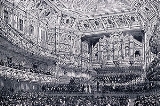
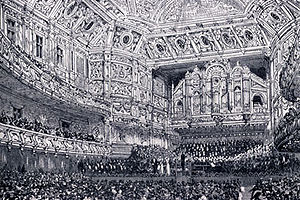
). The premiere was at the Queen's Hall
on 29 September 1918, conducted by Holst's friend Adrian Boult
to an invited audience of about 250 people. The first complete public performance was given in London on 15 November 1920, with the London Symphony Orchestra
conducted by Albert Coates
.
 The concept of the work is astrological
rather than astronomical
(which is why Earth
is not included): each movement is intended to convey ideas and emotions associated with the influence of the planets on the psyche
, not the Roman deities
. The idea of the work was suggested to Holst by Clifford Bax
, who introduced him to astrology when the two were part of a small group of English artists holidaying in Majorca in the spring of 1913; Holst became quite a devotee of the subject, and liked to cast his friends' horoscopes for fun. Holst also used Alan Leo
's book What is a Horoscope? as a springboard for his own ideas, as well as for the subtitles (i.e., "The Bringer of...") for the movements.
The Planets as a work in progress was originally scored for a piano duet, except for "Neptune", which was scored for a single organ
, as Holst believed that the sound of the piano
was too percussive for a world as mysterious and distant as Neptune. Holst then scored the suite for a large orchestra
, and it was in this incarnation that it became enormously popular. Holst's use of orchestration was very imaginative and colourful, showing the influence of Arnold Schoenberg
and other continental composers of the day rather than his English predecessors. The influence of the late Russian romantics such as Nikolai Rimsky-Korsakov
and Alexander Glazunov
is also notable, as it is in Igor Stravinsky
's great early ballets. Its novel sonorities helped make the work an immediate success with audiences at home and abroad. Although The Planets remains Holst's most popular work, the composer himself did not count it among his best creations and later in life complained that its popularity had completely surpassed his other works. He was, however, partial to his own favourite movement, "Saturn".
, was held at short notice on 29 September 1918, during the last weeks of World War I, in the Queen's Hall
with the financial support of Holst's friend and fellow composer Henry Balfour Gardiner
. It was hastily rehearsed; the musicians of the Queen's Hall Orchestra first saw the complicated music only two hours before the performance, and the choir for "Neptune" was recruited from pupils from St Paul's Girls' School
(where Holst taught). It was a comparatively intimate affair, attended by around 250 invited associates, but Holst regarded it as the public premiere, inscribing Boult's copy of the score, "This copy is the property of Adrian Boult who first caused the Planets to shine in public and thereby earned the gratitude of Gustav Holst."
A public concert was given in London under the auspices of the Royal Philharmonic Society
on 27 February 1919, conducted by Boult. Five of the seven movements were played in the order Mars, Mercury, Saturn, Uranus, and Jupiter.It was Boult's decision not to play all seven movements at this concert. He felt that when the public were being given a totally new language like that, "half an hour of it was as much as they could take in". See Kennedy, p. 68. The anonymous critic in Hazell's Annual called it "an extraordinarily complex and clever suite". At a Queen's Hall symphony concert on 22 November of that year, Holst conducted Venus, Mercury and Jupiter (this was the first public performance of Venus). There was another incomplete public performance, in Birmingham
, on 10 October 1920, with five movements (Mars, Venus, Mercury, Saturn and Jupiter). It is not clear whether this performance was conducted by Appleby Matthews
or the composer. The composer conducted a complete performance for the first time on 13 October 1923, with the Queen's Hall Orchestra at a Promenade Concert. His daughter recalled, " He hated incomplete performances of The Planets, though on several occasions he had to agree to conduct three or four movements at Queen's Hall concerts. He particularly disliked having to finish with Jupiter, to make a 'happy ending', for, as he himself said, 'in the real work the end is not happy at all'".
The first complete performance of the suite at a public concert did not occur until 15 November 1920; the London Symphony Orchestra
(LSO) was conducted by Albert Coates
. This was the first time the movement "Neptune" had been heard in a public performance, all the other movements having been given earlier public airings.
Holst conducted the LSO himself, in two recorded performances of The Planets: the first was an acoustic recording made in sessions between 1922 and 1924 (now available on Pavilion Records' Pearl label); the second was made in 1926, and utilised the then-new electrical recording process (in 2003, this was released on compact disc
by IMP
and later on Naxos
outside the United States
). Because of the time constraints of the 78rpm format, the tempi are often much faster than is usually the case today.
and its corresponding astrological character (see Planets in astrology
):
Holst's original title (clearly seen on the handwritten full score) was "Seven Pieces for Large Orchestra". The composer's name was given as Gustav von Holst - by the time he wrote "Mercury" in 1916 he had dropped the 'von', for he signed the score of that movement separately as Gustav Holst. The movements were called only by the second part of each title (I "The Bringer of War", II "The Bringer of Peace" and so on). The present titles were added in time for the first (incomplete) public performance in September 1919, though they were never added to the original score.. It is perhaps instructive to realise Holst attended an early performance of Schoenberg's "Five Orchestral Pieces" in 1914 (the year he wrote "Mars", "Venus" and "Jupiter") and owned a score of it.
A typical performance of all seven movements lasts for about fifty minutes. Some commentators have suggested that the ordering is structural, with the anomaly of Mars, Venus, Mercury, instead of the reverse, being a device to make the first four movements match the form of a symphony
. An alternative explanation may be the ruling of astrological signs of the zodiac
by the planets: if the signs are listed along with their ruling planets in the traditional order starting with Aries
, ignoring duplication, Pluto
(then undiscovered) and the luminaries (the Sun and Moon), the order of the movements corresponds. Another possibility, this time from an astronomical perspective, is that the first three movements, representing the inner terrestrial planet
s, are ordered by decreasing distance from the Sun; the remaining movements, representing the gas giant
s, are ordered by increasing distance from the Sun. Critic David Hurwitz offers an alternative explanation for the piece's structure: that "Jupiter" is the centrepoint of the suite and that the movements on either side are in mirror images. Thus "Mars" involves motion and "Neptune" is static; "Venus" is sublime while "Uranus" is vulgar, and "Mercury" is light and scherzando while "Saturn" is heavy and plodding. This hypothesis is lent credence by the fact that the two outer movements, "Mars" and "Neptune", are both written in rather unusual quintuple metre.
A more prosaic explanation may simply be that Holst wrote the movements in the order they stand, with one exception, and that the only structural change was to place "Mercury" third. "Mars", "Venus" and "Jupiter" were from 1914, "Saturn", "Uranus" and "Neptune" from 1915 and "Mercury" from 1916. It has been speculated that "Mars" was a response to the outbreak of World War I, but Holst denied this, saying that "Mars" was completed before war was expected, and in August 1914 he was half-way through "Venus". Nevertheless, "Mars" is seen as prescient of mechanical warfare, something that was not a reality until after the entire suite was complete. Contrary to what is also sometimes said, Holst was not a pacifist but wanted to enlist as his friend Vaughan Williams did, but he was rejected as unfit: he suffered neuritis in his right arm—something that caused him to seek help from several amanuenses in scoring The Planets. This is clear from the number of different hands apparent in the full score.
"Neptune" was one of the first pieces of orchestral music to have a fade-out
ending, although several composers (including Joseph Haydn
in the finale of his Farewell Symphony
) had achieved a similar effect by different means. Holst stipulates that the women's choruses are "to be placed in an adjoining room, the door of which is to be left open until the last bar of the piece, when it is to be slowly and silently closed", and that the final bar (scored for choruses alone) is "to be repeated until the sound is lost in the distance". Although commonplace today, the effect bewitched audiences in the era before widespread recorded sound—after the initial 1918 run-through, Holst's daughter Imogen
(in addition to watching the charwomen dancing in the aisles during "Jupiter") remarked that the ending was "unforgettable, with its hidden chorus of women's voices growing fainter and fainter... until the imagination knew no difference between sound and silence".
was discovered in 1930, four years before Holst's death, and was hailed by astronomer
s as the ninth planet. Holst, however, expressed no interest in writing a movement for the new planet. He had become disillusioned by the popularity of the suite, believing that it took too much attention away from his other works.
In 2000, the Hallé Orchestra
commissioned the English composer Colin Matthews
, an authority on Holst, to write a new eighth movement, which he called "Pluto, the Renewer
". Dedicated to the late Imogen Holst
, Gustav Holst's daughter, it was first performed in Manchester
on 11 May 2000, with Kent Nagano
conducting the Hallé Orchestra. Matthews also changed the ending of "Neptune" slightly so that movement would lead directly into "Pluto".
Six years later, in August 2006, the International Astronomical Union
promulgated for the very first time a definition of the term "planet", which resulted in Pluto's status being demoted from planet
to dwarf planet
. Consequently, Holst's original work is once again a complete representation of all of the extraterrestrial planets in the Solar System
.
". As a hymn tune
it has the title Thaxted
, after the town in Essex
where Holst lived for many years, and it has also been used for other hymns, such as "O God beyond all praising".
"I Vow to Thee, My Country" was written between 1908 and 1918 by Sir Cecil Spring-Rice
and became known as a response to the human cost of World War I. The hymn was first performed in 1925 and quickly became a patriotic anthem. Although Holst had no such patriotic intentions when he originally composed the music, these adaptations have encouraged others to draw upon the score in similar ways throughout the 20th Century.
Opus number
An Opus number , pl. opera and opuses, abbreviated, sing. Op. and pl. Opp. refers to a number generally assigned by composers to an individual composition or set of compositions on publication, to help identify their works...
, is a seven-movement
Movement (music)
A movement is a self-contained part of a musical composition or musical form. While individual or selected movements from a composition are sometimes performed separately, a performance of the complete work requires all the movements to be performed in succession...
orchestra
Orchestra
An orchestra is a sizable instrumental ensemble that contains sections of string, brass, woodwind, and percussion instruments. The term orchestra derives from the Greek ορχήστρα, the name for the area in front of an ancient Greek stage reserved for the Greek chorus...
l suite by the English
English people
The English are a nation and ethnic group native to England, who speak English. The English identity is of early mediaeval origin, when they were known in Old English as the Anglecynn. England is now a country of the United Kingdom, and the majority of English people in England are British Citizens...
composer Gustav Holst
Gustav Holst
Gustav Theodore Holst was an English composer. He is most famous for his orchestral suite The Planets....
, written between 1914 and 1916. Each movement of the suite is named after a planet
Planet
A planet is a celestial body orbiting a star or stellar remnant that is massive enough to be rounded by its own gravity, is not massive enough to cause thermonuclear fusion, and has cleared its neighbouring region of planetesimals.The term planet is ancient, with ties to history, science,...
of the Solar System
Solar System
The Solar System consists of the Sun and the astronomical objects gravitationally bound in orbit around it, all of which formed from the collapse of a giant molecular cloud approximately 4.6 billion years ago. The vast majority of the system's mass is in the Sun...
and its corresponding astrological
Astrology
Astrology consists of a number of belief systems which hold that there is a relationship between astronomical phenomena and events in the human world...
character as defined by Holst. With the exception of Earth
Earth
Earth is the third planet from the Sun, and the densest and fifth-largest of the eight planets in the Solar System. It is also the largest of the Solar System's four terrestrial planets...
, which is not observed in astrological practice, all the planets are represented.
From its premiere to the present day, the suite has been enduringly popular, influential, widely performed and the subject of numerous recordings. However, it had a protracted birth. There were four performances between September 1918 and October 1920, but they were all either private (the first performance, in London
London
London is the capital city of :England and the :United Kingdom, the largest metropolitan area in the United Kingdom, and the largest urban zone in the European Union by most measures. Located on the River Thames, London has been a major settlement for two millennia, its history going back to its...
) or incomplete (two others in London and one in Birmingham
Birmingham
Birmingham is a city and metropolitan borough in the West Midlands of England. It is the most populous British city outside the capital London, with a population of 1,036,900 , and lies at the heart of the West Midlands conurbation, the second most populous urban area in the United Kingdom with a...
). The premiere was at the Queen's Hall
Queen's Hall
The Queen's Hall was a concert hall in Langham Place, London, opened in 1893. Designed by the architect T.E. Knightley, it had room for an audience of about 2,500 people. It became London's principal concert venue. From 1895 until 1941, it was the home of the promenade concerts founded by Robert...
on 29 September 1918, conducted by Holst's friend Adrian Boult
Adrian Boult
Sir Adrian Cedric Boult CH was an English conductor. Brought up in a prosperous mercantile family he followed musical studies in England and at Leipzig, Germany, with early conducting work in London for the Royal Opera House and Sergei Diaghilev's ballet company. His first prominent post was...
to an invited audience of about 250 people. The first complete public performance was given in London on 15 November 1920, with the London Symphony Orchestra
London Symphony Orchestra
The London Symphony Orchestra is a major orchestra of the United Kingdom, as well as one of the best-known orchestras in the world. Since 1982, the LSO has been based in London's Barbican Centre.-History:...
conducted by Albert Coates
Albert Coates (musician)
Albert Coates was an English conductor and composer. Born in Saint Petersburg where his English father was a successful businessman, he studied in Russia, England and Germany, before beginning his career as a conductor in a series of German opera houses...
.
Background
Astrology
Astrology consists of a number of belief systems which hold that there is a relationship between astronomical phenomena and events in the human world...
rather than astronomical
Astronomy
Astronomy is a natural science that deals with the study of celestial objects and phenomena that originate outside the atmosphere of Earth...
(which is why Earth
Earth
Earth is the third planet from the Sun, and the densest and fifth-largest of the eight planets in the Solar System. It is also the largest of the Solar System's four terrestrial planets...
is not included): each movement is intended to convey ideas and emotions associated with the influence of the planets on the psyche
Planets in astrology
Planets in astrology have a meaning different from the modern astronomical understanding of what a planet is. Before the age of telescopes, the night sky was thought to consist of two very similar components: fixed stars, which remained motionless in relation to each other, and wandering stars, ,...
, not the Roman deities
Dii Consentes
The Dii Consentes were a list of twelve major deities, six gods and six goddesses, in the pantheon of Ancient Rome. Their gilt statues stood in the Forum, later apparently in the Porticus Deorum Consentium....
. The idea of the work was suggested to Holst by Clifford Bax
Clifford Bax
Clifford Bax was a versatile English writer, known particularly as a playwright, a journalist, critic and editor, and a poet, lyricist and hymn writer. He also was a translator, for example of Goldoni...
, who introduced him to astrology when the two were part of a small group of English artists holidaying in Majorca in the spring of 1913; Holst became quite a devotee of the subject, and liked to cast his friends' horoscopes for fun. Holst also used Alan Leo
Alan Leo
Alan Leo, born William Frederick Allan, , was a prominent British astrologer, author, publisher and theosophist, and is considered by many to be the father of modern astrology....
's book What is a Horoscope? as a springboard for his own ideas, as well as for the subtitles (i.e., "The Bringer of...") for the movements.
The Planets as a work in progress was originally scored for a piano duet, except for "Neptune", which was scored for a single organ
Organ (music)
The organ , is a keyboard instrument of one or more divisions, each played with its own keyboard operated either with the hands or with the feet. The organ is a relatively old musical instrument in the Western musical tradition, dating from the time of Ctesibius of Alexandria who is credited with...
, as Holst believed that the sound of the piano
Piano
The piano is a musical instrument played by means of a keyboard. It is one of the most popular instruments in the world. Widely used in classical and jazz music for solo performances, ensemble use, chamber music and accompaniment, the piano is also very popular as an aid to composing and rehearsal...
was too percussive for a world as mysterious and distant as Neptune. Holst then scored the suite for a large orchestra
Orchestra
An orchestra is a sizable instrumental ensemble that contains sections of string, brass, woodwind, and percussion instruments. The term orchestra derives from the Greek ορχήστρα, the name for the area in front of an ancient Greek stage reserved for the Greek chorus...
, and it was in this incarnation that it became enormously popular. Holst's use of orchestration was very imaginative and colourful, showing the influence of Arnold Schoenberg
Arnold Schoenberg
Arnold Schoenberg was an Austrian composer, associated with the expressionist movement in German poetry and art, and leader of the Second Viennese School...
and other continental composers of the day rather than his English predecessors. The influence of the late Russian romantics such as Nikolai Rimsky-Korsakov
Nikolai Rimsky-Korsakov
Nikolai Andreyevich Rimsky-Korsakov was a Russian composer, and a member of the group of composers known as The Five.The Five, also known as The Mighty Handful or The Mighty Coterie, refers to a circle of composers who met in Saint Petersburg, Russia, in the years 1856–1870: Mily Balakirev , César...
and Alexander Glazunov
Alexander Glazunov
Alexander Konstantinovich Glazunov was a Russian composer of the late Russian Romantic period, music teacher and conductor...
is also notable, as it is in Igor Stravinsky
Igor Stravinsky
Igor Fyodorovich Stravinsky ; 6 April 1971) was a Russian, later naturalized French, and then naturalized American composer, pianist, and conductor....
's great early ballets. Its novel sonorities helped make the work an immediate success with audiences at home and abroad. Although The Planets remains Holst's most popular work, the composer himself did not count it among his best creations and later in life complained that its popularity had completely surpassed his other works. He was, however, partial to his own favourite movement, "Saturn".
Premieres
The orchestral premiere of The Planets suite, conducted at Holst's request by Adrian BoultAdrian Boult
Sir Adrian Cedric Boult CH was an English conductor. Brought up in a prosperous mercantile family he followed musical studies in England and at Leipzig, Germany, with early conducting work in London for the Royal Opera House and Sergei Diaghilev's ballet company. His first prominent post was...
, was held at short notice on 29 September 1918, during the last weeks of World War I, in the Queen's Hall
Queen's Hall
The Queen's Hall was a concert hall in Langham Place, London, opened in 1893. Designed by the architect T.E. Knightley, it had room for an audience of about 2,500 people. It became London's principal concert venue. From 1895 until 1941, it was the home of the promenade concerts founded by Robert...
with the financial support of Holst's friend and fellow composer Henry Balfour Gardiner
Henry Balfour Gardiner
Henry Balfour Gardiner was an English musician, composer, and teacher. Between his conventional education at Charterhouse School and New College, Oxford, where he obtained only a pass degree, Gardiner was a piano student at the Hoch Conservatory in Frankfurt am Main where he was taught by Knorr...
. It was hastily rehearsed; the musicians of the Queen's Hall Orchestra first saw the complicated music only two hours before the performance, and the choir for "Neptune" was recruited from pupils from St Paul's Girls' School
St Paul's Girls' School
St Paul's Girls' School is a senior independent school, located in Brook Green, Hammersmith, in West London, England.-History:In 1904 a new day school for girls was established by the trustees of the Dean Colet Foundation , which had run St Paul's School for boys since the sixteenth century...
(where Holst taught). It was a comparatively intimate affair, attended by around 250 invited associates, but Holst regarded it as the public premiere, inscribing Boult's copy of the score, "This copy is the property of Adrian Boult who first caused the Planets to shine in public and thereby earned the gratitude of Gustav Holst."
A public concert was given in London under the auspices of the Royal Philharmonic Society
Royal Philharmonic Society
The Royal Philharmonic Society is a British music society, formed in 1813. It was originally formed in London to promote performances of instrumental music there. Many distinguished composers and performers have taken part in its concerts...
on 27 February 1919, conducted by Boult. Five of the seven movements were played in the order Mars, Mercury, Saturn, Uranus, and Jupiter.It was Boult's decision not to play all seven movements at this concert. He felt that when the public were being given a totally new language like that, "half an hour of it was as much as they could take in". See Kennedy, p. 68. The anonymous critic in Hazell's Annual called it "an extraordinarily complex and clever suite". At a Queen's Hall symphony concert on 22 November of that year, Holst conducted Venus, Mercury and Jupiter (this was the first public performance of Venus). There was another incomplete public performance, in Birmingham
Birmingham
Birmingham is a city and metropolitan borough in the West Midlands of England. It is the most populous British city outside the capital London, with a population of 1,036,900 , and lies at the heart of the West Midlands conurbation, the second most populous urban area in the United Kingdom with a...
, on 10 October 1920, with five movements (Mars, Venus, Mercury, Saturn and Jupiter). It is not clear whether this performance was conducted by Appleby Matthews
Appleby Matthews
Thomas Appleby Matthews was an English conductor and organist, the son of George Matthews and his wife Rebecca Clarson Bonas.He served as organist of St. Philip's Cathedral, Birmingham...
or the composer. The composer conducted a complete performance for the first time on 13 October 1923, with the Queen's Hall Orchestra at a Promenade Concert. His daughter recalled, " He hated incomplete performances of The Planets, though on several occasions he had to agree to conduct three or four movements at Queen's Hall concerts. He particularly disliked having to finish with Jupiter, to make a 'happy ending', for, as he himself said, 'in the real work the end is not happy at all'".
The first complete performance of the suite at a public concert did not occur until 15 November 1920; the London Symphony Orchestra
London Symphony Orchestra
The London Symphony Orchestra is a major orchestra of the United Kingdom, as well as one of the best-known orchestras in the world. Since 1982, the LSO has been based in London's Barbican Centre.-History:...
(LSO) was conducted by Albert Coates
Albert Coates (musician)
Albert Coates was an English conductor and composer. Born in Saint Petersburg where his English father was a successful businessman, he studied in Russia, England and Germany, before beginning his career as a conductor in a series of German opera houses...
. This was the first time the movement "Neptune" had been heard in a public performance, all the other movements having been given earlier public airings.
Holst conducted the LSO himself, in two recorded performances of The Planets: the first was an acoustic recording made in sessions between 1922 and 1924 (now available on Pavilion Records' Pearl label); the second was made in 1926, and utilised the then-new electrical recording process (in 2003, this was released on compact disc
Compact Disc
The Compact Disc is an optical disc used to store digital data. It was originally developed to store and playback sound recordings exclusively, but later expanded to encompass data storage , write-once audio and data storage , rewritable media , Video Compact Discs , Super Video Compact Discs ,...
by IMP
IMP
Imp is a fantasy creature.IMP or imp may also refer to:* Interactive Mathematics Program , a Key Curriculum Press Interactive Math program* Isle of Man pound, or Manx pound* Imp , American Champion Thoroughbred racehorse...
and later on Naxos
Naxos Records
Naxos Records is a record label specializing in classical music. Through a number of imprints, Naxos also releases genres including Chinese music, jazz, world music, and early rock & roll. The company was founded in 1987 by Klaus Heymann, a German-born resident of Hong Kong.Naxos is the largest...
outside the United States
United States
The United States of America is a federal constitutional republic comprising fifty states and a federal district...
). Because of the time constraints of the 78rpm format, the tempi are often much faster than is usually the case today.
Instrumentation
The work is scored for an extremely large orchestra:- Woodwind: 4 fluteFluteThe flute is a musical instrument of the woodwind family. Unlike woodwind instruments with reeds, a flute is an aerophone or reedless wind instrument that produces its sound from the flow of air across an opening...
s (3rd doubling 1st piccoloPiccoloThe piccolo is a half-size flute, and a member of the woodwind family of musical instruments. The piccolo has the same fingerings as its larger sibling, the standard transverse flute, but the sound it produces is an octave higher than written...
; 4th doubling 2nd piccolo and a "bass flute in G", actually an alto fluteAlto fluteThe alto flute is a type of Western concert flute, a musical instrument in the woodwind family. It is the next extension downward of the C flute after the flûte d'amour. It is characterized by its distinct, mellow tone in the lower portion of its range...
), 3 oboeOboeThe oboe is a double reed musical instrument of the woodwind family. In English, prior to 1770, the instrument was called "hautbois" , "hoboy", or "French hoboy". The spelling "oboe" was adopted into English ca...
s (3rd doubling bass oboeBass oboeThe bass oboe or baritone oboe is a double reed instrument in the woodwind family. It is about twice the size of a regular oboe and sounds an octave lower; it has a deep, full tone not unlike that of its higher-pitched cousin, the English horn. The bass oboe is notated in the treble clef, sounding...
), an English horn, 3 clarinetClarinetThe clarinet is a musical instrument of woodwind type. The name derives from adding the suffix -et to the Italian word clarino , as the first clarinets had a strident tone similar to that of a trumpet. The instrument has an approximately cylindrical bore, and uses a single reed...
s in B-flat, a bass clarinetBass clarinetThe bass clarinet is a musical instrument of the clarinet family. Like the more common soprano B clarinet, it is usually pitched in B , but it plays notes an octave below the soprano B clarinet...
in B-flat, 3 bassoonBassoonThe bassoon is a woodwind instrument in the double reed family that typically plays music written in the bass and tenor registers, and occasionally higher. Appearing in its modern form in the 19th century, the bassoon figures prominently in orchestral, concert band and chamber music literature...
s and a contrabassoonContrabassoonThe contrabassoon, also known as the double bassoon or double-bassoon, is a larger version of the bassoon, sounding an octave lower...
- BrassBrass instrumentA brass instrument is a musical instrument whose sound is produced by sympathetic vibration of air in a tubular resonator in sympathy with the vibration of the player's lips...
: 6 hornsHorn (instrument)The horn is a brass instrument consisting of about of tubing wrapped into a coil with a flared bell. A musician who plays the horn is called a horn player ....
in F, 4 trumpetTrumpetThe trumpet is the musical instrument with the highest register in the brass family. Trumpets are among the oldest musical instruments, dating back to at least 1500 BCE. They are played by blowing air through closed lips, producing a "buzzing" sound which starts a standing wave vibration in the air...
s in C, 3 tromboneTromboneThe trombone is a musical instrument in the brass family. Like all brass instruments, sound is produced when the player’s vibrating lips cause the air column inside the instrument to vibrate...
s (2 tenor and 1 bass), a "tenor tuba" (euphonium in B-flat)EuphoniumThe euphonium is a conical-bore, tenor-voiced brass instrument. It derives its name from the Greek word euphonos, meaning "well-sounding" or "sweet-voiced"...
and a bass tubaTubaThe tuba is the largest and lowest-pitched brass instrument. Sound is produced by vibrating or "buzzing" the lips into a large cupped mouthpiece. It is one of the most recent additions to the modern symphony orchestra, first appearing in the mid-19th century, when it largely replaced the...
- KeyboardsKeyboard instrumentA keyboard instrument is a musical instrument which is played using a musical keyboard. The most common of these is the piano. Other widely used keyboard instruments include organs of various types as well as other mechanical, electromechanical and electronic instruments...
: a celestaCelestaThe celesta or celeste is a struck idiophone operated by a keyboard. Its appearance is similar to that of an upright piano or of a large wooden music box . The keys are connected to hammers which strike a graduated set of metal plates suspended over wooden resonators...
, and an organPipe organThe pipe organ is a musical instrument that produces sound by driving pressurized air through pipes selected via a keyboard. Because each organ pipe produces a single pitch, the pipes are provided in sets called ranks, each of which has a common timbre and volume throughout the keyboard compass...
- Percussion: 6 timpaniTimpaniTimpani, or kettledrums, are musical instruments in the percussion family. A type of drum, they consist of a skin called a head stretched over a large bowl traditionally made of copper. They are played by striking the head with a specialized drum stick called a timpani stick or timpani mallet...
(2 players, 3 drums each except in "Uranus" having 4 drums for 1st and 2 drums for 2nd), a bass drumBass drumBass drums are percussion instruments that can vary in size and are used in several musical genres. Three major types of bass drums can be distinguished. The type usually seen or heard in orchestral, ensemble or concert band music is the orchestral, or concert bass drum . It is the largest drum of...
, a snare drumSnare drumThe snare drum or side drum is a melodic percussion instrument with strands of snares made of curled metal wire, metal cable, plastic cable, or gut cords stretched across the drumhead, typically the bottom. Pipe and tabor and some military snare drums often have a second set of snares on the bottom...
, cymbalCymbalCymbals are a common percussion instrument. Cymbals consist of thin, normally round plates of various alloys; see cymbal making for a discussion of their manufacture. The greater majority of cymbals are of indefinite pitch, although small disc-shaped cymbals based on ancient designs sound a...
s, a triangleTriangle (instrument)The triangle is an idiophone type of musical instrument in the percussion family. It is a bar of metal, usually steel but sometimes other metals like beryllium copper, bent into a triangle shape. The instrument is usually held by a loop of some form of thread or wire at the top curve...
, a tam-tam, a tambourineTambourineThe tambourine or marine is a musical instrument of the percussion family consisting of a frame, often of wood or plastic, with pairs of small metal jingles, called "zils". Classically the term tambourine denotes an instrument with a drumhead, though some variants may not have a head at all....
, a glockenspielGlockenspielA glockenspiel is a percussion instrument composed of a set of tuned keys arranged in the fashion of the keyboard of a piano. In this way, it is similar to the xylophone; however, the xylophone's bars are made of wood, while the glockenspiel's are metal plates or tubes, and making it a metallophone...
, a xylophoneXylophoneThe xylophone is a musical instrument in the percussion family that consists of wooden bars struck by mallets...
, and tubular bellTubular bellTubular bells are musical instruments in the percussion family. Each bell is a metal tube, 30–38 mm in diameter, tuned by altering its length. Its standard range is from C4-F5, though many professional instruments reach G5 . Tubular bells are often replaced by studio chimes, which are a smaller...
s
- StringsString sectionThe string section is the largest body of the standard orchestra and consists of bowed string instruments of the violin family.It normally comprises five sections: the first violins, the second violins, the violas, the cellos, and the double basses...
: 2 harpHarpThe harp is a multi-stringed instrument which has the plane of its strings positioned perpendicularly to the soundboard. Organologically, it is in the general category of chordophones and has its own sub category . All harps have a neck, resonator and strings...
s, 1st and 2nd violinViolinThe violin is a string instrument, usually with four strings tuned in perfect fifths. It is the smallest, highest-pitched member of the violin family of string instruments, which includes the viola and cello....
s, violaViolaThe viola is a bowed string instrument. It is the middle voice of the violin family, between the violin and the cello.- Form :The viola is similar in material and construction to the violin. A full-size viola's body is between and longer than the body of a full-size violin , with an average...
s, violoncellos, and double bassDouble bassThe double bass, also called the string bass, upright bass, standup bass or contrabass, is the largest and lowest-pitched bowed string instrument in the modern symphony orchestra, with strings usually tuned to E1, A1, D2 and G2...
es
- VoiceVoiceVoice may refer to:* Human voice* Voice control or voice activation* Writer's voice* Voice acting* Voice vote* Voice message-In film:* Voice , a 2005 South Korean film* The Voice , a 2010 Turkish horror film directed by Ümit Ünal...
s: ("Neptune" only), 2 three-part women's chorusesChoirA choir, chorale or chorus is a musical ensemble of singers. Choral music, in turn, is the music written specifically for such an ensemble to perform.A body of singers who perform together as a group is called a choir or chorus...
(SSopranoA soprano is a voice type with a vocal range from approximately middle C to "high A" in choral music, or to "soprano C" or higher in operatic music. In four-part chorale style harmony, the soprano takes the highest part, which usually encompasses the melody...
SSopranoA soprano is a voice type with a vocal range from approximately middle C to "high A" in choral music, or to "soprano C" or higher in operatic music. In four-part chorale style harmony, the soprano takes the highest part, which usually encompasses the melody...
AAltoAlto is a musical term, derived from the Latin word altus, meaning "high" in Italian, that has several possible interpretations.When designating instruments, "alto" frequently refers to a member of an instrumental family that has the second highest range, below that of the treble or soprano. Hence,...
) located in an adjoining room which is to be screened from the audience
Structure
The suite has seven movements, each named after a planetPlanet
A planet is a celestial body orbiting a star or stellar remnant that is massive enough to be rounded by its own gravity, is not massive enough to cause thermonuclear fusion, and has cleared its neighbouring region of planetesimals.The term planet is ancient, with ties to history, science,...
and its corresponding astrological character (see Planets in astrology
Planets in astrology
Planets in astrology have a meaning different from the modern astronomical understanding of what a planet is. Before the age of telescopes, the night sky was thought to consist of two very similar components: fixed stars, which remained motionless in relation to each other, and wandering stars, ,...
):
- MarsMarsMars is the fourth planet from the Sun in the Solar System. The planet is named after the Roman god of war, Mars. It is often described as the "Red Planet", as the iron oxide prevalent on its surface gives it a reddish appearance...
, the Bringer of WarMars (mythology)Mars was the Roman god of war and also an agricultural guardian, a combination characteristic of early Rome. He was second in importance only to Jupiter, and he was the most prominent of the military gods worshipped by the Roman legions... - VenusVenusVenus is the second planet from the Sun, orbiting it every 224.7 Earth days. The planet is named after Venus, the Roman goddess of love and beauty. After the Moon, it is the brightest natural object in the night sky, reaching an apparent magnitude of −4.6, bright enough to cast shadows...
, the Bringer of PeaceVenus (mythology)Venus is a Roman goddess principally associated with love, beauty, sex,sexual seduction and fertility, who played a key role in many Roman religious festivals and myths... - MercuryMercury (planet)Mercury is the innermost and smallest planet in the Solar System, orbiting the Sun once every 87.969 Earth days. The orbit of Mercury has the highest eccentricity of all the Solar System planets, and it has the smallest axial tilt. It completes three rotations about its axis for every two orbits...
, the Winged MessengerMercury (mythology)Mercury was a messenger who wore winged sandals, and a god of trade, the son of Maia Maiestas and Jupiter in Roman mythology. His name is related to the Latin word merx , mercari , and merces... - JupiterJupiterJupiter is the fifth planet from the Sun and the largest planet within the Solar System. It is a gas giant with mass one-thousandth that of the Sun but is two and a half times the mass of all the other planets in our Solar System combined. Jupiter is classified as a gas giant along with Saturn,...
, the Bringer of JollityJupiter (mythology)In ancient Roman religion and myth, Jupiter or Jove is the king of the gods, and the god of the sky and thunder. He is the equivalent of Zeus in the Greek pantheon.... - SaturnSaturnSaturn is the sixth planet from the Sun and the second largest planet in the Solar System, after Jupiter. Saturn is named after the Roman god Saturn, equated to the Greek Cronus , the Babylonian Ninurta and the Hindu Shani. Saturn's astronomical symbol represents the Roman god's sickle.Saturn,...
, the Bringer of Old AgeSaturn (mythology)In ancient Roman religion and myth, Saturn was a major god presiding over agriculture and the harvest time. His reign was depicted as a Golden Age of abundance and peace by many Roman authors. In medieval times he was known as the Roman god of agriculture, justice and strength. He held a sickle in... - UranusUranusUranus is the seventh planet from the Sun. It has the third-largest planetary radius and fourth-largest planetary mass in the Solar System. It is named after the ancient Greek deity of the sky Uranus , the father of Cronus and grandfather of Zeus...
, the MagicianUranus (mythology)Uranus , was the primal Greek god personifying the sky. His equivalent in Roman mythology was Caelus. In Ancient Greek literature, according to Hesiod in his Theogony, Uranus or Father Sky was the son and husband of Gaia, Mother Earth... - NeptuneNeptuneNeptune is the eighth and farthest planet from the Sun in the Solar System. Named for the Roman god of the sea, it is the fourth-largest planet by diameter and the third largest by mass. Neptune is 17 times the mass of Earth and is slightly more massive than its near-twin Uranus, which is 15 times...
, the MysticNeptune (mythology)Neptune was the god of water and the sea in Roman mythology and religion. He is analogous with, but not identical to, the Greek god Poseidon. In the Greek-influenced tradition, Neptune was the brother of Jupiter and Pluto, each of them presiding over one of the three realms of the universe,...
Holst's original title (clearly seen on the handwritten full score) was "Seven Pieces for Large Orchestra". The composer's name was given as Gustav von Holst - by the time he wrote "Mercury" in 1916 he had dropped the 'von', for he signed the score of that movement separately as Gustav Holst. The movements were called only by the second part of each title (I "The Bringer of War", II "The Bringer of Peace" and so on). The present titles were added in time for the first (incomplete) public performance in September 1919, though they were never added to the original score.. It is perhaps instructive to realise Holst attended an early performance of Schoenberg's "Five Orchestral Pieces" in 1914 (the year he wrote "Mars", "Venus" and "Jupiter") and owned a score of it.
A typical performance of all seven movements lasts for about fifty minutes. Some commentators have suggested that the ordering is structural, with the anomaly of Mars, Venus, Mercury, instead of the reverse, being a device to make the first four movements match the form of a symphony
Symphony
A symphony is an extended musical composition in Western classical music, scored almost always for orchestra. A symphony usually contains at least one movement or episode composed according to the sonata principle...
. An alternative explanation may be the ruling of astrological signs of the zodiac
Zodiac
In astronomy, the zodiac is a circle of twelve 30° divisions of celestial longitude which are centred upon the ecliptic: the apparent path of the Sun across the celestial sphere over the course of the year...
by the planets: if the signs are listed along with their ruling planets in the traditional order starting with Aries
Aries (astrology)
Aries is the first astrological sign in the Zodiac, which spans the zodiac between the zero degree and the 29th degree of celestial longitude. The Sun enters Aries when it reaches the northern vernal equinox, which is usually on March 21 each year, and remains in this sign until around April 20...
, ignoring duplication, Pluto
Pluto
Pluto, formal designation 134340 Pluto, is the second-most-massive known dwarf planet in the Solar System and the tenth-most-massive body observed directly orbiting the Sun...
(then undiscovered) and the luminaries (the Sun and Moon), the order of the movements corresponds. Another possibility, this time from an astronomical perspective, is that the first three movements, representing the inner terrestrial planet
Terrestrial planet
A terrestrial planet, telluric planet or rocky planet is a planet that is composed primarily of silicate rocks or metals. Within the Solar System, the terrestrial planets are the inner planets closest to the Sun...
s, are ordered by decreasing distance from the Sun; the remaining movements, representing the gas giant
Gas giant
A gas giant is a large planet that is not primarily composed of rock or other solid matter. There are four gas giants in the Solar System: Jupiter, Saturn, Uranus, and Neptune...
s, are ordered by increasing distance from the Sun. Critic David Hurwitz offers an alternative explanation for the piece's structure: that "Jupiter" is the centrepoint of the suite and that the movements on either side are in mirror images. Thus "Mars" involves motion and "Neptune" is static; "Venus" is sublime while "Uranus" is vulgar, and "Mercury" is light and scherzando while "Saturn" is heavy and plodding. This hypothesis is lent credence by the fact that the two outer movements, "Mars" and "Neptune", are both written in rather unusual quintuple metre.
A more prosaic explanation may simply be that Holst wrote the movements in the order they stand, with one exception, and that the only structural change was to place "Mercury" third. "Mars", "Venus" and "Jupiter" were from 1914, "Saturn", "Uranus" and "Neptune" from 1915 and "Mercury" from 1916. It has been speculated that "Mars" was a response to the outbreak of World War I, but Holst denied this, saying that "Mars" was completed before war was expected, and in August 1914 he was half-way through "Venus". Nevertheless, "Mars" is seen as prescient of mechanical warfare, something that was not a reality until after the entire suite was complete. Contrary to what is also sometimes said, Holst was not a pacifist but wanted to enlist as his friend Vaughan Williams did, but he was rejected as unfit: he suffered neuritis in his right arm—something that caused him to seek help from several amanuenses in scoring The Planets. This is clear from the number of different hands apparent in the full score.
"Neptune" was one of the first pieces of orchestral music to have a fade-out
Fade (audio engineering)
In audio engineering, a fade is a gradual increase or decrease in the level of an audio signal. The term can also be used for film cinematography or theater lighting, in much the same way ....
ending, although several composers (including Joseph Haydn
Joseph Haydn
Franz Joseph Haydn , known as Joseph Haydn , was an Austrian composer, one of the most prolific and prominent composers of the Classical period. He is often called the "Father of the Symphony" and "Father of the String Quartet" because of his important contributions to these forms...
in the finale of his Farewell Symphony
Symphony No. 45 (Haydn)
Symphony No. 45 in F-sharp minor, known as the "Farewell" Symphony , was composed by Joseph Haydn in 1772....
) had achieved a similar effect by different means. Holst stipulates that the women's choruses are "to be placed in an adjoining room, the door of which is to be left open until the last bar of the piece, when it is to be slowly and silently closed", and that the final bar (scored for choruses alone) is "to be repeated until the sound is lost in the distance". Although commonplace today, the effect bewitched audiences in the era before widespread recorded sound—after the initial 1918 run-through, Holst's daughter Imogen
Imogen Holst
Imogen Clare Holst, CBE was a British composer and conductor, and sole child of composer Gustav Holst.Imogen Holst was brought up in west London and educated at St Paul's Girls' School, where her father was director of music...
(in addition to watching the charwomen dancing in the aisles during "Jupiter") remarked that the ending was "unforgettable, with its hidden chorus of women's voices growing fainter and fainter... until the imagination knew no difference between sound and silence".
Pluto
PlutoPluto
Pluto, formal designation 134340 Pluto, is the second-most-massive known dwarf planet in the Solar System and the tenth-most-massive body observed directly orbiting the Sun...
was discovered in 1930, four years before Holst's death, and was hailed by astronomer
Astronomer
An astronomer is a scientist who studies celestial bodies such as planets, stars and galaxies.Historically, astronomy was more concerned with the classification and description of phenomena in the sky, while astrophysics attempted to explain these phenomena and the differences between them using...
s as the ninth planet. Holst, however, expressed no interest in writing a movement for the new planet. He had become disillusioned by the popularity of the suite, believing that it took too much attention away from his other works.
In 2000, the Hallé Orchestra
The Hallé
The Hallé is a symphony orchestra based in Manchester, England. It is the UK's oldest extant symphony orchestra , supports a choir, youth choir and a youth orchestra, and releases its recordings on its own record label, though it has occasionally released recordings on Angel Records and EMI...
commissioned the English composer Colin Matthews
Colin Matthews
Colin Matthews OBE is an English composer of classical music.-Early life and education:Matthews was born in London in 1946; his older brother is the composer David Matthews. He read classics at the University of Nottingham, and then studied composition there with Arnold Whittall, and with Nicholas...
, an authority on Holst, to write a new eighth movement, which he called "Pluto, the Renewer
Pluto (mythology)
In ancient Greek religion and myth, Pluto was a name for the ruler of the underworld; the god was also known as Hades, a name for the underworld itself...
". Dedicated to the late Imogen Holst
Imogen Holst
Imogen Clare Holst, CBE was a British composer and conductor, and sole child of composer Gustav Holst.Imogen Holst was brought up in west London and educated at St Paul's Girls' School, where her father was director of music...
, Gustav Holst's daughter, it was first performed in Manchester
Manchester
Manchester is a city and metropolitan borough in Greater Manchester, England. According to the Office for National Statistics, the 2010 mid-year population estimate for Manchester was 498,800. Manchester lies within one of the UK's largest metropolitan areas, the metropolitan county of Greater...
on 11 May 2000, with Kent Nagano
Kent Nagano
__FORCETOC__Kent George Nagano is an American conductor and opera administrator. He is currently the music director of the Orchestre Symphonique de Montréal and the Bavarian State Opera.-Biography:...
conducting the Hallé Orchestra. Matthews also changed the ending of "Neptune" slightly so that movement would lead directly into "Pluto".
Six years later, in August 2006, the International Astronomical Union
International Astronomical Union
The International Astronomical Union IAU is a collection of professional astronomers, at the Ph.D. level and beyond, active in professional research and education in astronomy...
promulgated for the very first time a definition of the term "planet", which resulted in Pluto's status being demoted from planet
Planet
A planet is a celestial body orbiting a star or stellar remnant that is massive enough to be rounded by its own gravity, is not massive enough to cause thermonuclear fusion, and has cleared its neighbouring region of planetesimals.The term planet is ancient, with ties to history, science,...
to dwarf planet
Dwarf planet
A dwarf planet, as defined by the International Astronomical Union , is a celestial body orbiting the Sun that is massive enough to be spherical as a result of its own gravity but has not cleared its neighboring region of planetesimals and is not a satellite...
. Consequently, Holst's original work is once again a complete representation of all of the extraterrestrial planets in the Solar System
Solar System
The Solar System consists of the Sun and the astronomical objects gravitationally bound in orbit around it, all of which formed from the collapse of a giant molecular cloud approximately 4.6 billion years ago. The vast majority of the system's mass is in the Sun...
.
Non-orchestral arrangements
- OrganOrgan (music)The organ , is a keyboard instrument of one or more divisions, each played with its own keyboard operated either with the hands or with the feet. The organ is a relatively old musical instrument in the Western musical tradition, dating from the time of Ctesibius of Alexandria who is credited with...
– Morgan FisherMorgan FisherMorgan Fisher is an English keyboard player / composer, and is most known for being a member of Mott the Hoople in the early 1970s. However, his career has covered a wide range of musical activities, and he is still highly active in the music industry...
used the main theme from "Jupiter" for the intro of the song "Nova SolisNova Solis-Track listing :All tracks composed by Fisher and Staffell , with "Nova Solis" incorporating "April Lady" and "Earth" by Staffell's earlier band, Smile....
" in 1972. - Drum and bugle corpsDrum and bugle corps (modern)A drum and bugle corps, also known as a drum corps, is a musical marching unit consisting of brass instruments, percussion instruments, and color guard. Typically operating as independent non-profit organizations, drum corps perform in competitions, parades, festivals, and other civic functions...
– Several drum and bugle corps have performed excerpts from The Planets, in 1959 with the Miami Vanguard, in the early 1970's with the Des Plaines Vanguard, in 1980 with the Santa Clara Vanguard and most recently in 1995 with The CavaliersThe Cavaliers Drum and Bugle CorpsThe Cavaliers are a World Class drum and bugle corps based in Rosemont, Illinois and founded in 1948 by Donald Warren, and are a member corps of Drum Corps International, marching music's major league. The Cavaliers are currently under the direction of Adolph DeGrauwe...
. - Piano duet (four hands) – An engraved copy of Holst's own piano duet arrangement was found by John York.
- Two pianos (duo) – Holst also created a version for two pianos. When he was composing the duo, he had two friends play the four-hands version to aid in the transcription. The two-piano arrangement was published in 1949. Holst's original manuscripts for it are now in the holdings of the Royal College of Music ("Mars", "Venus", "Saturn", "Uranus", "Neptune"), Royal Academy of Music ("Mercury") and British Library ("Jupiter", "Saturn", "Uranus").
- OrganOrgan (music)The organ , is a keyboard instrument of one or more divisions, each played with its own keyboard operated either with the hands or with the feet. The organ is a relatively old musical instrument in the Western musical tradition, dating from the time of Ctesibius of Alexandria who is credited with...
– Peter Sykes transcribed The Planets for organ. - Moog – Isao Tomita adapted The Planets for a Moog and other synthesizers and electronic devices.
- Brass bandBrass band (British style)A British-style brass band is a musical ensemble comprising a standardised range of brass and percussion instruments. The modern form of the brass band in the United Kingdom dates back to the 19th century, with a vibrant tradition of competition based around local industry and communities...
– Stephen Roberts, associate conductor of the English Symphony Orchestra, transcribed the entire suite for brass band. - Marching bandMarching bandMarching band is a physical activity in which a group of instrumental musicians generally perform outdoors and incorporate some type of marching with their musical performance. Instrumentation typically includes brass, woodwinds, and percussion instruments...
– The movements "Mars", "Venus", and "Jupiter" have all been arranged for marching band by Jay Bocook. Paul Murtha also arranged the chorale section of "Jupiter" for marching band. - Percussion ensemblePercussion ensembleA percussion ensemble is a musical ensemble consisting of only percussion instruments. Although the term can be used to describe any such group, it commonly refers to groups of classically-trained percussionists performing primarily classical music. Percussion ensembles are most commonly found at...
– James Ancona arranged Mercury for a percussion ensemble. It consisted of 2 glockenspielGlockenspielA glockenspiel is a percussion instrument composed of a set of tuned keys arranged in the fashion of the keyboard of a piano. In this way, it is similar to the xylophone; however, the xylophone's bars are made of wood, while the glockenspiel's are metal plates or tubes, and making it a metallophone...
s, 2 xylophoneXylophoneThe xylophone is a musical instrument in the percussion family that consists of wooden bars struck by mallets...
s, 2 vibraphoneVibraphoneThe vibraphone, sometimes called the vibraharp or simply the vibes, is a musical instrument in the struck idiophone subfamily of the percussion family....
s, 2 marimbaMarimbaThe marimba is a musical instrument in the percussion family. It consists of a set of wooden keys or bars with resonators. The bars are struck with mallets to produce musical tones. The keys are arranged as those of a piano, with the accidentals raised vertically and overlapping the natural keys ...
s, 5 timpaniTimpaniTimpani, or kettledrums, are musical instruments in the percussion family. A type of drum, they consist of a skin called a head stretched over a large bowl traditionally made of copper. They are played by striking the head with a specialized drum stick called a timpani stick or timpani mallet...
, a small suspended cymbalCymbalCymbals are a common percussion instrument. Cymbals consist of thin, normally round plates of various alloys; see cymbal making for a discussion of their manufacture. The greater majority of cymbals are of indefinite pitch, although small disc-shaped cymbals based on ancient designs sound a...
, and 2 trianglesTriangle (instrument)The triangle is an idiophone type of musical instrument in the percussion family. It is a bar of metal, usually steel but sometimes other metals like beryllium copper, bent into a triangle shape. The instrument is usually held by a loop of some form of thread or wire at the top curve...
. - RockRock musicRock music is a genre of popular music that developed during and after the 1960s, particularly in the United Kingdom and the United States. It has its roots in 1940s and 1950s rock and roll, itself heavily influenced by rhythm and blues and country music...
bands – An arrangement of "Mars" by progressive-rock trio Emerson, Lake & PowellEmerson, Lake & PowellEmerson, Lake & Powell, sometimes abbreviated as ELPowell, were an English rock band, an offshoot or variant lineup of Emerson, Lake & Palmer, that released one official studio album in 1986....
appeared on their eponymous albumEmerson, Lake & Powell (album)Emerson, Lake & Powell is the only studio album recorded by the ELP offshoot band of the same name. It was recorded in 1985 and released in 1986 on Polydor Records. However, two further albums comprising rehearsals and live material were subsequently issued in 2003...
(1985) and was played in their 1985–86 live shows.
King CrimsonKing CrimsonKing Crimson are a rock band founded in London, England in 1969. Often categorised as a foundational progressive rock group, the band have incorporated diverse influences and instrumentation during their history...
, Greg Lake'sGreg LakeGregory Stuart "Greg" Lake is an English musician, songwriter and producer, best known as a vocalist and bassist of King Crimson, and the bassist, guitarist, vocalist, and lyricist of Emerson, Lake & Palmer.-1960s: King Crimson:...
first successful band performed a rock arrangement of "Mars" live in 1969. This arrangement was issued on their second LP, In the Wake of PoseidonIn the Wake of PoseidonIn the Wake of Poseidon is the second album by the progressive rock group King Crimson. By the time this album was released, the band had already undergone their first change in line-up, however they still maintained much of the style of their first album, In the Court of the Crimson King.Greg Lake...
, although for copyright reasons it was renamed "The Devil's Triangle" and Robert FrippRobert FrippRobert Fripp is an English guitarist, composer and record producer. He was ranked 42nd on Rolling Stone magazine's 2003 list of the "100 Greatest Guitarists of All Time" and #47 on Gibson.com’s "Top 50 Guitarists of All Time". Among rock guitarists, Fripp is a master of crosspicking, a technique...
claimed authorship, with Holst receiving no composer credit.
A third progressive-rock band, Manfred Mann's Earth BandManfred Mann's Earth BandManfred Mann's Earth Band is a British progressive rock group formed in 1971 by Manfred Mann.-Formation:Having started in the 1960s with a British band that had such hits as "Do Wah Diddy Diddy" and "The Mighty Quinn", then moving on to Jazz Fusion with Manfred Mann's Chapter Three, Manfred's third...
, performed an arrangement of "Jupiter" with lyrics which they entitled "Joybringer".
Black MetalBlack metalBlack metal is an extreme subgenre of heavy metal music. Common traits include fast tempos, shrieked vocals, highly distorted guitars played with tremolo picking, blast beat drumming, raw recording, and unconventional song structure....
/Viking MetalViking metalViking metal is a subgenre of heavy metal music characterized by its galloping pace, keyboard-rich anthemic sound, bleakness and dramatic emphasis on lyrical themes of Norse mythology, Norse paganism, and the Viking Age...
band BathoryBathory (band)Bathory was a Swedish heavy metal band, formed by Quorthon in 1983. They are regarded as pioneers of both black metal and viking metal. Quorthon remained the main songwriter and member of Bathory for more than two decades. Bathory was permanently ended after Quorthon's death in 2004...
arranged a section of "Jupiter" as the melody of the song "Hammerheart", from the album Twilight of the GodsTwilight of the Gods (album)Twilight of the Gods is the sixth album by Bathory. It continues the exploration of the newly created Viking metal style, and also displays heavy Epic doom and classical influences; it is titled after an opera by Wagner, and the melody of "Hammerheart" is lifted from Gustav Holst's The Planets...
. The rock group Sands recorded an abridged version of "Mars" that would dominate the latter half of their 1967 single "Listen to the Sky". Dave EdmundsDave EdmundsDavid 'Dave' Edmunds is a Welsh singer, guitarist and record producer. Although he is primarily associated with Pub rock and New Wave, and had numerous hits in the 1970s and early 1980s, his natural leaning has always been towards 1950s style rock and roll.-Early bands:As a teenager Edmunds first...
' band Love SculptureLove SculptureLove Sculpture were a Welsh blues-rock band of the late 1960s, led by Dave Edmunds , plus bassist John Williams - stage name John David and drummer Rob 'Congo' Jones .-Career:Love...
included the Mars movement on their 1970 album "Forms and Feelings," though this was only included in the U.S. version of the album due to Holst's family preventing worldwide release of the track. Progressive rock band YesYes (band)Yes are an English rock band who achieved worldwide success with their progressive, art, and symphonic style of rock music. Regarded as one of the pioneers of the progressive genre, Yes are known for their lengthy songs, mystical lyrics, elaborate album art, and live stage sets...
quoted a few sections of "Jupiter" in the song "The Prophet" from their 1970 album "Time and a WordTime and a WordTime and a Word is the second album by progressive rock band Yes, released in mid-1970 in the UK and November 1970 in the US. This was the last Yes album to feature the group's original line-up, as Peter Banks was fired before the album's release....
". Death metalDeath metalDeath metal is an extreme subgenre of heavy metal. It typically employs heavily distorted guitars, tremolo picking, deep growling vocals, blast beat drumming, minor keys or atonality, and complex song structures with multiple tempo changes....
band Nile (band)Nile (band)Nile is an American death metal band from Greenville, South Carolina, formed in 1993. Their music and lyrics are inspired by Ancient Egyptian/Near Eastern mysticism, history, religion, and art, as well as stories by H. P. Lovecraft.- History :...
's track "Ramses Bringer Of War" makes sonic and titular reference to "Mars". - The War of the WorldsWar of the Worlds (TV series)War of the Worlds is a television program that ran for two seasons, from 1988 to 1990. The series is an extension of the original 1953 film The War of the Worlds, using the same War Machine, often incorporating aspects from the film, radio adaptation, and original novel into its mythology.Though...
TV series used a variation on "Mars", written by Billy ThorpeBilly ThorpeWilliam Richard "Billy" Thorpe, AM was a renowned English-born Australian pop / rock singer-songwriter and musician...
, as its Season 1 opening titles music. - The BBC Concert OrchestraBBC Concert OrchestraThe BBC Concert Orchestra is a British orchestra based in London, one of the British Broadcasting Corporation's five radio orchestras. With around fifty players, it is the only one of the five which is not a full-scale symphony orchestra....
adapted "Jupiter" as the interval act for the 1998 Eurovision Song Contest, which took place in Birmingham's National Indoor ArenaNational Indoor ArenaThe National Indoor Arena is a large indoor arena and is owned by the NEC Group. It is situated in central Birmingham, England and was opened in 1991, as the largest indoor arena at the time in the UK...
. As the theme of the interval act for that year was a celebration of the multi-cultural and multi-ethnicity that is the United Kingdom, the piece was arranged and altered to allow it to be performed in various styles by, amongst others, a Welsh Choir, Irish Harpist, Yorkshire Brass Band, Punjabi Bhangra, Scottish Bagpipers and featured guest performances form Leslie Garrett and Vanessa Mae. It was orchestrated and conducted by Martin KochMartin KochMartin Koch is the name of:*Martin Koch , Tony and Drama Desk Award-winning orchestrator, musical supervisor, arranger, and conductor*Martin Koch , Swedish novelist*Martin Koch , Austrian ski-jumper...
. - Japanese singer Ayaka Hirahara released a pop version of "Jupiter" in December 2003. It went to #2 on the OriconOricon, established in 1999, is the holding company at the head of a Japanese corporate group that supplies statistics and information on music and the music industry in Japan. It started as , which was founded by Sōkō Koike in November 1967 and became known for its music charts. Oricon Inc...
charts and sold nearly a million copies, making it the third-best-selling single in the Japanese popular musicJ-pop, an abbreviation for Japanese pop, is a musical genre that entered the musical mainstream of Japan in the 1990s. Modern J-pop has its roots in 1960s music, such as The Beatles, and replaced kayōkyoku in the Japanese music scene...
market for 2004. It remained on the charts for over three years.
Hymns
Holst himself adapted the melody of the central section of Jupiter in 1921 to fit the metre of a poem beginning "I vow to thee, my countryI Vow to Thee, My Country
I Vow to Thee, My Country is a British patriotic song created in 1921 when a poem by Sir Cecil Spring-Rice was set to music by Gustav Holst.-History:...
". As a hymn tune
Hymn tune
A hymn tune is the melody of a musical composition to which a hymn text is sung. Musically speaking, a hymn is generally understood to have four-part harmony, a fast harmonic rhythm , and no refrain or chorus....
it has the title Thaxted
Thaxted (tune)
Thaxted is a hymn tune by the British composer Gustav Holst, based on the stately theme from the middle section of the Jupiter movement of his orchestral suite The Planets and named after the English village where he resided much of his life...
, after the town in Essex
Thaxted
Thaxted is a town in the Uttlesford district of Essex, England, with about 2,500 inhabitants.-History:Thaxted appears in the Domesday Book of 1086 as Tachesteda, Old English for "place where thatch was got." Once a centre of cutlery manufacture, Thaxted went into decline with the rise of Sheffield...
where Holst lived for many years, and it has also been used for other hymns, such as "O God beyond all praising".
"I Vow to Thee, My Country" was written between 1908 and 1918 by Sir Cecil Spring-Rice
Cecil Spring-Rice
Sir Cecil Arthur Spring-Rice GCMG GCVO , was a British diplomat who served as British Ambassador to the United States from 1912 to 1918.-Early life:...
and became known as a response to the human cost of World War I. The hymn was first performed in 1925 and quickly became a patriotic anthem. Although Holst had no such patriotic intentions when he originally composed the music, these adaptations have encouraged others to draw upon the score in similar ways throughout the 20th Century.
Further reading
- Head, Raymond. Astrology and Modernism in "The Planets", Tempo (Boosey & Hawkes, London, now Cambridge University Press) No 187 December 1993.
- Short, Michael. Gustav Holst: The Man and his Music. Oxford: Oxford University Press, 1990. ISBN 0-19-314154-X
- Reid, James. An Astronomer's Guide to Holst’s The Planets. Sky and Telescope Magazine, January 2011 issue.
External links
- Links to public domain scores of The Planets:
- The Planets: Suite for Large Orchestra (Score in the Public Domain)
- Thaxted sheet music (PDF)
- Online Recordings:
- The Planets Suite Op. 32 Live recording by Peabody Concert Orchestra (2002)
- Free MIDI recordings of "The Planets" (containing some errors, however)
- IMDB entry for the 1983 Ken Russell documentary "The Planets"
Audio clips
- Jupiter performed by the Royal Scottish National OrchestraRoyal Scottish National OrchestraThe Royal Scottish National Orchestra is Scotland's national symphony orchestra. Based in Glasgow, the 89-member professional orchestra also regularly performs in Edinburgh, Aberdeen and Dundee, and abroad. Formed in 1891 as the Scottish Orchestra, the company has performed full-time since 1950,...
with Alexander GibsonAlexander Gibson (conductor)Sir Alexander Gibson, CBE was a Scottish conductor and opera intendant.Gibson was born in Motherwell and studied music at the Royal Scottish Academy of Music and Drama in Glasgow, as well as in London, Salzburg and Siena, Italy...
in the Henry Wood Hall in GlasgowGlasgowGlasgow is the largest city in Scotland and third most populous in the United Kingdom. The city is situated on the River Clyde in the country's west central lowlands...
in July 1979 - Jupiter arranged by Stephen Roberts and performed by the Black Dyke BandBlack Dyke BandThe Black Dyke Band, formerly the Black Dyke Mills Band, is one of the oldest and best-known brass bands in the world. The band has won many prizes and competitions over the years...